Hemp Plant Setup Cost in India: Manufacturing Process Flow, Machinery, DPR & Financial Model 2026
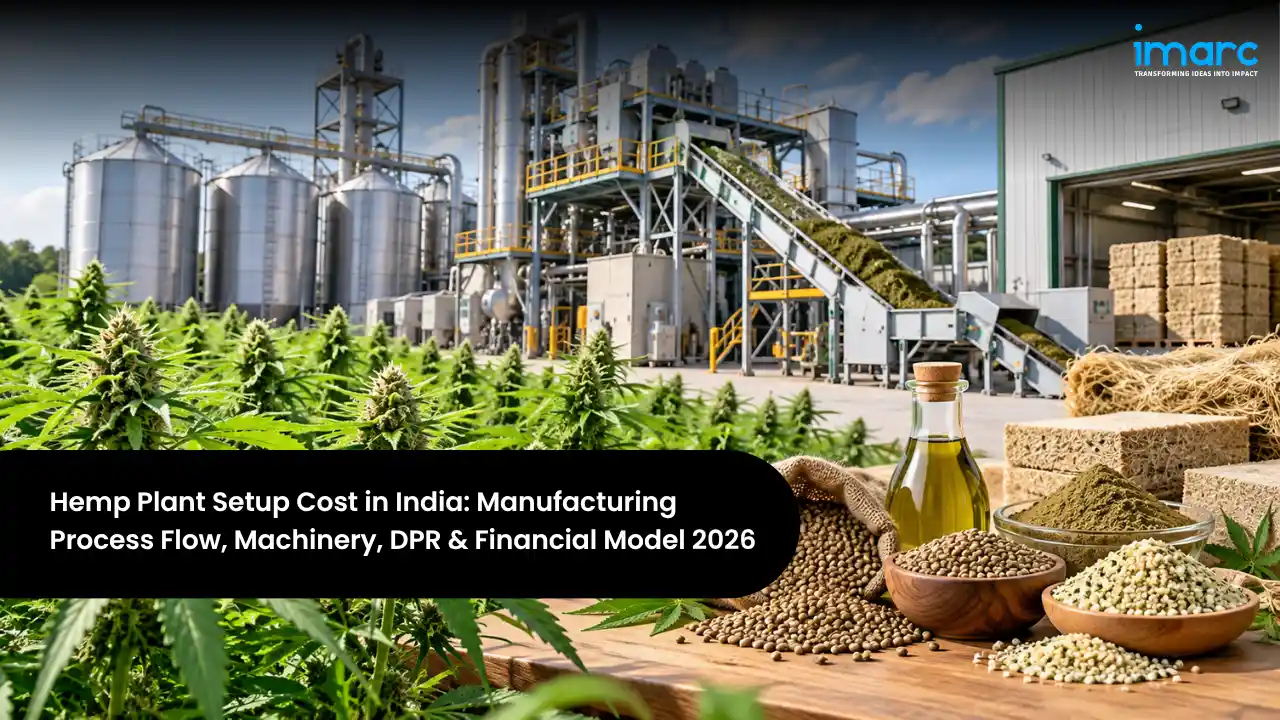
Hemp processing is the conversion of low-THC industrial hemp stalks and seed into separated, graded, saleable materials. The stalk is retted, dried and decorticated to split the long outer bast fiber from the woody inner hurd, while the seed is cleaned, dehulled and cold-pressed into food-grade hemp hearts and hemp seed oil. The fiber, tow and hurd go into textiles, ropes, geotextiles, nonwoven matting, natural fiber composites, hemp-lime building materials, animal bedding and absorbents, and the seed outputs go into food, nutraceuticals and personal care.
This guide concentrates on the route an Indian promoter can realistically build today: a licensed, mid-sized plant processing roughly 1,000 to 3,000 tonnes of hemp stalk a year into decorticated fiber, tow and graded hurd, with an attached seed line cleaning, dehulling and cold-pressing 300 to 1,000 tonnes of hemp seed a year. These are the product forms that matter because India's hemp chain is short of primary processing capacity. States that license cultivation can produce stalk and seed, but very few plants exist that can turn that material into fiber of consistent length and fineness, screened hurd, or food-grade seed and oil that a mill, a builder or a food brand will buy on annual contract.
This guide is written for investors trying to understand how to start a Hemp Processing Plant in India: the process, machinery, raw materials, location, cost, profitability, licenses and the role of a project report and DPR.
India Market Snapshot
| Key Facts | Details |
|---|---|
| India Hemp Processing Market (2025) | INR 350-700 Crore (indicative) |
| Forecast (2034) | INR 2,500-5,500 Crore, 24-30% CAGR (2025-2034) |
| Supply Gap / Import Dependence | Licensed stalk and seed exceed organised processing capacity |
| Policy Trigger | State industrial hemp policies; FSSAI hemp food approval, November 2021 |
| Indicative Total Investment | INR 12-35 Crore (1,000-3,000 TPA stalk basis) |
| Typical Payback Period | 4-7 Years |
The snapshot above sets out the size, growth, supply position and investment frame for hemp processing in India, at a scale an Indian promoter can act on. All figures are indicative estimates drawn from general industry knowledge and are meant for early planning only.
What the snapshot shows is an early-stage but structurally attractive conversion opportunity. Demand for hemp fiber, hurd, seed and oil already exists in Indian textiles, construction materials, composites, animal bedding, food and cosmetics, but organised primary processing capacity does not exist at anything like the same scale. The consequence is a chain that discards or exports raw stalk while finished material is imported or substituted. Policy has moved in one direction, slowly: the licensing framework under the Narcotics Drugs and Psychotropic Substances Act, 1985 is administered state by state through notified industrial hemp policies, and in November 2021 the Food Safety and Standards Authority of India recognised hemp seed, hemp seed oil and hemp seed flour as food. The investment range is wide because a promoter can begin with a compact decortication unit serving growers within one district, or commit to an integrated stalk and seed plant with retting, fiber cleaning, hurd grading and cold pressing on one licensed site. The sections that follow work through that choice.
Investment Highlights
Indicative Project Cost in India (2026)
| Parameter | Value |
|---|---|
| Product Range | Decorticated fiber, tow, graded hurd, hulled seed, cold-pressed hemp seed oil |
| Total Project Investment | INR 12-35 Crore (indicative) |
| Payback Period | 4-7 Years |
| Net Profit Margin | 12-20% |
| IRR | 15-23% |
| Preferred States/Regions | Uttarakhand, Himachal Pradesh, Uttar Pradesh, Madhya Pradesh |
| Key Approvals | State industrial hemp license, FSSAI license, SPCB consents |
| Key Requirement | Licensed low-THC stalk supply and a contracted grower network |
Hemp processing in India is an opportunity defined by the gap between permitted cultivation and installed processing capacity, not by demand creation. States that license industrial hemp have growers able to produce stalk and seed, and the buyers for graded fiber, hurd, hulled seed and oil are already identifiable: spinning and weaving mills, nonwoven and needle-punch producers, composite and automotive interior trim makers, hemp-lime and bio-based building material manufacturers, bedding and absorbent suppliers, and food, nutraceutical and cosmetics brands. What is missing is the plant that stands between them, able to rett, decorticate, clean, grade and pack to a written specification, batch after batch. A licensed processor inside a permitted growing belt, with contracted stalk and a documented quality system, holds a position that is difficult to displace, because the state license, the grower network and buyer qualification are barriers a later entrant must rebuild from the beginning.
These ranges are indicative and frame early feasibility work only. Actual hemp processing plant cost and the returns on it depend chiefly on the landed cost of licensed stalk, the fiber yield recovered per tonne of stalk, the share of output sold as graded textile or composite fiber rather than as ungraded tow, and the loading of the seed and oil line, so a site-specific hemp feasibility report should refine each figure before capital is committed.
Table of Contents
- What is Hemp Processing?
- Why is Hemp Processing Growing in India?
- Hemp Processing Flow
- Raw Materials Required for Hemp Processing
- Location, Land & Infrastructure
- Hemp Processing Machinery and Equipment
- Hemp Processing Plant Setup Cost in India (CapEx & OpEx)
- Financial Analysis and Profitability
- Licenses and Approvals for Hemp Processing in India
- Recent Developments in the India Hemp Processing Industry
- How a Hemp Processing Project Report and DPR Helps Investors
- Frequently Asked Questions
What is Hemp Processing?
Hemp processing is the conversion of the stalk and seed of low-THC industrial hemp into separated, graded, saleable materials. On the stalk side the plant takes baled hemp straw, rets it so that the pectin binding the bast fiber to the woody core breaks down, dries and conditions the stalk, then runs it through a decorticator that breaks and scutches the stalk to separate the long outer bast fiber from the inner hurd, or shiv. The fiber is cleaned, opened and classified into long line fiber and shorter tow, and the hurd is screened into size fractions and de-dusted. On the seed side the plant cleans, de-stones, dehulls and aspirates hemp seed into hulled hearts and hull fractions, and cold-presses part of the seed into unfiltered oil with a protein-rich press cake as the co-product.
Every output is a graded intermediate or a finished consumer input rather than a raw agricultural commodity, which is what makes the plant the value-adding step in the chain. Commercially, hemp processing is two businesses sharing a site and a license. The stalk business is a bulk materials business: volumes are large, realisations per tonne are moderate but improve sharply with grade, and profitability turns on yield and on how much tonnage leaves the gate as graded fiber rather than as low-value tow or dust. The seed business is a food and nutraceutical business: volumes are smaller, specifications are tighter, the compliance load is heavier, and the realisation per kilogram is far higher. A promoter running both lines from one licensed site spreads fixed cost across two revenue streams and is much less exposed to a single crop or a single buyer group than a plant doing only one of them.
The manufacturing scope of a typical Indian plant therefore runs wider than the decorticator. It includes licensed raw material intake and lot documentation, controlled retting or management of field retting with growers, drying and moisture conditioning, decortication, fiber cleaning and opening, hurd screening and dust extraction, baling and packing, seed cleaning, dehulling, cold pressing and filtration, fiber, seed and oil testing in an in-house laboratory, and the record keeping that a state hemp license and a food license each require. How far a plant goes beyond primary processing, into needle-punched matting, composite preforms or retail-packed seed and oil, decides both the capital requirement and the margin it earns.
The Main Hemp Product Types
This guide prioritises decorticated fiber, tow and graded hurd from the stalk line, together with food-grade hulled seed and cold-pressed seed oil from the seed line, because these outputs can be produced from one licensed mid-sized site using proven mechanical equipment and can be sold to buyers who already operate in India. Cannabinoid extraction is deliberately outside the scope: it sits beyond the licensing framework in most states, carries a separate regulatory burden, and is not a route a first-time industrial investor should plan the plant around.
| Hemp Product Type | Description | Key Property | Primary Demand |
|---|---|---|---|
| Decorticated bast fiber | Long outer stalk fiber, cleaned and graded | Length, fineness, tenacity | Textiles, ropes, geotextiles, composites |
| Hemp tow and short fiber | Shorter entangled fiber from cleaning | Bulk, absorbency, cost | Nonwovens, insulation, trim panels |
| Hemp hurd or shiv | Woody inner core, screened and de-dusted | Porosity, low density, lime bonding | Hemp-lime blocks, boards, bedding, absorbents |
| Hemp seed and hulled hearts | Cleaned and dehulled food-grade seed | Protein, omega fatty acids | Food, nutraceuticals, bakery, snacks |
| Cold-pressed hemp seed oil | Expeller-pressed and filtered seed oil | Omega-3 to omega-6 ratio | Food, cosmetics, personal care |
Why is Hemp Processing Growing in India?
Key Growth Drivers in the India Market
- State licensing is opening a legal supply base: industrial hemp in India sits under the Narcotics Drugs and Psychotropic Substances Act, 1985, and Uttarakhand became the first state to license it when it notified an industrial hemp policy in 2018, with Himachal Pradesh and other states following through their own frameworks and research permissions. Each new licensed state adds cultivable acreage and, more importantly, a documented legal supply of stalk and seed that a processing plant can contract against before sowing.
- Food regulation has recognised hemp seed: in November 2021 the Food Safety and Standards Authority of India recognised hemp seed, hemp seed oil and hemp seed flour as food, which moved hemp seed products out of a grey zone and into the mainstream food and nutraceutical market. A processor holding an FSSAI license can now sell dehulled hearts, seed oil and seed flour to Indian food brands, bakeries, wellness companies and exporters, rather than depending on industrial and cosmetic buyers alone.
- A fiber and hurd market is forming in construction and composites: hemp-lime walling and other bio-based building materials, nonwoven insulation, needle-punched matting and natural fiber composite panels for automotive interiors all consume hurd and short fiber. Buyers in these segments qualify suppliers on consistent grading, moisture and dust content, which favours an organised processor over scattered manual decortication.
- Textile and export buyers are asking for traceable natural fiber: spinners blending hemp with cotton and export-facing brands under pressure to document fiber origin and sustainability need hemp that can be traced from a named field to a graded bale. That traceability is something only an organised plant with lot-level records can supply.
- Import substitution in a thin value chain: much of the hemp fiber, hurd, seed and oil consumed in India is imported or supplied by very small unorganised units. Domestic primary processing shortens lead times, removes currency and import exposure, and gives Indian buyers a supplier they can visit and audit before awarding an annual contract.
- Mainstream agri-processing support applies to the project: although the hemp license sits with the state, the plant itself qualifies as a post-harvest processing unit, and can therefore be assessed under the Pradhan Mantri Kisan Sampada Yojana and the Agriculture Infrastructure Fund, alongside state industrial development incentives for buildings, plant and machinery, and boiler and power connections.
India-Specific Market Opportunity
| Segment | India Market Context | Manufacturing Role |
|---|---|---|
| Textile and apparel fiber | Mills seek traceable natural fiber blends for domestic and export yarns | Supply graded long fiber and tow in specified bales |
| Building materials | Bio-based construction interest growing; hemp-lime walls under trial | Supply screened, de-dusted hurd in consistent fractions |
| Composites and automotive trim | Natural fiber panels increasingly used in interior trim | Supply short fiber and tow for nonwoven matting |
| Food and nutraceuticals | FSSAI-approved hemp seed, oil and flour; wellness brands expanding | Dehull, cold-press, filter and pack food-grade products |
| Animal bedding and absorbents | Poultry, equine and pet segments buy low-dust absorbent bedding | Supply coarse hurd fractions with controlled dust content |
The strongest opportunity lies in matching plant capacity to the buyer clusters that can be reached from the licensed growing belt, rather than in aiming at the whole market at once. A processor that starts with hurd and food-grade seed, where buyers are accessible and specifications are written down, and adds graded textile fiber once decorticator settings and grower retting are under control, builds revenue while it learns the material.
Hemp Processing Flow
The process below follows a licensed mid-sized plant handling baled hemp straw through to packed fiber, hurd, seed and oil, and marks where retting by growers hands over to controlled in-plant processing. Retting is the step that fixes the value of everything downstream: under-retted stalk will not release fiber cleanly from the hurd, and over-retted stalk has already lost tenacity before it reaches the decorticator. Everything after decortication is about protecting grade, staple length and cleanliness.
The Hemp Processing Flow
Quality control clusters at four points in this flow. Retting degree at intake decides fiber separation and strength, and is best judged by a hand-scutching test and a moisture reading on every incoming lot rather than by eye. Decorticator settings decide how much saleable fiber is broken into tow and how much hurd still carries attached fiber, which is where yield is won or lost. Dust and fines removal on both the fiber and the hurd lines decides whether a bale is accepted by a mill or a bedding buyer, because dust content is the most common cause of rejection. Seed moisture and foreign matter at the dehuller decide oil quality and shelf life on the food line. A plant that records each of these against a lot number can trace a buyer complaint back to a named grower and harvest date, which is exactly what a state license inspection and a food-safety audit both require.
| Unit Operation | Key Activity |
|---|---|
| Raw material intake and grading | Weigh baled stalk, verify license documents and moisture, sample per lot |
| Retting | Field, water or controlled enzymatic retting to break the bast-to-hurd bond |
| Drying and conditioning | Bring stalk to a stable working moisture for clean decortication |
| Bale breaking and stalk opening | Open compacted bales into a uniform stalk mat for the decorticator |
| Decortication | Break and scutch the stalk to separate bast fiber from woody hurd |
| Fiber cleaning and opening | Remove hurd particles, dust and entanglements from the fiber stream |
| Fiber grading, cutting and baling | Classify long fiber and tow, cut to staple length, press graded bales |
| Hurd screening and de-dusting | Screen hurd into size fractions and extract fines and dust |
| Seed cleaning and dehulling | De-stone, aspirate, dehull and separate hemp hearts from hull fractions |
| Cold pressing, filtration and packing | Expel seed oil, filter it, pack oil, hearts and press cake for dispatch |
Raw Materials Required for Hemp Processing
The input list for a hemp processing plant is short, and one item dominates it. Baled low-THC hemp stalk is the largest input by value and the input whose quality decides whether the plant can hold a specification at all, because retting degree, staple length and contamination enter through the bale and cannot be corrected economically once the stalk has been decorticated.
| Raw Material | Role in Process | India Sourcing | % of OpEx |
|---|---|---|---|
| Low-THC hemp stalk (baled straw) | Primary fiber and hurd feedstock | Contracted from licensed growers in permitted states | 42-52% |
| Hemp seed (food grade) | Feedstock for hulled hearts and cold-pressed oil | Licensed growers and seed cooperatives; imports need clearance | 10-16% |
| Retting enzymes and additives | Controlled retting and fiber release | Domestic enzyme and specialty chemical suppliers | 2-4% |
| Water and treatment chemicals | Retting, washing and boiler feed | Borewell or canal water with in-house treatment | 1-3% |
| Packaging materials | Bale wrap, food-grade pouches, drums and labels | Local converters; compliant food-contact material | 5-9% |
| Biomass boiler fuel and lubricants | Drying heat and machine lubrication | Agri-residue briquettes from nearby districts | 3-6% |
Because stalk alone can be half of operating cost, procurement strategy is the single largest lever on both margin and quality, and it is also a regulatory question rather than only a commercial one. Hemp stalk can be bought only from growers licensed by a state that permits industrial hemp cultivation, so a plant sitting outside a permitted belt carries both extra freight and the risk that a license is not renewed. The practical response is to contract named acreage before sowing, agree a THC testing protocol and lot documentation at intake, hold enough baled stalk to cover the whole gap from one harvest to the next, and treat imported seed cautiously because it requires a permit and phytosanitary clearance under the Plant Quarantine (Regulation of Import into India) Order, 2003.
Location, Land & Infrastructure
Where a hemp processing plant is built is decided by three conditions that rarely sit in the same district: the license and the growing belt, the distance from bale to decorticator, and the buyer for graded fiber and hurd. Stalk is bulky and low in value per tonne, so it cannot travel far before freight consumes the margin, while graded fiber, hurd and packed seed can travel to national buyers. That asymmetry makes proximity to licensed cultivation the first filter, with the state's industrial and food-safety environment the second.
Choosing the Best Location for Hemp Processing Plant Setup
| State | Why It Works | Key Advantage |
|---|---|---|
| Uttarakhand | India's first industrial hemp framework, notified in 2018, with cultivation under state excise control | First-mover licensing and an established grower base in the hill districts |
| Himachal Pradesh | State approval for controlled industrial hemp cultivation through the excise route | Short grower-to-plant distance and temperate-climate fiber quality |
| Uttar Pradesh | Early permission for industrial hemp cultivation for research and pilot use on a large farm base | Scale of farmland and strong road and rail access to national buyers |
| Madhya Pradesh | Large cultivable area and an active agri-processing ecosystem assessing hemp for diversification | Land availability and low-cost agri-residue fuel for the boiler |
| Manipur (North-East) | Long-standing local hemp growing knowledge and regional interest in a licensing route | Grower familiarity with the crop and scope for a hill-region cluster |
| Tamil Nadu | Established textile, nonwoven and composite clusters plus port access | Buyer proximity for graded fiber and export logistics |
Location selection for a hemp processing plant in India depends on licensing readiness, grower proximity, and buyer access working in combination. Uttarakhand and Himachal Pradesh offer the strongest regulatory headstart, while Uttar Pradesh adds scale and national freight connectivity. Madhya Pradesh suits biomass-dependent operations given its low-cost agri-residue supply, Manipur leverages deep grower familiarity for hill-region clustering, and Tamil Nadu is the natural choice for plants targeting fibre exports through its established textile clusters and port infrastructure.
Cleanliness, Process Control and Quality Standards
Quality in hemp processing is measured at the bale, at the baler and in the laboratory, because the two output families are qualified against different rulebooks. On the fiber and hurd side, a plant should run a quality management system to ISO 9001:2015 and environment and safety systems to ISO 14001:2015 and ISO 45001:2018, and should test fiber fineness and breaking tenacity along the practice of ISO 5079 for individual fibers, moisture content by oven drying, and dust and fines content by sieve analysis. Hurd sold into hemp-lime or board applications is specified on bulk density, particle-size distribution and dust content, while hurd sold as bedding is specified on absorbency and dust, which is the same measurement seen from a different buyer's perspective. Where fiber is blended with cotton or other fibers, blend composition is verified along the ISO 1833 series.
On the food side the plant is a food business and is regulated as one. A hemp seed and hemp seed oil line requires an FSSAI license, compliance with the Food Safety and Standards (Licensing and Registration of Food Businesses) Regulations, 2011 including the good manufacturing and hygiene requirements of Schedule 4, and a food safety management system built on HACCP and, where retail or export customers ask for it, certification to ISO 22000:2018. Cold-pressed oil needs peroxide value, free fatty acid and moisture testing on every press batch, and hulled seed needs foreign matter, moisture and microbiological testing against FSSAI limits, with methods drawn from the FSSAI manual of methods of analysis and the laboratory working to ISO/IEC 17025 discipline. Two safety items deserve attention from the design stage: hemp dust from decortication and screening is a combustible dust hazard and needs collection and housekeeping designed for it, and the boiler, dryer and bale store need a fire risk assessment with interlocked protection.
Infrastructure Requirements (Mid-Sized Plant)
| Infrastructure Element | Specification | India-Specific Note |
|---|---|---|
| Land | 4 to 8 acres, industrial or agri-zoned, with expansion space | Confirm state land-use rules allow processing inside the hemp belt |
| Built-up area | 25,000 to 60,000 sq ft covered, plus open bale yard | Covered bale stores protect straw from monsoon moisture |
| Power | 250 to 600 kVA connected load with standby genset | Decorticator drives and the dehulling line are the main loads |
| Water | 20,000 to 50,000 litres per day with treatment and softening | Retting tanks and boiler feed need consistent quality |
| Boiler and drying | Biomass boiler of 1 to 3 tonnes per hour steam, plus hot-air dryer | Agri-residue briquettes are available locally at low cost |
| Dust extraction and effluent | Bag filter and cyclone on decortication; retting water treatment | Retting water carries a high organic load and must be treated |
| Logistics and storage | Weighbridge, bale handling equipment, dry godown, food-grade store | Seed and cake stores need moisture and pest control |
Infrastructure for a hemp processing plant centres on covered storage, consistent water supply, reliable power, and effective effluent management, because fibre quality and regulatory compliance depend on all of them. Confirming state land-use rules before site selection is essential, as proximity to the hemp belt reduces haulage costs and often conditions the processing licence itself. A standby genset protects decorticator and dehulling operations from unplanned outages, while an in-house effluent treatment system is non-negotiable given the high organic load that retting water carries. Because seed and cake stores contribute meaningfully to overall plant economics, dry godowns with moisture and pest control are as important as the processing infrastructure itself.
Hemp Processing Machinery and Equipment
The equipment set runs in process order from bale intake through retting, decortication, fiber cleaning, hurd screening, seed dehulling and cold pressing, with laboratory and dust-control equipment alongside. Because the stalk line and the seed line serve different buyers and different specifications, the two are usually specified and commissioned as separate blocks, so that one can run at revenue while the other is still being qualified. The main items are set out below, with the process step each one serves.
| Equipment | Function | Key Specification |
|---|---|---|
| Weighbridge and moisture meter | Intake weighing, lot moisture and traceability | 20-40 tonne weighbridge; calibrated moisture meter |
| Bale breaker and stalk opener | Open compacted bales into a uniform stalk mat | 1-3 tonnes per hour, matched to the decorticator |
| Retting system (tanks or controlled retting) | Controlled retting to break the bast-to-hurd bond | Thermostatic tanks with agitation, drain and aeration |
| Decorticator (breaker and scutcher) | Separate bast fiber from woody hurd | 1-3 tonnes per hour; adjustable beating gap and drum speed |
| Fiber cleaner and opener | Remove hurd, dust and entanglements from fiber | Multi-stage cleaning with integrated extraction |
| Hurd screener and de-duster | Grade hurd into buyer-specified fractions | Multi-deck vibrating screens; 2-8 mm fractions |
| Fiber cutter and hydraulic baling press | Cut staple length and press graded bales | Bale weight and strap pattern to buyer specification |
| Dust collection and air handling | Capture hemp dust at decortication and screening | Bag filter or cyclone rated for combustible dust |
| Seed cleaner, de-stoner and gravity separator | Clean and grade seed to food-grade standard | 0.5-2 tonnes per hour capacity |
| Seed dehuller with aspiration | Shell seed and separate hearts, hulls and brokens | Hulling efficiency above 90 per cent; low broken-kernel rate |
| Cold press, filter and packing line | Expel, filter and pack oil; pack hearts and cake | Temperature-controlled screw expeller; compliant packing |
Equipment choice should follow the output specification rather than the other way round. A plant selling hurd to bedding and hemp-lime buyers can begin with a single decorticator, screens and a press, while a plant targeting spinning mills needs a cleaner and opener able to hold staple length and dust content inside tight limits, and a seed and oil line needs dehulling efficiency and press temperature control that a general-purpose expeller will not deliver. Automation should be added where it protects quality rather than where it merely reduces headcount: controlled feed at the decorticator, in-line moisture measurement, interlocked dust extraction and regulated press temperature all pay back through consistency. On vendors, decortication equipment is supplied mainly by European builders alongside a growing number of Indian fabricators offering lower-cost lines, so service response and spare-part availability should weigh heavily, because a decorticator stopped for want of a blade set stops the entire stalk business. Promoters also commonly budget for a technical collaboration or an experienced processing consultant during commissioning, since retting regimes and decorticator settings are learned on the actual material rather than from a manual.
Hemp Processing Plant Setup Cost in India (CapEx & OpEx)
The blocks below set out an indicative capital and operating cost structure for a mid-sized hemp processing plant in India, based on industry analysis of comparable agri-processing projects. The actual hemp processing plant cost for a specific project depends on capacity, whether retting is controlled in-plant or managed in the field with growers, how much of the seed and oil line is built in the first phase, the effluent and dust-control capacity the site requires, and whether land is owned or leased. Every range should be treated as indicative.
Capital Expenditure (CapEx) Cost Structure
| CapEx Component | % of Total CapEx | What It Covers |
|---|---|---|
| Land and site development | 7-10% | Land, levelling, internal roads, drainage and fencing |
| Buildings and civil works | 16-21% | Decortication hall, retting area, food-grade room, stores, bale yard |
| Retting, decortication and fiber cleaning line | 25-31% | Retting system, decorticator, cleaners, openers, baling press |
| Seed cleaning, dehulling and cold-press line | 10-14% | Cleaner, de-stoner, dehuller, expeller, filtration, packing |
| Boiler, utilities, dust extraction and power connection | 9-13% | Biomass boiler, dryer, bag filter, electricals, genset, water treatment |
| Laboratory, quality control and IT | 3-5% | Fiber and seed testing instruments, oil testing, batch records systems |
| Pre-operative expenses, approvals and contingency | 12-18% | Licensing, engineering, trial runs, contingency and working capital margin |
Because the stalk line carries the plant throughput, decortication, fiber cleaning and hurd screening normally take the largest single share of capital, and these are also the items least often found second-hand in serviceable condition. Working capital and the pre-operative block are what first-time investors most often underestimate, since stalk is paid for at harvest while graded fiber and hurd are sold on credit, so the cash requirement peaks once a year regardless of monthly sales.
Operating Expenditure (OpEx) Cost Structure
| OpEx Component | % of Total OpEx | India-Specific Note |
|---|---|---|
| Licensed hemp stalk procurement | 42-52% | Contracted with growers in permitted states before sowing |
| Hemp seed procurement | 10-16% | Food-grade lots preferred over imports needing clearance |
| Power, fuel and water | 12-18% | Grid power for drives, biomass fuel for drying; tariffs vary by state |
| Manpower and contract labour | 10-15% | Skill concentrated in retting, decorticator setting and grading |
| Packaging, consumables and logistics | 8-13% | Bale wrap, food-grade pouches, inland freight to mills and brands |
Stalk and seed together are the largest recurring cost, and both are bought once a year at harvest but consumed across twelve months, which makes procurement timing as important as procurement price. The practical levers are fiber yield recovered per tonne of stalk, the share of output leaving as graded fiber rather than tow or dust, boiler fuel switched to locally available agri-residue briquettes, and running the seed line through the off-season to spread fixed cost.
Financial Analysis and Profitability
Based on analysis of a mid-sized licensed hemp processing facility in India, the financial profile is attractive at high utilisation and thin at low utilisation, because the license, the decortication line and the technical team carry fixed costs that do not fall with volume. The figures below are indicative ranges for a plant processing roughly 1,000 to 3,000 tonnes of stalk a year with an attached seed line, and should be replaced by project-specific modelling before capital is committed.
| Financial Metric | Indicative Value | India Context |
|---|---|---|
| Total Investment | INR 12-35 Crore | Land, buildings, stalk and seed lines, utilities, approvals, working capital margin |
| Revenue at full capacity | INR 15-45 Crore | Graded fiber, tow, hurd, hulled seed and cold-pressed oil combined |
| Gross Margin | 28-40% | Wider when output sells as graded fiber and food-grade seed |
| Net Profit Margin | 12-20% | Depends on utilisation, license stability and grade mix |
| IRR | 15-23% | Improves with contracted stalk and more value-added output |
| Payback Period | 4-7 Years | Shorter where land is owned and the seed line is fully loaded |
Several levers move a project within these ranges. Contracting stalk acreage with named licensed growers before sowing protects the largest cost line and the license audit trail; raising the share of output sold as graded long fiber and food-grade seed rather than as tow, dust and ungraded seed lifts the average realisation; running the seed and oil line through the off-season spreads fixed cost across more months; and using locally sourced agri-residue fuel for the boiler and dryer keeps the largest utility line in check. Because this is an emerging sector with few directly comparable plants, a signed offtake arrangement with a textile, composite or food buyer before commissioning is usually worth more than a marginal reduction in capital cost.
Key Risks and Mitigation
- Regulatory and licensing risk: industrial hemp operates under the Narcotics Drugs and Psychotropic Substances Act, 1985 framework, and permission to cultivate, transport and process is granted state by state with conditions that can be revised; mitigate by locating inside a state with a notified policy, holding lot-level license documentation and THC test records, and building a working relationship with the state excise or drugs control authority before construction begins.
- Raw material supply and price risk: stalk can be half of operating cost and arrives once a year from a limited number of licensed growers; mitigate with forward contracts over named acreage, a bale stock sized to bridge one harvest to the next, and a fallback plan to buy stalk from a second permitted state.
- Yield and grade risk: under-retted or over-retted stalk produces fiber that breaks into tow, and a badly set decorticator converts saleable fiber into dust; mitigate with intake moisture and hand-scutching tests, trial decortication on every new grower lot, retained samples, and sieve and dust testing against the buyer specification before dispatch.
- Quality and food-safety risk: hulled seed and cold-pressed oil must meet FSSAI limits on moisture, foreign matter and microbiology, and a rejected batch usually cannot be reworked; mitigate with a segregated food-grade area, HACCP documentation, laboratory testing of every press batch, and physically separate storage for food and industrial outputs.
- Buyer concentration and price risk: a new plant typically starts with one or two fiber or food buyers who know it has few alternatives; mitigate by spreading sales across textile, composite, building material, bedding and food segments, quoting at least two grades to each buyer, and adding value where the plant already has equipment, for example needle-punched matting or retail-packed seed.
Licenses and Approvals for Hemp Processing in India
Approvals sit on the critical path for this project, because a hemp processing unit cannot buy stalk without a state license, cannot sell food-grade seed or oil without a food license, and cannot build or operate its retting, drying and dust-generating sections without pollution control consent. The route differs from state to state, which is why the licensing position of the chosen district is normally tested before land is purchased. Promoters planning to establish a hemp processing plant in India generally need the following before commencing operations.
- State industrial hemp license: issued by the state excise, drugs control or narcotics department under the Narcotics Drugs and Psychotropic Substances Act, 1985 and the state's own industrial hemp policy or rules, covering cultivation, procurement, transport, storage and processing of low-THC material.
- Company incorporation and tax registrations: incorporation through the Ministry of Corporate Affairs, Goods and Services Tax registration, Udyam registration where eligible, Importer-Exporter Code from the Directorate General of Foreign Trade for seed imports and fiber exports, and registration on the state industries portal for incentives.
- FSSAI license: a Central or State FSSAI license under the Food Safety and Standards Act, 2006 and the Food Safety and Standards (Licensing and Registration of Food Businesses) Regulations, 2011 for the seed cleaning, dehulling, cold-pressing and packing lines, with Schedule 4 manufacturing and hygiene compliance.
- State Pollution Control Board consents: Consent to Establish and Consent to Operate under the Water (Prevention and Control of Pollution) Act, 1974 and the Air (Prevention and Control of Pollution) Act, 1981, covering retting water, boiler emissions, dryer exhaust and decortication dust.
- Environmental Clearance: clearance under the Environmental Impact Assessment Notification, 2006 where the capacity, process scope and location bring the unit within the schedule of the notification, obtained from the Ministry of Environment, Forest and Climate Change or the State Environment Impact Assessment Authority.
- Boiler registration: registration and periodic inspection of the biomass boiler under the Indian Boilers Act, 1923 through the state Directorate of Boilers, together with certification of the boiler operator and the pressure parts.
- Occupational safety, electrical and fire approvals: registration under the Occupational Safety, Health and Working Conditions Code, 2020, approval from the state electrical inspectorate for the connected load and installations, and a no objection certificate from the state fire services for the bale store, drying area and boiler house.
- Plant quarantine and seed import permits: where hemp seed is imported, an import permit and phytosanitary clearance under the Plant Quarantine (Regulation of Import into India) Order, 2003, with the associated variety, testing and treatment conditions.
Recent Developments in the India Hemp Processing Industry
- 2023: Himachal Pradesh approved a framework for controlled cultivation of industrial hemp within THC limits for research and industrial use, adding a second state to a licensing map that had been led by Uttarakhand and reinforcing the treatment of hemp as an agricultural diversification crop in the hill states.
- 2022: Indian hemp brands and processors widened their product range across food, textiles and building materials, and the first dedicated decortication and seed-processing units began operating in states that license cultivation, moving the sector from research trials toward commercial primary processing.
- November 2021: The Food Safety and Standards Authority of India recognised hemp seed, hemp seed oil and hemp seed flour as food, which allowed licensed food businesses to sell hemp seed products openly in the Indian market and created the demand base that a food-grade seed and oil line is built to serve.
- 2019: Uttarakhand began issuing licenses for cultivation and processing under its industrial hemp framework, giving the country its first documented licensed supply chain from grower to buyer and establishing the lot-level documentation model that other states have since followed.
- 2018: Uttarakhand notified India's first industrial hemp policy, permitting cultivation of low-THC hemp under state excise control and making it the first state in which a processor could legally contract stalk from licensed growers.
The common thread across these developments is that hemp processing in India has shifted from a research question to a licensing and logistics question. Policy has advanced state by state rather than through a single national framework, food regulation has opened the consumer end of the chain, and the supply of licensed stalk and seed is now growing faster than the capacity to process it. For a new entrant in 2026 that is a favourable but demanding position: the license takes time, the grower network has to be built before the plant is commissioned, and quality standards in fiber and food are set by buyers rather than by the processor. Those who secure a license early, contract acreage before construction and build testing and traceability into the plant from the start will be best placed as permitted acreage and domestic demand expand through the decade.
How a Hemp Processing Project Report and DPR Helps Investors
A hemp project report and detailed project report sets out the case for the plant in the order a lender, a state industrial development corporation, an incentive administrator or an equity partner needs it. That means a demand assessment by output, covering graded fiber, tow, hurd, hulled seed and oil, with a named list of textile, composite, building material, bedding and food buyers in the target radius; a raw material plan naming the licensed growers, the districts and expected acreage, the THC testing protocol and the intake documentation; a process configuration showing whether retting is controlled in-plant or managed with growers and how far value addition runs; a site and layout covering the bale yard, retting area, decortication hall, food-grade seed room and the dust and effluent systems; machinery specifications supported by vendor quotations and performance guarantees; and the statutory approval route, including the state hemp license, FSSAI licensing and pollution control consents, with sequence and lead times shown.
At the centre of the document is a hemp financial model covering revenue by output grade and buyer, stalk and seed cost by source with price and yield sensitivity, utilisation ramp-up, capital cost, working capital across the harvest cycle, depreciation, debt service and tax, from which the project IRR, equity IRR, payback period and debt service coverage ratio are derived. Sensitivity runs on stalk price, fiber yield, grade mix, utilisation and selling price show lenders where the project is robust and where it is exposed, and a pre-feasibility study or hemp feasibility report is normally prepared first to decide whether the full DPR is worth commissioning.
For an investor, the value of the document is that it converts an attractive but unfamiliar sector into a set of numbers and commitments that can be tested. It shows how much capital is needed and when, which licenses gate each stage of spending, which buyers and growers are expected to sign before commissioning, and what happens to returns if stalk costs rise, retting is poorer than planned or the seed line ramps up slowly. A lender will normally ask for this document before sanctioning term finance, and an incentive administrator will ask for it before appraising a subsidy or credit-linked claim, so a well-built DPR shortens both timelines and reduces the risk of rework late in the process.
Frequently Asked Questions
What is the hemp plant setup cost in India?
A mid-sized licensed hemp processing plant handling roughly 1,000 to 3,000 tonnes of stalk a year with an attached seed and oil line typically needs an indicative total investment of INR 12-35 Crore. The figure depends on capacity, whether retting is controlled in-plant, how much of the seed line is built first, and whether land is owned or leased, so a site-specific feasibility study should refine it.
Is hemp processing legal in India?
Industrial hemp with low THC content can be cultivated and processed in India only under a state license issued within the framework of the Narcotics Drugs and Psychotropic Substances Act, 1985. States such as Uttarakhand and Himachal Pradesh have notified frameworks, and FSSAI recognised hemp seed, seed oil and seed flour as food in November 2021. Rules differ by state and can change, so the licensing position of the chosen district should be confirmed before land is purchased.
What products can a hemp processing plant make?
A plant of this type produces decorticated bast fiber, tow and short fiber, graded hemp hurd, hulled hemp seed hearts and cold-pressed hemp seed oil with protein-rich press cake. These go into textiles, nonwovens, composites, hemp-lime building materials, animal bedding, food, nutraceuticals and personal care.
What is the payback period and profitability of a hemp processing plant?
Indicative figures are a payback period of 4-7 years, a net profit margin of 12-20% and an IRR of 15-23%. These depend heavily on the landed cost of licensed stalk, fiber yield, the share of output sold as graded fiber and food-grade seed, and how fully the seed and oil line is loaded.
Which licenses are needed to start a hemp processing plant in India?
The main approvals are the state industrial hemp license, company and GST registrations, an FSSAI license for the seed and oil lines, State Pollution Control Board consents, Environmental Clearance where applicable, boiler registration, and electrical, fire and occupational safety approvals. Seed imports additionally need a permit and phytosanitary clearance. Requirements vary by state, capacity and product range.
Which states are best for a hemp processing plant?
Uttarakhand and Himachal Pradesh offer the clearest licensing frameworks and established grower bases. Uttar Pradesh and Madhya Pradesh offer farmland scale, logistics and agri-processing ecosystems, while Tamil Nadu offers buyer proximity in textiles and composites. The best choice depends on where licensed stalk can be contracted within a short haul of the plant.
What is the biggest operating cost in hemp processing?
Licensed hemp stalk is the largest operating cost at roughly 42-52% of OpEx, followed by hemp seed, power and fuel, manpower, and packaging and logistics. Forward contracts with named growers and a bale stock sized to bridge one harvest to the next are the main ways to control it.
Our Clients









Contact Us
Have a question or need assistance?
Please complete the form with your inquiry or reach out to us at
Phone Number
+91-120-433-0800+1-201-971-6302
+44-113-547-7077
Previous Post

Ashwagandha, or Withania somnifera, is one of the most important herbs in Ayurveda, valued as an adaptogen for stress, sleep, energy, and overall wellness.
Chicory is mainly Cichorium intybus, a perennial herb that is grown for its root, leaves, and sometimes seeds. In industrial applications, the chicory root is the most valuable part. The chicory root contains inulin, a natural soluble dietary fiber, as well as sugars and bioactive compounds. When roasted and dried, chicory root has a similar taste to coffee and is often used as a coffee extender or substitute.
Agriculture in India is and has always been something more than an occupation; it's a way of life that keeps millions of households going and the country's economy running. Yet, in a rapidly changing world, traditional methods cannot alone meet the growing demand for food, fiber, and raw materials.
Australia's agricultural machinery industry stands as a cornerstone of the nation's farming modernization drive, experiencing robust expansion fueled by technological innovation and evolving agricultural demands. According to IMARC Group's comprehensive market analysis, the Australia agricultural machinery market reached a valuation of USD 4.0 Billion in 2024, reflecting the accelerating adoption of advanced farming equipment across the continent's diverse agricultural landscapes.
Australia fertilizer industry is one of the key pillars of the country's farm setup. Fertilizers are a critical input in soil productivity, boosting crop output and the uniform production of food and other farm products. Australia has a wide and varied agricultural scene with grain growing horticulture, livestock, and specialty crops. Every industry depends upon fertilizers to optimize production and ensure soil fertility, especially in areas where the natural soil nutrients are nil or climatic conditions are unsuitable.
The Japan agritourism industry is experiencing remarkable transformation as travelers increasingly seek authentic connections with rural landscapes and agricultural traditions. Agritourism represents a dynamic fusion of agriculture and tourism, offering visitors immersive experiences through farm stays, hands-on agricultural activities, and cultural immersion in Japan's countryside.
HDPE pipes are thermoplastic piping systems made from high-strength polyethylene resin, which features excellent flexibility, high impact resistance, and strong chemical and corrosion resistance. HDPE pipes are produced by extruding molten polyethylene into a variety of diameters and pressure ratings. Their seamless structure, along with their low friction and resistance to internal pressure and external load, makes them ideal for the transport of fluids. HDPE pipes boast superior endurance, long service life, and leak-free performance, since it is possible to join them through heat fusion, thus creating monolithic, continuous pipelines that are suitable for buried, aboveground, or underwater installations.
The Brazil agricultural machinery market stands as a cornerstone of the nation's agricultural modernization drive, experiencing robust expansion fueled by technological innovation, government support initiatives, and the imperative to enhance agricultural productivity across the world's largest soybean producer. According to IMARC Group's comprehensive market analysis, the Brazil agricultural machinery market reached a valuation of USD 3.1 Billion in 2024, reflecting the accelerating adoption of advanced farm equipment Brazil offers across diverse agricultural landscapes spanning grain production, sugarcane cultivation, coffee farming, and livestock operations. This impressive growth trajectory positions the industry for continued prosperity, with projections indicating the market will reach USD 4.5 Billion by 2033, exhibiting a compound annual growth rate (CAGR) of 4.1% during the 2025-2033 forecast period.
The smart agriculture market is revolutionizing the global agriculture industry through the integration of cutting-edge technologies such as Internet of Things (IoT), artificial intelligence (AI), robotics, sensors, and big data analytics. As the world population continues to grow, farmers and agribusinesses face mounting pressure to increase productivity while minimizing environmental impact.
Australia's agribusiness sector is at a crossroads, combining its historic advantage in bulk farming with new-generation technologies and green practices. The industry is pivotal to the nation's economy, adding billions to GDP and underpinning exports to overseas markets. Increasing food security demands and climate change pressures have compelled Australian farmers and agribusiness companies to take up innovation at an unprecedented scale.
A fertilizer is any natural or manufactured material containing one or more nutrients that are applied to the soil or plant tissues and that are usually beneficial for plant growth by improving fertility. The elements that plants need in large quantities, namely nitrogen (N), phosphorus (P), and potassium (K), are known as the primary macronutrients. The other secondary nutrients include calcium, magnesium, and sulfur; micronutrients include zinc, iron, manganese, and copper.
Coco peat, or coir pith or coir dust, is a fibrous natural byproduct generated during the processing of coconut husks to extract coir fiber. Coco peat is an organic, renewable, and biodegradable product that has gained international significance as a sustainable substitute for peat moss in horticulture, agriculture, and hydroponics. The coco peat production process starts with the gathering of coconut husks, which are retted, soaked, and mechanically treated to exclude long coir fibers that are employed in ropes, mats, or brushes. The leftover fine material, the pith is washed, sieved, dried, and compressed into briquettes, blocks, or grow bags.
Bamboo is a poaceous grass which regrows rapidly, has a high yield of biomass and good material properties, ranging from tiny clumping species to huge timber-grade culms over 20 meters tall; genera of economic importance are Bambusa, Phyllostachys and Dendrocalamus. Botanically, bamboo integrates the regenerative benefit of an agricultural crop (short rotation, annual or multi-annual yield) with certain mechanical characteristics of softwoods like large specific strength, good tensile performance, and natural hollow culm geometry for light-weight structural property.
Sustainability is reshaping the future of agriculture, energy, and environmental management, with biochar emerging as a transformative force within the ecosystem. Produced from biomass through pyrolysis, biochar enriches soils, strengthens crop resilience, and reduces dependence on chemical fertilizers. According to reports, long-term application delivers measurable benefits—boosting average crop yields by 10.8% and increasing soil organic carbon by 52.5%—underscoring its role in restoring soil health while combating degradation.
Sesame seeds are one of the oldest oilseed crops known to humankind, prized for their high oil content, distinctive nutty flavor, and valuable nutritional profile. They are composed of approximately 50–60% oil and 20–25% protein, making them an essential raw material for edible oil, bakery, confectionery, and health food industries. The seeds are also rich in antioxidants such as sesamol and sesamin, which contribute to their oxidative stability and health-promoting properties. Processing of sesame seeds typically involves cleaning, dehulling, roasting, pressing, and solvent extraction, depending on the end-use product.
The global seed industry plays an important role in ensuring food security and the sustainability of agricultural practices. As the world grapples with food insecurity, climate volatility, and shrinking arable land, the market has emerged as a critical enabler of agricultural resilience.
Explore how to start a biofertilizer manufacturing business, from setup and licenses to market trends, investment, and sustainable growth strategies.
World Environment Day, observed on June 5th each year, serves as an important reminder to protect and preserve our planet. This day inspires millions of people from across the globe to reflect on environmental issues and take tangible measures toward securing the world for future generations.
Bamboo is one of the sustainable and versatile materials that are being used in several different industries. Bamboo provides a very environmentally friendly option for food packaging, as it reduces plastic use. At high temperatures, bamboo is burnt to produce bamboo biochar. This is a soil enhancer for soil health and carbon sequestration. Bamboo is also a sustainable building material and is used in the construction industry. Due to its antibacterial properties, bamboo vinegar, which is a byproduct of bamboo charcoal manufacturing, is used in skincare and agriculture.
The global poultry market is growing at a fast pace, driven by several factors, such as rising demand for affordable and protein-rich food sources, especially in developing countries. The growing preference for white meat over red meat due to health considerations, as well as urbanization and increasing disposable incomes, also contributes to higher consumption of poultry products. Moreover, technological advancements in poultry farming, such as improved breeding techniques and feed conversion ratios (FCR), enhance productivity and efficiency, further boosting market growth. As per IMARC Group, the global animal feed market size reached US$ 518.4 Billion in 2023 and is expected to reach US$ 674.7 Billion by 2032, exhibiting a growth rate (CAGR) of 2.9% during 2024-2032.