How Government Policies Are Propelling the Japan Luxury Apparel Market
Introduction to Japan's Luxury Apparel Industry:
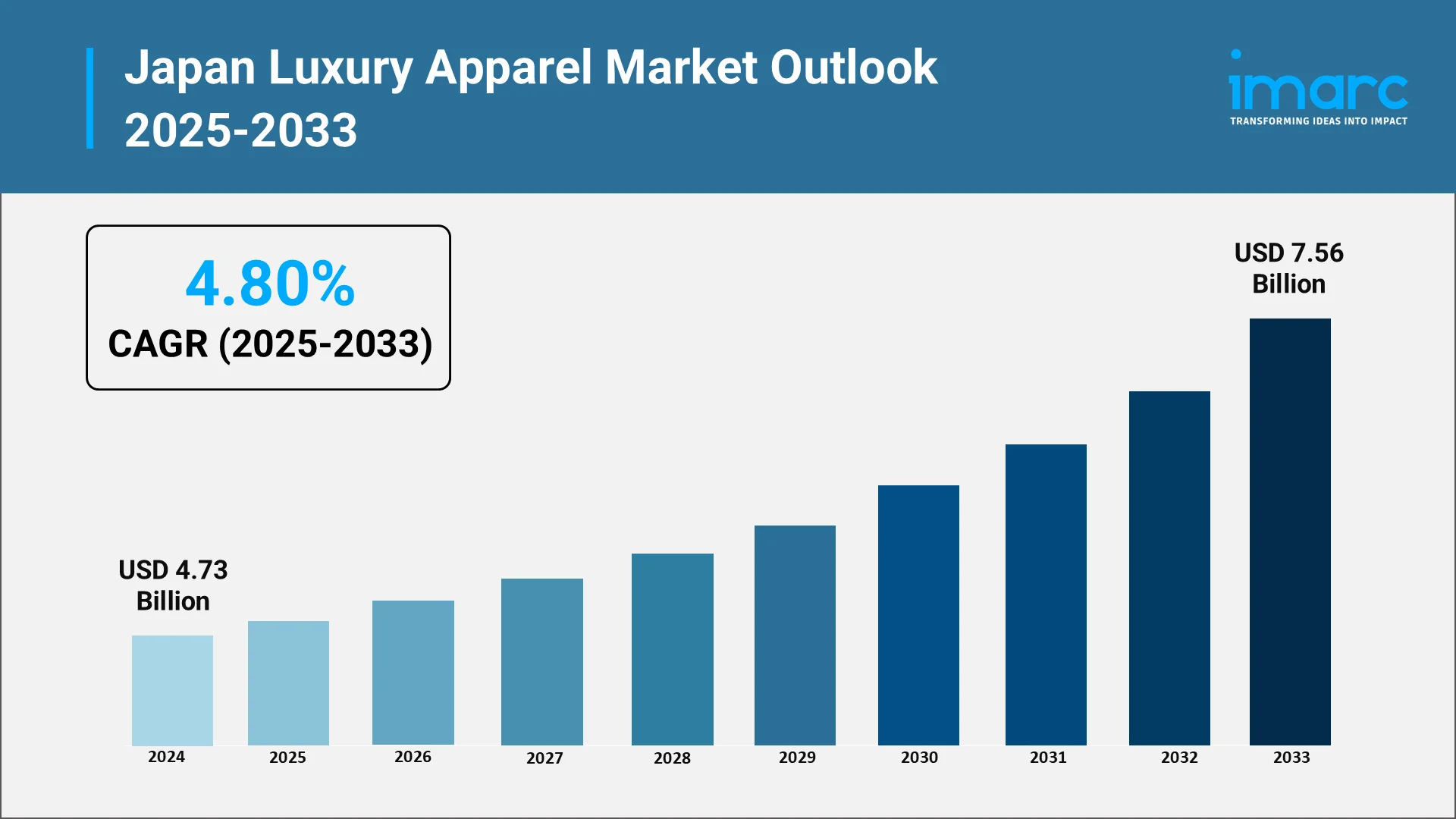
Japan's luxury apparel industry has traditionally been characterized by its profound respect for craftsmanship, quality, and cultural refinement. Japanese consumers have a reverence for art and nuance, preferring items that reflect precision and enduring design over short-lived trends. Over the past decade, Japanese luxury fashion has transcended conventional retailing experiences and assumed a contemporary identity that coalesces international influences with domestic sentiments. The Japan luxury apparel market size reached USD 4.73 Billion in 2024. Looking forward, the market is expected to reach USD 7.56 Billion by 2033, exhibiting a growth rate (CAGR) of 4.80% during 2025–2033. This growth trajectory is supported by government policies aimed at reinforcing domestic fashion infrastructure, promoting innovation, and aligning the industry with global sustainability and digitalization trends.
Japan's luxury fashion industry is sustained not only by the popularity of upscale overseas brands but also by the rising prestige of domestic designers who blend cultural heritage with contemporary style. State efforts increasingly recognize fashion as both an economic force and a cultural export. Consequently, policies are encouraging local creativity, enhancing trade facilitation, and positioning Japan as a leading global fashion investment destination. These measures have cultivated an enabling environment where luxury fashion houses and homegrown brands can thrive, meeting evolving consumer expectations centered on authenticity, innovation, and ethical values.
Explore in-depth findings for this market, Request Sample
Overview of Government Policies Supporting the Fashion Sector:
The government of Japan has also taken a calculated role in influencing the country's fashion industry. Identifying fashion as a creative sector that can impact tourism, exports, and cultural diplomacy, policies were created to boost the luxury apparel sector's competitiveness and recognition. Through collaborations with industry groups, education, and creative clusters, the government promotes talent creation and knowledge exchange among the fashion community.
Small and medium enterprise policies that promote fashion production have been especially relevant. These initiatives typically include access to capital, mentorship, and global partnership opportunities, enabling aspiring designers and artisans to make the leap from local to global markets. On 19 February 2025, a partnership event titled “A Journey into Japanese Textile Mastery” in Riyadh brought together leading Saudi and Japanese textile manufacturers, designers, and industry experts to explore collaboration in sustainability, innovation, and craft. Regional regeneration initiatives have also called attention to the significance of cultural textiles and crafts to modern fashion, compelling designers to incorporate traditional techniques into high-end collections. This fusion of past and present has become the signature characteristic of Japan's luxury brand identity.
The government also understands that fashion overlaps with other industries like tourism, technology, and sustainability. Through the promotion of cooperation between these industries, policy environments empower fashion businesses to generate engaging consumer experiences, test digital platforms, and extend the global appeal of Japanese luxury beyond Japan. These efforts illustrate that fashion is not just a business enterprise but a technological and cultural endowment that contributes to Japan's larger innovation-led economy.
Trade Arrangements and Import Policies Impacting Luxury Brands:
The trade ecosystem of Japan is central to the dynamics of the luxury clothing sector. The nation has a sound infrastructure of trade agreements that simplify the movement of goods and services across the borders. Such agreements have facilitated the entry and growth of international luxury brands in the Japanese market, as well as providing opportunities for local designers to present their offerings to the world. Reflecting this, LVMH Moët Hennessy Louis Vuitton has recently strengthened its investment in Japan as part of a broader shift in focus toward the region amid a slowdown in China’s luxury demand.
Import controls have come to strike a balance between consumer protection and industrial competitiveness. The government makes sure that luxury items being imported to Japan are of good quality and authentic, maintaining consumer confidence in high-end products. Concurrently, streamlined customs processes and favorable trade regimes have minimized hurdles for global partnerships, allowing luxury fashion brands to function effectively in Japan.
Aside from facilitating trade, Japan's policy landscape promotes fairness and transparency across the apparel supply chain. The promotion of ethical sourcing and manufacturing standards conforms to world expectations for responsible luxury. Consequently, domestic and foreign actors in the market are guided by norms that enhance the prestige of Japan as a center for high-quality, ethically manufactured apparel. These trade frameworks not only draw investment from famous global labels but also place Japanese fashion as a credible and sophisticated sector in the international luxury market.
Sustainability and Ethical Fashion Initiatives by the Government:
Sustainability has become a cornerstone of Japan’s fashion policy landscape, with the government emphasizing ethical strategy, environmental care, and social justice as the future of luxury. Policies encourage brands to adopt circular economy principles, reduce waste, and use low-impact materials. Reflecting this shift, Kering launched its first-ever “Kering Generation Award” in Japan in partnership with CIC Tokyo, offering a ¥10 million prize to startups innovating in sustainable fashion and beauty. This aligns with Japanese consumers’ growing preference for moderation, longevity, and timeless quality over excess, shaping a market where conscious consumption defines prestige.
A key area of government support lies in sustainable production. Efforts to improve textile manufacturing efficiency by cutting energy and water use and minimizing waste have helped luxury brands integrate sustainability into their operations. Public funding also supports research into biodegradable fabrics and eco-friendly dyes, driving innovation in materials that lower the fashion industry’s environmental footprint while maintaining high design standards.
Japan’s policies also promote ethical labor practices and supply chain transparency, fostering consumer trust and enhancing the reputation of its luxury fashion as both beautiful and responsibly made. Collaboration between government bodies, academia, and private enterprises continues to generate innovative solutions blending sustainability with design excellence. For example, Japan aims to achieve a 70% textile recycling rate by 2030 — a major step toward circular fashion and resource efficiency. Through these initiatives, Japan has positioned itself as a global leader in responsible luxury, aligning its fashion sector with national goals of environmental harmony and social progress. This approach ensures the long-term relevance of Japanese luxury in a world where ethical production and mindful consumption increasingly define success.
Support for Innovation, Digitalization, and Local Designers:
Digital transformation and innovation have become defining forces in Japan’s luxury clothing market, with the government actively fostering digitalization in fashion retail and design. Policies encourage brands to integrate advanced technologies such as data analytics, virtual fitting tools, and e-commerce platforms to enhance customer engagement and operational efficiency. These digital strategies not only elevate the consumer experience but also position Japan as a frontrunner in merging technology with high-end fashion. For instance, ZOZO Group (Japan’s leading online fashion group) recently announced the acquisition of the UK-based fashion discovery platform Lyst for US $154 million — a move aimed at combining ZOZO’s technology and Japanese market expertise with Lyst’s global data and AI capabilities, underscoring how local luxury-fashion players are using tech to expand internationally. Small labels and emerging designers particularly benefit from government-backed innovation programs that provide access to infrastructure, allowing experimentation with new materials, digital tools, and production processes. Technologies like 3D modeling and virtual fashion shows have further enabled brands to reach global audiences, expanding their influence beyond geographical boundaries.
Simultaneously, the government is nurturing local talent through initiatives that celebrate Japan’s cultural heritage and creative excellence. Programs highlighting regional craftsmanship, traditional textiles, and modern interpretations of Japanese aesthetics have brought local designers international recognition. Subsidies and incubator projects support these designers from concept to global acclaim, ensuring that Japan’s luxury fashion retains its distinctive cultural identity. Collaboration between technology firms and fashion houses is also encouraged, driving advancements in wearable technology, smart fabrics, and sustainable materials. By combining artistic heritage with scientific innovation, Japan exemplifies how luxury fashion can evolve through digital sophistication and environmental consciousness. This forward-looking approach ensures that Japan’s luxury clothing industry remains both culturally rooted and globally competitive in the era of digital transformation.
.webp)
Future Outlook: Policy-Led Expansion of Japan's Luxury Fashion Market
The future of Japan’s luxury fashion market is firmly tied to the government’s continued pursuit of innovation, sustainability, and global collaboration. Policy support remains crucial as evolving consumer preferences and intensifying global competition reshape the industry. Initiatives focused on creativity, heritage preservation, and digital transformation are providing a clear roadmap for growth. The integration of sustainability across design, production, and consumption phases is positioning Japan as a leader in ethical luxury, while collaborations between traditional artisans and contemporary designers are enriching the nation’s creative depth and broadening market appeal.
Digitalization will play a defining role in this evolution, with government-backed programs driving investments in artificial intelligence, virtual retail, and advanced manufacturing. These technologies are transforming customer engagement, offering personalized, immersive experiences that blend craftsmanship with innovation. At the same time, education and skill-development initiatives are nurturing future generations of designers and entrepreneurs to thrive at the intersection of art and technology. Japan’s proactive participation in international trade and cultural exchange further strengthens its reputation as a global trendsetter. Through policies that balance innovation with heritage, Japan is cultivating a luxury fashion ecosystem that unites artistry, ethics, and technology—ensuring the market remains dynamic, inclusive, and globally admired.
Partner with IMARC for Unmatched Insights into Japan’s Luxury Apparel Industry:
For comprehensive, data-driven intelligence on Japan’s luxury apparel landscape, IMARC Group stands as the trusted research partner, delivering actionable insights that empower strategic planning, brand development, and investment decisions across this sophisticated and fast-evolving market.
- Extensive Market Coverage: IMARC’s analysis spans the full spectrum of luxury fashion including haute couture, designer ready-to-wear, accessories, and premium footwear, while also examining rising areas such as sustainable fashion, digital retail experiences, and gender-neutral design trends, ensuring a 360° industry perspective.
- Reliable Forecasting and Strategic Outlook: Leveraging advanced forecasting methodologies, our reports integrate economic indicators, evolving fashion preferences, digital adoption, and macroeconomic shifts to produce dependable market projections supporting brand expansion and long-term investment strategies.
- In-Depth Competitive Landscape: IMARC delivers detailed evaluations of key luxury brands, homegrown designers, and emerging fashion tech startups. We assess their product innovations, sustainability initiatives, marketing approaches, and market share positions to help clients benchmark performance and refine their competitive edge.
- Regional and Consumer Insights: Our granular breakdowns by major cities, consumer segments, and distribution channels reveal high-potential markets and emerging demographic trends, enabling brands to design targeted outreach and retail optimization strategies.
- Policy and Innovation Intelligence: IMARC monitors Japan’s government initiatives promoting sustainability, digital transformation, and cultural exports in fashion, offering clarity on policy frameworks and innovation incentives shaping the industry’s evolution.
- Trusted Global Expertise: With a proven record of analytical depth, reliability, and tailored support, IMARC continues to empower global clients with comprehensive market intelligence, helping them navigate Japan’s luxury fashion ecosystem with precision and confidence.
Our Clients










Contact Us
Have a question or need assistance?
Please complete the form with your inquiry or reach out to us at
Phone Number
+91-120-433-0800+1-201-971-6302
+44-113-547-7077
Previous Post

A mattress is a cushioned structure intended to support the human body, either while sleeping, resting, or for therapeutic purposes. It is typically made up of comfort layers, including foam, latex, fiber, or gel, combined with a supportive core, like innerspring coils, high-density foam, or hybrid constructions. Mattresses are designed to evenly distribute body weight to relieve pressure points and ensure proper spinal alignment.
Liquid detergent is a formulated cleaning solution comprising surfactants, solvents, builders, enzymes, pH stabilizers, perfumes, and other additives, which are collectively used for removing dirt, stains, and oils from fabrics, dishes, and different surfaces. Unlike powdered detergents, liquid detergents dissolve immediately in water, allowing even distribution during washing and effective performance in both hot and cold water.
The Japan personal luxury goods industry stands as one of the world’s most crucial and dynamic markets, consistently ranking among the top three globally, alongside the United States and China. In 2024, Japan personal luxury goods market size reached USD 32,060.65 Million in 2024.
The luxury watch industry represents one of the most enduring segments of the global fashion and lifestyle market. Combining precision engineering with timeless craftsmanship, luxury watches continue to hold strong appeal among high-net-worth individuals, collectors, and aspirational consumers. The global luxury watch market size reached USD 29.12 Billion in 2024, reflecting steady growth driven by premiumization, rising consumer demand in emerging economies, and the enduring value of heritage timepieces.
The Vietnam athleisure market stands at a pivotal juncture, experiencing remarkable transformation driven by evolving lifestyles, rising health consciousness, and rapid urbanization. As Vietnamese people are increasingly prioritizing wellness and seeking versatile clothing that seamlessly transitions from gym workouts to casual social settings, the demand for activewear trends has surged dramatically. With lifestyle apparel Vietnam witnessing unprecedented growth and fitness clothing demand reaching new heights, both international brands and homegrown labels are competing vigorously to capture market share in this dynamic sector.
The Philippines conveyor belt market is picking up speed, powered by the country’s industrial growth and focus on automation. According to the IMARC Group, the market reached USD 31.23 Million in 2024, reflecting notable growth across manufacturing, mining, logistics, and food processing. As industries modernize, the need for efficient material handling systems is creating strong momentum for both domestic and imported conveyor solutions.
The US retail market is undergoing a profound transformation, fueled by the integration of artificial intelligence (AI) across multiple business operations. From personalized consumer engagement to predictive inventory management and dynamic pricing strategies, AI is redefining how retailers operate, compete, and deliver value. Increasing consumer expectations for seamless, personalized, and efficient shopping experiences are prompting businesses to embrace AI-driven solutions to optimize performance, reduce costs, and enhance decision-making.
The global beauty and personal care products market is undergoing a profound transformation, driven by technological innovation, evolving consumer expectations, and sustainability-focused practices. Increasing consumer awareness of health, wellness, and ethical sourcing is compelling companies to rethink traditional formulations and adopt advanced manufacturing techniques. Businesses are now integrating biotechnology, artificial intelligence, and data-driven insights into product development, distribution, and marketing strategies.
The Philippines board game market is on a winning streak, fueled by a growing passion for social play, learning, and creative pastimes. According to IMARC Group, the market reached USD 83.39 Million in 2024, reflecting how board gaming is becoming a favorite form of entertainment across generations. Family games, strategy and role-playing titles, and educational options for kids are gaining steady traction, alongside collectible and pop culture–inspired editions.
The Australian fantasy sports industry is entering a phase of heightened momentum, with market size for 2024 reaching approximately USD 810.6 Million, as detailed in a recent report. This market is forecast to grow to USD 2,180.2 Million by 2033, representing a compound annual growth rate (CAGR) of around 10.4 % from 2025 through 2033 .
Australia's textile recycling sector is experiencing a technological renaissance, with 40% of SMEs currently adopting artificial intelligence (AI), marking a 5% increase compared to the previous quarter (July-Sept 2024). The percentage of businesses unaware of how to utilize AI has decreased by 2% to 21%.
Containers are standardized, tough, watertight containers for efficient storage and transportation of goods by ship, rail, and truck without the need for handling the cargo itself. They are the lifeblood of global trade and logistics, allowing for effective intermodal transport. Constructed from high-strength steel, aluminum, or composite materials, they are designed to withstand rigorous marine and environmental elements. The most common types are dry storage containers for general cargo; however, there are also refrigerated (reefers) for perishables, tank containers for liquids and gases, open-top and flat-rack for oversized equipment, and high-cube for voluminous cargo. Standardization, mainly through ISO specifications, allows for seamless compatibility and efficiency throughout global logistics systems.
Carpet is a textile floor covering made of a pile, tufts of yarn or fiber, sewn to a backing for dimensional stability. Carpets are manufactured in various construction forms: tufted (universal across the world, yarn punched through a primary backing and treated with secondary backing), woven (Wilton and Axminster, highly valued for durability and pattern intricacy), needle-felt (bonded fibers for industrial applications), and knotted (hand-made rugs).
Aloe vera gel is a natural concentrate obtained from the parenchyma of the inner leaf of Aloe barbadensis miller, which is valued for its therapeutic, nutritional, and cosmetic uses. The gel mostly comprises water (more than 95%) and polysaccharides, vitamins, minerals, amino acids, enzymes, and antioxidants responsible for its soothing, moisturizing, and healing actions. Renowned for its anti-inflammatory, antimicrobial, and skin-rejuvenating properties, the aloe vera gel finds broad application in personal care cosmetics, pharmaceuticals, food supplements, and beverages.
Aloe vera is a perennial fleshy succulent plant of the species Aloe barbadensis miller, grown worldwide for its nutritional, medicinal, and cosmetic benefits. It has two primary constituents: the transparent inner gel consisting mainly of polysaccharides, vitamins, enzymes, and amino acids; and the yellowish latex, consisting of anthraquinones with powerful laxative properties. Aloe vera gel is highly prized for its emollient, moisturizing, and healing properties and is a common ingredient in skincare, personal care, and pharmaceutical products.
Air purifiers are appliances that enhance indoor air quality by eliminating pollutants like dust, allergens, smoke, volatile organic compounds (VOCs), and microbial particles. They work on various technologies such as HEPA (High-Efficiency Particulate Air) filters, activated carbon filters, UV-C light, ionizers, and photocatalytic oxidation. Their major components are usually fans or blowers, filter media, sensors, electronic controls, and metal or durable plastic housings. Some of the crucial characteristics of air purifiers include efficiency of filtration, airflow, noise levels, power consumption, and filter material durability.
Air coolers are evaporative coolers based on the principle of water evaporation, utilizing a fan or blower to blow cooled air, as opposed to air conditioners, which function based on refrigerant and compressor principles. Air coolers are designed to deliver low-cost and energy-efficient temperature management, mainly applicable to dry and hot climates. They generally consist of a pump, motor, cooling pads, water tank, blower/fan, and electronic control units. Main characteristics are low energy usage, environmental friendliness, portability, and low cost. Production of air coolers typically consists of combining sheet metal or plastic enclosures with motor-driven fans, water distribution networks, and cellulose or aspen cooling pads.
A4 paper, which is one of the most commonly used paper formats around the world, is 210 mm × 297 mm and forms the part of the ISO 216 system. It mainly consists of cellulose fibers obtained from wood pulp, recycled papers, or other fibrous raw materials like bagasse or bamboo. A4 paper contains crucial characteristics like smoothness, even thickness, high opacity, brightness, tensile strength, and durability, which enable it for printing, copying, and writing. The production process includes pulping raw fibers, bleaching for whiteness, refining for increasing fiber bonding, and sheet formation under regulated drying and calendaring.
The manufacturing sector is constantly changing with continuously rising demands for sustainability, innovation, and efficiency. The time comes when companies want to expand their business or venture into new markets.
India's manufacturing industry is experiencing a remarkable transformation and growth in 2025, aiming to establish the nation as a key player in global manufacturing. Supported by governmental initiatives such as the Make in India program and the Production Linked Incentive (PLI) schemes, the sector has drawn significant foreign direct investment (FDI) and encouraged innovation across multiple industries.
India's manufacturing industry is undergoing a turning point in 2025 based on strong government initiatives, a highly skilled and youthful population, and a worldwide trend towards diverse supply chains.
The global tobacco sector remains one of the most mature yet closely scrutinized industries in the world. With demand persisting across both developing and developed markets, cigarette production continues to be a high-volume, technically refined activity governed by extensive regulation and economic influence.
The global vegan cosmetics market is experiencing unprecedented growth, driven by a new wave of conscious consumers who demand beauty products that are not only effective, but also ethical, sustainable, and cruelty-free. This movement is more than just a passing trend; it's a fundamental shift in values that is reshaping the industry.
The global online grocery market has rapidly evolved from a convenience service to a mainstream retail segment, reshaping how consumers shop for everyday essentials. According to the IMARC group report, the market reached a value of USD 710.10 Billion in 2024 and is projected to witness consistent expansion.
The India textile market is picking up serious momentum, supported by smarter tech and changing user preferences. As more buyers look for eco-friendly, premium-quality products, manufacturers are stepping up with automation, digital tools, and flexible production systems.
The global toys market plays a crucial role as toys fundamentally support child development by fostering creativity, cognitive skills, and social interaction. In 2024, the global toys market was valued at USD 113.94 Billion.
The worldwide luxury watch market is poised for sustained growth, driven by rising affluence, aspirational lifestyle, and digital evolution. As consumers place greater importance on exclusivity and craftsmanship, demand for luxury watches is growing in developed as well as emerging markets.
Baby wipes are wet disposable wipes used to clean the tender skin of an infant, mostly when changing diapers. Composed of non-woven materials and embedded with delicate cleansing products, commonly made from water, mild surfactants, moisturizers such as aloe vera, and preservatives baby wipes are made to be delicate, hypoallergenic, and safe for daily use.
A tennis ball is a type of high-performance sporting ball used in both competitive and recreational tennis. On various court surfaces, its rubber core and felt covering provide the best bounce, speed, and durability. Both pressurised and non-pressurized tennis balls are available to accommodate different playing situations and ability levels. Under international regulations, they are crucial for competitions and training, and business expansion is being driven by sustainability and material innovation.
Caramel colour or E150d, is a common food and beverage colouring ingredient that is made by carefully heating food-grade carbohydrates with alkali or acid catalysts. Known as sulfite ammonia caramel, it gives baked items, sauces, soft drinks, and alcoholic beverages a rich brown colour. In food business, it is a preferred option because to its stability, solubility, and capacity to improve aesthetic appeal. Major food regulators across the world have authorised E150d and regulated it for safe consumption.
Kitchen appliances are a diverse category of electrical and mechanical devices that are essential in modern kitchens for various cooking and food preparation tasks. These appliances have revolutionized the way we prepare and cook food, making the process more efficient and convenient. For instance, refrigerators are crucial for storing perishable foods and keeping them fresh. Ovens and stoves are fundamental for baking, roasting, and cooking on open flames or electric coils. Microwaves provide quick heating, cooking, and defrosting, saving time in the kitchen. Dishwashers automate the often-tedious task of cleaning dishes, while blenders and food processors simplify chopping, pureeing, and blending ingredients.
A plastic cigarette lighter is a small portable hand-held device that gives a flame generally used for lighting cigarettes, cigars, candles, and other small things. They are mostly butane-gas fueled, which makes them easily disposable after all the fuel has been depleted. It's manufactured using polycarbonate or polypropylene plastic, so it's very lightweight and affordable.
Tissue paper, made from both virgin and recycled pulp, has become an essential part of daily life for cleaning, dusting, wrapping, and personal use. The industry's expansion is driven by luxurious tissue products, ultra-absorbent paper towels, and rising prices. Favorable factors such as growth in the IT sector, tourism, and MNCs, along with shifts in lifestyle and attitudes towards hygiene, cleanliness, and freshness, have boosted tissue consumption. Institutions like hospitals, malls, office complexes, and F&B chains are major consumers. Government support for sustainable practices has further spurred growth. West and South India are projected to be the largest consumers of tissues due to high foreign tourist influx, growing urbanization, and a hot climate that increases demand for disposable tissues.
While secondary research acts as the base of decision-making for businesses, primary research fills in the gaps that only a nuanced and personalized perspective can deliver. With enormous volumes of data being added daily on search engines, relying on obsolete and unauthentic data could cost businesses heavily. To stay ahead of the curve and make informed decisions, tapping directly into the information gathered through your customers is essential. This helps reveal the drivers of the decision-making process, unveiling unmet needs, and highlighting nascent trends before they take shape.
Consumer behavior mainly includes consumers’ mental, emotional, and behavioral responses toward the buying pattern of products. There are several factors that influence consumer behavior, such as personal, social, cultural, and psychological. Personal factors include the age, gender, and income of the consumer. Social factors like friends and family and cultural factors such as religion and tradition also play an important role in consumer buying patterns. Motivation, perception, and learning about goods and services change consumer preferences and fall under psychological factors.