Top Factors Driving Growth in the India Ayurvedic Products Industry
India's Ayurvedic products market is experiencing remarkable transformation as consumers increasingly prioritize holistic wellness and natural remedies over conventional alternatives. The convergence of traditional healing wisdom with modern consumer preferences has created a dynamic landscape where herbal medicines, chemical-free personal care products, and immunity-boosting supplements are becoming household staples. As lifestyle diseases become more prevalent and consumers seek preventive healthcare solutions, Ayurveda's holistic approach resonates deeply with India's health-conscious population.
Shift Toward Herbal Medicines and Chemical-Free Personal Care:
The movement away from synthetic ingredients toward plant-based formulations represents one of the most significant trends reshaping India's consumer goods landscape. Urban and semi-urban households are increasingly scrutinizing product labels, seeking transparency about ingredients and manufacturing processes. This heightened awareness stems from concerns about long-term side effects associated with chemical-laden products and a growing appreciation for Ayurveda's preventive health philosophy.
Herbal syrups have emerged as popular alternatives to conventional cough remedies, with formulations containing tulsi, ginger, and honey gaining widespread acceptance across demographic segments. Similarly, Ayurvedic oils for hair care and massage are displacing synthetic alternatives, particularly among consumers experiencing hair loss, dandruff, or stress-related ailments.
The natural personal care segment has witnessed particularly strong traction, with herbal face creams, cleansers, and body care products finding favor among millennial and Gen Z consumers. These demographics value sustainability, ethical sourcing, and cruelty-free testing practices—values that align seamlessly with traditional Ayurvedic principles. Brands emphasizing botanical ingredients like neem, turmeric, sandalwood, and aloe vera are capitalizing on this preference shift, offering products that promise both beauty and wellness benefits.
Herbal supplements addressing specific health concerns—digestive health, stress management, hormonal balance, and metabolic support—are gaining mainstream acceptance. Consumers are moving beyond viewing Ayurveda as merely traditional medicine, recognizing it as a comprehensive wellness system capable of addressing modern lifestyle challenges.
Market Size and Growth Opportunity:
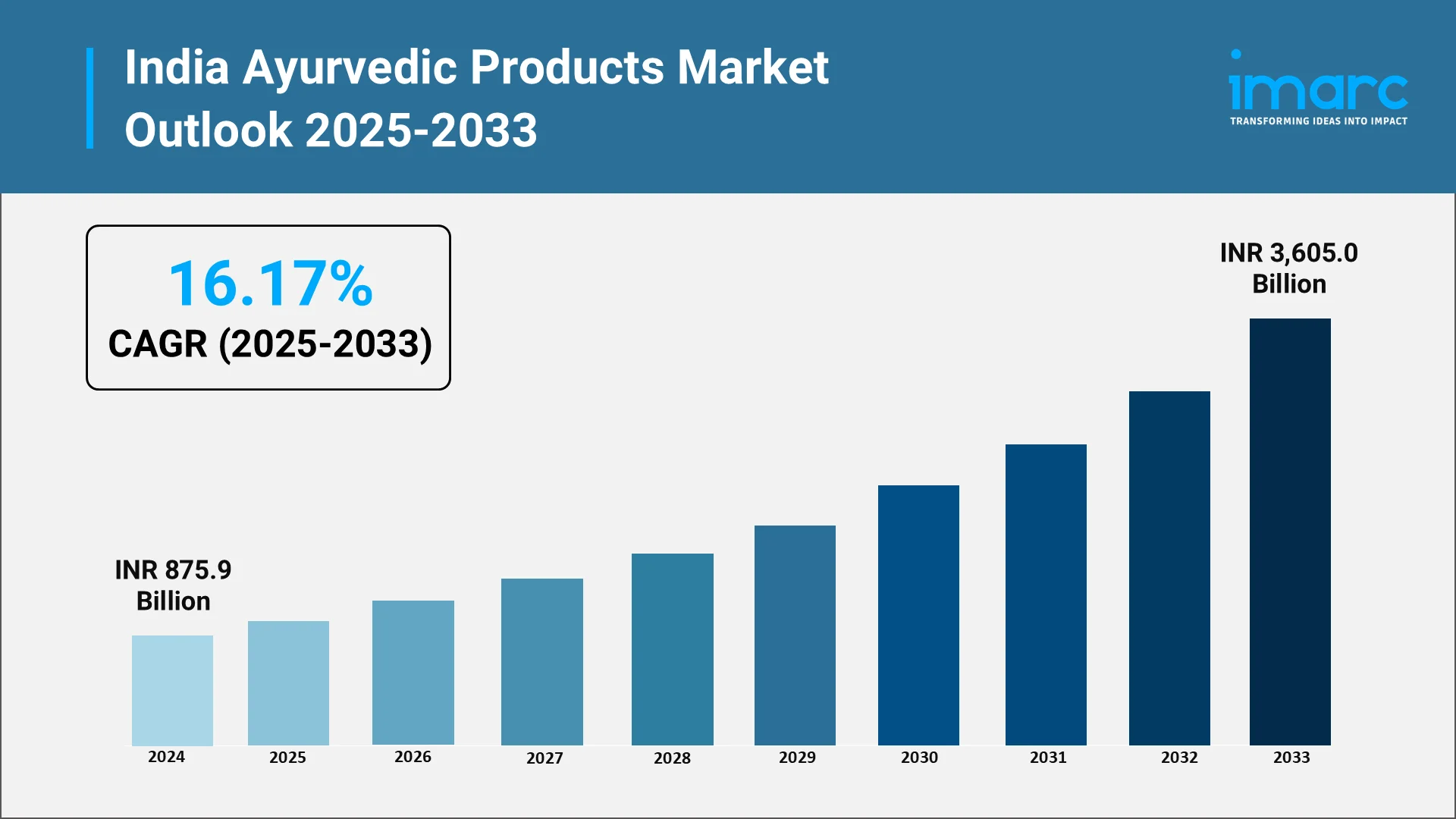
India's Ayurvedic products industry presents substantial expansion potential, fueled by demographic advantages, cultural affinity, and supportive government policies. The market's foundation rests on India's rich heritage of traditional medicine, with Ayurveda deeply embedded in cultural practices across generations. The India ayurvedic products market size reached INR 875.9 Billion in 2024. The market is projected to reach INR 3,605.0 Billion by 2033, exhibiting a growth rate (CAGR) of 16.17% during 2025-2033.
Urban households are demonstrating particularly strong uptake of premium Ayurvedic products, driven by higher disposable incomes and greater exposure to wellness trends through digital media. Metropolitan consumers are willing to pay premium prices for certified organic formulations, sustainably sourced ingredients, and innovative delivery formats.
Semi-urban and rural markets represent untapped growth frontiers, where traditional Ayurvedic practices already enjoy cultural acceptance, but modern packaged products have limited penetration. As distribution networks expand and digital commerce reaches deeper into smaller towns, these markets offer significant volume growth potential.
The wellness tourism sector is creating additional demand vectors, with international visitors seeking authentic Ayurvedic experiences and taking products back to their home countries. This cross-border interest is positioning Indian Ayurvedic brands for global expansion, particularly in Western markets where interest in alternative medicine and natural products continues growing.
Explore in-depth findings for this market, Request Sample
Recent Government Initiatives Accelerating Growth:
The Government of India has undertaken transformative initiatives to strengthen the Ayurvedic sector. On January 5, 2025, Prime Minister Narendra Modi laid the foundation stone of the Central Ayurveda Research Institute in Rohini, describing it as "Ayurveda's next big leap." This state-of-the-art facility will advance research, standardization, and global dissemination of Ayurvedic knowledge.
In a groundbreaking move on March 17, 2025, the Ministry of AYUSH incorporated Artificial Intelligence (AI) into undergraduate and postgraduate curricula to modernize the Indian Systems of Medicine. This initiative equips students with traditional medicine foundations while integrating cutting-edge technological advancements to improve healthcare delivery and research capabilities.
The Ministry of AYUSH's Union Budget allocation for FY26 witnessed a significant increase to Rs. 3,992.9 Crore, marking a robust growth trajectory that underscores governmental commitment to promoting traditional medicine systems.
Immunity-Boosting Products Driving Mass Sales:
The heightened focus on immune system strengthening has propelled specific Ayurvedic immunity boosters to unprecedented popularity across Indian households.
- Chyawanprash, a time-honored herbal jam formulation, has transcended its traditional positioning to become a mass-market preventive health product consumed by families across socioeconomic strata.
- Kadha (herbal decoctions) have experienced remarkable mainstreaming, transitioning from grandmother's remedies to commercially packaged instant mixes and ready-to-consume beverages. The convenience of pre-mixed formulations containing ginger, tulsi, cinnamon, and black pepper has democratized access to this traditional immune-boosting preparation.
- Giloy, recognized in Ayurveda as an immunity-enhancing herb, has gained significant consumer mindshare through intensive marketing and scientific validation of its immunomodulatory properties. Available in multiple formats including juices, tablets, capsules, and powder, giloy products appeal to consumers seeking targeted immune support.
- Herbal tablets and capsules formulated with ashwagandha, tulsi, neem, and other immunity-supporting botanicals have carved substantial market share in the preventive healthcare segment. These products offer convenient, standardized dosing that fits seamlessly into daily routines.
The sustained demand for immunity-boosting Ayurvedic products reflects a fundamental shift in consumer health philosophy toward proactive wellness strategies that emphasize strengthening the body's natural defense mechanisms.
E-commerce and D2C Ayurvedic Brands Growing Quickly:
The digital commerce revolution has fundamentally transformed how consumers discover, evaluate, and purchase Ayurvedic products. E-commerce platforms provide unprecedented access to diverse brands and product variants, breaking geographical barriers that previously limited consumer choice.
- Direct-to-consumer (D2C) Ayurvedic brands are leveraging digital channels to build authentic relationships with customers, bypassing traditional retail intermediaries. This direct engagement enables brands to educate consumers about Ayurvedic principles, product usage protocols, and expected outcomes.
- Subscription models for Ayurvedic products address the challenge of maintaining consistent wellness routines by automating replenishment and offering curated combinations targeting specific health goals. Monthly wellness kits containing complementary products—herbal supplements, teas, and personal care items—simplify consumer decision-making while encouraging comprehensive Ayurvedic lifestyle adoption.
- Home delivery convenience has proven particularly valuable for Ayurvedic products, which often require sustained usage over extended periods. Fast delivery timelines and hassle-free return policies reduce perceived purchase risk, encouraging trial among consumers new to Ayurvedic alternatives.
- Digital platforms enable personalized product recommendations based on individual health concerns, body constitution (prakruti), and lifestyle factors—core principles of Ayurvedic practice.
- Social media marketing and influencer partnerships have accelerated awareness and trial, particularly among younger demographics initially skeptical of traditional medicine.
.webp)
Top Companies in India Ayurvedic Products Market:
The Indian Ayurvedic products industry features a competitive landscape where established heritage brands coexist with innovative new entrants. Leading companies have successfully scaled traditional formulations for mass production while maintaining quality standards and therapeutic efficacy.
- Amrutanjan Health Care Ltd. is a century-old leader in pain management, famous for its Ayurvedic balms and roll-ons. The company has successfully diversified into cold relief, women’s hygiene, and functional beverages.
- Biotique (Bio Veda Action Research Co.) integrates traditional Ayurveda with modern Swiss biotechnology. It offers high-end, preservative-free skin and hair care products, emphasizing organic purity, clinical safety, and sustainable, eco-friendly packaging.
- Charak Pharma Pvt Ltd., established in 1947, focuses on standardized, evidence-based Ayurvedic formulations. It operates WHO-GMP certified facilities, providing researched-backed herbal healthcare solutions for chronic ailments, women's health, and general wellness.
- Dabur Ltd., world’s largest Ayurvedic company, boasts a massive portfolio including Chyawanprash and Honey. It blends traditional wisdom with modern science across healthcare, personal care, and food categories.
- Emami Ltd is a major FMCG player with iconic Ayurvedic brands like Zandu and BoroPlus. Emami specializes in therapeutic personal care, pain relief, and digestive health, maintaining a strong global distribution network.
- Herbal Hills Wellness is a specialized manufacturer focusing on organic herbal supplements and classical Ayurvedic formulations. They offer a diverse range of powders, capsules, and juices targeted at immunity, detoxification, and vitality.
- Himalaya Wellness Company is a globally recognized brand pioneering "head-to-heel" wellness. Himalaya combines pharmaceutical-grade research with Ayurveda to offer a wide array of personal care, baby care, and specialized herbal medicines.
- Maharishi Ayurveda is focused on "Consciousness-based" healing, this company offers authentic Rasayanas and supplements. It bridges ancient Vedic texts with modern quality controls, serving global markets with premium, clinically-tested wellness products.
- Patanjali Ayurved Limited is a disruptive force in the Indian market, Patanjali offers a vast range of affordable Ayurvedic medicines and FMCG goods. It emphasizes Swadeshi principles and traditional herbomineral processing.
- Shahnaz Husain Group is a pioneer in Ayurvedic beauty care, the group is world-renowned for its organic salon treatments and formulations. It specializes in premium herbal cosmetics, blending ancient traditions with innovative techniques.
- Viccolabs is an iconic brand famous for its "Vajradanti" oral care and "Turmeric" skin cream. Vicco focuses on pure Ayurvedic ingredients, maintaining a legacy of trusted, chemical-free personal care solutions.
Choose IMARC Group for Unmatched Market Intelligence:
IMARC Group delivers actionable Ayurvedic market insights that drive strategic decisions and competitive advantage. Our comprehensive intelligence reports decode consumer trends, competitive dynamics, and untapped opportunities across India's booming wellness sector.
We forecast emerging opportunities in herbal supplements, natural personal care, and immunity products—helping you stay ahead of market shifts. Our competitive benchmarking reveals winning strategies from market leaders, positioning your brand for accelerated growth.
Navigate AYUSH regulations, organic certifications, and quality standards with confidence through our expert advisory. Whether you're launching breakthrough formulations, expanding internationally, or strengthening distribution networks, our custom consulting delivers results.
Partner with IMARC Group—where Ayurvedic insights become your competitive edge. Click here for more details: https://www.imarcgroup.com/india-ayurvedic-products-market
Our Clients










Contact Us
Have a question or need assistance?
Please complete the form with your inquiry or reach out to us at
Phone Number
+91-120-433-0800+1-201-971-6302
+44-113-547-7077
Previous Post

Nicotine pouches are small, smokeless oral delivery products of nicotine, free from tobacco, designed to allow for controlled release of the active principle without burning, vaporizing, or use of traditional tobacco leaves. It consists of a small pouch that contains a matrix made basically from plant fibers, flavorings, pH adjusters, and stabilizers impregnated with nicotine, encased in a permeable material permitting the gradual absorption of the product via the oral mucosa.
The pharmaceutical industry in Japan is among the most advanced globally, recognized for combining innovation, high-quality standards, and patient-centered care. Its extensive value chain includes drug discovery, clinical trials, manufacturing, distribution, marketing, and post-market surveillance. Serving both domestic and international markets, Japanese pharmaceutical companies are respected for regulatory compliance, safety, and reliability, establishing them as trusted global collaborators in drug development.
The pharmaceutical industry in Japan is among the most advanced globally, recognized for combining innovation, high-quality standards, and patient-centered care. Its extensive value chain includes drug discovery, clinical trials, manufacturing, distribution, marketing, and post-market surveillance. Serving both domestic and international markets, Japanese pharmaceutical companies are respected for regulatory compliance, safety, and reliability, establishing them as trusted global collaborators in drug development.
The global healthcare IT industry is on a remarkable upswing, fueled by the surge in preventive care, digital health platforms, and smarter patient management systems. According to IMARC Group, the market hit USD 363.15 Billion in 2024, a clear sign of worldwide adoption. An aging population, the growing comfort with remote care, and the push toward personalized medicine are all speeding this momentum.
The global endoscopy devices market is on a sharp growth path, fueled by the shift toward minimally invasive procedures, the need for early diagnosis, and cutting-edge imaging technologies. IMARC Group reported the market hit USD 50.01 Billion in 2024, underscoring its worldwide acceptance.
The global business-to-business (B2B) payments landscape is experiencing a fundamental transformation that is reshaping how enterprises conduct financial transactions across borders and industries. The market, valued at approximately 1,189.6 Billion in 2024, is projecting remarkable growth with expectations to reach USD 2,189.0 Billion by 2033, exhibiting a CAGR of 7% from 2025-2033. This exponential expansion is signaling a paradigm shift in commercial finance, driven by technological innovation, changing business expectations, and the urgent need for more efficient payment infrastructures.
The smart medical devices market is entering a decade defined by connected care, real-time diagnostics, and patient empowerment. Valued at USD 45.9 Billion in 2024, the market is projected to reach USD 82 Billion by 2033, expanding at a compound annual growth rate (CAGR) of 6.33% between 2025 and 2033 by IMARC Group. This steady rise reflects growing confidence in data-driven healthcare systems, integration of IoT in medical environments, and the increasing role of artificial intelligence in clinical decision-making.
Active Pharmaceutical Ingredients (APIs) are the bioactive molecules of any drug used in pharmaceuticals, which cause the desired therapeutic action in the body of a human being. APIs are the central core of all drugs, chemical or biological and are responsible for the efficacy, strength, and safety of the drug. APIs are synthesized by various complex chemical synthesis, fermentation, biotechnological, or extraction processes based on the type of drug.
A bio medical incinerator is a high-temperature combustion system specialized for biomedical waste disposal by hospitals, clinics, laboratories, and research institutions. Biomedical waste usually consists of infectious waste, pathological waste, sharps, pharmaceuticals, and contaminated disposables that are very hazardous to human health and the environment if not treated.
Obesity, once viewed primarily as a lifestyle choice, is now widely recognized as a complex and chronic disease characterized by excessive body fat accumulation. Its global prevalence is escalating at an alarming rate posing a significant and growing challenge to public health systems worldwide.
Gonorrhea, a sexually transmitted infection caused by the bacterium Neisseria gonorrhoeae, is a major public health issue globally. Reports show that over one million new cases of curable STIs are contracted every day by individuals aged 15 to 49 years, with the majority being asymptomatic.
The 7 major allergic conjunctivitis markets reached a value of USD 2.1 Billion in 2024. Looking forward, IMARC Group expects the 7MM to reach USD 2.9 Billion by 2035, exhibiting a growth rate (CAGR) of 3.00% during 2025-2035.
The healthcare sector is changing rapidly because of the growing demand for better ways to manage chronic diseases. As we move toward 2025 and beyond, digital tools are playing an important role in dealing with conditions like diabetes, heart disease, cancer, and respiratory problems.
The global multivitamin gummies market consists of chewable dietary supplements that are charged with key vitamins and minerals aimed at maintaining general health and wellness. The gummies present a handy, enjoyable, and easy-to-swallow option to classic pills or tablets, hence are predominantly preferred by children and adults who do not like taking pills.
India's pharmaceutical sector is evolving rapidly, supported by the integration of artificial intelligence (AI) across the value chain. As of 2023, India ranked as the third-largest pharmaceutical producer by volume, accounting for 20% of global generic drug exports.
As Lung Cancer Awareness continues to build global momentum in 2025, Artificial Intelligence (AI) is proving to be a transformative force—not only in clinical diagnostics but also in public education and preventive health efforts. Given that lung cancer remains one of the world’s deadliest cancers, accounting for over 1.8 million deaths each year and a five-year survival rate of just 28.4%, the integration of AI marks a critical turning point.
Observed on May 19, Hepatitis Testing Day 2025 emphasizes the need to "Test. Treat. Eliminate," highlighting the gap in diagnosing hepatitis B and C, which cause over 1.3 million deaths annually. Hepatitis remains a major global health threat, on par with HIV, tuberculosis, and malaria. The growing viral hepatitis market <Viral Hepatitis Market Size | Share, Trends - 2034 > reflects rising demand for better diagnostics, treatments, and integrated care. The WHO warns that without faster testing and treatment, the goal of eliminating hepatitis by 2030 may not be achieved, with disparities in diagnostics, particularly in low- and middle-income countries, hindering progress.
Observed on May 8, World Ovarian Cancer Day 2025 carries the theme “No Woman Left Behind,” reinforcing the urgent need to close the gaps in access, diagnosis, treatment, and care across all regions and socioeconomic groups. Ovarian cancer remains one of the deadliest gynecological cancers, often detected too late due to vague symptoms and limited screening tools. The World Ovarian Cancer Coalition projects a 55% rise in annual cases and nearly 70% more deaths by 2050, with the heaviest burden falling on low- and middle-income countries. Equitable access to early diagnostics, genetic testing, and targeted therapies is critical.
In clinics around the world, a concerning pattern is becoming increasingly evident: a growing number of patients are experiencing wheezing, breathlessness, and persistent coughing. This surge reflects a broader global trend. According to the World Health Organization (WHO), more than 260 million people are currently living with asthma, making it one of the most widespread and persistent chronic respiratory conditions globally.
Observed on April 25, World Malaria Day 2025 carries the theme “Accelerating Equity in Malaria Prevention and Cure,” underscoring the urgent need to reach communities still lacking access to life-saving vaccines and diagnostics. While global malaria death rates have seen modest declines, the disease continues to claim the life of one child every minute, highlighting the critical need for swift, equity-driven action
Sulfamethoxazole is a common synthetic antibacterial that is a member of the sulfonamide class of antibiotics. This substance plays a very significant role in modern medicine due to the amazing capabilities offered by the substance for curing infections and bacterial diseases. Trimethoprim and sulfamethoxazole are frequently used together to create the well-known antibiotic co-trimoxazole, which is well-known for its potency against a variety of bacterial infections. It works by preventing the manufacture of folic acid, which is necessary for the growth of bacteria. Sulfamethoxazole is an essential part of modern antibiotic therapy since it has been used to treat lung infections, urinary tract infections, and other common bacterial illnesses.
Healthcare consumables are necessary medical supplies used for patient treatment, diagnostics, and cleanliness in clinics, hospitals, and home care settings. These consist of supplies such as surgical masks, bandages, gloves, syringes, catheters, and disinfectants. Usually, they are disposable or single use to preserve sterility and stop infections. Healthcare consumables are an essential component of the global healthcare ecosystem and are in high demand due to expanding healthcare needs, an increase in operations, infection control measures, and technological improvements.
Catheters are flexible, tubular medical devices designed to access various body cavities, organs, or blood vessels for diagnostic or therapeutic purposes. They can be broadly classified into types based on their application, including urinary catheters, cardiac catheters, and intravenous (IV) catheters. Catheters are commonly used in diverse healthcare settings for managing chronic conditions, enabling fluid drainage, delivering medications, or facilitating minimally invasive surgeries.
Bioinformatics involves applying computational techniques and tools to study and understand biological systems at the molecular level. It is a field of study that combines mathematics, biology, computer science, and statistics to research genomic data and biological networks. The goal is to interpret information from large biological data sets, such as DNA sequences, protein structures, gene expressions, and other high-throughput experimental data. This field provides various products and services, such as knowledge management tools, bioinformatics platforms, and services.
A non-animal model refers to an experimental system or method used in scientific research or testing that does not involve the use of animals. These models are developed to simulate biological processes, test hypotheses, or study diseases without the need for live animals. The aim is often to reduce the reliance on animal testing, which has ethical implications and raises concerns about animal welfare.
Cell therapy involves the transplantation and manipulation of living cells to replace and repair damaged tissue. Its primary branches include stem cell therapy and non-stem cell therapy. Stem cell therapy utilizes stem cells to repair, replace, or rejuvenate damaged or diseased cells and tissues as they possess the ability to differentiate into various specialized cell types, making them valuable for regenerative medicine. Non-stem cell-based therapies typically involve somatic cells isolated from the human body. These cells are propagated, expanded, selected, and then administered to patients for curative, preventive, or diagnostic purposes. On the other hand, gene therapy seeks to treat diseases by introducing, replacing, or inactivating genes within cells.