E-Rickshaw Plant Setup Cost in India: Manufacturing Process Flow, Machinery, DPR & Financial Model 2026
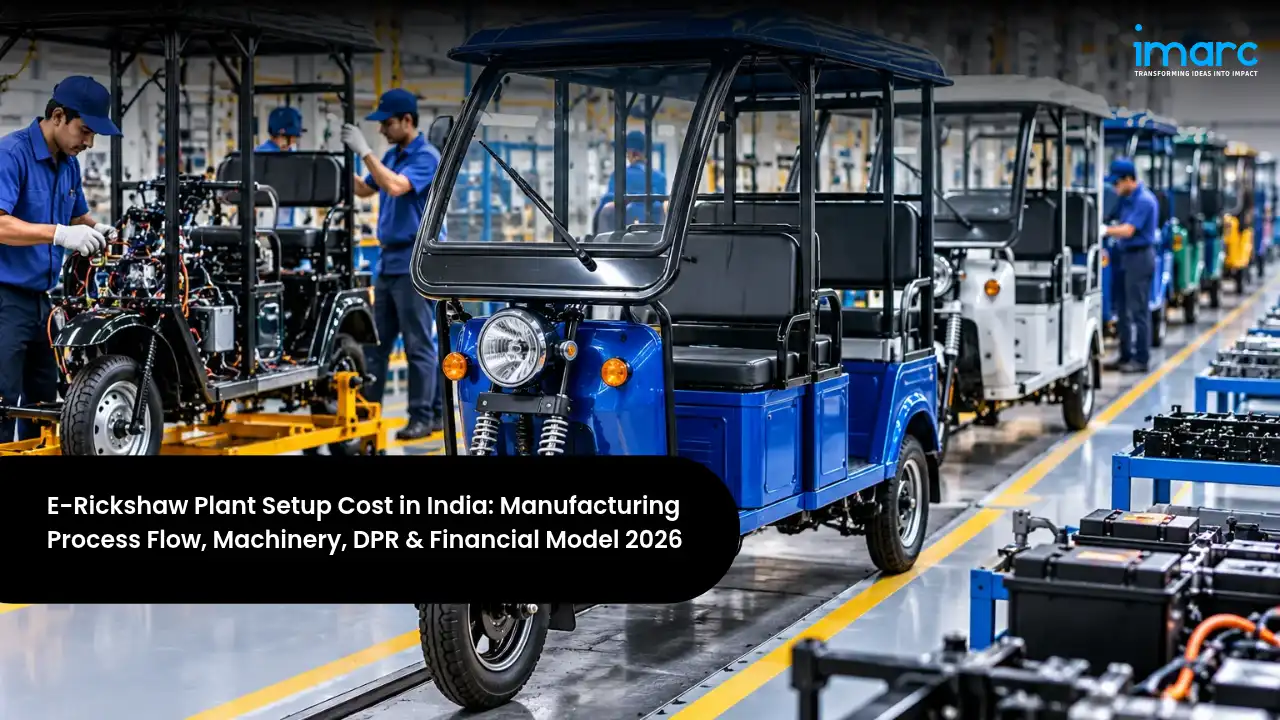
A battery rickshaw is a low-speed electric three-wheeler with a steel tubular frame, a hub or axle-mounted motor of up to about 2 kW, a controller, and a lead-acid or lithium-ion battery pack, built to carry four passengers and a driver, or light cargo in its e-cart form, on short urban and semi-urban routes. It has become the backbone of last-mile transport in north and east India because it costs little to buy and very little to run. IMARC values the global market at about USD 3.54 billion in 2025 and expects it to reach USD 15.10 billion by 2034, while India's own market stood at about USD 1.55 billion in 2025. With roughly 29,000 to 35,000 passenger units registered every month in 2026 and central support extended to March 2028, E-Rickshaw Manufacturing Plant Setup in India remains an attractive opportunity for automotive and engineering investors.
Investment depends mainly on annual output, how much of the vehicle is made in-house, from frames and body panels to battery packs, the paint process, the level of automation in welding and assembly, testing and homologation facilities, and the share of lithium-ion models. The E-Rickshaw Manufacturing Plant Cost ranges from about INR 2–5 crore for an assembly unit making 2,000 to 3,000 vehicles a year, to INR 30–50 crore for an integrated plant of about 20,000 vehicles a year with frame fabrication, a powder coating line, and assembly lines, and INR 100–150 crore for plants above 50,000 vehicles that also assemble battery packs. Bought-in components make up 75 to 85% of operating cost, with the battery the single biggest item, so sourcing and design decide competitiveness. IMARC estimates a gross margin of 20 to 30% and a net margin of 8 to 12% for a well-run plant.
This guide is written for investors exploring how to start an E-Rickshaw manufacturing plant in India. It focuses on an integrated plant making about 20,000 vehicles a year, roughly 70 a day, with in-house frame fabrication, powder coating, and assembly, offering lead-acid and lithium-ion passenger models and cargo carts through dealers and fleet operators, and also explains small assembly units and larger plants. It covers products and markets, the demand outlook, the production process flow, machinery and components, location and infrastructure, a detailed cost and financial breakdown, certification and approvals, and how a DPR and financial model turn all of this into a bankable plan.
India Market Snapshot
| Key Facts | Details |
|---|---|
| Global Market (2025) | About USD 3.54 Billion |
| Global Market Forecast (2034) | USD 15.10 Billion, 17.5% CAGR |
| India Market (2025) | About USD 1.55 Billion |
| India Passenger Units (2026) | About 29,000 – 35,000 a Month |
| PM E-DRIVE Support | INR 2,500 per kWh, Cap INR 12,500 |
| Indicative Total Investment | INR 2 Crore to 150 Crore |
The snapshot shows a large, established domestic market with steady monthly volumes and a fast-growing global opportunity as other countries electrify their own three-wheelers. India's segment is crowded, with hundreds of makers, so quality, financing tie-ups, and dealer networks matter as much as price.
Investment Highlights
Indicative Project Cost in India (2026)
| Parameter | Value |
|---|---|
| Product Range | Passenger, cargo, garbage, shuttle |
| Plant Capacity | 2,000 – 50,000 Vehicles Per Year |
| Total Project Investment | INR 2–5 Crore (assembly unit) to 30–50 Crore (20,000 vehicles) |
| Payback Period | 3 – 5 Years |
| Net Profit Margin | 8 – 12% |
| IRR | 20 – 28% |
| Preferred States | Uttar Pradesh, Haryana, West Bengal, Bihar, Rajasthan, Assam |
| Key Requirement | Type approval, dealers, financing |
These ranges provide a realistic frame for early planning, but actual returns depend on battery, motor, and steel prices, the lead-acid and lithium-ion mix, dealer margins and retail financing, subsidy eligibility and domestic value addition rules, warranty claims, competition from hundreds of makers and large automotive brands, and the working capital tied up in components and dealer credit. A site-specific E-Rickshaw Feasibility Report narrows each of these assumptions to your chosen capacity, location, product mix, and buyers.
Table of Contents
- What is E-Rickshaw Manufacturing?
- Why is E-Rickshaw Manufacturing Growing in India?
- E-Rickshaw Manufacturing Process Flow
- Raw Materials Required for E-Rickshaw Manufacturing
- Location, Land & Infrastructure
- E-Rickshaw Manufacturing Machinery and Equipment
- E-Rickshaw Manufacturing Plant Setup Cost in India (CapEx & OpEx)
- Financial Analysis and Profitability
- Licenses and Approvals for E-Rickshaw Manufacturing in India
- Recent Developments in the India E-Rickshaw Manufacturing Industry
- How an E-Rickshaw Manufacturing Project Report and DPR Helps Investors
- Frequently Asked Questions
What is E-Rickshaw Manufacturing?
Under Indian motor vehicle rules, a battery rickshaw is a three-wheeled vehicle that carries up to four passengers besides the driver and up to 40 kg of luggage, with a top speed of 25 km per hour and motor power of up to about 2 kW. It is built on a welded steel chassis with mild steel or fibreglass body panels, a canopy, leaf or coil suspension, drum brakes, and a rear axle driven by a brushless DC motor through a controller. Most models still run on lead-acid batteries, but lithium-ion packs are gaining share because they last longer and charge faster. Range, durability, battery life, braking, and resale value decide its worth to owners.
Commercially, the vehicles are sold through dealers to owner-drivers, who often buy on loans from NBFCs, to fleet and rental operators, to e-commerce and grocery companies for cargo carts, to municipalities for garbage collection, and to schools, campuses, resorts, and industrial sites for shuttles, with exports to Nepal, Bangladesh, and African markets. An E-Rickshaw Manufacturing Plant can serve all these buyers by building different bodies, seats, and battery options on common frames. Buyers value low price, reliability, long battery life, easy financing, and service support close to where they operate.
- Passenger: Last-mile shared rides.
- Cargo: Grocery and parcel delivery.
- Municipal: Garbage collection carts.
- Campus: Schools, resorts, factories.
The Main Products and Applications
Choosing the product mix is the most important commercial decision, because it determines frames, bodies, battery choices, and margins:
| Product | Description | Key Property | Primary Demand |
|---|---|---|---|
| Passenger, Lead-acid | 4+1 seats | Lowest cost | Owner-drivers |
| Passenger, Li-ion | Lithium pack | Longer life | Fleets, operators |
| Cargo Cart | Open or box body | Low running cost | Grocery, parcels |
| Garbage Cart | Tipper body | Municipal use | Urban local bodies |
| Shuttle | Covered seating | Comfort, safety | Schools, campuses |
| L5 Passenger | Faster, bigger | Longer routes | City auto routes |
These choices shape the whole project. Lead-acid passenger models give volume in a price-sensitive market, while lithium-ion, cargo, and municipal models earn better margins and steadier orders but need stronger engineering, battery partnerships, and after-sales service.
Why is E-Rickshaw Manufacturing Growing in India?
Key Growth Drivers in India
Demand is supported by low running costs, last-mile transport needs, and policy support:
- Low running cost: Charging costs far less per km than petrol, diesel, or CNG.
- Livelihoods: Vehicles offer affordable self-employment for drivers.
- Last-mile links: Metro and bus networks need feeder transport.
- Logistics: Grocery and parcel delivery use more cargo carts.
- Policy support: PM E-DRIVE support for these vehicles runs to March 2028.
India-Specific Market Opportunity
| Segment | Market Context | Manufacturing Role |
|---|---|---|
| Owner-Drivers | North and east India | Affordable models |
| Fleet Operators | Rental, rides | Lithium, telematics |
| Logistics | Grocery, parcels | Cargo carts |
| Municipal Bodies | Waste collection | Tipper carts |
The strongest opportunity for new entrants lies in reliable lithium-ion models for fleets and financiers, in cargo and municipal carts with steady institutional orders, and in exports to neighbouring countries. Makers that combine sound engineering, battery partnerships, dealer financing, and dependable service will be best placed to grow.
E-Rickshaw Manufacturing Process Flow
Understanding the process helps you plan equipment, layout, and where cost and quality are decided. The flow runs from steel tube cutting and bending through frame welding on fixtures, surface treatment and powder coating, fitting of body panels and canopy, axle, suspension, and brakes, motor and controller, battery and wiring harness, seats and trim, and final testing and pre-delivery inspection. Frame accuracy and welding decide strength and safety, while wiring and battery integration decide reliability on the road.
The E-Rickshaw Manufacturing Process Flow
The sequence below reflects an integrated plant making its own frames and bodies. Assembly-only units start at the paint or trim stage with bought-in frames.
| Unit Operation | Key Activity |
|---|---|
| Tube Cutting | Laser or CNC |
| Bending & Pressing | Frame members, brackets |
| Frame Welding | MIG, fixtures |
| Pretreatment & Painting | Powder coating |
| Body Panels | Steel or fibreglass |
| Axle & Suspension | Brakes, wheels |
| Motor & Controller | Drive system |
| Battery & Wiring | Pack, harness |
| Seats, Roof & Trim | Canopy, lights |
| Testing & PDI | Brakes, speed, water |
Two factors decide profitability across this flow. The first is component cost and design, because bought-in parts make up most of the cost, so smart sourcing of batteries, motors, and controllers, standard frames across models, and in-house fabrication of steel parts directly set the cost of each vehicle. The second is quality and warranty, since frame cracks, wiring faults, and early battery failure lead to costly claims and damage the brand among drivers and financiers, so good welding fixtures, rust protection, and end-of-line testing decide long-term returns.
Raw Materials Required for E-Rickshaw Manufacturing
The main inputs are steel tubes and sheets for frames and panels, fibreglass or steel body parts, battery packs, brushless DC motors with differentials or hub motors, controllers, tyres and wheels, axles, suspension and brake parts, wiring harnesses, lights, chargers, seats, canopies, and powder coating materials.
| Input | Role in Vehicle | India Sourcing | % of OpEx |
|---|---|---|---|
| Battery Packs | Energy storage | Domestic pack makers | 30–40% |
| Motor & Controller | Drive system | Domestic, imported | 12–16% |
| Steel & Body Parts | Frame, panels | Steel mills, moulders | 12–16% |
| Wheels, Axle & Brakes | Running gear | Auto component makers | 8–10% |
| Electricals & Charger | Lights, harness | Domestic suppliers | 5–7% |
Batteries are by far the largest cost and the main source of warranty risk, so long-term supply agreements and clear warranty terms with battery makers are essential.
Location, Land & Infrastructure
Site selection for a three-wheeler plant is driven by closeness to the largest markets in north and east India, access to steel and auto component suppliers, skilled welders and assemblers, and good road links for dispatch to dealers. Other factors include land for a paint shop and test track, reliable power, nearby testing agencies, and state electric vehicle policies with capital subsidies, tax refunds, and stamp duty relief. Locating near the biggest consumer states cuts freight on bulky finished vehicles.
Choosing the Best Location for E-Rickshaw Manufacturing Plant Setup
| State / Region | Why It Works | Key Advantage |
|---|---|---|
| Uttar Pradesh | Noida, Ghaziabad, Lucknow | Largest market |
| Haryana | Faridabad, Bahadurgarh | NCR supply chain |
| West Bengal | Kolkata, Hooghly | Eastern cluster |
| Bihar | Patna, Muzaffarpur | Strong demand |
| Rajasthan | Bhiwadi, Jaipur | NCR access, policy |
| Assam | Guwahati | North-east demand |
Uttar Pradesh and the Delhi NCR belt combine the largest demand with a deep base of component suppliers, while West Bengal's Hooghly cluster serves eastern markets. The final choice should weigh market access, component supply, labour, testing agency access, and state incentives.
Quality, Safety and Homologation Systems
Every model must be type approved under the Central Motor Vehicle Rules by an authorised testing agency such as ICAT or ARAI before it can be registered, and lithium-ion packs must meet the battery safety requirements of AIS-156. A credible plant needs welding fixtures and gauges for frame accuracy, salt spray and paint adhesion tests, battery and motor testing, and end-of-line checks for brakes, speed limits, lighting, and water ingress, together with conformity of production audits and vehicle identification records for every unit. Safety in the plant focuses on welding, paint shop fire risk, and safe storage of lithium batteries. Environmental systems cover paint shop emissions, pretreatment effluent, and battery waste under extended producer responsibility rules. An experienced E-Rickshaw Manufacturing Consultant in India can help plan capacity, product range, homologation, and subsidy eligibility so the plant meets regulatory and customer requirements from the start.
Infrastructure Requirements (20,000 Vehicles a Year)
| Infrastructure Element | Specification | India-Specific Note |
|---|---|---|
| Plant Land | 5 – 8 acres | Test track space |
| Built-up Area | 80,000 – 1,20,000 sq ft | Fabrication, assembly |
| Power Supply | 750 – 1,000 kVA | Welding, paint shop |
| Paint Shop | Powder coating line | Pretreatment, oven |
| Test Track | 200 – 300 m loop | Brakes, gradient |
| Battery Store | Fire-safe area | Lithium safety |
| Finished Vehicle Yard | Covered parking | Dealer dispatch |
A well-designed fabrication and paint shop, a flowing assembly layout, and proper testing facilities are the most important infrastructure requirements, since they decide both output and product quality.
E-Rickshaw Manufacturing Machinery and Equipment
The equipment set covers tube and sheet processing, welding, surface treatment and painting, assembly, battery and motor testing, and end-of-line inspection. The paint shop and fabrication equipment account for most of the machinery cost, followed by assembly lines and testing systems.
| Equipment | Function | Key Specification |
|---|---|---|
| Laser Tube Cutter | Cut frame tubes | CNC controlled |
| CNC Pipe Bender | Bend frame members | Multi-axis |
| Hydraulic Presses | Form brackets | With dies |
| MIG Welding & Fixtures | Weld frames | Jig-based |
| Pretreatment Tanks | Clean, phosphate | Multi-stage |
| Powder Coating Line | Paint frames | Booth and oven |
| Assembly Conveyor | Move vehicles | Station-based |
| Torque Tools | Tighten fasteners | Calibrated |
| Battery Testers | Check packs | Charge, discharge |
| End-of-Line Rig | Test brakes, speed | Roller type |
| Shower & PDI Bay | Final checks | Water ingress |
Machinery should follow the project plan. A small assembly unit buys painted frames and needs only assembly stands, torque tools, battery testers, and a simple test lane, while a 20,000 vehicle plant adds laser cutting, bending, welding fixtures, a powder coating line, a conveyor, and end-of-line testing rigs.
E-Rickshaw Manufacturing Plant Setup Cost in India (CapEx & OpEx)
The tables below break down capital and operating costs for an integrated plant making about 20,000 vehicles a year in India. The final E-Rickshaw Investment Cost for your project will depend on capacity, depth of in-house fabrication, paint process, battery pack assembly, testing facilities, land cost, and location.
Capital Expenditure (CapEx) Cost Structure
| CapEx Component | % of Total CapEx | What It Covers |
|---|---|---|
| Frame Fabrication | 18–22% | Cutting, welding |
| Paint Shop | 18–22% | Pretreatment, coating |
| Assembly Lines | 12–16% | Conveyor, tools |
| Testing & Homologation | 6–10% | Rigs, approvals |
| Land & Buildings | 22–28% | Plant, test track |
| Pre-operatives & Working Capital | 8–12% | Parts stock, fees |
Fabrication, painting, and buildings make up most of the capital, while working capital is heavy because components are bought ahead and dealers expect credit. Because of this, a detailed E-Rickshaw Business Plan should model battery, motor, and steel prices, the lead-acid and lithium-ion mix, dealer margins, retail financing tie-ups, subsidy eligibility, warranty claims, homologation costs, exports, receivables, and financing costs together, so that funding supports the plant through ramp-up.
Operating Expenditure (OpEx) Cost Structure
| OpEx Component | % of Total OpEx | India-Specific Note |
|---|---|---|
| Bought-in Components | 75–85% | Battery led |
| Labour | 5–8% | Welders, fitters |
| Power & Utilities | 4–6% | Paint oven, welding |
| Paint & Consumables | 2–3% | Powder, gases |
| Warranty & Service | 2–3% | Battery claims |
| Logistics & Overheads | 3–5% | Freight, insurance |
With components making up most of the cost, margins depend on sourcing, design, and selling price. A good operating model tracks material cost per vehicle, labour hours per vehicle, warranty claims per hundred units, dealer stock and credit, and realised prices by model, and tests results against higher battery prices, slower sales, or subsidy changes.
Financial Analysis and Profitability
Based on analysis of a 20,000 vehicle plant, the financial profile combines moderate capital needs with high working capital and margins that depend on sourcing and scale in a crowded market. The profitability of E-Rickshaw manufacturing business in India improves markedly with in-house frame and body fabrication, strong battery partnerships, a growing share of lithium-ion and cargo models, retail financing tie-ups, wide dealer and service networks, institutional orders, and exports.
| Financial Metric | Indicative Value | India Context |
|---|---|---|
| Gross Profit Margin | 20–30% | Component cost driven |
| Net Profit Margin | 8–12% | After depreciation, taxes |
| Payback Period | 3–5 Years | Moderate capital |
| IRR (Internal Rate of Return) | 20–28% | Volume dependent |
| Capacity Utilization (stable ops) | 60–80% | Crowded market |
| Break-even Capacity Utilization | 40–50% | Dealer reach |
Distribution and product mix decide where a plant lands within these ranges. Makers with strong dealer networks, financing tie-ups, and lithium-ion and cargo models earn the higher returns, while those selling only low-priced lead-acid models sit at the lower end.
Returns can be strengthened by assembling battery packs in-house, offering telematics and battery swapping options, selling spare parts and service, bidding for municipal and institutional orders, and exporting to neighbouring countries.
Key Risks and Mitigation
The main risks are intense price competition, battery cost and quality, warranty claims, subsidy and rule changes, dealer credit, and city restrictions on vehicle numbers. Competition risk is reduced by quality, service, and product range; battery risk by long-term supply and testing; warranty risk by robust design and inspection; policy risk by models that sell without subsidy; credit risk by financing partners; and route restrictions by moving into cargo, municipal, and export segments. Promoters often work with a E-Rickshaw Business Plan Consultant in India to test these scenarios before committing capital.
Licenses and Approvals for E-Rickshaw Manufacturing in India
Approvals for a three-wheeler plant centre on vehicle type approval, battery safety, subsidy eligibility, and environmental and factory consents, along with standard business registrations. Promoters setting up an E-Rickshaw Manufacturing Plant in India generally need the following:
- Type Approval: CMVR certification from ICAT, ARAI, or another authorised agency.
- Battery Safety: AIS-156 compliance for lithium-ion packs.
- Subsidy Eligibility: PM E-DRIVE registration and domestic value addition checks.
- Battery EPR: Registration under the Battery Waste Management Rules.
- Pollution Control: Consent to Establish and Operate for the paint shop.
- Factory & Fire: Factory license, building plan approval, and fire NOC.
- Business & Trade Registrations: Business registration, GST, Udyam, trademark, and Import Export Code.
Type approval and pollution consent for the paint shop are usually on the critical path, followed by subsidy registration and dealer onboarding.
Note: The exact approvals, registrations, licenses, and certification requirements may vary depending on factors such as plant location, capacity, products, state pollution control categories, customer specifications, and applicable regulations. Businesses are advised to undertake a detailed regulatory assessment during the project planning stage to ensure full compliance and timely implementation.
Recent Developments in the India E-Rickshaw Manufacturing Industry
Several recent developments give useful context for investors considering this market:
- Subsidy extended: In March 2026, PM E-DRIVE support for low-speed passenger and cargo models was extended to March 2028 at INR 2,500 per kWh.
- Record year: In FY2026, electric three-wheeler sales rose 19% to 830,819 units, 61% of all three-wheeler sales, across about 680 makers.
- Big brands enter: In November 2025, Bajaj Auto entered the low-speed segment with its Riki range, including a cargo model.
- Monthly volumes: In July 2026, about 34,716 passenger units and 7,277 e-carts were registered, led by YC Electric and JS Auto.
The common thread is a large, steady market that is consolidating as major automotive brands enter. Makers who combine sound engineering, battery partnerships, financing, and service will be best placed to grow.
How an E-Rickshaw Manufacturing Project Report and DPR Helps Investors
A detailed DPR provides a structured roadmap for the venture, from market demand and product strategy to sourcing, process design, plant layout, homologation, approvals, and economics. It helps investors decide the right capacity, location, and product mix, estimate capital and operating expenditure, assess profitability, and identify risks before committing funds.
At its core is a detailed E-Rickshaw Financial Model covering component prices by model, battery choices, labour hours, power, paint and consumables, warranty, dealer margins, subsidies, homologation costs, working capital, depreciation, taxes, financing, debt servicing, cash flows, break-even, return on investment, and payback under different price and volume scenarios. Banks and investors rely on this model to judge long-term viability, which is why many promoters appoint an E-Rickshaw Plant Project Report Consultant in India to prepare the report and validate its assumptions against current market data.
For a three-wheeler project, a strong DPR also clarifies the product range, the battery and component sourcing strategy, the dealer and financing plan, and the homologation and subsidy path, which together are the factors most likely to decide success.
Frequently Asked Questions
What are the first steps to set up an E-rickshaw manufacturing plant in India?
Start by choosing your models and markets, such as passenger models for owner-drivers or cargo carts for logistics firms. Then commission a feasibility study and DPR, secure land with room for a paint shop and test track, line up battery, motor, and controller suppliers, design and homologate your models, obtain approvals, and arrange project financing.
How much does it cost to set up the E-rickshaw manufacturing plant in India?
Investment ranges from about INR 2–5 crore for an assembly unit making 2,000 to 3,000 vehicles a year to INR 30–50 crore for an integrated plant of about 20,000 vehicles, and INR 100–150 crore for plants above 50,000 vehicles with battery pack assembly.
What are the main steps in making E-rickshaw?
The flow runs from tube cutting and bending through frame welding, pretreatment and powder coating, body panels, axle and suspension, motor and controller, battery and wiring, seats and trim, and testing and pre-delivery inspection.
Which machinery does the E-rickshaw manufacturing plant need?
Key equipment includes laser tube cutters, CNC pipe benders, hydraulic presses, MIG welding with fixtures, pretreatment tanks, a powder coating line, an assembly conveyor, torque tools, battery testers, an end-of-line test rig, and a shower and PDI bay.
Which components are used for E-rickshaw manufacturing?
The main components are battery packs, motors and controllers, steel tubes and body parts, wheels, axles, and brakes, wiring harnesses, lights, chargers, seats, and canopies.
How profitable is E-rickshaw manufacturing in India?
IMARC estimates a 20 to 30% gross margin and an 8 to 12% net margin for a well-run plant, with payback in about 3 to 5 years. Profitability depends on component sourcing, scale, product mix, and dealer and financing networks.
Which approvals does the E-rickshaw manufacturing plant need in India?
Typical approvals include CMVR type approval, AIS-156 battery safety compliance, PM E-DRIVE registration, battery EPR registration, pollution board consents, factory license and fire NOC, and GST, Udyam, trademark, and Import Export Code registrations.
How do I get a feasibility study or DPR for the E-rickshaw manufacturing project?
A detailed feasibility study and DPR covers market and channels, product range, sourcing, process and layout, homologation, approvals, and full financials. Investors usually engage an E-Rickshaw Manufacturing Feasibility Study Consultant with experience in automotive and electric vehicle projects to prepare the report and validate it for lenders.
Our Clients








Contact Us
Have a question or need assistance?
Please complete the form with your inquiry or reach out to us at
Phone Number
+91-120-433-0800+1-201-971-6302
+44-113-547-7077
Previous Post

The Saudi Arabia Logistics Market reached USD 55.29 Billion in 2025 and is projected to reach USD 83.41 Billion by 2034, expanding at a CAGR of 4.67% (2026–2034). Vision 2030 infrastructure investments, e-commerce expansion, and the Kingdom's strategic positioning as a trade corridor connecting Asia, Europe, and Africa are the primary forces driving this growth.
Australia's logistics sector is drawing renewed investor attention because scale, geography, and policy have converged in one market cycle. How big is the Logistics Industry in Australia?
Nearly every container ship, port crane, and rail yard in the world exists to move these standardized steel boxes, making the Shipping Container Market the physical backbone of global trade. The industry reached USD 12.7 Billion in 2025 and is projected to reach USD 22.2 Billion by 2034, growing at a CAGR of 6.38% during 2026–2034, as globalization, e-commerce, and infrastructure investment sustain demand across the shipping container industry.
A two-wheeler clutch plate is an essential transmission system part in motorcycles and scooters that helps to engage and disengage the engine power to the drivetrain. The clutch plate is a part of the clutch system, which usually consists of friction plates and steel plates, and is designed to transmit torque smoothly from the engine to the gearbox.
The bus industry in Australia is an important sector of the national public transport system, conveying people in urban and regional settings. It has recently gone through a remarkable expansion due to fast urbanization and the growth of population in major cities. With such factors, the demand for public transportation with considerable sustainable and effective mass transit solutions has surged noticeably.
The Saudi Arabia road freight transport market represents one of the key building blocks of the economic infrastructure in the Kingdom, providing for cargo movement across various domestic supply chains. It also involves road freight operations, which allow for the distribution of goods-from manufactured goods, consumer goods, and industrial supplies to agricultural produce-across its large and wide geography.
The exponential rise in online shopping is fueling unprecedented parcel movement across India. Consumers are increasingly relying on e-commerce platforms for everyday essentials, including fashion, electronics, grocery, and lifestyle products. Additionally, the rise of direct-to-consumer (D2C) brands has added a new dimension to the logistics ecosystem, with a growing emphasis on speed, reliability, and personalized delivery experiences.
The GCC outbound travel and tourism market has experienced remarkable transformation, driven by economic prosperity, demographic shifts, and evolving consumer preferences. Citizens across the Gulf Cooperation Council nations, including Saudi Arabia, United Arab Emirates, Qatar, Kuwait, Bahrain, and Oman, increasingly venture beyond borders to explore international destinations.
The UAE cold chain logistics market has emerged as a critical component of the nation's broader economic diversification strategy. As the country positions itself as a leading regional hub for trade, commerce, and healthcare, the demand for sophisticated temperature-controlled supply chain solutions continues to intensify.
The Indian online food-delivery ecosystem is undergoing a rapid expansion, propelled by multiple structural shifts in technology, consumer behaviour, and delivery infrastructure. According to a recent report by Bain & Company and Swiggy, the overall food-services market in India is projected to grow from roughly INR 5.5?lakh crore in 2023 to around INR 9–10?lakh crore by 2030.
The Philippines travel and tourism industry is thriving, with travelers drawn to its islands, heritage, and vibrant city life. IMARC Group estimates the market reached USD 14.0 Billion in 2025, reflecting the country’s growing appeal as a global destination. Stronger air connectivity, better infrastructure, and widespread use of digital booking platforms are boosting both leisure and business travel.
The Mexico 3PL market has emerged as a critical pillar supporting the country's economic transformation and integration into global trade networks. As multinational corporations are increasingly viewing Mexico as a strategic manufacturing and distribution hub, the industry is evolving from a supporting service sector into a fundamental driver of competitive advantage.
An e-rickshaw is an electric-powered three-wheeled vehicle designed to transport passengers and goods over a short distance. It is an efficient, low-cost, eco-friendly substitute for conventional fuel-based auto-rickshaws and cycle rickshaws. The general specification of an e-rickshaw involves an electrical motor ranging from 650W to 1500W powered by a rechargeable lead-acid or lithium-ion battery, a lightweight chassis manufactured from mild steel or reinforced metal, and a simple drivetrain system.
Speed, reliability, and supply chain precision have become cornerstones of global commerce. As businesses operate across borders and customers expect shorter delivery times, the need to move products efficiently across continents has become essential. Air freight isn’t just connecting time zones—it’s enabling fast, predictable service that modern logistics depend on.
A truck radiator is an essential part of the truck's cooling system, which is used to control engine temperature by dispersing the excess heat produced during running. The radiator functions by circulating a coolant liquid around the engine, absorbing heat, and then releasing the heat to the air through the radiator's finned surface.
Australia's third-party logistics (3PL) industry is witnessing a revolution, driven by the integration of artificial intelligence (AI), digital infrastructure, and e-commerce growth. Initially based on manual procedures and operations, contemporary logistics chains are now being transformed by real-time data streams, predictive analytics, and smart automation.
Dropshipping is a streamlined e-commerce fulfillment model where sellers promote products without the need to maintain inventory. Instead of managing stock, sellers pass customer orders to third-party suppliers, often manufacturers or wholesalers, who handle packaging and shipping directly to the customer.
The logistics industry, encompassing transportation, warehousing, and distribution, is undergoing significant transformation in 2025. This growth is driven by technological advancements, evolving consumer expectations, and the need for more resilient supply chains.
The logistics sector is a vital component of the supply chain, encompassing the management and transportation of goods and services from their origin to their destination. It involves a broad spectrum of activities such as transportation, warehousing, inventory management, packaging, and goods handling, alongside information flow and supply chain management. The sector ensures the efficient movement of goods through various supply chain stages to meet consumer demand, playing a crucial role in facilitating trade and commerce, supporting economic growth, and serving diverse industries, including manufacturing, consumer goods, retail, food and beverages, IT hardware, healthcare, and chemicals.