How Vision 2030 Is Reinventing Saudi Arabia’s Logistics and Supply Chain Ecosystem
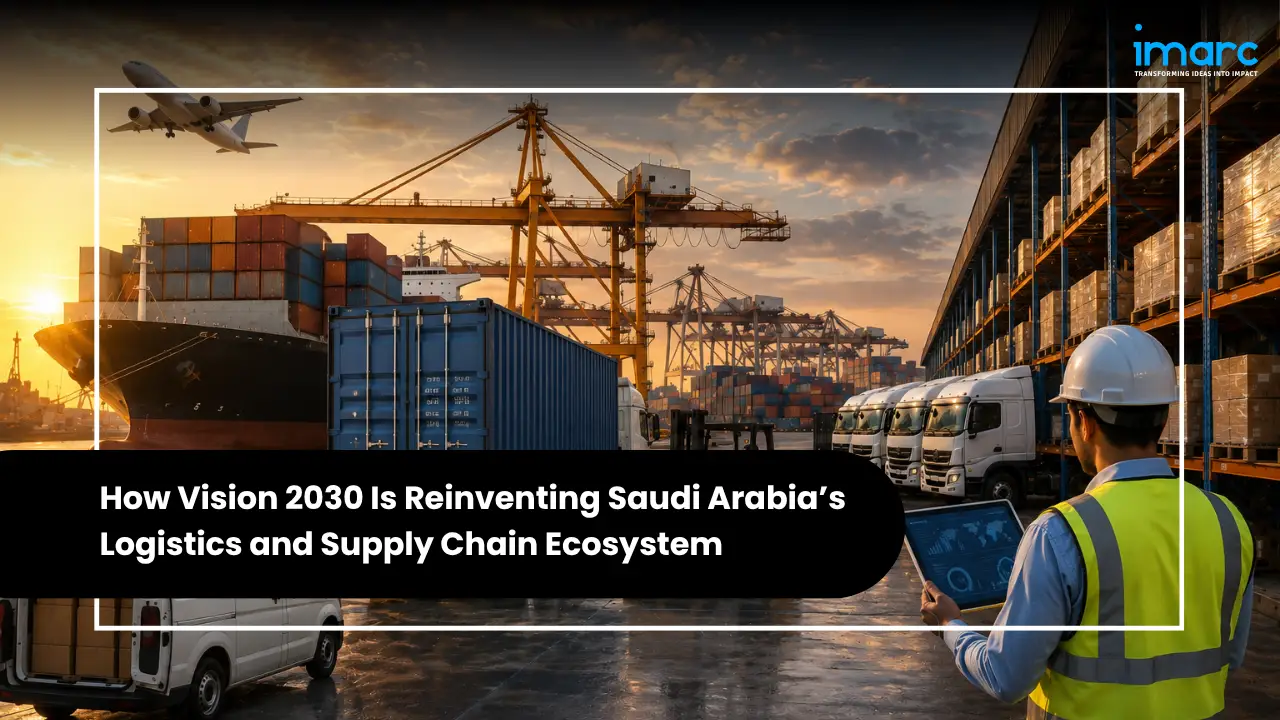
Introduction: Saudi Arabia's Logistics Market Enters a Defining Decade
The Saudi Arabia Logistics Market reached USD 55.29 Billion in 2025 and is projected to reach USD 83.41 Billion by 2034, expanding at a CAGR of 4.67% (2026–2034). Vision 2030 infrastructure investments, e-commerce expansion, and the Kingdom's strategic positioning as a trade corridor connecting Asia, Europe, and Africa are the primary forces driving this growth.
The logistics industry in saudi arabia is drawing rising interest from both global logistics players and local operators. International integrators such as DHL, Kuehne+Nagel, and Agility continue to expand their Saudi footprints, while domestic champions like Bahri and AJEX Logistics scale national shipping and e-commerce fulfillment capacity. This dual momentum, global network reach paired with local operational density, is a defining feature of the current cycle.
A localized and integrated supply chain network has become just as important as raw capital deployment. Special Integrated Logistics Zones, multimodal corridor investment, and rising Saudization requirements are reshaping how goods move through the Kingdom, reducing dependence on fragmented, single-mode freight flows.
Key Takeaways
- The Saudi Arabia Logistics Market was valued at USD 55.29 Billion in 2025 and is forecast to reach USD 83.41 Billion by 2034, at a CAGR of 4.67% (2026–2034).
- 3PL leads the model type mix at 46.12% share, Roadways leads transportation mode at 59.08% share, and Manufacturing leads end use at 18.07% share, all in 2025.
- The Northern and Central Region leads with a 38.0% regional share in 2025, anchored by Riyadh's economic centrality and the Special Integrated Logistics Zone (SILZ).
- In November 2025, DHL Supply Chain announced a EUR 130 million investment to establish a 78,000 square meter regional logistics hub at SILZ under a 26-year lease agreement.
- 3PL (~5.1% CAGR, 2026–2034) and the Southern Region (~4.5% CAGR, 2026–2034) are the fastest-growing model type and regional segments, alongside accelerating adoption of AI-driven logistics platforms.
Market Size, Share & Growth Outlook
IMARC Group's segmentation of the Saudi Arabia Logistics Market shows exactly where capital and volume are concentrated across model type, transportation mode, and end use.
- By Model Type: 3PL commands a 46.12% share in 2025, driven by enterprise outsourcing of non-core supply chain operations, ahead of 2PL (33.58%) for traditional asset-based freight and 4PL (20.30%) for premium multi-vendor orchestration.
- By Transportation Mode: Roadways dominate at 59.08% share, reflecting the Kingdom's 73,000-kilometer highway network, ahead of Seaways (16.42%) through Jeddah, Dammam, and King Abdullah Ports, Railways (13.75%), and Airways (10.75%).
- By End Use: Manufacturing leads with an 18.07% share in 2025, reflecting Saudi Arabia's industrial diversification push under Vision 2030.
Recent News & Mega Announcements
The Saudi Arabia logistics pipeline in 2025–2026 reflects capital deployment and strategic partnerships at an accelerating pace:
- In 2025, DHL Supply Chain announced a EUR 130 million investment to establish a 78,000 square meter regional logistics hub at the Special Integrated Logistics Zone (SILZ) under a 26-year lease agreement.
- In 2026, Bahri and Hadeed signed a Letter of Intent to explore collaboration in maritime transport, focused on supporting Hadeed's iron ore shipping requirements.
- In 2025, AJEX Logistics Services launched Saudi Arabia's first GMP-GxP compliant logistics facility in Riyadh, a purpose-built 3,000-square-meter facility for temperature-controlled pharmaceutical storage and distribution.
- In 2024, Alstom signed a SAR 300 million agreement with Saudi Railway Company to enhance the east-west freight corridor, reinforcing continued multimodal connectivity investment.
Collectively, these developments signal that Saudi Arabia's logistics buildout is shifting from broad infrastructure planning toward specialized, sector-specific capacity, spanning pharma-grade warehousing, industrial shipping partnerships, and dedicated regional hubs.
Industry Trends Shaping 2026
Three macro-trends are redefining the Saudi Arabia logistics sector.
1. Vision 2030 Infrastructure and Mega-Event Buildout
The government targets increasing transport and logistics sector GDP contribution from 6% to 10% by 2030, funding large-scale investment in port expansion, airport cargo capacity, and rail corridor extension. The upcoming Expo 2030 and FIFA World Cup 2034 are accelerating infrastructure buildout across ports, airports, and rail corridors, exemplified by Alstom's SAR 300 million east-west freight corridor agreement with Saudi Railway Company.
2. Digital Transformation and AI-Driven Logistics Platforms
The market is witnessing accelerated adoption of artificial intelligence, IoT sensors, and blockchain-based tracking, with providers deploying AI-driven route optimization, predictive analytics, and real-time inventory visibility to improve delivery accuracy and reduce operational costs. IoT-enabled containers and blockchain platforms are increasingly used for tamper-proof customs documentation and multi-party supply chain coordination across cross-border corridors.
3. Free Trade Zones and Green Logistics Expansion
The proliferation of specialized logistics zones is reshaping the market landscape, with SILZ attracting global operators through a 50-year tax holiday and 4-hour customs clearance. In parallel, operators are aligning with the Kingdom's 2060 net-zero targets by integrating electric delivery vehicles, solar-powered warehouses, and carbon-neutral fleets, supported by Saudi Green Initiative funding.
.webp)
Geographic Hotspots
The Northern and Central Region dominates with a 38.0% share in 2025, anchored by Riyadh's role as the Kingdom's economic and administrative capital, hosting major corporate headquarters, the SILZ, and a population of nearly 7.95 million driving e-commerce fulfillment demand.
The Western Region follows at 27.4% share, benefiting from Jeddah Islamic Port, the Kingdom's largest seaport handling over 65% of imports, alongside King Abdullah Economic City's manufacturing clusters and religious tourism logistics serving Makkah and Madinah. The Eastern Region holds 20.6% share, serving the oil and gas corridor through Dammam port and petrochemical complexes, while the Southern Region, at 14.0% share, is emerging through Jazan Economic City and industrial diversification programs, and is projected as the fastest-growing region at approximately 4.5% CAGR (2026–2034).
Competitive Landscape & Key Players' Strategies
The competitive landscape is moderately fragmented, with no single operator holding more than 8-10% of total revenue. International integrators are increasingly establishing partnerships and minority-stake acquisitions with local operators, as illustrated by DHL eCommerce's stake in AJEX Logistics, while Saudi companies scale their own freight, warehousing, and 3PL capabilities. The top companies are:
- Agility: Kuwaiti regional leader offering contract logistics, fairs and events, and project logistics with a strong GCC network and warehousing scale.
- AJEX Logistics: Fast-growing Saudi parcel delivery and e-commerce logistics specialist; launched the Kingdom's first GMP-GxP compliant pharma logistics facility in October 2025, backed by its DHL eCommerce partnership.
- Bahri: The Kingdom's national shipping champion operating one of the world's largest VLCC fleets, supporting Saudi Aramco's energy export flows and diversifying into liner services.
- DHL Group: Global contract logistics leader anchored by its SILZ regional hub; announced a EUR 130 million, 78,000 square meter hub investment in November 2025.
- GWC: Qatari player pursuing regional expansion with multimodal logistics, warehousing, and freight forwarding services.
- Kuehne+Nagel: Global forwarder serving Vision 2030 industrial clients across sea, air, and road logistics.
- Saudi Post | SPL: National postal operator enabling parcel delivery and e-commerce last-mile infrastructure at nationwide scale.
- SAL: Air cargo and ground handling specialist affiliated with the Saudia Group.
Consolidation is accelerating through strategic partnerships and minority acquisitions, with private equity and sovereign wealth fund interest, including PIF-led investments, reshaping competitive dynamics and driving scale-building across 3PL, warehousing, and last-mile segments.
Policy & Regulatory Landscape, Challenges & Risks
Government policy continues to actively shape logistics investment and operating costs across the Kingdom:
- Vision 2030 and the National Transport and Logistics Strategy (NTLS): Targets raising the transport and logistics sector's GDP contribution from 6% to 10% by 2030, anchoring large-scale port, airport, and rail investment.
- Special Integrated Logistics Zone (SILZ) Incentives: Offers a 50-year tax holiday and 4-hour customs clearance, attracting multinational operators seeking streamlined import-export operations.
- Saudization and Regulatory Compliance: Localization mandates requiring domestic employment quotas, alongside evolving customs protocols and cross-border documentation requirements, add complexity and cost, particularly for smaller operators.
On the constraining side, several structural challenges persist.
- Skilled workforce shortage and talent gap in warehouse management, logistics technology, and digital platform operations increases recruitment and training costs, compounded by Saudization compliance requirements.
- Warehousing capacity constraints in major urban centers pressure storage availability, leading to rising rental costs and limited expansion options for importers and e-commerce players.
- High technology integration costs for automation, blockchain tracking, and advanced material handling slow adoption among SMEs, widening the efficiency gap versus large, well-capitalized operators.
- Last-mile urban density and delivery cost pressure strains delivery infrastructure across Riyadh, Jeddah, and Dammam as congestion and addressing inconsistencies increase per-parcel costs.
.webp)
Forecast 2026–2034
The IMARC Group Saudi Arabia Logistics Market Report projects the market to grow from USD 55.29 Billion (2025) to USD 83.41 Billion (2034), at a CAGR of 4.67% (2026–2034), adding USD 28.1 billion in incremental market value over the forecast period.
Three forces will most significantly shape this trajectory: mega-event infrastructure for Expo 2030 and FIFA World Cup 2034 accelerating multimodal buildout, e-commerce penetration driving last-mile densification, and AI and automation adoption reshaping warehouse economics in favor of technology-enabled 3PL leaders. 3PL and the Southern Region are expected to remain the fastest-growing model type and regional segments through the forecast period.
Opportunities for Stakeholders
- Smart Logistics and Automation Investors: Warehouse management systems, AI-powered route optimization, and IoT-based cargo tracking are moving from pilot to mainstream, rewarding technology vendors and 3PL operators that invest early.
- Green Logistics and Sustainability Providers: Electric delivery fleets, solar-powered warehouses, and carbon-neutral operations aligned with the Kingdom's 2060 net-zero targets and Saudi Green Initiative funding represent a genuine emerging opportunity.
- Free Trade Zone and SILZ Tenants: The 50-year tax holiday and rapid customs clearance offered by SILZ and similar zones provide a clear, de-risked entry point for multinational operators seeking regional distribution platforms.
- Workforce Development and Training Providers: The skilled workforce shortage in logistics technology and warehouse management creates a durable opportunity for training and talent-development providers supporting Saudization compliance.
- Southern and Eastern Region Operators: The Southern Region's fastest-growing status and the Eastern Region's petrochemical-driven industrial freight demand offer expansion opportunities beyond the concentrated Northern and Central core.
Saudi Arabia's Logistics Market: Where Vision 2030 Meets Supply Chain Reality
The Saudi Arabia Logistics Market has moved decisively from ambitious infrastructure blueprint to sustained, multi-decade execution. Set to cross USD 83.41 Billion by 2034, the market's growth reflects Vision 2030 infrastructure momentum, a rapidly localizing 3PL and e-commerce ecosystem, and mega-event-driven multimodal investment, all converging in the same decade.
For enterprises and logistics operators, the imperative is to build Saudization-compliant workforce structures and technology capability ahead of tightening talent and automation requirements. For investors, PIF-backed infrastructure investment and a still-fragmented competitive base offer a durable long-term platform-building thesis. For policymakers, sustaining the balance between rapid mega-event-driven infrastructure delivery and closing the skilled-workforce and warehousing-capacity gaps will determine how completely Saudi Arabia's logistics reality catches up with its Vision 2030 ambition.
Our Clients









Contact Us
Have a question or need assistance?
Please complete the form with your inquiry or reach out to us at
Phone Number
+91-120-433-0800+1-201-971-6302
+44-113-547-7077
Previous Post

Australia's logistics sector is drawing renewed investor attention because scale, geography, and policy have converged in one market cycle. How big is the Logistics Industry in Australia?
Nearly every container ship, port crane, and rail yard in the world exists to move these standardized steel boxes, making the Shipping Container Market the physical backbone of global trade. The industry reached USD 12.7 Billion in 2025 and is projected to reach USD 22.2 Billion by 2034, growing at a CAGR of 6.38% during 2026–2034, as globalization, e-commerce, and infrastructure investment sustain demand across the shipping container industry.
A two-wheeler clutch plate is an essential transmission system part in motorcycles and scooters that helps to engage and disengage the engine power to the drivetrain. The clutch plate is a part of the clutch system, which usually consists of friction plates and steel plates, and is designed to transmit torque smoothly from the engine to the gearbox.
The bus industry in Australia is an important sector of the national public transport system, conveying people in urban and regional settings. It has recently gone through a remarkable expansion due to fast urbanization and the growth of population in major cities. With such factors, the demand for public transportation with considerable sustainable and effective mass transit solutions has surged noticeably.
The Saudi Arabia road freight transport market represents one of the key building blocks of the economic infrastructure in the Kingdom, providing for cargo movement across various domestic supply chains. It also involves road freight operations, which allow for the distribution of goods-from manufactured goods, consumer goods, and industrial supplies to agricultural produce-across its large and wide geography.
The exponential rise in online shopping is fueling unprecedented parcel movement across India. Consumers are increasingly relying on e-commerce platforms for everyday essentials, including fashion, electronics, grocery, and lifestyle products. Additionally, the rise of direct-to-consumer (D2C) brands has added a new dimension to the logistics ecosystem, with a growing emphasis on speed, reliability, and personalized delivery experiences.
The GCC outbound travel and tourism market has experienced remarkable transformation, driven by economic prosperity, demographic shifts, and evolving consumer preferences. Citizens across the Gulf Cooperation Council nations, including Saudi Arabia, United Arab Emirates, Qatar, Kuwait, Bahrain, and Oman, increasingly venture beyond borders to explore international destinations.
The UAE cold chain logistics market has emerged as a critical component of the nation's broader economic diversification strategy. As the country positions itself as a leading regional hub for trade, commerce, and healthcare, the demand for sophisticated temperature-controlled supply chain solutions continues to intensify.
The Indian online food-delivery ecosystem is undergoing a rapid expansion, propelled by multiple structural shifts in technology, consumer behaviour, and delivery infrastructure. According to a recent report by Bain & Company and Swiggy, the overall food-services market in India is projected to grow from roughly INR 5.5?lakh crore in 2023 to around INR 9–10?lakh crore by 2030.
The Philippines travel and tourism industry is thriving, with travelers drawn to its islands, heritage, and vibrant city life. IMARC Group estimates the market reached USD 14.0 Billion in 2025, reflecting the country’s growing appeal as a global destination. Stronger air connectivity, better infrastructure, and widespread use of digital booking platforms are boosting both leisure and business travel.
The Mexico 3PL market has emerged as a critical pillar supporting the country's economic transformation and integration into global trade networks. As multinational corporations are increasingly viewing Mexico as a strategic manufacturing and distribution hub, the industry is evolving from a supporting service sector into a fundamental driver of competitive advantage.
An e-rickshaw is an electric-powered three-wheeled vehicle designed to transport passengers and goods over a short distance. It is an efficient, low-cost, eco-friendly substitute for conventional fuel-based auto-rickshaws and cycle rickshaws. The general specification of an e-rickshaw involves an electrical motor ranging from 650W to 1500W powered by a rechargeable lead-acid or lithium-ion battery, a lightweight chassis manufactured from mild steel or reinforced metal, and a simple drivetrain system.
Speed, reliability, and supply chain precision have become cornerstones of global commerce. As businesses operate across borders and customers expect shorter delivery times, the need to move products efficiently across continents has become essential. Air freight isn’t just connecting time zones—it’s enabling fast, predictable service that modern logistics depend on.
A truck radiator is an essential part of the truck's cooling system, which is used to control engine temperature by dispersing the excess heat produced during running. The radiator functions by circulating a coolant liquid around the engine, absorbing heat, and then releasing the heat to the air through the radiator's finned surface.
Australia's third-party logistics (3PL) industry is witnessing a revolution, driven by the integration of artificial intelligence (AI), digital infrastructure, and e-commerce growth. Initially based on manual procedures and operations, contemporary logistics chains are now being transformed by real-time data streams, predictive analytics, and smart automation.
Dropshipping is a streamlined e-commerce fulfillment model where sellers promote products without the need to maintain inventory. Instead of managing stock, sellers pass customer orders to third-party suppliers, often manufacturers or wholesalers, who handle packaging and shipping directly to the customer.
The logistics industry, encompassing transportation, warehousing, and distribution, is undergoing significant transformation in 2025. This growth is driven by technological advancements, evolving consumer expectations, and the need for more resilient supply chains.
The logistics sector is a vital component of the supply chain, encompassing the management and transportation of goods and services from their origin to their destination. It involves a broad spectrum of activities such as transportation, warehousing, inventory management, packaging, and goods handling, alongside information flow and supply chain management. The sector ensures the efficient movement of goods through various supply chain stages to meet consumer demand, playing a crucial role in facilitating trade and commerce, supporting economic growth, and serving diverse industries, including manufacturing, consumer goods, retail, food and beverages, IT hardware, healthcare, and chemicals.