How to Enter Australia’s Logistics Industry: Market-Entry Strategy and ROI Benchmarks
Introduction
Australia's logistics sector is drawing renewed investor attention because scale, geography, and policy have converged in one market cycle. How big is the Logistics Industry in Australia? The Australia Logistics Market reached USD 163.6 Billion in 2025 and is projected to reach USD 223.4 Billion by 2034, growing at a CAGR of 3.35% (2026–2034), a scale that reflects the country's dependence on efficient freight movement across vast distances between widely dispersed population centers.
Why Australia, why now? The structural demand drivers behind current growth, surging e-commerce penetration, expanding cold chain and healthcare logistics needs, and resource-sector freight volumes, remain firmly intact. What has changed is where Australia sits in the industry's consolidation cycle: global carriers and diversified domestic groups have already established scaled networks, while digital freight platforms and automation specialists are still fragmenting the technology layer. That combination, proven demand plus an unsettled technology and mid-market layer, is precisely the kind of window that tends to attract new entrants before consolidation locks in pricing power.
Key Takeaways of Australia Logistics Market:
- The Australia Logistics Market was valued at USD 163.6 Billion in 2025 and is forecast to reach USD 223.4 Billion by 2034, at a CAGR of 3.35% (2026–2034).
- The market is segmented by model type (2PL, 3PL, 4PL), transportation mode (roadways, seaways, railways, airways), and end use, with roadways and third-party logistics providers forming the operational backbone.
- The Australian Government is advancing a 10-year infrastructure investment program worth more than USD 120 billion to support a continuous pipeline of sustainable land transport projects. Through collaboration with state and territory governments, the program aims to deliver reliable and long-term infrastructure solutions that enhance economic productivity, improve resilience, promote sustainability, and strengthen community liveability.
- In June 2025, Couriers & Freight has opened a new third-party logistics (3PL) warehouse in Kemps Creek, Western Sydney, to address growing supply chain demands across New South Wales. The new facility is designed to support e-commerce businesses, retailers, and FMCG companies by improving storage capacity, reducing warehouse bottlenecks, and enabling faster delivery operations.
- E-commerce penetration, cold chain expansion, and AI-driven visibility and automation are converging as the market's next major growth vectors.
Market Size, Share & Growth Outlook
IMARC Group segments the logistics market in Australia by model type, transportation mode, and end use, revealing where the operational backbone of the industry actually sits.
- By Model Type: The market spans 2PL (asset-based carriers), 3PL (outsourced logistics providers), and 4PL (lead logistics integrators), with third-party logistics continuing to gain share as businesses outsource warehousing, distribution, and freight forwarding.
- By Transportation Mode: Roadways remain the dominant mode given Australia's dispersed population centers, ahead of seaways (critical for international trade), railways (increasingly favored for long-haul and bulk freight), and airways (fastest for time-sensitive and healthcare shipments).
- By End Use: Manufacturing, consumer goods, and retail lead demand, with healthcare and chemicals, which depend heavily on temperature-controlled cold chain logistics, representing the fastest-growing end-use categories.
Recent News & Mega Announcements for Logistics Industry in Australia:
Recent investment activity signals accelerating capacity and technology upgrades across the sector:
- In March 2025, Chemist Warehouse partnered with Augmodo to modernize store operations by deploying spatial AI assistants that help store associates improve efficiency and productivity. The collaboration marks Augmodo’s Australian launch, supported by several major suppliers and the appointment of Simon Morriss as Commercial Director for APAC to drive regional growth.
- In October 2025, approximately AUD 3.8 billion was invested in Australian port infrastructure upgrades in recent years, even as rising operational costs continued to pressure performance and competitiveness.
- In March 2026, Australia’s National Cabinet approved a staged National Fuel Security Plan to manage potential fuel supply disruptions and protect critical supply chains amid global geopolitical risks and shipping uncertainties. The framework outlines measures to enhance fuel resilience across businesses and fuel-dependent industries, with renewable fuels such as Hydrotreated Vegetable Oil (HVO) gaining attention as a potential solution to diversify supply and reduce reliance on fossil diesel.
Collectively, these developments show capital flowing into both physical capacity (warehousing, ports) and the digital layer (AI-enabled visibility), consistent with a market still actively being built out rather than one that has already consolidated.
Industry Trends Shaping the Logistics Industry in Australia:
Three macro-trends are shaping the Australia Logistics market dynamics through the forecast period.
1. E-Commerce Growth Reshaping Warehousing and Delivery Networks
Australians spent USD 82.6 billion online in 2025, up 13.9% year on year, with 9.8 million households (82%) shopping online. This sustained online retail growth is directly reshaping how logistics providers store, handle, and deliver goods, driving continued investment in fulfillment infrastructure and last-mile capability.
2. AI-Driven Visibility and Warehouse Automation Becoming Baseline
Digital integration is shifting from a competitive advantage to a baseline requirement, with Australia's transportation and logistics automation market alone expected to reach USD 1.8 billion by 2030 as autonomous mobile robots and advanced sorting systems scale across Australia warehouse. 2026 is shaping up as a decisive year for AI adoption, as operators move from experimentation to integrating AI into day-to-day freight and data operations.
3. Sustainability and Electrification of Delivery Fleets
Rising focus on sustainability is driving adoption of electric delivery vehicles, route optimization to reduce emissions, and sustainable packaging, exemplified by DHL Freight's Go Green Plus service to minimize road transport CO2 emissions. Autonomous and electric delivery fleet development represents a parallel long-term opportunity as urban congestion and emissions regulation tighten.
Geographic Hotspots of Australia Logistics Industry:
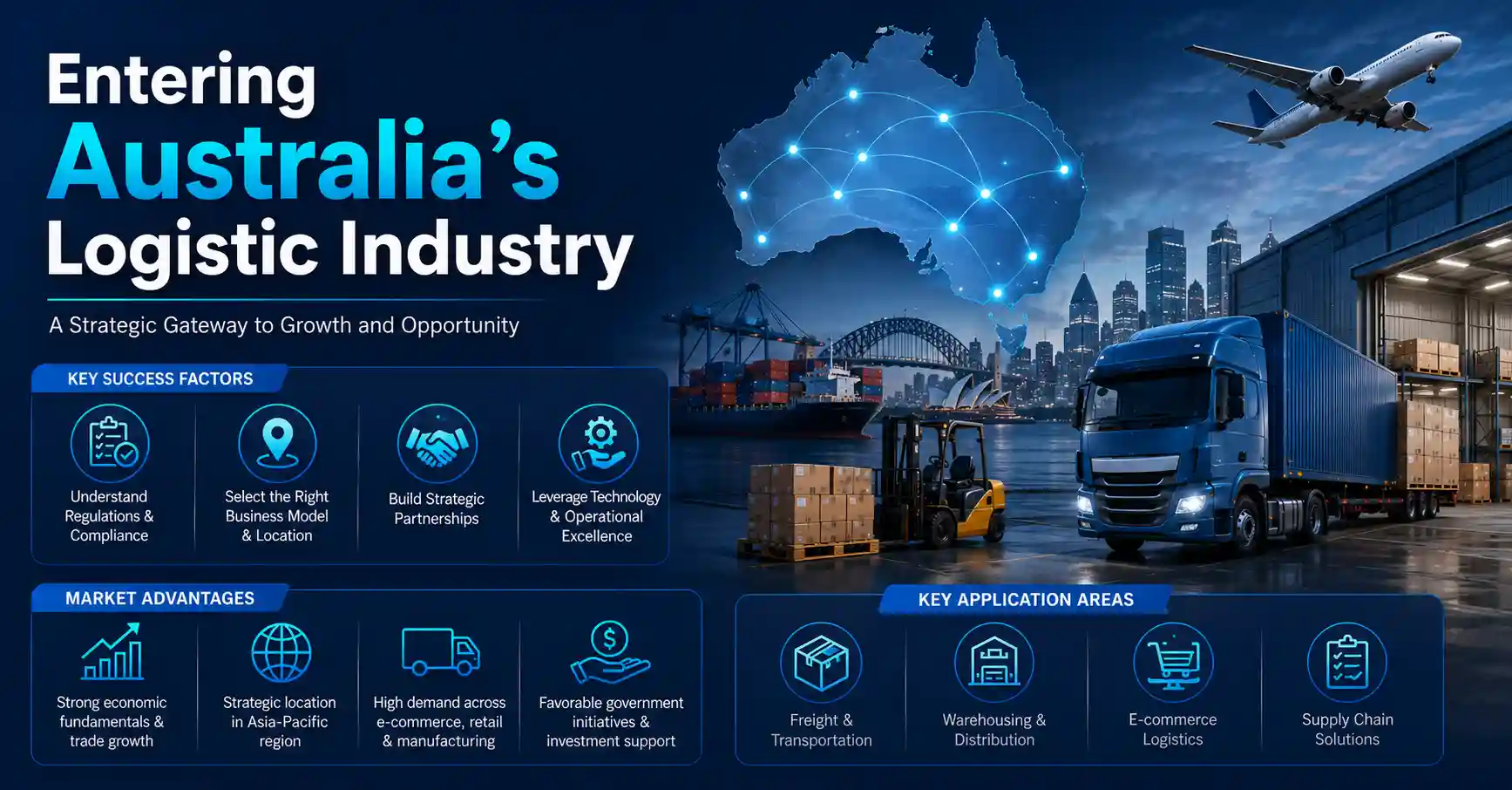
IMARC Group segments the Australian Transportation and Logistics market into five regions: Australia Capital Territory & New South Wales, Victoria & Tasmania, Queensland, Northern Territory & Southern Australia, and Western Australia.
New South Wales anchors the eastern seaboard's distribution networks, reinforced by Sydney-area capacity additions such as the Kemps Creek Australia Third-Party Logistics (3PL) warehouse. Queensland is centered on the Port of Brisbane, the largest seaport in the state and the third-fastest-growing and busiest port in the country, handling more than 28 million tonnes of cargo annually across roughly 2,600 ship visits. Western Australia's Port of Broome gained expanded First Point of Entry status in February 2024, strengthening its role in international trade access, while Victoria continues to anchor major e-commerce fulfillment investment, including Amazon's first Australian sort center in Melbourne's Craigieburn precinct.
Competitive Landscape & Key Players' Strategies
The competitive landscape spans global logistics conglomerates, domestic freight and rail operators, and specialized carriers. The key players are:
- Aurizon Ltd.: Australia's largest rail freight operator, central to bulk commodity and intermodal transport across regional corridors.
- Centurion Transport: Domestic heavy haulage and bulk transport specialist serving mining and resources-sector freight.
- DB Schenker: Global logistics and freight forwarding provider with strong air and ocean freight capabilities in Australia.
- DHL Group: Global logistics leader; its Go Green Plus service reflects broader sustainability positioning in the Australian market.
- DSV A/S: Global transport and logistics group with integrated road, air, and sea freight solutions.
- FedEx: Global express and freight operator publishing regular Australia-specific logistics trend analysis, reflecting its strategic focus on the market.
- Linfox Pty Ltd: Major Australian-owned logistics and supply chain group serving retail, FMCG, and industrial clients nationally.
- Qube Holdings Ltd.: ASX-listed integrated logistics provider spanning ports, bulk, and logistics services across Australia.
Competitive positioning increasingly centers on digital freight platforms, real-time visibility, and integrated multimodal capability rather than asset ownership alone, opening room for technology-forward challengers alongside the scaled incumbents above.
Policy & Regulatory Landscape, Challenges & Risks of Logistics Industry in Australia:
National infrastructure and freight strategy priorities, backed by government incentives and investment-facilitation programs, remain central to the sector's trajectory:
- National Land Transport Infrastructure Pipeline: A 10-year pipeline valued at USD 120 billion is funding land transport projects of national significance, spanning port upgrades, rail duplication, and intermodal terminal development.
- Inland Rail and Intermodal Hubs: One of the country's largest infrastructure undertakings, designed to connect regional producers with major ports and urban centers, shifting long-haul freight from road to rail to cut transit times, congestion, and emissions.
- National Freight and Supply Chain Strategy: A collaborative federal-state-industry framework aligning performance standards, data sharing, resilience planning, and safety regulation across the logistics ecosystem.
- Heavy Vehicle National Law (HVNL): Applies nationally, except in Western Australia and the Northern Territory, governing heavy vehicles over 4.5 tonnes gross vehicle mass.
Key challenges and risks to evaluate before entering the market include the following.
- Limited digitization among small and regional operators creates a fragmented technology landscape, with cost barriers and limited technical capacity slowing real-time tracking and predictive analytics adoption outside major carriers.
- Urban congestion and last-mile delivery constraints in major cities raise costs and complicate route planning as same-day and next-day delivery expectations escalate.
- Vulnerability to natural disasters and supply chain disruption from bushfires and floods, combined with geographic isolation and reliance on sea freight, amplifies exposure to global supply chain shocks.
.webp)
Forecast 2026–2034
The IMARC Group Australia Logistics Market Report projects the market to grow from USD 163.6 Billion (2025) to USD 223.4 Billion (2034), at a CAGR of 3.35% (2026–2034), adding USD 59.8 Billion in incremental market value over the forecast period.
Cold chain and healthcare logistics, e-commerce fulfillment, and resource-sector freight are expected to outpace the broader market's growth rate, while digital freight platforms and AI-enabled visibility tools shift from differentiator to baseline operating requirement. Continued government investment in ports, rail, and intermodal connectivity is expected to steadily improve network reliability, supporting margin expansion for operators able to invest in automation and multimodal integration ahead of full-scale market consolidation.
Australia’s Logistics Industry Opportunities for Stakeholders
- Investors and Private Equity: A market still consolidating at the technology and mid-market layer, atop a stable USD 163.6 billion base, offers a platform-building entry window ahead of full-scale consolidation.
- 3PL and 4PL Operators: Rising outsourcing demand from businesses seeking warehousing and distribution flexibility rewards providers who can scale capacity quickly, as demonstrated by Couriers & Freight's Kemps Creek expansion.
- Cold Chain and Healthcare Logistics Specialists: Temperature-controlled transport and storage for pharmaceuticals, fresh produce, and frozen food represent a premium, faster-growing sub-segment relative to the broader market.
- Digital Freight and Automation Technology Vendors: AI-driven visibility, warehouse robotics, and digital freight-matching platforms are moving from pilot to baseline adoption, rewarding early, scaled technology providers.
- Regional and Resource-Sector Logistics Providers: Mining, agriculture, and energy-sector freight demand in regional areas offers expansion opportunities beyond the concentrated eastern-seaboard core.
Australia's Logistics Market: Entering Before the Window Narrows
The Australia Logistics Market offers a rare combination for prospective entrants: a large, stable demand base, direct government co-investment in the infrastructure that underpins the sector, and a competitive field that is scaled at the top but still fragmenting at the technology and mid-market layer. Set against a forecast of USD 223.4 Billion by 2034, the market rewards entrants who move now, while digital capability and multimodal integration are still being actively built out rather than defended.
For investors and operators, the imperative is to match capital deployment to where structural demand, cold chain, e-commerce fulfillment, resource-sector freight, is compounding fastest, rather than competing head-on for share in mature road-freight corridors. For technology vendors, the shift of AI-driven visibility and automation from differentiator to baseline requirement creates a limited but real window to embed platforms before larger operators build in-house. For policymakers, sustaining the USD 120 billion infrastructure pipeline and Inland Rail's momentum will determine how much of this market-entry opportunity remains open for the next wave of capital.
Our Clients










Contact Us
Have a question or need assistance?
Please complete the form with your inquiry or reach out to us at
Phone Number
+91-120-433-0800+1-201-971-6302
+44-113-547-7077
Previous Post

Nearly every container ship, port crane, and rail yard in the world exists to move these standardized steel boxes, making the Shipping Container Market the physical backbone of global trade. The industry reached USD 12.7 Billion in 2025 and is projected to reach USD 22.2 Billion by 2034, growing at a CAGR of 6.38% during 2026–2034, as globalization, e-commerce, and infrastructure investment sustain demand across the shipping container industry.
A two-wheeler clutch plate is an essential transmission system part in motorcycles and scooters that helps to engage and disengage the engine power to the drivetrain. The clutch plate is a part of the clutch system, which usually consists of friction plates and steel plates, and is designed to transmit torque smoothly from the engine to the gearbox.
The bus industry in Australia is an important sector of the national public transport system, conveying people in urban and regional settings. It has recently gone through a remarkable expansion due to fast urbanization and the growth of population in major cities. With such factors, the demand for public transportation with considerable sustainable and effective mass transit solutions has surged noticeably.
The Saudi Arabia road freight transport market represents one of the key building blocks of the economic infrastructure in the Kingdom, providing for cargo movement across various domestic supply chains. It also involves road freight operations, which allow for the distribution of goods-from manufactured goods, consumer goods, and industrial supplies to agricultural produce-across its large and wide geography.
The exponential rise in online shopping is fueling unprecedented parcel movement across India. Consumers are increasingly relying on e-commerce platforms for everyday essentials, including fashion, electronics, grocery, and lifestyle products. Additionally, the rise of direct-to-consumer (D2C) brands has added a new dimension to the logistics ecosystem, with a growing emphasis on speed, reliability, and personalized delivery experiences.
The GCC outbound travel and tourism market has experienced remarkable transformation, driven by economic prosperity, demographic shifts, and evolving consumer preferences. Citizens across the Gulf Cooperation Council nations, including Saudi Arabia, United Arab Emirates, Qatar, Kuwait, Bahrain, and Oman, increasingly venture beyond borders to explore international destinations.
The UAE cold chain logistics market has emerged as a critical component of the nation's broader economic diversification strategy. As the country positions itself as a leading regional hub for trade, commerce, and healthcare, the demand for sophisticated temperature-controlled supply chain solutions continues to intensify.
The Indian online food-delivery ecosystem is undergoing a rapid expansion, propelled by multiple structural shifts in technology, consumer behaviour, and delivery infrastructure. According to a recent report by Bain & Company and Swiggy, the overall food-services market in India is projected to grow from roughly INR 5.5?lakh crore in 2023 to around INR 9–10?lakh crore by 2030.
The Philippines travel and tourism industry is thriving, with travelers drawn to its islands, heritage, and vibrant city life. IMARC Group estimates the market reached USD 14.0 Billion in 2025, reflecting the country’s growing appeal as a global destination. Stronger air connectivity, better infrastructure, and widespread use of digital booking platforms are boosting both leisure and business travel.
The Mexico 3PL market has emerged as a critical pillar supporting the country's economic transformation and integration into global trade networks. As multinational corporations are increasingly viewing Mexico as a strategic manufacturing and distribution hub, the industry is evolving from a supporting service sector into a fundamental driver of competitive advantage.
An e-rickshaw is an electric-powered three-wheeled vehicle designed to transport passengers and goods over a short distance. It is an efficient, low-cost, eco-friendly substitute for conventional fuel-based auto-rickshaws and cycle rickshaws. The general specification of an e-rickshaw involves an electrical motor ranging from 650W to 1500W powered by a rechargeable lead-acid or lithium-ion battery, a lightweight chassis manufactured from mild steel or reinforced metal, and a simple drivetrain system.
Speed, reliability, and supply chain precision have become cornerstones of global commerce. As businesses operate across borders and customers expect shorter delivery times, the need to move products efficiently across continents has become essential. Air freight isn’t just connecting time zones—it’s enabling fast, predictable service that modern logistics depend on.
A truck radiator is an essential part of the truck's cooling system, which is used to control engine temperature by dispersing the excess heat produced during running. The radiator functions by circulating a coolant liquid around the engine, absorbing heat, and then releasing the heat to the air through the radiator's finned surface.
Australia's third-party logistics (3PL) industry is witnessing a revolution, driven by the integration of artificial intelligence (AI), digital infrastructure, and e-commerce growth. Initially based on manual procedures and operations, contemporary logistics chains are now being transformed by real-time data streams, predictive analytics, and smart automation.
Dropshipping is a streamlined e-commerce fulfillment model where sellers promote products without the need to maintain inventory. Instead of managing stock, sellers pass customer orders to third-party suppliers, often manufacturers or wholesalers, who handle packaging and shipping directly to the customer.
The logistics industry, encompassing transportation, warehousing, and distribution, is undergoing significant transformation in 2025. This growth is driven by technological advancements, evolving consumer expectations, and the need for more resilient supply chains.
The logistics sector is a vital component of the supply chain, encompassing the management and transportation of goods and services from their origin to their destination. It involves a broad spectrum of activities such as transportation, warehousing, inventory management, packaging, and goods handling, alongside information flow and supply chain management. The sector ensures the efficient movement of goods through various supply chain stages to meet consumer demand, playing a crucial role in facilitating trade and commerce, supporting economic growth, and serving diverse industries, including manufacturing, consumer goods, retail, food and beverages, IT hardware, healthcare, and chemicals.