Paper Cups and Paper Plates Market: Industry Insights, Consumer Preferences and Growth Potential Beyond Plastic
Introduction: Beyond Plastic, Toward Paper
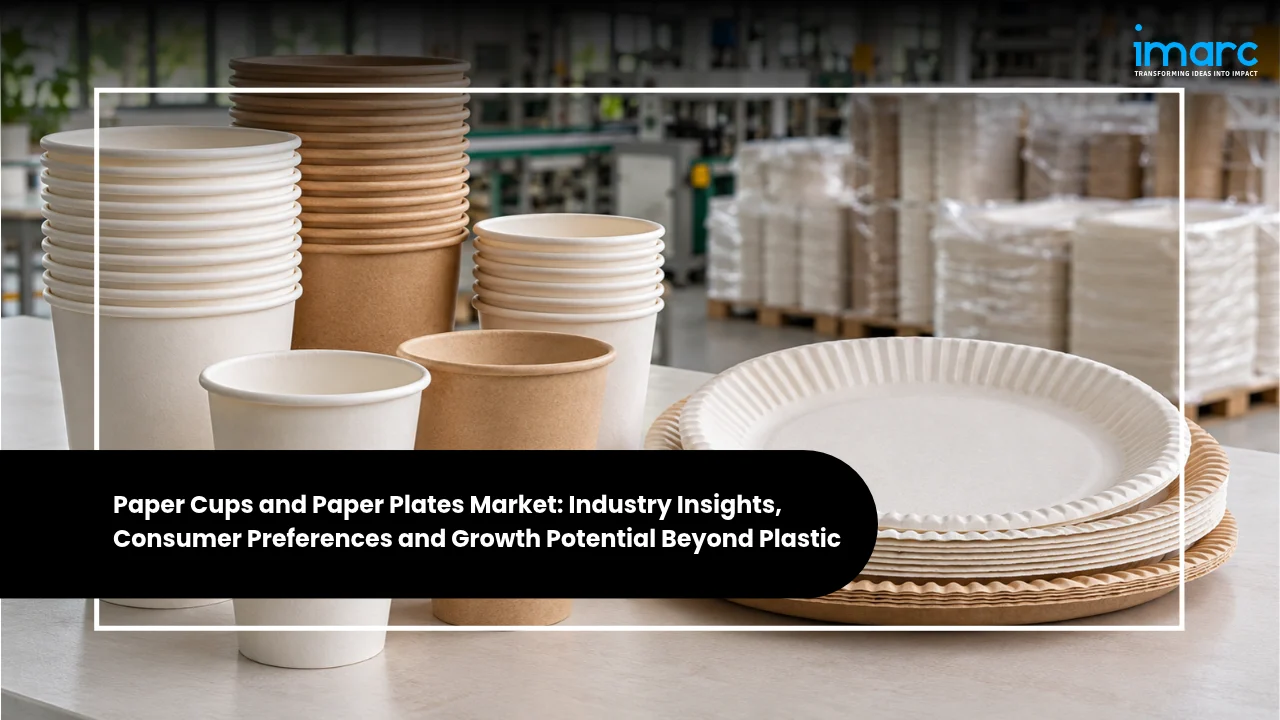
The paper cups and paper plates market has moved from the margins of foodservice supply into the center of the global packaging debate, as regulators, brands and consumers trade plastic and foam disposables for fiber-based tableware. According to IMARC Group, the market grew from USD 122.7 Billion in 2025 to USD 125.4 Billion in 2026 and is projected to reach USD 144.1 Billion by 2034, registering a CAGR of 1.75% during 2026-2034. Those numbers describe something more interesting than a boom: a very large, already mature category that keeps expanding steadily while its material composition changes underneath it.
The demand base is broad rather than concentrated. Cafes, quick service restaurants (QSRs), coffee outlets, bars and institutional caterers consume paper cups and plates in daily volumes, and the wider food and beverage (F&B) industry continues to add outlets in both developed and emerging markets. Rising disposable incomes, food innovation, the growth of food delivery applications and the simple convenience of utensils that need no washing all reinforce the shift away from reusable service in high-turnover settings. Growing awareness of the environmental damage caused by plastic and foam disposables has given that convenience argument a regulatory and reputational tailwind it did not have a decade ago.
The defining theme of the current cycle is not just substitution but re-engineering. Converters are replacing polyethylene linings with single-coat and water-based barrier systems so that cups and plates can be repulped in standard mills, and brands are using print, shape and finish to differentiate commodity products. Huhtamaki illustrated the direction of travel in February 2025 when it launched recyclable single coated paper cups for yogurt and dairy, a format designed to improve recyclability without sacrificing barrier performance.
This blog examines the paper cups and plates market size and structure, the consumer preferences reshaping demand, paper tableware market growth through 2034 and the regulatory pressures that will separate winners from laggards in disposable paper cups and paper plates.
Key Takeaways
- The global paper cups and paper plates market stood at USD 122.7 Billion in 2025, reached USD 125.4 Billion in 2026 and is forecast to touch USD 144.1 Billion by 2034, a CAGR of 1.75% over 2026-2034, which implies roughly USD 18.7 Billion of incremental value across the forecast window.
- Hot paper cups are the largest product type within the paper cups category, double wall construction leads the wall type split and heavy-duty paper plates dominate the plates category, a hierarchy that reflects the market's dependence on take-away hot beverages, food delivery and outdoor catering.
- Asia Pacific is the largest regional market, ahead of North America, Europe, the Middle East and Africa and Latin America, supported by rising disposable incomes, a fast-expanding F&B sector and institutional demand from hospitals, schools and railway stations.
- The key trend is the migration to fiber-based and single-coat barrier systems that make paper cups and plates genuinely recyclable, a shift accelerated by Europe's packaging rules and by brand commitments to remove plastic linings from high-volume cup formats.
Paper Cups and Paper Plates Market Size, Share & Growth Outlook
According to IMARC Group, the global paper cups and paper plates market grew from USD 122.7 Billion in 2025 to USD 125.4 Billion in 2026 and is expected to reach USD 144.1 Billion by 2034, expanding at a CAGR of 1.75% during 2026-2034. The scale of the category is unusual for a disposable product: only a handful of packaging segments generate more than USD 120 Billion in annual value, and the low single-digit growth rate signals a market where volume is defended through substitution rather than created through new consumption occasions. The leading segments are:
- Product Type (Paper Cups): Hot paper cups represent the largest segment, ahead of cold paper cups, because take-away coffee and tea programs, together with the fast-food industry, generate repeat daily demand; hot cups use virgin paperboard with a polyethylene or polylactic acid lining and an insulating sleeve or external coating.
- Wall Type (Paper Cups): Double wall cups account for the largest share, driven by coffee vendors who need an insulating air barrier that keeps drinks warm while protecting the consumer's hand, a format well suited to mobile and take-away consumption.
- Product Type (Paper Plates): Heavy-duty paper plates are the largest segment, ahead of medium-duty plates, because they are microwavable, soak-proof coated, cut resistant and hold their shape, making them suitable for catering, camping, picnics and large social gatherings.
- Region: Asia Pacific is the largest regional market, followed by North America, Europe, the Middle East and Africa and Latin America, with Asia Pacific's lead resting on household income growth, changing lifestyles and a rapidly formalizing F&B sector.
The report notes that the market structure is fragmented, with several small and large players operating simultaneously because capital investment and exit barriers are low, product differentiation is limited and the volume of new entrants remains high. That fragmentation matters for paper tableware market growth: it keeps prices competitive and margins thin, and it means consolidation, rather than organic expansion alone, is likely to shape the competitive map.
Recent News & Mega Announcements
The 2024 to 2026 period has been defined by consolidation among converters, regulation-driven product redesign and steady recyclability announcements. Each development below shifts either the cost base or the compliance threshold for paper cups and paper plates manufacturers:
- Huhtamaki, February 2025: The Finland-based converter launched recyclable single coated paper cups for yogurt and dairy, a format that reduces coating complexity and supports fiber recovery in standard recycling streams, extending paper cup technology from beverages into dairy packaging.
- European Union, February 2025: Regulation (EU) 2025/40 on packaging and packaging waste entered into force on 11 February 2025 and applies from 12 August 2026, introducing recyclability, harmonized labelling, minimum recycled content and empty space limits that directly affect how paper cups and plates are designed and sold in the single market.
- European Union, single-use plastics rules: Directive (EU) 2019/904 imposes consumption reduction, marking and separate collection obligations on single-use plastic cups, and its scope reaches paper cups that carry a plastic lining, pushing converters toward mono-material and fiber-based designs.
- India, July 2022 and ongoing enforcement: The ban on identified single-use plastic items, including plastic plates, cups, cutlery and straws, took effect under the Plastic Waste Management (Amendment) Rules 2021, creating structural substitution demand for paper cups and plates across one of the world's largest consumer markets.
Industry Trends Shaping 2026
Three shifts are redefining how paper cups and plates are made, sold and positioned. They matter because they determine which converters can hold price in a market where product differentiation has historically been weak.
1. Fiber-Based Barrier Coatings Replace Polyethylene Linings
The polyethylene lining that made paper cups leak-proof also made them difficult to recycle, because the plastic film has to be separated from the fiber before repulping. Dispersion coatings, water-based barriers and single-coat systems now allow mills to recover the paper fraction without dedicated separation lines, and converters are reformulating high-volume hot cup and food container ranges accordingly. Regulatory timing is reinforcing the technical push: Europe's packaging regulation requires all packaging to be recyclable by design within a defined timeline, and the single-use plastics directive already captures plastic-lined cups in its marking and collection scope. Disposable paper cups market trends therefore point toward fewer material layers, not more, with the barrier function delivered by a coating thin enough to disperse during repulping. The commercial consequence is a higher technical bar for entry: small converters that buy standard coated board can compete on price, but they cannot easily offer certified recyclability, which is increasingly a procurement requirement for global coffee and QSR chains.
2. Premiumisation and Design-Led Paper Tableware
Because functionality is easy to replicate, differentiation in paper cups and plates has migrated to appearance and specification. Double wall cups with matte finishes, custom-printed sleeves, embossed plates and shaped bowls now carry brand identity for cafes, bakeries and event caterers, and they command a price premium over plain stock items. The same logic drives format innovation: heavy-duty plates that resist cutting and hold shape have displaced thinner alternatives in catering and outdoor use, while designed plates made from varied paper grades target gifting and celebration occasions. This matters for the paper plates industry analysis because it shows value growth coming from mix upgrade rather than volume alone. It also explains why the market remains fragmented despite consolidation at the top: a small converter with strong print capability and short run flexibility can serve regional chains that large manufacturers consider sub-scale, and low capital requirements keep that niche accessible. Premiumisation is, in effect, the main defense against commoditization.
3. Food Delivery, QSR Expansion and Online Distribution
The demand engine has shifted from dine-in to off-premise consumption. Coffee outlets, QSR chains, cloud kitchens and delivery aggregators all need packaging that travels well, resists moisture and does not leak, which favors double wall cups and coated, rigid plates. Hectic urban lifestyles and the preference for disposable containers over washing up have made single-use tableware a household purchase as well as a foodservice one, and that has changed distribution. Paper cups and plates are now bought in bulk through e-commerce and quick-commerce platforms as well as through traditional wholesale and cash-and-carry channels, widening reach to small caterers, offices and event organizers who were previously poorly served. Wider availability lowers the effective barrier to trial and expands the addressable base beyond large institutional buyers. The channel shift also compresses the advantage that incumbents once held through distributor relationships, since online listings let regional producers compete for the same shelf space as global brands.

Geographic Hotspots
Asia Pacific is the largest and most consequential regional market for paper cups and plates. Growth there is being carried by rising household disposable incomes, changing food consumption patterns and a food and beverage sector that is formalizing quickly as organized chains replace unbranded outlets in urban centers. Institutional demand adds a second layer: hospitals, schools and railway stations are shifting to paper cups and plates on health and hygiene grounds, which creates steady, contracted volumes that are less sensitive to consumer sentiment than retail or restaurant demand. The region's manufacturing base is also the source of much of the world's paper cup conversion capacity, which keeps regional prices competitive and supports export volumes into North America and Europe.
North America remains a high-consumption market built around take-away coffee culture, dense QSR networks and large-scale catering. Its regulatory pattern is decentralized, with state and municipal restrictions on expanded polystyrene foodservice ware creating localized substitution demand while federal rules remain limited. Europe is the most regulated of the major markets and therefore the most design-driven: the single-use plastics directive and the packaging and packaging waste regulation together determine material choice, labelling and collection obligations, so European buyers tend to specify recyclability and fiber sourcing credentials earlier than buyers elsewhere.
The Middle East and Africa and Latin America are smaller but faster-moving in structural terms. In both regions, event catering, religious and cultural gatherings, and a growing QSR footprint create concentrated demand for paper plates and cups, while informal retail and wholesale channels distribute much of the volume. In Latin America, food delivery adoption in dense urban markets has expanded the base for double wall cups, and in the Gulf, hospitality and aviation catering standards favor higher-specification formats. Across all five regions the common thread is that substitution from plastic and foam, rather than population growth alone, is doing the heavy lifting on demand.
Competitive Landscape & Key Players Strategies
Competition in the paper cups and paper plates market is best described as fragmented at the base and consolidating at the top. IMARC Group characterizes the market structure as fragmented, with several small and large players operating simultaneously because capital investment and exit barriers are low, product differentiation is limited and the rate of new entrants is high. In practice this means two distinct competitive games. Large manufacturers compete on scale, supply security, certified recyclability and multi-region contracts with global coffee and QSR chains. Regional converters compete on print quality, order flexibility, lead times and price, and they survive because those chains need short runs of branded stock that are uneconomic for larger plants.
The strategic response of the largest players has been to buy scale and technical capability rather than build it. The April 2025 Novolex and Pactiv Evergreen combination, valued at approximately USD 6.7 billion, is the clearest expression of that logic in foodservice packaging, and it follows a broader pattern of consolidation across fiber-based converters. The companies with the strongest positions in paper cups and plates include:
- Dart Container Corporation: A high-volume manufacturer with deep coverage of foodservice and retail channels, competing on scale and product breadth across cups, containers and lids.
- Pactiv Evergreen Inc.: Recently combined with Novolex, giving the platform greater scale across paper, fiber and specialty foodservice formats and a stronger position in North American foodservice contracts.
- Huhtamaki: A Finland-headquartered converter that competes on material science and sustainability credentials, with paper cup innovation extending into dairy and food formats.
- Graphic Packaging International, LLC: A fiber-based packaging major whose paperboard integration supports cost control and recycled content claims in cups and foodservice items.
- Georgia-Pacific Consumer Products LP: A large paper and tissue producer whose pulp and paperboard position underpins supply reliability in disposable tableware.
- Go-Pak Group: A foodservice packaging supplier with a broad disposable range, competing on distribution reach and customer service for mid-sized chains.
- F Bender Limited: A paper cup specialist serving foodservice and vending customers, benefiting from the shift to fiber in hot beverage formats.
- Paper Cup Company: A focused cup converter competing on customization and short-run branded production.
The competitive lesson is that scale wins the volume contracts while specialization wins the niche ones, and consolidation is narrowing the middle ground between the two.
Policy & Regulatory Landscape, Challenges & Risks
Government policy has become a primary market force, determining which materials qualify, how products must be labelled and who pays for collection. Key frameworks include:
- EU Single-Use Plastics Directive (EU) 2019/904: Restricts and imposes marking and separate collection obligations on single-use plastic items, including beverage cups containing plastic, which captures plastic-lined paper cups; its effect is to push converters toward fiber-based and mono-material designs rather than a ban on paper cups themselves.
- EU Packaging and Packaging Waste Regulation (EU) 2025/40: In force since 11 February 2025 and applicable from 12 August 2026, it sets recyclability by design, harmonized labelling, recycled content thresholds and empty space limits, raising compliance costs but rewarding converters whose products are already recyclable and properly labelled.
- India's single-use plastic ban (2021 rules, effective July 2022): Prohibits manufacture, import, stocking, distribution, sale and use of identified items including plastic plates, cups, cutlery and straws, creating a direct, policy-driven substitution market for paper alternatives across a very large consumer base.
- Subnational foam and foodservice ware restrictions in North America and municipal procurement rules elsewhere: State, provincial and city-level bans on expanded polystyrene foodservice items, together with public-sector green procurement standards, create localized demand shocks and favor paper and fiber alternatives in schools, hospitals and government catering.
On the constraining side, several structural risks persist:
- Raw material and coating cost volatility: Virgin paperboard, pulp and barrier coatings are commodity inputs exposed to energy and fiber price swings; because the market is fragmented and differentiation is low, converters cannot easily pass cost increases through, and margin compression follows quickly.
- Recyclability and repulping infrastructure gaps: Even recyclable single-coat cups need collection and mills willing to process them, and where collection systems, sorting capacity or end markets are missing, the environmental case weakens and brand commitments become harder to substantiate, which slows procurement conversion.
- Substitution from reusables and alternative materials: Reuse mandates in some jurisdictions, alongside molded fiber, bagasse and compostable formats, compete directly for the same foodservice occasions, and reusable cup schemes in dense urban markets can erode single-use volume at the margin.
- Low entry barriers and price competition: Low capital requirements, weak product differentiation and low exit barriers keep new capacity coming into the market, sustaining overcapacity in commoditized segments, limiting pricing power and discouraging investment in the very technology upgrades regulators now expect.
Paper Cups and Paper Plates Market Forecast 2026-2034
IMARC Group's paper cups and plates market forecast points to USD 144.1 Billion by 2034, up from USD 125.4 Billion in 2026 and USD 122.7 Billion in 2025, with a CAGR of 1.75% across the 2026-2034 period. Read against the historical base, the projection implies roughly USD 18.7 Billion of additional annual value over eight years, which is meaningful in absolute terms even though the percentage growth rate is modest. A growth rate below 2% tells us the category has matured: penetration of disposable tableware in foodservice is already high in developed markets, and the incremental volume now comes from substitution of plastic and foam, from delivery-led off-premise consumption and from formalization of food retail in emerging economies rather than from new use cases.
The composition of growth is likely to matter more than its size. Value growth should outpace volume growth in Europe and North America, where recyclability specifications, heavier board grades and premium print raise average selling prices, while Asia Pacific should contribute more of the volume. That mix has two consequences for planning. First, converters that fail to certify recyclability will increasingly be confined to price-sensitive, unregulated segments. Second, because the overall CAGR is low, market share gains will come from winning substitution contracts and from consolidation rather than from riding a rising tide, which is consistent with the consolidation activity already visible among large manufacturers.
The forecast also implies that input cost management, not demand generation, will be the primary determinant of profitability through 2034. In a market expanding at 1.75% annually, a shift of a few percentage points in board or coating costs matters more than a similar shift in volumes.
Opportunities for Stakeholders
The gap between low headline growth and high strategic activity is where the real opportunities sit. Stakeholders can act on five fronts:
- Converters and manufacturers: Invest in dispersion and single-coat barrier lines now, because regulatory timelines in Europe and procurement standards among global coffee and QSR chains are turning recyclability from a marketing claim into a purchase condition, and converters with certified formats can win share from commodity suppliers in a slow-growth market.
- Foodservice chains and coffee retailers: Consolidate cup and plate specifications onto fewer, recyclable formats and use print and double wall construction to carry brand identity, capturing consumer preference for hygienic, presentable disposables while reducing compliance exposure across multiple jurisdictions.
- Pulp, paperboard and coating suppliers: Position around recycled and certified fiber, since recycled content thresholds and labelling rules create a traceability requirement that favors suppliers able to document material origin and barrier chemistry at the batch level.
- Distributors and e-commerce platforms: Build bulk and quick-commerce channels for small caterers, offices and event organizers, a segment that is under-served by traditional wholesale and where online listings let regional producers compete for national demand.
- Recyclers and waste management operators: Develop collection and sorting routes for single-coat cups and plates, since the commercial case for recyclable formats depends on actual recovery, and operators that can demonstrate closed-loop recovery become essential partners for brand sustainability commitments.
- Investors and acquirers: Target regional converters with strong print capability or proprietary coating technology, because a fragmented structure with low entry barriers produces a long tail of candidates whose technical capability is more valuable inside a scaled platform.
A Fiber-First Future for Disposable Dining
The paper cups and paper plates market is not a high-growth story, and it does not need to be. A market that moves from USD 122.7 Billion in 2025 to USD 144.1 Billion by 2034, at a 1.75% CAGR is large enough to absorb technological change without needing rapid expansion to justify investment, and the pressure on it is qualitative rather than volumetric. What is changing is the specification of the product: fewer material layers, dispersible barriers, certified recyclability, better print and stronger performance under heat, moisture and weight.
That shift rewards different capabilities than the last decade did. Scale alone secured volume when buyers competed mainly on price; now scale has to be paired with material science, documentation and compliance reach across jurisdictions. The consolidation already visible among major manufacturers reflects that logic, and the fragmentation at the base of the market reflects the opposite: low barriers keep small converters alive in commoditized segments, but those segments are exactly where regulatory and procurement pressure will bite first.
For stakeholders reading this as a paper plates industry analysis, the practical conclusion is straightforward. Demand is durable because the alternatives are worse on hygiene and convenience, growth is modest because the category is mature, and the returns will accrue to those who treat recyclability, cost control and channel reach as operating requirements rather than as positioning language. The transition beyond plastic is already underway; what remains to be decided is which parts of the value chain capture its value.
Our Clients







Contact Us
Have a question or need assistance?
Please complete the form with your inquiry or reach out to us at
Phone Number
+91-120-433-0800+1-201-971-6302
+44-113-547-7077
Previous Post

The Philippine LED Industry has shifted from a simple replacement-bulb story into a policy-steered market, where Department of Energy rules, mandatory labelling and public procurement now influence demand as strongly as price and product availability. According to IMARC Group, the Philippines LED market size reached USD 909.3 Million in 2025 and is forecast to reach USD 2,211.4 Million by 2034, expanding at a CAGR of 10.10% during 2026-2034.
The global packaging machinery market has moved past the capacity-building phase that followed the pandemic and into a phase where intelligence, material compatibility and line flexibility decide who wins contracts. According to IMARC Group, the packaging machinery market was valued at USD 59.6 Billion in 2025 and is estimated at USD 62.4 Billion in 2026, with a projected USD 83.8 Billion by 2034 at a CAGR of 3.75% during 2026-2034.
Setting up a PVC Blister Packaging Manufacturing Plant in India puts an investor at the heart of the country's pharmaceutical and consumer goods supply chain. Almost every strip of tablets and capsules sold in India, and a large share of the medicines it exports, is packed in a blister made from rigid PVC film sealed with aluminium foil.
A two-piece beverage can is made by punching shallow cups from thin aluminium coil, drawing and ironing them into tall, seamless bodies at very high speed, then washing, printing, lacquering inside, and necking them to take an easy-open end that is seamed on after filling.
PET preforms are test-tube-shaped mouldings of polyethylene terephthalate with a finished threaded neck, which bottlers heat and stretch-blow into bottles for drinking water, soft drinks, juices, edible oil, dairy, pharmaceuticals, personal care, and household products.
Biodegradable tableware covers plates, bowls, trays, cups, food containers, clamshells, and cutlery made from plant-based materials such as sugarcane bagasse, bamboo and wheat straw fibre, areca palm leaves, paper, wood, and certified compostable bioplastics.
Setting up a Corrugated Box Manufacturing Plant in India is a high-demand, packaging-driven venture, powered by the country's booming e-commerce, FMCG, and export sectors, and the steady shift toward recyclable paper-based packaging.
Setting up a Pallets Manufacturing Plant in India is a high-demand, logistics-driven venture, powered by the country's booming warehousing, e-commerce, and organized-retail sectors, and the steady formalization of supply chains after GST.
The GCC biodegradable food service disposables market size is undergoing a remarkable change as environmental sustainability takes center stage in regional business and regulatory agendas. Throughout the Gulf Cooperation Council nations, which include countries like Saudi Arabia, the UAE, Qatar, Kuwait, Oman, and Bahrain, significant players within the food service packaging sector are powerfully embracing novel packaging solutions that not only reduce environmental impact but also cater to modern-day consumers' needs for convenience and efficiency.
PVC blisters packaging is a type of thermoforming packaging wherein polyvinyl chloride (PVC) material is heated to mold it into packaging cavities to securely place individual items inside, which is then closed with either aluminum foil or paper-based lidding materials. PVC packaging exhibits clarity, strength, and moldability, making it possible to view the individual items while also protecting them against external damage.
A PET bottle is a type of rigid packaging packaging that is produced using a thermoplastic called polyethylene terephthalate, also known as polyester. The production of a PET bottle involves an injection stretch-blow molding technique that provides a lightweight and durable package with high clarity, strength, and impermeability.
Paper cups are a type of beverage container made mostly from paperboard. The paperboard gives the container strength. The lining of the paperboard varies and usually consists of waterborne coatings, bio-based coatings, and polymer coatings. This facilitates the paper cup to hold hot and cold fluids for an amount of time. Paper cups come in various sizes and different wall structures. This makes the paper cup functional for the desired purpose and environment.
Bagasse kraft paper is a green packaging material made from bagasse, the fibrous byproduct that is left when juice is extracted from sugarcane. Kraft paper is generally produced traditionally using wood pulp via the sulfate process, but bagasse offers a sustainable, non-wood source used in promoting green manufacturing and less reliance on forest resources. Bagasse fibers have high cellulose, moderate fiber length, and good bonding properties, making them ideal for manufacturing strong and long-lasting kraft paper. Production includes bagasse collection from sugar mills, purification to eliminate impurities, and processing into pulp either by chemical or mechanical pulping.
Bagasse biodegradable cutlery is made from the fibrous material remaining after extracting sugarcane stalk juice, a low-value agricultural residue also known as bagasse. The material is harvested from sugar mills, washed, pulped and mechanically molded into wet-molded forms; those wet parts are dried, pressed in heat-resistant molds and thermally cured to create rigid, food-grade spoons, forks and knives that are grease- and water-resistant but not covered with plastic coatings.
The global food packaging market is evolving as consumer expectations, sustainability concerns, and technological advancements redefine the way food is kept safe, secure, and delivered. Packaging is no longer merely a container; it has transformed into a critical enabler that drives purchase decisions, improves product shelf life, and communicates brand values. As demand for ready-to-eat, convenience, and packaged foods grows, packaging has emerged to convey sustainability, safety, and innovation.
Aluminum foil is a flexible, thin, and extremely versatile aluminum sheet that has gained universal application in different industries owing to its superior barrier, thermal, and mechanical characteristics. Usually made by rolling aluminum slabs or ingots into extremely thin sheets, aluminum foil is 0.006 mm to 0.2 mm thick.
Glass bottles are rigid, non-porous, and chemically inert packages commonly employed in the packing of beverages, foods, drugs, cosmetics, and specialty chemicals. Constructed mainly from silica sand, soda ash, and limestone, glass bottles are prized for their preservation of product purity, inhibition of chemical leaching, and retention of flavor character.
The corrugated box industry is powered by its versatility, strength, and sustainability, rendering it crucial for shipping, storage, and retail packaging. Crafted from kraft paper, the boxes are strong, cushioned, and protective, serving e-commerce, food & beverage, electronics, and pharmaceuticals industries. Online retailing demand, sustainability drives, and innovation in packaging are driving the growth of the market.
Aluminium cans are common packaging solutions in the food, beverage, and industrial sectors because they are strong, lightweight, and highly recyclable. They ensure product freshness by shielding contents from light, air, and pathogens thanks to their exceptional barrier qualities. Because of its limitless recyclability and little environmental impact, aluminium cans have become the favoured option as sustainability awareness has grown.