Triple Superphosphate (TSP) Plant Setup Cost in India: Manufacturing Process Flow, Machinery, DPR & Financial Model 2026
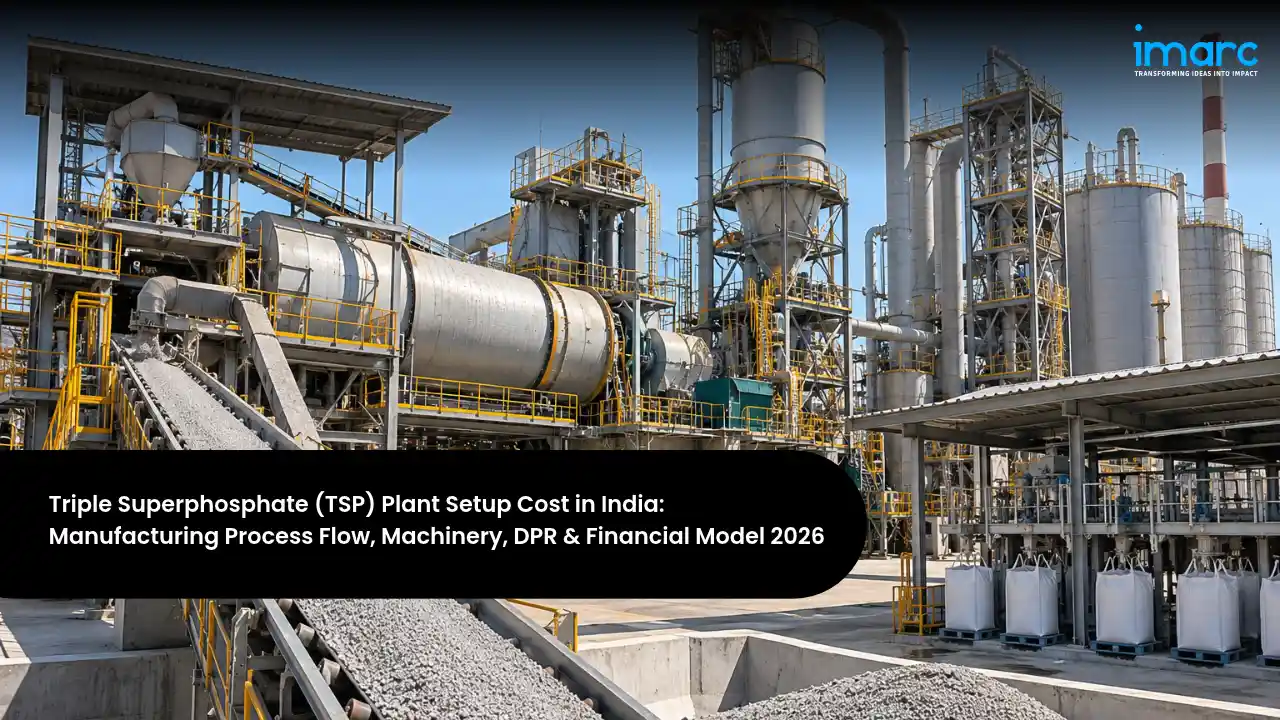
Triple superphosphate is a concentrated phosphate fertiliser containing 44 to 46% P2O5, mainly as water-soluble monocalcium phosphate. It is made by reacting finely ground phosphate rock with phosphoric acid, and because it carries phosphorus without nitrogen, it suits pulses, oilseeds, and soils that need phosphate alone, as well as bulk blending into custom NPK mixes. The global TSP market was valued at about USD 11.84 billion in 2025. India began importing TSP in 2024 to ease its dependence on DAP, signed agreements for about 1 million tonnes from Morocco in 2025, and now treats it as an important part of its phosphate supply. Together these factors make Triple Superphosphate (TSP) Manufacturing Plant Setup in India a timely opportunity for fertiliser, chemical, and agribusiness companies.
Investment depends mainly on capacity, whether the plant buys phosphoric acid or makes its own, and the extent of pollution control and storage. A granulation unit using imported phosphoric acid is the most accessible project, a mid-sized plant with rock grinding, granulation, and full gas scrubbing is a larger investment, and an integrated complex with sulphuric and phosphoric acid plants needs much more capital. The Triple Superphosphate (TSP) Manufacturing Plant Cost ranges from about INR 60–150 crore for a unit of 30,000 to 50,000 tonnes a year to INR 200–450 crore for a plant of 1 to 2 lakh tonnes a year, and INR 1,500–3,000 crore for an integrated complex of 3 lakh tonnes a year or more. Raw materials make up 60 to 70% of operating cost, so phosphate rock and phosphoric acid prices, subsidy rates, and logistics shape profitability. A well-run plant typically earns a gross margin of 20 to 30% and a net margin of 8 to 15%.
This guide is written for investors exploring how to start a Triple Superphosphate (TSP) manufacturing plant in India. It focuses on a granular TSP plant of about 1 lakh tonnes a year using phosphate rock and purchased phosphoric acid, located near a port, and also explains small granulation units and integrated complexes. It covers products and markets, the demand outlook, the production process flow, machinery and raw materials, location and infrastructure, a detailed cost and financial breakdown, fertiliser and environmental approvals, and how a DPR and financial model turn all of this into a bankable plan.
India Market Snapshot
| Key Facts | Details |
|---|---|
| Global TSP Market (2025) | About USD 11.84 Billion |
| Global Forecast (2034) | USD 18.50 Billion, 4.9% CAGR |
| India TSP Supply Deals with OCP (2025) | About 1 Million Tonnes |
| India TSP Sales (May 2026) | About 59,000 Tonnes |
| P&K Subsidy Allocation (Kharif 2026) | INR 41,533.81 Crore |
| Indicative Total Investment | INR 60 Crore to 3,000 Crore |
The snapshot shows a large global market and a new, fast-growing role for TSP in India, which imports most of its phosphate fertilisers and raw materials. Tight DAP supply from traditional sources has pushed India to diversify into TSP, and the government's subsidy support for phosphatic fertilisers keeps farm-gate prices affordable. Domestic production would reduce import dependence, but all TSP sold in India today is imported. The wide investment range reflects a real choice between a granulation unit, a mid-sized plant, and an integrated complex. The sections below work through that choice.
Investment Highlights
Indicative Project Cost in India (2026)
| Parameter | Value |
|---|---|
| Product Range | Granular, powder, blending, and fortified TSP |
| Plant Capacity | 30,000 – 3,00,000+ Tonnes per year |
| Total Project Investment | INR 60–150 Crore (granulation unit) to 1,500–3,000 Crore (integrated) |
| Payback Period | 5 – 7 Years |
| Net Profit Margin | 8 – 15% |
| IRR | 14 – 20% |
| Preferred States | Odisha, Andhra Pradesh, Gujarat, Rajasthan, Maharashtra, Tamil Nadu |
| Key Requirement | Rock and acid supply, port, subsidy |
These ranges provide a realistic frame for early planning, but actual returns depend on international phosphate rock and phosphoric acid prices, the subsidy rate for phosphorus, the gap between notified selling prices and production cost, timely subsidy payments, freight and port handling costs, and competition from imported TSP and DAP. A site-specific Triple Superphosphate (TSP) Feasibility Report narrows each of these assumptions to your chosen raw material strategy, capacity, location, and markets.
Table of Contents
- What is Triple Superphosphate (TSP) Manufacturing?
- Why is Triple Superphosphate (TSP) Manufacturing Growing in India?
- Triple Superphosphate (TSP) Manufacturing Process Flow
- Raw Materials Required for Triple Superphosphate (TSP) Manufacturing
- Location, Land & Infrastructure
- Triple Superphosphate (TSP) Manufacturing Machinery and Equipment
- Triple Superphosphate (TSP) Manufacturing Plant Setup Cost in India (CapEx & OpEx)
- Financial Analysis and Profitability
- Licenses and Approvals for Triple Superphosphate (TSP) Manufacturing in India
- Recent Developments in the India Triple Superphosphate (TSP) Manufacturing Market
- How a Triple Superphosphate (TSP) Manufacturing Project Report and DPR Helps Investors
- Frequently Asked Questions
What is Triple Superphosphate (TSP) Manufacturing?
Triple superphosphate (TSP), chemically monocalcium phosphate monohydrate, is produced by reacting phosphate rock with phosphoric acid instead of sulphuric acid. This gives roughly three times the phosphate content of single superphosphate, at 44 to 46% P2O5, with most of it water-soluble and readily available to plants. TSP also supplies about 15% calcium but contains no nitrogen and little sulphur. It is usually sold as hard grey granules of 2 to 4 mm that spread evenly and blend well with other fertilisers, and it is valued wherever farmers need phosphate without adding nitrogen.
Commercially, TSP is sold through fertiliser companies, cooperatives, dealer networks, and government channels to farmers, and to bulk blenders who mix custom NPK grades. A Triple Superphosphate (TSP) Manufacturing Plant can supply fertiliser marketing companies and cooperatives, state agencies and institutional buyers, bulk blending units, plantation and horticulture estates, and neighbouring export markets. Buyers value consistent P2O5 content, hard and uniform granules, low moisture and free acid, good storage behaviour, and timely supply before the sowing seasons.
- Pulses & Oilseeds: Phosphate without nitrogen for legumes.
- Cereals & Cash Crops: Basal phosphate for rice, wheat, cotton, and sugarcane.
- Bulk Blending: Phosphate source for custom NPK blends.
- Plantations & Horticulture: Phosphate for orchards, tea, and vegetables.
The Main TSP Product Grades and Applications
Choosing the product range is the most important commercial decision, because it determines granulation, coating, and customers:
| Product Grade | Description | Key Property | Primary Demand |
|---|---|---|---|
| Granular TSP | 2–4 mm, 46% P2O5 | Easy spreading | Direct application |
| Run-of-Pile TSP | Cured, ungranulated | Lower cost | Local use, blending |
| Blending Grade | Size-matched granules | Blend-compatible | NPK bulk blends |
| Fortified TSP | Zinc or boron added | Fixes deficiencies | Deficient soils |
| Coated TSP | Anti-caking coating | Better storage | Long supply chains |
| Export Grade | Buyer specifications | Certified quality | Neighbouring markets |
These choices shape the whole plant. Granular TSP needs a granulator, dryer, screens, and cooler, while run-of-pile material can be sold after curing and crushing with much less equipment. Blending grades need tight size control to avoid segregation, fortified grades need accurate dosing of micronutrients, and coated grades need a coating drum and conditioning agents. Most new entrants therefore start with standard granular TSP for the domestic subsidised market, and add fortified, blending, and export grades as their customer base and quality systems grow.
Why is Triple Superphosphate (TSP) Manufacturing Growing in India?
Key Growth Drivers in India and Export Markets
Demand is supported by India's need for phosphate, diversification away from DAP, and balanced nutrition policies:
- Phosphate import dependence: India imports most of its phosphate fertilisers and raw materials, and supply from traditional sources has been tight.
- DAP diversification: TSP offers phosphate without the ammonia needed for DAP, widening supply options.
- Pulses and oilseeds push: Government missions for pulses and oilseeds raise demand for straight phosphate.
- Balanced fertilisation: Subsidy policy encourages balanced use of N, P, and K.
- Bulk blending: Customised blends need concentrated, single-nutrient feedstocks such as TSP.
India-Specific Market Opportunity
| Segment | Market Context | Manufacturing Role |
|---|---|---|
| DAP Substitution | Tight DAP supply | Phosphate without nitrogen |
| Pulses & Oilseeds | Government crop missions | Straight phosphate |
| Bulk Blending | Custom NPK blends | Blending feedstock |
The strongest opportunity for new entrants lies in domestic granular TSP that replaces imports for fertiliser companies and cooperatives, in supply to bulk blenders, and in regional exports to neighbouring countries that use TSP widely. Producers that secure reliable rock and acid supply, operate efficiently near ports, and manage subsidy cash flows well will be best placed to grow.
Triple Superphosphate (TSP) Manufacturing Process Flow
Understanding the process helps you plan equipment, layout, and where cost and quality are decided. Production runs from rock receipt and testing through rock grinding, acid preparation, reaction and mixing, curing, granulation, drying, screening and crushing, and cooling and coating to bagging and dispatch. The rock-to-acid ratio and reaction control decide P2O5 content and availability, while fluorine-bearing gases released during reaction must be captured and scrubbed.
The Triple Superphosphate (TSP) Manufacturing Process Flow
The sequence below reflects a granular TSP plant using purchased phosphoric acid. Integrated complexes first make sulphuric and phosphoric acid on site.
| Unit Operation | Key Activity |
|---|---|
| Rock Receipt & Testing | P2O5 and impurities checked |
| Rock Grinding | Milled to fine powder |
| Acid Preparation | Phosphoric acid dosed |
| Reaction & Mixing | Rock and acid reacted |
| Curing | Reaction completed |
| Granulation | Granules formed |
| Drying | Moisture removed |
| Screening & Crushing | Sized, oversize recycled |
| Cooling & Coating | Cooled, anti-caking added |
| Bagging & Dispatch | Bagged and shipped |
Two factors decide profitability across this flow. The first is raw material efficiency, because the right blend of rock and acid, fine grinding, and complete reaction convert more of the purchased phosphate into available P2O5, while poor control leaves unreacted rock and lowers grade. The second is granulation and energy efficiency, since a stable granulation loop with low recycle, efficient drying, and good heat recovery cut fuel use and raise throughput, which matters greatly in a low-margin, high-volume business.
Raw Materials Required for Triple Superphosphate (TSP) Manufacturing
The main inputs are phosphate rock and phosphoric acid, along with fuel for drying, anti-caking and coating agents, micronutrients for fortified grades, and HDPE bags. India has limited phosphate rock in Rajasthan and Madhya Pradesh and imports most of its rock and phosphoric acid from Morocco, Jordan, and other suppliers, so raw material contracts and port logistics are central to any project.
| Raw Material | Role in Product | India Sourcing | % of OpEx |
|---|---|---|---|
| Phosphate Rock | Phosphate source | Imports, Rajasthan, MP | 22–28% |
| Phosphoric Acid | Main reactant | Mainly imported | 35–40% |
| Micronutrients | Fortification | Domestic suppliers | 1–2% |
| Coating Agents | Anti-caking | Domestic suppliers | 1–2% |
| HDPE Bags | Packaging | Domestic suppliers | 2–3% |
Phosphoric acid is the largest and most volatile cost, with prices set in quarterly contracts with overseas suppliers, while rock prices depend on grade and origin. Long-term supply agreements, flexibility to use several rock sources, storage to buy when prices are favourable, and eventual integration into phosphoric acid help manage cost and supply risk.
Location, Land & Infrastructure
Site selection for a TSP plant is driven above all by port access, since most rock and phosphoric acid are imported in bulk, followed by proximity to consuming regions, availability of land in notified industrial areas, and environmental capacity for a chemical fertiliser plant. Other factors include rail connectivity for dispatch, reliable power and water, and access to sulphuric acid for future integration. Because fertiliser demand is seasonal and inland freight is costly, plants near ports on the east and west coasts can serve large farming states efficiently while keeping raw material handling costs low. Existing phosphate clusters also offer skilled operators and shared infrastructure.
Choosing the Best Location for Triple Superphosphate (TSP) Manufacturing Plant Setup
| State / Region | Why It Works | Key Advantage |
|---|---|---|
| Odisha | Paradeep phosphate cluster | Port, acid supply |
| Andhra Pradesh | Kakinada and Visakhapatnam | Ports, existing plants |
| Gujarat | Kandla, Dahej, Hazira | Ports and chemicals |
| Rajasthan | Udaipur rock deposits | Domestic rock |
| Maharashtra | Western farm markets | Demand and ports |
| Tamil Nadu | Tuticorin and Ennore | Ports, southern demand |
Odisha, Andhra Pradesh, and Gujarat combine major ports with existing phosphate and acid plants, making them the strongest locations for import-based production. Rajasthan offers domestic rock, Maharashtra has large farm markets and ports, and Tamil Nadu serves southern demand through its ports. The final choice should weigh port and rail access, raw material logistics, market distance, environmental approvals, and land cost.
Quality, Safety and Environmental Systems
TSP sold in India must meet the specifications notified under the Fertiliser Control Order, including total and water-soluble P2O5, free acid, moisture, and particle size, and samples are regularly checked by state fertiliser inspectors. A credible plant needs a laboratory for P2O5, free acid, moisture, and granule strength testing, along with batch traceability and ISO 9001 certification. Safety focuses on phosphoric acid handling, hot gases, dust, and moving equipment. Environmental systems cover scrubbing of fluorine compounds released during reaction and drying, dust collection, effluent treatment, and stormwater management. An experienced Triple Superphosphate (TSP) Manufacturing Consultant in India can help plan the raw material strategy, process design, pollution control, and fertiliser registrations so the plant meets regulatory and customer requirements from the start.
Infrastructure Requirements (1 Lakh TPA Plant)
| Infrastructure Element | Specification | India-Specific Note |
|---|---|---|
| Total Land Area | 20 – 40 acres | Near port preferred |
| Rock Storage | Covered sheds | Weeks of stock |
| Acid Tank Farm | Rubber-lined tanks | Bunded storage |
| Process Plant | Reaction, granulation | Acid-resistant |
| Utilities | Power, fuel, water | 3 – 6 MW load |
| Product Warehouse | Bagged and bulk | Seasonal stock |
| Gas Scrubbing & ETP | Fluorine, effluent | Consent requirement |
Port connectivity and large covered storage for rock and finished product are the most important infrastructure requirements, since fertiliser sales are seasonal and raw materials arrive in bulk shipments. Acid-resistant process areas, effective gas scrubbing, reliable power and fuel, and rail and road links complete the core needs.
Triple Superphosphate (TSP) Manufacturing Machinery and Equipment
The equipment set covers rock handling, grinding, acid storage, reaction, curing, granulation, drying, screening, cooling, coating, bagging, and gas scrubbing. The granulation loop, rock mills, dryers, and scrubbing systems account for most of the machinery budget. The main items are summarised below.
| Equipment | Function | Key Specification |
|---|---|---|
| Rock Handling System | Unload and store rock | Conveyors, hoppers |
| Rock Mill | Grind rock | Ball or vertical mill |
| Acid Storage Tanks | Store phosphoric acid | Rubber-lined |
| Reactor & Mixer | React rock and acid | Acid-proof, agitated |
| Curing Den | Complete reaction | Continuous den |
| Granulator | Form granules | Rotary drum |
| Dryer | Remove moisture | Rotary, fuel-fired |
| Screens & Crushers | Size granules | Vibrating, chain mill |
| Cooler & Coating Drum | Cool and coat | Fluid bed or rotary |
| Fluorine Scrubber | Treat gases | Venturi, packed tower |
| Bagging Plant | Pack product | 50 kg automatic |
Machinery should follow the product plan. A small granulation unit needs rock storage, a mill, an acid-rock mixer, a granulator, dryer, screens, a scrubber, and bagging, while a mid-sized plant adds larger equipment, automated dosing, coating, and bulk handling. Integrated complexes add sulphuric acid and phosphoric acid plants, gypsum handling, and power generation from waste heat, and acid-resistant materials throughout are essential for long equipment life.
Triple Superphosphate (TSP) Manufacturing Plant Setup Cost in India (CapEx & OpEx)
The tables below break down capital and operating costs for a granular plant of about 1 lakh tonnes a year in India. The final Triple Superphosphate (TSP) Investment Cost for your project will depend on capacity, integration into acids, storage capacity, pollution control, port and rail facilities, land cost, and location.
Capital Expenditure (CapEx) Cost Structure
| CapEx Component | % of Total CapEx | What It Covers |
|---|---|---|
| Plant & Machinery | 45–55% | Mills, granulation, scrubbing |
| Civil Works & Storage | 15–20% | Sheds, tanks, warehouse |
| Land & Site Development | 6–10% | Land and approvals |
| Pollution Control Systems | 5–8% | Scrubbers, ETP |
| Pre-operative & Approvals | 3–5% | EC, FCO, trials |
| Working Capital | 10–15% | Raw materials, subsidy dues |
Machinery and storage make up most of the capital budget, because a fertiliser plant must hold large stocks of raw materials and finished product for the sowing seasons. Working capital is significant, as subsidy is paid after sales are confirmed and raw materials are paid for on import. Because profitability depends on subsidy rates and raw material prices set outside the company, a detailed Triple Superphosphate (TSP) Business Plan should model raw material contracts, subsidy rates and payment timing, notified selling prices, seasonal sales, inventory, and working capital together, so that funding supports the business through price cycles.
Operating Expenditure (OpEx) Cost Structure
| OpEx Component | % of Total OpEx | India-Specific Note |
|---|---|---|
| Raw Materials & Packaging | 60–70% | Rock, acid, bags |
| Utilities (fuel, power, water) | 10–15% | Drying and grinding |
| Labour | 3–5% | Operators and chemists |
| Maintenance | 2–4% | Acid-resistant upkeep |
| Logistics & Handling | 5–8% | Port, rail, road |
| Overheads & Finance | 3–5% | Admin, working capital |
With raw materials making up most of the cost, margins depend on phosphoric acid and rock prices, conversion efficiency, subsidy rates, and selling prices. A good operating model tracks raw material cost per tonne of P2O5, recovery and grade, fuel use per tonne, plant uptime, subsidy receivable days, and realised prices, and tests margins against higher acid prices, lower subsidy rates, or delays in subsidy payments.
Financial Analysis and Profitability
Based on analysis of a 1 lakh TPA granular plant, the financial profile is moderate but steady, supported by strong demand and subsidy support, but returns depend on raw material prices, subsidy policy, and working capital management. The profitability of Triple Superphosphate (TSP) manufacturing business in India improves markedly with long-term raw material contracts, a port-based location, high plant utilisation, efficient granulation and drying, timely subsidy receipts, and, over time, integration into phosphoric acid.
| Financial Metric | Indicative Value | India Context |
|---|---|---|
| Gross Profit Margin | 20–30% | Subsidy and acid driven |
| Net Profit Margin | 8–15% | After finance and taxes |
| Payback Period | 5–7 Years | Working capital heavy |
| IRR (Internal Rate of Return) | 14–20% | Higher with integration |
| Capacity Utilization (stable ops) | 70–90% | Seasonal demand |
| Break-even Capacity Utilization | 50–60% | Thin unit margins |
Raw material access and subsidy economics decide where a plant lands within these ranges. Integrated producers with captive phosphoric acid and long-term rock contracts earn more stable margins, while units buying acid at spot prices are exposed to sharp swings. Fortified and blending grades can carry modest premiums over standard granular TSP.
Returns can be strengthened by securing long-term rock and acid contracts, locating at a port with low handling costs, optimising granulation and drying, managing subsidy claims closely, adding fortified and blending grades, and integrating into phosphoric acid as volumes grow.
Key Risks and Mitigation
The main risks are swings in phosphoric acid and rock prices, changes in subsidy rates, delayed subsidy payments, competition from imported TSP and DAP, monsoon-driven demand variations, and environmental compliance for fluorine and dust. Price risk is reduced through long-term contracts and flexible sourcing; subsidy risk by careful scenario planning and strong working capital lines; competition risk by efficient port-based operations; demand risk by serving several regions and blending customers; and environmental risk by well-designed scrubbing and monitoring. Promoters often work with a Triple Superphosphate (TSP) Business Plan Consultant in India to test these scenarios before committing capital.
Licenses and Approvals for Triple Superphosphate (TSP) Manufacturing in India
Approvals for a TSP plant cover fertiliser regulation, subsidy eligibility, environmental clearance, and chemical safety, since the product is a controlled and subsidised agricultural input. Promoters setting up a Triple Superphosphate (TSP) Manufacturing Plant in India generally need the following:
- Fertiliser Control Order: Registration as a manufacturer and product compliance with the notified TSP specification.
- Subsidy Eligibility: Registration with the Department of Fertilizers for subsidy under the Nutrient Based Subsidy scheme.
- Environmental Clearance: Clearance for a chemical fertiliser plant under the EIA Notification 2006, followed by Consent to Establish and Operate.
- Hazardous Chemicals & Waste: Compliance with the hazardous chemical rules for acids and authorisation for hazardous wastes.
- Factory, Boiler & Fire Safety: Factory license, boiler registration where applicable, and fire NOC.
- Port & Land Approvals: Land allotment, port handling agreements, and rail siding approvals.
- Business & Trade Registrations: Business registration, GST, and Import Export Code.
Environmental clearance, Fertiliser Control Order registration, and subsidy eligibility are usually on the critical path, since the plant cannot operate or sell subsidised product without them. Preparing the EIA, raw material contracts, and registrations in parallel with engineering shortens the time from investment decision to first sales.
Note: The exact approvals, registrations, licenses, and certification requirements may vary depending on factors such as plant location, capacity, products, state pollution control categories, customer specifications, and applicable regulations. Businesses are advised to undertake a detailed regulatory assessment during the project planning stage to ensure full compliance and timely implementation.
Recent Developments in the India Triple Superphosphate (TSP) Manufacturing Market
Several recent developments give useful context for investors considering this market:
- Subsidy support: In April 2026, the Cabinet approved INR 41,533.81 crore of Nutrient Based Subsidy for Kharif 2026, up about INR 4,317 crore from the previous kharif season, covering 28 phosphatic and potassic grades.
- TSP supply agreements: In 2025, Indian importers agreed to buy about 1 million tonnes of TSP and 1.5 million tonnes of DAP from Morocco's OCP, after India began importing TSP in June 2024.
- Market activity: In May 2026, India sold about 59,000 tonnes of TSP while stocks fell to about 314,000 tonnes, with no imports for three months and new Moroccan cargoes expected.
- Global capacity: In July 2025, OCP Nutricrops reported that its TSP capacity had passed 5 million tonnes through its TSP Hub programme.
The common thread is that TSP has quickly become an important phosphate source for India, supplied entirely by imports and supported by subsidy. New entrants who secure raw materials, locate efficiently near ports, and manage subsidy economics well will be best placed to build domestic capacity.
How a Triple Superphosphate (TSP) Manufacturing Project Report and DPR Helps Investors
A detailed DPR provides a structured roadmap for the venture, from market demand and product selection to raw material sourcing, plant design, approvals, subsidy registration, and economics. It helps investors decide the right capacity, integration level, and location, estimate capital and operating expenditure, assess profitability, and identify risks before committing funds.
At its core is a detailed Triple Superphosphate (TSP) Financial Model covering sales by grade and season, phosphate rock, phosphoric acid, fuel, and packaging costs, subsidy rates and payment timing, notified selling prices, logistics, labour, working capital, debt servicing, cash flows, break-even, return on investment, and payback under different price and subsidy scenarios. Banks and investors rely on this model to judge long-term viability, which is why many promoters appoint a Triple Superphosphate (TSP) Plant Project Report Consultant in India to prepare the report and validate its assumptions against current market data.
For a TSP project, a strong DPR also clarifies the raw material strategy, the port and logistics plan, the subsidy and pricing assumptions, and the environmental design, which together are the factors most likely to decide success. By testing margins against acid prices, subsidy changes, and import competition, the report turns a strategic opportunity into a plan that lenders and partners can trust.
Frequently Asked Questions
What are the first steps to set up a triple superphosphate (TSP) manufacturing plant in India?
Start by deciding your capacity and raw material strategy, including whether to buy phosphoric acid or make your own. Then commission a feasibility study and DPR, secure rock and acid supply agreements, select a port-based site, apply for environmental clearance, Fertiliser Control Order registration, and subsidy eligibility, install the plant, and line up marketing partners or cooperatives before the sowing season.
How much does it cost to set up a triple superphosphate (TSP) manufacturing plant in India?
Investment ranges from about INR 60–150 crore for a unit of 30,000 to 50,000 tonnes a year to INR 200–450 crore for a plant of 1 to 2 lakh tonnes a year, and INR 1,500–3,000 crore for an integrated complex of 3 lakh tonnes a year or more.
What are the main steps in making triple superphosphate (TSP)?
The flow runs from rock receipt and testing through rock grinding, acid preparation, reaction and mixing, curing, granulation, drying, screening and crushing, cooling and coating, and bagging and dispatch, with scrubbing of fluorine gases throughout.
Which machinery does a triple superphosphate (TSP) manufacturing plant need?
Key equipment includes rock handling systems, rock mills, acid storage tanks, reactors and mixers, curing dens, granulators, dryers, screens and crushers, coolers and coating drums, fluorine scrubbers, and bagging plants.
What raw materials are used to make triple superphosphate (TSP)?
The main raw materials are phosphate rock and phosphoric acid, along with fuel for drying, anti-caking and coating agents, micronutrients for fortified grades, and HDPE bags.
How profitable is triple superphosphate (TSP) manufacturing in India?
A well-run plant typically earns a 20 to 30% gross margin and an 8 to 15% net margin, with payback in about 5 to 7 years. Profitability depends on raw material prices, subsidy rates and timing, plant efficiency, and logistics.
Which approvals does a triple superphosphate (TSP) manufacturing plant need in India?
Typical approvals include Fertiliser Control Order registration, subsidy eligibility with the Department of Fertilizers, environmental clearance and pollution control consents, hazardous chemical and waste compliance, a factory license, boiler registration, fire NOC, port and land approvals, and GST and Import Export Code registrations.
How do I get a feasibility study or DPR for a triple superphosphate (TSP) manufacturing project?
A detailed feasibility study and DPR covers market demand, raw materials, plant design, approvals, subsidy economics, and full financials. Investors usually engage a Triple Superphosphate (TSP) Manufacturing Feasibility Study Consultant with experience in fertiliser and chemical projects to prepare the report and validate it for lenders.
Our Clients










Contact Us
Have a question or need assistance?
Please complete the form with your inquiry or reach out to us at
Phone Number
+91-120-433-0800+1-201-971-6302
+44-113-547-7077
Previous Post

Liquid biofertilizers are concentrated suspensions of beneficial microorganisms, such as Rhizobium, Azotobacter, Azospirillum, and phosphate, potash, and zinc solubilising bacteria, that fix atmospheric nitrogen or release locked-up nutrients in the soil.
Hemp processing is the conversion of low-THC industrial hemp stalks and seed into separated, graded, saleable materials. The stalk is retted, dried and decorticated to split the long outer bast fiber from the woody inner hurd, while the seed is cleaned, dehulled and cold-pressed into food-grade hemp hearts and hemp seed oil.
Ashwagandha, or Withania somnifera, is one of the most important herbs in Ayurveda, valued as an adaptogen for stress, sleep, energy, and overall wellness.
Chicory is mainly Cichorium intybus, a perennial herb that is grown for its root, leaves, and sometimes seeds. In industrial applications, the chicory root is the most valuable part. The chicory root contains inulin, a natural soluble dietary fiber, as well as sugars and bioactive compounds. When roasted and dried, chicory root has a similar taste to coffee and is often used as a coffee extender or substitute.
Agriculture in India is and has always been something more than an occupation; it's a way of life that keeps millions of households going and the country's economy running. Yet, in a rapidly changing world, traditional methods cannot alone meet the growing demand for food, fiber, and raw materials.
Australia's agricultural machinery industry stands as a cornerstone of the nation's farming modernization drive, experiencing robust expansion fueled by technological innovation and evolving agricultural demands. According to IMARC Group's comprehensive market analysis, the Australia agricultural machinery market reached a valuation of USD 4.0 Billion in 2024, reflecting the accelerating adoption of advanced farming equipment across the continent's diverse agricultural landscapes.
Australia fertilizer industry is one of the key pillars of the country's farm setup. Fertilizers are a critical input in soil productivity, boosting crop output and the uniform production of food and other farm products. Australia has a wide and varied agricultural scene with grain growing horticulture, livestock, and specialty crops. Every industry depends upon fertilizers to optimize production and ensure soil fertility, especially in areas where the natural soil nutrients are nil or climatic conditions are unsuitable.
The Japan agritourism industry is experiencing remarkable transformation as travelers increasingly seek authentic connections with rural landscapes and agricultural traditions. Agritourism represents a dynamic fusion of agriculture and tourism, offering visitors immersive experiences through farm stays, hands-on agricultural activities, and cultural immersion in Japan's countryside.
HDPE pipes are thermoplastic piping systems made from high-strength polyethylene resin, which features excellent flexibility, high impact resistance, and strong chemical and corrosion resistance. HDPE pipes are produced by extruding molten polyethylene into a variety of diameters and pressure ratings. Their seamless structure, along with their low friction and resistance to internal pressure and external load, makes them ideal for the transport of fluids. HDPE pipes boast superior endurance, long service life, and leak-free performance, since it is possible to join them through heat fusion, thus creating monolithic, continuous pipelines that are suitable for buried, aboveground, or underwater installations.
The Brazil agricultural machinery market stands as a cornerstone of the nation's agricultural modernization drive, experiencing robust expansion fueled by technological innovation, government support initiatives, and the imperative to enhance agricultural productivity across the world's largest soybean producer. According to IMARC Group's comprehensive market analysis, the Brazil agricultural machinery market reached a valuation of USD 3.1 Billion in 2024, reflecting the accelerating adoption of advanced farm equipment Brazil offers across diverse agricultural landscapes spanning grain production, sugarcane cultivation, coffee farming, and livestock operations. This impressive growth trajectory positions the industry for continued prosperity, with projections indicating the market will reach USD 4.5 Billion by 2033, exhibiting a compound annual growth rate (CAGR) of 4.1% during the 2025-2033 forecast period.
The smart agriculture market is revolutionizing the global agriculture industry through the integration of cutting-edge technologies such as Internet of Things (IoT), artificial intelligence (AI), robotics, sensors, and big data analytics. As the world population continues to grow, farmers and agribusinesses face mounting pressure to increase productivity while minimizing environmental impact.
Australia's agribusiness sector is at a crossroads, combining its historic advantage in bulk farming with new-generation technologies and green practices. The industry is pivotal to the nation's economy, adding billions to GDP and underpinning exports to overseas markets. Increasing food security demands and climate change pressures have compelled Australian farmers and agribusiness companies to take up innovation at an unprecedented scale.
A fertilizer is any natural or manufactured material containing one or more nutrients that are applied to the soil or plant tissues and that are usually beneficial for plant growth by improving fertility. The elements that plants need in large quantities, namely nitrogen (N), phosphorus (P), and potassium (K), are known as the primary macronutrients. The other secondary nutrients include calcium, magnesium, and sulfur; micronutrients include zinc, iron, manganese, and copper.
Coco peat, or coir pith or coir dust, is a fibrous natural byproduct generated during the processing of coconut husks to extract coir fiber. Coco peat is an organic, renewable, and biodegradable product that has gained international significance as a sustainable substitute for peat moss in horticulture, agriculture, and hydroponics. The coco peat production process starts with the gathering of coconut husks, which are retted, soaked, and mechanically treated to exclude long coir fibers that are employed in ropes, mats, or brushes. The leftover fine material, the pith is washed, sieved, dried, and compressed into briquettes, blocks, or grow bags.
Bamboo is a poaceous grass which regrows rapidly, has a high yield of biomass and good material properties, ranging from tiny clumping species to huge timber-grade culms over 20 meters tall; genera of economic importance are Bambusa, Phyllostachys and Dendrocalamus. Botanically, bamboo integrates the regenerative benefit of an agricultural crop (short rotation, annual or multi-annual yield) with certain mechanical characteristics of softwoods like large specific strength, good tensile performance, and natural hollow culm geometry for light-weight structural property.
Sustainability is reshaping the future of agriculture, energy, and environmental management, with biochar emerging as a transformative force within the ecosystem. Produced from biomass through pyrolysis, biochar enriches soils, strengthens crop resilience, and reduces dependence on chemical fertilizers. According to reports, long-term application delivers measurable benefits—boosting average crop yields by 10.8% and increasing soil organic carbon by 52.5%—underscoring its role in restoring soil health while combating degradation.
Sesame seeds are one of the oldest oilseed crops known to humankind, prized for their high oil content, distinctive nutty flavor, and valuable nutritional profile. They are composed of approximately 50–60% oil and 20–25% protein, making them an essential raw material for edible oil, bakery, confectionery, and health food industries. The seeds are also rich in antioxidants such as sesamol and sesamin, which contribute to their oxidative stability and health-promoting properties. Processing of sesame seeds typically involves cleaning, dehulling, roasting, pressing, and solvent extraction, depending on the end-use product.
The global seed industry plays an important role in ensuring food security and the sustainability of agricultural practices. As the world grapples with food insecurity, climate volatility, and shrinking arable land, the market has emerged as a critical enabler of agricultural resilience.
Explore how to start a biofertilizer manufacturing business, from setup and licenses to market trends, investment, and sustainable growth strategies.
World Environment Day, observed on June 5th each year, serves as an important reminder to protect and preserve our planet. This day inspires millions of people from across the globe to reflect on environmental issues and take tangible measures toward securing the world for future generations.
Bamboo is one of the sustainable and versatile materials that are being used in several different industries. Bamboo provides a very environmentally friendly option for food packaging, as it reduces plastic use. At high temperatures, bamboo is burnt to produce bamboo biochar. This is a soil enhancer for soil health and carbon sequestration. Bamboo is also a sustainable building material and is used in the construction industry. Due to its antibacterial properties, bamboo vinegar, which is a byproduct of bamboo charcoal manufacturing, is used in skincare and agriculture.
The global poultry market is growing at a fast pace, driven by several factors, such as rising demand for affordable and protein-rich food sources, especially in developing countries. The growing preference for white meat over red meat due to health considerations, as well as urbanization and increasing disposable incomes, also contributes to higher consumption of poultry products. Moreover, technological advancements in poultry farming, such as improved breeding techniques and feed conversion ratios (FCR), enhance productivity and efficiency, further boosting market growth. As per IMARC Group, the global animal feed market size reached US$ 518.4 Billion in 2023 and is expected to reach US$ 674.7 Billion by 2032, exhibiting a growth rate (CAGR) of 2.9% during 2024-2032.