How the Webcams Market is Shaping the Global Digital Communication Industry: Trends, Challenges, and Opportunities

Introduction:
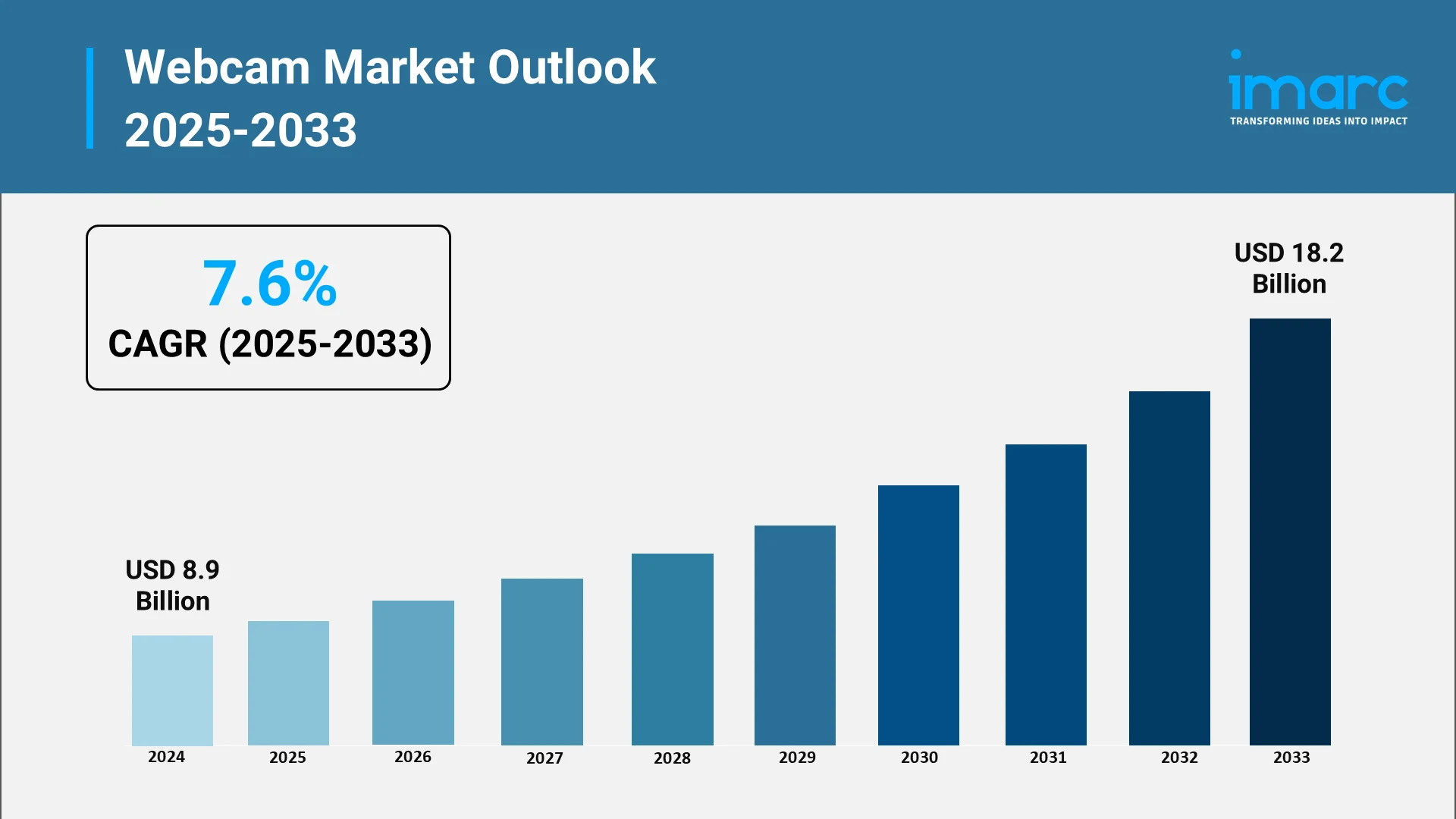
The webcams market is experiencing unprecedented transformation as digital communication becomes the cornerstone of modern business, education, and healthcare. Global webcam industry dynamics are being reshaped by technological innovation and evolving workplace models. The global webcam market size reached USD 8.9 Billion in 2024.
The surge in webcam demand reflects fundamental shifts in how organizations communicate and collaborate in an increasingly interconnected world. From corporate boardrooms to telehealth consultations and content creation studios, webcams have become indispensable tools enabling seamless visual connectivity. This analysis examines the market forces, regulatory frameworks, and strategic opportunities shaping the global webcams industry.
Explore in-depth findings for this market, Request Sample
The Role, Impact, and Benefits of Webcams in the Digital Communication Industry:
Webcams have evolved from simple video capture devices to sophisticated technological solutions powering the digital economy. Modern webcams integrate advanced image sensors and high-definition lenses, supporting resolutions from 1080p to ultra-high-definition 4K video, enabling crystal-clear visual transmission across diverse applications.
The digital communication industry has witnessed transformative benefits from webcam adoption. Organizations leveraging video conferencing technology report employees saving an average of 40 minutes daily in commute time, with remote and hybrid workers demonstrating productivity levels equal to or exceeding office-based counterparts. Video collaboration through webcams supports virtual meetings, online education, telehealth consultations, security surveillance, and live streaming. Educational institutions report retention rates reaching 60%, substantially higher than traditional classrooms.
Webcams offer superior portability and affordability compared to traditional video cameras. Organizations transitioning to digital collaboration save 50-70% on training and operational costs. The plug-and-play functionality of modern USB webcams enables rapid deployment across enterprise environments.
Key Growth Drivers in the Global Webcams Market:
The global webcams market is propelled by interconnected growth drivers reshaping workplace dynamics. Hybrid work models stand as the primary catalyst, with 28.2% of full-time employees operating under flexible arrangements in 2024. Research shows 60% of remote-capable employees prefer hybrid arrangements, creating sustained demand for professional video communication equipment. The remote work paradigm has stabilized at levels 2-5 times higher than pre-pandemic baselines.
Online education expansion accelerates market growth. The global e-learning market reached USD 342.4 Billion in 2024, projecting growth to USD 682.3 Billion by 2033. Over 73.8 million learners engaged with online platforms in 2024, a 900% increase since 2000. With 75% of undergraduates enrolling in at least one online course, webcams are essential infrastructure for virtual education.
The telehealth revolution drives substantial demand. Global telemedicine valuations reached USD 111.4 Billion in 2025, projecting expansion to USD 602.1 Billion by 2034 at a CAGR of 20.62%. Healthcare providers increasingly adopt virtual platforms, with 79% of U.S. hospitals implementing live telehealth capabilities. Patient satisfaction remains high, with majority expressing preference for telemedicine services.
Security and surveillance applications generate market momentum as organizations prioritize safety. Major retailers like Walmart committed substantial resources in 2024 to upgrading surveillance infrastructure with AI-enabled cameras. The commercial segment commands the largest market share across video surveillance applications.
Content creation and live streaming expand rapidly. The online entertainment segment's 16.38% projected growth rate from 2026 to 2034 reflects surging demand from gamers, influencers, and broadcasters requiring broadcast-quality video production capabilities.
Regulatory Framework and Policy Landscape in the Webcams Industry:
The webcams industry operates within an increasingly complex regulatory framework addressing privacy protection and data security. The Electronic Communications Privacy Act (ECPA) establishes foundational privacy protections, while the Federal Communications Commission (FCC) mandates technical compliance certifications for wireless webcams.
Comprehensive state privacy laws have proliferated dramatically, with 14 states enacting data protection legislation by 2024. California's Consumer Privacy Rights Act (CPRA) and similar statutes impose stringent requirements on businesses collecting personal information through video systems, mandating transparent privacy notices and data minimization practices.
Biometric data regulations present particular significance for webcam applications with facial recognition capabilities. The National Defense Authorization Act (NDAA) Section 889 addresses national security by prohibiting federal agencies from utilizing surveillance technology from designated foreign manufacturers, creating preference for NDAA-compliant equipment. The Federal Trade Commission (FTC) maintains active enforcement regarding data security, while state regulations like the Texas Data Security Act mandate AES-256 encryption for cloud-stored camera footage.
Government Support / Initiatives for the Webcams Market:
Government agencies worldwide have implemented strategic initiatives supporting digital communication infrastructure development. The Health Resources and Services Administration (HRSA) expanded telehealth funding programs, with healthcare facilities receiving federal support for technology infrastructure upgrades directly supporting webcam procurement. The extension of Medicare telehealth flexibilities through September 30, 2025, sustains policies encouraging video-enabled healthcare services.
Educational technology initiatives provide significant support. K-12 schools accessed an average of over 2,500 edtech tools per district in 2023, compared to 895 tools in 2018-2019, necessitating investment in video communication hardware. Smart city and public safety programs drive webcam adoption for surveillance, with urban security upgrades receiving over USD 1.2 billion in funding during 2024.
International governmental bodies advance digital communication policies. The World Health Organization's Global Digital Health Strategy 2020-2025 promotes telehealth accessibility, while India's Ayushman Bharat Digital Mission (ABDM) issued over 800 million health IDs by August 2025, establishing digital infrastructure requiring video consultation capabilities.
Top Webcams Manufacturing Companies Worldwide:
The global webcams market features intense competition among technology leaders. Logitech International S.A. maintains market leadership through comprehensive product portfolios. In March 2024, Logitech unveiled the MX Brio, featuring Ultra HD 4K resolution, 70% larger pixels than previous models, and AI-enhanced image quality delivering 2x better face visibility in challenging lighting. The innovative Show Mode enables users to tilt the camera 90 degrees for document presentation. In January 2025, Logitech announced the Rally Camera Streamline Kit, a USD 2,199 PTZ solution for hybrid learning environments.
Cisco Systems, Inc. delivers comprehensive video conferencing solutions. Cisco unveiled the Room Bar BYOD at Cisco Live Amsterdam in February 2025, enabling collaboration through USB-C connectivity and AI-powered capabilities including voice commands, facial recognition, and real-time transcription. Microsoft Corporation maintains strong presence through Microsoft Teams integration, while Razer Inc. targets gaming and content creation with 4K video capture capabilities. Sony Corporation, Canon Inc., and Lenovo Group Limited leverage imaging expertise for premium market segments.
Opportunities and Challenges in the Global Webcams Market:
The webcams market presents substantial growth opportunities driven by technological innovation. Artificial intelligence integration represents a transformative opportunity, with AI-powered features including automatic framing, noise cancellation, and facial recognition enhancing experiences.
Wireless webcam adoption constitutes another significant opportunity, with consumers preferring cable-free setups. Advancements in Wi-Fi 6 and Bluetooth connectivity enable seamless integration across platforms. The expansion of hybrid work models creates sustained enterprise demand, with organizations requiring multiple webcams per employee for home offices and corporate workspaces. The Asia-Pacific region, particularly China and India, demonstrates rapid adoption, collectively accounting for majority of regional demand.
However, challenges require strategic navigation. Several security as well as privacy concerns remain utmost important, compelling robust security protocols including hardware privacy shutters and encrypted transmission. The 500+ healthcare data breaches affecting 82.6 million individuals in 2023 underscore security importance. Technological commoditization presents competitive pressure as basic functionality becomes standardized. Manufacturers must differentiate through advanced features and superior quality. Regulatory compliance complexity across 14 U.S. states and international frameworks including GDPR requires sophisticated compliance programs.
.webp)
Conclusion:
The global webcams market stands at a pivotal juncture where technological innovation, regulatory evolution, and workplace transformation converge to create unprecedented opportunities. Market projections indicate market revenue to grow at 7.6% during 2025-2033, reaching USD 18.2 Billion by 2033, reflecting robust demand drivers spanning remote work, online education, telehealth, and security applications.
Strategic success requires manufacturers to prioritize innovation, security, and user-centric design while navigating regulatory landscapes and competition. The future trajectory appears exceptionally promising, supported by irreversible shifts toward hybrid work models, continued digitalization of education and healthcare, and expanding applications in artificial intelligence ecosystems. Webcams will remain essential infrastructure enabling human connection and productivity in our interconnected digital world.
IMARC Group’s Unmatched Expertise and Core Services:
IMARC Group empowers technology leaders and market participants with comprehensive intelligence needed to navigate the rapidly evolving webcams industry. Our specialized services deliver actionable insights supporting strategic decision-making across this dynamic sector.
- Data-Driven Market Research: Access in-depth analysis of global webcams market size, growth trajectories, competitive landscapes, and emerging technology trends including 4K video, AI integration, wireless connectivity, and hybrid work solutions through comprehensive market research reports.
- Strategic Growth Forecasting: Anticipate market developments across video collaboration, security surveillance, online education, telehealth applications, and content creation segments with detailed regional analysis covering North America, Europe, Asia-Pacific, and emerging markets.
- Competitive Benchmarking: Evaluate competitive positioning of leading manufacturers including Logitech, Microsoft, Cisco, Razer, Sony, and emerging innovators through product pipeline analysis, pricing strategies, and technological differentiation assessments.
- Policy and Infrastructure Advisory: Stay ahead of evolving regulatory frameworks including comprehensive state privacy laws, NDAA compliance requirements, cybersecurity mandates, and international data protection regulations affecting webcam deployment and usage.
- Custom Reports and Consulting: Obtain tailored insights aligned with your organizational objectives—whether launching new product lines, evaluating strategic partnerships, assessing market entry opportunities, or optimizing supply chain strategies in the webcams and digital communication sectors.
At IMARC Group, our mission is to equip business leaders with clarity and intelligence required to capitalize on opportunities in the transformative webcams market. Partner with us to drive strategic growth—because clear vision creates competitive advantage.
Our Clients










Contact Us
Have a question or need assistance?
Please complete the form with your inquiry or reach out to us at
Phone Number
+91-120-433-0800+1-201-971-6302
+44-113-547-7077
Previous Post

As smartphones become a way of life for most Filipinos, the market has changed dramatically and expectations from consumers are higher than ever before. With the demand for smartphones growing, there is a significant change in consumer shopping habits with more emphasis on using online platforms for shopping. This change is closely interlinked with the fast growth of the Philippines e-commerce market, both bringing opportunities and challenges to the stakeholders of the smartphone industry.
As technology continues to advance, lighting has transformed from a basic necessity into a strategic enabler of innovation, efficiency, and sustainability. The evolution from incandescent bulbs to LEDs, smart systems, and intelligent lighting networks represents not just technological change but a redefinition of how energy, design, and functionality intersect in the built environment.
An LED light is an illuminating device that utilizes Light Emitting Diodes as its source of light, generating light through a semiconductor-based process called electroluminescence. When electrical current flows across the semiconductor material of the diode, electrons emit energy as photons and thus produce highly efficient and concentrated illumination.
An LED bulb is a solid-state lighting device that uses Light Emitting Diodes (LEDs) as its illumination source. Different from incandescent or fluorescent lamps, light in LED bulbs is produced by electroluminescence, a process where the passing of an electric current through a semiconductor material emits photons directly. This process is highly energy-efficient, with a far larger percentage of the electricity being converted to usable light and very little heat generated in the process.
The junction box, generally made from plastic, metal, or composite materials, houses wire connections, terminations, and protective components to allow the safe distribution and routing of electrical circuits. The junction box will provide insulation, mechanical protection, and a secure environment to avoid accidental contact with live electrical parts, moisture intrusion, or dust accumulation.
The Japan power electronics market is poised to grow substantially, driven by rising demand in automotive, energy, industrial automation, and infrastructure sectors. According to IMARC Group, the Japan power electronics market is studied from 2019 to 2024 with projections extending to 2033.
Japan's printed circuit board (PCB) industry is the world leader in technology innovation, enabling consumer electronics, automotive, and next-generation communication system development. As a key enabler of modern electronic products, PCBs provide the essential building blocks for embedding semiconductors, sensors, and microchips into miniaturized, high-performance devices. Japan, through its world-class manufacturing base and engineering expertise, remains the hub of the global PCB supply chain.
Aluminum-Air (Al-Air) battery is a new energy storage technology that has attracted interest as a future alternative to conventional lithium-ion batteries, specifically for electric vehicle (EV) use. As opposed to normal rechargeable batteries, the Al-Air battery is a metal-air electrochemical cell with aluminum as the anode, oxygen from the ambient air as the cathode reactant, and a liquid electrolyte (commonly sodium hydroxide or potassium hydroxide) as the medium through which the reaction occurs.
Aluminium wire is an essential industrial commodity commonly employed in power transmission, electrical distribution, building construction, and manufacturing processes owing to its high conductivity-to-weight ratio, resistance to corrosion, and cost advantage over copper. Produced by methods including continuous casting, rolling, and drawing, aluminum wire is available in various grades and alloys to serve the wide demands, from overhead transmission conductors and building wiring to automotive harnesses and electronic applications.
Air conditioners are electromechanical devices used to control indoor climate by extracting heat and humidity and ensuring optimum air circulation. Generally consisting of a compressor, condenser, evaporator, refrigerant fluid, filters, fans, and electronic controls, air conditioners work based on the principle of heat exchange, moving heat from indoor areas to the external environment. Contemporary units come in diverse configurations, such as split systems, window units, central air systems, and portable models, supporting respective residential, commercial, and industrial applications. Some of the major characteristics are efficiency in cooling, energy use, noise rating, and environmental footprint in relation to refrigerant type.
E-waste, or electronic waste, is electrical and electronic equipment that has been discarded, such as computers, cell phones, television sets, servers, and household appliances. It is among the world's fastest-growing streams of waste, consisting of a heterogeneous combination of metals, plastics, glass, and toxic substances. E-waste contains valuable metals like copper, aluminum, gold, silver, palladium, and rare earth elements, in addition to toxic materials like lead, mercury, cadmium, and brominated flame retardants.
Polished silicon wafers are very pure, ultra-flat semiconductor substrates that are produced from high-quality single-crystal silicon. The wafers act as the material base for making integrated circuits, power devices, and MEMS (Microelectromechanical Systems). The wafers are made of monocrystalline silicon ingots using the Czochralski or Float-Zone process, from which the wafers are cut, lapped, etched, and polished to atomic-scale flatness and defect-free surfaces.
AI is revolutionizing Japan’s semiconductor industry by boosting innovation and efficiency across the entire value chain. Advanced artificial intelligence (AI)-powered Electronic Design Automation (EDA) tools significantly shorten chip design cycles, improving performance and energy efficiency.
Recent projections indicate that Australia semiconductor market, including services, is growing at a steady compound annual growth rate as the nation deepens its tech infrastructure. The importance of semiconductors spans electronics, defense systems, telecommunications, and emerging AI applications, which position the local ecosystem as strategically vital for growth.
Fiber optic cables are high-tech communications cables that carry information like bursts of light along extremely thin glass or plastic strands, providing high-speed, high-bandwidth connectivity with little loss of signal. Fiber optic cables make up the foundation of contemporary telecommunications, carrying internet, cloud computing, 5G networks, and smart infrastructure.
CAT (Category) cables are twisted-pair Ethernet cables utilized for copper-based wired network communications, varying from CAT5e to CAT8 standards. The cables carry data through copper conductors, but with different speeds (up to 40 Gbps for CAT8) and bandwidths, supporting networks such as LANs, data centers, and smart buildings.
India's semiconductor industry is undergoing a revolutionary phase driven by rising demand from industries like consumer electronics, automotive technologies, industrial automation, and telecom infrastructure.
USB data cables are critical elements of contemporary digital connectivity, enabling high-speed and consistent data transfer and power supply for a broad scope of electronic products. They provide the foundation for charging and synchronizing smartphones, tablets, laptops, and other peripherals, with significant applications in consumer electronics, industrial automation, and new technologies. With technologies like USB-C, the cables today carry faster data speeds, more power output, and universal compatibility, making them essential in a world that is connected.
Thin-film-transistor (TFT) liquid-crystal display (LCD) is a type of display technology used in many electronic devices, such as smartphones, tablets, laptops, and televisions (TVs). A backlight, colour filters, a thin-film transistor array, and a liquid crystal layer are among the layers that make up this flat-panel display. TFT LCDs are made to produce sharp images with superb viewing angles, strong contrast, and accurate colour reproduction. They are made up of thousands of tiny transistors that regulate how much light enters each pixel. This makes it possible for the display to generate crisp, detailed images at rapid refresh rates. TFT LCD technology's low power consumption is one of its main benefits, which makes it perfect for battery-operated gadgets.
Polycrystalline solar photovoltaic (PV) modules are a key component of solar energy systems, harnessing sunlight and converting it into electricity through the photovoltaic effect. These modules are composed of multiple interconnected solar cells, each made from polycrystalline silicon. Polycrystalline solar panels are renowned for their efficiency, affordability, and versatility, making them a popular choice for various applications such as solar installations, commercial and industrial projects, off-grid systems and solar farms.
The LED chip is the core component of an LED bulb, comprising semiconductor layers that enable the free flow of protons and electrons. Employed in all LED lighting fixtures—from bulbs to tubes—the LED chip fundamentally determines light quality, with variations in brightness, voltage, and wavelength. These chips are manufactured through a process called MOCVD (metal-organic chemical vapor deposition), which creates the semiconductor layers that facilitate electric flow. Major applications of these chips include backlighting, illumination, automotive lighting, signs, and signals.
Semiconductors are crucial components in the modern electronics industry, used in electronic equipment and devices to manage and control the flow of electricity. They are found in consumer items like smartphones, wearables, smart TVs, and advanced equipment used in industrial applications, defense, and aerospace. Semiconductors are further divided into four broad categories: optoelectronics, discrete components, integrated circuits, and sensors. Memory devices, logic devices, analog ICs, MPUs, discrete power devices, MCUs, and sensors are some of the major components of semiconductors.