Drip Irrigation Systems Plant Setup Cost in India: Manufacturing Process Flow, Machinery, DPR & Financial Model 2026
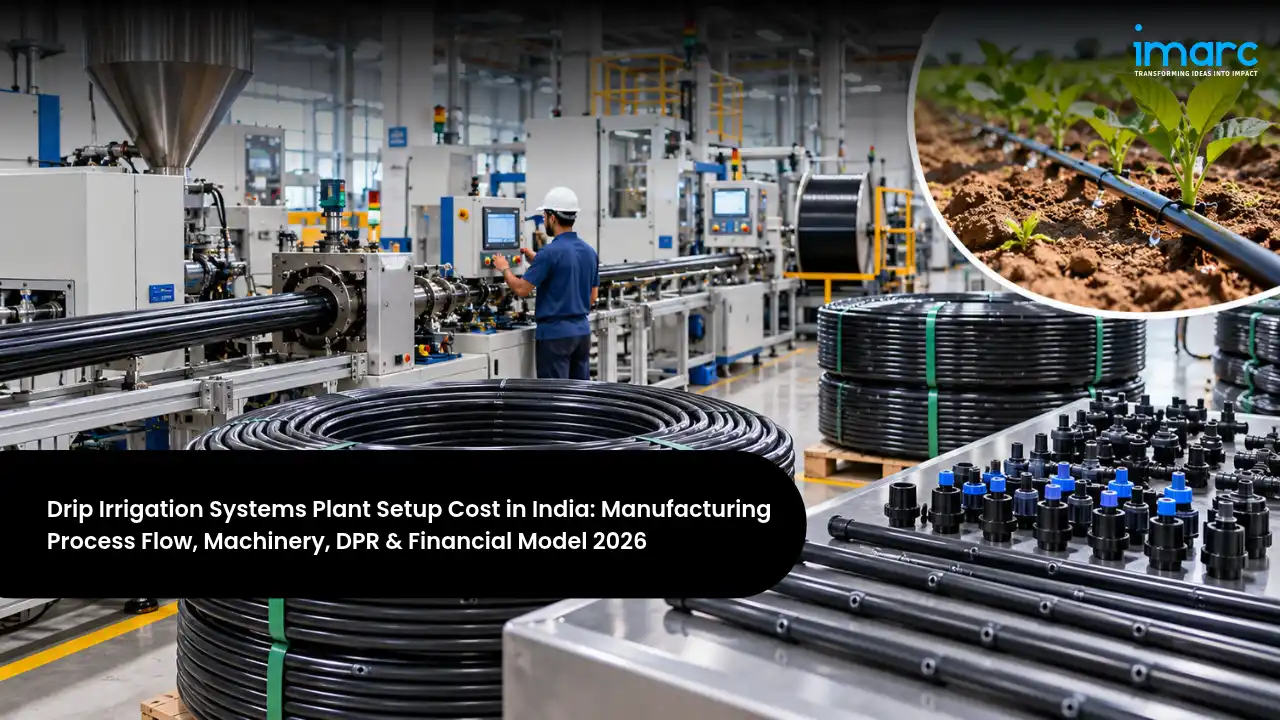
Drip irrigation delivers water and fertiliser slowly and directly to the root zone of each plant through a network of plastic pipes, laterals, and precisely calibrated emitters, cutting water use sharply while raising yields of fruits, vegetables, sugarcane, cotton, and plantation crops. A complete drip kit includes PVC or HDPE mains and submains, polyethylene laterals with built-in or fitted emitters, filters, fertiliser injectors, valves, and fittings. Under the Per Drop More Crop programme, micro irrigation now covers about 110.9 lakh hectares, roughly 8% of India's net sown area, with subsidies of 55% for small and marginal farmers. Water scarcity, falling groundwater, government support, and the shift to high-value horticulture make Drip Irrigation Systems Manufacturing Plant Setup in India a strong opportunity for plastics processors and agri-input investors.
Investment depends mainly on capacity, the number of lateral extrusion and emitter insertion lines, emitter and fitting moulding, PVC pipe extrusion, filter assembly, testing facilities, and the dealer and field service network. The Drip Irrigation Systems Manufacturing Plant Cost ranges from about INR 5–10 crore for a small unit of 1,000 to 1,500 tonnes a year making laterals with purchased emitters to INR 40–70 crore for an integrated plant of about 6,000 tonnes a year, and INR 150–250 crore for a large facility of 20,000 tonnes a year with high-speed flat emitter lines and sprinkler products. Raw materials make up 65 to 75% of operating cost and utilities 10 to 15%, so polymer prices, emitter quality, and subsidy receivables shape profitability. A well-run plant typically earns a gross margin of 25 to 35% and a net margin of 12 to 20%.
This guide is written for investors exploring how to start a Drip Irrigation Systems manufacturing plant in India. It focuses on an integrated plant of about 6,000 tonnes a year producing inline and online drip laterals, moulded emitters and fittings, and PVC mains, with filters and fertiliser injectors assembled for complete farm kits, and also explains small units and large facilities. It covers products and markets, the demand outlook, the production process flow, machinery and raw materials, location and infrastructure, a detailed cost and financial breakdown, BIS and scheme approvals, and how a DPR and financial model turn all of this into a bankable plan.
India Market Snapshot
| Key Facts | Details |
|---|---|
| Micro Irrigation Coverage (PDMC) | About 110.9 Lakh Hectares |
| Share of Net Sown Area | About 8% |
| Farmer Subsidy | 55% small, marginal; 45% others |
| PMKSY Budget (2026-27) | INR 6,587 Crore |
| Typical Plant Capacity | 5,000 – 20,000 Tonnes a Year |
| Indicative Total Investment | INR 5 Crore to 250 Crore |
The snapshot shows a market with a long runway: micro irrigation still covers only a small part of India's farmland, and government subsidies make systems affordable for most farmers. Because a large share of sales flows through subsidy schemes, empanelment, BIS certification, and the speed of subsidy payments matter as much as manufacturing cost.
Investment Highlights
Indicative Project Cost in India (2026)
| Parameter | Value |
|---|---|
| Product Range | Laterals, emitters, filters, fittings, mains |
| Plant Capacity | 1,000 – 20,000 Tonnes per year |
| Total Project Investment | INR 5–10 Crore (small unit) to 150–250 Crore (large plant) |
| Payback Period | 3 – 5 Years |
| Net Profit Margin | 12 – 20% |
| IRR | 18 – 25% |
| Preferred States | Maharashtra, Gujarat, Karnataka, Andhra Pradesh, Tamil Nadu, Rajasthan |
| Key Requirement | BIS License, scheme empanelment, dealers |
These ranges provide a realistic frame for early planning, but actual returns depend on polyethylene and PVC prices, which follow crude oil and petrochemical cycles, state subsidy budgets and the time taken to release payments, monsoon conditions, competition from large brands and regional makers, emitter performance in the field, and the cost of design, installation, and after-sales service. A site-specific Drip Irrigation Systems Feasibility Report narrows each of these assumptions to your chosen products, capacity, location, and markets.
Table of Contents
- What is Drip Irrigation Systems Manufacturing?
- Why is Drip Irrigation Systems Manufacturing Growing in India?
- Drip Irrigation Systems Manufacturing Process Flow
- Raw Materials Required for Drip Irrigation Systems Manufacturing
- Location, Land & Infrastructure
- Drip Irrigation Systems Manufacturing Machinery and Equipment
- Drip Irrigation Systems Manufacturing Plant Setup Cost in India (CapEx & OpEx)
- Financial Analysis and Profitability
- Licenses and Approvals for Drip Irrigation Systems Manufacturing in India
- Recent Developments in the India Drip Irrigation Systems Manufacturing Industry
- How a Drip Irrigation Systems Manufacturing Project Report and DPR Helps Investors
- Frequently Asked Questions
What is Drip Irrigation Systems Manufacturing?
A drip system carries filtered water from a source such as a well, canal, or farm pond through a main line and submains to thin polyethylene laterals laid along crop rows. Emitters on the laterals release a set flow, typically 1 to 8 litres an hour, close to each plant. Inline laterals have flat or cylindrical emitters welded inside the tube during extrusion, while online laterals have button emitters punched in at the field. Flow accuracy, uniformity across the lateral, resistance to clogging, wall thickness, and UV stability decide quality.
Commercially, drip equipment is sold to farmers through dealers under state subsidy schemes, directly to large farms, plantations, and sugar mills, to government and community irrigation projects, to landscaping and greenhouse projects, and to export markets in Africa, the Middle East, and Asia. A Drip Irrigation Systems Manufacturing Plant can serve all these channels by offering complete kits with design and installation support. Buyers value proven emitter performance, BIS marking, scheme approval, reliable after-sales service, and competitive prices.
- Horticulture: Fruits, vegetables, and flowers.
- Field Crops: Sugarcane, cotton, maize, and pulses.
- Plantations: Coconut, arecanut, tea, and coffee.
- Landscaping & Greenhouses: Gardens, nurseries, protected farming.
The Main Drip Products and Applications
Choosing the product mix is the most important commercial decision, because it determines equipment, moulds, and customers:
| Product | Description | Key Property | Primary Demand |
|---|---|---|---|
| Inline Laterals | Built-in emitters | Uniform flow | Row crops, cane |
| Online Laterals | Fitted emitters | Flexible spacing | Orchards |
| Thin-Wall Drip Tape | Seasonal tape | Low cost | Vegetables |
| PC Emitters | Pressure compensating | Works on slopes | Hilly farms |
| Filters & Injectors | Screen, disc, venturi | Clog protection | All systems |
| Mains & Fittings | PVC, HDPE, PP | Water delivery | All systems |
These choices shape the whole plant. Inline laterals and drip tape are high-volume products that need fast extrusion and insertion lines, while emitters and fittings depend on precise multi-cavity moulds, and filters and injectors are often assembled from moulded and bought-out parts.
Why is Drip Irrigation Systems Manufacturing Growing in India?
Key Growth Drivers in India and Export Markets
Demand is supported by water scarcity, government support, and changing cropping patterns:
- Water scarcity: Falling groundwater pushes farmers to use water more efficiently.
- Subsidies: Central and state schemes cover a large share of system cost.
- High-value crops: Horticulture and plantations gain most from drip and fertigation.
- Sugarcane mandates: Several states and sugar mills promote drip for cane.
- Exports: Indian systems are supplied to Africa, the Middle East, and Asia.
India-Specific Market Opportunity
| Segment | Market Context | Manufacturing Role |
|---|---|---|
| Subsidy Schemes | State-wide programmes | Complete kits |
| Sugar Mills | Cane drip drives | Inline laterals |
| Large Farms | Plantations, orchards | Custom designs |
| Govt Projects | Community irrigation | Bulk supply |
The strongest opportunity for new entrants lies in empanelment under state subsidy schemes in high-adoption states, in supplying sugar mills and large farms with inline laterals, and in exporting laterals and emitters to emerging markets. Producers that combine reliable emitter quality, efficient extrusion, a strong dealer and service network, and careful management of subsidy receivables will be best placed to grow.
Drip Irrigation Systems Manufacturing Process Flow
Understanding the process helps you plan equipment, layout, and where cost and quality are decided. The flow runs from resin receipt and blending through emitter moulding, emitter feeding, lateral extrusion with inline emitter insertion, vacuum sizing and cooling, hole punching, printing, coiling and flow testing, and packing. Emitter design and moulding precision decide flow accuracy, while insertion and punching decide uniformity along the lateral.
The Drip Irrigation Systems Manufacturing Process Flow
The sequence below reflects an inline lateral line. Online laterals skip emitter insertion, and emitters are fitted later.
| Unit Operation | Key Activity |
|---|---|
| Resin Blending | LLDPE, carbon black |
| Emitter Moulding | Multi-cavity moulds |
| Emitter Feeding | Vibratory feeders |
| Extrusion | Lateral tube formed |
| Emitter Insertion | Welded at set spacing |
| Sizing & Cooling | Vacuum tank |
| Hole Punching | Outlet over emitter |
| Printing | Marking, spacing |
| Coiling & Testing | Flow uniformity |
| Packing & Dispatch | Coils, kits |
Two factors decide profitability across this flow. The first is emitter precision, because a small variation in the labyrinth dimensions changes flow, and poor uniformity or clogging in the field leads to complaints, rejected subsidy claims, and lost dealers. The second is material efficiency, since resin is most of the cost, so thin but strong walls, accurate weights per metre, and low scrap directly protect margins.
Raw Materials Required for Drip Irrigation Systems Manufacturing
The main raw materials are LLDPE and HDPE resins for laterals and pipes, PVC resin and compounds for mains, polypropylene and engineering plastics for emitters, fittings, and filter bodies, carbon black masterbatch and UV stabilisers, and bought-out parts such as filter screens, valves, and venturi injectors, along with packaging.
| Raw Material | Role in Product | India Sourcing | % of OpEx |
|---|---|---|---|
| LLDPE & HDPE Resin | Laterals, pipes | Domestic producers | 42–50% |
| PVC Resin & Compounds | Mains, submains | Domestic, imported | 10–14% |
| PP & Engineering Plastics | Emitters, fittings | Domestic, imported | 5–8% |
| Carbon Black & Additives | UV protection | Domestic suppliers | 2–4% |
| Bought-out Parts & Packing | Valves, screens | Domestic suppliers | 4–6% |
Polyethylene resin is by far the largest cost, and its price moves with crude oil and global petrochemical markets. Contracts with domestic resin producers, price variation clauses in large orders, careful stocking ahead of the irrigation season, and close control of wall thickness and scrap help manage cost and supply risk.
Location, Land & Infrastructure
Site selection for a drip equipment plant is driven by proximity to high-adoption farming states, access to resin supply, and reliable power for extrusion and moulding. Other factors include good roads for bulky coils, availability of skilled machine operators and mould technicians, the presence of empanelled dealers, and state incentives for plastics and agri-input units. Because coils are bulky, demand is seasonal, and service must reach farmers quickly, locating in or near a major drip-adopting region is usually the best option.
Choosing the Best Location for Drip Irrigation Systems Manufacturing Plant Setup
| State / Region | Why It Works | Key Advantage |
|---|---|---|
| Maharashtra | Largest drip market | Demand, cluster |
| Gujarat | Strong state scheme | Resin, demand |
| Karnataka | Horticulture, cane | High adoption |
| Andhra Pradesh | State MI project | Scheme volumes |
| Tamil Nadu | Plantations, cane | Southern market |
| Rajasthan | Water-scarce farms | Growing demand |
Maharashtra has India's largest drip market and an established cluster of manufacturers, while Gujarat combines a strong state programme with domestic resin supply. Karnataka, Andhra Pradesh, and Tamil Nadu have high adoption in horticulture, sugarcane, and plantations, and Rajasthan's water-scarce farms are a growing market. The final choice should weigh scheme volumes, dealer reach, resin access, and land cost.
Quality, Safety and Environmental Systems
Products sold under subsidy schemes must carry BIS certification to the relevant Indian Standards for emitters, emitting pipes, laterals, filters, and fittings, and buyers expect tests for flow rate, coefficient of variation, pressure compensation, burst pressure, and UV resistance. A credible plant needs a hydraulic test bench, flow uniformity testing, dimensional checks, and batch traceability, supported by ISO 9001 and a field service team that designs and commissions systems. Safety focuses on extruders, moulding machines, and hot surfaces. Environmental systems cover recycling of scrap and rejects, energy-efficient chillers, and dust control in resin handling. An experienced Drip Irrigation Systems Manufacturing Consultant in India can help plan products, moulds, lines, and certification so the plant meets regulatory and customer requirements from the start.
Infrastructure Requirements (6,000 TPA Plant)
| Infrastructure Element | Specification | India-Specific Note |
|---|---|---|
| Total Land Area | 4 – 6 acres | Industrial area |
| Extrusion Hall | Lateral, PVC lines | Long bays |
| Moulding Shop | Emitters, fittings | Temperature controlled |
| Resin Store | Silos, bags | Dry storage |
| Utilities | Power, chilled water | 1.5 – 2.5 MW load |
| Finished Goods Yard | Coils, pipes | Covered |
| Test Laboratory | Flow, pressure | BIS tests |
Reliable power, long extrusion bays, and a temperature-controlled moulding shop are the most important infrastructure requirements, since extrusion and moulding run continuously and emitter precision depends on stable conditions.
Drip Irrigation Systems Manufacturing Machinery and Equipment
The equipment set covers resin handling, lateral extrusion, emitter insertion, moulding, PVC pipe extrusion, testing, and utilities. Lateral lines with insertion units and precision emitter moulds account for most of the machinery budget.
| Equipment | Function | Key Specification |
|---|---|---|
| Gravimetric Blender | Mix resin, additives | Accurate dosing |
| Lateral Extruder | Form tube | High speed |
| Emitter Insertion Unit | Insert emitters | Inline, synchronised |
| Vacuum Sizing Tank | Set diameter | Water cooled |
| Hole Punching Unit | Make outlets | Vision guided |
| Inkjet Printer | Mark laterals | BIS marking |
| Coiler | Wind coils | Automatic |
| Injection Moulding Machines | Make emitters, fittings | Precision |
| Emitter Moulds | Form labyrinths | Multi-cavity |
| PVC Pipe Line | Make mains | Twin screw |
| Flow Test Bench | Test emitters | Uniformity, pressure |
Machinery should follow the product plan. A small unit needs an online lateral extruder, a coiler, and a few moulding machines, buying emitters and filters from outside, while an integrated plant adds high-speed inline lateral lines, in-house emitter moulding, a PVC pipe line, filter assembly, and a full test laboratory.
Drip Irrigation Systems Manufacturing Plant Setup Cost in India (CapEx & OpEx)
The tables below break down capital and operating costs for an integrated plant of about 6,000 tonnes a year in India. The final Drip Irrigation Systems Investment Cost for your project will depend on capacity, number of lateral and moulding lines, PVC pipe and filter capability, land cost, and location.
Capital Expenditure (CapEx) Cost Structure
| CapEx Component | % of Total CapEx | What It Covers |
|---|---|---|
| Extrusion & Insertion Lines | 30–38% | Laterals, PVC |
| Moulding Machines & Moulds | 15–20% | Emitters, fittings |
| Utilities & Chillers | 6–9% | Power, cooling |
| Buildings & Civil Works | 12–16% | Halls, stores |
| Land & Site Development | 5–8% | Land and approvals |
| Working Capital | 18–25% | Resin, subsidy dues |
Extrusion and moulding equipment make up most of the fixed capital, but working capital is unusually large because subsidy payments from state agencies can take months to arrive. Because of this, a detailed Drip Irrigation Systems Business Plan should model sales by product and channel, scheme volumes by state, resin prices, wall thickness and scrap, installation and service costs, dealer margins, the timing of subsidy receipts, and working capital together, so that funding supports the business through delayed payments.
Operating Expenditure (OpEx) Cost Structure
| OpEx Component | % of Total OpEx | India-Specific Note |
|---|---|---|
| Raw Materials & Packaging | 65–75% | PE, PVC, PP |
| Utilities | 10–15% | Extrusion, moulding |
| Labour | 4–6% | Operators, technicians |
| Maintenance & Moulds | 1–2% | Spares, moulds |
| Logistics & Installation | 3–5% | Freight, field teams |
| Overheads & Testing | 2–3% | Quality, admin |
With raw materials making up most of the cost, margins depend on resin buying, weight per metre, scrap, utilisation, and the cost of field service. A good operating model tracks resin per metre of lateral, scrap rates, power per kilogram, installation cost per hectare, and realised prices by channel, and tests results against higher resin prices, cuts in subsidy budgets, or delays in payments.
Financial Analysis and Profitability
Based on analysis of a 6,000 TPA plant, the financial profile is attractive, supported by government subsidies and growing adoption, but returns depend heavily on scheme volumes, product quality, and the speed of subsidy collections. The profitability of Drip Irrigation Systems manufacturing business in India improves markedly with empanelment in several high-adoption states, reliable emitter performance, efficient extrusion, strong dealer and service networks, direct sales to sugar mills and large farms, and a growing share of complete kits and exports.
| Financial Metric | Indicative Value | India Context |
|---|---|---|
| Gross Profit Margin | 25–35% | Kit sales driven |
| Net Profit Margin | 12–20% | After depreciation, taxes |
| Payback Period | 3–5 Years | Moderate capital |
| IRR (Internal Rate of Return) | 18–25% | Higher with exports |
| Capacity Utilization (stable ops) | 65–80% | Seasonal demand |
| Break-even Capacity Utilization | 40–50% | Moderate fixed costs |
Channel mix and collections decide where a plant lands within these ranges. Complete kits with design and installation earn better margins than bare laterals sold to traders, but they also tie up cash in subsidy receivables.
Returns can be strengthened by investing in pressure-compensating and anti-siphon emitters, adding filters, fertigation units, and automation controllers, offering agronomy support to farmers, entering export markets, and spreading scheme business across several states to reduce payment risk.
Key Risks and Mitigation
The main risks are delayed subsidy payments, changes in scheme budgets, resin price swings, emitter clogging and field complaints, competition from low-priced regional makers, and seasonal demand. Payment risk is reduced by spreading sales across states and channels; budget risk by direct and export sales; price risk by quick price updates; quality risk by strict testing and good filtration advice; competition risk by brand and service; and seasonal risk by building stock ahead of peak months. Promoters often work with a Drip Irrigation Systems Business Plan Consultant in India to test these scenarios before committing capital.
Licenses and Approvals for Drip Irrigation Systems Manufacturing in India
Approvals for a drip equipment plant centre on BIS certification, empanelment in subsidy schemes, and factory requirements, along with standard business registrations. Promoters setting up a Drip Irrigation Systems Manufacturing Plant in India generally need the following:
- BIS Certification: ISI License for emitters, emitting pipes, laterals, filters, and fittings under the relevant standards.
- Scheme Empanelment: Registration with state agriculture or horticulture departments and micro irrigation agencies.
- Pollution Control: Consent to Establish and Operate from the state pollution control board.
- Power Connection: HT electricity connection for extrusion and moulding lines.
- Quality Certifications: ISO 9001 and an in-house laboratory for product testing.
- Factory & Fire: Factory License, building plan approval, and fire NOC.
- Business & Trade Registrations: Business registration, GST, Udyam, trademark, and Import Export Code.
BIS certification and scheme empanelment are usually on the critical path, since subsidised sales, the largest channel, are not possible without them.
Note: The exact approvals, registrations, licences, and certification requirements may vary depending on factors such as plant location, capacity, products, state pollution control categories, customer specifications, and applicable regulations. Businesses are advised to undertake a detailed regulatory assessment during the project planning stage to ensure full compliance and timely implementation.
Recent Developments in the India Drip Irrigation Systems Manufacturing Industry
Several recent developments give useful context for investors considering this market:
- Programme reach: In June 2026, government data showed micro irrigation under Per Drop More Crop had covered about 110.9 lakh hectares since 2015-16.
- Budget support: In February 2026, the Union Budget for 2026-27 allocated INR 6,587 crore to PMKSY.
- Capacity expansion: In January 2026, RM Drip and Sprinklers Systems announced a new 12,000 tonne plant at Sinnar, Maharashtra, raising capacity by about 50%.
- New technology: In February 2025, Netafim launched its patented Hybrid Dripline with a built-in outlet.
The common thread is steady government backing, rising adoption, and investment in new capacity and technology. New entrants who build reliable products, earn BIS and scheme approvals, and develop strong dealer and service networks will be best placed to grow.
How a Drip Irrigation Systems Manufacturing Project Report and DPR Helps Investors
A detailed DPR provides a structured roadmap for the venture, from market demand and product selection to resin sourcing, line and mould selection, plant design, approvals, and economics. It helps investors decide the right products, capacity, and location, estimate capital and operating expenditure, assess profitability, and identify risks before committing funds.
At its core is a detailed Drip Irrigation Systems Financial Model covering sales by product, channel, and state, polyethylene, PVC, and PP prices, weight per metre and scrap, power, labour, moulds, installation and service costs, dealer margins, subsidy collection timelines, working capital, debt servicing, cash flows, break-even, return on investment, and payback under different price and volume scenarios. Banks and investors rely on this model to judge long-term viability, which is why many promoters appoint a Drip Irrigation Systems Plant Project Report Consultant in India to prepare the report and validate its assumptions against current market data.
For a drip project, a strong DPR also clarifies the product and kit strategy, the target states and channels, the BIS and empanelment plan, and the working capital approach for subsidy receivables, which together are the factors most likely to decide success.
Frequently Asked Questions
What are the first steps to set up a drip irrigation systems manufacturing plant in India?
Start by choosing your products and channels, such as inline laterals for sugar mills or complete kits for subsidy schemes. Then commission a feasibility study and DPR, select extrusion lines and emitter moulds, secure resin supply, choose a site near high-adoption states, obtain BIS licences and scheme empanelment, install the lines and test laboratory, and build a dealer and service network.
How much does it cost to set up a drip irrigation systems manufacturing plant in India?
Investment ranges from about INR 5–10 crore for a small unit of 1,000 to 1,500 tonnes a year to INR 40–70 crore for an integrated plant of about 6,000 tonnes a year, and INR 150–250 crore for a large facility of 20,000 tonnes a year.
What are the main steps in making drip irrigation systems?
The flow runs from resin blending and emitter moulding through emitter feeding, extrusion, emitter insertion, vacuum sizing and cooling, hole punching, printing, coiling and flow testing, and packing and dispatch.
Which machinery does a drip irrigation systems manufacturing plant need?
Key equipment includes gravimetric blenders, lateral extruders, emitter insertion units, vacuum sizing tanks, hole punching units, inkjet printers, coilers, injection moulding machines, emitter moulds, a PVC pipe line, and flow test benches.
What raw materials are used for drip irrigation systems?
The main raw materials are LLDPE and HDPE resins, PVC resin and compounds, polypropylene and engineering plastics, carbon black masterbatch and UV stabilisers, and bought-out parts such as filter screens, valves, and venturi injectors.
How profitable is drip irrigation systems manufacturing in India?
A well-run plant typically earns a 25 to 35% gross margin and a 12 to 20% net margin, with payback in about 3 to 5 years. Profitability depends on scheme volumes, resin prices, product quality, and the speed of subsidy collections.
Which approvals does a drip irrigation systems manufacturing plant need in India?
Typical approvals include BIS licences for drip products, empanelment with state micro irrigation schemes, pollution control consents, an HT power connection, ISO 9001, factory and fire approvals, and GST, Udyam, trademark, and Import Export Code registrations.
How do I get a feasibility study or DPR for a drip irrigation systems manufacturing project?
A detailed feasibility study and DPR covers market demand, products, resin sourcing, lines and moulds, plant design, approvals, and full financials. Investors usually engage a Drip Irrigation Systems Manufacturing Feasibility Study Consultant with experience in plastics and agri-input projects to prepare the report and validate it for lenders.
Our Clients










Contact Us
Have a question or need assistance?
Please complete the form with your inquiry or reach out to us at
Phone Number
+91-120-433-0800+1-201-971-6302
+44-113-547-7077
Previous Post

Quality seed is the starting point of every crop, and improved seed alone can raise yields significantly. Commercial seed is produced by contract growers on carefully managed fields and then conditioned in seed processing plants, where it is dried, cleaned, graded, treated, tested, and packed so that farmers receive pure, healthy seed with high germination.
Triple superphosphate is a concentrated phosphate fertiliser containing 44 to 46% P2O5, mainly as water-soluble monocalcium phosphate.
Liquid biofertilizers are concentrated suspensions of beneficial microorganisms, such as Rhizobium, Azotobacter, Azospirillum, and phosphate, potash, and zinc solubilising bacteria, that fix atmospheric nitrogen or release locked-up nutrients in the soil.
Hemp processing is the conversion of low-THC industrial hemp stalks and seed into separated, graded, saleable materials. The stalk is retted, dried and decorticated to split the long outer bast fiber from the woody inner hurd, while the seed is cleaned, dehulled and cold-pressed into food-grade hemp hearts and hemp seed oil.
Ashwagandha, or Withania somnifera, is one of the most important herbs in Ayurveda, valued as an adaptogen for stress, sleep, energy, and overall wellness.
Chicory is mainly Cichorium intybus, a perennial herb that is grown for its root, leaves, and sometimes seeds. In industrial applications, the chicory root is the most valuable part. The chicory root contains inulin, a natural soluble dietary fiber, as well as sugars and bioactive compounds. When roasted and dried, chicory root has a similar taste to coffee and is often used as a coffee extender or substitute.
Agriculture in India is and has always been something more than an occupation; it's a way of life that keeps millions of households going and the country's economy running. Yet, in a rapidly changing world, traditional methods cannot alone meet the growing demand for food, fiber, and raw materials.
Australia's agricultural machinery industry stands as a cornerstone of the nation's farming modernization drive, experiencing robust expansion fueled by technological innovation and evolving agricultural demands. According to IMARC Group's comprehensive market analysis, the Australia agricultural machinery market reached a valuation of USD 4.0 Billion in 2024, reflecting the accelerating adoption of advanced farming equipment across the continent's diverse agricultural landscapes.
Australia fertilizer industry is one of the key pillars of the country's farm setup. Fertilizers are a critical input in soil productivity, boosting crop output and the uniform production of food and other farm products. Australia has a wide and varied agricultural scene with grain growing horticulture, livestock, and specialty crops. Every industry depends upon fertilizers to optimize production and ensure soil fertility, especially in areas where the natural soil nutrients are nil or climatic conditions are unsuitable.
The Japan agritourism industry is experiencing remarkable transformation as travelers increasingly seek authentic connections with rural landscapes and agricultural traditions. Agritourism represents a dynamic fusion of agriculture and tourism, offering visitors immersive experiences through farm stays, hands-on agricultural activities, and cultural immersion in Japan's countryside.
HDPE pipes are thermoplastic piping systems made from high-strength polyethylene resin, which features excellent flexibility, high impact resistance, and strong chemical and corrosion resistance. HDPE pipes are produced by extruding molten polyethylene into a variety of diameters and pressure ratings. Their seamless structure, along with their low friction and resistance to internal pressure and external load, makes them ideal for the transport of fluids. HDPE pipes boast superior endurance, long service life, and leak-free performance, since it is possible to join them through heat fusion, thus creating monolithic, continuous pipelines that are suitable for buried, aboveground, or underwater installations.
The Brazil agricultural machinery market stands as a cornerstone of the nation's agricultural modernization drive, experiencing robust expansion fueled by technological innovation, government support initiatives, and the imperative to enhance agricultural productivity across the world's largest soybean producer. According to IMARC Group's comprehensive market analysis, the Brazil agricultural machinery market reached a valuation of USD 3.1 Billion in 2024, reflecting the accelerating adoption of advanced farm equipment Brazil offers across diverse agricultural landscapes spanning grain production, sugarcane cultivation, coffee farming, and livestock operations. This impressive growth trajectory positions the industry for continued prosperity, with projections indicating the market will reach USD 4.5 Billion by 2033, exhibiting a compound annual growth rate (CAGR) of 4.1% during the 2025-2033 forecast period.
The smart agriculture market is revolutionizing the global agriculture industry through the integration of cutting-edge technologies such as Internet of Things (IoT), artificial intelligence (AI), robotics, sensors, and big data analytics. As the world population continues to grow, farmers and agribusinesses face mounting pressure to increase productivity while minimizing environmental impact.
Australia's agribusiness sector is at a crossroads, combining its historic advantage in bulk farming with new-generation technologies and green practices. The industry is pivotal to the nation's economy, adding billions to GDP and underpinning exports to overseas markets. Increasing food security demands and climate change pressures have compelled Australian farmers and agribusiness companies to take up innovation at an unprecedented scale.
A fertilizer is any natural or manufactured material containing one or more nutrients that are applied to the soil or plant tissues and that are usually beneficial for plant growth by improving fertility. The elements that plants need in large quantities, namely nitrogen (N), phosphorus (P), and potassium (K), are known as the primary macronutrients. The other secondary nutrients include calcium, magnesium, and sulfur; micronutrients include zinc, iron, manganese, and copper.
Coco peat, or coir pith or coir dust, is a fibrous natural byproduct generated during the processing of coconut husks to extract coir fiber. Coco peat is an organic, renewable, and biodegradable product that has gained international significance as a sustainable substitute for peat moss in horticulture, agriculture, and hydroponics. The coco peat production process starts with the gathering of coconut husks, which are retted, soaked, and mechanically treated to exclude long coir fibers that are employed in ropes, mats, or brushes. The leftover fine material, the pith is washed, sieved, dried, and compressed into briquettes, blocks, or grow bags.
Bamboo is a poaceous grass which regrows rapidly, has a high yield of biomass and good material properties, ranging from tiny clumping species to huge timber-grade culms over 20 meters tall; genera of economic importance are Bambusa, Phyllostachys and Dendrocalamus. Botanically, bamboo integrates the regenerative benefit of an agricultural crop (short rotation, annual or multi-annual yield) with certain mechanical characteristics of softwoods like large specific strength, good tensile performance, and natural hollow culm geometry for light-weight structural property.
Sustainability is reshaping the future of agriculture, energy, and environmental management, with biochar emerging as a transformative force within the ecosystem. Produced from biomass through pyrolysis, biochar enriches soils, strengthens crop resilience, and reduces dependence on chemical fertilizers. According to reports, long-term application delivers measurable benefits—boosting average crop yields by 10.8% and increasing soil organic carbon by 52.5%—underscoring its role in restoring soil health while combating degradation.
Sesame seeds are one of the oldest oilseed crops known to humankind, prized for their high oil content, distinctive nutty flavor, and valuable nutritional profile. They are composed of approximately 50–60% oil and 20–25% protein, making them an essential raw material for edible oil, bakery, confectionery, and health food industries. The seeds are also rich in antioxidants such as sesamol and sesamin, which contribute to their oxidative stability and health-promoting properties. Processing of sesame seeds typically involves cleaning, dehulling, roasting, pressing, and solvent extraction, depending on the end-use product.
The global seed industry plays an important role in ensuring food security and the sustainability of agricultural practices. As the world grapples with food insecurity, climate volatility, and shrinking arable land, the market has emerged as a critical enabler of agricultural resilience.
Explore how to start a biofertilizer manufacturing business, from setup and licenses to market trends, investment, and sustainable growth strategies.
World Environment Day, observed on June 5th each year, serves as an important reminder to protect and preserve our planet. This day inspires millions of people from across the globe to reflect on environmental issues and take tangible measures toward securing the world for future generations.
Bamboo is one of the sustainable and versatile materials that are being used in several different industries. Bamboo provides a very environmentally friendly option for food packaging, as it reduces plastic use. At high temperatures, bamboo is burnt to produce bamboo biochar. This is a soil enhancer for soil health and carbon sequestration. Bamboo is also a sustainable building material and is used in the construction industry. Due to its antibacterial properties, bamboo vinegar, which is a byproduct of bamboo charcoal manufacturing, is used in skincare and agriculture.
The global poultry market is growing at a fast pace, driven by several factors, such as rising demand for affordable and protein-rich food sources, especially in developing countries. The growing preference for white meat over red meat due to health considerations, as well as urbanization and increasing disposable incomes, also contributes to higher consumption of poultry products. Moreover, technological advancements in poultry farming, such as improved breeding techniques and feed conversion ratios (FCR), enhance productivity and efficiency, further boosting market growth. As per IMARC Group, the global animal feed market size reached US$ 518.4 Billion in 2023 and is expected to reach US$ 674.7 Billion by 2032, exhibiting a growth rate (CAGR) of 2.9% during 2024-2032.