Electrical Panel Plant Setup Cost in India: Manufacturing Process Flow, Machinery, DPR & Financial Model 2026
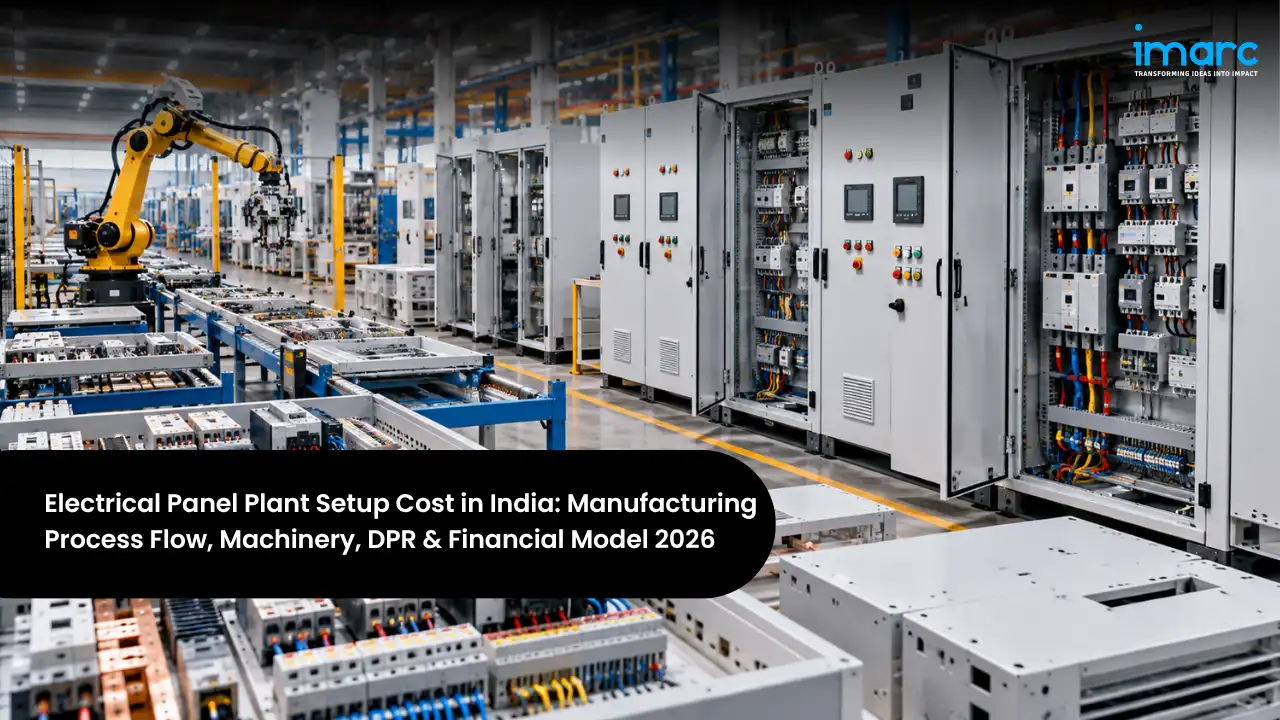
Setting up an Electrical Panel Manufacturing Plant in India is a fabrication-and-assembly venture powered by heavy grid modernisation, a fast-growing renewable-energy build-out, rising industrial and commercial construction, and the spread of automation across factories and buildings. Electrical panels sit at the heart of every power distribution and control system, and demand now climbs with each new substation, solar park, data centre, factory, and commercial project that needs safe, reliable power management. With sustained transmission-and-distribution investment, a large industrial base, and a clear push toward smart and energy-efficient systems, an Electrical Panel Manufacturing Plant is one of the more strategic and scalable opportunities in India's electrical-equipment economy.
The Electrical Panel Manufacturing Plant Cost depends heavily on scale, product range, and the degree of in-house fabrication versus bought-out components. Switchgear components, copper busbars, and CRCA steel together form the majority of the bill of materials, so component sourcing, design efficiency, and fabrication capability are the most important decisions in the project, and together they shape the overall Electrical Panel Investment Cost. A compact assembly-and-wiring unit can start modestly, while a large plant with in-house sheet-metal fabrication, powder coating, and testing serves a very different, more demanding market.
This guide is written for investors and entrepreneurs asking how to start an Electrical Panel manufacturing plant in India. It covers what the business involves, why demand is rising, the process flow, the raw materials required, location and infrastructure planning, a detailed cost and financial breakdown, the licenses you must secure, and how a project report and DPR turn all of this into a bankable plan.
India Market Snapshot
| Key Facts | Details |
|---|---|
| India Electrical Equipment Market | Large, fast-growing (indicative) |
| Primary Products | LT panels, MCC, PCC, control panels |
| Projected Market CAGR (2026-2032) | 6-9% (indicative) |
| Typical Plant Capacity | 300 - 5,000+ panels/year |
| Indicative Total Investment | INR 2-40 Crore |
| Typical Payback Period | 3-5 Years |
The snapshot captures why an Electrical Panel Manufacturing Plant in India attracts strong investor interest: sustained grid and infrastructure spending, a large industrial base, and a structural shift toward automation, renewables, and reliable power management. The wide investment range reflects a genuine choice of scale and scope, from a lean assembly-and-wiring unit to a large plant with in-house sheet-metal fabrication, powder coating, and full testing. Because electrical panels are essential to almost every project that uses power, the demand base is structurally steady and growing, even though the business is engineering- and quality-intensive, which is part of why lenders view well-run, well-certified plants favourably. The rest of this guide unpacks that decision in detail.
Investment Highlights
Indicative Project Cost in India (2026)
| Cost Head | Indicative Range |
|---|---|
| Land & Building | INR 0.5-12 Crore |
| Sheet-Metal Fabrication | INR 0.5-10 Crore |
| Powder-Coating Line | INR 0.3-5 Crore |
| Busbar & Assembly Tools | INR 0.3-5 Crore |
| Testing & Instruments | INR 0.3-4 Crore |
| Working Capital | INR 1-15 Crore |
| Pre-operative & Contingency | INR 0.3-4 Crore |
| Indicative Total | INR 2-40 Crore |
These figures are indicative and scale with capacity, product range, and how much fabrication is done in-house. A lean assembly unit that buys enclosures and focuses on wiring sits near the lower end, while a large plant with laser cutting, CNC punching, bending, powder coating, and full testing sits near the top. The single largest swing factor is the depth of in-house fabrication, since sheet-metal and coating equipment adds significant capital but improves control, quality, and margin at scale.
Table of Contents
- What is Electrical Panel Manufacturing?
- Why is Electrical Panel Manufacturing Growing in India?
- Electrical Panel Manufacturing Process
- Raw Materials and India Sourcing
- Location, Land & Infrastructure
- Machinery and Equipment Required
- Electrical Panel Manufacturing Plant Setup Cost in India (CapEx & OpEx)
- Financial Analysis and Profitability
- Licenses and Approvals for Electrical Panel Manufacturing Plant in India
- Recent Developments in the India Electrical Panel Manufacturing Industry
- How an Electrical Panel Manufacturing Project Report and DPR Helps Investors
- Frequently Asked Questions
What is Electrical Panel Manufacturing?
Electrical panel manufacturing is essentially an engineering, fabrication, and assembly operation. It combines a fabricated sheet-metal enclosure with switchgear components such as breakers, contactors, and relays, copper or aluminium busbars, wiring, meters, and controls, assembled and tested to a defined electrical design for safe power distribution or control. Unlike a continuous chemical process, most panel builders fabricate or buy enclosures and then mount, bus, wire, and test components to customer or standard specifications, so the technical heart of the business is accurate design, clean fabrication, correct assembly, and rigorous testing that ensure every panel is safe and reliable.
The economics of an Electrical Panel Manufacturing Plant are shaped by this assembly-and-engineering nature. Bought-out switchgear components, copper busbars, and CRCA steel typically account for the large majority of cost, so the value a plant adds lies in design capability, efficient fabrication, quality assembly, reliable testing, and certification or approvals. Because much of the material is bought out, procurement, design efficiency, and workmanship strongly influence margin. Engineered, certified, and control-and-automation panels carry better margins than basic distribution boards, which is why product mix and engineering strength matter as much as volume.
It is useful to think of the plant as a system that converts steel, copper, and components into safe, certified, correctly engineered assemblies, where design discipline, fabrication quality, and testing decide whether the plant earns repeat business and healthy margins. Many entrants begin as job-work fabricators or sub-assemblers for larger firms and contractors, securing steady volume before investing in their own brand and approvals. This route lowers market risk, keeps fabrication and assembly capacity loaded, and builds the track record and certifications that lenders and large customers look for, after which successful plants add their own brand, a wider product range, and a growing share of engineered and automation panels.
- Power distribution panels: PCC, MCC, and distribution boards that receive and distribute power across facilities, the high-volume core segment.
- Control & automation panels: PLC, relay, and APFC panels for process control and power-factor correction, a higher-margin engineered category.
- Special & MV panels: Feeder pillars, metering panels, and medium-voltage assemblies that broaden the portfolio for demanding projects.
The Main Segments in Electrical Panel Manufacturing
Investors usually target one or two segments based on capital, engineering capability, and customer access. The table below outlines the common configurations.
| Segment | Typical Capacity | Capital Intensity | Best Fit For |
|---|---|---|---|
| Distribution (PCC/MCC) | 500-5,000 panels/yr | Moderate | Contractors & industry |
| Control / automation | 300-3,000 panels/yr | Moderate | Engineered-panel focus |
| APFC & metering | 300-2,000 panels/yr | Low-Moderate | Specialist suppliers |
A first-time promoter often begins with distribution panels and a strong contractor or industrial relationship, then broadens into control, automation, and medium-voltage products as engineering capability and approvals mature. Each step toward engineered and certified products can improve margins but requires deeper design know-how, stronger testing, and relevant approvals. A key advantage of this business is that the same fabrication and assembly base can make several panel types, so a plant can widen its portfolio without proportional new capital, spreading fixed costs across more revenue lines.
Why is Electrical Panel Manufacturing Growing in India?
Key Growth Drivers in the Indian Market
India's electrical-equipment market is among the most attractive in the world because power infrastructure, renewables, and industrial capacity are all expanding at once. As the grid is modernised, renewable capacity scales up, factories automate, and commercial construction grows, demand for electrical panels rises steadily across utility, industrial, and building segments. Several forces reinforce this trend.
- Grid modernisation & T&D capex: Large transmission-and-distribution upgrades and grid-strengthening schemes drive panel and switchgear demand.
- Renewable-energy build-out: Solar parks, wind, and grid integration need extensive power-control and distribution panels.
- Industrial & infrastructure growth: New factories, metros, airports, and buildings all require distribution and control panels.
- Data centres & EV charging: Fast-growing data centres and EV charging networks add demand for reliable power management.
- Automation & efficiency: The shift to smart, energy-efficient, and automated systems lifts demand for control panels.
India-Specific Market Opportunity
| Driver | What It Means | Impact on Plant |
|---|---|---|
| Grid upgrades | T&D modernisation spending | Broad volume base |
| Renewables | Solar & wind integration | Distribution-panel demand |
| Industrial capex | New factories & automation | Control-panel upside |
| Data & EV growth | Reliable power management | New demand segments |
| Smart systems | Digital & efficient panels | Higher-margin mix |
For an investor, the message is clear: a well-run Electrical Panel Manufacturing Plant in India serves a market that is both large and structurally growing, provided the plant manages component costs, engineering quality, and delivery well. Because panels feed power, infrastructure, and industrial output, demand is tied to long-term national investment priorities, which gives the business a structural quality that lenders and long-term investors value.
Electrical Panel Manufacturing Process
Producing a finished panel is a controlled engineering-to-assembly flow. Whether a plant runs manual fabrication or CNC-based lines, the same core stages apply, differing mainly in scale, automation, and the range of products made. Accurate design, clean fabrication, correct assembly, and rigorous testing are what separate a reliable, certified panel from a costly rework or a field failure. Understanding the full Electrical Panel Manufacturing Process helps promoters decide where to invest in fabrication, how much testing to build in, and which quality controls to prioritise.
The Electrical Panel Manufacturing Process
The table below walks through a typical plant from design and incoming material to a tested, packed panel.
| Stage | What Happens |
|---|---|
| Design & engineering | Electrical and mechanical designs are prepared to customer or standard specs. |
| Material & component receipt | CRCA steel, busbars, breakers, and components are received and inspected. |
| Sheet-metal cutting | Enclosure sheets are cut and punched by laser, CNC, or shearing. |
| Bending & forming | Cut sheets are bent and formed into enclosure sections. |
| Welding & assembly | Sections are welded and assembled into the panel structure. |
| Powder coating | Enclosures are cleaned, coated, and cured for finish and protection. |
| Busbar & component mounting | Busbars, breakers, contactors, and controls are mounted and bused. |
| Wiring & termination | Internal wiring, terminations, and labelling are completed to drawing. |
| Testing & dispatch | Panels are tested for safety and function, inspected, packed, and dispatched. |
The most sensitive stages are design, wiring, and testing, because a design error, a poor termination, or a missed test can cause a field failure that is dangerous and costly and quickly damages the plant's reputation. Investing in a capable design team, skilled wiring staff, and proper testing equipment is essential; it is where quality and safety are won or lost, and it protects the business more than almost any other spend in the plant. Larger plants add CNC fabrication and structured testing to improve consistency and throughput while keeping skilled attention on design and assembly. Because panels are often engineered to order, disciplined project management and documentation are as important as the physical build.
Raw Materials and India Sourcing
Materials and bought-out components dominate the cost of every panel, so a dependable, competitively priced supply base is central to the business case. Switchgear components such as breakers, contactors, and relays are the largest input, followed by copper or aluminium busbars, CRCA sheet steel, wiring, meters, and powder paint. India has a strong domestic base for CRCA, busbars, wiring, and enclosures, while premium switchgear components come from established brands, so sourcing strategy and design efficiency directly determine margin.
| Material | India Sourcing | Role in Product | Share |
|---|---|---|---|
| Switchgear components | Domestic brands | Protection & switching | High |
| Copper / aluminium busbars | Domestic | Power carrying | Med |
| CRCA sheet steel | Domestic | Enclosure structure | Med |
| Wiring & terminals | Domestic | Internal connections | Low-Med |
| Powder paint & hardware | Domestic | Finish & assembly | Low |
Because components and materials drive cost, procurement scale, supplier tie-ups, and design efficiency are the main levers for protecting margin. Many promoters build relationships with switchgear brands for reliable, approved components, source CRCA, busbars, and wiring locally, and standardise designs to cut waste and speed delivery. Managing exposure to copper and steel price movements through timing and contracts is a core discipline in this business.
Location, Land & Infrastructure
Location influences component logistics, customer proximity, skilled labour, and compliance. Because panels are engineered to order and often bulky, closeness to industrial customers, contractors, and component suppliers matters. Choosing the best location for Electrical Panel manufacturing plant setup means balancing market access, component sourcing, skilled-labour availability, and state incentives.
Best States for Electrical Panel Manufacturing Plant Setup in India
| State / Cluster | Why It Works | Best For |
|---|---|---|
| Maharashtra | Industrial base & market access | Industry & contractor supply |
| Gujarat | Manufacturing hub & logistics | Industrial & export plants |
| Tamil Nadu | Strong industry & engineering | South India supply |
| Karnataka | Industry, IT & data centres | Automation & data demand |
| Haryana / NCR | North demand centre, logistics | Distribution-led plants |
The right choice depends on your market and sourcing strategy. A plant near industrial clusters and contractors shortens delivery and service, while access to skilled electrical and fabrication labour underpins quality and throughput. State-level incentives, industrial-land availability, and reliable power can tip the decision, so promoters should weigh total delivered cost and market proximity rather than land price alone.
Infrastructure Requirements (Mid-Sized Plant)
| Utility | Indicative Need | Notes |
|---|---|---|
| Land | 0.5-4 acres | Scales with fabrication & storage |
| Power | 0.1-1 MW | Fabrication, coating, testing |
| Compressed air | Clean, dry supply | Coating & tools |
| Fabrication shop | Cutting, bending, welding | Core in-house capability |
| Testing area | Safe, equipped test bay | Quality & certification |
| Storage | Component & finished-goods store | Manages inventory & projects |
Because quality and safety are central, a well-equipped testing area and a controlled fabrication shop are core to plant design, not afterthoughts. Adequate storage for components and finished panels also underpins smooth project execution and dispatch, so utility and layout planning is both a quality and a commercial decision.
Machinery and Equipment Required
The machinery list depends on scale, the panel types made, and how much fabrication is done in-house. A compact plant needs basic fabrication tools, busbar and assembly tools, and testing instruments, while a large plant adds laser cutting, CNC punching, bending, welding, and a powder-coating line. The table below covers the core equipment for a mid-sized plant.
| Machinery | Function | Indicative Cost |
|---|---|---|
| Laser / CNC cutting | Sheet-metal cutting | INR 0.5-8 Crore |
| CNC turret punch | Punching & perforation | INR 0.5-6 Crore |
| Press brake / bending | Enclosure forming | INR 0.3-4 Crore |
| Welding equipment | Structure assembly | INR 0.2-3 Crore |
| Powder-coating line | Finish & protection | INR 0.3-5 Crore |
| Busbar machines | Cutting, bending, punching | INR 0.2-3 Crore |
| Assembly & wiring tools | Mounting & termination | INR 0.2-3 Crore |
| Testing instruments | Safety & function testing | INR 0.3-4 Crore |
| Material handling | Cranes, trolleys, storage | INR 0.2-3 Crore |
For most new entrants, the highest-value investments are fabrication capability, powder coating, and reliable testing. CNC cutting, punching, and coating are added as volumes and product complexity grow, improving consistency and throughput while controlling cost per panel. A flexible plant that can switch between panel types and sizes with minimal changeover is a real advantage, because customer requirements vary widely and demand shifts steadily toward engineered and automation panels.
Electrical Panel Manufacturing Plant Setup Cost in India (CapEx & OpEx)
The Electrical Panel Manufacturing Plant Cost splits into one-time capital expenditure and recurring operating expenditure. CapEx is driven by land, buildings, fabrication and coating equipment, and testing, while OpEx is overwhelmingly dominated by bought-out components, copper, and steel, making procurement and design efficiency the decisive levers on profitability.
Capital Expenditure (CapEx) Cost Structure
| CapEx Head | Share | Notes |
|---|---|---|
| Land & building | 12-22% | Includes shop & storage layout |
| Plant & machinery | 30-45% | Fabrication, coating, testing |
| Utilities & tooling | 6-12% | Power, air, jigs, fixtures |
| Pre-operative & contingency | 5-10% | Setup, trials, buffer |
| Initial working capital | 25-40% | Components & material inventory |
| Indicative total | INR 2-40 Cr | Scales with fabrication depth |
Operating Expenditure (OpEx) Cost Structure
| OpEx Head | Share | Notes |
|---|---|---|
| Components & busbars | 55-70% | Dominant, brand & copper-linked |
| Steel & consumables | 8-15% | CRCA, paint, hardware, wire |
| Labour & engineering | 8-16% | Design, fabrication, wiring, test |
| Power & utilities | 2-5% | Fabrication, coating, testing |
| Logistics & installation | 3-7% | Delivery & site support |
| Overheads & selling | 4-8% | Approvals, admin, marketing |
Because components, copper, and steel account for the bulk of OpEx, even small improvements in sourcing, design standardisation, and material yield flow straight to the bottom line. This is why procurement discipline, efficient design, and product mix matter so much in this business.
Financial Analysis and Profitability
Electrical panels are an engineering-and-project business where basic distribution boards earn moderate margins and engineered, certified, or automation panels earn more. Returns depend on order flow, product mix, engineering and quality strength, and disciplined management of component and material costs. A credible Electrical Panel Financial Model tests these variables and shows how sensitive returns are to copper and component prices, utilisation, and the engineered-product share.
| Metric | Indicative Range | Notes |
|---|---|---|
| Net profit margin | 8-16% | Higher with engineered mix |
| Gross margin | 20-35% | Driven by components & design |
| Capacity utilisation | 55-85% | Builds with order flow |
| Payback period | 3-5 years | Faster for lean assemblers |
| Project IRR | 18-28% | Sensitive to mix & approvals |
| Return on capital | 16-26% | Improves with brand & scale |
Assessing the profitability of Electrical Panel manufacturing business in India means looking beyond a single order cycle to a full, multi-year view. Well-run plants earn healthy returns by combining strong engineering, reliable quality and approvals, a steady order pipeline, a growing share of engineered and automation panels, and disciplined procurement. A thorough Electrical Panel Feasibility Report stress-tests these assumptions before capital is committed.
The biggest financial swing factors are copper and component prices, order flow and utilisation, engineering quality, and approvals. Because much of the material is bought out and basic-panel margins are moderate, the difference between a strong and a weak year often comes down to procurement, design efficiency, and how effectively the plant wins and delivers higher-margin engineered and certified panels.
Key Risks and Mitigation
The main risks are copper and component price volatility, dependence on project order flow, intense competition from established brands and unorganised fabricators, and quality or safety failures. These are mitigated by strategic sourcing and supplier tie-ups, design standardisation and efficiency, a growing share of engineered and certified panels, strong customer relationships across industry and contracting, and rigorous testing and quality control backed by relevant approvals. Building the brand, approvals, and engineering strength steadily, rather than competing only on price, is what turns a basic fabricator into a durable, profitable business, and many entrants start with job-work to load capacity while their brand and certifications build.
Licenses and Approvals for Electrical Panel Manufacturing Plant in India
Every manufacturers must obtain the approvals, registrations, licences, testing and certifications applicable to their products, premises and intended customers. Because panels are safety-critical electrical equipment, product standards, testing, and type approvals are especially important, alongside factory and standard business registrations. Working with an experienced Electrical Panel Manufacturing Consultant in India helps sequence these approvals correctly and avoid costly delays.
- Factory & trade Licenses: Factory License and local trade/establishment approvals for the manufacturing site.
- BIS / product standards: Compliance with applicable electrical-panel and switchgear safety standards.
- Type tests & certifications: Type/design verification and test reports may be required by applicable standards, utilities, EPCs and customer specifications.
- Pollution-control consent: Consent to establish and operate, covering coating and workshop emissions.
- GST, trademark & registrations: Company incorporation, GST, trademark, and other statutory registrations.
Manufacturers should also plan for safe workshop practices and electrical-testing discipline, which are both regulatory requirements and reputational factors. Getting the standards, testing, and approval strategy right early avoids expensive rework and lost tenders.
Because type approvals and product certifications gate access to utility and large-buyer orders, promoters should build these approval timelines into the project schedule from the outset rather than treating them as an afterthought before bidding.
Recent Developments in the India Electrical Panel Manufacturing Industry
The Indian electrical-equipment industry is in a phase of strong demand and modernisation. Requirements are moving from basic distribution boards toward smart, compact, energy-efficient, and automation-ready panels, driven by grid upgrades, renewables, data centres, and digitalisation.
- Smart & digital panels: Sensor-rich, monitored panels support condition monitoring and energy efficiency.
- Renewables & storage: Solar, wind, and storage integration drives demand for specialised power panels.
- Data centres & EV: Data-centre power distribution and EV charging add new, reliability-focused demand.
- Compact & modular designs: Space-saving, modular panels suit modern buildings and industrial layouts.
- Energy-efficiency focus: Efficient, safe, and standards-compliant designs command better positioning.
For a new entrant, these trends favour plants that build strong engineering and quality credibility, focus on growing engineered, smart, and automation panels, and stay flexible across panel types that widen reach and improve economics.
How an Electrical Panel Manufacturing Project Report and DPR Helps Investors
A detailed Electrical Panel Project Report converts market opportunity into a structured, financeable plan. It sizes the market, fixes capacity and product mix, quantifies the Electrical Panel Manufacturing Plant Cost, and models revenue, costs, and returns across order and price cycles. For most promoters, this is the document that anchors both internal decisions and lender conversations.
A bankable Detailed Project Report (DPR) typically combines a market study, a technical plan covering process and machinery, a full financial model, a risk assessment, and a compliance roadmap. Working with an experienced Electrical Panel Plant Project Report Consultant in India ensures the assumptions are realistic and the report meets lender expectations. A well-structured Electrical Panel Business Plan then translates that analysis into an execution and go-to-market strategy, covering product mix, target segments, approvals, and the phasing of engineered and automation panels over time. The strongest plans are built around scenarios rather than a single forecast, so promoters can see how the venture performs across a copper-price spike, a slow order period, or a faster shift to engineered products.
Before committing capital, prudent investors commission an Electrical Panel Manufacturing Feasibility Study Consultant to validate demand, component sourcing, location, and financials independently, and many also retain an Electrical Panel Business Plan Consultant in India to sharpen positioning and channel strategy. Together, a rigorous feasibility study, a detailed project report, and a well-built Electrical Panel Financial Model give investors and lenders the confidence that the plant can navigate component-cost volatility, project-order cycles, and competition to deliver sustainable returns. This documentation is also what unlocks term loans and working-capital limits needed to fund components and project execution.
In short, electrical panel manufacturing in India offers a large, growing, and strategically important market tied to power, infrastructure, and industry. The businesses that succeed respect the realities of bought-out component costs and project-driven demand, invest early in engineering, quality, and approvals, grow their engineered and automation mix, and back every major decision with rigorous planning. For an investor who approaches it with discipline, an Electrical Panel Manufacturing Plant can be a durable, scalable participant in one of the country's most essential electrical-equipment value chains.
Frequently Asked Questions
How much does it cost to set up an electrical panel manufacturing plant in India?
The indicative Electrical Panel Investment Cost ranges from around INR 2 crore for a compact assembly-and-wiring unit to INR 40 crore or more for a large plant with in-house laser cutting, CNC punching, bending, powder coating, and full testing. The biggest swing factors are the depth of in-house fabrication, product complexity, and working capital for components and copper.
How to start an electrical panel manufacturing plant in India?
Start with a feasibility study and project report, choose your panel segments, secure land near industrial customers, obtain factory, product-standard, and testing approvals, set up fabrication, coating, assembly, and testing, and build supplier tie-ups for switchgear components and busbars. An Electrical Panel Manufacturing Consultant in India can help sequence these steps.
Is electrical panel manufacturing profitable in India?
It can be, given strong structural demand, though basic-panel margins are moderate. Net margins of roughly 8-16% are typical, improving with a higher share of engineered, certified, and automation panels, strong order flow, and disciplined procurement. Returns depend on utilisation, mix, and engineering strength, which is why a detailed Electrical Panel Financial Model is essential.
What are the main raw materials?
The key inputs are switchgear components such as breakers, contactors, and relays, copper or aluminium busbars, CRCA sheet steel, wiring, meters, powder paint, and hardware. Bought-out components and copper are the largest costs, so component sourcing and design efficiency are critical to margin.
What licenses are required for an electrical panel manufacturing plant?
The essential approvals include a factory License, applicable BIS, type-test reports and certifications for utility and large-buyer supply, pollution-control consent, and standard GST, trademark, and company registrations.
Where is the best location for an electrical panel manufacturing plant?
The best location for Electrical Panel manufacturing plant setup depends on market and sourcing strategy. Industrial states such as Maharashtra, Gujarat, Tamil Nadu, or Karnataka suit plants close to customers and component suppliers, while proximity to skilled electrical and fabrication labour and reliable power supports quality and delivery.
Our Clients










Contact Us
Have a question or need assistance?
Please complete the form with your inquiry or reach out to us at
Phone Number
+91-120-433-0800+1-201-971-6302
+44-113-547-7077
Previous Post

Saudi Arabia has turned its power transition into one of the world's largest procurement programmes, and international developers, lenders, and equipment makers are following the tenders.
Setting up a Battery Manufacturing Plant in India is a high-demand, energy-driven venture, powered by the country's booming automotive sector, huge power-backup market, and the fast-growing shift to electric vehicles and renewable storage.
Setting up a Liquefied Natural Gas (LNG) Manufacturing Plant in India is a capital-intensive, strategically important venture, powered by the country's push toward a gas-based economy, the shift to cleaner fuels in transport and industry, and rising demand for LNG as a truck, bus, and industrial fuel.
The India carbon credit market is moving from a voluntary, project-by-project trade into a regulated national system with binding targets, a central registry, and exchange-based price discovery. According to IMARC Group, the market was valued at USD 33.69 Billion in 2025, grew to USD 44.42 Billion in 2026, and is projected to reach USD 405.47 Billion by 2034, expanding at a CAGR of 31.84% (2026–2034).
Setting up a Syngas Production Plant in India is a capital-intensive but strategically valuable venture, driven by the country's push for cleaner industrial fuels, coal and biomass utilization, and chemical self-reliance. Syngas, or synthesis gas, is a mixture of hydrogen and carbon monoxide produced by gasifying carbon-rich feedstocks, and it serves as a versatile building block for power, chemicals, hydrogen, and synthetic fuels. With abundant biomass, coal, and waste feedstock and growing policy support for gasification, India offers a favourable environment for new plants.
Setting up a Battery Energy Storage System Manufacturing Plant in India is a capital-efficient, high-growth venture, driven by the country's renewable energy expansion, grid modernization, and supportive storage policies. As solar and wind capacity scales up and the grid needs to balance variable generation, battery energy storage systems have become essential infrastructure.
Setting up a Lithium-ion Battery Recycling Plant in India is a capital-intensive but high-potential venture. India's rapid rise as a major electric-vehicle market, its large consumer-electronics base, and its fast-growing energy-storage sector are together creating one of the deepest and fastest-expanding pools of end-of-life lithium-ion batteries in the world.
Solar glass is a type of specialty glass that has high transmittance and is designed exclusively for use in solar energy systems. Unlike regular flat glass, solar glass is designed to have maximum light transmission with minimal losses due to reflection and absorption.
A solar inverter is a vital component in solar photovoltaic (PV) systems, responsible for transforming the direct current (DC) electricity produced by solar panels into alternating current (AC) electricity. This AC power is then suitable for use by the electrical grid, various appliances, and industrial equipment.
Australia has firmly established itself as a dominant force in the global liquefied natural gas (LNG) market, maintaining its position as one of the world's leading exporters. The country's strategic geographical location in the Asia-Pacific region, combined with substantial natural gas reserves, has enabled it to become a critical energy supplier to rapidly growing Asian economies, particularly China, Japan, and South Korea.
Japan's lead acid battery market stands as a cornerstone of the nation's energy storage infrastructure, demonstrating remarkable resilience and adaptability in an era dominated by rapid technological evolution. Despite the global shift toward lithium-ion technologies, the Japanese lead acid battery sector continues to thrive, driven by its unmatched cost-effectiveness, proven reliability, and exceptional recyclability.
Green hydrogen is the cleanest form of hydrogen available, as it is produced through water electrolysis using the electricity generated from renewable energy sources such as solar, wind, or hydropower. Carbon dioxide emissions are zero since no fossil fuels are used. Essentially, an electrolyzer is used in the electrolysis process to split water molecules into hydrogen and oxygen. The resulting hydrogen is refined by purification, compression, or liquefaction and then fed into various applications. Green hydrogen is considered a cornerstone of the global energy transition because it can store renewable energy, decarbonize hard-to-abate sectors, and serve as a sustainable alternative to fossil-fuel-based hydrogen.
Japan’s thermal power plant industry remains a crucial pillar of the nation’s energy infrastructure, providing a stable and reliable source of electricity for both industrial and residential consumption. Thermal power generation, which primarily involves the combustion of fossil fuels such as coal, natural gas, and oil, continues to play a key role despite increasing investments in renewable energy.
An electrical panel, also called a distribution board or switchboard, is an important installation in electrical infrastructure that acts as the main center for the distribution, control, and protection of electrical power within residential, commercial, and industrial systems. It acts as the point at which electrical energy is received from the utility or a source of power generation and is distributed to various circuits and equipment in an organized manner.
The global oil and gas EPC market is currently experiencing a remarkable transformation as it positions itself at the intersection of traditional energy demands and technological innovation. As of 2024, the market is demonstrating robust growth, reaching USD 52.9 Billion in 2024, depending on regional scope and market segmentation approaches. This substantial market base is supporting a major number of capital projects worldwide, including offshore platform projects and onshore installations that are collectively shaping the energy landscape.
Bamboo pellets are a biomass fuel type created through the compression of bamboo residues like shavings, sawdust, and chips into thick cylindrical pellets. They are an environmentally friendly substitute for conventional fossil fuels like natural gas and coal. Due to the fast growth rate and high biomass yield of bamboo, it has become one of the most renewable raw materials for the production of bioenergy.
Biomass briquettes are dense, solid fuel blocks made of compressed organic waste materials like sawdust, agricultural wastes, wood shavings, coconut shells, rice husk, or herbaceous biomass. The briquetting process usually involves drying the biomass to lower the moisture content (usually down to 10-15%), grinding or milling for a fine particle size uniformity, and then compressing under high pressure with or without a binding agent.
Biogas is a renewable energy form generated by the anaerobic fermentation of organic matter including agricultural residues, animal waste, municipal solid waste, sewage sludge, and food waste. Microorganisms in the absence of oxygen break down organic substances in the process and produce a gaseous mixture of mainly methane (CH4) and carbon dioxide (CO2), with traces of hydrogen sulfide (H2S) and water vapor.
A battery is an electrochemical energy storage system that transforms chemical energy into electrical energy by way of redox reactions between its electrodes and electrolyte. It consists of a single or multiple electrochemical cells, each having a positive electrode (cathode), a negative electrode (anode), and an electrolyte for ion transfer. Batteries are categorically divided into primary (non-rechargeable) and secondary (rechargeable) types.
The global energy landscape is undergoing a seismic transformation, with green hydrogen emerging as one of the most promising solutions to achieve deep decarbonization across sectors. Far from a niche technology, green hydrogen is emerging as a critical pillar of the future energy system, offering a pathway to a sustainable and resilient economy.
Transmission line towers are essential support components of transmission lines installed on overhead to distribute high-voltage electricity over long distances. Towers are made of galvanized steel, primarily, and are designed to tolerate mechanical stress, environmental loads, and electrical safety. Some of the important characteristics of transmission line towers are high structural strength, corrosion resistance, adaptability for modular design, and high service life. They are normally produced in lattice form (tubular or free-standing towers) or tubular form, with types including suspension towers, tension towers, angle towers, and terminal towers based on use.
The energy storage revolution is here, and it's powered by graphene. While the world struggles with the limitations of conventional lithium-ion batteries, a new technology is emerging that promises to shatter every performance barrier we've accepted as unchangeable.
Australia is undergoing a significant energy transformation, underscoring the growing role of renewable energy sources. These sources are key to combating climate change by reducing greenhouse gas emissions, the primary cause of global warming and air pollution. Beyond environmental benefits, renewable energy strengthens energy security by diversifying power sources and reducing dependence on volatile fossil fuel imports, contributing to greater energy independence.
Learn how to plan capital investment, manage raw material costs, post manufacturing cost and optimize operations for setting up solar panel plant.
Battery Energy Storage System (BESS) represents a power grid technology that stores electricity to enhance electric power grid reliability while increasing operational efficiency. BESS permits battery recharging during periods of low demand or extra grid supply capacity. BESS provides three principal operational functionalities which include power grid stabilization during supply disruptions, control of energy supply variations, and integration of intermittent renewable generation from wind and solar resources.
China's economic presence is expanding globally, and Latin America and the Caribbean (LAC) have become a focal point for its investments, especially within the energy sector. The region, rich in natural resources and experiencing rising energy demands, offers strategic opportunities for Chinese energy giants looking to invest and expand. LAC is currently leading a transformative movement towards sustainable energy. From 2015 to 2022, the region increased its renewable energy capacity by an impressive 51%, now generating 64% of its electricity from renewables such as hydropower, wind, and solar. This shift addresses the global demand for cleaner energy while supporting local economic growth and enhancing energy security.
Hydrogen is a clean, renewable, and widely available energy source that can be produced through various methods. Production techniques such as coal gasification, steam methane reforming, electrolysis, and thermochemical processes highlight its versatility. Hydrogen is essential in several critical sectors, including methanol and ammonia production, petroleum refining, transportation, power generation, as well as in electronics, metal industries, and as a rocket propellant. The increasing concern over carbon emissions and greenhouse gases has led to a shift towards cleaner fuel options. Hydrogen is recognized for its cleanliness and versatility as an energy carrier. Additionally, supportive government initiatives and favorable policies are driving the growth of hydrogen production globally.
Hydrogen is a clean, renewable, and abundant energy source derived from various methods. Its applications span across transportation, heating, and power generation. Diverse production methods, including coal gasification, steam methane reforming, electrolysis, and thermochemical processes, contribute to its versatility. Hydrogen plays a pivotal role in crucial sectors like methanol and ammonia production, petroleum refining, transportation, power generation, as well as in electronics, metal industries, and as a rocket propellant.
A floating solar farm is a renewable energy installation in which solar panels are mounted on floating structures in water bodies such as lakes, reservoirs, ponds, or even the sea. This technology, also known as a floating photovoltaic (PV) system, or “floatovoltaics,” enables solar power generation in areas with limited available land or where land use is restricted for other purposes. Floating solar farms offer various benefits, including improved solar panel efficiency through cooling, land conservation, reduction of evaporation and algae growth, and integration with hydropower facilities to generate both solar and hydroelectric power in the same location.
Nuclear power utilizes nuclear reactions to generate heat, which is then converted into electricity. This energy is released from the nucleus—the core of atoms composed of protons and neutrons. Nuclear power can be derived from nuclear fission, nuclear decay, and nuclear fusion reactions. Across the globe, nuclear power plants predominantly use the fission of uranium and plutonium to produce electricity. The heat generated from fission is used to create steam, which drives turbines connected to generators. Nuclear power offers several advantages over fossil fuels, such as minimal greenhouse gas emissions and a higher energy density, meaning a small amount of nuclear fuel produces a large amount of energy.