Smartphone Manufacturing Cost Analysis: Engineering Mobility, Measuring Margins
What is Smartphone?
A smartphone is a portable electronic device that combines sophisticated capabilities in computer processing, wireless communication, multimedia entertainment, and internet access. Smartphones are distinct from other mobile phones in that their operation involves highly sophisticated platforms of operation that are capable of supporting multiple applications, multitasking, and connectivity with internet platforms. Smartphones are an amalgam of hardware components such as processors, memory, cameras, and touchscreens with software elements that can facilitate a multitude of functions falling within the realms of communication, computer processing, and the role of a personal digital assistant in their usage by a user through a single portable device.
Key Applications Across Industries:
Smartphones have applications ranging from personal, business, commercial, and institutional settings, making them one of the most versatile electronic products for consumption. From the user perspective, smartphones act as communication gadgets allowing the user to make voice calls, send messages, video call, or socialize. The products can be used for entertainment, with functionality for live streaming, playing games, taking photographs, listening to music, or creating content. The advanced camera feature has enabled smartphones to be used for day-to-day photography.
Professionally and organizationally, smartphones encourage productivity and mobility. With smartphones, users can view their emails, make modifications to texts and documents, hold online meetings, organize calendars and time management, and collaborate using cloud services. Smartphone applications also encourage professionals to organize financial matters, operations management, and communication as they work through remote or mobility operations for sales and medical and field service delivery organizations.
Smartphones are also used for electronic business as well as electronic financial services. Such services include electronic payment systems, electronic shopping, electronic investments, as well as electronic banking. The use of smartphones is also related to education, learning, teaching, as well as digital classrooms. Other sectors include telemedicine, personal health monitoring, as well as electronic appointments.
Smartphones are also significant interfaces for smart homes and devices for controlling other appliances and devices such as security systems and power consumption. The use of smartphones in navigation and ridesharing or ride-hailing services puts the technology into broader usage in daily activities.
What the Expert Says: Market Overview & Growth Drivers
The global smartphones market reached a volume of 1,563.8 Million Units in 2025. According to IMARC Group, the market is projected to reach 2,049.8 Million Units by 2034, at a projected CAGR of 2.96% during 2026-2034.
The global smartphone market is attributed to several factors such as digital transformation, innovation, and behavior change. One of the key driving factors for global smartphone market growth is the growing dependency on mobile network connectivity for communication, business, entertainment, and e-commerce. Hence, as smartphones form an essential part of daily life, a replacement drive is experienced based on improved performances.
The advancement of technology is an imperative factor that influences market development. There is innovation with regard to processors, display, camera capabilities, battery power, and wireless network technology, which improves the functionality of the smartphone and excites consumers. The adoption of AI, advanced security, and power-saving technology makes consumers upgrade to new gadgets.
An increasing usage of digital services also accelerates the demand. The rise in the usage of mobile applications, digital payments, streaming, and cloud computing increases the utility of the smartphone. As governments and companies embrace digital platforms for service delivery, the smartphone acts as the gateway to these services for the citizen and customer.
The emerging markets make a significant contribution to demand as well. The increasing disposable income, along with mobility network expansion and internet penetration, create opportunities for initial smartphone purchases and upgrades as well. Premiumization also drives demand in developed markets for high-end smartphones with cutting-edge features.
The trend of work patterns and lifestyles is also another factor that impacts the smartphone market. With the help of technological advancements, people are reliant on their smartphones for work from anywhere around the globe, online education, and on-demand services like online payment solutions, food delivery, and much more. Thus, with these trends, the market for smartphone manufacturing is witnessing steady growth.

Case Study on Cost Model of Smartphone Manufacturing Plant:
Objective
One of our clients reached out to us to conduct a feasibility study for setting up a medium scale smartphone manufacturing plant.
IMARC Approach: Comprehensive Financial Feasibility
We developed a comprehensive financial model for the setup and operation of a proposed smartphone manufacturing plant in India. This plant is designed to manufacture 1 million units of smartphone annually.
Manufacturing Process: The manufacture of a smartphone involves a complex, multi-step procedure that combines sophisticated electronics assembly, precision manufacturing, and quality control. The initial phase of the manufacturing process involves the fabrication or procurement of mainstream components like processors, memory, displays, cameras, batteries, and sensors. The semiconductor components are produced in specialized labs, while displays and camera modules have dedicated supply chains for manufacturing. Before being shipped off to assembly plants, individual components undergo testing.
During the assembly stage, the circuit boards are populated by electronic components via surface mount technology. The chips, resistors, and capacitors are placed on the circuit board by automated pick-and-place machines, followed by the soldering process to verify the electrical correctness. The assembled circuit board is further connected to other components, such as display, speakers, cameras, antennas, and batteries, to assemble in the smartphone. The mechanical process of assembly involves the correct positioning of frames, cases, buttons, and connectors.
The installation and calibration of software follow. The operating system, firmwares, and major applications are installed on the device, while the hardware components like cameras, sensors, and wireless modules are calibrated. The device is tested for functionality, which checks for all the functionalities like touch responsiveness, signal reception, audio, battery, and system stability.
Finally, quality assurance involves stress testing, cosmetic examination, and safety testing in order to ensure durability and conformance with regulations. After approval of the devices, they are cleaned and packaged with accessories as well as literature for distribution. This manufactures smartphones with emphasis on automation, coordination of the supply chain, as well as a commitment to quality control.
Get a Tailored Feasibility Report for Your Project Request Sample
Raw Material Required:
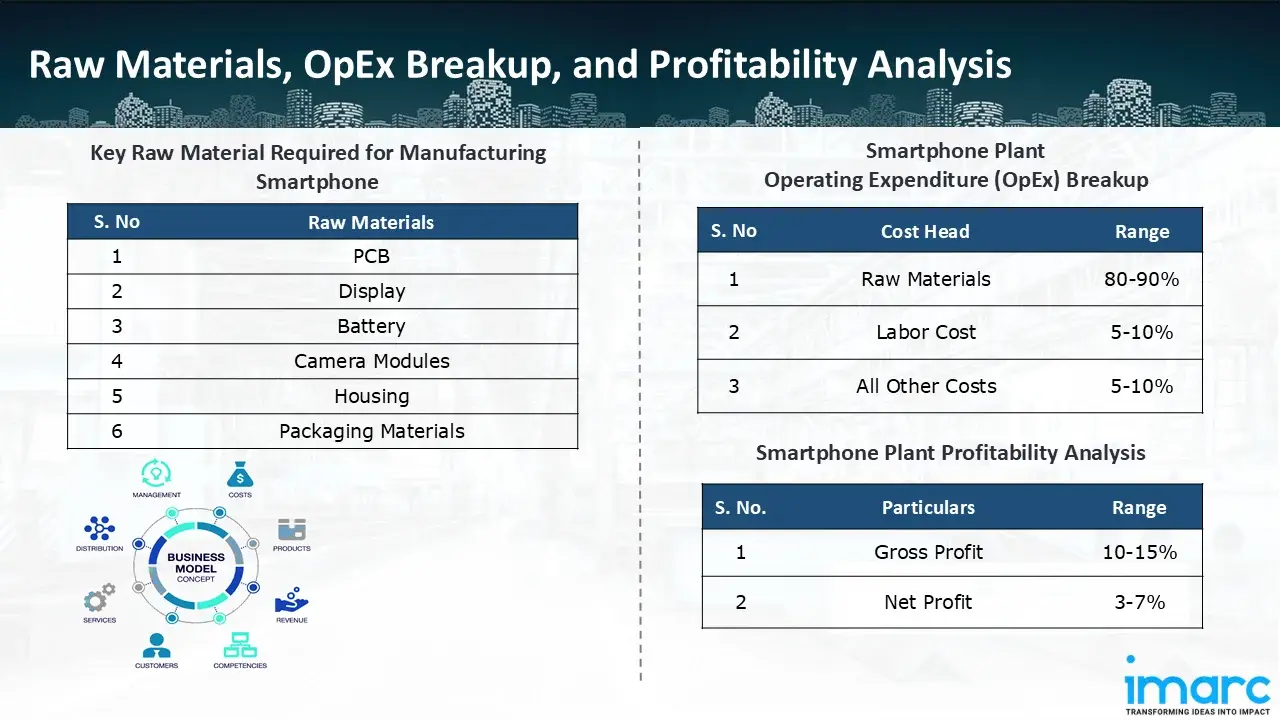
The basic raw materials required for smartphone manufacturing include:
- PCB
- Display
- Battery
- Camera Modules
- Housing
- Packaging Materials
Machine Section or Lines Required:
- SMT Line
- Assembly Line
- Testing
- Software Loading
- Packing
Techno-Commercial Parameter:
- Capital Expenditure (CapEx): Capital expenditure (CapEx) in a manufacturing plant includes various investments essential for its setup and long-term operations. It covers machinery and equipment costs, including procurement, installation, and commissioning. Civil works expenses involve land development, factory construction, and infrastructure setup. Utilities such as power, water supply, and HVAC systems are also significant. Additionally, material handling systems, automation, environmental compliance, and safety measures are key components. Other expenditures include IT infrastructure, security systems, and office essentials, ensuring operational efficiency and business growth.
- Operating Expenditure (OpEx): Operating expenditure is the cost incurred to operate a manufacturing plant effectively. OpEx in a manufacturing plant typically includes the cost of raw materials, utilities, depreciation, taxes, packing cost, transportation cost, and repairs and maintenance. The operating expenses are part of the cost structure of a manufacturing plant and have a significant effect on profitability and efficiency. Effective control of these costs is necessary for maintaining competitiveness and growth. Furthermore, raw material cost in smartphone manufacturing plant ranges between 80-90%, labor cost ranges between 5% to 10%, and all other costs ranges between 5-10% in the proposed plant.
- Profitability Analysis Year on Year Basis: We assisted our client in developing a detailed cost model, which projects steady growth, with revenue rising throughout the projected period. Moreover, gross profit margins lie between a range of 10-15%, and net profit lie between the range of 3-7% during the income projection years, highlighting strong financial viability and profitability.
Conclusion & IMARC's Impact:
Our financial model for the smartphone manufacturing plant was meticulously developed to meet the client’s objectives, providing an in-depth analysis of production costs, including raw materials, manufacturing, capital expenditure, and operational expenses. By addressing the specific requirements of manufacturing 1 million units of smartphone annually, we successfully identified key cost drivers and projected profitability, considering market trends, inflation, and potential fluctuations in raw material prices. This comprehensive financial model equipped the client with valuable insights into strategic decision-making, demonstrating our commitment to delivering high-quality, client-focused solutions that ensure the long-term success of large-scale manufacturing ventures.
Latest News and Developments:
- In January 2026, Google announced getting ready to make a significant change to its global supply chain by creating and producing high-end smartphones in Vietnam for the first time. The action is a result of US IT companies' efforts to lessen their reliance on China and create more comprehensive manufacturing ecosystems abroad.
- In August 2025, Apple recently announced a new USD 100 billion commitment to America, in a major acceleration of its U.S. investment, which now stands at USD 600 billion over the next four years. The ambitious new American Manufacturing Program (AMP), which aims to bring even more of Apple's advanced manufacturing and supply chain to the Americans.
Why Choose IMARC?
IMARC's Financial Model Expertise: Helping Our Clients Explore Industry Economics
IMARC is a global market research company that offers a wide range of services, including market entry and expansion, market entry and opportunity assessment, competitive intelligence and benchmarking, procurement research, pricing and cost research, regulatory approvals and licensing, factory setup, factory auditing, company incorporation, incubation services, recruitment services, and marketing and sales.
Under our factory setup services, we assist our clients in exploring the feasibility of their plants by providing comprehensive financial modeling. Additionally, we offer end-to-end consultation for setting up a plant in India or abroad. Our financial modeling includes an analysis of capital expenditure (CapEx) required to establish the manufacturing facility, covering costs such as land acquisition, building infrastructure, purchasing high-tech production equipment, and installation. Furthermore, the layout and design of the factory significantly influence operational efficiency, energy consumption, and labor productivity, all of which impact long-term operational expenditure (OpEx). So, every parameter is covered in the analysis.
At IMARC, we leverage our comprehensive market research expertise to support companies in every aspect of their business journey, from market entry and expansion to operational efficiency and innovation. By integrating our factory setup services with our deep knowledge of industry dynamics, we empower our clients to not only establish manufacturing facilities but also strategically position themselves in highly competitive markets. Our financial modeling and end-to-end consultation services ensure that clients can explore the feasibility of their plant setups while also gaining insights into competitors' strategies, technological advancements, and regulatory landscapes. This holistic approach enables our clients to make informed decisions, optimize their operations, and align with sustainable practices, ultimately driving long-term success and growth.
Our Clients










Contact Us
Have a question or need assistance?
Please complete the form with your inquiry or reach out to us at
Phone Number
+91-120-433-0800+1-201-971-6302
+44-113-547-7077
Previous Post

Semiconductor manufacturing is a highly specialized industrial process that involves the design, fabrication, and assembly of semiconductor devices including integrated circuits (ICs), memory chips, sensors, and discrete components. The process transforms raw semiconductor materials, primarily silicon, into sophisticated electronic components through a combination of physical and chemical processing steps, such as wafer fabrication, photolithography, doping, etching, thin-film deposition, and packaging.
The retail landscape is experiencing a profound transformation as self-checkout systems emerge as critical infrastructure components reshaping consumer experiences and operational efficiency globally. These automated solutions enable customers to independently scan, bag, and pay for purchases without cashier assistance, representing a fundamental shift in modern commerce.
The webcams market is experiencing unprecedented transformation as digital communication becomes the cornerstone of modern business, education, and healthcare. Global webcam industry dynamics are being reshaped by technological innovation and evolving workplace models.
As smartphones become a way of life for most Filipinos, the market has changed dramatically and expectations from consumers are higher than ever before. With the demand for smartphones growing, there is a significant change in consumer shopping habits with more emphasis on using online platforms for shopping. This change is closely interlinked with the fast growth of the Philippines e-commerce market, both bringing opportunities and challenges to the stakeholders of the smartphone industry.
As technology continues to advance, lighting has transformed from a basic necessity into a strategic enabler of innovation, efficiency, and sustainability. The evolution from incandescent bulbs to LEDs, smart systems, and intelligent lighting networks represents not just technological change but a redefinition of how energy, design, and functionality intersect in the built environment.
An LED light is an illuminating device that utilizes Light Emitting Diodes as its source of light, generating light through a semiconductor-based process called electroluminescence. When electrical current flows across the semiconductor material of the diode, electrons emit energy as photons and thus produce highly efficient and concentrated illumination.
An LED bulb is a solid-state lighting device that uses Light Emitting Diodes (LEDs) as its illumination source. Different from incandescent or fluorescent lamps, light in LED bulbs is produced by electroluminescence, a process where the passing of an electric current through a semiconductor material emits photons directly. This process is highly energy-efficient, with a far larger percentage of the electricity being converted to usable light and very little heat generated in the process.
The junction box, generally made from plastic, metal, or composite materials, houses wire connections, terminations, and protective components to allow the safe distribution and routing of electrical circuits. The junction box will provide insulation, mechanical protection, and a secure environment to avoid accidental contact with live electrical parts, moisture intrusion, or dust accumulation.
The Japan power electronics market is poised to grow substantially, driven by rising demand in automotive, energy, industrial automation, and infrastructure sectors. According to IMARC Group, the Japan power electronics market is studied from 2019 to 2024 with projections extending to 2033.
Japan's printed circuit board (PCB) industry is the world leader in technology innovation, enabling consumer electronics, automotive, and next-generation communication system development. As a key enabler of modern electronic products, PCBs provide the essential building blocks for embedding semiconductors, sensors, and microchips into miniaturized, high-performance devices. Japan, through its world-class manufacturing base and engineering expertise, remains the hub of the global PCB supply chain.
Aluminum-Air (Al-Air) battery is a new energy storage technology that has attracted interest as a future alternative to conventional lithium-ion batteries, specifically for electric vehicle (EV) use. As opposed to normal rechargeable batteries, the Al-Air battery is a metal-air electrochemical cell with aluminum as the anode, oxygen from the ambient air as the cathode reactant, and a liquid electrolyte (commonly sodium hydroxide or potassium hydroxide) as the medium through which the reaction occurs.
Aluminium wire is an essential industrial commodity commonly employed in power transmission, electrical distribution, building construction, and manufacturing processes owing to its high conductivity-to-weight ratio, resistance to corrosion, and cost advantage over copper. Produced by methods including continuous casting, rolling, and drawing, aluminum wire is available in various grades and alloys to serve the wide demands, from overhead transmission conductors and building wiring to automotive harnesses and electronic applications.
Air conditioners are electromechanical devices used to control indoor climate by extracting heat and humidity and ensuring optimum air circulation. Generally consisting of a compressor, condenser, evaporator, refrigerant fluid, filters, fans, and electronic controls, air conditioners work based on the principle of heat exchange, moving heat from indoor areas to the external environment. Contemporary units come in diverse configurations, such as split systems, window units, central air systems, and portable models, supporting respective residential, commercial, and industrial applications. Some of the major characteristics are efficiency in cooling, energy use, noise rating, and environmental footprint in relation to refrigerant type.
E-waste, or electronic waste, is electrical and electronic equipment that has been discarded, such as computers, cell phones, television sets, servers, and household appliances. It is among the world's fastest-growing streams of waste, consisting of a heterogeneous combination of metals, plastics, glass, and toxic substances. E-waste contains valuable metals like copper, aluminum, gold, silver, palladium, and rare earth elements, in addition to toxic materials like lead, mercury, cadmium, and brominated flame retardants.
Polished silicon wafers are very pure, ultra-flat semiconductor substrates that are produced from high-quality single-crystal silicon. The wafers act as the material base for making integrated circuits, power devices, and MEMS (Microelectromechanical Systems). The wafers are made of monocrystalline silicon ingots using the Czochralski or Float-Zone process, from which the wafers are cut, lapped, etched, and polished to atomic-scale flatness and defect-free surfaces.
AI is revolutionizing Japan’s semiconductor industry by boosting innovation and efficiency across the entire value chain. Advanced artificial intelligence (AI)-powered Electronic Design Automation (EDA) tools significantly shorten chip design cycles, improving performance and energy efficiency.
Recent projections indicate that Australia semiconductor market, including services, is growing at a steady compound annual growth rate as the nation deepens its tech infrastructure. The importance of semiconductors spans electronics, defense systems, telecommunications, and emerging AI applications, which position the local ecosystem as strategically vital for growth.
Fiber optic cables are high-tech communications cables that carry information like bursts of light along extremely thin glass or plastic strands, providing high-speed, high-bandwidth connectivity with little loss of signal. Fiber optic cables make up the foundation of contemporary telecommunications, carrying internet, cloud computing, 5G networks, and smart infrastructure.
CAT (Category) cables are twisted-pair Ethernet cables utilized for copper-based wired network communications, varying from CAT5e to CAT8 standards. The cables carry data through copper conductors, but with different speeds (up to 40 Gbps for CAT8) and bandwidths, supporting networks such as LANs, data centers, and smart buildings.
India's semiconductor industry is undergoing a revolutionary phase driven by rising demand from industries like consumer electronics, automotive technologies, industrial automation, and telecom infrastructure.
USB data cables are critical elements of contemporary digital connectivity, enabling high-speed and consistent data transfer and power supply for a broad scope of electronic products. They provide the foundation for charging and synchronizing smartphones, tablets, laptops, and other peripherals, with significant applications in consumer electronics, industrial automation, and new technologies. With technologies like USB-C, the cables today carry faster data speeds, more power output, and universal compatibility, making them essential in a world that is connected.
Thin-film-transistor (TFT) liquid-crystal display (LCD) is a type of display technology used in many electronic devices, such as smartphones, tablets, laptops, and televisions (TVs). A backlight, colour filters, a thin-film transistor array, and a liquid crystal layer are among the layers that make up this flat-panel display. TFT LCDs are made to produce sharp images with superb viewing angles, strong contrast, and accurate colour reproduction. They are made up of thousands of tiny transistors that regulate how much light enters each pixel. This makes it possible for the display to generate crisp, detailed images at rapid refresh rates. TFT LCD technology's low power consumption is one of its main benefits, which makes it perfect for battery-operated gadgets.
Polycrystalline solar photovoltaic (PV) modules are a key component of solar energy systems, harnessing sunlight and converting it into electricity through the photovoltaic effect. These modules are composed of multiple interconnected solar cells, each made from polycrystalline silicon. Polycrystalline solar panels are renowned for their efficiency, affordability, and versatility, making them a popular choice for various applications such as solar installations, commercial and industrial projects, off-grid systems and solar farms.
The LED chip is the core component of an LED bulb, comprising semiconductor layers that enable the free flow of protons and electrons. Employed in all LED lighting fixtures—from bulbs to tubes—the LED chip fundamentally determines light quality, with variations in brightness, voltage, and wavelength. These chips are manufactured through a process called MOCVD (metal-organic chemical vapor deposition), which creates the semiconductor layers that facilitate electric flow. Major applications of these chips include backlighting, illumination, automotive lighting, signs, and signals.
Semiconductors are crucial components in the modern electronics industry, used in electronic equipment and devices to manage and control the flow of electricity. They are found in consumer items like smartphones, wearables, smart TVs, and advanced equipment used in industrial applications, defense, and aerospace. Semiconductors are further divided into four broad categories: optoelectronics, discrete components, integrated circuits, and sensors. Memory devices, logic devices, analog ICs, MPUs, discrete power devices, MCUs, and sensors are some of the major components of semiconductors.