Coco Peat Plant Setup Cost in India: Manufacturing Process Flow, Machinery, DPR & Financial Model 2026
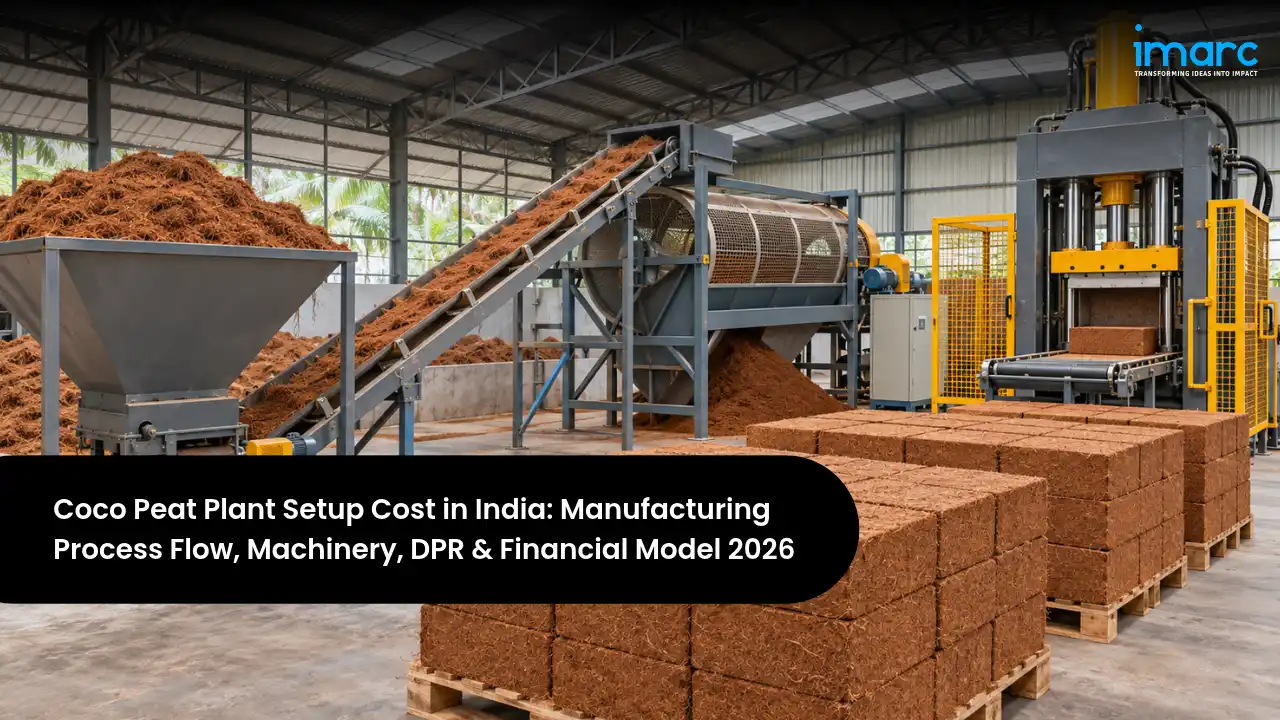
A Coco Peat Manufacturing Plant Setup in India turns a coconut-processing by-product into one of the country's fastest-growing agricultural exports. Coco peat, also called coir pith, is the spongy, fibrous material that remains when coconut husks are processed for coir fibre. Once cleaned, washed to reduce salts, dried, and compressed into blocks, briquettes, discs, or grow bags, it becomes a sustainable growing medium prized for its water-holding capacity, aeration, and resistance to decay. Greenhouse growers, hydroponic farms, nurseries, landscapers, and home gardeners around the world use it as a renewable alternative to peat moss.
The overall Coco Peat Manufacturing Plant Cost depends mainly on capacity, whether the plant processes whole husks or buys raw coir pith, the extent of washing and buffering for low-EC horticultural grades, and the product formats offered, with a small unit of 1,000 to 3,000 tonnes a year typically needing INR 1 crore to INR 4 crore and a mid-sized export plant of 10,000 to 20,000 tonnes a year needing INR 8 crore to INR 25 crore. Raw material makes up roughly half of operating cost, with utilities, labour, and export packaging accounting for most of the rest. Industry benchmarks place net margins at about 10 to 20%, depending on product mix and export price realisation.
This guide is written for coir processors, agri-entrepreneurs, farmer producer organisations, exporters, and investors exploring how to start a Coco Peat manufacturing plant in India. It covers product types and markets, demand drivers, the processing steps from husk to export-ready block, machinery and raw materials, site and infrastructure planning, a detailed cost and returns breakdown, the approvals involved, and how a DPR turns these elements into a bankable plan.
India Market Snapshot
| Key Facts | Details |
|---|---|
| Global Coco Peat Market | USD 3.74 Billion (2025) |
| Global Market Outlook | USD 5.37 Billion by 2034, 4.1% CAGR |
| Indicative Total Investment | INR 8–25 Crore (10,000–20,000 TPA) |
| Typical Payback Period | 3–5 Years |
The snapshot shows a steadily growing global market in which India has become a leading supplier. In 2025, India's coir pith exports rose about 30% in volume and about 86% in value over 2024, making coco peat the main driver of the country's coir exports. The investment range reflects the gap between a basic block-making unit using purchased pith and an integrated export plant with defibring, washing, buffering, drying, and grow bag lines.
Investment Highlights
Indicative Project Cost in India (2026)
| Parameter | Value |
|---|---|
| Product Range | 5 Kg blocks, briquettes, discs, grow bags, husk chips, loose coco peat |
| Total Project Investment | INR 8 – 25 Crore (10,000–20,000 TPA) |
| Payback Period | 3 – 5 Years |
| Net Profit Margin | 10 – 20% |
| IRR | 18 – 25% |
| Best Locations | Tamil Nadu, Kerala, Karnataka, Andhra Pradesh, Odisha, Goa & Konkan |
| Mandatory Approvals | SPCB Consents, Factory License, Coir Board Registration, IEC, Phytosanitary Certification |
| Key Requirement | Reliable husk or pith supply and export buyer relationships |
These figures provide a practical frame for early evaluation. Returns depend on securing raw material close to the plant, producing consistent low-EC, low-impurity grades that meet buyer specifications, drying efficiently, and building long-term relationships with importers, greenhouse growers, and distributors. A capacity- and market-specific Coco Peat Feasibility Report refines these numbers before capital is committed.
Table of Contents
- What is Coco Peat Manufacturing?
- Why is Coco Peat Manufacturing Growing in India?
- Coco Peat Manufacturing Process Flow
- Raw Materials Required for Coco Peat Manufacturing
- Location, Land & Infrastructure
- Coco Peat Manufacturing Machinery and Equipment
- Coco Peat Manufacturing Plant Setup Cost in India (CapEx & OpEx)
- Financial Analysis and Profitability
- Licenses and Approvals for Coco Peat Manufacturing in India
- Recent Developments in the India Coco Peat Manufacturing Industry
- How Coco Peat Manufacturing Project Report and DPR Helps Investors
- Frequently Asked Questions
What is Coco Peat Manufacturing?
Coconut husk contains long coir fibres held together by fine, cork-like pith. When husks are crushed and defibred, the fibre is separated for ropes, mats, and other coir products, and the pith is left behind. Raw pith contains salts, tannins, and fine dust, so it is screened, aged, washed with fresh water to bring down electrical conductivity (EC), often buffered with calcium nitrate to stabilise nutrients, dried, graded, and compressed. A Coco Peat Manufacturing Plant therefore combines raw material handling, screening, washing and buffering, drying, compression, and export packaging, often alongside or close to coir fibre units.
Commercially, coco peat is sold mainly to export markets, including Europe, North America, the Middle East, China, South Korea, Japan, and Australia, where it is used in greenhouse vegetables, berries, flowers, nurseries, hydroponics, and potting mixes. Domestic demand is rising from nurseries, horticulture, terrace gardening, mushroom cultivation, and landscaping. Buyers range from large importers and growing-media companies to distributors, retailers, and commercial growers.
- Coco Peat Blocks: Compressed 5 kg blocks, the most traded export format, which expand many times when rehydrated.
- Briquettes and Discs: Smaller compressed formats for retail, home gardening, and seed starting.
- Grow Bags: Ready-to-use slabs or bags filled with buffered coco peat blends for greenhouse and hydroponic growers.
- Husk Chips and Blends: Chips and fibre-pith mixes that improve drainage for specific crops.
Main Product Types in Coco Peat Production
The product mix determines processing intensity and margins:
| Product Type | Description | Key Feature | Primary Demand |
|---|---|---|---|
| Unwashed / High-EC Blocks | Basic screened and compressed pith | Lowest cost | Landscaping, some domestic uses |
| Washed Low-EC Blocks | Washed to reduce salts | Suitable for horticulture | Nurseries, growing-media firms |
| Buffered Low-EC Blocks | Washed and calcium-buffered | Stable nutrient profile | Greenhouses, hydroponics |
| Grow Bags and Slabs | Ready-to-use filled bags | High value per unit | Commercial greenhouse growers |
| Briquettes, Discs, Husk Chips | Retail and specialty formats | Convenience and drainage | Retail, home gardening, specific crops |
Washed and buffered low-EC products and grow bags earn substantially higher prices than unwashed material, but require more water, buffering chemicals, drying capacity, and quality control. Many plants start with washed blocks and add buffering, grow bags, and retail formats as they gain buyer trust and certifications.
Why is Coco Peat Manufacturing Growing in India?
Key Growth Drivers in the Indian Market
Demand for coco peat is driven by global horticulture trends and India's strong coconut base. IMARC Group values the global coco peat market at USD 3.74 billion in 2025 and expects it to reach USD 5.37 billion by 2034:
- Greenhouse and hydroponic farming: Controlled-environment agriculture is expanding worldwide, increasing demand for consistent, soilless growing media.
- Sustainability: Coco peat is renewable and made from agricultural waste, making it an attractive substitute for peat moss as peat extraction faces restrictions.
- India's raw material base: India is one of the world's largest coconut producers, generating abundant husks in Tamil Nadu, Kerala, Karnataka, and Andhra Pradesh.
- Domestic horticulture: Nurseries, urban gardening, polyhouses, and mushroom farming are growing in India.
- Waste-to-value initiatives: Urban and rural programmes increasingly convert coconut waste into coir and coco peat.
India-Specific Market Opportunity
| Segment | India Market Context | Manufacturing Role |
|---|---|---|
| Export Growing-Media Buyers | Europe, US, Middle East, East Asia | Washed and buffered blocks |
| Commercial Greenhouses | Global and Indian polyhouses | Grow bags and slabs |
| Nurseries & Landscaping | Domestic and export nurseries | Blocks and loose coco peat |
| Retail & Home Gardening | Online and garden centres | Briquettes, discs, small packs |
| Mushroom & Specialty Uses | Casing and bedding | Specialty grades |
The strongest position for a Coco Peat Manufacturing Plant in India combines high-quality export products for growing-media buyers with a growing domestic and retail presence. Exports provide volume and better prices, while domestic sales help balance currency and freight swings. Certifications, consistent quality, and reliable container shipments are the keys to winning long-term contracts.
Coco Peat Manufacturing Process Flow
Understanding the Coco Peat Manufacturing Process helps promoters plan equipment, layout, water management, and quality controls. The process is simple in concept but requires careful control of impurities, salts, moisture, and compression to meet buyer specifications. The flow below reflects an integrated plant that receives husks or raw pith and produces washed, buffered blocks and grow bags.
Step-by-Step Coco Peat Manufacturing Process Flow
Husks are crushed and defibred, or raw pith is received from coir units. The pith is screened, aged, washed and buffered, dewatered, and dried. It is then graded and blended, compressed into blocks, briquettes, or discs, or filled into grow bags, tested, packed, palletised, and loaded into containers.
| Unit Operation | Key Activity |
|---|---|
| Husk or Pith Receipt | Quality and moisture checks |
| Crushing & Defibring | Fibre separated from pith |
| Screening & Sieving | Fibre, sand, and oversize removed |
| Ageing | Pith stabilised in heaps |
| Washing & Buffering | EC reduced, calcium buffering applied |
| Dewatering | Excess water pressed out |
| Drying | Sun or mechanical drying to target moisture |
| Grading & Blending | Fine, chips, and fibre blends prepared |
| Compression or Bag Filling | Blocks, briquettes, discs, or grow bags |
| Testing, Packing & Loading | EC, pH, moisture, expansion; palletising |
Two factors decide profitability. The first is quality consistency: buyers test for EC, pH, moisture, sand and fibre content, expansion ratio, and freedom from weed seeds and pathogens, and failing these specifications leads to rejections or lower prices. The second is drying efficiency: moisture must be reduced to the target level before compression, and in monsoon-prone coastal regions this can become a bottleneck, so mechanical dryers or covered drying yards help maintain year-round output. Water management for washing and buffering also matters for both cost and environmental compliance.
Raw Materials Required for Coco Peat Manufacturing
The main input is coconut husk or raw coir pith, supported by water, buffering chemicals, and packaging materials. Raw material cost and availability depend heavily on local coconut production and the coir fibre industry.
| Raw Material | Role in Process | India Sourcing | % of OpEx |
|---|---|---|---|
| Coconut Husk or Raw Coir Pith | Source of coco peat | Coconut farms, traders, coir fibre units | 40–50% |
| Calcium Nitrate & Buffering Agents | Stabilise nutrients | Domestic fertiliser suppliers | 2–4% |
| Water | Washing and buffering | Borewells, surface water, recycling | 1–2% |
| Packaging Materials | Wraps, grow bags, pallets, strapping | Domestic suppliers | 6–9% |
| Additives (Optional) | Enriched or specialty blends | Bio-inputs and amendments | 0–1% |
Raw pith prices have risen as export demand has grown, so long-term arrangements with coir fibre units and husk suppliers, or integrating defibring into the plant, help secure supply. Washing and buffering require significant amounts of fresh water, so access to adequate water and wastewater treatment or recycling is essential. Packaging, especially UV-stabilised grow bags and export pallets, is a meaningful cost item for value-added products.
Location, Land & Infrastructure
Location strongly affects raw material cost, drying conditions, water availability, and export logistics. The best location for Coco Peat manufacturing plant setup lies within a coconut-growing belt with plentiful husk supply, adequate fresh water, open land for drying and storage, and good road access to a container port.
Best Location for Coco Peat Manufacturing Plant Setup in India
| State | Why It Works | Key Advantage |
|---|---|---|
| Tamil Nadu | Pollachi, Coimbatore, and Thanjavur belts | Largest coco peat cluster, Tuticorin and Chennai ports |
| Kerala | Traditional coir heartland | Coir skills and Kochi port |
| Karnataka | Tumakuru and Hassan coconut belts | Husk supply and Mangaluru port |
| Andhra Pradesh | Konaseema coconut region | Raw material and Kakinada port |
| Odisha | Coastal coconut production | Emerging supply base |
| Goa & Konkan | Coconut-growing coastal belt | Husk availability and western ports |
Tamil Nadu hosts India's largest coco peat manufacturing cluster around Pollachi and Coimbatore, with access to Tuticorin and Chennai ports, while Kerala brings the traditional coir industry and skills. Karnataka and Andhra Pradesh offer large coconut belts with port access, and Odisha and the Goa and Konkan coast provide additional raw material bases. Drier inland locations within coconut belts can also ease drying during the monsoon.
Quality, Phytosanitary and Environmental Requirements
Export buyers expect coco peat with specified EC, pH, moisture, particle size, and expansion characteristics, free from sand, stones, weed seeds, and pests. Certifications such as RHP for growing media, along with ISO quality systems, can be important for European buyers. Exports require phytosanitary certification from plant quarantine authorities, and some destinations impose additional treatment or inspection requirements. Washing generates wastewater containing salts and tannins, which must be managed under pollution control conditions, and stored dry coco peat is a fire hazard that needs proper storage and fire protection.
Infrastructure Requirements (Mid-Sized Plant)
| Infrastructure Element | Specification | India-Specific Note |
|---|---|---|
| Total Land Area | 3 – 10 acres | Large drying yard and storage |
| Processing Shed | Screening, compression, packing | Covered, well-ventilated |
| Power Requirement | 150 – 600 kW | Presses, screens, dryers |
| Water Supply | Washing and buffering | Borewells or surface water with recycling |
| Drying Yard or Dryer | Sun yard and/or rotary dryer | Monsoon backup essential |
| Wastewater Management | Settling ponds or ETP | SPCB consent conditions |
| Warehousing & Loading | Covered storage, container loading | Fire protection |
Infrastructure for a coco peat plant centres on large, well-drained drying yards, covered processing and storage sheds, reliable water supply with recycling, wastewater management, and space for container loading. Mechanical dryers or covered yards reduce monsoon downtime. Planning space for grow bag lines and additional presses from the outset supports future growth.
Coco Peat Manufacturing Machinery and Equipment
Coco peat machinery is relatively simple and mostly made in India, which keeps investment moderate. The main equipment is summarised below.
| Equipment | Function | Key Specification |
|---|---|---|
| Husk Crusher & Defibering Machine | Separate fibre and pith | Robust, continuous operation |
| Trommel & Vibrating Screens | Remove fibre, sand, oversize | Adjustable mesh sizes |
| Washing & Buffering Tanks | Reduce EC, buffer pith | Agitated tanks or pools |
| Dewatering Press | Remove excess water | Screw or hydraulic type |
| Rotary Dryer | Mechanical drying | Biomass-fired heat source |
| Blending Equipment | Mix grades and chips | Batch or continuous |
| Hydraulic Block Press | Compress 5 kg blocks | High tonnage, high output |
| Briquette & Disc Press | Make small formats | Precision dies |
| Grow Bag Filling & Sealing Machine | Produce grow bags | Automatic dosing and sealing |
| Testing Equipment, Conveyors & Forklifts | Quality and handling | EC and pH meters, moisture analysers |
Equipment selection should follow the product range and capacity. Block presses determine output for the main export product, while washing and buffering systems and dryers determine quality and year-round capacity. Grow bag lines and briquette or disc presses add higher-value formats and help diversify the customer base.
Coco Peat Manufacturing Plant Setup Cost in India (CapEx & OpEx)
The tables below summarise the capital and operating cost structure of a mid-sized coco peat facility in India. The final Coco Peat Investment Cost for a specific project depends on capacity, integration with husk processing, washing and buffering capability, drying systems, product formats, and land costs.
Capital Expenditure (CapEx) Cost Structure
| CapEx Component | % of Total CapEx | What It Covers |
|---|---|---|
| Plant & Machinery | 30–40% | Crushers, screens, presses, dryers, grow bag line |
| Land & Site Development | 20–28% | Land, drying yards, drainage |
| Buildings & Sheds | 12–18% | Processing and storage sheds |
| Water & Wastewater Systems | 6–10% | Borewells, tanks, ponds, ETP |
| Pre-operative & Contingency | 3–5% | Engineering, DPR, certifications |
| Working Capital | 12–18% | Raw pith stocks, inventory, receivables |
Land and drying yards form a large share of investment because coco peat needs space for ageing, drying, and storage. Machinery is moderate in cost, and working capital matters because raw material is often stocked ahead of the monsoon and export payments may take time. A Coco Peat Business Plan models these components so that capacity, product mix, and financing rest on realistic numbers.
Operating Expenditure (OpEx) Cost Structure
| OpEx Component | % of Total OpEx | India-Specific Note |
|---|---|---|
| Raw Materials | 45–55% | Husk or pith dominates |
| Power, Fuel & Water | 12–18% | Pressing, drying, washing |
| Labour & Manpower | 12–18% | Handling, drying, packing |
| Packaging & Export Logistics | 6–10% | Wraps, pallets, inland freight |
| Maintenance | 2–3% | Presses, screens, dryers |
| Overheads & Compliance | 2–4% | Testing, certifications, administration |
Raw material is the largest cost, but labour and utilities are also significant in coco peat production. Profitability depends on raw material sourcing, the share of washed and buffered products, drying efficiency, and export price realisation. A sound financial model should test margins against raw pith prices, export prices, exchange rates, and freight costs.
Financial Analysis and Profitability
Coco peat manufacturing offers attractive returns relative to its moderate investment, supported by strong export demand and low-cost raw material. The profitability of Coco Peat manufacturing business in India improves with secure raw material supply, consistent export-grade quality, value-added grow bags and buffered products, and long-term buyer contracts.
| Financial Metric | Indicative Value | India Context |
|---|---|---|
| Gross Profit Margin | 20–40% | Higher for buffered and grow bag products |
| Net Profit Margin | 10–20% | After depreciation and Indian corporate taxes |
| Payback Period | 3–5 Years | Moderate capital intensity |
| IRR (Internal Rate of Return) | 18–25% | Sensitive to export prices |
| Capacity Utilization (stable ops) | 65–85% | Monsoon and raw material seasonality |
| Break-even Capacity Utilization | 40–55% | Moderate fixed costs |
Product mix and export prices are the decisive factors. Washed, buffered blocks and grow bags sold to established growing-media buyers earn far more than unwashed material, while consistent quality and reliable shipments support long-term contracts. Export prices rose sharply in 2025, but new projects should plan with more conservative pricing to allow for market cycles and freight swings.
Returns can be strengthened by integrating husk defibring, investing in washing, buffering, and mechanical drying, adding grow bags and retail formats, obtaining certifications valued by European buyers, and balancing export sales with domestic horticulture and retail markets.
Key Risks and Mitigation
The main risks are raw material price increases, monsoon disruption to drying, quality rejections, export price and freight volatility, currency fluctuations, wastewater compliance, and fire. Raw material risk is reduced through supplier contracts and integration; monsoon risk through dryers and covered yards; quality risk through testing and process control; market risk through diversified buyers and domestic sales; compliance risk through proper wastewater management; and fire risk through safe storage and fire protection.
Licenses and Approvals for Coco Peat Manufacturing in India
A coco peat unit requires environmental, industrial, and export approvals. Promoters typically need the following before commencing operations:
- Pollution Control Consents: Consent to Establish and Consent to Operate from the State Pollution Control Board, covering washing effluent and dust.
- Factory License: Factory registration and building plan approval under the Occupational Safety, Health and Working Conditions Code, 2020.
- Water Use Permissions: Groundwater or surface water permissions from state authorities where required.
- Coir Board Registration: Registration with the Coir Board, which also serves as the export promotion body for coir products.
- Export and Phytosanitary Clearances: Import Export Code and phytosanitary certification from plant quarantine authorities for each export consignment.
- Quality Certifications: ISO and growing-media certifications such as RHP where buyers require them.
- Fire NOC, Tax and Labour Registrations: Fire safety approval, GST, Udyam, and EPF and ESI registrations.
Pollution consents, water permissions, and export registrations sit on the critical path for most projects, while buyer certifications should be planned early if the plant targets European growing-media companies. Engaging a Coco Peat Manufacturing Consultant in India can help promoters plan raw material sourcing, select equipment, manage approvals, and set up quality systems for export markets.
Note: The exact approvals, registrations, licenses, and certification requirements may vary depending on factors such as plant location, product range, capacity, target customers, and applicable regulations. Businesses are advised to undertake a detailed regulatory assessment during the project planning stage to ensure full compliance and timely implementation.
Recent Developments in the India Coco Peat Manufacturing Industry
Several recent developments highlight the momentum in India's coco peat industry:
- Record export growth: India's coir pith exports rose from about 7.33 lakh tonnes worth USD 262.19 million in 2024 to about 9.54 lakh tonnes worth USD 486.92 million in 2025, lifting total coir exports to about USD 612.53 million.
- Capacity expansion and policy reform: Gro-Med, a division of Vaighai Agro, opened its third coco peat grow bag unit in Salem, Tamil Nadu, in April 2025, while the government announced plans in January 2025 to revise the decades-old Coir Industry Act and promote value-added products and export facilitation.
- Waste-to-value adoption: In December 2025, urban local bodies under the Swachh Bharat Mission in cities such as Chennai, Indore, Bhubaneswar, and Patna were converting coconut waste into coir, compost, and coco peat.
Together these point to a fast-growing, export-led industry with supportive policy and rising raw material awareness. For new entrants, the opportunity lies in high-quality, washed and buffered products, reliable export supply, and value-added formats.
How Coco Peat Manufacturing Project Report and DPR Helps Investors
A detailed Coco Peat Project Report gives investors a structured roadmap covering market and buyer assessment, product strategy, raw material sourcing, process design, machinery, plant layout, water and drying systems, regulatory pathway, and economics. It helps promoters choose the right capacity and product mix, estimate capital expenditure (CapEx) and operating expenditure (OpEx), assess profitability, and identify risks before implementation.
At the core of the DPR is a Coco Peat Financial Model covering raw material sourcing and prices, product-wise volumes and export prices, washing, drying, and packaging costs, working capital, cash flow projections, break-even, return on investment (ROI), and payback. Lenders expect sensitivity to export prices and currency, which is why many promoters engage a Coco Peat Plant Project Report Consultant in India to prepare bank-ready documents and support subsidy applications.
For a coco peat project specifically, a strong DPR also answers the questions that matter most: how to secure raw material, how much washing, buffering, and drying capacity is needed, which buyers and formats to target, and how returns hold up if export prices soften. An experienced Coco Peat Manufacturing Feasibility Study Consultant tests these scenarios so that the final plan is one lenders and partners can back with confidence.
Frequently Asked Questions
How do I set up a coco peat manufacturing unit in India?
Start by securing husk or raw pith supply and identifying target buyers, then commission a feasibility study and DPR. Choose a site in a coconut belt with water and drying space, install screening, washing, drying, and compression equipment, obtain pollution, factory, and water approvals, register with the Coir Board and for export, and build relationships with importers and growers.
What is the coco peat manufacturing plant setup cost in India?
A small unit of 1,000 to 3,000 tonnes a year typically needs INR 1 crore to INR 4 crore, while a mid-sized export plant of 10,000 to 20,000 tonnes a year needs INR 8 crore to INR 25 crore, depending on washing, buffering, drying, and grow bag capability.
How is coco peat made?
Coconut husks are crushed and defibred to separate pith from fibre. The pith is screened, aged, washed and buffered to reduce salts, dewatered, dried, graded, and compressed into blocks, briquettes, or discs, or filled into grow bags.
What machinery is needed for a coco peat manufacturing plant?
Key equipment includes a husk crusher and defibering machine, trommel and vibrating screens, washing and buffering tanks, a dewatering press, rotary dryer, blending equipment, hydraulic block press, briquette and disc presses, a grow bag filling machine, and testing equipment.
What raw materials are used to make coco peat?
The main raw material is coconut husk or raw coir pith, along with fresh water for washing, calcium nitrate for buffering, and packaging materials such as wraps, grow bags, and pallets.
Is coco peat manufacturing profitable in India?
Yes. A well-run plant typically earns a 10 to 20% net margin, with payback in 3 to 5 years. Returns improve with washed and buffered products, grow bags, consistent quality, and long-term export contracts.
What licenses are needed for a coco peat manufacturing unit in India?
A unit typically needs State Pollution Control Board consents, a Factory License, water use permissions, Coir Board registration, an Import Export Code, phytosanitary certification for exports, a Fire NOC, and GST, Udyam, and labour registrations.
Which state is best for a coco peat manufacturing plant?
Tamil Nadu, Kerala, Karnataka, Andhra Pradesh, Odisha, and the Goa and Konkan coast are strong options. The best site offers abundant husk supply, fresh water, drying space, and good access to a container port.
How do I get a feasibility study or DPR for a coco peat manufacturing plant?
A professionally prepared DPR covers market assessment, raw material sourcing, technical design, approvals, costs, and financial projections for bank appraisal and subsidy applications. Many promoters work with a Coco Peat Business Plan Consultant in India to prepare it and align it with lender requirements.
Our Clients










Contact Us
Have a question or need assistance?
Please complete the form with your inquiry or reach out to us at
Phone Number
+91-120-433-0800+1-201-971-6302
+44-113-547-7077
Previous Post

Polyhouses and other protected cultivation structures are frames of galvanised steel covered with UV-stabilised plastic film, shade net, or glass, inside which farmers grow vegetables, flowers, seedlings, and fruit under controlled conditions.
Drip irrigation delivers water and fertiliser slowly and directly to the root zone of each plant through a network of plastic pipes, laterals, and precisely calibrated emitters, cutting water use sharply while raising yields of fruits, vegetables, sugarcane, cotton, and plantation crops.
Quality seed is the starting point of every crop, and improved seed alone can raise yields significantly. Commercial seed is produced by contract growers on carefully managed fields and then conditioned in seed processing plants, where it is dried, cleaned, graded, treated, tested, and packed so that farmers receive pure, healthy seed with high germination.
Triple superphosphate is a concentrated phosphate fertiliser containing 44 to 46% P2O5, mainly as water-soluble monocalcium phosphate.
Liquid biofertilizers are concentrated suspensions of beneficial microorganisms, such as Rhizobium, Azotobacter, Azospirillum, and phosphate, potash, and zinc solubilising bacteria, that fix atmospheric nitrogen or release locked-up nutrients in the soil.
Hemp processing is the conversion of low-THC industrial hemp stalks and seed into separated, graded, saleable materials. The stalk is retted, dried and decorticated to split the long outer bast fiber from the woody inner hurd, while the seed is cleaned, dehulled and cold-pressed into food-grade hemp hearts and hemp seed oil.
Ashwagandha, or Withania somnifera, is one of the most important herbs in Ayurveda, valued as an adaptogen for stress, sleep, energy, and overall wellness.
Chicory is mainly Cichorium intybus, a perennial herb that is grown for its root, leaves, and sometimes seeds. In industrial applications, the chicory root is the most valuable part. The chicory root contains inulin, a natural soluble dietary fiber, as well as sugars and bioactive compounds. When roasted and dried, chicory root has a similar taste to coffee and is often used as a coffee extender or substitute.
Agriculture in India is and has always been something more than an occupation; it's a way of life that keeps millions of households going and the country's economy running. Yet, in a rapidly changing world, traditional methods cannot alone meet the growing demand for food, fiber, and raw materials.
Australia's agricultural machinery industry stands as a cornerstone of the nation's farming modernization drive, experiencing robust expansion fueled by technological innovation and evolving agricultural demands. According to IMARC Group's comprehensive market analysis, the Australia agricultural machinery market reached a valuation of USD 4.0 Billion in 2024, reflecting the accelerating adoption of advanced farming equipment across the continent's diverse agricultural landscapes.
Australia fertilizer industry is one of the key pillars of the country's farm setup. Fertilizers are a critical input in soil productivity, boosting crop output and the uniform production of food and other farm products. Australia has a wide and varied agricultural scene with grain growing horticulture, livestock, and specialty crops. Every industry depends upon fertilizers to optimize production and ensure soil fertility, especially in areas where the natural soil nutrients are nil or climatic conditions are unsuitable.
The Japan agritourism industry is experiencing remarkable transformation as travelers increasingly seek authentic connections with rural landscapes and agricultural traditions. Agritourism represents a dynamic fusion of agriculture and tourism, offering visitors immersive experiences through farm stays, hands-on agricultural activities, and cultural immersion in Japan's countryside.
HDPE pipes are thermoplastic piping systems made from high-strength polyethylene resin, which features excellent flexibility, high impact resistance, and strong chemical and corrosion resistance. HDPE pipes are produced by extruding molten polyethylene into a variety of diameters and pressure ratings. Their seamless structure, along with their low friction and resistance to internal pressure and external load, makes them ideal for the transport of fluids. HDPE pipes boast superior endurance, long service life, and leak-free performance, since it is possible to join them through heat fusion, thus creating monolithic, continuous pipelines that are suitable for buried, aboveground, or underwater installations.
The Brazil agricultural machinery market stands as a cornerstone of the nation's agricultural modernization drive, experiencing robust expansion fueled by technological innovation, government support initiatives, and the imperative to enhance agricultural productivity across the world's largest soybean producer. According to IMARC Group's comprehensive market analysis, the Brazil agricultural machinery market reached a valuation of USD 3.1 Billion in 2024, reflecting the accelerating adoption of advanced farm equipment Brazil offers across diverse agricultural landscapes spanning grain production, sugarcane cultivation, coffee farming, and livestock operations. This impressive growth trajectory positions the industry for continued prosperity, with projections indicating the market will reach USD 4.5 Billion by 2033, exhibiting a compound annual growth rate (CAGR) of 4.1% during the 2025-2033 forecast period.
The smart agriculture market is revolutionizing the global agriculture industry through the integration of cutting-edge technologies such as Internet of Things (IoT), artificial intelligence (AI), robotics, sensors, and big data analytics. As the world population continues to grow, farmers and agribusinesses face mounting pressure to increase productivity while minimizing environmental impact.
Australia's agribusiness sector is at a crossroads, combining its historic advantage in bulk farming with new-generation technologies and green practices. The industry is pivotal to the nation's economy, adding billions to GDP and underpinning exports to overseas markets. Increasing food security demands and climate change pressures have compelled Australian farmers and agribusiness companies to take up innovation at an unprecedented scale.
A fertilizer is any natural or manufactured material containing one or more nutrients that are applied to the soil or plant tissues and that are usually beneficial for plant growth by improving fertility. The elements that plants need in large quantities, namely nitrogen (N), phosphorus (P), and potassium (K), are known as the primary macronutrients. The other secondary nutrients include calcium, magnesium, and sulfur; micronutrients include zinc, iron, manganese, and copper.
Coco peat, or coir pith or coir dust, is a fibrous natural byproduct generated during the processing of coconut husks to extract coir fiber. Coco peat is an organic, renewable, and biodegradable product that has gained international significance as a sustainable substitute for peat moss in horticulture, agriculture, and hydroponics. The coco peat production process starts with the gathering of coconut husks, which are retted, soaked, and mechanically treated to exclude long coir fibers that are employed in ropes, mats, or brushes. The leftover fine material, the pith is washed, sieved, dried, and compressed into briquettes, blocks, or grow bags.
Bamboo is a poaceous grass which regrows rapidly, has a high yield of biomass and good material properties, ranging from tiny clumping species to huge timber-grade culms over 20 meters tall; genera of economic importance are Bambusa, Phyllostachys and Dendrocalamus. Botanically, bamboo integrates the regenerative benefit of an agricultural crop (short rotation, annual or multi-annual yield) with certain mechanical characteristics of softwoods like large specific strength, good tensile performance, and natural hollow culm geometry for light-weight structural property.
Sustainability is reshaping the future of agriculture, energy, and environmental management, with biochar emerging as a transformative force within the ecosystem. Produced from biomass through pyrolysis, biochar enriches soils, strengthens crop resilience, and reduces dependence on chemical fertilizers. According to reports, long-term application delivers measurable benefits—boosting average crop yields by 10.8% and increasing soil organic carbon by 52.5%—underscoring its role in restoring soil health while combating degradation.
Sesame seeds are one of the oldest oilseed crops known to humankind, prized for their high oil content, distinctive nutty flavor, and valuable nutritional profile. They are composed of approximately 50–60% oil and 20–25% protein, making them an essential raw material for edible oil, bakery, confectionery, and health food industries. The seeds are also rich in antioxidants such as sesamol and sesamin, which contribute to their oxidative stability and health-promoting properties. Processing of sesame seeds typically involves cleaning, dehulling, roasting, pressing, and solvent extraction, depending on the end-use product.
The global seed industry plays an important role in ensuring food security and the sustainability of agricultural practices. As the world grapples with food insecurity, climate volatility, and shrinking arable land, the market has emerged as a critical enabler of agricultural resilience.
Explore how to start a biofertilizer manufacturing business, from setup and licenses to market trends, investment, and sustainable growth strategies.
World Environment Day, observed on June 5th each year, serves as an important reminder to protect and preserve our planet. This day inspires millions of people from across the globe to reflect on environmental issues and take tangible measures toward securing the world for future generations.
Bamboo is one of the sustainable and versatile materials that are being used in several different industries. Bamboo provides a very environmentally friendly option for food packaging, as it reduces plastic use. At high temperatures, bamboo is burnt to produce bamboo biochar. This is a soil enhancer for soil health and carbon sequestration. Bamboo is also a sustainable building material and is used in the construction industry. Due to its antibacterial properties, bamboo vinegar, which is a byproduct of bamboo charcoal manufacturing, is used in skincare and agriculture.
The global poultry market is growing at a fast pace, driven by several factors, such as rising demand for affordable and protein-rich food sources, especially in developing countries. The growing preference for white meat over red meat due to health considerations, as well as urbanization and increasing disposable incomes, also contributes to higher consumption of poultry products. Moreover, technological advancements in poultry farming, such as improved breeding techniques and feed conversion ratios (FCR), enhance productivity and efficiency, further boosting market growth. As per IMARC Group, the global animal feed market size reached US$ 518.4 Billion in 2023 and is expected to reach US$ 674.7 Billion by 2032, exhibiting a growth rate (CAGR) of 2.9% during 2024-2032.