Australia Industrial Couplings Industry: Automation Boom, Major Sectors, Leading Manufacturers
Introduction: Overview of Australia's Industrial Couplings Market
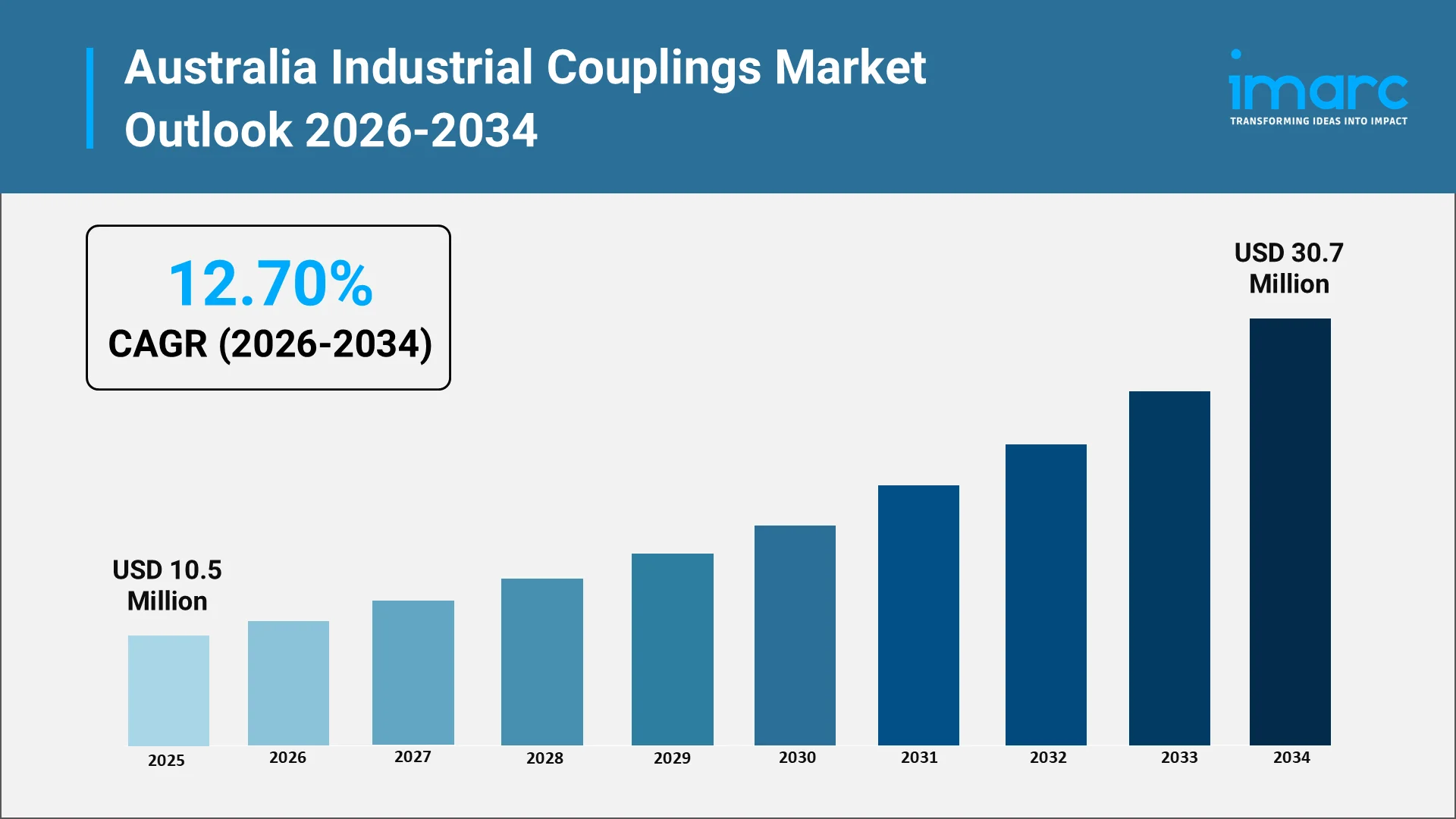
The Australia industrial couplings industry stands at a transformative juncture in 2025, propelled by technological advancement and surging demand across critical sectors. As mechanical devices connecting two shafts to transmit power and torque, industrial couplings form the backbone of machinery operations in manufacturing, mining, automotive, and energy sectors. The Australia industrial couplings market size reached USD 10.5 Million in 2025. Looking forward, the market is expected to reach USD 30.7 Million by 2034, exhibiting a growth rate (CAGR) of 12.70% during 2026-2034.
Recent market intelligence reveals promising growth trajectories. The Australia coupling market is projected to witness growth during the forecast period, reflecting strong domestic demand and technological advancement. This acceleration aligns with broader industrial trends, as the Australia Industry 4.0 market reached USD 3,294.00 Million in 2024 and is projected to grow to USD 11,142.25 Million by 2033, exhibiting a CAGR of 14.50%.
The industrial couplings market encompasses diverse product categories including flexible couplings, rigid couplings, gear couplings, fluid couplings, and elastomeric couplings. Each type serves specific applications across industries, offering solutions for misalignment compensation, vibration absorption, and efficient power transmission. Australia’s manufacturing sector plays a vital role in driving demand for essential industrial components, serving as a key pillar of the national economy and a major source of employment across multiple industries.
Explore in-depth findings for this market, Request Sample
Key Drivers: Automation, Industrial Growth, and Technological Advancements
Automation adoption represents the primary catalyst transforming Australia's industrial couplings demand. Australian manufacturing experienced significant technological progress throughout 2024, with automation, robotics, and digital manufacturing accelerating across the industry, enhancing operational efficiency.
Industry partners report accelerated adoption of smart technologies, including robotics, AI, IoT, and digital twins, across Australian manufacturing in June 2025, enabling smart factories that boost productivity and workplace safety. Many SMEs deploy robotic automation and predictive maintenance systems to drive operational efficiency.
Australia’s mining sector remains a major driver of demand for industrial couplings, supported by extensive extraction and processing activities across the country. The industry’s reliance on heavy machinery such as drills, haul trucks, and conveyors creates strong incentives for adopting predictive maintenance technologies that enhance equipment reliability and operational efficiency.
The National Robotics Strategy unveiled in June 2024 targets AUD 170-600 billion annual GDP contribution by 2030 with 50-150% productivity growth. AUD 15 billion National Reconstruction Fund and Industry Growth Program support deployment, creating demand for precision coupling solutions.
Role of AI, Impact, and Benefits in the Australia Industrial Couplings Market:
Artificial intelligence applications are revolutionizing industrial coupling utilization through predictive maintenance and performance optimization. The Australia predictive maintenance market reached USD 254.00 Million in 2024, with projections to reach USD 1,620.05 Million by 2033, exhibiting a CAGR of 22.86%. This exponential growth directly impacts coupling industry dynamics.
AI-based predictive maintenance systems analyze sensor data embedded in coupling equipment, detecting anomalies and forecasting failures before they occur. This proactive approach enables timely, targeted interventions, helping companies avoid costly disruptions. Research suggests that predictive maintenance can significantly reduce maintenance expenses while prolonging equipment lifespan, key benefits for capital-intensive industries that depend on maximizing asset performance and minimizing unplanned downtime.
In March 2025, Razor Labs revealed plans to conduct webinars demonstrating how AI sensor fusion aids in revolutionizing predictive maintenance in the Australian mining sector, helping anticipate significant failures and recognize concealed problems that conventional systems overlooked.
IoT integration allows businesses to analyze large volumes of data using advanced analytics and machine learning, leading to more accurate maintenance scheduling. In Australia, where industries operate in remote environments, IoT-supported maintenance solutions provide critical insights without physical inspections. As IoT devices become more affordable, their role in benefiting the predictive maintenance market continues to strengthen.
Smart coupling technologies incorporating sensors to monitor torque, misalignment, and wear in real-time enable predictive maintenance strategies, reducing unplanned downtime. As connected technologies continue to expand worldwide, the adoption of smart couplings within automated systems is poised for strong growth, driven by the increasing integration of IoT-enabled monitoring and control solutions across industrial operations.
Top Companies in the Australia Industrial Couplings Market:
The Australia industrial couplings market features established global manufacturers creating a competitive yet consolidated landscape. Leading companies leverage technological innovation and extensive distribution networks to maintain market positions.
The Timken Company maintains a prominent position as a global technology leader. Timken posted $4.6 billion in sales in 2024 and employs approximately 19,000 people globally, operating from 45 countries. The company's coupling portfolio, including the Lovejoy brand, experiences strong demand for jaw and grid couplings used widely in diverse OEM applications.
KTR Systems GmbH specializes in mechanical couplings with strong emphasis on customization meeting specific client requirements. KTR's expertise in flexible elastic couplings, projected to dominate the industrial coupling industry with 42% market share in 2025, positions the company advantageously for growth in sectors requiring vibration damping and misalignment tolerance.
Regal Rexnord Corporation offers extensive power transmission solutions including diverse coupling types serving multiple industrial sectors. The company's comprehensive product portfolio addresses applications ranging from simple shaft connections to complex drivetrain systems requiring sophisticated torque management.
SKF Group brings bearing expertise to coupling solutions, offering integrated approaches to rotating equipment challenges. SKF's focus on reliability, efficiency, and condition monitoring aligns with Australian industry's emphasis on asset optimization and predictive maintenance.
Additional significant players include ABB Ltd, Altra Industrial Motion Corporation, Voith GmbH, John Crane, Renold PLC, and Tsubakimoto Chain Co., collectively serving Australia's industrial coupling needs while investing in research and development to advance coupling technology.
Major Sectors and Applications of Industrial Couplings:
The mining and resources sector represents the largest consumer. Mining contributed 14.3% of Australia's GDP in 2024, creating 1.1 million jobs. The sector's heavy machinery demands robust coupling solutions handling extreme torque and harsh conditions.
Australia leads globally in iron ore exports and supplies over half the world's lithium—critical for electric vehicle batteries and energy storage. Mining equipment depends on industrial couplings for efficient power transfer.
The manufacturing sector encompasses automotive components, food processing, pharmaceuticals, and metal fabrication. The automotive sector, projected to command 38% of the global coupling market share in 2025, requires lightweight, high-torque couplings for electric vehicle drivetrains.
Energy and power generation utilize specialized couplings in renewable installations, including wind turbines and hydroelectric plants. Wind turbine drivetrains employ couplings that manage torque variations while protecting equipment.
Oil and gas, water treatment, and material handling sectors create additional demand across diverse applications requiring specialized coupling solutions.
Opportunities and Challenges in the Australian Market:
Significant growth opportunities emerge from Australia's transition toward clean energy and critical minerals production. The CSIRO's Critical Energy Materials roadmap estimates annual demand for metals and minerals exceeding 700 million tonnes by 2050, including 9 million tonnes of lithium, over 130 million tonnes each of silicon and copper, and 48 million tonnes of nickel. This demand expansion necessitates corresponding mining equipment growth, directly translating to increased coupling requirements.
The government's $2 Billion Critical Minerals Tax Credit supports domestic processing of minerals essential for the clean energy transition. Infrastructure development initiatives, including strategic transmission networks and industrial precincts, create additional coupling demand. Regional development opportunities in areas like Upper Spencer Gulf, Pilbara, and Gladstone promise sustained industrial activity.
Smart manufacturing initiatives create opportunities for advanced coupling products incorporating condition monitoring sensors and IoT connectivity. As 30% of Australian manufacturers have implemented Industrial IoT at scale, demand grows for couplings supporting digital transformation initiatives.
Challenges include skills gaps limiting advanced manufacturing adoption. The National Skills Commission projects at least 15,000 new workers needed in clean energy sectors by 2030, slowing Industry 4.0 adoption, particularly among SMEs.
Infrastructure challenges persist, given Australia's vast geography and uneven access to digital infrastructure in remote areas. High initial costs of implementing automation can be barriers for SMEs, while integrating technologies with legacy systems proves complex.
Supply chain vulnerabilities remain concerning due to Australia's geographic isolation and dependence on imported components. Environmental pressures intensify, with mining companies facing pressure to reduce carbon footprints through renewable energy adoption.
.webp)
Leading Manufacturers, Recent Developments, and Market Outlook:
Recent developments demonstrate ongoing innovation. In February 2025, Timken reported implementing cost reduction actions expected to generate approximately $75 million in savings, reflecting industry trends emphasizing efficiency.
Smart couplings incorporating sensors enable predictive maintenance strategies. Emerging trends include increased focus on sustainability, with manufacturers developing products that minimize power losses. Electrification of mining fleets creates new requirements as companies transition to electric-powered equipment.
The Australia industrial couplings market outlook remains positive, supported by sustained mining activity, manufacturing digitalization, infrastructure development, and renewable energy expansion.
Conclusion:
The Australia industrial couplings industry stands poised for significant expansion through 2025 and beyond, driven by automation adoption, mining sector strength, and manufacturing digitalization. The convergence of Industry 4.0 technologies, artificial intelligence, and IoT connectivity is fundamentally transforming coupling applications, creating opportunities for innovative suppliers.
Key growth drivers, including the National Robotics Strategy, critical minerals development, and renewable energy transition, establish strong foundations for sustained coupling demand. The sector’s strong growth outlook underscores solid market fundamentals, though ongoing challenges such as workforce skill gaps and infrastructure constraints remain key factors influencing long-term development.
Leading manufacturers, including Timken, KTR Systems, and other global players, continue investing in advanced coupling technologies incorporating smart sensors and predictive maintenance capabilities. As Australia advances toward ambitious economic and environmental targets, industrial couplings will remain essential components enabling reliable power transmission.
Companies successfully navigating technological disruption while maintaining focus on fundamental engineering excellence will capture greatest opportunities in this evolving market landscape. Stakeholders must remain agile, innovative, and committed to excellence to thrive in this dynamic environment characterized by unprecedented opportunity.
Partner with IMARC Group for Strategic Market Intelligence:
Choose IMARC Group as your trusted advisor for navigating the complexities of Australia's industrial couplings market and achieving sustainable competitive advantage through data-driven insights and strategic intelligence.
- Data-Driven Market Research: Deepen your knowledge of industrial coupling market dynamics, technological advancements, and application trends across mining, manufacturing, and infrastructure sectors through comprehensive market research reports analyzing market size, growth forecasts, competitive landscapes, and emerging opportunities.
- Strategic Growth Forecasting: Predict emerging trends in industrial automation, smart manufacturing adoption, and digital transformation impacting coupling requirements—from IoT-enabled predictive maintenance and Industry 4.0 integration to electrification of industrial equipment—with detailed analysis by technology type, end-use sector, and geographic region.
- Competitive Benchmarking: Analyze competitive forces shaping the industrial couplings market, review product portfolios of leading manufacturers, monitor technological innovations in coupling design and materials, and understand strategic positioning of major players including Timken, KTR Systems, and other key suppliers serving Australian industrial customers.
- Policy and Infrastructure Advisory: Stay informed of regulatory developments, government support programs for advanced manufacturing and automation, industrial policy initiatives impacting equipment investments, and infrastructure projects creating coupling demand across mining, energy, and manufacturing sectors nationwide.
- Custom Reports and Consulting: Obtain tailored insights aligned with your organizational objectives—whether expanding into Australian industrial markets, developing new coupling products for automation applications, evaluating acquisition opportunities, or optimizing supply chain strategies for serving demanding industrial sectors across Australia and the broader Asia-Pacific region.
At IMARC Group, our mission is empowering industrial leaders, equipment manufacturers, and investors with clarity and intelligence required to capitalize on opportunities in Australia's dynamic industrial couplings market. Join us in driving industrial innovation and operational excellence—because every connection matters for industrial performance, reliability, and competitiveness in the evolving landscape of modern manufacturing and automation.
Our Clients










Contact Us
Have a question or need assistance?
Please complete the form with your inquiry or reach out to us at
Phone Number
+91-120-433-0800+1-201-971-6302
+44-113-547-7077
Previous Post

The Saudi Arabia real estate market stands at a pivotal juncture in its evolution, representing one of the most dynamic and transformative sectors within the Kingdom's economy. With this country having a very ambitious agenda of economic diversification and modernization, the real estate business has come out as one of the pillars of this transformation.
Steel is an alloy that consists of iron and carbon in addition to trace amounts of other elements like manganese, silicon, chromium, and nickel. The amount of carbon in steel is usually less than two percent and is an important factor in determining the strength, hardness, and ductility of steel.
Saudi Arabia’s precast concrete market reached USD 1.2 Billion in 2024 as per the IMARC Group, clear proof that off-site construction is rapidly becoming the Kingdom’s go-to building solution. With residential, commercial, and major infrastructure projects multiplying, developers are increasingly turning to precast building solutions to keep pace.
The GCC cold storage construction market represents critical infrastructure underpinning regional food security, pharmaceutical distribution, and temperature-sensitive logistics across the Arabian Peninsula. As Gulf Cooperation Council nations diversify their economies and reduce hydrocarbon dependence, robust cold chain infrastructure has emerged as a cornerstone of sustainable development planning.
PVC panels are lightweight, durable building materials made from polyvinyl chloride using extrusion or molding processes. They are available as rigid or semi-rigid sheets designed primarily for wall and ceiling cladding, partitions, and decorative finishes. Known for their excellent resistance to moisture, chemicals, termites, and corrosion, PVC panels offer a smooth surface and a clean, polished look that’s easy to maintain. Available in an extensive range of colors, textures, and patterns, these panels serve as a practical alternative to traditional materials like wood, plaster, or tiles.
Ready mix concrete (RMC) is a precisely engineered construction material produced in a controlled environment within a batching plant and delivered to construction sites in a freshly mixed, plastic state. It is formulated by combining cement, aggregates, water, and chemical or mineral admixtures in carefully proportioned quantities to achieve specific performance characteristics. Unlike site-mixed concrete, RMC ensures consistent quality, uniformity, and superior workability through automated production and quality control processes.
The construction industry across the Gulf Cooperation Council (GCC) member states is at the core of a monumental economic transformation. Far exceeding traditional building activities, the sector now serves as the principal vehicle for national economic diversification strategies, moving these nations beyond reliance on oil revenues.
Paver blocks are precast construction material made basically from cement, aggregates, sand, and pigments for constructing surfacing. They are produced in standardized shape and thickness, allowing each unit to interlock to form a strong, load-bearing surface with no need for continuous concrete pouring. Paver blocks possess high compressive strength, abrasion resistance, and are easy to lay and maintain.
The Brazil ceramic tiles market has witnessed stable growth, reflecting broader trends in the construction and building materials industries of the country. The Brazil ceramic tiles market size was valued at USD 1.6 Billion in 2025. The market is expected to reach USD 2.2 Billion by 2034, exhibiting a CAGR of 3.91% during 2026-2034.
MDF is an engineered wood product produced by breaking down hardwood or softwood residuals into wood fibers, which are then combined with resin binders under heat and pressure. MDF exhibits a homogeneous density, a smooth surface, and fine texture, ensuring a much more workable material compared to natural wood.
Float glass is a type of flat glass that is manufactured by floating molten glass on a bed of molten tin. This produces a smooth, uniform surface and consistent thickness. The float process was developed by Pilkington in the 1950s and revolutionized glassmaking because it enabled the production of large, flawless sheets of glass without needing polishing or grinding. The basic raw materials used-silica sand, soda ash, limestone, and dolomite-are heated in the furnace to a very high temperature, then continuously poured onto the tin bath, where the molten glass spreads out into an even layer. It cools and solidifies into a perfectly flat and perfectly transparent sheet. As it provides optical clarity and strength and is easily processed into coated, laminated, or toughened forms, float glass is used as a basic product for various applications, ranging from architectural and automotive to industrial applications.
ERW steel pipes can be identified as one of the most important categories of welded pipes and find wide applications in infrastructure, construction, and other industries because of their precision, cost-effectiveness, and reliability. The raw material to produce these pipes is either hot-rolled or cold-rolled steel coils that are longitudinally formed and welded by the application of high-frequency electric resistance welding.
Drill bits are specifically designed cutting instruments intended to produce cylindrical holes in various materials, ranging from soft woods and plastics to hardened steels, stone, and rock. Although they seem straightforward, drill bits consist of various specialized shapes, coatings, and materials that are designed to suit the cutting characteristics of the intended material and the requirements of the drilling task.
Concrete is among the most widely used construction materials in the world due to its strength, versatility, and durability. It is a composite material largely made of cement, water, aggregates-sand, gravel, or crushed stone-and in some cases, admixtures which give special properties to the concrete.
Clay bricks are one of the oldest and most extensively used construction materials in the globe, appreciated for their strength, durability, insulation against heat, and beauty. They are produced mainly from natural clay and shale, which are fashioned, dried, and subjected to high-temperature firing to produce a hard, dense material that can resist multiple environmental and structural stresses. The mix generally consists of alumina, silica, lime, iron oxide, and magnesia that collectively decide the color, texture, and performance properties of the brick.
Metal beam crash barriers and high mast light poles are essential infrastructural features providing security and visibility on highways, city roads, and industrial sites. Metal beam crash barriers or guardrails are made of galvanized steel beams, typically W-beam or Thrie-beam, that are designed to dissipate the impact energy on impact with a vehicle and minimize death and damage to vehicles.
Laminated plywood is an engineered wood material that is produced by laminating several layers of thin veneers of wood together with powerful adhesives and covering them with a protective or decorative laminate sheet. This amalgamation not only increases the strength of the plywood but also its beauty, which is why it is extremely versatile for use in furniture, cabinetry, floors, paneling, and interior design.
Ductile iron pipes (DIP) are a key part of new water and wastewater infrastructure, providing enhanced performance capabilities over older piping materials. Cast from ductile cast iron, a material that has the strength of steel combined with the resistance to corrosion of cast iron, these pipes are designed to endure high-pressure use while still being flexible enough to absorb stress without cracking.
The real estate sector plays a critical role in driving economic growth and shaping communities. It significantly contributes to national economies by generating jobs, influencing investment flows, and boosting government revenues through taxes. Beyond these economic benefits, real estate development directly affects the quality of life by creating homes, enhancing infrastructure, and revitalizing urban areas.
Gypsum boards, also referred to as drywall or plasterboard, are lightweight, strong and fireproof building materials that are frequently used for partitions, walls and ceilings. Constructed from a gypsum core encased in paper liners, they provide improved acoustics, cost effectiveness, and speedy installation. Gypsum boards are favoured in industrial, commercial, and residential construction because of its environmentally beneficial qualities, ability to withstand moisture, and ability to insulate against heat. They are an essential part of efficient and sustainable construction methods because of their adaptability to contemporary building processes.
A frameless shower door is a modern and aesthetically appealing bathroom fixture that has gained popularity for its sleek and minimalist design. They are constructed without the bulky metal framing that surrounds the glass panels and are typically made from thick, tempered glass that is securely attached to the wall and floor using hinges or brackets.