Solar Inverter Plant Setup Cost in India: Manufacturing Process Flow, Machinery, DPR & Financial Model 2026
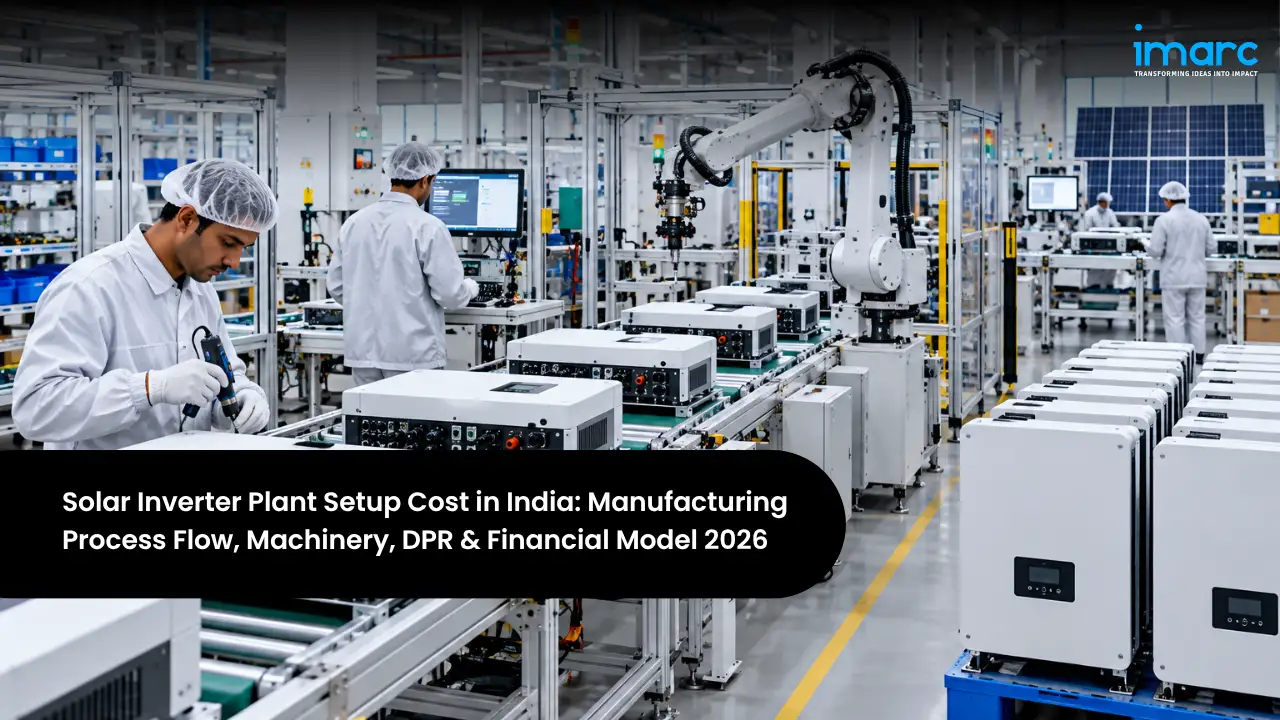
Every solar power system needs an inverter to convert the direct current produced by solar panels into alternating current that homes, businesses, and the grid can use. Inverters also manage power output, protect the system, and increasingly connect to batteries and digital monitoring platforms. India's rapid solar expansion across utility-scale parks, commercial and industrial rooftops, and household installations under the PM Surya Ghar programme is creating strong, recurring demand. Mandatory quality certification and the government's push to localise the solar supply chain make Solar Inverter Manufacturing Plant Setup in India a timely opportunity for electronics manufacturers and investors.
Investment depends on the inverter types produced, whether small string and hybrid units or large utility inverters, the annual capacity in gigawatts, and how much of the electronics and power stage is built in-house. Because production is an electronics assembly process rather than heavy manufacturing, capital needs are moderate. The Solar Inverter Manufacturing Plant Cost ranges from about INR 25 crore for a focused string and hybrid inverter assembly unit to INR 250 crore for a large, vertically integrated plant with in-house SMT lines and utility inverter testing. Power semiconductors, electronic components, magnetics, and enclosures make up most of the operating cost, so component sourcing, design, and testing quality are the decisions that shape profitability. At healthy utilisation, a well-run plant can deliver a gross margin of 25 to 35% and a net profit margin of 10 to 15%, with payback typically within 3 to 5 years.
This guide is written for investors trying to understand how to start a Solar Inverter manufacturing plant in India. It covers the main inverter types and their markets, the demand outlook, the production process flow, machinery and raw materials, location and infrastructure, a detailed cost and financial breakdown, the certifications and approvals involved, and how a DPR and financial model turn all of this into a bankable plan.
India Market Snapshot
| Key Facts | Details |
|---|---|
| India Solar Inverter Market (2025) | USD 426.9 Million |
| Projected Market Size (2034) | USD 847.6 Million, 7.92% CAGR |
| Main Inverter Types | String, central, hybrid, and micro inverters |
| Key Application Segments | Utility-scale, C&I, and residential rooftop |
| Indicative Total Investment | INR 25–250 Crore |
| Typical Payback Period | 3–5 Years |
The snapshot shows a steadily growing market supported by one of the world's largest solar build-outs. String inverters dominate commercial and rooftop installations, central inverters serve large utility plants, and hybrid inverters that connect to batteries are growing quickly as storage spreads. A large share of inverters used in India is still imported, which creates room for domestic manufacturers who can meet certification requirements and compete on reliability and service. The wide investment range reflects a genuine choice between a focused plant assembling residential and commercial inverters and a larger facility producing utility-scale units with deeper in-house electronics. The sections below work through that choice.
Investment Highlights
Indicative Project Cost in India (2026)
| Parameter | Value |
|---|---|
| Product Range | String, hybrid, central, and micro inverters |
| Total Project Investment | INR 25 – 250 Crore |
| Payback Period | 3 – 5 Years |
| Net Profit Margin | 10 – 15% |
| IRR | 18 – 26% |
| Preferred States | Gujarat, Tamil Nadu, Karnataka, Maharashtra, Uttar Pradesh, Telangana |
| Key Approvals | BIS registration under the Solar Goods Order, Factory License, SPCB consent, ISO |
| Key Requirement | Strong power electronics design, firmware, and testing capability |
These ranges provide a realistic frame for early planning, but actual returns depend on product mix, the share of higher-value hybrid and utility inverters, semiconductor and component prices, and success in winning EPC contractors, distributors, and utility tenders. A site-specific Solar Inverter Feasibility Report narrows each of these assumptions to your chosen products, customers, location, and capacity.
Table of Contents
- What is Solar Inverter Manufacturing?
- Why is Solar Inverter Manufacturing Growing in India?
- Solar Inverter Manufacturing Process Flow
- Raw Materials and Components for Solar Inverter Manufacturing
- Location, Land & Infrastructure
- Solar Inverter Manufacturing Machinery and Equipment
- Solar Inverter Manufacturing Plant Setup Cost in India (CapEx & OpEx)
- Financial Analysis and Profitability
- Licenses and Approvals for Solar Inverter Manufacturing in India
- Recent Developments in the India Solar Inverter Manufacturing Industry
- How a Solar Inverter Manufacturing Project Report and DPR Helps Investors
- Frequently Asked Questions
What is Solar Inverter Manufacturing?
A solar inverter uses power semiconductors such as IGBTs or MOSFETs, switching thousands of times a second under the control of a microcontroller, to convert direct current from solar panels into grid-quality alternating current. It also tracks the maximum power point of the panels, synchronises with the grid, protects against faults, and communicates data to monitoring platforms. Manufacturing inverters combines power electronics and firmware design, printed circuit board assembly, power stage and magnetics assembly, enclosure and thermal design, and extensive electrical, safety, and environmental testing.
Commercially, the business serves every segment of the solar market. A Solar Inverter Manufacturing Plant can supply utility-scale developers and EPC contractors, commercial and industrial rooftop installers, residential solar installers and distributors, battery storage integrators, and export customers. Service, warranty support, and monitoring software are important parts of the offer, since inverters are expected to operate reliably for many years in demanding outdoor conditions.
- Utility-Scale Solar: Central and high-power string inverters for large solar parks.
- Commercial & Industrial: Three-phase string inverters for factories, warehouses, and offices.
- Residential Rooftop: Single- and three-phase string and hybrid inverters for homes.
- Storage & Off-Grid: Hybrid, battery, and off-grid inverters for backup and remote power.
The Main Solar Inverter Product Types
Choosing which inverter types to make is the most important commercial decision, because it determines design capability, machinery, certifications, and customers:
| Product Type | Description | Key Property | Primary Demand |
|---|---|---|---|
| String Inverters | Connect one or more panel strings | Flexible and easy to maintain | Rooftop, C&I, and utility |
| Central Inverters | High-power units for large arrays | Low cost per watt at scale | Utility-scale solar parks |
| Hybrid Inverters | Combine solar and battery management | Enable storage and backup | Homes and small businesses |
| Micro Inverters | Mounted on individual panels | Panel-level optimisation | Residential rooftops |
| Off-Grid Inverters & PCUs | Work with batteries without the grid | Independent power supply | Rural, remote, and backup use |
Product choice shapes the whole plant. Residential and commercial string and hybrid inverters are produced in high volumes on SMT and assembly lines, while central and high-power utility inverters need heavier power stages, larger enclosures, and high-power test facilities. Many new entrants begin with string and hybrid inverters for rooftop and commercial markets, where demand is broad and design cycles are shorter, then move into higher-power utility products as engineering capability, certifications, and references grow.
Why is Solar Inverter Manufacturing Growing in India?
Key Growth Drivers in the Indian Market
Demand is supported by India's renewable energy targets, rooftop solar programmes, and a strong push for domestic manufacturing:
- Solar capacity expansion: India’s target of 500 GW of non-fossil capacity by 2030 requires very large annual solar additions, each needing inverters.
- Rooftop solar programmes: PM Surya Ghar: Muft Bijli Yojana aims to put rooftop solar on one crore households, driving residential inverter demand.
- Battery storage growth: Storage tenders and rising interest in backup power are boosting hybrid and battery inverters.
- Quality regulation: Mandatory BIS certification under the Solar Goods Order raises quality standards and favours committed manufacturers.
- Replacement demand: Inverters typically need replacement during a solar plant’s life, creating a steady aftermarket.
India-Specific Market Opportunity
| Segment | India Market Context | Manufacturing Role |
|---|---|---|
| Utility-Scale Solar Parks | Large annual capacity additions | Central and high-power string inverters |
| C&I Rooftop & Open Access | Businesses cutting power costs | Three-phase string inverters |
| Residential Rooftop | PM Surya Ghar and rising adoption | Single-phase and hybrid inverters |
| Battery Storage | Storage tenders and backup demand | Hybrid and battery inverters |
The strongest opportunity lies in combining a certified, reliable product range with a nationwide service network. Residential and C&I segments reward brands with strong distributor relationships and fast after-sales support, while utility customers value bankability, proven performance, and the ability to deliver large volumes on time. Hybrid inverters and storage-ready products offer the fastest growth as battery adoption rises.
Solar Inverter Manufacturing Process Flow
Understanding the process helps you plan machinery, factory layout, and where cost and quality are decided. Inverter production is an electronics manufacturing process, from printed circuit board assembly through power stage and final assembly to firmware loading and extensive testing. Electrostatic discharge control, soldering quality, and thorough testing are critical, since field failures are costly and damage brand reputation.
The Solar Inverter Manufacturing Process Flow
The sequence below reflects string and hybrid inverter production. Central inverters follow a similar route with larger power modules, heavier cabinet assembly, and high-power testing.
| Unit Operation | Key Activity |
|---|---|
| Design & Firmware Development | Circuit, thermal, and control software designed and validated |
| Incoming Component Inspection | Semiconductors, capacitors, and PCBs checked |
| SMT Assembly | Solder paste printing, component placement, and reflow |
| Through-Hole Assembly & Soldering | Large components fitted by wave or selective soldering |
| PCB Inspection & Testing | Optical, X-ray, in-circuit, and functional tests |
| Conformal Coating | Boards protected against moisture and dust |
| Power Stage & Magnetics Assembly | Power modules, heat sinks, inductors, and capacitors fitted |
| Final Assembly | Boards, wiring, and connectors installed in enclosure |
| Firmware Loading, Burn-in & Testing | Software loaded, units run under load, safety tests done |
| Final Inspection & Packing | Visual check, labelling, and dispatch |
Two factors decide profitability across this flow. The first is design: efficient topologies, good thermal design, and robust firmware reduce component cost, improve efficiency, and lower field failure rates. The second is test coverage: automated optical inspection, in-circuit and functional testing, and burn-in under load catch defects before products leave the factory, which protects warranty costs and brand reputation. A plant that controls both can compete on reliability rather than price alone.
Raw Materials and Components for Solar Inverter Manufacturing
The main inputs are power semiconductors such as IGBT and MOSFET modules, capacitors, inductors and transformers, printed circuit boards, microcontrollers and other integrated circuits, sensors, aluminium heat sinks, enclosures, cables, connectors, and protective devices. Because components make up most of the cost and several key parts are imported, a reliable and diversified supply chain is central to project planning.
| Component | Role in Inverter | India Sourcing | % of OpEx |
|---|---|---|---|
| Power Semiconductors (IGBT, MOSFET, SiC) | Convert DC to AC | Largely imported | 22–30% |
| PCBs, ICs & Other Electronics | Control, sensing, and communication | Mix of imported and domestic | 16–22% |
| Capacitors & Magnetics | Filter and store energy | Imported and domestic suppliers | 12–18% |
| Heat Sinks & Enclosures | Cooling and weather protection | Largely domestic | 8–12% |
| Cables, Connectors & Protective Devices | Connections, switches, and surge protection | Domestic and imported | 5–8% |
| Packaging & Consumables | Solder, coating, and packing | Domestic suppliers | 1–2% |
India has a growing base of PCB assemblers, enclosure and heat sink makers, and magnetics suppliers, but power semiconductors, many capacitors, and integrated circuits are still mostly imported. Semiconductor supply can be affected by global shortages and price swings, so qualifying alternative suppliers, holding strategic buffer stocks, and designing products that accept equivalent parts are important. Local sourcing of enclosures, heat sinks, magnetics, and PCB assembly improves cost and supports localisation goals.
Location, Land & Infrastructure
Site selection for an inverter plant is shaped by access to electronics component suppliers and skilled technicians, proximity to solar developers, EPC contractors, and distributors, port and airport connectivity for imported components, and state electronics and renewable energy incentives. Because inverters are compact and relatively light, logistics are simpler than for heavy equipment, and the plant can serve national markets from a single well-connected location.
Choosing the Best Location for Solar Inverter Manufacturing Plant Setup
| State / Region | Why It Works | Key Advantage |
|---|---|---|
| Gujarat (Ahmedabad & Sanand) | India’s largest solar manufacturing and project hub | Customers, suppliers, and ports |
| Tamil Nadu (Chennai & Krishnagiri) | Major electronics and power electronics cluster | Skilled workforce and ports |
| Karnataka (Bengaluru) | Electronics design and R&D base | Engineering talent |
| Maharashtra (Pune) | Power electronics and industrial base | Talent and suppliers |
| Uttar Pradesh (Noida & Greater Noida) | Large electronics manufacturing cluster | EMS partners and North Indian market |
| Telangana (Hyderabad) | Electronics and renewable energy growth | Land, talent, and incentives |
Gujarat, as the centre of India's solar manufacturing and project development, offers proximity to developers, EPC contractors, and module makers. Tamil Nadu and Uttar Pradesh bring large electronics manufacturing ecosystems and skilled workforces, Karnataka and Maharashtra offer power electronics design talent, and Telangana combines land, incentives, and a growing electronics base. The final choice should weigh component supply, engineering talent, customer access, and state incentives.
Quality, Reliability and Testing Systems
Solar inverters must operate reliably for many years in heat, dust, and humidity, and must meet strict safety and grid connection requirements. A credible plant needs ESD-controlled production areas, automated inspection of circuit boards, full traceability, burn-in testing under load, safety and insulation testing, environmental and thermal cycling tests, and a laboratory with grid and PV simulators for performance validation. An experienced Solar Inverter Manufacturing Consultant in India can help plan the product roadmap, testing laboratory, and BIS certification process so the plant can reach the market quickly with reliable products.
Infrastructure Requirements (Mid-Sized Plant)
| Infrastructure Element | Specification | India-Specific Note |
|---|---|---|
| Total Land Area | 2 – 10 acres | Room for future lines |
| SMT & Electronics Area | ESD-controlled, air-conditioned | Humidity and dust control |
| Assembly & Burn-in Area | Assembly lines and load test racks | Energy recovery reduces power cost |
| Testing Laboratory | Grid and PV simulators, environmental chambers | Core to certification and quality |
| Warehouse | Component and finished goods storage | Humidity-controlled for components |
| Power Requirement | 0.5 – 3 MW | Stable supply with backup |
| R&D and Design Centre | Hardware and firmware teams | Core to product competitiveness |
ESD-controlled SMT areas, well-organised assembly lines, burn-in facilities, and a capable testing laboratory are the defining infrastructure needs. Burn-in and load testing can consume significant power, so regenerative test equipment that feeds energy back into the plant supply is worth considering. A strong in-house design team is as important as the factory itself, because product design largely determines cost, efficiency, and reliability.
Solar Inverter Manufacturing Machinery and Equipment
The equipment set covers PCB assembly, inspection and testing, power stage and final assembly, burn-in, and performance and safety testing. SMT lines and test systems account for most of the machinery budget. The main items are summarised below.
| Equipment | Function | Key Specification |
|---|---|---|
| Solder Paste Printer & SPI | Apply and inspect solder paste | High-precision printing |
| Pick-and-Place Machines | Place surface-mount components | High speed and accuracy |
| Reflow Oven | Solder surface-mount components | Controlled thermal profile |
| AOI & X-Ray Inspection | Detect assembly defects | Automated optical and X-ray checks |
| Wave or Selective Soldering | Solder through-hole components | Suited to power components |
| In-Circuit & Functional Testers | Verify assembled boards | Automated test programmes |
| Conformal Coating Line | Protect boards from environment | Selective coating and curing |
| Magnetics Winding Machines | Make inductors and transformers | Optional for in-house magnetics |
| Assembly Lines & Torque Tools | Assemble power stages and enclosures | ESD-safe workstations |
| Burn-in & Load Test Racks | Run units under load | Regenerative energy recovery |
| Grid/PV Simulators & Safety Testers | Validate performance and safety | Hi-pot, insulation, and efficiency tests |
Machinery should follow the product and capacity plan. A smaller plant can outsource PCB assembly to an electronics manufacturing services partner and focus on power stage assembly, final assembly, and testing, while a larger plant brings SMT in-house for cost, quality, and design control. Automated inspection and testing improve reliability and reduce warranty costs, and regenerative burn-in systems lower energy bills.
Solar Inverter Manufacturing Plant Setup Cost in India (CapEx & OpEx)
The tables below break down capital and operating costs for a mid-sized solar inverter facility in India. The final Solar Inverter Investment Cost for your project will depend on product types and power ratings, annual capacity, the degree of in-house PCB assembly and magnetics production, the scope of the testing laboratory, and location.
Capital Expenditure (CapEx) Cost Structure
| CapEx Component | % of Total CapEx | What It Covers |
|---|---|---|
| Plant & Machinery | 35–45% | SMT lines, assembly, burn-in, and test systems |
| Land & Buildings | 15–22% | Production halls, ESD areas, and warehouse |
| Testing Laboratory & Equipment | 8–12% | Grid/PV simulators and environmental chambers |
| R&D, Design Tools & Certification | 6–10% | Design software, prototypes, and BIS testing |
| Utilities & ESD Infrastructure | 4–7% | Air conditioning, power backup, and ESD flooring |
| Pre-operative & Contingency | 4–6% | Engineering, DPR, trial runs, buffer |
| Working Capital | 12–18% | Component inventory and receivables |
Machinery and testing equipment dominate the capital budget, while working capital deserves careful planning because imported components need long lead times and buffer stocks, and distributors and EPC customers often expect credit. A detailed Solar Inverter Business Plan should model product mix, component lead times, inventory levels, warranty provisions, and payment terms together, so that funding matches the real cash cycle of an electronics business.
Operating Expenditure (OpEx) Cost Structure
| OpEx Component | % of Total OpEx | India-Specific Note |
|---|---|---|
| Components & Materials | 75–85% | Semiconductors and electronics largely imported |
| Utilities (power, air conditioning) | 5–10% | SMT, burn-in, and climate control |
| Labour & Engineering | 4–7% | Technicians, test engineers, and designers |
| Warranty & After-Sales Service | 2–4% | Field service and replacements |
| Testing & Certification | 1–2% | Ongoing BIS and product testing |
| Logistics & Overheads | 2–3% | Distribution and administration |
With components making up most of the cost, margins depend on smart design, strong supplier negotiation, and low failure rates. A good operating model tracks material cost per watt, first-pass yield, field failure and warranty rates, and inventory turns, and tests how margins respond when semiconductor prices or exchange rates move or when price competition intensifies.
Financial Analysis and Profitability
Based on analysis of a mid-sized solar inverter facility, the financial profile is attractive, supported by strong solar demand, moderate capital needs, and the value of a trusted, certified brand. The profitability of Solar Inverter manufacturing business in India improves markedly with a strong distribution and service network, a growing share of hybrid and higher-power products, in-house design, and localised components.
| Financial Metric | Indicative Value | India Context |
|---|---|---|
| Gross Profit Margin | 25–35% | Higher for hybrid and branded products |
| Net Profit Margin | 10–15% | After depreciation and Indian corporate taxes |
| Payback Period | 3–5 Years | Faster with strong distribution |
| IRR (Internal Rate of Return) | 18–26% | Higher with in-house design and brand |
| Capacity Utilization (stable ops) | 65–85% | Depends on sales channels |
| Break-even Capacity Utilization | 35–45% | Moderate fixed costs |
Product mix and sales channels decide where a plant lands within these ranges. A plant competing mainly on price for utility tenders faces tight margins against large global suppliers, while one with a recognised brand, strong distributor network, and hybrid and storage-ready products can earn significantly more. Service quality matters as much as the product, because installers and customers stay loyal to brands that resolve problems quickly.
Returns can be strengthened by investing in in-house power electronics and firmware design, building a nationwide distributor and service network, adding hybrid and battery inverters, localising enclosures, heat sinks, and magnetics, and offering monitoring software and extended warranties. Reliability data and field performance records are what win repeat orders from installers and EPC contractors.
Key Risks and Mitigation
The main risks are intense price competition from established global brands, semiconductor supply and price volatility, currency movements, field failures and warranty claims, and changes in certification requirements. Price risk is reduced through design efficiency and a branded, service-led offer; supply risk by multiple qualified suppliers and buffer stocks; warranty risk by rigorous testing; and regulatory risk by early engagement with certification bodies. Promoters often work with a Solar Inverter Business Plan Consultant in India to test these scenarios before committing capital.
Licenses and Approvals for Solar Inverter Manufacturing in India
Approvals for an inverter plant combine industrial registrations with mandatory product certification and grid compliance requirements. Promoters setting up a Solar Inverter Manufacturing Plant in India generally need the following:
- BIS Registration: Registration of each inverter model under the Solar Systems, Devices and Components Goods Order, based on tests to IS 16221 for safety, IS 16169 for grid performance, and applicable efficiency standards.
- Grid Connectivity Compliance: Compliance with Central Electricity Authority technical standards and state DISCOM requirements for grid-connected systems.
- Factory License: Registration and plan approval under the Occupational Safety, Health and Working Conditions Code, 2020.
- Pollution Control Consent: Consent to Establish and Consent to Operate from the State Pollution Control Board, as applicable for electronics assembly.
- E-Waste Compliance: Extended Producer Responsibility registration under the E-Waste Management Rules where applicable.
- Quality & Export Certifications: ISO 9001 and ISO 14001, and international IEC certifications for export markets.
- Business & Tax Registration: Company incorporation, GST, Udyam, IEC for imports and exports, Fire NOC, and EPF and ESI registrations.
The factory license and pollution consent are needed before production starts, while BIS registration for each model depends on testing at recognised laboratories and can take several months, so it should be planned alongside product development. Testing the highest-rated model in each product series, where permitted, and preparing complete technical documentation in advance help shorten the time to market.
Note: The exact approvals, registrations, licenses, and certification requirements may vary depending on factors such as plant location, product types, power ratings, target applications, export markets, and applicable regulations. Businesses are advised to undertake a detailed regulatory assessment during the project planning stage to ensure full compliance and timely implementation.
Recent Developments in the India Solar Inverter Manufacturing Industry
Several recent developments give useful context for investors considering this market:
- Steady market growth: India’s solar inverter market reached USD 426.9 million in 2025 and is expected to reach USD 847.6 million by 2034, growing at about 7.9% a year.
- Solar Goods Order testing guidelines: In June 2025, MNRE issued draft guidelines for series testing of solar inverters under the Solar Systems, Devices and Components Goods Order, 2025.
- New product launches: In August 2025, Eastman Auto & Power launched grid-tie inverters from 3 kW to 110 kW for residential and commercial use.
- Rooftop solar momentum: PM Surya Ghar: Muft Bijli Yojana continues to drive residential rooftop installations and demand for small inverters.
The common thread is a growing market in which quality regulation is tightening and domestic brands are expanding their ranges. New entrants who build strong design capability, certified products, and dependable service networks will be best placed as India's solar and storage build-out continues through the decade.
How a Solar Inverter Manufacturing Project Report and DPR Helps Investors
A detailed DPR provides a structured roadmap for the venture, from market demand and product selection to factory design, machinery, certification, and economics. It helps investors decide the right product mix and power ratings, estimate capital and operating expenditure, assess profitability, and identify risks before committing funds.
At its core is a detailed Solar Inverter Financial Model covering revenue by product and customer segment, component cost build-ups, inventory and working capital, warranty provisions, certification costs, cash flows, break-even, return on investment, and payback. Banks and investors rely on this model to judge long-term viability, which is why many promoters appoint a Solar Inverter Plant Project Report Consultant in India to prepare the report and validate its assumptions against current market data.
For an inverter project, a strong DPR also clarifies the product roadmap, the in-house versus outsourced manufacturing plan, the certification strategy, and the sales and service model, which together are the factors most likely to decide success. By modelling utilisation against realistic sales channels and testing margins against component price swings and competition, the report turns a technology-led opportunity into a plan that lenders and partners can trust.
Frequently Asked Questions
What are the first steps to set up a solar inverter manufacturing plant in India?
Start by choosing your product types, power ratings, and target customers, and decide whether to develop designs in-house or license them. Then commission a feasibility study and DPR, secure land or an industrial shed in a supportive state, set up ESD-controlled production and testing areas, install SMT, assembly, and test equipment, recruit engineers and technicians, obtain the factory license and pollution consent, and complete BIS registration for each model.
How much does it cost to set up a solar inverter manufacturing plant in India?
A plant typically needs about INR 25 crore to INR 250 crore, depending on product types and power ratings, capacity, the degree of in-house PCB assembly, and the scope of the testing laboratory. Machinery, testing equipment, buildings, and working capital are the largest components.
What are the main steps in solar inverter manufacturing?
The flow runs from design and firmware development through incoming inspection, SMT assembly, through-hole soldering, PCB inspection and testing, conformal coating, power stage and magnetics assembly, final assembly, firmware loading, burn-in and testing, and final inspection and packing.
Which machinery does a solar inverter manufacturing plant need?
Key equipment includes solder paste printers and inspection systems, pick-and-place machines, reflow ovens, AOI and X-ray inspection, wave or selective soldering, in-circuit and functional testers, conformal coating lines, magnetics winding machines, ESD-safe assembly lines, burn-in and load test racks, and grid and PV simulators with safety testers.
What components are used to make solar inverters?
The main inputs are power semiconductors such as IGBTs and MOSFETs, printed circuit boards, microcontrollers and other ICs, capacitors, inductors and transformers, sensors, aluminium heat sinks, enclosures, cables, connectors, and protective devices.
How profitable is solar inverter manufacturing in India?
A well-run plant typically earns a 25 to 35% gross margin and a 10 to 15% net margin, with payback in 3 to 5 years at healthy utilisation. Profitability improves with in-house design, hybrid and storage-ready products, a strong distribution and service network, and localised components.
Which approvals does a solar inverter manufacturing plant need in India?
Typical approvals include BIS registration for each inverter model under the Solar Goods Order, compliance with grid connectivity standards, a factory license, State Pollution Control Board consent, EPR registration where applicable, ISO certifications, a Fire NOC, and GST, Udyam, IEC, and labour registrations.
How do I get a feasibility study or DPR for a solar inverter manufacturing project?
A detailed feasibility study and DPR covers market demand, product and customer strategy, factory design, certification, and full financials. Investors usually engage a Solar Inverter Manufacturing Feasibility Study Consultant with experience in power electronics and renewable energy manufacturing projects to prepare the report and validate it for lenders.
Our Clients










Contact Us
Have a question or need assistance?
Please complete the form with your inquiry or reach out to us at
Phone Number
+91-120-433-0800+1-201-971-6302
+44-113-547-7077
Previous Post

Sodium-ion batteries are emerging as a practical complement to lithium-ion technology. They work on the same principle, shuttling ions between a cathode and an anode, but use sodium, which is abundant, inexpensive, and available within India, in place of lithium.
Few industries in India have scaled as quickly as solar manufacturing. Backed by ambitious renewable energy targets, a rooftop programme for households, import duties on foreign modules, and the Approved List of Models and Manufacturers (ALMM), domestic module capacity has multiplied in just a few years.
Setting up an Electrical Panel Manufacturing Plant in India is a fabrication-and-assembly venture powered by heavy grid modernisation, a fast-growing renewable-energy build-out, rising industrial and commercial construction, and the spread of automation across factories and buildings.
Saudi Arabia has turned its power transition into one of the world's largest procurement programmes, and international developers, lenders, and equipment makers are following the tenders.
Setting up a Battery Manufacturing Plant in India is a high-demand, energy-driven venture, powered by the country's booming automotive sector, huge power-backup market, and the fast-growing shift to electric vehicles and renewable storage.
Setting up a Liquefied Natural Gas (LNG) Manufacturing Plant in India is a capital-intensive, strategically important venture, powered by the country's push toward a gas-based economy, the shift to cleaner fuels in transport and industry, and rising demand for LNG as a truck, bus, and industrial fuel.
The India carbon credit market is moving from a voluntary, project-by-project trade into a regulated national system with binding targets, a central registry, and exchange-based price discovery. According to IMARC Group, the market was valued at USD 33.69 Billion in 2025, grew to USD 44.42 Billion in 2026, and is projected to reach USD 405.47 Billion by 2034, expanding at a CAGR of 31.84% (2026–2034).
Setting up a Syngas Production Plant in India is a capital-intensive but strategically valuable venture, driven by the country's push for cleaner industrial fuels, coal and biomass utilization, and chemical self-reliance. Syngas, or synthesis gas, is a mixture of hydrogen and carbon monoxide produced by gasifying carbon-rich feedstocks, and it serves as a versatile building block for power, chemicals, hydrogen, and synthetic fuels. With abundant biomass, coal, and waste feedstock and growing policy support for gasification, India offers a favourable environment for new plants.
Setting up a Battery Energy Storage System Manufacturing Plant in India is a capital-efficient, high-growth venture, driven by the country's renewable energy expansion, grid modernization, and supportive storage policies. As solar and wind capacity scales up and the grid needs to balance variable generation, battery energy storage systems have become essential infrastructure.
Setting up a Lithium-ion Battery Recycling Plant in India is a capital-intensive but high-potential venture. India's rapid rise as a major electric-vehicle market, its large consumer-electronics base, and its fast-growing energy-storage sector are together creating one of the deepest and fastest-expanding pools of end-of-life lithium-ion batteries in the world.
Solar glass is a type of specialty glass that has high transmittance and is designed exclusively for use in solar energy systems. Unlike regular flat glass, solar glass is designed to have maximum light transmission with minimal losses due to reflection and absorption.
A solar inverter is a vital component in solar photovoltaic (PV) systems, responsible for transforming the direct current (DC) electricity produced by solar panels into alternating current (AC) electricity. This AC power is then suitable for use by the electrical grid, various appliances, and industrial equipment.
Australia has firmly established itself as a dominant force in the global liquefied natural gas (LNG) market, maintaining its position as one of the world's leading exporters. The country's strategic geographical location in the Asia-Pacific region, combined with substantial natural gas reserves, has enabled it to become a critical energy supplier to rapidly growing Asian economies, particularly China, Japan, and South Korea.
Japan's lead acid battery market stands as a cornerstone of the nation's energy storage infrastructure, demonstrating remarkable resilience and adaptability in an era dominated by rapid technological evolution. Despite the global shift toward lithium-ion technologies, the Japanese lead acid battery sector continues to thrive, driven by its unmatched cost-effectiveness, proven reliability, and exceptional recyclability.
Green hydrogen is the cleanest form of hydrogen available, as it is produced through water electrolysis using the electricity generated from renewable energy sources such as solar, wind, or hydropower. Carbon dioxide emissions are zero since no fossil fuels are used. Essentially, an electrolyzer is used in the electrolysis process to split water molecules into hydrogen and oxygen. The resulting hydrogen is refined by purification, compression, or liquefaction and then fed into various applications. Green hydrogen is considered a cornerstone of the global energy transition because it can store renewable energy, decarbonize hard-to-abate sectors, and serve as a sustainable alternative to fossil-fuel-based hydrogen.
Japan’s thermal power plant industry remains a crucial pillar of the nation’s energy infrastructure, providing a stable and reliable source of electricity for both industrial and residential consumption. Thermal power generation, which primarily involves the combustion of fossil fuels such as coal, natural gas, and oil, continues to play a key role despite increasing investments in renewable energy.
An electrical panel, also called a distribution board or switchboard, is an important installation in electrical infrastructure that acts as the main center for the distribution, control, and protection of electrical power within residential, commercial, and industrial systems. It acts as the point at which electrical energy is received from the utility or a source of power generation and is distributed to various circuits and equipment in an organized manner.
The global oil and gas EPC market is currently experiencing a remarkable transformation as it positions itself at the intersection of traditional energy demands and technological innovation. As of 2024, the market is demonstrating robust growth, reaching USD 52.9 Billion in 2024, depending on regional scope and market segmentation approaches. This substantial market base is supporting a major number of capital projects worldwide, including offshore platform projects and onshore installations that are collectively shaping the energy landscape.
Bamboo pellets are a biomass fuel type created through the compression of bamboo residues like shavings, sawdust, and chips into thick cylindrical pellets. They are an environmentally friendly substitute for conventional fossil fuels like natural gas and coal. Due to the fast growth rate and high biomass yield of bamboo, it has become one of the most renewable raw materials for the production of bioenergy.
Biomass briquettes are dense, solid fuel blocks made of compressed organic waste materials like sawdust, agricultural wastes, wood shavings, coconut shells, rice husk, or herbaceous biomass. The briquetting process usually involves drying the biomass to lower the moisture content (usually down to 10-15%), grinding or milling for a fine particle size uniformity, and then compressing under high pressure with or without a binding agent.
Biogas is a renewable energy form generated by the anaerobic fermentation of organic matter including agricultural residues, animal waste, municipal solid waste, sewage sludge, and food waste. Microorganisms in the absence of oxygen break down organic substances in the process and produce a gaseous mixture of mainly methane (CH4) and carbon dioxide (CO2), with traces of hydrogen sulfide (H2S) and water vapor.
A battery is an electrochemical energy storage system that transforms chemical energy into electrical energy by way of redox reactions between its electrodes and electrolyte. It consists of a single or multiple electrochemical cells, each having a positive electrode (cathode), a negative electrode (anode), and an electrolyte for ion transfer. Batteries are categorically divided into primary (non-rechargeable) and secondary (rechargeable) types.
The global energy landscape is undergoing a seismic transformation, with green hydrogen emerging as one of the most promising solutions to achieve deep decarbonization across sectors. Far from a niche technology, green hydrogen is emerging as a critical pillar of the future energy system, offering a pathway to a sustainable and resilient economy.
Transmission line towers are essential support components of transmission lines installed on overhead to distribute high-voltage electricity over long distances. Towers are made of galvanized steel, primarily, and are designed to tolerate mechanical stress, environmental loads, and electrical safety. Some of the important characteristics of transmission line towers are high structural strength, corrosion resistance, adaptability for modular design, and high service life. They are normally produced in lattice form (tubular or free-standing towers) or tubular form, with types including suspension towers, tension towers, angle towers, and terminal towers based on use.
The energy storage revolution is here, and it's powered by graphene. While the world struggles with the limitations of conventional lithium-ion batteries, a new technology is emerging that promises to shatter every performance barrier we've accepted as unchangeable.
Australia is undergoing a significant energy transformation, underscoring the growing role of renewable energy sources. These sources are key to combating climate change by reducing greenhouse gas emissions, the primary cause of global warming and air pollution. Beyond environmental benefits, renewable energy strengthens energy security by diversifying power sources and reducing dependence on volatile fossil fuel imports, contributing to greater energy independence.
Learn how to plan capital investment, manage raw material costs, post manufacturing cost and optimize operations for setting up solar panel plant.
Battery Energy Storage System (BESS) represents a power grid technology that stores electricity to enhance electric power grid reliability while increasing operational efficiency. BESS permits battery recharging during periods of low demand or extra grid supply capacity. BESS provides three principal operational functionalities which include power grid stabilization during supply disruptions, control of energy supply variations, and integration of intermittent renewable generation from wind and solar resources.
China's economic presence is expanding globally, and Latin America and the Caribbean (LAC) have become a focal point for its investments, especially within the energy sector. The region, rich in natural resources and experiencing rising energy demands, offers strategic opportunities for Chinese energy giants looking to invest and expand. LAC is currently leading a transformative movement towards sustainable energy. From 2015 to 2022, the region increased its renewable energy capacity by an impressive 51%, now generating 64% of its electricity from renewables such as hydropower, wind, and solar. This shift addresses the global demand for cleaner energy while supporting local economic growth and enhancing energy security.
Hydrogen is a clean, renewable, and widely available energy source that can be produced through various methods. Production techniques such as coal gasification, steam methane reforming, electrolysis, and thermochemical processes highlight its versatility. Hydrogen is essential in several critical sectors, including methanol and ammonia production, petroleum refining, transportation, power generation, as well as in electronics, metal industries, and as a rocket propellant. The increasing concern over carbon emissions and greenhouse gases has led to a shift towards cleaner fuel options. Hydrogen is recognized for its cleanliness and versatility as an energy carrier. Additionally, supportive government initiatives and favorable policies are driving the growth of hydrogen production globally.
Hydrogen is a clean, renewable, and abundant energy source derived from various methods. Its applications span across transportation, heating, and power generation. Diverse production methods, including coal gasification, steam methane reforming, electrolysis, and thermochemical processes, contribute to its versatility. Hydrogen plays a pivotal role in crucial sectors like methanol and ammonia production, petroleum refining, transportation, power generation, as well as in electronics, metal industries, and as a rocket propellant.
A floating solar farm is a renewable energy installation in which solar panels are mounted on floating structures in water bodies such as lakes, reservoirs, ponds, or even the sea. This technology, also known as a floating photovoltaic (PV) system, or “floatovoltaics,” enables solar power generation in areas with limited available land or where land use is restricted for other purposes. Floating solar farms offer various benefits, including improved solar panel efficiency through cooling, land conservation, reduction of evaporation and algae growth, and integration with hydropower facilities to generate both solar and hydroelectric power in the same location.
Nuclear power utilizes nuclear reactions to generate heat, which is then converted into electricity. This energy is released from the nucleus—the core of atoms composed of protons and neutrons. Nuclear power can be derived from nuclear fission, nuclear decay, and nuclear fusion reactions. Across the globe, nuclear power plants predominantly use the fission of uranium and plutonium to produce electricity. The heat generated from fission is used to create steam, which drives turbines connected to generators. Nuclear power offers several advantages over fossil fuels, such as minimal greenhouse gas emissions and a higher energy density, meaning a small amount of nuclear fuel produces a large amount of energy.