Copper Cable Plant Setup Cost in India: Manufacturing Process Flow, Machinery, DPR & Financial Model 2026
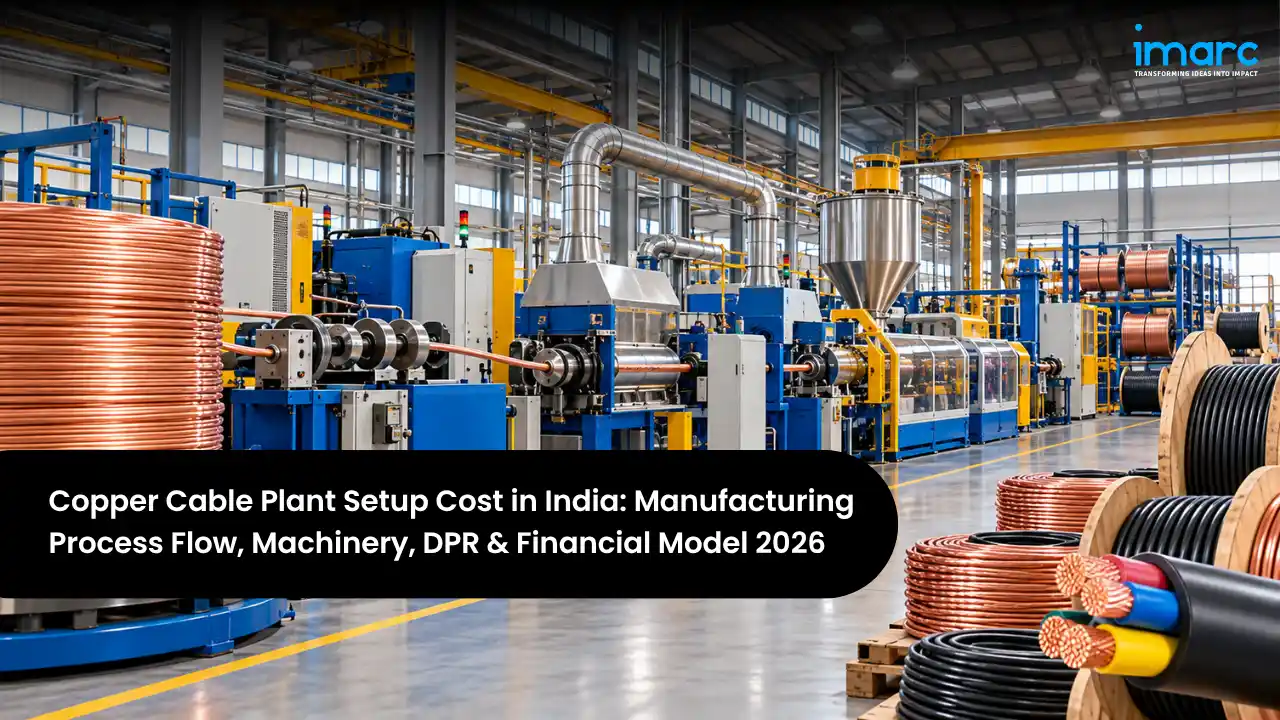
Setting up a Copper Cable Manufacturing Plant in India is a high-demand, infrastructure-driven venture, powered by the country's construction boom, rapid electrification, and steady industrial and appliance demand. Copper cables and wires carry power and signals in almost every building, machine, and vehicle, and demand rises with every home wired, factory built, and grid extended. With a strong domestic copper base, proven drawing-and-extrusion technology, and broad end-use demand, a Copper Cable Manufacturing Plant is one of the more dependable and scalable opportunities in the electrical products economy.
The Copper Cable Manufacturing Plant Cost depends on capacity, product range, and level of automation, with total project investment typically ranging from INR 5 crore to INR 50 crore. Copper is by far the largest operating input, so metal sourcing and conversion efficiency are the most important financial decisions in the project, and together they shape the overall Copper Cable Investment Cost. At healthy capacity utilisation, a well-run unit in India delivers a net profit margin of 6 to 12% and an IRR of 18 to 28%, with payback typically achieved within 3 to 5 years, with returns turning on volume and efficient metal management rather than fat unit margins.
This guide is written for investors and entrepreneurs asking how to start a Copper Cable manufacturing plant in India. It covers what the business involves, why demand is rising, the process flow, the machinery and raw materials required, location and infrastructure planning, a detailed cost and financial breakdown, the licenses you must secure, and how a project report and DPR turns all of this into a bankable plan.
India Market Snapshot
| Key Facts | Details |
|---|---|
| India Wires & Cables Market | Large, multi-billion dollar (indicative) |
| Primary Products | Copper building wires and cables |
| Projected Market CAGR (2026–2034) | 9–13% (indicative) |
| Typical Plant Capacity | Few thousand to tens of thousands km/year |
| Indicative Total Investment | INR 5–50 Crore |
| Typical Payback Period | 3–5 Years |
The snapshot captures why a Copper Cable Manufacturing Plant in India attracts strong investor interest: an essential electrical product, broad and growing demand across construction, industry, and appliances, and a deep copper and compound base. The wide investment range reflects a genuine choice of product mix and scale, from a compact building-wire unit to a larger plant producing flexible, power, and control cables. Because copper wires and cables are a standard, repeat-purchase item across every sector, the demand base is resilient, which is part of why lenders view well-run units favourably. The rest of this guide unpacks that decision in detail.
Investment Highlights
Indicative Project Cost in India (2026)
| Parameter | Value |
|---|---|
| Plant Capacity (Typical) | Few thousand to tens of thousands km/yr |
| Total Project Investment | INR 5 – 50 Crore |
| Payback Period | 3 – 5 Years |
| Net Profit Margin | 6 – 12% |
| IRR | 18 – 28% |
| Best Locations | Gujarat, Maharashtra, Delhi-NCR, Tamil Nadu, Haryana |
| Mandatory Approvals | Factory License, GST, BIS (ISI), Fire NOC, EPF/ESI |
| Primary Revenue | Copper wires and cables |
These indicative parameters give a realistic frame for early feasibility work. The returns are attractive, but they depend on managing copper cost, running an efficient line, and building steady buyers among electrical distributors, contractors, OEMs, and industry. A well-prepared Copper Cable Feasibility Report tightens each of these numbers to your specific location, capacity, and product range.
Table of Contents
- What is Copper Cable Manufacturing?
- Why is Copper Cable Manufacturing Growing in India?
- Copper Cable Manufacturing Process
- Raw Materials and India Sourcing
- Location, Land & Infrastructure
- Machinery and Equipment Required
- Copper Cable Manufacturing Plant Setup Cost in India (CapEx & OpEx)
- Financial Analysis and Profitability
- Licenses and Approvals for Copper Cable Manufacturing Plant in India
- Recent Developments in the India Copper Cable Manufacturing Industry
- How a Copper Cable Manufacturing Project Report and DPR Helps Investors
- Frequently Asked Questions
What is Copper Cable Manufacturing?
Copper cable manufacturing generally involves drawing copper rod into conductors, annealing where required, bunching or stranding, insulation extrusion and, depending on the product, laying-up, inner sheathing, armouring, outer sheathing, printing and testing. Common product categories include building wires, flexible cables, low-voltage power cables and control cables, although the product mix varies by manufacturer. The output is used across house wiring, industrial plants, appliances, panels, and infrastructure, where copper is valued for its conductivity and reliability.
From a business perspective, what makes this sector attractive in India is the combination of essential, recurring demand and a broad customer base. Every builder, electrical contractor, distributor, OEM, and industry is a potential buyer, and a strong copper and compound supply base supports production. A manufacturer that produces to standard specifications with consistent quality is positioned to serve a large, essential, and steadily growing market driven by construction, electrification, and industrial activity.
- Building Wires: FR and FRLS house-wiring cables, a high-volume, brand-driven segment.
- Flexible Cables: Multi-strand flexible copper cables for appliances and equipment.
- Power & Control Cables: Low-voltage power and control cables for industry and panels.
- Specialty & Armoured: Armoured, instrumentation, and specialty cables that command better prices.
The Main Segments in Copper Cable Manufacturing
Understanding which segment your unit will serve is the foundational decision, because it drives machinery, certification, and value:
| Segment | Typical Products | Key Property | Primary Demand |
|---|---|---|---|
| Building Wires | FR / FRLS wires | Brand and ISI-driven | Housing and retail |
| Flexible Cables | Multi-strand cables | Flexibility | Appliances and OEMs |
| Power & Control | LT power, control | Industrial-grade | Plants and panels |
| Specialty / Armoured | Armoured, instrumentation | Higher margin | Industry and infra |
This choice shapes the entire unit, because building wires are a high-volume, brand-and-ISI-driven business while power, control, and specialty cables command better margins but need more machinery and certification. Many Indian entrants begin with building wires and flexible cables, the largest and most accessible segment, and add power, control, and armoured cables as they build capability and buyers. The segment decision drives everything from machinery to the level of investment required.
Why is Copper Cable Manufacturing Growing in India?
Key Growth Drivers in the Indian Market
India's wires and cables sector is being propelled by several structural factors that combine a construction boom with electrification and industrial growth. Few products ride as many favourable trends at once:
- Construction and housing boom: Rapid residential and commercial construction drives constant demand for building wires and cables.
- Electrification and grid growth: Rural electrification, distribution upgrades, and new connections expand cable demand.
- Industrial and infrastructure capex: Factories, metros, and infrastructure projects increase demand for power and control cables.
- Appliances and renewables: Growing appliance production and solar projects add steady demand for copper cables.
- Brand and quality shift: A move toward branded, ISI-certified wires favours reliable, quality-focused producers.
India-Specific Market Opportunity
| Segment | India Market Context | Cable Role |
|---|---|---|
| Construction | Booming building activity | Building wires |
| Industry | Growing manufacturing | Power and control cables |
| Appliances | Large appliance output | Flexible cables |
| Infrastructure | Metros and projects | Power cables |
| Renewables | Rapid solar build-out | DC and power cables |
The strongest opportunity lies in supplying distributors, contractors, OEMs, and industry with consistent, competitively priced, certified cables, ideally near both copper supply and demand clusters. A manufacturer that runs efficiently and maintains quality can lock in steady, repeat orders. Moving into power, control, armoured, and specialty cables, where margins are better and competition thinner, further strengthens a unit's position in a large, growing market, while a strong brand lifts building-wire realisations.
Copper Cable Manufacturing Process
Understanding how a cable is actually made helps you plan equipment, material handling, and the main cost drivers. Production is a sequential operation that turns copper rod into drawn, stranded, insulated, and, where needed, sheathed cable, with quality control throughout. The typical flow moves copper through drawing and stranding to insulation, assembly, and testing:
The Copper Cable Manufacturing Process
In this flow, copper rod is drawn down to wire, annealed for flexibility, bunched or stranded into conductors, insulated by extrusion, then for multicore cables laid up, sheathed, and armoured, before printing and full electrical testing. Consistent conductor size and sound insulation are essential to cables that meet electrical and safety specifications at a competitive cost.
| Unit Operation | Key Activity |
|---|---|
| Wire Drawing | Copper rod drawn to wire |
| Annealing | Wire softened for flexibility |
| Bunching / Stranding | Wires formed into conductors |
| Insulation | PVC or XLPE extruded on conductor |
| Laying Up | Cores assembled for multicore |
| Inner Sheathing | Inner sheath applied |
| Armouring | Armour applied where required |
| Outer Sheathing | Outer sheath and printing |
| Testing | Spark, HV, and resistance tests |
| Coiling & Dispatch | Coiled or drummed and dispatched |
Two points determine profitability across this flow. First, copper yield and conductor accuracy drive both quality and cost, so drawing and stranding control directly govern outcomes, because copper is expensive and wastage is costly. Second, sound insulation and low rejection are decisive margin levers, since a cable that fails testing is scrap. Rigorous testing, for conductor resistance, spark, and high voltage, is what allows a manufacturer to certify cables to standards and win repeat orders. Because contractors and OEMs rely on cables meeting rated specifications, consistent quality and correct conductor content matter as much to them as headline price.
Raw Materials and India Sourcing
The main input is copper, in the form of rod, and securing it efficiently is the single biggest determinant of a unit's viability. Because copper dominates cost and its price moves daily with global markets, procurement strategy and price management materially affect margin, alongside the insulation and sheathing compounds, armour, and consumables the process needs.
| Raw Material | Role in Process | India Sourcing | % of OpEx |
|---|---|---|---|
| Copper Rod | Conductor | Domestic copper suppliers | 65–75% |
| PVC / XLPE Compound | Insulation and sheath | Domestic and imports | 8–14% |
| Fillers & Master Batch | Assembly and colour | Domestic suppliers | 2–5% |
| Armour (Wire/Strip) | Mechanical protection | Domestic suppliers | 3–6% |
| Packaging & Consumables | Coils, drums, spares | Domestic suppliers | 2–5% |
Because copper is such a large share of cost, metal management is the biggest lever on profitability and the defining feature of this business. Copper prices move daily with global markets, so a manufacturer must buy carefully, hedge or pass through metal cost in pricing, and minimise wastage, since even small yield losses are expensive at these metal volumes. Compounds, armour, and consumables are smaller but important to quality, and good conductor yield through efficient drawing is a quiet but meaningful margin lever given how much a cable's economics depend on copper.
Location, Land & Infrastructure
Choosing the best location for Copper Cable manufacturing plant setup significantly affects copper access, power reliability, and proximity to distributors and industrial demand. Being near copper supply, electrical-goods clusters, and reliable power shapes site selection, alongside adequate covered space for drawing, extrusion, and cable storage.
Best States for Copper Cable Manufacturing Plant Setup in India
| State | Why It Works | Key Advantage |
|---|---|---|
| Gujarat | Industrial and port base | Metal, logistics, exports |
| Maharashtra | Large electrical market | Demand and industry |
| Delhi-NCR | Electrical goods cluster | Distributors and OEMs |
| Tamil Nadu | Manufacturing and appliances | Demand and workforce |
| Haryana | Auto and electrical belt | OEM demand and access |
| Dadra & Nagar Haveli | Cable manufacturing cluster | Ecosystem and access |
The strongest locations combine reliable copper and compound supply and power with proximity to electrical-goods clusters and end-use demand. Gujarat and Maharashtra offer industrial depth, logistics, and market, while Delhi-NCR, Tamil Nadu, Haryana, and established cable clusters add distributors, OEM demand, and ecosystem. Because drawing and extrusion depend on continuous power and cables are heavy, power reliability, covered production and storage space, and good road access should weigh heavily in the final choice, alongside room to add lines as demand grows.
Infrastructure Requirements (Mid-Sized Plant)
| Infrastructure Element | Specification | India-Specific Note |
|---|---|---|
| Total Shed Area | 2,000 – 12,000 sq. meters | Covered production space |
| Wire Drawing Section | Drawing and annealing | For conductor preparation |
| Stranding Area | Bunching and stranding | For conductor forming |
| Extrusion Lines | Insulation and sheathing | Multiple extruders |
| Testing Laboratory | Electrical testing | Spark, HV, resistance |
| Power & Utilities | Reliable power and air | For machines and testing |
| Copper & FG Storage | Secure storage | For metal and finished cable |
Infrastructure for a cable unit centres on the wire-drawing section, stranding area, extrusion lines, and a testing laboratory, because output, quality, and compliance depend on all of them. Reliable power is important given that drawing and extrusion run continuously, and secure copper storage is essential given the metal's value. Planning the shed with room to add extrusion or stranding lines later makes future expansion far cheaper than reconfiguring a cramped layout, so scalable design pays off early.
Machinery and Equipment Required
The equipment set spans wire drawing, stranding, extrusion, and testing, and the line-up scales with capacity and product range. Because quality and productivity depend on well-controlled drawing and extrusion, machinery must be robust and well matched to the product. The core machinery, from copper drawing through finished-cable testing, is summarized below.
| Equipment | Function | Key Specification |
|---|---|---|
| Rod Breakdown Machine | Draw rod to wire | Coarse wire drawing |
| Fine Wire Drawing | Draw fine wire | Multi-wire drawing |
| Annealing Unit | Soften the wire | Online or batch |
| Bunching / Stranding | Form conductors | Bunchers and stranders |
| Insulation Extruder | Insulate conductor | PVC or XLPE |
| Laying-Up Machine | Assemble cores | For multicore cables |
| Armouring Machine | Apply armour | Wire or strip |
| Sheathing Extruder | Apply outer sheath | Sized to cable |
| Testing Equipment | Test the cable | Spark, HV, resistance |
| Coiling / Rewinding | Coil and pack | Coilers and drums |
Equipment selection should follow your product range and capacity rather than the other way around. A building-wire unit centres on drawing, stranding, insulation, and coiling, while power, control, and armoured cables need laying-up, armouring, and sheathing lines and stronger testing. Drawing efficiency and extrusion stability are easy to under-plan yet decisive, because they determine conductor accuracy, copper yield, and scrap, and therefore the cost per unit and the ability to meet specifications and volumes.
Copper Cable Manufacturing Plant Setup Cost in India (CapEx & OpEx)
The tables below give you a breakdown of both the upfront capital investment and the ongoing operating costs, based on industry analysis of a mid-sized facility in India. The actual Copper Cable Manufacturing Plant Cost for your specific project will depend on your chosen location, capacity, product range, and level of automation.
Capital Expenditure (CapEx) Cost Structure
| CapEx Component | % of Total CapEx | What It Covers |
|---|---|---|
| Drawing & Stranding Machinery | 22–30% | Rod breakdown, drawing, stranding |
| Extrusion & Finishing Lines | 20–28% | Insulation, sheathing, armouring |
| Shed & Civil Works | 12–18% | Production shed and interiors |
| Testing & Quality Setup | 5–8% | Electrical testing lab |
| Utilities & Power | 5–8% | Power, cooling, and air |
| Pre-operative & Contingency | 5–8% | Engineering, DPR, and buffer |
| Working Capital | 18–25% | Copper stock and receivables |
The CapEx profile is balanced across drawing, stranding, and extrusion machinery, with working capital unusually large because copper is expensive and must be financed through production and credit cycles. Metal working capital, not machinery, is often the biggest single financing need in this business. Under-provisioning working capital is a common and costly mistake, so it is modelled carefully in the Copper Cable Business Plan and Financial Model, alongside the plant and machinery.
Operating Expenditure (OpEx) Cost Structure
| OpEx Component | % of Total OpEx | India-Specific Note |
|---|---|---|
| Copper | 65–75% | Largest cost; price moves daily |
| Compounds & Materials | 8–14% | Insulation and sheathing |
| Power & Utilities | 5–8% | Drawing and extrusion |
| Labour & Manpower | 4–8% | Operators and QC staff |
| Maintenance & Consumables | 2–5% | Machine and die upkeep |
| Logistics & Overheads | 2–5% | Freight and factory costs |
With copper overwhelmingly dominating operating cost, this is fundamentally a metal-conversion business, and margin depends on efficient metal management, high yield, and low scrap far more than on the small conversion spread. Copper prices move daily, so a financial model should track them closely and, like most cable makers, build in metal-price pass-through and tight inventory control, since holding copper is both costly and risky. Volume, yield, and disciplined pricing are what make the economics work, with power, control, and branded products lifting the blended margin.
Financial Analysis and Profitability
Based on analysis of a mid-sized cable facility in India, the financial profile is volume-driven and steady, supported by essential, growing demand and a strong copper base. Because metal management and volume drive economics, the profitability of Copper Cable manufacturing business in India improves markedly with efficient copper handling, high utilisation, low scrap, and a move toward higher-value and branded products.
| Financial Metric | Indicative Value | India Context |
|---|---|---|
| Gross Profit Margin | 12–20% | Driven by conversion spread and mix |
| Net Profit Margin | 6–12% | After depreciation and Indian corporate taxes |
| Payback Period | 3–5 Years | Faster with high volumes |
| IRR (Internal Rate of Return) | 18–28% | Higher for power, control, and branded |
| Capacity Utilization (stable ops) | 70–90% | Volume favours high run rates |
| Break-even Capacity Utilization | 55–65% | Steady demand supports throughput |
Metal management, volume, and yield are the factors that most determine outcomes, because unit margins are thin and a cable line must run at high volumes to earn well on a large copper turnover. An operator with efficient copper handling, high utilisation, and steady demand can build strong returns on volume, while one with high scrap or poor metal discipline will struggle despite high sales. This is why metal management and efficiency are as central to the financial model as the machinery itself, more so than in most manufacturing.
There are several ways to strengthen returns in the Indian context: buying and managing copper efficiently with price pass-through, minimising scrap through good drawing and extrusion, moving into power, control, armoured, and branded products, keeping the line well utilised, and building a strong dealer network for building wires. Reliable distributor and OEM relationships further stabilize order flow and pricing. Building a trusted, ISI-certified brand in building wires also lifts realisations, which smooths out the thin margins that pressure smaller, unbranded producers and supports steady growth.
Key Risks and Mitigation
The principal risks are copper price volatility, thin conversion margins, and competition. Metal risk is mitigated by careful buying, pass-through pricing, and tight inventory; margin risk is mitigated by high yield, low scrap, and a shift to value-added and branded products; and competition risk is mitigated by certification, quality, and a strong dealer network. A manufacturer that treats metal management, efficiency, and branding as core priorities is far better placed to sustain healthy returns.
Licenses and Approvals for Copper Cable Manufacturing Plant in India
The approvals for this business are important, because cables are safety products and building wires in particular must meet mandatory standards. Manufacturers planning to establish a Copper Cable Manufacturing Plant generally need to obtain the following before commencing operations, and BIS certification is especially central:
- BIS (ISI) Certification: ISI mark under mandatory Indian Standards for building wires and cables, central to the market.
- Factory License: Factory establishment and operation approval under the Occupational Safety, Health and Working Conditions Code, 2020.
- Business & Tax Registration: Company or firm incorporation, GST registration, and Udyam (MSME) registration.
- Pollution Control Consent: Consent from the State Pollution Control Board for the manufacturing process.
- Fire Safety NOC: Fire safety compliance for the factory premises.
- Import-Export Code (IEC): IEC for units importing copper or compounds or exporting cables.
- Labour Registrations: EPF, ESI, and other workforce-welfare registrations required for factory employment.
For a cable unit, BIS (ISI) certification, the factory license, and pollution and fire compliance are the critical items and should be pursued early, in parallel with setup, because building wires cannot be sold without the ISI mark and a plant cannot operate without the others. Engaging a consultant familiar with BIS certification and factory regulations is usually worth the cost, since a delayed mark can shut out the main market. Sequencing approvals well, alongside copper and dealer development, can shave weeks off the project timeline.
Note: The exact approvals, registrations, licenses, and compliance requirements may vary depending on factors such as plant location, capacity, product type, and applicable regulations. Businesses are advised to undertake a detailed regulatory assessment during the project planning stage to ensure full compliance and timely implementation.
Recent Developments in the India Copper Cable Manufacturing Industry
A few structural trends give useful context for investors considering entry into this industry:
- Construction and electrification growth: Sustained housing, infrastructure, and electrification activity continues to drive strong cable demand.
- Branding and quality shift: A move toward branded, ISI-certified wires is rewarding quality-focused, well-marketed producers.
- Renewables and industry: Solar projects and industrial capex are expanding demand for power and specialty copper cables.
The common thread is a market growing with construction, electrification, and industry, with quality, certification, and branding increasingly important. For a new entrant, the implication is clear: the window to establish an efficient, certified line and build a dealer network is open, and those who build metal discipline, quality, and branding into their model from the start will be best placed as demand grows through the decade.
How a Copper Cable Manufacturing Project Report and DPR Helps Investors
A comprehensive Copper Cable Project Report, prepared as a Detailed Project Report (DPR), provides a structured roadmap for establishing the facility by evaluating every aspect of the venture, from market demand and product mix to machinery selection, plant layout, and economics. It helps investors determine the optimal capacity and product range, estimate capital expenditure (CapEx) and operating expenditure (OpEx), assess profitability, and identify potential risks before implementation.
The report also brings together a Copper Cable Business Plan with revenue forecasts, production costs, cash flow analysis, break-even assessment, return on investment (ROI), and payback period calculations, supported by a detailed Copper Cable Financial Model. These insights enable investors, lenders, and stakeholders to make informed decisions and evaluate the long-term viability of the project. Many investors engage a Copper Cable Business Plan Consultant in India or a Copper Cable Manufacturing Consultant in India to prepare and validate these documents.
For a cable project specifically, a strong DPR also clarifies the copper-management strategy, the product and certification focus, and the target dealer and industrial segments, which are the factors most likely to determine success in this metal-heavy, volume-driven business. By modelling utilisation against realistic demand and testing margins against copper-price swings and pass-through, the report turns a competitive but essential-product opportunity into an executable plan that lenders and partners can trust. It also maps the phased scale-up and working-capital needs, so investors can see how the unit grows and when each tranche of funding is needed.
Frequently Asked Questions
How to start a copper cable manufacturing plant in India?
Begin by choosing your product mix and capacity, then prepare a feasibility report and DPR, secure a shed near copper supply and demand, arrange drawing, stranding, and extrusion machinery with a test lab, tie up copper and compound suppliers and dealers, and obtain BIS (ISI), factory, and pollution approvals. A detailed project report maps each step for your target setup.
What is the copper cable manufacturing plant cost in India?
It typically ranges from INR 5 crore to INR 50 crore depending on capacity, product mix, and automation, and the wider Copper Cable Investment Cost is driven by machinery and, importantly, copper working capital. Metal stock is often the biggest single financing need.
What is the copper cable manufacturing process?
The process runs from copper rod drawing and annealing, through bunching or stranding into conductors, insulation by extrusion, laying up, sheathing, and armouring for multicore cables, to printing, spark, high-voltage, and resistance testing, and coiling or drumming, with quality checks throughout.
What machinery is required for a copper cable plant?
Key equipment includes a rod breakdown machine, fine wire drawing and annealing units, bunching and stranding machines, insulation and sheathing extruders, laying-up and armouring machines, testing equipment for spark, high voltage, and resistance, and coiling and rewinding machines.
What is the best location for copper cable manufacturing plant setup?
The ideal site combines reliable copper and compound supply and power with proximity to electrical-goods clusters and end-use demand. Gujarat, Maharashtra, Delhi-NCR, Tamil Nadu, and Haryana are leading choices.
What is the profitability of copper cable manufacturing business in India?
It is volume-driven, with a typical 6 to 12% net profit margin and an 18 to 28% IRR, and a 3 to 5 year payback at healthy utilization. Because unit margins are thin and copper-heavy, returns depend on efficient metal management, high volumes, low scrap, and a shift to value-added and branded products.
How do I get a project report or feasibility report for a copper cable plant?
A Copper Cable Project Report and Copper Cable Feasibility Report cover the full plant setup and financials. Many investors engage a Copper Cable Plant Project Report Consultant in India or a Copper Cable Manufacturing Feasibility Study Consultant to prepare and validate them.
Our Clients










Contact Us
Have a question or need assistance?
Please complete the form with your inquiry or reach out to us at
Phone Number
+91-120-433-0800+1-201-971-6302
+44-113-547-7077
Previous Post

Setting up a Junction Box Manufacturing Plant in India is a high-demand, infrastructure-driven venture, powered by the country's construction boom, rapid electrification, and expanding solar and industrial sectors.
Setting up an Electric Cable Manufacturing Plant in India is a high-demand, infrastructure-linked venture, powered by the country's rapid growth in power, construction, renewable energy, and electrification. Cables and wires are essential to every building, factory, grid, and vehicle, giving an Electric Cable Manufacturing Plant a large and steadily growing market.
Setting up a Semiconductor Fabrication Manufacturing Plant in India is a highly capital-intensive but strategically transformative venture, driven by the country's semiconductor mission, deep policy incentives, and a vast import-substitution opportunity. Semiconductors are the foundation of every modern electronic and digital product, yet India currently imports almost all of its chip requirement.
Setting up a PCB Manufacturing Plant in India is a capital-intensive but strategically timed venture, driven by the country's electronics manufacturing push, strong policy incentives, and a large import-substitution opportunity. Printed circuit boards are the backbone of every electronic product, yet India still imports the overwhelming majority of its PCB requirement.
The Indian PCB (Printed Circuit Board) Market is emerging as the physical backbone of the country's electronics manufacturing ambitions. The market reached USD 7.27 Billion in 2025 and is projected to reach USD 25.48 Billion by 2034, growing at a CAGR of 14.96% (2026–2034), a total addressable market expansion driven by the Production Linked Incentive (PLI) scheme, 5G infrastructure rollout, and rising domestic consumer electronics demand.
Setting up an E-waste Recycling Plant in India is a capital-intensive but high-potential venture, driven by the country's soaring volume of discarded electronics, tightening Extended Producer Responsibility regulations, and the rising value of recovered metals. India is now among the world's largest generators of electronic waste, yet only a small share is processed through formal, compliant channels, leaving a large, policy-backed opportunity for organized recyclers who can capture volumes shifting from the informal sector.
Global semiconductor demand across automotive, data centers, and defense, highlighting market segmentation, key applications, regional dynamics, and industry shifts.
The hearables market represents one of the most dynamic segments within consumer electronics and wearable technology. These intelligent audio devices have evolved beyond simple wireless earbuds into multifunctional platforms combining premium audio with health monitoring, artificial intelligence, and seamless digital connectivity.
A smart washing machine is a sophisticated home appliance that incorporates advanced digital features such as connectivity, sensor technology, and automated controls for improved efficiency, convenience, and user control. In contrast to traditional washing machines, smart washing machines come pre-installed with advanced features such as Wi-Fi connectivity, smart load detection, smart detergent dispensing, and voice-control capability.
A smartphone is a portable electronic device that combines sophisticated capabilities in computer processing, wireless communication, multimedia entertainment, and internet access. Smartphones are distinct from other mobile phones in that their operation involves highly sophisticated platforms of operation that are capable of supporting multiple applications, multitasking, and connectivity with internet platforms.
Semiconductor manufacturing is a highly specialized industrial process that involves the design, fabrication, and assembly of semiconductor devices including integrated circuits (ICs), memory chips, sensors, and discrete components. The process transforms raw semiconductor materials, primarily silicon, into sophisticated electronic components through a combination of physical and chemical processing steps, such as wafer fabrication, photolithography, doping, etching, thin-film deposition, and packaging.
The retail landscape is experiencing a profound transformation as self-checkout systems emerge as critical infrastructure components reshaping consumer experiences and operational efficiency globally. These automated solutions enable customers to independently scan, bag, and pay for purchases without cashier assistance, representing a fundamental shift in modern commerce.
The webcams market is experiencing unprecedented transformation as digital communication becomes the cornerstone of modern business, education, and healthcare. Global webcam industry dynamics are being reshaped by technological innovation and evolving workplace models.
As smartphones become a way of life for most Filipinos, the market has changed dramatically and expectations from consumers are higher than ever before. With the demand for smartphones growing, there is a significant change in consumer shopping habits with more emphasis on using online platforms for shopping. This change is closely interlinked with the fast growth of the Philippines e-commerce market, both bringing opportunities and challenges to the stakeholders of the smartphone industry.
As technology continues to advance, lighting has transformed from a basic necessity into a strategic enabler of innovation, efficiency, and sustainability. The evolution from incandescent bulbs to LEDs, smart systems, and intelligent lighting networks represents not just technological change but a redefinition of how energy, design, and functionality intersect in the built environment.
An LED light is an illuminating device that utilizes Light Emitting Diodes as its source of light, generating light through a semiconductor-based process called electroluminescence. When electrical current flows across the semiconductor material of the diode, electrons emit energy as photons and thus produce highly efficient and concentrated illumination.
An LED bulb is a solid-state lighting device that uses Light Emitting Diodes (LEDs) as its illumination source. Different from incandescent or fluorescent lamps, light in LED bulbs is produced by electroluminescence, a process where the passing of an electric current through a semiconductor material emits photons directly. This process is highly energy-efficient, with a far larger percentage of the electricity being converted to usable light and very little heat generated in the process.
The junction box, generally made from plastic, metal, or composite materials, houses wire connections, terminations, and protective components to allow the safe distribution and routing of electrical circuits. The junction box will provide insulation, mechanical protection, and a secure environment to avoid accidental contact with live electrical parts, moisture intrusion, or dust accumulation.
The Japan power electronics market is poised to grow substantially, driven by rising demand in automotive, energy, industrial automation, and infrastructure sectors. According to IMARC Group, the Japan power electronics market is studied from 2019 to 2024 with projections extending to 2033.
Japan's printed circuit board (PCB) industry is the world leader in technology innovation, enabling consumer electronics, automotive, and next-generation communication system development. As a key enabler of modern electronic products, PCBs provide the essential building blocks for embedding semiconductors, sensors, and microchips into miniaturized, high-performance devices. Japan, through its world-class manufacturing base and engineering expertise, remains the hub of the global PCB supply chain.
Aluminum-Air (Al-Air) battery is a new energy storage technology that has attracted interest as a future alternative to conventional lithium-ion batteries, specifically for electric vehicle (EV) use. As opposed to normal rechargeable batteries, the Al-Air battery is a metal-air electrochemical cell with aluminum as the anode, oxygen from the ambient air as the cathode reactant, and a liquid electrolyte (commonly sodium hydroxide or potassium hydroxide) as the medium through which the reaction occurs.
Aluminium wire is an essential industrial commodity commonly employed in power transmission, electrical distribution, building construction, and manufacturing processes owing to its high conductivity-to-weight ratio, resistance to corrosion, and cost advantage over copper. Produced by methods including continuous casting, rolling, and drawing, aluminum wire is available in various grades and alloys to serve the wide demands, from overhead transmission conductors and building wiring to automotive harnesses and electronic applications.
Air conditioners are electromechanical devices used to control indoor climate by extracting heat and humidity and ensuring optimum air circulation. Generally consisting of a compressor, condenser, evaporator, refrigerant fluid, filters, fans, and electronic controls, air conditioners work based on the principle of heat exchange, moving heat from indoor areas to the external environment. Contemporary units come in diverse configurations, such as split systems, window units, central air systems, and portable models, supporting respective residential, commercial, and industrial applications. Some of the major characteristics are efficiency in cooling, energy use, noise rating, and environmental footprint in relation to refrigerant type.
E-waste, or electronic waste, is electrical and electronic equipment that has been discarded, such as computers, cell phones, television sets, servers, and household appliances. It is among the world's fastest-growing streams of waste, consisting of a heterogeneous combination of metals, plastics, glass, and toxic substances. E-waste contains valuable metals like copper, aluminum, gold, silver, palladium, and rare earth elements, in addition to toxic materials like lead, mercury, cadmium, and brominated flame retardants.
Polished silicon wafers are very pure, ultra-flat semiconductor substrates that are produced from high-quality single-crystal silicon. The wafers act as the material base for making integrated circuits, power devices, and MEMS (Microelectromechanical Systems). The wafers are made of monocrystalline silicon ingots using the Czochralski or Float-Zone process, from which the wafers are cut, lapped, etched, and polished to atomic-scale flatness and defect-free surfaces.
AI is revolutionizing Japan’s semiconductor industry by boosting innovation and efficiency across the entire value chain. Advanced artificial intelligence (AI)-powered Electronic Design Automation (EDA) tools significantly shorten chip design cycles, improving performance and energy efficiency.
Recent projections indicate that Australia semiconductor market, including services, is growing at a steady compound annual growth rate as the nation deepens its tech infrastructure. The importance of semiconductors spans electronics, defense systems, telecommunications, and emerging AI applications, which position the local ecosystem as strategically vital for growth.
Fiber optic cables are high-tech communications cables that carry information like bursts of light along extremely thin glass or plastic strands, providing high-speed, high-bandwidth connectivity with little loss of signal. Fiber optic cables make up the foundation of contemporary telecommunications, carrying internet, cloud computing, 5G networks, and smart infrastructure.
CAT (Category) cables are twisted-pair Ethernet cables utilized for copper-based wired network communications, varying from CAT5e to CAT8 standards. The cables carry data through copper conductors, but with different speeds (up to 40 Gbps for CAT8) and bandwidths, supporting networks such as LANs, data centers, and smart buildings.
India's semiconductor industry is undergoing a revolutionary phase driven by rising demand from industries like consumer electronics, automotive technologies, industrial automation, and telecom infrastructure.
USB data cables are critical elements of contemporary digital connectivity, enabling high-speed and consistent data transfer and power supply for a broad scope of electronic products. They provide the foundation for charging and synchronizing smartphones, tablets, laptops, and other peripherals, with significant applications in consumer electronics, industrial automation, and new technologies. With technologies like USB-C, the cables today carry faster data speeds, more power output, and universal compatibility, making them essential in a world that is connected.
Thin-film-transistor (TFT) liquid-crystal display (LCD) is a type of display technology used in many electronic devices, such as smartphones, tablets, laptops, and televisions (TVs). A backlight, colour filters, a thin-film transistor array, and a liquid crystal layer are among the layers that make up this flat-panel display. TFT LCDs are made to produce sharp images with superb viewing angles, strong contrast, and accurate colour reproduction. They are made up of thousands of tiny transistors that regulate how much light enters each pixel. This makes it possible for the display to generate crisp, detailed images at rapid refresh rates. TFT LCD technology's low power consumption is one of its main benefits, which makes it perfect for battery-operated gadgets.
Polycrystalline solar photovoltaic (PV) modules are a key component of solar energy systems, harnessing sunlight and converting it into electricity through the photovoltaic effect. These modules are composed of multiple interconnected solar cells, each made from polycrystalline silicon. Polycrystalline solar panels are renowned for their efficiency, affordability, and versatility, making them a popular choice for various applications such as solar installations, commercial and industrial projects, off-grid systems and solar farms.
The LED chip is the core component of an LED bulb, comprising semiconductor layers that enable the free flow of protons and electrons. Employed in all LED lighting fixtures—from bulbs to tubes—the LED chip fundamentally determines light quality, with variations in brightness, voltage, and wavelength. These chips are manufactured through a process called MOCVD (metal-organic chemical vapor deposition), which creates the semiconductor layers that facilitate electric flow. Major applications of these chips include backlighting, illumination, automotive lighting, signs, and signals.
Semiconductors are crucial components in the modern electronics industry, used in electronic equipment and devices to manage and control the flow of electricity. They are found in consumer items like smartphones, wearables, smart TVs, and advanced equipment used in industrial applications, defense, and aerospace. Semiconductors are further divided into four broad categories: optoelectronics, discrete components, integrated circuits, and sensors. Memory devices, logic devices, analog ICs, MPUs, discrete power devices, MCUs, and sensors are some of the major components of semiconductors.