Heat Exchanger Manufacturing Plant Setup in India: Investment Cost, Machinery, Raw Materials & Production Process
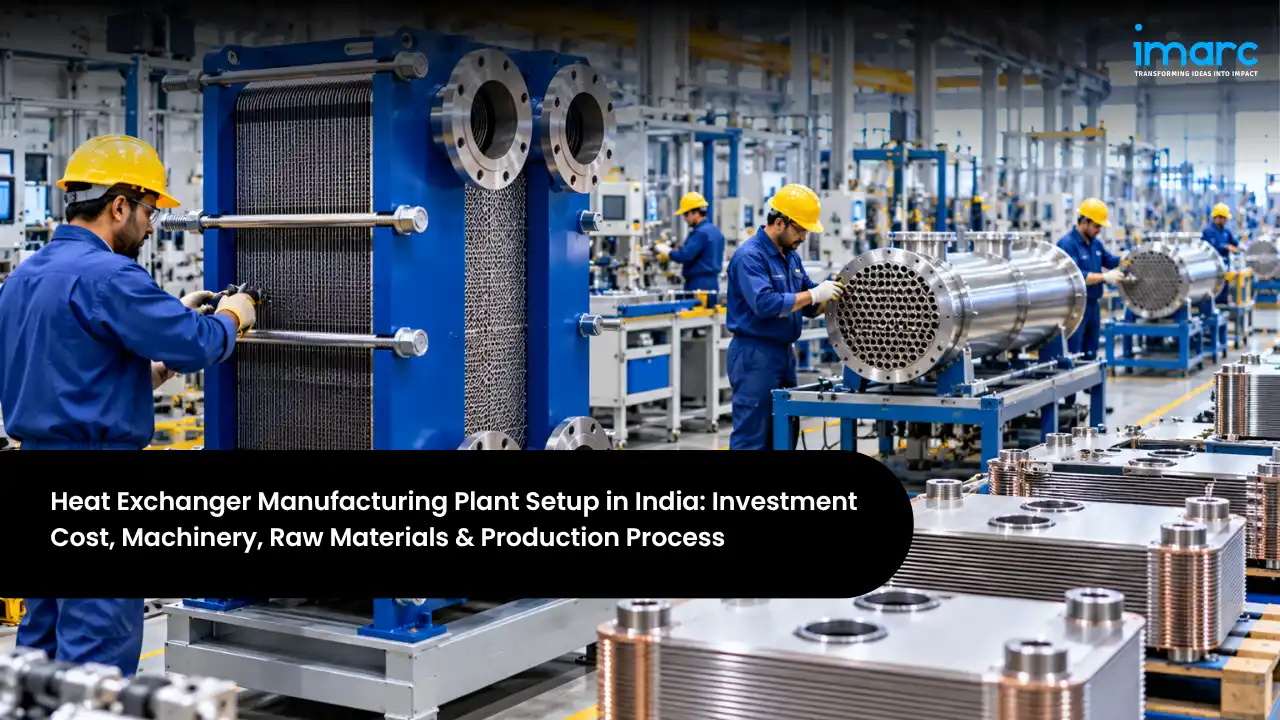
Heat exchangers are among the most widely used pieces of engineering equipment in the world. Refineries, petrochemical and fertiliser plants, power stations, pharmaceutical and food factories, HVAC systems, and data centers all depend on them to heat, cool, condense, and recover energy from process streams. India's expanding refining and chemical capacity, power sector growth, energy-efficiency mandates, and rising HVAC adoption are creating steady demand for well-engineered, certified equipment. For fabrication companies and investors, building heat exchangers in India offers access to a technically demanding market with established domestic applications and potential export opportunities.
Investment depends on the product range, the maximum size and pressure class of equipment, the materials handled, and the depth of in-house machining, welding, and testing capability. For a typical plant producing shell-and-tube, plate, and air-cooled heat exchangers, the Heat Exchanger Manufacturing Plant Cost ranges from about INR 20 crore to INR 200 crore. Plates, tubes, and forgings make up most of the operating cost, followed by skilled welding and engineering labour, so material sourcing, fabrication productivity, and quality certification are the decisions that shape profitability. At healthy utilisation, a well-run plant can deliver a net profit margin of 10 to 15% and an IRR of 16 to 24%, with payback typically within 3.5 to 5 years.
This guide is written for investors trying to understand how to start a Heat Exchanger manufacturing plant in India. It covers the main product types and their markets, the demand outlook, the production process, machinery and raw materials, location and infrastructure, a detailed cost and financial breakdown, the codes, approvals, and certifications involved, and how a DPR turns all of this into a bankable plan.
India Market Snapshot
| Key Facts | Details |
|---|---|
| India Heat Exchanger Market (2025) | USD 904.0 Million, 5.44% CAGR to 2034 |
| Largest Type | Shell & tube, about 42.6% share |
| Fastest-Growing Type | Plate & frame, about 26.8% share |
| Leading Region | South India, about 34.8% share |
| Indicative Total Investment | INR 20–200 Crore |
| Typical Payback Period | 3.5–5 Years |
The snapshot shows a mature but steadily growing market anchored in refineries, petrochemicals, chemicals, and power, with plate exchangers and stainless steel equipment growing fastest as industries push for compact, efficient designs. Buyers commonly consider code compliance, reliable delivery, proven performance, and supplier quality credentials when selecting manufacturers. The wide investment range reflects a genuine choice between a focused plant for compact and plate exchangers and a heavy fabrication facility capable of large, high-pressure shell-and-tube units for refineries and power plants. The sections below work through that choice.
Investment Highlights
Indicative Project Cost in India (2026)
| Parameter | Value |
|---|---|
| Product Range | Shell-and-tube, plate, air-cooled, finned coil, and special exchangers |
| Total Project Investment | INR 20 – 200 Crore |
| Payback Period | 3.5 – 5 Years |
| Net Profit Margin | 10 – 15% |
| IRR | 16 – 24% |
| Preferred States | Gujarat, Maharashtra, Tamil Nadu, Telangana, Karnataka, Haryana |
| Key Approvals | Factory Licence, SPCB consents, ASME/IBR as applicable, AERB for radiography, ISO |
| Key Requirement | Code-qualified design, welding, and inspection capability |
These ranges provide a realistic frame for early planning, but actual returns depend on the product mix, the share of high-value alloy and high-pressure equipment, steel and alloy prices, and success in qualifying with refinery, chemical, and EPC buyers. A site-specific Heat Exchanger Feasibility Report narrows each of these assumptions to your chosen products, target industries, location, and capacity.
Table of Contents
- What is Heat Exchanger Manufacturing?
- Why is Heat Exchanger Manufacturing Growing in India?
- Heat Exchanger Manufacturing Process Flow
- Raw Materials Required for Heat Exchanger Manufacturing
- Location, Land & Infrastructure
- Heat Exchanger Manufacturing Machinery and Equipment
- Heat Exchanger Manufacturing Plant Setup Cost in India (CapEx & OpEx)
- Financial Analysis and Profitability
- Licences and Approvals for Heat Exchanger Manufacturing in India
- Recent Developments in the India Heat Exchanger Manufacturing Industry
- How a Heat Exchanger Manufacturing Project Report and DPR Helps Investors
- Frequently Asked Questions
What is Heat Exchanger Manufacturing?
A heat exchanger transfers heat between two fluids without mixing them, whether by passing one fluid through tubes surrounded by another, channelling fluids between thin corrugated plates, or blowing air across finned tubes. Manufacturing heat exchangers combines thermal and mechanical design, precision cutting and machining, code-qualified welding, tube expansion and assembly, non-destructive testing, and pressure testing. Because many exchangers operate at high pressures and temperatures or handle hazardous fluids, they are designed and built to recognised codes and inspected by independent agencies.
Commercially, the business serves some of the largest industrial investment programmes in India. A Heat Exchanger Manufacturing Plant can supply refineries, petrochemical, fertiliser, and chemical plants, power stations, pharmaceutical and food processors, HVAC and data center projects, and EPC contractors who build these facilities, as well as replacement and retubing work for existing plants. Custom-engineered equipment earns healthy margins, while standard compact and plate units provide steady volume.
- Refining & Petrochemicals: Large shell-and-tube and air-cooled exchangers in carbon steel, stainless steel, and alloys.
- Chemicals & Fertilisers: Corrosion-resistant exchangers, condensers, and reboilers.
- Power & Energy: Feedwater heaters, condensers, and waste heat recovery exchangers.
- Pharma, Food & HVAC: Hygienic plate and tubular exchangers, and compact units for buildings and data centers.
The Main Heat Exchanger Product Types
Choosing which product types to make is the most important commercial decision, because it determines machinery, workshop size, certifications, and customers:
| Product Type | Description | Key Property | Primary Demand |
|---|---|---|---|
| Shell-and-Tube | Tube bundle inside a pressure shell | Handles high pressure and temperature | Refineries, chemicals, power |
| Plate Heat Exchangers | Gasketed, brazed, or welded plates | Compact and highly efficient | Pharma, food, HVAC, chemicals |
| Air-Cooled Exchangers | Finned tubes with fans | No cooling water needed | Refineries, gas processing, power |
| Finned Coils & Compact Units | Tube-fin coils and compact cores | Lightweight and efficient | HVAC, data centers, process cooling |
| Special Designs | Double-pipe, spiral, and hairpin units | Handle difficult fluids | Specialty chemical and process duties |
Product choice shapes the whole plant. Large shell-and-tube and air-cooled exchangers need heavy fabrication bays, plate rolling, deep-hole drilling, heavy cranes, and extensive NDT, while plate exchangers and compact coils rely on precision pressing, brazing, and assembly. Many new entrants begin with small and mid-sized shell-and-tube units, finned coils, and plate exchanger assembly, then move into larger, higher-pressure, and alloy equipment as code certifications, references, and workshop capacity grow.
Why is Heat Exchanger Manufacturing Growing in India?
Key Growth Drivers in the Indian Market
Demand is supported by large industrial and energy investment programmes and a strong push for efficiency:
- Refinery and petrochemical expansion: Capacity additions and upgrades at refineries and petrochemical complexes require large numbers of exchangers.
- Power sector growth: Plans to expand national generation capacity substantially by the early 2030s support demand for condensers, heaters, and heat recovery equipment.
- Chemical and pharmaceutical growth: Expanding chemical corridors and pharmaceutical manufacturing need corrosion-resistant and hygienic exchangers.
- Energy efficiency: Efficiency mandates and rising energy costs encourage waste heat recovery and higher-performance designs.
- HVAC and data centers: Rising cooling demand in buildings and data centers boosts plate exchangers, coils, and dry coolers.
India-Specific Market Opportunity
| Segment | India Market Context | Manufacturing Role |
|---|---|---|
| Refineries & Petrochemicals | Major capacity additions and upgrades | Large shell-and-tube and air-cooled units |
| Chemicals & Fertilisers | Chemical corridors in west and south | Alloy and corrosion-resistant exchangers |
| Power Generation | Thermal, nuclear, and renewable growth | Condensers, feedwater heaters, heat recovery |
| Pharma & Food | Hygienic process expansion | Plate and tubular sanitary exchangers |
| Replacement & Exports | Ageing plants and global demand | Retubing, spares, and export equipment |
The strongest opportunity lies in becoming a code-certified, reliable supplier to one or two anchor industries, such as refineries and chemicals or pharmaceuticals and HVAC, while building a replacement and retubing business that provides steady work between large projects. Export markets in the Middle East, Africa, and South-East Asia value Indian fabrication quality and cost competitiveness once references are established.
Heat Exchanger Manufacturing Process Flow
Understanding the process helps you plan machinery, workshop layout, and where cost and quality are decided. Heat exchangers are usually built to order, following a code-driven sequence from design approval through fabrication, inspection, and testing. Every weld and joint must meet qualified procedures, and each step is documented for the customer and inspecting agency.
The Heat Exchanger Manufacturing Process Flow
The sequence below reflects shell-and-tube exchanger manufacturing, the most common type. Plate exchangers follow a shorter route of plate pressing or sourcing, gasket fitting, frame assembly, and pressure testing, while air-cooled units add finned tube production and fan assembly.
| Unit Operation | Key Activity |
|---|---|
| Thermal & Mechanical Design | Sizing, code calculations, and drawings approved |
| Material Receipt & Verification | Plates, tubes, and forgings checked against certificates |
| Cutting & Forming | Plates cut, rolled into shells, and ends formed |
| Machining & Drilling | Tube sheets, flanges, and baffles machined and drilled |
| Welding | Shells, nozzles, and flanges welded to qualified procedures |
| Tube Bundle Assembly | Tubes inserted, expanded, and welded to tube sheets |
| Heat Treatment | Stress relieving where required by code |
| Non-Destructive Testing | Radiography, ultrasonic, dye penetrant, and magnetic tests |
| Pressure & Leak Testing | Hydrostatic, pneumatic, or helium leak tests |
| Painting, Inspection & Dispatch | Surface finish, final inspection, and shipment |
Two factors decide profitability across this flow. The first is fabrication productivity: welding, drilling, and tube expansion consume most of the labour hours, so automated welding, CNC drilling, and well-planned workflows reduce cost and lead time. The second is first-time quality, because a failed radiograph or leaking tube joint means costly rework and delays that erode margins and reputation. Qualified welders, controlled procedures, and thorough in-process inspection are essential.
Raw Materials Required for Heat Exchanger Manufacturing
The main inputs are steel plates, tubes, forgings for tube sheets and flanges, plate exchanger plates and gaskets, fins for air-cooled units, welding consumables, and bought-out items such as fans and motors. Because materials make up most of the cost and must match exact code specifications, a reliable supplier base with full traceability is central to project planning.
| Raw Material | Role in Exchanger | India Sourcing | % of OpEx |
|---|---|---|---|
| Steel Plates (CS, SS, alloys) | Shells, channels, and covers | Domestic mills and imports for alloys | 18–25% |
| Tubes (CS, SS, Cu-Ni, titanium) | Heat transfer surface | Domestic and imported | 15–22% |
| Forgings & Flanges | Tube sheets, flanges, and nozzles | Domestic forging units | 8–12% |
| PHE Plates & Gaskets | Plate exchanger assembly | Largely imported or in-house pressed | 0–10% |
| Fins, Fans & Motors | Air-cooled exchangers | Domestic suppliers | 3–6% |
| Welding Consumables, Paints & Gases | Fabrication and finishing | Domestic suppliers | 4–6% |
India has a strong base of steel mills, tube makers, and forging units, which keeps carbon and stainless steel supply reliable. High-alloy materials such as duplex stainless steel, nickel alloys, and titanium are often imported and require longer lead times, so material planning must start as soon as an order is confirmed. Price-variation clauses in contracts help protect margins against steel and alloy price movements, and full material traceability is required by codes and inspecting agencies.
Location, Land & Infrastructure
Site selection for a heat exchanger plant is shaped by proximity to refinery, chemical, and power customers and EPC contractors, access to steel and forging suppliers, availability of qualified welders and engineers, and logistics for large, heavy equipment. Road access for oversized loads and proximity to ports for exports are especially important for larger units.
Choosing the Best Location for Heat Exchanger Manufacturing Plant Setup
| State / Region | Why It Works | Key Advantage |
|---|---|---|
| Gujarat (Vadodara, Ahmedabad & Bharuch) | India’s largest process equipment and chemical hub | Customers, suppliers, and ports |
| Maharashtra (Pune & Mumbai region) | Major engineering and EPC base | Talent, customers, and suppliers |
| Tamil Nadu (Chennai & Trichy) | Heavy fabrication and power equipment cluster | Skilled welders and ports |
| Telangana & Andhra Pradesh | Pharma and petrochemical growth | Customers, land, and ports |
| Karnataka (Bengaluru) | Engineering and HVAC base | Design talent and customers |
| Haryana & NCR | North Indian industrial and HVAC demand | Regional customers |
Gujarat, with its concentration of refineries, chemical plants, and process equipment makers around Vadodara and Bharuch, is a natural first choice, offering customers, suppliers, skilled fabricators, and port access. Maharashtra provides engineering talent and EPC relationships, Tamil Nadu has deep heavy fabrication expertise, and Telangana and Andhra Pradesh serve fast-growing pharmaceutical and petrochemical demand. The final choice should weigh customer proximity, supplier access, availability of certified welders, and logistics for oversized equipment.
Codes, Quality and Inspection Systems
Heat exchangers are pressure equipment, and buyers expect them to be designed, built, and tested to recognised codes such as ASME and TEMA, with Indian Boiler Regulations applying to certain steam-related equipment. A credible plant needs qualified welding procedures and welders, material traceability, in-process inspection, full NDT capability, pressure testing facilities, and a quality system that satisfies third-party inspection agencies and EPC contractors. An experienced Heat Exchanger Manufacturing Consultant in India can help plan code certifications, welding qualifications, and inspection systems so the plant can qualify for demanding refinery and chemical projects as quickly as possible.
Infrastructure Requirements (Mid-Sized Plant)
| Infrastructure Element | Specification | India-Specific Note |
|---|---|---|
| Total Land Area | 5 – 20 acres | Space for heavy bays and yard |
| Heavy Fabrication Bays | High-bay, crane-served buildings | Sized for largest planned equipment |
| Machine Shop | CNC drilling, boring, and machining | Heavy foundations for large machines |
| NDT & Radiography Enclosure | Shielded radiography area | Regulatory approval required |
| Hydrotest & Painting Bays | Pressure testing and surface finishing | Water supply and drainage |
| Power Requirement | 1 – 5 MW | Welding, machining, and heat treatment |
| Design Office | Thermal and mechanical design team | Core to engineered orders |
High-bay fabrication halls with heavy cranes, a capable machine shop, shielded radiography facilities, and hydrotest bays are the defining infrastructure needs. Crane capacity and bay height must be planned for the largest equipment the plant expects to build, since these are costly to upgrade later. Good road access for oversized loads, and ideally proximity to a port, makes delivery of large exchangers far easier.
Heat Exchanger Manufacturing Machinery and Equipment
The equipment set covers cutting and forming, machining, welding, tube processing, heat treatment, testing, and finishing. Heavy equipment such as plate rolls, deep-hole drilling machines, and large cranes defines the size of exchangers the plant can build. The main items are summarised below.
| Equipment | Function | Key Specification |
|---|---|---|
| CNC Plasma & Oxy-Fuel Cutting | Cut plates for shells and components | Large-format cutting tables |
| Plate Rolling Machine | Roll shells and cylinders | Capacity for planned thickness and width |
| CNC Deep-Hole & Tube Sheet Drilling | Drill tube sheets and baffles | High accuracy and speed |
| CNC Boring & Turning Machines | Machine flanges, covers, and tube sheets | Large-diameter capability |
| Submerged Arc & MIG/TIG Welding | Weld shells, nozzles, and seams | Column-and-boom and positioners |
| Orbital Tube-to-Tubesheet Welders | Weld tube joints | Consistent, code-quality welds |
| Tube Expanders & Tube Benders | Expand and bend tubes | Controlled expansion and U-bending |
| Fin Tube Machines | Make finned tubes for air coolers | Wound or extruded fins |
| Stress-Relieving Furnace | Post-weld heat treatment | Sized for large shells |
| NDT & Test Equipment | Inspect welds and verify integrity | Radiography, UT, PMI, helium leak detection |
| EOT Cranes, Rotators & Painting Booth | Handle and finish heavy equipment | High-capacity lifting |
Machinery should follow the product and size plan. A plant focused on plate exchangers and compact coils invests mainly in pressing or assembly lines, brazing, and testing, while a shell-and-tube and air-cooled plant needs heavy cutting, rolling, drilling, welding, and cranes. Automated welding and CNC drilling improve both quality and productivity, and in-house NDT and stress relieving reduce dependence on outside services and shorten delivery times.
Heat Exchanger Manufacturing Plant Setup Cost in India (CapEx & OpEx)
The tables below break down capital and operating costs for a mid-sized heat exchanger facility in India. The final Heat Exchanger Investment Cost for your project will depend on product types, maximum equipment size and pressure class, materials handled, the degree of in-house machining and testing, and location.
Capital Expenditure (CapEx) Cost Structure
| CapEx Component | % of Total CapEx | What It Covers |
|---|---|---|
| Plant & Machinery | 45–55% | Cutting, rolling, drilling, welding, and testing |
| Land & Buildings | 18–25% | Heavy fabrication bays, machine shop, test bays |
| Cranes & Handling Equipment | 5–8% | EOT cranes, rotators, and positioners |
| NDT, Test & Heat Treatment Facilities | 4–7% | Radiography, hydrotest, and stress relieving |
| Design Software & Engineering | 2–4% | Thermal and mechanical design tools |
| Pre-operative & Contingency | 4–6% | Engineering, DPR, certifications, buffer |
| Working Capital | 12–18% | Materials and project receivables |
Machinery and buildings dominate the capital budget, and crane capacity and bay dimensions are among the most important long-term decisions because they fix the largest equipment the plant can make. Working capital also deserves careful planning, as materials must be bought early and project customers often pay in milestones with retention. A detailed Heat Exchanger Business Plan should model order pipelines, material lead times, and payment terms together, so that funding matches the real cash cycle of project-based fabrication.
Operating Expenditure (OpEx) Cost Structure
| OpEx Component | % of Total OpEx | India-Specific Note |
|---|---|---|
| Materials (plates, tubes, forgings) | 60–70% | Alloy materials raise costs significantly |
| Skilled Labour & Engineering | 12–18% | Qualified welders, fitters, and designers |
| Power & Fuel | 4–7% | Welding, machining, and stress relieving |
| NDT, Inspection & Certification | 3–5% | Third-party inspection and code stamps |
| Logistics & Packaging | 2–4% | Oversized and heavy shipments |
| Maintenance & Overheads | 3–5% | Equipment upkeep and administration |
With materials making up most of the cost and skilled labour the next largest item, margins depend on accurate estimation, efficient fabrication, and avoiding rework. A good operating model tracks material cost per tonne of equipment, labour hours per exchanger, NDT rejection rates, and delivery performance, and tests how margins respond when steel or alloy prices move or when projects are delayed.
Financial Analysis and Profitability
Based on analysis of a mid-sized heat exchanger facility, the financial profile is attractive, supported by steady industrial investment, the value that code-certified engineering commands, and a recurring replacement market. The profitability of Heat Exchanger manufacturing business in India improves markedly with code certifications, strong references with refineries and EPC contractors, a growing share of alloy and specialised equipment, and a retubing and service business.
| Financial Metric | Indicative Value | India Context |
|---|---|---|
| Gross Profit Margin | 22–32% | Higher for alloy and engineered equipment |
| Net Profit Margin | 10–15% | After depreciation and Indian corporate taxes |
| Payback Period | 3.5–5 Years | Faster with repeat EPC customers |
| IRR (Internal Rate of Return) | 16–24% | Higher with specialised product mix |
| Capacity Utilization (stable ops) | 60–85% | Depends on project pipeline |
| Break-even Capacity Utilization | 40–50% | Moderate fixed costs |
Product mix and customer base decide where a plant lands within these ranges. A workshop making simple carbon steel exchangers in a price-competitive market will earn modest margins, while one supplying alloy, high-pressure, or specialised equipment to refineries, chemical plants, and export customers can earn significantly more per tonne. Because orders arrive as projects, a steady base of replacement and retubing work helps keep the workshop busy between large jobs.
Returns can be strengthened by securing ASME and other code certifications early, building references with major EPC contractors and plant owners, adding plate exchangers and compact units for faster-growing segments, investing in automated welding and CNC drilling, and developing retubing, spares, and service revenue. On-time delivery and flawless inspection records are what lead to repeat orders in this industry.
Key Risks and Mitigation
The main risks are steel and alloy price volatility, lumpy project demand, delays in customer payments, and quality failures that lead to rework or penalties. Price risk is reduced through price-variation clauses; demand risk by diversifying across industries and building replacement business; payment risk by clear milestone terms; and quality risk by qualified procedures, trained welders, and thorough inspection. Promoters often work with a Heat Exchanger Business Plan Consultant in India to test these scenarios before committing capital.
Licences and Approvals for Heat Exchanger Manufacturing in India
Approvals for a heat exchanger plant combine industrial and environmental registrations with pressure equipment codes, radiation safety approvals, and quality certifications that decide which projects the plant can bid for. Promoters setting up a Heat Exchanger Manufacturing Plant in India generally need the following:
- Factory Licence: Registration and plan approval under the Occupational Safety, Health and Working Conditions Code, 2020, with attention to heavy fabrication safety.
- Pollution Control Consents: Consent to Establish and Consent to Operate from the State Pollution Control Board, covering blasting, painting, and welding fumes.
- Radiography Approval: Authorisation from the Atomic Energy Regulatory Board for industrial radiography, if done in-house.
- Code Certifications: ASME certification for pressure vessel manufacture, TEMA-compliant design, and Indian Boiler Regulations approval for steam-related equipment where applicable.
- Quality Certifications: ISO 9001, ISO 14001, and ISO 45001, along with welding procedure and welder qualifications.
- Business & Tax Registration: Company incorporation, GST, Udyam, and an IEC for importing alloys and exporting equipment.
- Fire Safety & Labour Registrations: Fire NOC and employee welfare registrations such as EPF and ESI.
The factory licence and pollution consent are usually on the critical path for starting production, while code certifications and approvals from EPC contractors and refinery buyers take longer and depend on audits and references. Planning code certification, welder qualification, and inspection systems in parallel with construction shortens the time from commissioning to qualifying for larger, higher-value projects.
Note: The exact approvals, registrations, licences, and certification requirements may vary depending on factors such as plant location, product types, design codes, pressure classes, target customers, export markets, and applicable regulations. Businesses are advised to undertake a detailed regulatory assessment during the project planning stage to ensure full compliance and timely implementation.
Recent Developments in the India Heat Exchanger Manufacturing Industry
Several recent developments give useful context for investors considering this market:
- Steady market growth: India’s heat exchanger market reached USD 904.0 million in 2025 and is expected to grow at about 5.4% a year to 2034.
- Shift to compact designs: Plate and frame exchangers are the fastest-growing type, and stainless steel is the fastest-growing material.
- Power capacity expansion: National electricity planning targets substantial new generation capacity by the early 2030s, supporting demand for power plant exchangers.
- Refinery and chemical investment: Planned refinery expansions and growth in chemical corridors continue to generate large exchanger requirements.
The common thread is a steadily growing market in which efficiency, compact designs, and corrosion-resistant materials are gaining ground. New entrants who build code-certified capability, strong references, and a balance of engineered and standard products will be best placed as India's industrial and energy investment continues through the decade.
How a Heat Exchanger Manufacturing Project Report and DPR Helps Investors
A detailed DPR provides a structured roadmap for the venture, from market demand and product selection to workshop design, machinery, certifications, and economics. It helps investors decide the right product mix and equipment size range, estimate capital and operating expenditure, assess profitability, and identify risks before committing funds.
At its core is a detailed Heat Exchanger Financial Model covering revenue by product type and industry, material and labour cost build-ups, project-based working capital, certification costs, cash flows, break-even, return on investment, and payback. Banks and investors rely on this model to judge long-term viability, which is why many promoters appoint a Heat Exchanger Plant Project Report Consultant in India to prepare the report and validate its assumptions against current market data.
For a heat exchanger project, a strong DPR also clarifies the product and size strategy, the code certification plan, the material sourcing approach, and the customer and EPC relationships, which together are the factors most likely to decide success. By modelling utilisation against realistic project pipelines and testing margins against material price swings and project delays, the report turns an engineering-led opportunity into a plan that can support discussions with lenders and investors.
Frequently Asked Questions
What are the first steps to set up a heat exchanger manufacturing plant in India?
Start by choosing your product types, equipment size range, and target industries, then commission a feasibility study and DPR. Next, secure land in an industrial cluster with good road access, build fabrication bays with suitable cranes, install cutting, rolling, drilling, welding, and testing equipment, recruit qualified welders and designers, obtain the factory licence and pollution consent, and pursue code and quality certifications.
How much does it cost to set up a heat exchanger manufacturing plant in India?
A plant producing shell-and-tube, plate, and air-cooled exchangers typically needs about INR 20 crore to INR 200 crore, depending on product types, maximum equipment size and pressure class, materials, and in-house testing. Machinery, buildings, cranes, and working capital are the largest components.
What are the main steps in heat exchanger manufacturing?
For shell-and-tube exchangers, the flow runs from thermal and mechanical design through material verification, cutting and forming, machining and drilling, welding, tube bundle assembly, heat treatment, non-destructive testing, pressure and leak testing, and painting, inspection, and dispatch.
Which machinery does a heat exchanger manufacturing plant need?
Key equipment includes CNC plasma and oxy-fuel cutting, plate rolling machines, CNC deep-hole and tube sheet drilling, CNC boring and turning, submerged arc and MIG/TIG welding, orbital tube-to-tubesheet welders, tube expanders and benders, fin tube machines, a stress-relieving furnace, NDT and test equipment, and heavy cranes, rotators, and painting booths.
What raw materials are used to make heat exchangers?
The main inputs are carbon steel, stainless steel, and alloy plates, tubes in carbon steel, stainless steel, copper-nickel, or titanium, forgings and flanges, plate exchanger plates and gaskets, fins, fans, and motors for air coolers, and welding consumables, paints, and gases.
How profitable is heat exchanger manufacturing in India?
A well-run plant typically earns a 10 to 15% net margin and a 16 to 24% IRR, with payback in 3.5 to 5 years at healthy utilisation. Profitability improves with code certifications, alloy and engineered equipment, EPC references, and replacement and service business, while margins track steel and alloy prices.
Which approvals does a heat exchanger manufacturing plant need in India?
Typical approvals include a factory licence, State Pollution Control Board consents, AERB authorisation for in-house radiography, ASME and IBR certifications where applicable, ISO certifications and welder qualifications, a Fire NOC, and GST, Udyam, IEC, and labour registrations.
How do I get a feasibility study or DPR for a heat exchanger manufacturing project?
A detailed feasibility study and DPR covers market demand, product and industry strategy, workshop design, certifications, and full financials. Investors usually engage a Heat Exchanger Manufacturing Feasibility Study Consultant with experience in process equipment and heavy fabrication projects to prepare the report and validate it for lenders.
Our Clients










Contact Us
Have a question or need assistance?
Please complete the form with your inquiry or reach out to us at
Phone Number
+91-120-433-0800+1-201-971-6302
+44-113-547-7077
Previous Post

India's trucks and buses rarely rest. They carry freight across highway corridors, move goods from ports and factories, and ferry millions of passengers every day, often under heavy loads and tough road conditions.
Silicon wafers are the thin, precisely sliced discs and squares on which solar cells and computer chips are built. India has rapidly become a major assembler of solar modules and is now building cell capacity, but almost all of the wafers those cells need are still imported.
Every video call, UPI payment, and 5G connection in India ultimately travels over glass. Fiber optic cables carry the country's data between cities, into mobile towers and data centres, and increasingly right into homes through fiber-to-the-home connections.
Setting up an Air Conditioner Manufacturing Plant in India is an assembly-driven, high-volume consumer durable venture, powered by rising household incomes, extreme summers, rapid urbanisation, and one of the lowest room air-conditioning penetration rates among large economies.
Setting up a High Voltage Cable Manufacturing Plant in India is a capital-intensive, high-value venture, powered by the country's massive power-transmission expansion, renewable-energy build-out, and the shift toward underground cabling in cities.
Setting up a Copper Cable Manufacturing Plant in India is a high-demand, infrastructure-driven venture, powered by the country's construction boom, rapid electrification, and steady industrial and appliance demand.
Setting up a Junction Box Manufacturing Plant in India is a high-demand, infrastructure-driven venture, powered by the country's construction boom, rapid electrification, and expanding solar and industrial sectors.
Setting up an Electric Cable Manufacturing Plant in India is a high-demand, infrastructure-linked venture, powered by the country's rapid growth in power, construction, renewable energy, and electrification. Cables and wires are essential to every building, factory, grid, and vehicle, giving an Electric Cable Manufacturing Plant a large and steadily growing market.
Setting up a Semiconductor Fabrication Manufacturing Plant in India is a highly capital-intensive but strategically transformative venture, driven by the country's semiconductor mission, deep policy incentives, and a vast import-substitution opportunity. Semiconductors are the foundation of every modern electronic and digital product, yet India currently imports almost all of its chip requirement.
Setting up a PCB Manufacturing Plant in India is a capital-intensive but strategically timed venture, driven by the country's electronics manufacturing push, strong policy incentives, and a large import-substitution opportunity. Printed circuit boards are the backbone of every electronic product, yet India still imports the overwhelming majority of its PCB requirement.
The Indian PCB (Printed Circuit Board) Market is emerging as the physical backbone of the country's electronics manufacturing ambitions. The market reached USD 7.27 Billion in 2025 and is projected to reach USD 25.48 Billion by 2034, growing at a CAGR of 14.96% (2026–2034), a total addressable market expansion driven by the Production Linked Incentive (PLI) scheme, 5G infrastructure rollout, and rising domestic consumer electronics demand.
Setting up an E-waste Recycling Plant in India is a capital-intensive but high-potential venture, driven by the country's soaring volume of discarded electronics, tightening Extended Producer Responsibility regulations, and the rising value of recovered metals. India is now among the world's largest generators of electronic waste, yet only a small share is processed through formal, compliant channels, leaving a large, policy-backed opportunity for organized recyclers who can capture volumes shifting from the informal sector.
Global semiconductor demand across automotive, data centers, and defense, highlighting market segmentation, key applications, regional dynamics, and industry shifts.
The hearables market represents one of the most dynamic segments within consumer electronics and wearable technology. These intelligent audio devices have evolved beyond simple wireless earbuds into multifunctional platforms combining premium audio with health monitoring, artificial intelligence, and seamless digital connectivity.
A smart washing machine is a sophisticated home appliance that incorporates advanced digital features such as connectivity, sensor technology, and automated controls for improved efficiency, convenience, and user control. In contrast to traditional washing machines, smart washing machines come pre-installed with advanced features such as Wi-Fi connectivity, smart load detection, smart detergent dispensing, and voice-control capability.
A smartphone is a portable electronic device that combines sophisticated capabilities in computer processing, wireless communication, multimedia entertainment, and internet access. Smartphones are distinct from other mobile phones in that their operation involves highly sophisticated platforms of operation that are capable of supporting multiple applications, multitasking, and connectivity with internet platforms.
Semiconductor manufacturing is a highly specialized industrial process that involves the design, fabrication, and assembly of semiconductor devices including integrated circuits (ICs), memory chips, sensors, and discrete components. The process transforms raw semiconductor materials, primarily silicon, into sophisticated electronic components through a combination of physical and chemical processing steps, such as wafer fabrication, photolithography, doping, etching, thin-film deposition, and packaging.
The retail landscape is experiencing a profound transformation as self-checkout systems emerge as critical infrastructure components reshaping consumer experiences and operational efficiency globally. These automated solutions enable customers to independently scan, bag, and pay for purchases without cashier assistance, representing a fundamental shift in modern commerce.
The webcams market is experiencing unprecedented transformation as digital communication becomes the cornerstone of modern business, education, and healthcare. Global webcam industry dynamics are being reshaped by technological innovation and evolving workplace models.
As smartphones become a way of life for most Filipinos, the market has changed dramatically and expectations from consumers are higher than ever before. With the demand for smartphones growing, there is a significant change in consumer shopping habits with more emphasis on using online platforms for shopping. This change is closely interlinked with the fast growth of the Philippines e-commerce market, both bringing opportunities and challenges to the stakeholders of the smartphone industry.
As technology continues to advance, lighting has transformed from a basic necessity into a strategic enabler of innovation, efficiency, and sustainability. The evolution from incandescent bulbs to LEDs, smart systems, and intelligent lighting networks represents not just technological change but a redefinition of how energy, design, and functionality intersect in the built environment.
An LED light is an illuminating device that utilizes Light Emitting Diodes as its source of light, generating light through a semiconductor-based process called electroluminescence. When electrical current flows across the semiconductor material of the diode, electrons emit energy as photons and thus produce highly efficient and concentrated illumination.
An LED bulb is a solid-state lighting device that uses Light Emitting Diodes (LEDs) as its illumination source. Different from incandescent or fluorescent lamps, light in LED bulbs is produced by electroluminescence, a process where the passing of an electric current through a semiconductor material emits photons directly. This process is highly energy-efficient, with a far larger percentage of the electricity being converted to usable light and very little heat generated in the process.
The junction box, generally made from plastic, metal, or composite materials, houses wire connections, terminations, and protective components to allow the safe distribution and routing of electrical circuits. The junction box will provide insulation, mechanical protection, and a secure environment to avoid accidental contact with live electrical parts, moisture intrusion, or dust accumulation.
The Japan power electronics market is poised to grow substantially, driven by rising demand in automotive, energy, industrial automation, and infrastructure sectors. According to IMARC Group, the Japan power electronics market is studied from 2019 to 2024 with projections extending to 2033.
Japan's printed circuit board (PCB) industry is the world leader in technology innovation, enabling consumer electronics, automotive, and next-generation communication system development. As a key enabler of modern electronic products, PCBs provide the essential building blocks for embedding semiconductors, sensors, and microchips into miniaturized, high-performance devices. Japan, through its world-class manufacturing base and engineering expertise, remains the hub of the global PCB supply chain.
Aluminum-Air (Al-Air) battery is a new energy storage technology that has attracted interest as a future alternative to conventional lithium-ion batteries, specifically for electric vehicle (EV) use. As opposed to normal rechargeable batteries, the Al-Air battery is a metal-air electrochemical cell with aluminum as the anode, oxygen from the ambient air as the cathode reactant, and a liquid electrolyte (commonly sodium hydroxide or potassium hydroxide) as the medium through which the reaction occurs.
Aluminium wire is an essential industrial commodity commonly employed in power transmission, electrical distribution, building construction, and manufacturing processes owing to its high conductivity-to-weight ratio, resistance to corrosion, and cost advantage over copper. Produced by methods including continuous casting, rolling, and drawing, aluminum wire is available in various grades and alloys to serve the wide demands, from overhead transmission conductors and building wiring to automotive harnesses and electronic applications.
Air conditioners are electromechanical devices used to control indoor climate by extracting heat and humidity and ensuring optimum air circulation. Generally consisting of a compressor, condenser, evaporator, refrigerant fluid, filters, fans, and electronic controls, air conditioners work based on the principle of heat exchange, moving heat from indoor areas to the external environment. Contemporary units come in diverse configurations, such as split systems, window units, central air systems, and portable models, supporting respective residential, commercial, and industrial applications. Some of the major characteristics are efficiency in cooling, energy use, noise rating, and environmental footprint in relation to refrigerant type.
E-waste, or electronic waste, is electrical and electronic equipment that has been discarded, such as computers, cell phones, television sets, servers, and household appliances. It is among the world's fastest-growing streams of waste, consisting of a heterogeneous combination of metals, plastics, glass, and toxic substances. E-waste contains valuable metals like copper, aluminum, gold, silver, palladium, and rare earth elements, in addition to toxic materials like lead, mercury, cadmium, and brominated flame retardants.
Polished silicon wafers are very pure, ultra-flat semiconductor substrates that are produced from high-quality single-crystal silicon. The wafers act as the material base for making integrated circuits, power devices, and MEMS (Microelectromechanical Systems). The wafers are made of monocrystalline silicon ingots using the Czochralski or Float-Zone process, from which the wafers are cut, lapped, etched, and polished to atomic-scale flatness and defect-free surfaces.
AI is revolutionizing Japan’s semiconductor industry by boosting innovation and efficiency across the entire value chain. Advanced artificial intelligence (AI)-powered Electronic Design Automation (EDA) tools significantly shorten chip design cycles, improving performance and energy efficiency.
Recent projections indicate that Australia semiconductor market, including services, is growing at a steady compound annual growth rate as the nation deepens its tech infrastructure. The importance of semiconductors spans electronics, defense systems, telecommunications, and emerging AI applications, which position the local ecosystem as strategically vital for growth.
Fiber optic cables are high-tech communications cables that carry information like bursts of light along extremely thin glass or plastic strands, providing high-speed, high-bandwidth connectivity with little loss of signal. Fiber optic cables make up the foundation of contemporary telecommunications, carrying internet, cloud computing, 5G networks, and smart infrastructure.
CAT (Category) cables are twisted-pair Ethernet cables utilized for copper-based wired network communications, varying from CAT5e to CAT8 standards. The cables carry data through copper conductors, but with different speeds (up to 40 Gbps for CAT8) and bandwidths, supporting networks such as LANs, data centers, and smart buildings.
India's semiconductor industry is undergoing a revolutionary phase driven by rising demand from industries like consumer electronics, automotive technologies, industrial automation, and telecom infrastructure.
USB data cables are critical elements of contemporary digital connectivity, enabling high-speed and consistent data transfer and power supply for a broad scope of electronic products. They provide the foundation for charging and synchronizing smartphones, tablets, laptops, and other peripherals, with significant applications in consumer electronics, industrial automation, and new technologies. With technologies like USB-C, the cables today carry faster data speeds, more power output, and universal compatibility, making them essential in a world that is connected.
Thin-film-transistor (TFT) liquid-crystal display (LCD) is a type of display technology used in many electronic devices, such as smartphones, tablets, laptops, and televisions (TVs). A backlight, colour filters, a thin-film transistor array, and a liquid crystal layer are among the layers that make up this flat-panel display. TFT LCDs are made to produce sharp images with superb viewing angles, strong contrast, and accurate colour reproduction. They are made up of thousands of tiny transistors that regulate how much light enters each pixel. This makes it possible for the display to generate crisp, detailed images at rapid refresh rates. TFT LCD technology's low power consumption is one of its main benefits, which makes it perfect for battery-operated gadgets.
Polycrystalline solar photovoltaic (PV) modules are a key component of solar energy systems, harnessing sunlight and converting it into electricity through the photovoltaic effect. These modules are composed of multiple interconnected solar cells, each made from polycrystalline silicon. Polycrystalline solar panels are renowned for their efficiency, affordability, and versatility, making them a popular choice for various applications such as solar installations, commercial and industrial projects, off-grid systems and solar farms.
The LED chip is the core component of an LED bulb, comprising semiconductor layers that enable the free flow of protons and electrons. Employed in all LED lighting fixtures—from bulbs to tubes—the LED chip fundamentally determines light quality, with variations in brightness, voltage, and wavelength. These chips are manufactured through a process called MOCVD (metal-organic chemical vapor deposition), which creates the semiconductor layers that facilitate electric flow. Major applications of these chips include backlighting, illumination, automotive lighting, signs, and signals.
Semiconductors are crucial components in the modern electronics industry, used in electronic equipment and devices to manage and control the flow of electricity. They are found in consumer items like smartphones, wearables, smart TVs, and advanced equipment used in industrial applications, defense, and aerospace. Semiconductors are further divided into four broad categories: optoelectronics, discrete components, integrated circuits, and sensors. Memory devices, logic devices, analog ICs, MPUs, discrete power devices, MCUs, and sensors are some of the major components of semiconductors.