Solar Cables Plant Setup Cost in India: Manufacturing Process Flow, Machinery, DPR & Financial Model 2026
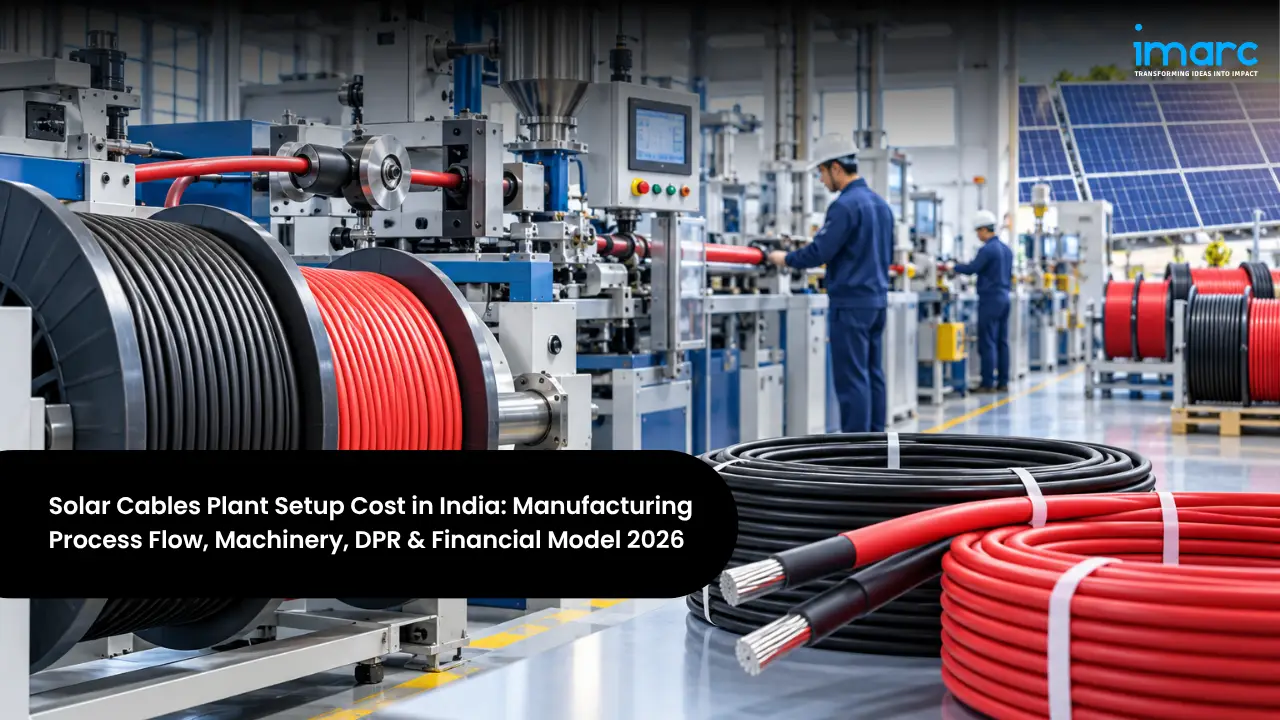
Every solar panel is connected by cables built to survive 25 years or more of sun, heat, rain, and high DC voltage. India added a record 44.6 GW of solar capacity in 2025-26, taking cumulative solar capacity past 150 GW, and rooftop programmes such as PM Surya Ghar are adding millions of smaller systems. Each of these projects needs DC string cables, AC cables, and earthing cables, and since 2024 solar DC cables sold in India must carry BIS certification. Together these trends make Solar Cables Manufacturing Plant Setup in India a timely, specialised opportunity within the wider cable industry, especially for producers who can meet strict quality and certification requirements.
Investment depends above all on how much of the process the plant does in-house and on scale. A unit that buys tinned copper conductors, runs extrusion lines, and sends cable out for electron beam cross-linking is a modest project, while an integrated plant with wire drawing, tinning, bunching, dual-layer extrusion, its own electron beam accelerator, and a testing laboratory needs much more capital. The Solar Cables Manufacturing Plant Cost ranges from about INR 5–15 crore for an extrusion-focused unit to INR 40–100 crore for an integrated solar DC cable plant of 5,000 to 10,000 tonnes a year, and INR 150–300 crore for a plant that also makes AC power cables for utility-scale projects. Raw materials make up 68 to 75% of operating cost, with copper the largest item, so metal price management and yield shape profitability. A well-run plant typically earns a gross margin of 14 to 22% and a net margin of 5 to 10%.
This guide is written for investors exploring how to start a Solar Cables manufacturing plant in India. It focuses on a plant making 1.5 kV DC photovoltaic cables with tinned copper conductors and electron beam cross-linked insulation, and also explains aluminium DC cables, AC cables for solar plants, and pre-assembled cable harnesses. It covers products and markets, the demand outlook, the production process flow, machinery and raw materials, location and infrastructure, a detailed cost and financial breakdown, approvals, and how a DPR and financial model turn all of this into a bankable plan.
India Market Snapshot
| Key Facts | Details |
|---|---|
| Global Solar Cable Market (2025) | USD 1.2 Billion |
| Projected Global Market (2034) | USD 3.9 Billion, 14.0% CAGR |
| India Solar Capacity Added (FY2025-26) | 44.6 GW, up 87% |
| Cumulative Solar Capacity (Mar 2026) | About 150 GW |
| BIS Standard for Solar DC Cable | IS 17293:2020, mandatory under QCO |
| Indicative Total Investment | INR 5 Crore to 300 Crore |
The snapshot shows a fast-growing global market and an Indian solar sector expanding at record pace, which translates directly into demand for DC and AC cables. Mandatory certification has raised entry barriers and pushed out low-quality imports and unbranded supply. The wide investment range reflects a real choice between an extrusion unit, an integrated DC cable plant, and a larger plant serving utility projects with both DC and AC cables. The sections below work through that choice.
Investment Highlights
Indicative Project Cost in India (2026)
| Parameter | Value |
|---|---|
| Product Range | 1.5 kV DC PV cables, aluminium DC cables, AC and earthing cables, harnesses |
| Plant Capacity | 5,000 – 20,000 Tonnes Per Year |
| Total Project Investment | INR 5 Crore (extrusion unit) to 150–300 Crore (DC and AC plant) |
| Payback Period | 3 – 5 Years |
| Net Profit Margin | 5 – 10% |
| IRR | 15 – 20% |
| Preferred States | Gujarat, Rajasthan, Maharashtra, Tamil Nadu, Karnataka, Uttarakhand |
| Key Requirement | BIS license, TÜV or IEC certification, and EPC approvals |
These ranges provide a realistic frame for early planning, but actual returns depend on copper prices and pass-through, solar installation volumes, approvals from developers and EPC contractors, certification for export markets, competition from large cable brands, and payment terms on projects. A site-specific Solar Cables Feasibility Report narrows each of these assumptions to your chosen products, capacity, integration depth, location, and customers.
Table of Contents
- What is Solar Cables Manufacturing?
- Why is Solar Cables Manufacturing Growing in India?
- Solar Cables Manufacturing Process Flow
- Raw Materials Required for Solar Cables Manufacturing
- Location, Land & Infrastructure
- Solar Cables Manufacturing Machinery and Equipment
- Solar Cables Manufacturing Plant Setup Cost in India (CapEx & OpEx)
- Financial Analysis and Profitability
- Licenses and Approvals for Solar Cables Manufacturing in India
- Recent Developments in the India Solar Cables Manufacturing Industry
- How a Solar Cables Manufacturing Project Report and DPR Helps Investors
- Frequently Asked Questions
What is Solar Cables Manufacturing?
Solar cables, also called photovoltaic or PV cables, carry direct current from solar panels to combiner boxes and inverters, and then alternating current from inverters to the grid. DC solar cables are single-core cables with fine, flexible tinned copper strands, insulated and sheathed with halogen-free, flame-retardant compounds that are cross-linked, usually by electron beam, so they resist heat, UV rays, ozone, moisture, and abrasion for decades. They are rated for 1.5 kV DC and typically come in sizes of 4, 6, and 10 sq mm, while larger aluminium DC cables and AC power cables connect inverters and substations in utility plants.
Commercially, solar cables are sold to EPC contractors, solar developers, rooftop installers, module and inverter distributors, and through electrical distributors to smaller installers. A Solar Cables Manufacturing Plant can supply utility-scale solar parks, commercial and industrial rooftop projects, residential rooftop systems, solar pumps, floating solar plants, battery storage projects, and export markets. Buyers value certification, long life, consistent quality, on-time delivery, and competitive prices per metre.
- Utility-Scale Solar: DC string cables, aluminium DC cables, and AC cables for solar parks.
- Rooftop Solar: DC cables for homes, businesses, and institutions.
- Solar Pumps & Off-Grid: Cables for agricultural pumps and mini-grids.
- Storage & Exports: Cables for battery storage and overseas solar markets.
The Main Solar Cable Types and Applications
Choosing the product range is the most important commercial decision, because it determines machinery, certifications, and customers:
| Cable Type | Description | Key Property | Primary Demand |
|---|---|---|---|
| DC PV Cables (4–10 sq mm) | Tinned copper, e-beam XLPO | 25+ year outdoor life | String wiring |
| Aluminium DC Cables | Larger DC feeder cables | Lower cost per metre | Utility-scale plants |
| AC LT Power Cables | Inverter to transformer | Armoured, durable | Utility and C&I plants |
| Earthing Cables | Bonding and grounding | Safety compliance | All solar plants |
| Floating Solar Cables | Water-resistant designs | Moisture protection | Floating projects |
| Cable Harnesses | Pre-terminated assemblies | Faster installation | Large EPC projects |
These choices shape the whole plant. DC PV cables need fine-wire drawing, tinning, dual-layer extrusion, and electron beam cross-linking, while aluminium DC and AC cables use heavier conductors, armouring, and larger extruders. Harnesses add connector crimping and testing. Most new entrants therefore start with certified DC PV cables for rooftop and C&I installers, build approvals with EPC contractors, and add aluminium DC, AC cables, and harnesses as their customer base grows.
Why is Solar Cables Manufacturing Growing in India?
Key Growth Drivers in the Indian Market
Demand is supported by record solar installations, rooftop programmes, storage growth, quality regulation, and exports:
- Utility-scale solar: About 34.8 GW of ground-mounted solar was added in 2025-26 alone, each gigawatt needing large volumes of DC and AC cable.
- Rooftop solar: Rooftop additions of about 8.7 GW in 2025-26, supported by PM Surya Ghar, create steady demand through distributors.
- Battery storage and hybrid parks: Storage and hybrid projects add DC and AC cabling needs.
- Quality regulation: Mandatory BIS certification for solar DC cables favours certified domestic producers over imports.
- Exports: Indian cable makers with international certifications are supplying solar projects abroad.
India-Specific Market Opportunity
| Segment | India Market Context | Manufacturing Role |
|---|---|---|
| Utility-Scale Solar Parks | Record annual additions | DC, aluminium DC, and AC cables |
| C&I Rooftop | Industrial cost savings | DC PV and AC cables |
| Residential Rooftop | PM Surya Ghar programme | DC PV cables via distributors |
| Solar Pumps & Agri | PM-KUSUM and farm solar | DC and pump cables |
| Storage & Exports | Hybrid parks and overseas demand | Certified DC and AC cables |
The strongest opportunity for new entrants lies in certified DC PV cables for the rooftop and C&I market, where demand is broad and distributor-led, and in supplying EPC contractors on mid-sized utility projects. Producers that secure BIS and international certifications, manage copper prices well, and deliver consistent quality on time will be best placed to win repeat orders.
Solar Cables Manufacturing Process Flow
Understanding the process helps you plan equipment, layout, and where cost and quality are decided. Production runs from copper rod receipt through wire drawing, annealing and tinning, bunching, insulation and sheath extrusion, electron beam cross-linking, spark testing, routine and type testing, and coiling and packing. Tinning, extrusion, and cross-linking decide durability and certification, while copper yield and scrap are the largest controllable costs.
The Solar Cables Manufacturing Process Flow
The sequence below reflects an integrated DC PV cable plant with in-house electron beam cross-linking. Smaller units buy tinned conductors and send extruded cable to electron beam service centres for cross-linking.
| Unit Operation | Key Activity |
|---|---|
| Copper Rod Receipt & Testing | Rod quality and size checked |
| Wire Drawing | Rod drawn to fine wires |
| Annealing & Tinning | Wires softened and tin-coated |
| Bunching | Fine wires formed into conductors |
| Insulation Extrusion | Halogen-free compound applied |
| Sheath Extrusion & Printing | Outer sheath and marking |
| Electron Beam Cross-Linking | Insulation cured by irradiation |
| Spark Testing & Inspection | Insulation faults detected |
| Routine & Type Testing | Electrical and weathering tests |
| Coiling, Drumming & Packing | Coils and drums prepared |
Two factors decide profitability across this flow. The first is copper efficiency: accurate conductor resistance, low drawing and bunching losses, and tight control of conductor size avoid giving away costly copper. The second is cross-linking and extrusion quality, because under-cured or uneven insulation fails heat, ozone, and long-term ageing tests, so controlled electron beam doses, clean compound handling, and regular testing keep rejection low and certification secure.
Raw Materials Required for Solar Cables Manufacturing
The main inputs are copper rod, tin for coating, halogen-free cross-linkable polyolefin (XLPO) compounds for insulation and sheathing, aluminium rod for aluminium DC and AC cables, colourants and printing materials, and reels, drums, and packaging. Because copper makes up most of the cost and its price changes daily, metal purchasing and price pass-through are central to project planning.
| Raw Material | Role in Cable | India Sourcing | % of OpEx |
|---|---|---|---|
| Copper Rod | Conductor | Domestic and imported | 50–58% |
| Tin | Conductor coating | Largely imported | 2–3% |
| XLPO Compounds | Insulation and sheath | Domestic and imported | 12–16% |
| Aluminium Rod | Aluminium DC and AC cables | Domestic smelters | Varies |
| Reels, Drums & Packing | Coils and drums | Domestic | 1–2% |
India has domestic copper and aluminium rod producers and a growing supply of cable compounds, though some specialty halogen-free compounds and tin are imported. Linking customer prices to copper exchange rates, hedging metal exposure, qualifying multiple compound suppliers, controlling scrap, and holding balanced inventory help manage cost and price risk.
Location, Land & Infrastructure
Site selection for a solar cable plant is shaped by proximity to solar project clusters and EPC contractors, access to copper and compound suppliers, availability of skilled cable operators, reliable power, and state industrial and renewable energy incentives.
Choosing the Best Location for Solar Cables Manufacturing Plant Setup
| State / Region | Why It Works | Key Advantage |
|---|---|---|
| Gujarat (Halol, Vadodara) | Cable hub and solar parks | Suppliers and projects |
| Rajasthan (Bhiwadi, Jodhpur) | Largest solar installations | Project proximity |
| Maharashtra & Silvassa | Major cable makers | Skills and suppliers |
| Tamil Nadu (Chennai) | Solar module and RE hub | Southern projects and ports |
| Karnataka (Tumakuru) | Cable plants and solar parks | Southern demand |
| Uttarakhand (Haridwar) | Electrical cluster | Incentives and northern access |
Gujarat and Rajasthan combine large solar parks with established cable and supplier bases, while Maharashtra and Silvassa host several of India's largest cable makers. Tamil Nadu and Karnataka sit close to southern solar and module manufacturing hubs, and Uttarakhand offers incentives and access to northern markets. The final choice should weigh project proximity, suppliers, skilled labour, power, and state incentives.
Quality, Safety and Environmental Systems
Solar DC cables sold in India must conform to IS 17293:2020 and carry the BIS Standard Mark under the quality control order, while many developers and export buyers also require certification to IEC 62930 or EN 50618 from bodies such as TÜV. A credible plant needs ISO 9001 quality systems, a laboratory for conductor resistance, high-voltage, insulation resistance, hot set, and weathering tests, in-line diameter and spark testing, and batch traceability. Safety focuses on radiation shielding for the electron beam accelerator, high-voltage testing, and heavy drum handling, while environmental systems cover compound fumes, scrap recycling, and cooling water. An experienced Solar Cables Manufacturing Consultant in India can help plan product design, process selection, and certification so the plant meets customer and regulatory requirements from the start.
Infrastructure Requirements (8,000 TPA Integrated DC Cable Plant)
| Infrastructure Element | Specification | India-Specific Note |
|---|---|---|
| Total Land Area | 5 – 12 acres | Long sheds and drum yards |
| Drawing & Tinning Shop | Fine-wire drawing, tinning | Fume extraction |
| Extrusion Hall | Tandem extrusion lines | Cooling troughs |
| Electron Beam Facility | Shielded accelerator vault | AERB licensing |
| Power Supply | HT connection, 2 – 4 MW | Accelerator and extruders |
| Testing Laboratory | Electrical and ageing tests | Supports certification |
| Stores & Dispatch | Copper, compounds, finished drums | Truck access |
A properly shielded electron beam facility, or a reliable cross-linking service partner nearby, and a well-equipped testing laboratory are the most important infrastructure requirements, since they decide certification and product life. Reliable power, efficient extrusion halls, and good storage and dispatch for coils and drums complete the core needs.
Solar Cables Manufacturing Machinery and Equipment
The equipment set covers wire drawing, annealing, tinning, bunching, extrusion, cross-linking, testing, and packing. The electron beam accelerator, extrusion lines, and drawing and tinning lines account for most of the machinery budget. The main items are summarised below.
| Equipment | Function | Key Specification |
|---|---|---|
| Rod Breakdown Machine | Draw copper rod | Inline annealing |
| Multi-Wire Drawing Machine | Draw fine wires | High-speed, precise |
| Tinning Line | Coat wires with tin | Uniform coating |
| Bunching Machines | Form flexible conductors | Class 5 conductors |
| Tandem Extrusion Lines | Insulate and sheath | Dual-layer extrusion |
| Compound Dryers & Feeders | Prepare compounds | Moisture control |
| Electron Beam Accelerator | Cross-link insulation | Controlled dose, shielding |
| Spark Tester & Laser Gauge | Inline inspection | Fault and size detection |
| Printing System | Mark cables | Inkjet or hot foil |
| Coiling & Packing Machines | Prepare coils and drums | Automatic length counting |
| Testing Laboratory | Verify quality | HV, IR, hot set, UV, ozone |
Machinery should follow the product and capacity plan. An extrusion-focused unit needs mainly bunchers, tandem extrusion lines, and testing equipment, while an integrated plant adds drawing, tinning, and an electron beam accelerator, which is the single largest equipment item. Plants making aluminium DC and AC cables add stranding, armouring, and larger extruders.
Solar Cables Manufacturing Plant Setup Cost in India (CapEx & OpEx)
The tables below break down capital and operating costs for an 8,000 tonne-per-year integrated DC PV cable plant in India. The final Solar Cables Investment Cost for your project will depend on capacity, product range, in-house cross-linking, drawing and tinning, testing facilities, and location.
Capital Expenditure (CapEx) Cost Structure
| CapEx Component | % of Total CapEx | What It Covers |
|---|---|---|
| Plant & Machinery | 35–45% | Drawing, tinning, extrusion lines |
| Electron Beam Facility | 15–22% | Accelerator and shielded vault |
| Testing Laboratory | 4–6% | Electrical and ageing tests |
| Civil Works & Buildings | 10–14% | Sheds, stores, offices |
| Land & Site Development | 4–7% | Land and drum yards |
| Certification & Pre-operative | 2–4% | BIS, TÜV, commissioning |
| Working Capital | 12–18% | Copper stocks and receivables |
Machinery and the electron beam facility dominate the capital budget, while working capital is large because copper inventory is expensive and EPC customers often pay slowly. Because copper prices move daily and solar project orders arrive unevenly, a detailed Solar Cables Business Plan should model metal prices and pass-through, the mix of rooftop and utility sales, credit terms, cross-linking options, and certification timelines together, so that funding remains sound through price swings.
Operating Expenditure (OpEx) Cost Structure
| OpEx Component | % of Total OpEx | India-Specific Note |
|---|---|---|
| Raw Materials | 68–75% | Copper dominates |
| Utilities (power, water) | 8–12% | Accelerator and extrusion |
| Labour | 4–6% | Operators and quality staff |
| Maintenance | 2–3% | Accelerator and lines |
| Testing & Certification | 1–2% | Audits and type tests |
| Selling, Logistics & Overheads | 4–6% | Distributors and freight |
With raw materials making up most of the cost, margins depend on copper pass-through, conversion efficiency, scrap, and product mix. A good operating model tracks copper yield, conversion cost per kilometre, cross-linking cost, rejection rates, and realised conversion margins by product and channel, and tests how profits respond when copper prices move sharply or solar installations slow.
Financial Analysis and Profitability
Based on analysis of an 8,000 tonne-per-year DC PV cable plant, the financial profile is solid, supported by strong solar installation growth and mandatory certification, but margins are thin relative to sales because copper forms most of the value. The profitability of Solar Cables manufacturing business in India improves markedly with good copper pass-through, high capacity utilisation, BIS and international certifications, approvals with EPC contractors and developers, and a balance of rooftop and utility customers.
| Financial Metric | Indicative Value | India Context |
|---|---|---|
| Gross Profit Margin | 14–22% | Depends on product mix |
| Net Profit Margin | 5–10% | After depreciation and taxes |
| Payback Period | 3–5 Years | Faster with high utilisation |
| IRR (Internal Rate of Return) | 15–20% | Higher with exports |
| Capacity Utilization (stable ops) | 65–85% | Depends on solar demand |
| Break-even Capacity Utilization | 45–55% | Thin conversion margins |
Certification and customer base decide where a plant lands within these ranges. Producers with BIS and TÜV approvals, EPC vendor status, and disciplined copper hedging earn steady margins, while those selling uncertified or commodity cables on price face pressure. Harnesses, floating solar cables, and export-certified products typically carry better margins than standard DC cables.
Returns can be strengthened by bringing cross-linking in-house at scale, adding aluminium DC and AC cables, offering pre-assembled harnesses, building distributor networks for rooftop installers, and exporting certified products.
Key Risks and Mitigation
The main risks are copper price swings, slower solar installations or tender delays, intense competition from large cable brands, payment delays from EPC contractors, certification lapses, and quality failures in the field. Price risk is reduced through linked pricing and hedging; demand risk by balancing rooftop, C&I, utility, and export sales; competition risk by specialisation and service; payment risk by credit control; certification risk by strong quality systems; and quality risk by rigorous testing. Promoters often work with a Solar Cables Business Plan Consultant in India to test these scenarios before committing capital.
Licenses and Approvals for Solar Cables Manufacturing in India
Approvals for a solar cable plant combine product certification and radiation safety with industrial and environmental permits. Promoters setting up a Solar Cables Manufacturing Plant in India generally need the following:
- BIS Certification: BIS license for solar DC cables to IS 17293:2020 under the Solar DC Cable and Fire Survival Cable (Quality Control) Order.
- International Certification: IEC 62930 or EN 50618 certification from TÜV or similar bodies for developers and export markets.
- Radiation Safety: Licenses from the Atomic Energy Regulatory Board for operating an electron beam accelerator, where installed in-house.
- Pollution Control Consents: Consent to Establish and Consent to Operate from the State Pollution Control Board as applicable.
- Vendor Approvals: Type tests at accredited laboratories and vendor registration with EPC contractors and developers.
- Factory & Fire Approvals: Factory license under the Occupational Safety, Health and Working Conditions Code, 2020, building approval, and Fire NOC.
- Business & Trade Registrations: Company incorporation, GST, Udyam where applicable, IEC for imports and exports, and EPF and ESI registrations.
BIS certification and, for in-house cross-linking, radiation safety licensing are usually on the critical path, since certified cables cannot be sold without the Standard Mark and an accelerator cannot run without approval. Planning certification, accelerator licensing, and plant approvals in parallel shortens the time from investment decision to commercial production.
Note: The exact approvals, registrations, licenses, and certification requirements may vary depending on factors such as plant location, capacity, cable types, cross-linking method, customer specifications, export markets, and applicable regulations. Businesses are advised to undertake a detailed regulatory assessment during the project planning stage to ensure full compliance and timely implementation.
Recent Developments in the India Solar Cables Manufacturing Industry
Several recent developments give useful context for investors considering this market:
- Mandatory certification: The Solar DC Cable and Fire Survival Cable (Quality Control) Order, notified in August 2023, made BIS certification to IS 17293:2020 compulsory for solar DC cables.
- Record installations: India added about 44.6 GW of solar in 2025-26, including 34.8 GW of utility-scale and 8.7 GW of rooftop capacity, taking cumulative solar capacity to about 150 GW.
- Capacity expansion: Leading cable makers are expanding, with Havells planning to raise its Tumakuru cable capacity from 3.48 lakh km to 4.63 lakh km a year by September 2026.
- New entrant: In September 2026, the Aditya Birla Group launched its Ultravolt wires and cables business with an INR 1,800 crore investment, adding competition.
The common thread is booming solar demand, stricter quality rules, and heavy investment by large cable companies. New entrants who specialise in certified solar products, manage copper prices well, and build strong EPC and distributor relationships will be best placed to compete.
How a Solar Cables Manufacturing Project Report and DPR Helps Investors
A detailed DPR provides a structured roadmap for the venture, from market demand and product selection to plant design, machinery, copper sourcing, certification, approvals, and economics. It helps investors decide the right products, capacity, and integration depth, estimate capital and operating expenditure, assess profitability, and identify risks before committing funds.
At its core is a detailed Solar Cables Financial Model covering revenue by product and channel, copper costs and pass-through, conversion and cross-linking costs, utilities and labour, working capital, debt servicing, cash flows, break-even, return on investment, and payback under different copper price and demand scenarios. Banks and investors rely on this model to judge long-term viability, which is why many promoters appoint a Solar Cables Plant Project Report Consultant in India to prepare the report and validate its assumptions against current market data.
For a solar cable project, a strong DPR also clarifies the cross-linking strategy, the certification plan, EPC and distributor channels, and working capital needs, which together are the factors most likely to decide success. By testing margins against copper price swings, solar demand cycles, and competition, the report turns a fast-growing opportunity into a plan that lenders and partners can trust.
Frequently Asked Questions
What are the first steps to set up a solar cables manufacturing plant in India?
Start by choosing the product range and capacity and deciding whether to cross-link in-house or through a service centre. Then commission a feasibility study and DPR, secure land with power and supplier access, select drawing, tinning, extrusion, and testing equipment, arrange copper and compound supply, obtain BIS and international certifications, and register with EPC contractors and distributors.
How much does it cost to set up a solar cables manufacturing plant in India?
Investment ranges from about INR 5–15 crore for an extrusion-focused unit to INR 40–100 crore for an integrated solar DC cable plant of 5,000 to 10,000 tonnes a year, and INR 150–300 crore for a plant that also makes AC power cables for utility-scale projects.
What are the main steps in solar cables manufacturing?
The flow runs from copper rod receipt and testing through wire drawing, annealing and tinning, bunching, insulation extrusion, sheath extrusion and printing, electron beam cross-linking, spark testing and inspection, routine and type testing, and coiling, drumming, and packing.
Which machinery does a solar cables manufacturing plant need?
Key equipment includes rod breakdown and multi-wire drawing machines, a tinning line, bunching machines, tandem extrusion lines, compound dryers, an electron beam accelerator, spark testers and laser gauges, printing systems, coiling and packing machines, and a testing laboratory.
What raw materials are used in solar cables?
The main raw materials are copper rod, tin for coating, halogen-free XLPO compounds for insulation and sheathing, aluminium rod for aluminium DC and AC cables, colourants and printing materials, and reels, drums, and packaging.
How profitable is solar cable manufacturing in India?
A well-run plant typically earns a 14 to 22% gross margin and a 5 to 10% net margin, with payback in about 3 to 5 years. Profitability depends on copper pass-through, utilisation, certification, and customer mix.
Which approvals does a solar cables manufacturing plant need in India?
Typical approvals include a BIS license to IS 17293:2020, IEC or EN certification from bodies such as TÜV, radiation safety licenses for an in-house electron beam accelerator, pollution control consents as applicable, vendor approvals with EPC contractors, a factory license, Fire NOC, and GST, IEC, and labour registrations.
How do I get a feasibility study or DPR for a solar cables manufacturing project?
A detailed feasibility study and DPR covers market demand, product strategy, copper sourcing, plant design, certification, approvals, and full financials. Investors usually engage a Solar Cables Manufacturing Feasibility Study Consultant with experience in cable and renewable energy projects to prepare the report and validate it for lenders.
Our Clients










Contact Us
Have a question or need assistance?
Please complete the form with your inquiry or reach out to us at
Phone Number
+91-120-433-0800+1-201-971-6302
+44-113-547-7077
Previous Post

Biomass briquettes, often called white coal, are dense blocks of compressed agricultural and forestry residues that burn cleanly in industrial boilers, furnaces, and power plants.
Lead-acid batteries start every car, truck, and two-wheeler, back up telecom towers, data centres, and homes through inverters and UPS systems, and store energy for solar installations. Almost all of the lead, plastic, and acid in a used battery can be recovered, and India already meets more than 80% of its lead demand from recycling.
Fuel cells turn hydrogen into electricity with water as the only exhaust, which makes them one of the most important technologies in India's clean energy transition. They power hydrogen buses, trucks, and trains, provide backup power for telecom towers and data centres, and supply off-grid and distributed electricity where diesel generators are used today.
India's cities generate well over a lakh tonnes of municipal solid waste every day, and much of it still ends up in overflowing dumpsites that release methane, catch fire, and pollute land and water.
Every solar power system needs an inverter to convert the direct current produced by solar panels into alternating current that homes, businesses, and the grid can use.
Sodium-ion batteries are emerging as a practical complement to lithium-ion technology. They work on the same principle, shuttling ions between a cathode and an anode, but use sodium, which is abundant, inexpensive, and available within India, in place of lithium.
Few industries in India have scaled as quickly as solar manufacturing. Backed by ambitious renewable energy targets, a rooftop programme for households, import duties on foreign modules, and the Approved List of Models and Manufacturers (ALMM), domestic module capacity has multiplied in just a few years.
Setting up an Electrical Panel Manufacturing Plant in India is a fabrication-and-assembly venture powered by heavy grid modernisation, a fast-growing renewable-energy build-out, rising industrial and commercial construction, and the spread of automation across factories and buildings.
Saudi Arabia has turned its power transition into one of the world's largest procurement programmes, and international developers, lenders, and equipment makers are following the tenders.
Setting up a Battery Manufacturing Plant in India is a high-demand, energy-driven venture, powered by the country's booming automotive sector, huge power-backup market, and the fast-growing shift to electric vehicles and renewable storage.
Setting up a Liquefied Natural Gas (LNG) Manufacturing Plant in India is a capital-intensive, strategically important venture, powered by the country's push toward a gas-based economy, the shift to cleaner fuels in transport and industry, and rising demand for LNG as a truck, bus, and industrial fuel.
The India carbon credit market is moving from a voluntary, project-by-project trade into a regulated national system with binding targets, a central registry, and exchange-based price discovery. According to IMARC Group, the market was valued at USD 33.69 Billion in 2025, grew to USD 44.42 Billion in 2026, and is projected to reach USD 405.47 Billion by 2034, expanding at a CAGR of 31.84% (2026–2034).
Setting up a Syngas Production Plant in India is a capital-intensive but strategically valuable venture, driven by the country's push for cleaner industrial fuels, coal and biomass utilization, and chemical self-reliance. Syngas, or synthesis gas, is a mixture of hydrogen and carbon monoxide produced by gasifying carbon-rich feedstocks, and it serves as a versatile building block for power, chemicals, hydrogen, and synthetic fuels. With abundant biomass, coal, and waste feedstock and growing policy support for gasification, India offers a favourable environment for new plants.
Setting up a Battery Energy Storage System Manufacturing Plant in India is a capital-efficient, high-growth venture, driven by the country's renewable energy expansion, grid modernization, and supportive storage policies. As solar and wind capacity scales up and the grid needs to balance variable generation, battery energy storage systems have become essential infrastructure.
Setting up a Lithium-ion Battery Recycling Plant in India is a capital-intensive but high-potential venture. India's rapid rise as a major electric-vehicle market, its large consumer-electronics base, and its fast-growing energy-storage sector are together creating one of the deepest and fastest-expanding pools of end-of-life lithium-ion batteries in the world.
Solar glass is a type of specialty glass that has high transmittance and is designed exclusively for use in solar energy systems. Unlike regular flat glass, solar glass is designed to have maximum light transmission with minimal losses due to reflection and absorption.
A solar inverter is a vital component in solar photovoltaic (PV) systems, responsible for transforming the direct current (DC) electricity produced by solar panels into alternating current (AC) electricity. This AC power is then suitable for use by the electrical grid, various appliances, and industrial equipment.
Australia has firmly established itself as a dominant force in the global liquefied natural gas (LNG) market, maintaining its position as one of the world's leading exporters. The country's strategic geographical location in the Asia-Pacific region, combined with substantial natural gas reserves, has enabled it to become a critical energy supplier to rapidly growing Asian economies, particularly China, Japan, and South Korea.
Japan's lead acid battery market stands as a cornerstone of the nation's energy storage infrastructure, demonstrating remarkable resilience and adaptability in an era dominated by rapid technological evolution. Despite the global shift toward lithium-ion technologies, the Japanese lead acid battery sector continues to thrive, driven by its unmatched cost-effectiveness, proven reliability, and exceptional recyclability.
Green hydrogen is the cleanest form of hydrogen available, as it is produced through water electrolysis using the electricity generated from renewable energy sources such as solar, wind, or hydropower. Carbon dioxide emissions are zero since no fossil fuels are used. Essentially, an electrolyzer is used in the electrolysis process to split water molecules into hydrogen and oxygen. The resulting hydrogen is refined by purification, compression, or liquefaction and then fed into various applications. Green hydrogen is considered a cornerstone of the global energy transition because it can store renewable energy, decarbonize hard-to-abate sectors, and serve as a sustainable alternative to fossil-fuel-based hydrogen.
Japan’s thermal power plant industry remains a crucial pillar of the nation’s energy infrastructure, providing a stable and reliable source of electricity for both industrial and residential consumption. Thermal power generation, which primarily involves the combustion of fossil fuels such as coal, natural gas, and oil, continues to play a key role despite increasing investments in renewable energy.
An electrical panel, also called a distribution board or switchboard, is an important installation in electrical infrastructure that acts as the main center for the distribution, control, and protection of electrical power within residential, commercial, and industrial systems. It acts as the point at which electrical energy is received from the utility or a source of power generation and is distributed to various circuits and equipment in an organized manner.
The global oil and gas EPC market is currently experiencing a remarkable transformation as it positions itself at the intersection of traditional energy demands and technological innovation. As of 2024, the market is demonstrating robust growth, reaching USD 52.9 Billion in 2024, depending on regional scope and market segmentation approaches. This substantial market base is supporting a major number of capital projects worldwide, including offshore platform projects and onshore installations that are collectively shaping the energy landscape.
Bamboo pellets are a biomass fuel type created through the compression of bamboo residues like shavings, sawdust, and chips into thick cylindrical pellets. They are an environmentally friendly substitute for conventional fossil fuels like natural gas and coal. Due to the fast growth rate and high biomass yield of bamboo, it has become one of the most renewable raw materials for the production of bioenergy.
Biomass briquettes are dense, solid fuel blocks made of compressed organic waste materials like sawdust, agricultural wastes, wood shavings, coconut shells, rice husk, or herbaceous biomass. The briquetting process usually involves drying the biomass to lower the moisture content (usually down to 10-15%), grinding or milling for a fine particle size uniformity, and then compressing under high pressure with or without a binding agent.
Biogas is a renewable energy form generated by the anaerobic fermentation of organic matter including agricultural residues, animal waste, municipal solid waste, sewage sludge, and food waste. Microorganisms in the absence of oxygen break down organic substances in the process and produce a gaseous mixture of mainly methane (CH4) and carbon dioxide (CO2), with traces of hydrogen sulfide (H2S) and water vapor.
A battery is an electrochemical energy storage system that transforms chemical energy into electrical energy by way of redox reactions between its electrodes and electrolyte. It consists of a single or multiple electrochemical cells, each having a positive electrode (cathode), a negative electrode (anode), and an electrolyte for ion transfer. Batteries are categorically divided into primary (non-rechargeable) and secondary (rechargeable) types.
The global energy landscape is undergoing a seismic transformation, with green hydrogen emerging as one of the most promising solutions to achieve deep decarbonization across sectors. Far from a niche technology, green hydrogen is emerging as a critical pillar of the future energy system, offering a pathway to a sustainable and resilient economy.
Transmission line towers are essential support components of transmission lines installed on overhead to distribute high-voltage electricity over long distances. Towers are made of galvanized steel, primarily, and are designed to tolerate mechanical stress, environmental loads, and electrical safety. Some of the important characteristics of transmission line towers are high structural strength, corrosion resistance, adaptability for modular design, and high service life. They are normally produced in lattice form (tubular or free-standing towers) or tubular form, with types including suspension towers, tension towers, angle towers, and terminal towers based on use.
The energy storage revolution is here, and it's powered by graphene. While the world struggles with the limitations of conventional lithium-ion batteries, a new technology is emerging that promises to shatter every performance barrier we've accepted as unchangeable.
Australia is undergoing a significant energy transformation, underscoring the growing role of renewable energy sources. These sources are key to combating climate change by reducing greenhouse gas emissions, the primary cause of global warming and air pollution. Beyond environmental benefits, renewable energy strengthens energy security by diversifying power sources and reducing dependence on volatile fossil fuel imports, contributing to greater energy independence.
Learn how to plan capital investment, manage raw material costs, post manufacturing cost and optimize operations for setting up solar panel plant.
Battery Energy Storage System (BESS) represents a power grid technology that stores electricity to enhance electric power grid reliability while increasing operational efficiency. BESS permits battery recharging during periods of low demand or extra grid supply capacity. BESS provides three principal operational functionalities which include power grid stabilization during supply disruptions, control of energy supply variations, and integration of intermittent renewable generation from wind and solar resources.
China's economic presence is expanding globally, and Latin America and the Caribbean (LAC) have become a focal point for its investments, especially within the energy sector. The region, rich in natural resources and experiencing rising energy demands, offers strategic opportunities for Chinese energy giants looking to invest and expand. LAC is currently leading a transformative movement towards sustainable energy. From 2015 to 2022, the region increased its renewable energy capacity by an impressive 51%, now generating 64% of its electricity from renewables such as hydropower, wind, and solar. This shift addresses the global demand for cleaner energy while supporting local economic growth and enhancing energy security.
Hydrogen is a clean, renewable, and widely available energy source that can be produced through various methods. Production techniques such as coal gasification, steam methane reforming, electrolysis, and thermochemical processes highlight its versatility. Hydrogen is essential in several critical sectors, including methanol and ammonia production, petroleum refining, transportation, power generation, as well as in electronics, metal industries, and as a rocket propellant. The increasing concern over carbon emissions and greenhouse gases has led to a shift towards cleaner fuel options. Hydrogen is recognized for its cleanliness and versatility as an energy carrier. Additionally, supportive government initiatives and favorable policies are driving the growth of hydrogen production globally.
Hydrogen is a clean, renewable, and abundant energy source derived from various methods. Its applications span across transportation, heating, and power generation. Diverse production methods, including coal gasification, steam methane reforming, electrolysis, and thermochemical processes, contribute to its versatility. Hydrogen plays a pivotal role in crucial sectors like methanol and ammonia production, petroleum refining, transportation, power generation, as well as in electronics, metal industries, and as a rocket propellant.
A floating solar farm is a renewable energy installation in which solar panels are mounted on floating structures in water bodies such as lakes, reservoirs, ponds, or even the sea. This technology, also known as a floating photovoltaic (PV) system, or “floatovoltaics,” enables solar power generation in areas with limited available land or where land use is restricted for other purposes. Floating solar farms offer various benefits, including improved solar panel efficiency through cooling, land conservation, reduction of evaporation and algae growth, and integration with hydropower facilities to generate both solar and hydroelectric power in the same location.
Nuclear power utilizes nuclear reactions to generate heat, which is then converted into electricity. This energy is released from the nucleus—the core of atoms composed of protons and neutrons. Nuclear power can be derived from nuclear fission, nuclear decay, and nuclear fusion reactions. Across the globe, nuclear power plants predominantly use the fission of uranium and plutonium to produce electricity. The heat generated from fission is used to create steam, which drives turbines connected to generators. Nuclear power offers several advantages over fossil fuels, such as minimal greenhouse gas emissions and a higher energy density, meaning a small amount of nuclear fuel produces a large amount of energy.