Top Factors Driving Growth in the India Electric Two-Wheeler Industry
Transportation in India is undergoing a spectacular change with the advent of electric two-wheelers that are quite an enticing alternative to traditional fuel-powered ones. This change is not merely an act of technological transformation, but an indication of how millions of Indians will think about city mobility, eco-awareness, and economic effectiveness.
The India market of electric two-wheeler is experiencing a never-before momentum, led by the intersecting forces of technology and government policies, as well as the turn in consumer preferences. With the country struggling to overcome air pollution in the city and high gas prices, electric scooters and motorcycles are making a case to be affordable, convenient, and sustainable to everyday commuters.
This comprehensive analysis explores the key factors propelling growth in India's electric two-wheeler sector, examining market dynamics, infrastructure developments, technological advancements, and the competitive landscape shaping this rapidly evolving industry.
E-Scooters Gaining Popularity as Low-Cost Urban Mobility Option:
Electric scooters have become an innovation that has transformed the lives of urban commuters who want to have an affordable, efficient means of transportation. The economics of owning electric two-wheelers make a strong argument over other conventional petrol-powered variants.
Electric scooters have a high operating cost advantage. Although petrol scooters have fuel that is influenced by the prices of oil in the world, the scooters that run on electricity have costs per kilometer that are considerably lower. The cost to charge an electric two-wheeler is between 0.50 and 1.00 per kilometer on average (according to data by the Ministry of Power), which is lower than the 2.50 to 3.50 per kilometer that it costs to charge a petrol scooter. This translates to a saving of about 60-70 percent in the cost of fuel alone.
In addition to fuel efficiency, the electric scooters have lower maintenance costs. The fewer moving parts since the complexity of internal combustion engines is absent, and hence there is no need for regular oil changes, spark plug replacement, and engine tune-ups. As compared to the maintenance of conventional scooters, the Society of Indian Automobile Manufacturers (SIAM) says that the annual cost of maintaining electric two-wheelers is about 40 percent less.
India has a favorable urban mobility environment that can be adapted to the adoption of electric two-wheelers. The average area to be covered by commuting in India cities can be said to be between 20-40 kilometers, which is not far at all in the range of modern electric scooters. The Bureau of Indian Standards has set up technical standards which ensure that the electric two-wheelers are safe and perform to the expected standards, which have given the consumer confidence in the vehicles.
Government initiatives have further enhanced the affordability equation. The Faster Adoption and Manufacturing of Electric Vehicles (FAME) scheme provides direct purchase incentives, reducing the upfront cost barrier. Several state governments, including Delhi, Maharashtra, and Gujarat, offer additional subsidies and road tax exemptions for electric vehicle buyers.
Market Size & Growth Opportunity:
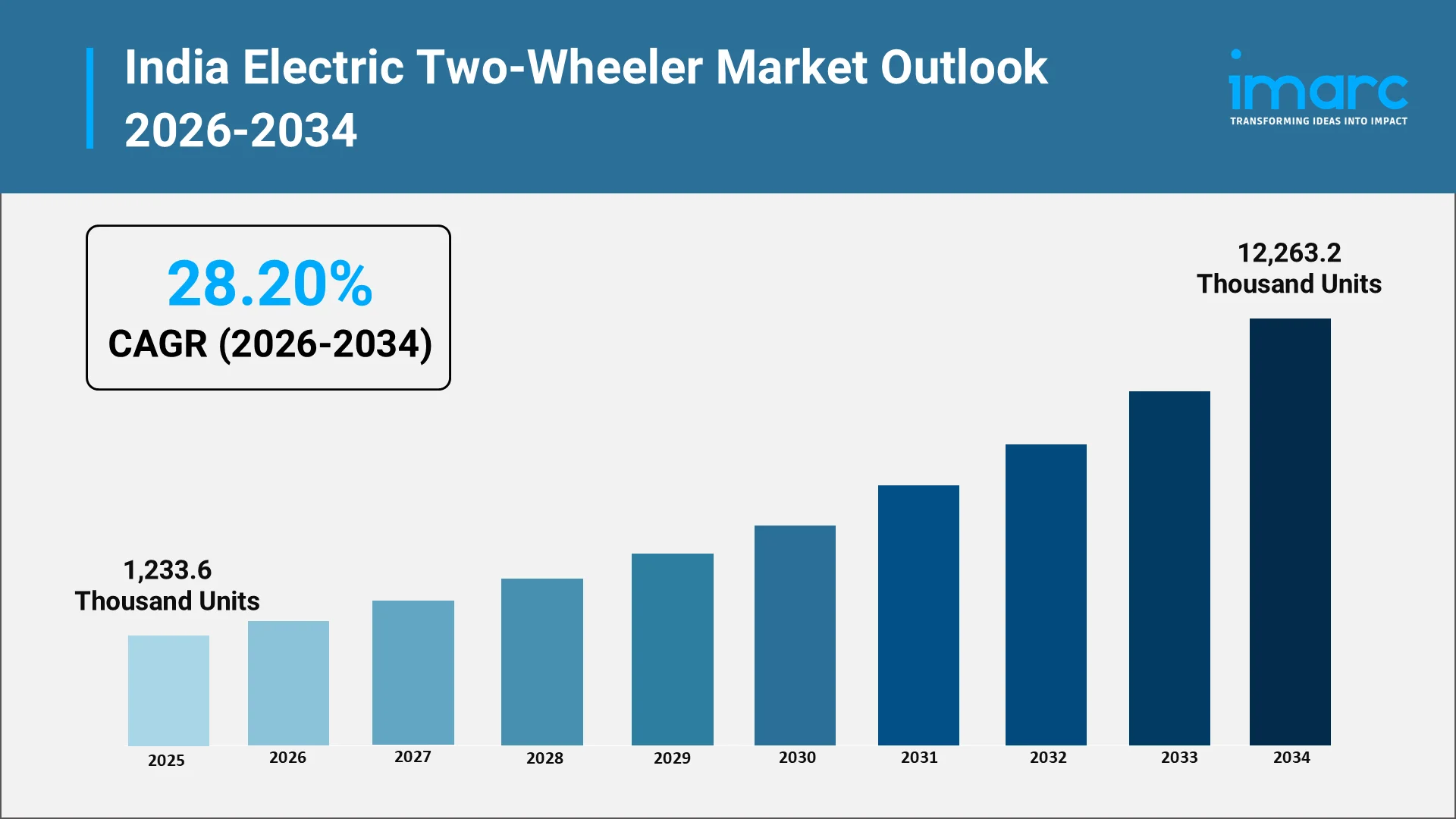
The Indian electric two-wheeler sector represents one of the most dynamic growth opportunities in the global automotive industry. The convergence of policy support, rising environmental awareness, and economic factors has created fertile ground for market expansion. India electric two-wheeler market size reached 1,233.6 Thousand Units in 2025. Looking forward, IMARC Group expects the market to reach 12,263.2 Thousand Units by 2034, exhibiting a growth rate (CAGR) of 28.20% during 2026-2034.
Government subsidies through the FAME II scheme have played a pivotal role in market acceleration. The Ministry of Heavy Industries allocated substantial funding under FAME II, with specific incentives for electric two-wheelers. According to official Ministry data, the scheme provides incentive support ranging from INR 10,000 to INR 15,000 per kWh of battery capacity for electric two-wheelers, significantly reducing the effective purchase price for consumers.
Rising fuel prices have emerged as a critical catalyst for electric vehicle adoption. Data from the Petroleum Planning and Analysis Cell shows that petrol prices in major Indian cities have experienced significant volatility and upward trends over recent years, making the stable and lower operating costs of electric vehicles increasingly attractive to budget-conscious consumers.
The Society of Indian Automobile Manufacturers reports substantial growth in electric two-wheeler registrations. Vehicle registration data from the Ministry of Road Transport and Highways indicates that electric two-wheeler sales have shown exponential growth, with penetration rates increasing significantly in urban and semi-urban markets.
Regional adoption patterns reveal interesting dynamics. States like Delhi, Karnataka, Maharashtra, and Gujarat have emerged as leading markets, supported by robust state-level policies and better charging infrastructure. According to data from the Central Motor Vehicles Rules, these states account for a substantial portion of national electric two-wheeler sales.
The electric vehicle policy framework continues to evolve supportively. The National Electric Mobility Mission Plan and the Production Linked Incentive (PLI) scheme for Advanced Chemistry Cell (ACC) battery storage are designed to strengthen the domestic manufacturing ecosystem, potentially reducing costs further and improving availability.
Explore in-depth findings for this market, Request Sample
Declining Battery Prices Improving Vehicle Affordability:
Battery technology represents the single most critical component influencing electric two-wheeler economics. The dramatic reduction in battery costs over recent years has fundamentally altered the affordability equation for electric vehicles.
Lithium-ion battery technology, which powers most modern electric two-wheelers, has experienced significant cost reductions globally. While specific Indian battery pricing data from government sources is limited, international benchmarks tracked by the International Energy Agency show that lithium-ion battery pack prices have declined substantially over the past decade, making electric vehicles increasingly cost-competitive with conventional alternatives.
The Indian government's focus on battery manufacturing through the PLI scheme for ACC battery storage demonstrates a strategic commitment to localizing this critical component. The Ministry of Heavy Industries has outlined ambitious targets for domestic battery production capacity, which is expected to reduce import dependence and further lower costs for Indian manufacturers.
Battery performance improvements have paralleled cost reductions. Modern lithium-ion batteries used in Indian electric two-wheelers typically offer ranges of 80-150 kilometers on a single charge, sufficient for most urban commuting needs. The Bureau of Indian Standards has established specific testing protocols (IS 17855) for lithium-ion batteries used in electric vehicles, ensuring safety and performance standards.
Battery management systems have become increasingly sophisticated, extending battery life and improving charging efficiency. Most contemporary electric two-wheelers feature smart battery management that optimizes charging cycles, prevents overcharging, and maintains thermal stability. These technological advances translate directly into lower total cost of ownership for consumers.
The battery warranty provisions offered by manufacturers have also improved consumer confidence. Most leading manufacturers now offer battery warranties of 3-5 years or 50,000-70,000 kilometers, addressing one of the primary concerns potential buyers have about long-term ownership costs.
Energy density improvements in lithium-ion technology mean that newer electric two-wheelers can offer greater range without proportionally increasing battery size or weight. This technological progression is making electric scooters more practical for a broader range of use cases, from daily commuting to longer intercity travel.
Charging Infrastructure Development:
The expansion of charging infrastructure represents a critical enabler for electric two-wheeler adoption across India. A multi-faceted approach encompassing public charging stations, home charging solutions, and innovative battery swapping networks is addressing range anxiety and convenience concerns.
Public charging station deployment has accelerated significantly. According to the Ministry of Power, the government has issued guidelines for charging infrastructure, establishing technical standards, and promoting uniform charging protocols. The Bureau of Energy Efficiency publishes data on public charging station installations across various Indian cities.
The Central Electricity Authority has developed model guidelines for electric vehicle charging infrastructure, providing a framework for both public and private sector players to establish charging facilities. These guidelines address technical specifications, safety requirements, and grid integration protocols.
Home charging solutions have emerged as the preferred charging method for most electric two-wheeler owners. The convenience of overnight charging using standard household electrical connections aligns well with typical usage patterns. Most electric scooters can be fully charged using a standard 15-ampere socket in 4-6 hours, making home charging practical and economical.
Several state electricity boards have introduced special tariff structures for electric vehicle charging during off-peak hours, further reducing charging costs. According to data from various State Load Dispatch Centres, off-peak electricity rates can reduce charging costs by 20-30% compared to standard residential tariffs.
Battery swapping networks represent an innovative approach to addressing charging time constraints. The government's Draft Battery Swapping Policy, released by NITI Aayog, outlines a framework for standardized battery swapping infrastructure. This approach offers the convenience of rapid battery replacement (typically 2-3 minutes) rather than waiting for charging cycles.
Leading electric two-wheeler manufacturers have established battery swapping stations in major cities. According to company disclosures and press releases, these networks are expanding rapidly in urban centers, offering subscription-based models that separate battery ownership from vehicle ownership, potentially reducing upfront purchase costs.
Workplace charging facilities are gaining traction in corporate parks and commercial establishments. The Ministry of Power's charging infrastructure guidelines encourage offices and commercial buildings to provide charging facilities for employees and visitors, supporting the integration of electric vehicles into daily routines.
Top Companies in India Electric Two-Wheeler Market:
The Indian electric two-wheeler market features a dynamic competitive landscape with established automobile manufacturers, new-age startups, and technology-focused companies vying for market leadership. Understanding the key industry players provides insight into market evolution and competitive strategies.
Ola Electric has emerged as a significant force in the Indian electric two-wheeler market. The company's manufacturing facility in Tamil Nadu represents one of the largest electric two-wheeler production capacities globally. According to company disclosures and press releases on their corporate website, Ola Electric has established an extensive direct-to-consumer sales network and battery swapping infrastructure across multiple Indian cities.
Ather Energy, a Bangalore-based electric vehicle manufacturer, has established itself as an innovation leader in the premium electric scooter segment. The company's focus on technology integration, performance, and proprietary charging infrastructure has created a distinctive market position. According to information available on Ather Energy's corporate website and regulatory filings, the company has deployed fast-charging stations across major cities and continues expanding its manufacturing capacity.
Hero Electric, part of the Hero Motors company group, represents one of the early movers in India's electric two-wheeler space. With decades of experience in the two-wheeler industry, Hero Electric has leveraged its understanding of Indian consumer preferences and distribution networks. Company announcements indicate a broad product portfolio targeting various price segments and use cases.
Bajaj Chetak symbolizes the revival of an iconic Indian brand in electric avatar. Bajaj Auto, a major player in India's automotive industry, re-launched the Chetak nameplate as an electric scooter. According to Bajaj Auto's investor presentations and corporate communications available on their website, the Chetak electric scooter combines heritage with modern electric vehicle technology.
TVS Motor Company, one of India's largest two-wheeler manufacturers, entered the electric segment with the TVS iQube. Leveraging its extensive manufacturing expertise and dealer network, TVS has positioned the iQube as a mainstream electric scooter option. Company annual reports and regulatory filings detail TVS's investment in electric vehicle technology and expansion plans.
Okinawa Autotech has established a significant presence in India's electric two-wheeler market with a range of products across different price points. The company's focus on localization and extensive dealer network has supported its market penetration. Corporate disclosures on Okinawa's official channels outline their manufacturing capabilities and distribution strategy.
Ampere Vehicles, acquired by Greaves Cotton Limited, represents another established player in the Indian electric two-wheeler space. According to Greaves Cotton's investor communications and annual reports, Ampere focuses on affordable electric scooters designed specifically for Indian market conditions and consumer preferences.
The competitive dynamics reveal distinct strategic approaches. Premium players emphasize technology, performance, and integrated ecosystems including proprietary charging infrastructure. Mass-market focused companies prioritize affordability, extensive distribution networks, and after-sales service accessibility. Technology startups bring innovative approaches to battery management, connectivity features, and user experience.
Manufacturing localization has become increasingly important. Government policies favoring local production through the PLI scheme and Phase Manufacturing Programme (PMP) have encouraged companies to establish or expand domestic manufacturing facilities. According to the Ministry of Heavy Industries, this localization trend supports job creation and reduces dependency on imports.
Recent Developments and News:
- November 2025: Yamaha Motor Co., Ltd. announced plans to introduce two new electric scooter models in India by November 2025, the AEROX E, an in-house developed electric sport scooter, and the EC-06, created in collaboration with River Mobility Private Limited.
.webp)
Conclusion:
The India electric two-wheeler industry stands at an inflection point where multiple favorable factors are converging to drive unprecedented growth. The combination of economic advantages through lower operating costs, supportive government policies and subsidies, declining battery prices, expanding charging infrastructure, and strong competition among established and emerging manufacturers has created a robust foundation for market expansion.
The transformation of India's urban mobility landscape is being powered by electric two-wheelers that offer practical solutions to pressing challenges—from air pollution and fossil fuel dependency to rising transportation costs for middle-class consumers. The substantial cost savings of 60-70% in operational expenses compared to petrol scooters make electric alternatives financially compelling for daily commuters.
Government initiatives through FAME II subsidies, state-level incentives, and policy frameworks supporting charging infrastructure development demonstrate sustained institutional commitment to electric mobility. The localization of battery manufacturing and vehicle production under schemes like the PLI program promises to further improve affordability and accessibility while strengthening domestic manufacturing capabilities.
The infrastructure ecosystem is maturing rapidly with expanding public charging networks, convenient home charging solutions, and innovative battery swapping models addressing range anxiety concerns. This multi-pronged infrastructure approach ensures that electric two-wheelers can serve diverse usage patterns across urban and semi-urban markets.
Looking forward, the India electric two-wheeler market is positioned for sustained expansion as technology continues advancing, costs decline further, and consumer awareness grows. The convergence of environmental consciousness, economic pragmatism, and technological innovation is reshaping how millions of Indians will travel in the coming decades.
The question for stakeholders is not whether electric two-wheelers will dominate India's urban mobility future, but how quickly this transformation will unfold and who will emerge as the leaders in this dynamic marketplace.
Choose IMARC Group for Unmatched Expertise and Strategic Intelligence:
- Data-Driven Market Research: Enhance your understanding of the India electric two-wheeler market through comprehensive research reports covering vehicle adoption trends, battery technology developments, charging infrastructure expansion, and segment-wise growth patterns across different price categories and regional markets.
- Strategic Growth Forecasting: Anticipate emerging opportunities in electric mobility, from advancements in lithium-ion and solid-state battery technologies to the evolution of battery swapping networks, smart connectivity features, and the impact of evolving government policies on market dynamics across Indian states.
- Competitive Benchmarking: Analyze the competitive landscape with detailed assessments of market leaders, emerging players, product portfolios, technology strategies, manufacturing capabilities, and distribution approaches that define success in India's electric two-wheeler sector.
- Policy and Infrastructure Advisory: Stay ahead of the regulatory curve with insights into central and state-level electric vehicle policies, FAME scheme evolutions, charging infrastructure guidelines, battery safety standards, and incentive structures affecting vehicle affordability and market penetration.
- Custom Reports and Consulting: Access tailored intelligence aligned with your specific objectives—whether launching new electric two-wheeler models, investing in charging infrastructure, developing battery technologies, expanding manufacturing operations, or building supply chain partnerships in India's electric mobility ecosystem.
At IMARC Group, our mission is to empower mobility leaders, automotive manufacturers, technology providers, and investors with the clarity and strategic intelligence required to navigate India's electric two-wheeler revolution. Partner with us to accelerate the transition to sustainable urban transportation—because every journey toward cleaner mobility matters.
For more details, please click on this link: https://www.imarcgroup.com/india-electric-two-wheeler-market
Our Clients










Contact Us
Have a question or need assistance?
Please complete the form with your inquiry or reach out to us at
Phone Number
+91-120-433-0800+1-201-971-6302
+44-113-547-7077
Previous Post

As one of the world's leading industrial powerhouses, Japan has long been recognized for its commitment to technological innovation and manufacturing precision. The industry for industrial automation components—encompassing sensors, controllers, actuators, drives, robotics, and human-machine interfaces—represents the backbone of modern manufacturing infrastructure.
The Australian brakes and clutches industry plays a vital role in ensuring vehicle performance, safety, and efficiency across both automotive and industrial segments. As the nation transitions toward electric mobility and smarter manufacturing systems, the demand for advanced braking and clutch mechanisms is rising significantly.
The Philippines automotive wiring harness industry stands at a transformative juncture, driven by technological innovations that are reshaping vehicle electrical architectures worldwide. As vehicles evolve into sophisticated mobile computing platforms, the wiring harness, the circulatory system transmitting electrical power and data throughout modern automobiles, has become increasingly complex and critical to vehicle performance.
Japan's hybrid vehicles market stands as a global benchmark for sustainable mobility innovation, demonstrating remarkable growth and technological leadership. The market achieved a valuation of USD 33.57 Billion in 2024. Japan's hybrid vehicle (HV) market is one of the most established globally, originating with pioneering models like the Toyota Prius. It currently represents a significant portion of the country's automotive sales.
The Japan warehouse robotics market is a highly dynamic and rapidly expanding segment of the global automation industry. The market, valued at USD 414.0 Million in 2024, is on a sharp growth trajectory. Its growth is fueled by critical domestic factors, including a severe labor shortage, the rapid expansion of e-commerce, and Japan's strategic position as a world-leading robotics manufacturer.
The UK is rapidly evolving into a dynamic hub for autonomous vehicle research, testing, and early-stage deployments. A strong ecosystem comprising academic institutions, technology start-ups, automakers, and mobility service providers fosters continuous innovation. Supported by a skilled workforce specializing in software, sensing, robotics, and transportation systems, the nation has become a fertile ground for experimentation.
Japan’s transportation landscape is on the brink of a major shift, with robo taxis, autonomous, driverless vehicles designed for passenger and goods transport, emerging as a practical mobility solution. The Japan robo taxi market reached USD 83.2 Million in 2024 . This remarkable expansion reflects Japan’s broader move toward smart mobility, sustainability, and automation.
The Japan electric truck market is experiencing transformative growth as the nation accelerates toward sustainable transportation and carbon neutrality. As a leading automotive manufacturing hub, Japan is witnessing unprecedented momentum in commercial vehicle electrification, driven by stringent environmental regulations, technological innovation, and strategic government support. The electric truck industry represents a critical component of Japan's commitment to achieving 100% electrified vehicle sales by 2035 and carbon neutrality by 2050.
An EV charging station represents the necessary main infrastructure that allows electrical energy to be transferred from the power grid into electric vehicles to enable their use for transportation. Unlike conventional fueling stations that offer liquid fuels, EV charging stations provide electric power through the use of standardized connectors and smart control systems. The core components include a power conversion unit, which transforms alternating current from the grid into direct current for the vehicle battery; a charging controller controlling communication between the charger and the EV; and a connector or plug matched to the vehicle's charging interface.
An electric scooter is a two-wheeled vehicle powered by an electric motor and rechargeable battery, aimed at offering the means for efficient, eco-friendly, and cost-effective urban mobility. Apart from the traditional scooters that are powered by internal combustion engines, the electric scooters make use of lithium-ion or lead-acid batteries that feed an electric supply to a BLDC motor, which drives the wheels either directly or via a belt or chain mechanism.
Electric bikes, commonly referred to as e-bikes, are one of the most transformational innovations in modern personal mobility, combining conventional bicycle mechanics with advanced electric propulsion technology. At the heart of e-bikes are an electric motor, a rechargeable battery, and a control system that add assistance to the rider while pedaling, making cycling easier, faster, and more accessible across varied terrains. Based on their design, they can be further categorized into pedal-assist, throttle-controlled, or hybrid models, each providing different levels of rider control and engagement of the motor.
The micro-mobility industry has emerged as a transformative force in urban transportation, revolutionizing how people navigate cities worldwide. According to IMARC, the global micro-mobility market size was valued at USD 63.10 Billion in 2024. Looking forward, IMARC Group estimates the market to reach USD 204.83 Billion by 2033, exhibiting a CAGR of 12.86% from 2025-2033.
India's electric vehicle (EV) revolution is accelerating at a breakneck speed, powered by a strategic combination of government incentives, infrastructure investments, and manufacturing policies that are transforming the automotive landscape. The IMARC Group forecasts that the Indian electric car market reached USD 963 Million in 2024.
The diesel engine industry is standing at a transformative crossroads. As global markets are pushing for sustainability, stricter emissions compliance, and cutting-edge innovations, diesel powertrains are facing both immense pressure and promising potential.
The global tire market is a multi-billion-dollar industry, driven by the growing demand for vehicles across emerging economies and the replacement tire segment in developed countries. The global tire market is expected to grow at a compound annual growth rate (CAGR) of 4.70% between 2025 and 2033. The industry is heavily influenced by factors such as technological advancements, raw material prices, environmental regulations, and consumer preferences.
Australia's electric vehicle (EV) sector is experiencing swift expansion, fueled by increasing interest in eco-friendly transportation alternatives. In 2024, sales of battery electric and plug-in hybrid vehicles hit an all-time high, totaling around 114,000 units.
The electric bus industry is the part of the transportation sector that deals with the production and installation of buses that run completely or partially on electricity, employing battery packs or fuel cells in place of conventional diesel or gasoline engines. The buses deliver lower greenhouse gas emissions, lesser noise levels, and enhanced energy efficiency, and thus they are a prime solution for environmentally friendly public transport.
India's electric vehicle market is undergoing a profound transformation, impelled by green priorities, economic imperatives, and changing consumer trends. With rising concerns about air pollution and fossil fuel dependence, electric mobility has become a strategic option for India's transport industry. Policy clarity, technology development, and an emerging ecosystem of makers and suppliers are driving this market shift.
The global electric vehicle market size was valued at USD 755 Billion in 2024. The global EV market is rapidly expanding, driven by technological advancements, government incentives, stricter emission regulations, rising fuel costs, extended battery range, growing environmental consciousness, and significant investments in charging and production infrastructure.
Electric Vehicles, or EVs, are vehicles operated partially or wholly by electrical power, generally with rechargeable battery packs as their fuel. In contrast to conventional internal combustion engine cars, EVs emit no tailpipe emissions, making them a cleaner, environmentally friendly transportation choice. EVs comprise Battery Electric Vehicles (BEVs), Plug-in Hybrid Electric Vehicles (PHEVs), and Hybrid Electric Vehicles (HEVs), and are gaining ground in passenger, commercial, and two-wheeler segments owing to developments in battery technology, charging infrastructure, and policy support.
Aluminum alloy wheels are high-performance, lightweight, and durable components widely used in the automotive industry. Their superior strength-to-weight ratio enhances vehicle efficiency, fuel economy, and handling, making them a preferred choice for both passenger and commercial vehicles. Beyond their functional benefits, aluminum alloy wheels contribute to vehicle aesthetics, offering sleek designs and customization options that appeal to consumers. Their corrosion resistance and thermal conductivity further enhance braking performance and longevity. With increasing demand for fuel-efficient and stylish vehicles, aluminum alloy wheels play a crucial role in the global automotive sector, catering to OEMs, aftermarket suppliers, and performance vehicle manufacturers.
A tyre is a crucial component of a vehicle, serving as the outer covering of a wheel. Its main purposes are to support the vehicle's weight, provide traction for movement, and act as a flexible cushion that absorbs shocks from the road. Usually composed of rubber, tires are strengthened with steel and cloth. Tires for cars, trucks, motorbikes, bicycles, and other vehicles have different designs and compositions depending on the vehicle type and its intended usage. To improve stability and grip, they have a tread pattern on the outside.
Electric kick scooters are small, battery-operated personal transportation vehicles intended for short-distance and urban movement. They offer an economical and environmentally responsible substitute for conventional modes of mobility thanks to their electric engine, rechargeable battery, and lightweight frame. The need for sustainable transportation options, traffic congestion, and growing urbanisation have all contributed to their rise in popularity. Electric kick scooters are now the go-to option for last-mile connectivity and personal commuting because to developments in battery technology, connectivity features, and government programs encouraging micro-mobility.
An automotive wiring harness is an organized assembly of electrical wires, connectors, and terminals that transmit power and signals across a vehicle’s electrical system. It guarantees effective communication between several parts, including the engine control unit, lighting, and sensors. Wiring harnesses are intended to increase vehicle performance and safety by lowering the possibility of short circuits. By maximising electrical connectivity and lowering wire complexity, they are utilised in both conventional and electric automobiles and are essential to contemporary automotive technology.
In an automotive braking system, brake pads are the most important parts since they are engineered to contact the brake rotor to produce friction, thus stopping or slowing down a vehicle in virtually any driving condition safely and efficiently. The key way of classifying these pads is according to their material types: low metallic, ceramic, organic, and semi-metallic.
Tires are essential components of vehicles designed to provide traction, support, and absorb road shocks. Primarily made of rubber, tires consist of treads, belts, and sidewalls that work together to offer grip, stability, and durability. Modern tires come in various types – such as all-season, winter, and performance tires – each engineered for specific driving conditions. The two major tire categories are radial and bias tires, and they are available in different sizes to suit various vehicle types, including passenger cars, light commercial vehicles, medium and heavy commercial vehicles, two-wheelers, and off-road vehicles.
Electric Vehicles (EVs) are powered by electric motors instead of traditional internal combustion engines (ICEs). Electric motors propel EVs by utilizing electricity stored in rechargeable batteries or other energy storage systems. They produce lower or zero tailpipe emissions, reduce air pollution and greenhouse gas (GHG) emissions, and help in mitigating climate change. Electric vehicles consist of various components, such as battery cells and packs, reducers, fuel stacks, power control units, power conditioners, air compressors, humidifiers, motors, on-board chargers, battery management systems, and others. EVs are classified into four types based on propulsion, outlined below.
Saudi Arabia is the second-largest producer and exporter of crude oil and holds the second-largest proven oil reserves in the world, with around 267 billion barrels. The country's oil sector is a significant part of its economy, accounting for 75% of government revenue and approximately 90% of exports. However, due to the volatility of oil prices and the potential for economic instability, Saudi Arabia is increasingly focusing on non-oil activities to reduce its dependency on the oil sector. Non-oil commodities tend to have more stable prices, providing protection against these fluctuations and strengthening the country's social, economic, and financial sectors.