WPC Door Manufacturing Cost Analysis: Structure Meets Strategy
What is WPC Door?
A WPC (Wood Plastic Composite) door is a type of composite door made from a combination of wood fibers or wood flour and thermoplastic resins like PVC, polyethylene, or polypropylene, with additives to improve durability and processability. The resulting composite material is then extruded or molded into door panels and frames, providing the attractive look of wood and the strength and water-resistance of plastic. WPC doors are designed to be resistant to warping, termite attack, rotting, and water absorption, making them ideal for interior and semi-outdoor applications where regular wood doors tend to deteriorate with time.
Key Applications Across Industries:
WPC doors are popularly used in various residential, commercial, and institutional building projects owing to their durability and easy maintenance. In a residential context, they are typically used as bathroom doors, kitchen doors, bedroom doors, and balcony enclosures, especially in regions with high humidity. Their water-resistant properties make them ideal for use in coastal and humid regions where regular wooden doors tend to swell and rot.
In commercial setups, WPC doors are employed in offices, shopping malls, educational institutions, hospitals, and hospitality infrastructure. Termination resistance and stability in size lower maintenance costs over time, making them ideal for commercial use. Moreover, WPC doors can be produced with different surface textures, laminations, veneers, or CNC designs, which can be customized according to interior design trends.
Institutional buildings like schools and hospitals favor the use of WPC doors owing to their hygiene benefits and resistance to microbial development with the addition of suitable additives. Easy machinability enables the incorporation of fire-resistant cores or sound-reducing filling materials, which improve performance.
WPC doors are also employed in modular housing and prefabricated construction systems owing to their light weight and simple installation process. As eco-friendly construction methods become popular, WPC doors are increasingly being promoted as eco-friendly substitutes for solid wood doors, especially when produced from recycled plastics and agricultural wood waste.
What the Expert Says: Market Overview & Growth Drivers
The global wood-plastic composites market reached a value of USD 6.1 Billion in 2025. According to IMARC Group, the market is projected to reach USD 13.6 Billion by 2034, at a projected CAGR of 8.79% during 2026-2034.
The major driving factor in the global WPC door market is the growth in the construction and infrastructure development sectors, especially in countries that are rapidly developing and urbanizing. With the rise in residential construction and commercial real estate development, the demand for more durable and affordable door options has increased. As property developers look for materials that can lower maintenance costs over time, WPC doors are preferred over traditional wood products.
The growing availability of natural hardwood at a higher cost is another major factor that drives the demand for WPC doors. With environmental regulations and deforestation issues limiting wood extraction in many parts of the world, the cost of wood has increased. WPC doors provide a viable alternative that can imitate wood without consuming much of the world's natural wood resources.
The preference for low-maintenance and water-resistant materials in construction also drives the demand for WPC doors. In many tropical and humid climates, traditional wood doors tend to swell, crack, and get infested with termites. The water-resistant properties of WPC doors provide a suitable solution to these problems.
Trends in sustainability are also important. WPC doors are made from recycled plastics and wood waste, which is in line with the principles of the circular economy. Green building ratings and sustainable construction practices promote the use of composite materials that are more environmentally friendly.
Advances in technology, such as improvements in extrusion and molding techniques, have increased the quality and versatility of WPC doors, allowing manufacturers to provide textured surfaces and custom profiles. Furthermore, greater awareness among architects, builders, and interior designers of the long-term functional benefits of WPC materials can improve market penetration.
In summary, urbanization, conservation of resources, durability advantages, sustainability initiatives, and technological advancements are the main structural drivers that are fueling the growth of WPC door production on a global scale.

Case Study on Cost Model of WPC Door Manufacturing Plant:
Objective
One of our clients reached out to us to conduct a feasibility study for setting up a medium scale WPC door manufacturing plant.
IMARC Approach: Comprehensive Financial Feasibility
We developed a comprehensive financial model for the setup and operation of a proposed WPC door manufacturing plant in India. This plant is designed to manufacture 100,000 units of WPC door annually.
Manufacturing Process: The WPC (Wood Plastic Composite) door production process is a controlled compounding and extrusion process aimed at producing a uniform and strong composite material by combining wood fibers and thermoplastic polymers. The process starts with raw material preparation, where wood flour or ground agricultural wood waste is dried to remove excess moisture, which may impact the bonding and dimensional stability of the material. The dried wood fibers are then mixed with thermoplastic resins like PVC, polyethylene, or polypropylene, along with additives such as stabilizers, coupling agents, lubricants, pigments, and impact modifiers. Coupling agents enhance the bonding between the hydrophilic wood particles and the hydrophobic plastic polymers.
The mixture is then loaded into a high-intensity mixer and further transferred to a twin-screw extruder. In the extruder, controlled heat and mechanical shear force melt the plastic polymer and evenly distribute the wood fibers, creating a uniform composite material melt. The molten material is then pushed through a die to produce door panels or hollow door profiles of desired sizes. Vacuum calibration systems are used to ensure accurate dimensions and smooth surfaces during the shaping process.
The profiles are then cooled by water baths or air-cooling systems to solidify the structure. The cooled boards are then cut to the desired size for doors and undergo surface finishing operations such as sanding, lamination, embossing, CNC routing, or application of decorative films to achieve the desired look. In some instances, internal reinforcement materials are inserted to increase strength.
The final steps involve quality checks for density, impact, water absorption, and dimensional stability. The approved products are then cut, equipped with hardware inserts, and packaged for distribution to the construction and interior sectors.
Get a Tailored Feasibility Report for Your Project Request Sample
Raw Material Required:
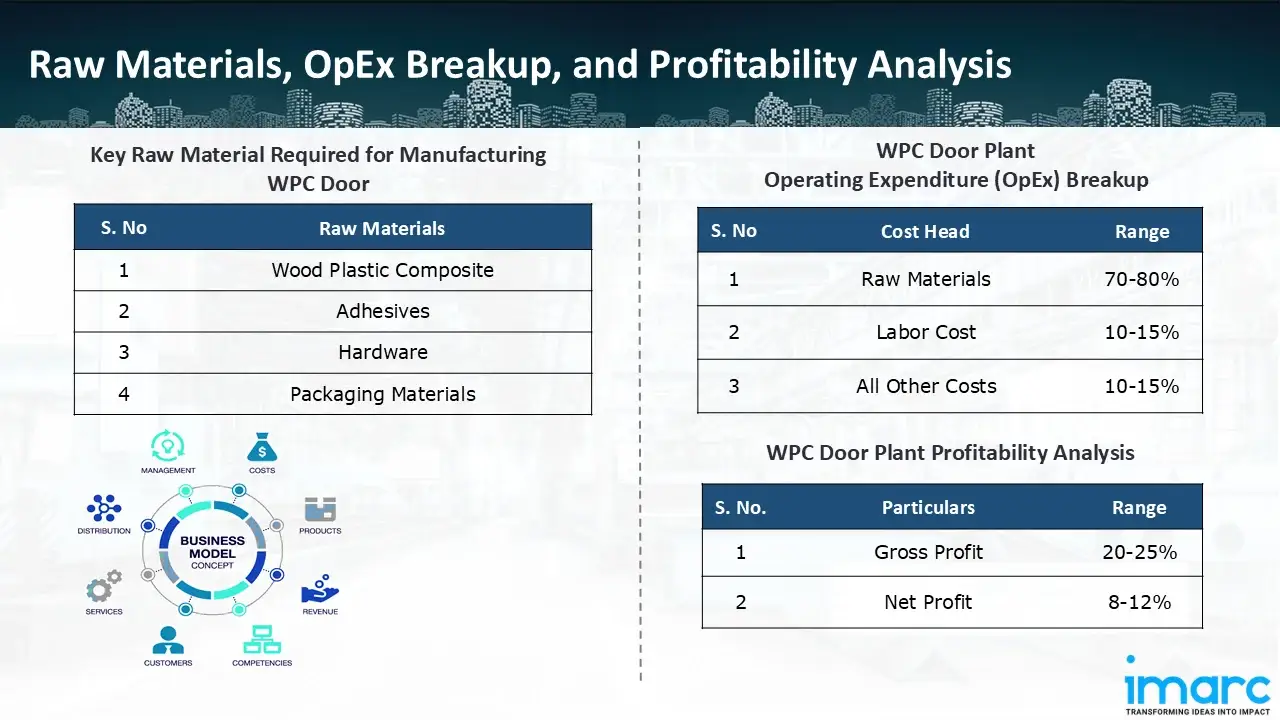
The basic raw materials required for WPC door manufacturing include:
- Wood Plastic Composite
- Adhesives
- Hardware
- Packaging Materials
Machine Section or Lines Required:
- Extrusion
- Cutting
- Embossing
- Assembly
- Packing
Techno-Commercial Parameter:
- Capital Expenditure (CapEx): Capital expenditure (CapEx) in a manufacturing plant includes various investments essential for its setup and long-term operations. It covers machinery and equipment costs, including procurement, installation, and commissioning. Civil works expenses involve land development, factory construction, and infrastructure setup. Utilities such as power, water supply, and HVAC systems are also significant. Additionally, material handling systems, automation, environmental compliance, and safety measures are key components. Other expenditures include IT infrastructure, security systems, and office essentials, ensuring operational efficiency and business growth.
- Operating Expenditure (OpEx): Operating expenditure is the cost incurred to operate a manufacturing plant effectively. OpEx in a manufacturing plant typically includes the cost of raw materials, utilities, depreciation, taxes, packing cost, transportation cost, and repairs and maintenance. The operating expenses are part of the cost structure of a manufacturing plant and have a significant effect on profitability and efficiency. Effective control of these costs is necessary for maintaining competitiveness and growth. Furthermore, raw material cost in WPC door manufacturing plant ranges between 70-80%, labor cost ranges between 10% to 15%, and all other costs ranges between 10-15% in the proposed plant.
- Profitability Analysis Year on Year Basis: We assisted our client in developing a detailed cost model, which projects steady growth, with revenue rising throughout the projected period. Moreover, gross profit margins lie between a range of 20-25%, and net profit lie between the range of 8-12% during the income projection years, highlighting strong financial viability and profitability.
Conclusion & IMARC's Impact:
Our financial model for the WPC door manufacturing plant was meticulously developed to meet the client’s objectives, providing an in-depth analysis of production costs, including raw materials, manufacturing, capital expenditure, and operational expenses. By addressing the specific requirements of manufacturing 100,000 units of WPC door annually, we successfully identified key cost drivers and projected profitability, considering market trends, inflation, and potential fluctuations in raw material prices. This comprehensive financial model equipped the client with valuable insights into strategic decision-making, demonstrating our commitment to delivering high-quality, client-focused solutions that ensure the long-term success of large-scale manufacturing ventures.
Latest News and Developments:
- In June 2025, Greenply has given its WOS, GSPPL, permission to establish a new production facility for PVC/WPC doors, frames, and boards in Vadodara, Gujarat. This would be the company's first facility for producing PVC/WPC doors, frames, and boards. 9.18 million kilograms of capacity would be added annually.
- In March 2025, Koemmerling, a well-known worldwide brand under profine GmbH for uPVC profiles, has announced the introduction of KömaBoard, a high-end line of PVC and WPC sheets for contemporary spaces, in the Indian market. For both indoor and outdoor applications, Koemmerling's latest product is poised to revolutionise quality, durability, and aesthetics.
Why Choose IMARC?
IMARC's Financial Model Expertise: Helping Our Clients Explore Industry Economics
IMARC is a global market research company that offers a wide range of services, including market entry and expansion, market entry and opportunity assessment, competitive intelligence and benchmarking, procurement research, pricing and cost research, regulatory approvals and licensing, factory setup, factory auditing, company incorporation, incubation services, recruitment services, and marketing and sales.
Under our factory setup services, we assist our clients in exploring the feasibility of their plants by providing comprehensive financial modeling. Additionally, we offer end-to-end consultation for setting up a plant in India or abroad. Our financial modeling includes an analysis of capital expenditure (CapEx) required to establish the manufacturing facility, covering costs such as land acquisition, building infrastructure, purchasing high-tech production equipment, and installation. Furthermore, the layout and design of the factory significantly influence operational efficiency, energy consumption, and labor productivity, all of which impact long-term operational expenditure (OpEx). So, every parameter is covered in the analysis.
At IMARC, we leverage our comprehensive market research expertise to support companies in every aspect of their business journey, from market entry and expansion to operational efficiency and innovation. By integrating our factory setup services with our deep knowledge of industry dynamics, we empower our clients to not only establish manufacturing facilities but also strategically position themselves in highly competitive markets. Our financial modeling and end-to-end consultation services ensure that clients can explore the feasibility of their plant setups while also gaining insights into competitors' strategies, technological advancements, and regulatory landscapes. This holistic approach enables our clients to make informed decisions, optimize their operations, and align with sustainable practices, ultimately driving long-term success and growth.
Our Clients










Contact Us
Have a question or need assistance?
Please complete the form with your inquiry or reach out to us at
Phone Number
+91-120-433-0800+1-201-971-6302
+44-113-547-7077
Previous Post

UPVC windows refer to window frames and window assemblies manufactured from ‘unplasticized polyvinyl chloride,’ which is a relatively rigid and strong thermoplastic substance. While PVC is a flexible material that requires the addition of a softening substance called a plasticizer to be formed into a durable performance material, PVC window frames and UPVC window assemblies, for instance, do not display such requirements due to the presence of unplasticizers, a component of the material that provides enhanced strength, stability, and resistance to the elements such as UV radiation, moisture, and temperature changes.
The Saudi Arabia factoring market represents a critical component of the Kingdom's evolving financial services landscape, offering businesses an increasingly popular alternative to traditional bank lending. Factoring, which involves the sale of accounts receivable to a third-party financial institution at a discount, has emerged as a vital mechanism for improving liquidity, managing cash flow, and mitigating credit risk across diverse industry sectors.
The GCC bridge construction market represents a vital component of the region's ambitious infrastructure transformation agenda, serving as a cornerstone for enhanced mobility, economic integration, and sustainable urban development across the Gulf states.
The Australia industrial couplings industry stands at a transformative juncture in 2025, propelled by technological advancement and surging demand across critical sectors. As mechanical devices connecting two shafts to transmit power and torque, industrial couplings form the backbone of machinery operations in manufacturing, mining, automotive, and energy sectors.
The Saudi Arabia real estate market stands at a pivotal juncture in its evolution, representing one of the most dynamic and transformative sectors within the Kingdom's economy. With this country having a very ambitious agenda of economic diversification and modernization, the real estate business has come out as one of the pillars of this transformation.
Steel is an alloy that consists of iron and carbon in addition to trace amounts of other elements like manganese, silicon, chromium, and nickel. The amount of carbon in steel is usually less than two percent and is an important factor in determining the strength, hardness, and ductility of steel.
Saudi Arabia’s precast concrete market reached USD 1.2 Billion in 2024 as per the IMARC Group, clear proof that off-site construction is rapidly becoming the Kingdom’s go-to building solution. With residential, commercial, and major infrastructure projects multiplying, developers are increasingly turning to precast building solutions to keep pace.
The GCC cold storage construction market represents critical infrastructure underpinning regional food security, pharmaceutical distribution, and temperature-sensitive logistics across the Arabian Peninsula. As Gulf Cooperation Council nations diversify their economies and reduce hydrocarbon dependence, robust cold chain infrastructure has emerged as a cornerstone of sustainable development planning.
PVC panels are lightweight, durable building materials made from polyvinyl chloride using extrusion or molding processes. They are available as rigid or semi-rigid sheets designed primarily for wall and ceiling cladding, partitions, and decorative finishes. Known for their excellent resistance to moisture, chemicals, termites, and corrosion, PVC panels offer a smooth surface and a clean, polished look that’s easy to maintain. Available in an extensive range of colors, textures, and patterns, these panels serve as a practical alternative to traditional materials like wood, plaster, or tiles.
Ready mix concrete (RMC) is a precisely engineered construction material produced in a controlled environment within a batching plant and delivered to construction sites in a freshly mixed, plastic state. It is formulated by combining cement, aggregates, water, and chemical or mineral admixtures in carefully proportioned quantities to achieve specific performance characteristics. Unlike site-mixed concrete, RMC ensures consistent quality, uniformity, and superior workability through automated production and quality control processes.
The construction industry across the Gulf Cooperation Council (GCC) member states is at the core of a monumental economic transformation. Far exceeding traditional building activities, the sector now serves as the principal vehicle for national economic diversification strategies, moving these nations beyond reliance on oil revenues.
Paver blocks are precast construction material made basically from cement, aggregates, sand, and pigments for constructing surfacing. They are produced in standardized shape and thickness, allowing each unit to interlock to form a strong, load-bearing surface with no need for continuous concrete pouring. Paver blocks possess high compressive strength, abrasion resistance, and are easy to lay and maintain.
The Brazil ceramic tiles market has witnessed stable growth, reflecting broader trends in the construction and building materials industries of the country. The Brazil ceramic tiles market size was valued at USD 1.6 Billion in 2025. The market is expected to reach USD 2.2 Billion by 2034, exhibiting a CAGR of 3.91% during 2026-2034.
MDF is an engineered wood product produced by breaking down hardwood or softwood residuals into wood fibers, which are then combined with resin binders under heat and pressure. MDF exhibits a homogeneous density, a smooth surface, and fine texture, ensuring a much more workable material compared to natural wood.
Float glass is a type of flat glass that is manufactured by floating molten glass on a bed of molten tin. This produces a smooth, uniform surface and consistent thickness. The float process was developed by Pilkington in the 1950s and revolutionized glassmaking because it enabled the production of large, flawless sheets of glass without needing polishing or grinding. The basic raw materials used-silica sand, soda ash, limestone, and dolomite-are heated in the furnace to a very high temperature, then continuously poured onto the tin bath, where the molten glass spreads out into an even layer. It cools and solidifies into a perfectly flat and perfectly transparent sheet. As it provides optical clarity and strength and is easily processed into coated, laminated, or toughened forms, float glass is used as a basic product for various applications, ranging from architectural and automotive to industrial applications.
ERW steel pipes can be identified as one of the most important categories of welded pipes and find wide applications in infrastructure, construction, and other industries because of their precision, cost-effectiveness, and reliability. The raw material to produce these pipes is either hot-rolled or cold-rolled steel coils that are longitudinally formed and welded by the application of high-frequency electric resistance welding.
Drill bits are specifically designed cutting instruments intended to produce cylindrical holes in various materials, ranging from soft woods and plastics to hardened steels, stone, and rock. Although they seem straightforward, drill bits consist of various specialized shapes, coatings, and materials that are designed to suit the cutting characteristics of the intended material and the requirements of the drilling task.
Concrete is among the most widely used construction materials in the world due to its strength, versatility, and durability. It is a composite material largely made of cement, water, aggregates-sand, gravel, or crushed stone-and in some cases, admixtures which give special properties to the concrete.
Clay bricks are one of the oldest and most extensively used construction materials in the globe, appreciated for their strength, durability, insulation against heat, and beauty. They are produced mainly from natural clay and shale, which are fashioned, dried, and subjected to high-temperature firing to produce a hard, dense material that can resist multiple environmental and structural stresses. The mix generally consists of alumina, silica, lime, iron oxide, and magnesia that collectively decide the color, texture, and performance properties of the brick.
Metal beam crash barriers and high mast light poles are essential infrastructural features providing security and visibility on highways, city roads, and industrial sites. Metal beam crash barriers or guardrails are made of galvanized steel beams, typically W-beam or Thrie-beam, that are designed to dissipate the impact energy on impact with a vehicle and minimize death and damage to vehicles.
Laminated plywood is an engineered wood material that is produced by laminating several layers of thin veneers of wood together with powerful adhesives and covering them with a protective or decorative laminate sheet. This amalgamation not only increases the strength of the plywood but also its beauty, which is why it is extremely versatile for use in furniture, cabinetry, floors, paneling, and interior design.
Ductile iron pipes (DIP) are a key part of new water and wastewater infrastructure, providing enhanced performance capabilities over older piping materials. Cast from ductile cast iron, a material that has the strength of steel combined with the resistance to corrosion of cast iron, these pipes are designed to endure high-pressure use while still being flexible enough to absorb stress without cracking.
The real estate sector plays a critical role in driving economic growth and shaping communities. It significantly contributes to national economies by generating jobs, influencing investment flows, and boosting government revenues through taxes. Beyond these economic benefits, real estate development directly affects the quality of life by creating homes, enhancing infrastructure, and revitalizing urban areas.
Gypsum boards, also referred to as drywall or plasterboard, are lightweight, strong and fireproof building materials that are frequently used for partitions, walls and ceilings. Constructed from a gypsum core encased in paper liners, they provide improved acoustics, cost effectiveness, and speedy installation. Gypsum boards are favoured in industrial, commercial, and residential construction because of its environmentally beneficial qualities, ability to withstand moisture, and ability to insulate against heat. They are an essential part of efficient and sustainable construction methods because of their adaptability to contemporary building processes.
A frameless shower door is a modern and aesthetically appealing bathroom fixture that has gained popularity for its sleek and minimalist design. They are constructed without the bulky metal framing that surrounds the glass panels and are typically made from thick, tempered glass that is securely attached to the wall and floor using hinges or brackets.