What’s Fueling the Boom in Saudi Arabia’s Construction Market Under Vision 2030?
Introduction: Saudi Arabia's Construction Market Enters a Defining Decade
The Saudi Arabia construction market has emerged as one of the most closely watched construction economies in the world. The market reached USD 101.4 Billion in 2025 and is projected to reach USD 140.4 Billion by 2034, expanding at a compound annual growth rate (CAGR) of 3.6% between 2026 and 2034. This growth reflects the maturing execution phase of Vision 2030, the Kingdom's national transformation agenda.
The construction industry in Saudi Arabia is drawing rising interest from both global construction firms and local developers. International EPC leaders such as Bechtel, Fluor, and Jacobs continue to expand their Saudi footprints, while domestic developers like ROSHN and the National Housing Company (NHC) are scaling residential delivery to meet the Kingdom's housing targets. For instance, Saudi Arabia’s National Housing Co. (NHC) launched more than 134,000 housing units with a total value exceeding SAR 100 billion. The launch forms part of NHC’s broader plan to make 300,000 housing units available by the end of the 2025, supporting Saudi Arabia’s efforts to expand housing supply and improve homeownership opportunities. This dual momentum, foreign expertise paired with local execution capacity, is a defining feature of the current cycle.
A localized construction supply chain has become just as important as capital deployment. Saudization mandates, local content requirements, and domestic manufacturing of cement, steel, and aggregates are reshaping how projects are procured and delivered, reducing the KSA construction market's historic reliance on imported materials and expatriate labor.
This blog delivers a focused Saudi Arabia construction market report-style analysis, covering market dynamics, geographic hotspots, competitive positioning, policy tailwinds, and long-range forecasts, to help stakeholders navigate one of the world's most consequential construction booms.
Key Takeaways
- The Saudi Arabia construction market was valued at USD 101.4 Billion in 2025 and is forecast to reach USD 140.4 Billion by 2034, at a CAGR of 3.6% (2026–2034).
- Residential construction leads with a 42.5% sector share, while the Western Region leads geographically with a 38.6% revenue share in 2025.
- NEOM alone represents USD 500 billion in planned investment, creating significant opportunities across smart city infrastructure, clean energy, advanced mobility, digital technologies, and sustainable urban development.
- Bechtel, Fluor, and Jacobs lead a moderately fragmented competitive landscape, with the top 5 players holding an estimated 28–32% of total construction value.
- Rising Saudization requirements, modular construction adoption, and renewable energy infrastructure are converging as the market's next major growth vectors.
Market Size, Share & Growth Outlook
According to IMARC Group, the Saudi Arabia construction market size reached USD 101.4 Billion in 2025, up from USD 85.2 Billion in 2020, and is set to expand to USD 140.4 Billion by 2034, at a CAGR of 3.6% during 2026-2034. The market's segmentation reveals clear concentration around residential delivery and western-region mega-projects.
- Sector: Residential construction commands the largest share at 42.5% in 2025, driven by ROSHN's plan to invest over SAR 350 billion (USD 93.3 billion) over the next decade, target of 400,000 homes by 2030.
- Sector: Commercial construction holds the second-largest share at 21.6%, propelled by a tourism target of 150 million annual visitors by 2030.
- Region: The Western Region dominates with a 38.6% share (approximately USD 39.1 Billion in 2025), anchored by the Grand Mosque expansion and Jeddah's waterfront mega-projects.
Recent News & Mega Announcements
The Saudi Arabia construction pipeline in 2025–2026 reflects capital deployment and contractor activity at an unprecedented scale:
- In May 2025, Bechtel Corporation signed an agreement with the King Salman International Airport Development Company to serve as delivery partner for three new terminals at King Salman International Airport (KSIA) in Riyadh.
- In November 2025, Jacobs confirmed its role in NEOM's Oxagon project, providing technical and environmental advisory services to DataVolt as part of a USD 5 billion net-zero data center initiative.
- In July 2025, AECOM unveiled a strategic collaboration with the Special Integrated Logistics Zones Company (SILZ), Saudi Arabia's foremost developer and operator of logistics hubs.
Collectively, these announcements signal that Saudi Arabia's construction buildout is shifting from planning to sustained, multi-decade execution across airports, logistics, data infrastructure, and mass housing.
Industry Trends Shaping 2026
Three macro-trends are redefining the Saudi Arabia construction market through the forecast period.
1. Government Support Under Vision 2030 and Giga-Project Initiatives
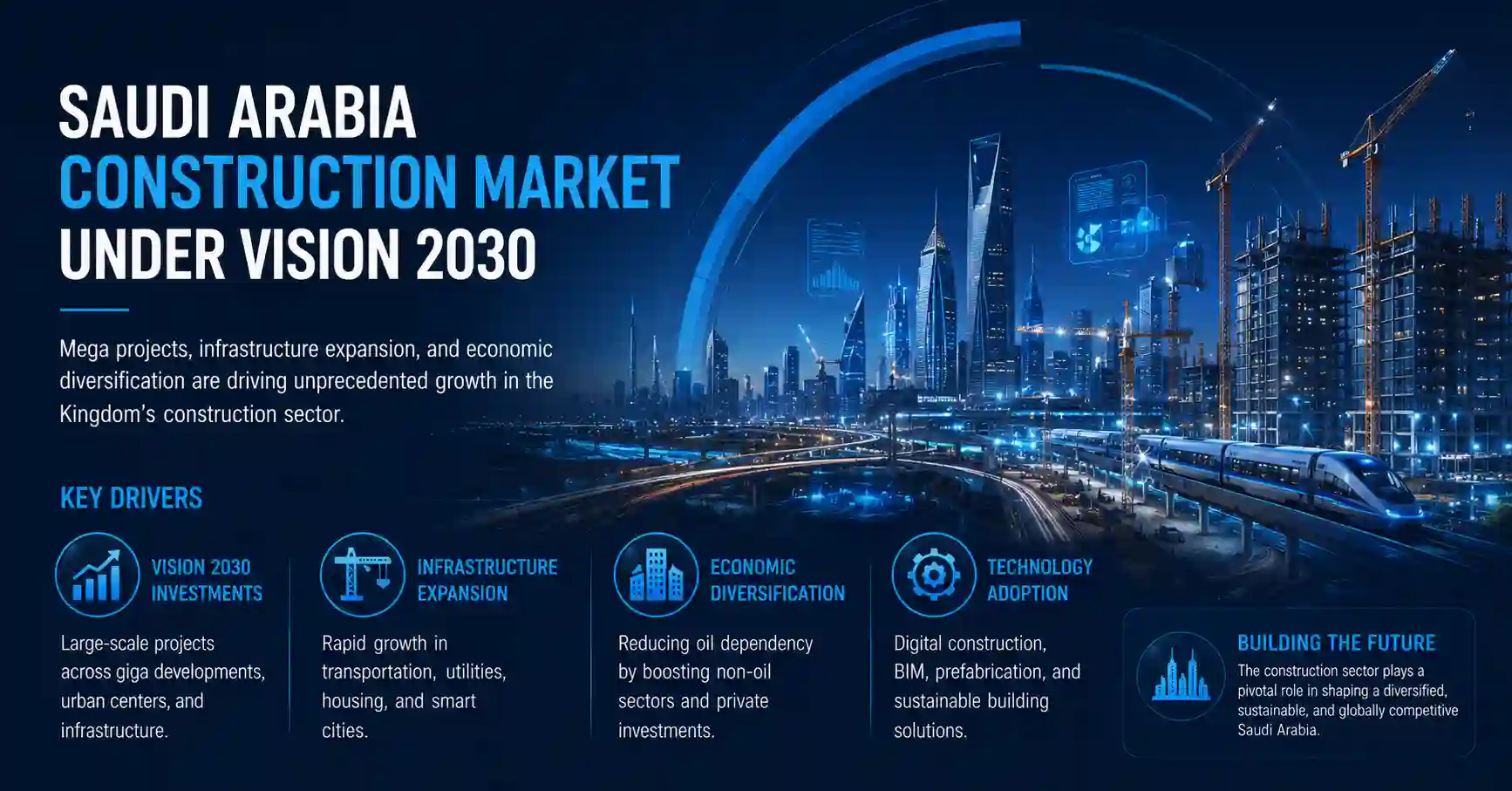
The Saudi government has committed USD 1 Trillion in strategic project investments through 2030, including NEOM (USD 500 Billion), the Red Sea Project (USD 15–16 Billion), and Diriyah Gate (USD 20 Billion). The Public Investment Fund's USD 40 Billion annual deployment capacity provides a structural backstop for this pipeline, financing everything from giga-cities to affordable housing programs.
2. Expansion of Renewable Energy, Green Building, and Smart City Infrastructure
The National Renewable Energy Program's target of 50% renewable electricity by 2030, spanning 130 GW of capacity including the Al-Shuaibah Solar PV Project (2.6 GW) and the NEOM Green Hydrogen Complex, is generating substantial construction demand for green infrastructure. Alongside this, NEOM's THE LINE and SINDALAH developments are pioneering BIM, AI-powered construction management, and IoT-enabled smart infrastructure, supported by the government's Smart Cities Program covering Riyadh, Jeddah, and NEOM.
3. Modular Construction and Digital, AI-Powered Site Management
Modular and off-site construction is gaining traction in the housing sector, with ROSHN and the National Housing Company (NHC) piloting prefabricated residential units across multiple regions to accelerate delivery timelines. AI-powered project management platforms, including Autodesk Construction Cloud and Oracle Primavera, alongside drone-based site surveillance, are reducing manual inspection costs on NEOM and Red Sea Project sites spanning multi-hundred-kilometer footprints.
Geographic Hotspots
The construction in Saudi Arabia is geographically concentrated yet diversifying. The Western Region leads with a 38.6% share, where Jeddah, Makkah, and Madinah form the tripartite hub anchored by the Grand Mosque expansion and Prophet's Mosque development, among the world's largest construction projects by value.
The Eastern Region follows at 24.4% share, driven by oil and industrial infrastructure including Aramco headquarters facilities and SABIC's Jubail expansions. The Northern & Central Region holds 21.8% share and is the market's most strategically significant growth zone for 2026–2034, home to NEOM, Qiddiya, and the Diriyah Gate Authority. The Southern Region, at 15.2% share, is emerging through the Aseer Tourism Program and military infrastructure investment, offering disproportionate growth runway from a smaller base.
Competitive Landscape & Key Players' Strategies
The competitive landscape of the Saudi Arabia construction market is moderately fragmented, mixing global EPC leaders, multinational engineering firms, and established regional contractors. International construction firms are increasingly establishing local partnerships and joint ventures, often through minority stakes in local contractors, to comply with Saudization mandates while securing preferred contractor status, as illustrated by AECOM's 2025 collaboration with SILZ. The top companies are:
- AFRAS: Local contracting specialist (Afras Trading & Contracting Company) focused on residential projects.
- AL Jazirah Engineers & Consultants: Emerging consulting and urban planning firm supporting Saudi giga-project design.
- Al-Latifia Trading and Contracting: Local civil contracting firm supporting regional infrastructure delivery.
- Bechtel Corporation: Operating as Saudi Arabian Bechtel Company (SABCO); leads on EPC and mega-infrastructure, including the Riyadh Metro and King Salman International Airport.
- Fluor Corporation: Operating as Fluor Arabia; four-decade track record in energy and industrial EPC with Saudi Aramco and SABIC.
- Gilbane Inc.: Mid-tier challenger with a strong commercial and institutional construction portfolio.
- Jacobs: Delivers program management consultancy and advisory services across NEOM and PIF portfolio projects.
- Tekfen Construction: Challenger with proven track record in industrial and energy project delivery.
Beneath these top-tier players, Saudi companies are scaling their own building materials, equipment, and contracting services, supported by domestic producers such as Al Rajhi Cement and Arabian Cement Company. This is reinforcing a broader subcontractor and supplier ecosystem: under Saudi contract law, main contractors may delegate work to subcontractors while remaining fully accountable to the employer, a structure that is deepening local capacity across specialized trades as project volumes scale.
Policy & Regulatory Landscape, Challenges & Risks
Saudi Arabia's policy environment continues to actively shape construction execution and sustainability standards. Key regulatory developments include:
- BIM Level 2 Mandate: The Ministry of Municipal, Rural Affairs, and Housing requires BIM Level 2 compliance for major public projects, widely adopted across NEOM, Red Sea Global, and PIF developments.
- Saudization of Engineering and Procurement Roles: Effective June 30, 2026, firms employing five or more accredited engineers must fill 30% of covered engineering roles with Saudi nationals (up from 25%); procurement role quotas rose to 70% effective November 30, 2025.
- Saudi Green Finance Framework (2023): Supports project-level green financing for LEED- and GSAS-certified, net-zero construction through ESG-linked bonds and sustainability-linked loans.
On the constraining side, several structural and regulatory challenges persist.
- High construction costs and inflation risk have elevated steel and cement prices since 2022, compressing project margins and feasibility for smaller developers.
- Skilled labor shortages and Saudization compliance create workforce planning complexity, as mid-tier supervisors and tradespeople remain in short supply despite rising nationalization targets.
- Dependency on oil revenue for capital budgets exposes construction spend to fiscal contraction risk during oil price downturns, as seen in 2020.
- Supply chain bottlenecks and import dependency for specialty materials and finishing products continue to extend project timelines and elevate procurement costs.
.webp)
Forecast 2026–2034
The IMARC Group Saudi Arabia Construction Market Report projects the market to grow from USD 101.4 Billion (2025) to USD 140.4 Billion (2034), at a CAGR of 3.6%, passing through an acceleration phase (2026–2028), a stabilization phase (2029–2031), and a maturity phase (2032–2034), with a 2030 checkpoint of USD 120.8 Billion.
Residential construction is expected to maintain segment leadership, while Energy & Utilities construction records the fastest growth at an estimated 4.2% CAGR as the Kingdom's renewable capacity buildout accelerates. The Northern & Central Region, anchored by NEOM, is expected to see the bulk of its construction spend materialize between 2026 and 2032, while modular construction, AI-powered project management, and autonomous equipment are projected to cut construction delays by 20–30%, supporting margin expansion for leading contractors.
Opportunities for Stakeholders
- Investors & Developers: The Southern Region's Aseer Tourism Program and NEOM's early-stage Northern Region buildout offer disproportionate long-term growth runway.
- Technology Vendors: BIM platforms, AI-powered project management, and modular/prefabrication systems are in acute demand across giga-projects.
- Green and Sustainable Construction Specialists: Smart city and green building mandates under Vision 2030 are creating strong premium-segment opportunities for LEED- and GSAS-certified contractors.
- EPC Firms and Global Contractors: Minority-stake joint ventures with local contractors offer a compliant route to preferred contractor status under Saudization rules.
- Local Suppliers and Subcontractors: Rising local content requirements are expanding opportunities for domestic building materials producers and specialized trade subcontractors.
Saudi Arabia's Construction Market: Where Vision 2030 Meets Concrete Reality
The Saudi Arabia construction market has moved decisively from ambitious blueprint to sustained, multi-decade execution. Set to cross USD 140.4 Billion by 2034, the market's growth reflects giga-project delivery in the Northern & Central Region, Western Region religious tourism infrastructure, and a rapidly localizing supply chain, all converging under the umbrella of Vision 2030.
For enterprises and contractors, the imperative is to build compliant local partnerships and workforce structures ahead of tightening Saudization thresholds. For investors, PIF-backed capital deployment and a diversified giga-project pipeline offer a durable long-term return thesis, tempered by oil-linked fiscal risk. For policymakers, sustaining the balance between rapid giga-project execution and local capacity-building will determine how completely Saudi Arabia's concrete reality catches up with its Vision 2030 ambition.
Our Clients







Contact Us
Have a question or need assistance?
Please complete the form with your inquiry or reach out to us at
Phone Number
+91-120-433-0800+1-201-971-6302
+44-113-547-7077
Previous Post

A WPC (Wood Plastic Composite) door is a type of composite door made from a combination of wood fibers or wood flour and thermoplastic resins like PVC, polyethylene, or polypropylene, with additives to improve durability and processability. The resulting composite material is then extruded or molded into door panels and frames, providing the attractive look of wood and the strength and water-resistance of plastic.
UPVC windows refer to window frames and window assemblies manufactured from ‘unplasticized polyvinyl chloride,’ which is a relatively rigid and strong thermoplastic substance. While PVC is a flexible material that requires the addition of a softening substance called a plasticizer to be formed into a durable performance material, PVC window frames and UPVC window assemblies, for instance, do not display such requirements due to the presence of unplasticizers, a component of the material that provides enhanced strength, stability, and resistance to the elements such as UV radiation, moisture, and temperature changes.
The Saudi Arabia factoring market represents a critical component of the Kingdom's evolving financial services landscape, offering businesses an increasingly popular alternative to traditional bank lending. Factoring, which involves the sale of accounts receivable to a third-party financial institution at a discount, has emerged as a vital mechanism for improving liquidity, managing cash flow, and mitigating credit risk across diverse industry sectors.
The GCC bridge construction market represents a vital component of the region's ambitious infrastructure transformation agenda, serving as a cornerstone for enhanced mobility, economic integration, and sustainable urban development across the Gulf states.
The Australia industrial couplings industry stands at a transformative juncture in 2025, propelled by technological advancement and surging demand across critical sectors. As mechanical devices connecting two shafts to transmit power and torque, industrial couplings form the backbone of machinery operations in manufacturing, mining, automotive, and energy sectors.
The Saudi Arabia real estate market stands at a pivotal juncture in its evolution, representing one of the most dynamic and transformative sectors within the Kingdom's economy. With this country having a very ambitious agenda of economic diversification and modernization, the real estate business has come out as one of the pillars of this transformation.
Steel is an alloy that consists of iron and carbon in addition to trace amounts of other elements like manganese, silicon, chromium, and nickel. The amount of carbon in steel is usually less than two percent and is an important factor in determining the strength, hardness, and ductility of steel.
Saudi Arabia’s precast concrete market reached USD 1.2 Billion in 2024 as per the IMARC Group, clear proof that off-site construction is rapidly becoming the Kingdom’s go-to building solution. With residential, commercial, and major infrastructure projects multiplying, developers are increasingly turning to precast building solutions to keep pace.
The GCC cold storage construction market represents critical infrastructure underpinning regional food security, pharmaceutical distribution, and temperature-sensitive logistics across the Arabian Peninsula. As Gulf Cooperation Council nations diversify their economies and reduce hydrocarbon dependence, robust cold chain infrastructure has emerged as a cornerstone of sustainable development planning.
PVC panels are lightweight, durable building materials made from polyvinyl chloride using extrusion or molding processes. They are available as rigid or semi-rigid sheets designed primarily for wall and ceiling cladding, partitions, and decorative finishes. Known for their excellent resistance to moisture, chemicals, termites, and corrosion, PVC panels offer a smooth surface and a clean, polished look that’s easy to maintain. Available in an extensive range of colors, textures, and patterns, these panels serve as a practical alternative to traditional materials like wood, plaster, or tiles.
Ready mix concrete (RMC) is a precisely engineered construction material produced in a controlled environment within a batching plant and delivered to construction sites in a freshly mixed, plastic state. It is formulated by combining cement, aggregates, water, and chemical or mineral admixtures in carefully proportioned quantities to achieve specific performance characteristics. Unlike site-mixed concrete, RMC ensures consistent quality, uniformity, and superior workability through automated production and quality control processes.
The construction industry across the Gulf Cooperation Council (GCC) member states is at the core of a monumental economic transformation. Far exceeding traditional building activities, the sector now serves as the principal vehicle for national economic diversification strategies, moving these nations beyond reliance on oil revenues.
Paver blocks are precast construction material made basically from cement, aggregates, sand, and pigments for constructing surfacing. They are produced in standardized shape and thickness, allowing each unit to interlock to form a strong, load-bearing surface with no need for continuous concrete pouring. Paver blocks possess high compressive strength, abrasion resistance, and are easy to lay and maintain.
The Brazil ceramic tiles market has witnessed stable growth, reflecting broader trends in the construction and building materials industries of the country. The Brazil ceramic tiles market size was valued at USD 1.6 Billion in 2025. The market is expected to reach USD 2.2 Billion by 2034, exhibiting a CAGR of 3.91% during 2026-2034.
MDF is an engineered wood product produced by breaking down hardwood or softwood residuals into wood fibers, which are then combined with resin binders under heat and pressure. MDF exhibits a homogeneous density, a smooth surface, and fine texture, ensuring a much more workable material compared to natural wood.
Float glass is a type of flat glass that is manufactured by floating molten glass on a bed of molten tin. This produces a smooth, uniform surface and consistent thickness. The float process was developed by Pilkington in the 1950s and revolutionized glassmaking because it enabled the production of large, flawless sheets of glass without needing polishing or grinding. The basic raw materials used-silica sand, soda ash, limestone, and dolomite-are heated in the furnace to a very high temperature, then continuously poured onto the tin bath, where the molten glass spreads out into an even layer. It cools and solidifies into a perfectly flat and perfectly transparent sheet. As it provides optical clarity and strength and is easily processed into coated, laminated, or toughened forms, float glass is used as a basic product for various applications, ranging from architectural and automotive to industrial applications.
ERW steel pipes can be identified as one of the most important categories of welded pipes and find wide applications in infrastructure, construction, and other industries because of their precision, cost-effectiveness, and reliability. The raw material to produce these pipes is either hot-rolled or cold-rolled steel coils that are longitudinally formed and welded by the application of high-frequency electric resistance welding.
Drill bits are specifically designed cutting instruments intended to produce cylindrical holes in various materials, ranging from soft woods and plastics to hardened steels, stone, and rock. Although they seem straightforward, drill bits consist of various specialized shapes, coatings, and materials that are designed to suit the cutting characteristics of the intended material and the requirements of the drilling task.
Concrete is among the most widely used construction materials in the world due to its strength, versatility, and durability. It is a composite material largely made of cement, water, aggregates-sand, gravel, or crushed stone-and in some cases, admixtures which give special properties to the concrete.
Clay bricks are one of the oldest and most extensively used construction materials in the globe, appreciated for their strength, durability, insulation against heat, and beauty. They are produced mainly from natural clay and shale, which are fashioned, dried, and subjected to high-temperature firing to produce a hard, dense material that can resist multiple environmental and structural stresses. The mix generally consists of alumina, silica, lime, iron oxide, and magnesia that collectively decide the color, texture, and performance properties of the brick.
Metal beam crash barriers and high mast light poles are essential infrastructural features providing security and visibility on highways, city roads, and industrial sites. Metal beam crash barriers or guardrails are made of galvanized steel beams, typically W-beam or Thrie-beam, that are designed to dissipate the impact energy on impact with a vehicle and minimize death and damage to vehicles.
Laminated plywood is an engineered wood material that is produced by laminating several layers of thin veneers of wood together with powerful adhesives and covering them with a protective or decorative laminate sheet. This amalgamation not only increases the strength of the plywood but also its beauty, which is why it is extremely versatile for use in furniture, cabinetry, floors, paneling, and interior design.
Ductile iron pipes (DIP) are a key part of new water and wastewater infrastructure, providing enhanced performance capabilities over older piping materials. Cast from ductile cast iron, a material that has the strength of steel combined with the resistance to corrosion of cast iron, these pipes are designed to endure high-pressure use while still being flexible enough to absorb stress without cracking.
The real estate sector plays a critical role in driving economic growth and shaping communities. It significantly contributes to national economies by generating jobs, influencing investment flows, and boosting government revenues through taxes. Beyond these economic benefits, real estate development directly affects the quality of life by creating homes, enhancing infrastructure, and revitalizing urban areas.
Gypsum boards, also referred to as drywall or plasterboard, are lightweight, strong and fireproof building materials that are frequently used for partitions, walls and ceilings. Constructed from a gypsum core encased in paper liners, they provide improved acoustics, cost effectiveness, and speedy installation. Gypsum boards are favoured in industrial, commercial, and residential construction because of its environmentally beneficial qualities, ability to withstand moisture, and ability to insulate against heat. They are an essential part of efficient and sustainable construction methods because of their adaptability to contemporary building processes.
A frameless shower door is a modern and aesthetically appealing bathroom fixture that has gained popularity for its sleek and minimalist design. They are constructed without the bulky metal framing that surrounds the glass panels and are typically made from thick, tempered glass that is securely attached to the wall and floor using hinges or brackets.