Alkaline Battery Plant Setup Cost in India: Manufacturing Process Flow, Machinery, DPR & Financial Model 2026
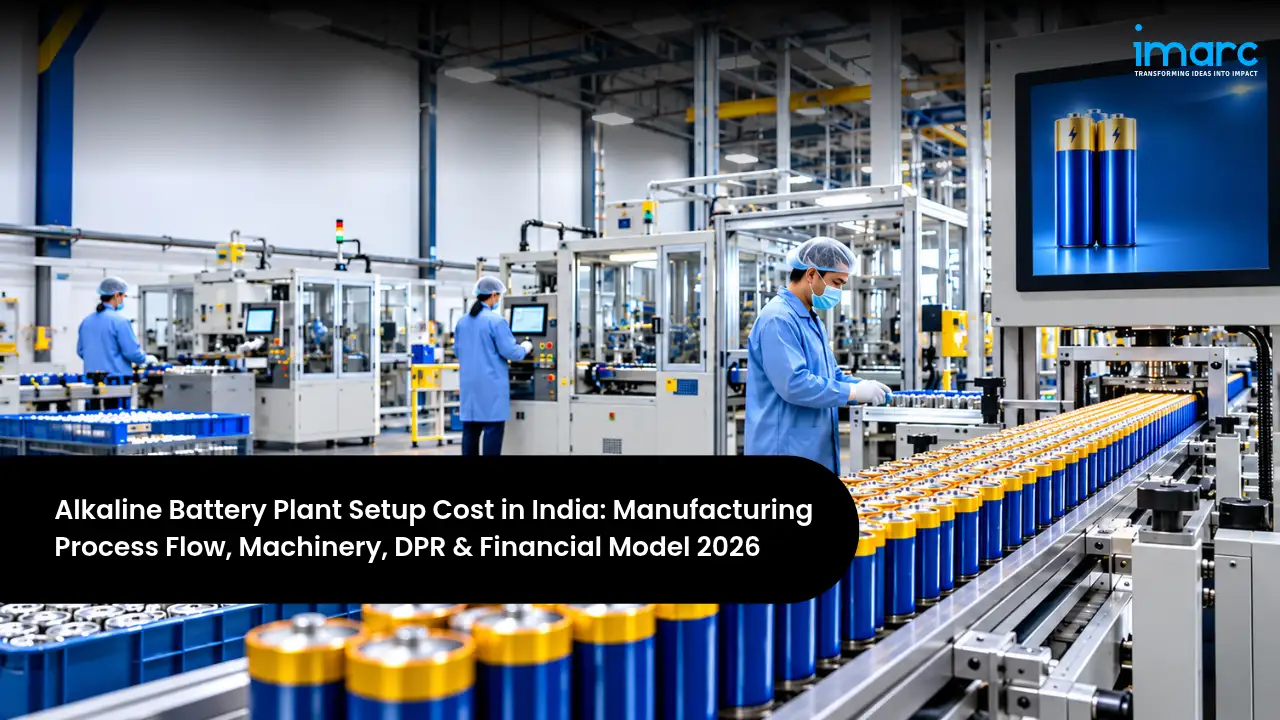
An Alkaline Battery Manufacturing Plant Setup in India addresses a product used in almost every home, office, and clinic, yet until recently made almost entirely abroad. Alkaline batteries, mainly AA and AAA cells, power remote controls, clocks, toys, torches, wireless keyboards and mice, smart home sensors, and medical devices such as thermometers and blood pressure monitors. They use a zinc anode and a manganese dioxide cathode in a potassium hydroxide electrolyte, giving several times the capacity and much longer shelf life than older zinc-carbon cells. India's large dry cell market has long been dominated by zinc-carbon batteries, but rising incomes and device use are shifting demand towards alkaline cells, and the first large domestic plant began production in 2026.
The overall Alkaline Battery Manufacturing Plant Cost depends mainly on capacity, the number and speed of assembly lines, the level of automation in cathode and anode preparation, testing and packing equipment, and the product range. A plant producing 300 million to 500 million cells a year typically needs INR 150 crore to INR 250 crore, in line with the roughly INR 200 crore invested in India's first large alkaline plant with 456 million cells of installed capacity, while a single-line plant of 100 million to 150 million cells a year can start at around INR 60 crore to INR 100 crore. Raw materials make up 55 to 65% of operating cost, and IMARC Group benchmarks point to gross margins of 28 to 38% and net margins of 10 to 18%.
This guide is written for battery and electrical companies, consumer goods brands, contract manufacturers, and investors exploring how to start an Alkaline Battery manufacturing plant in India. It explains product types and markets, demand drivers, the cathode, anode, and cell assembly process, machinery and raw materials, site and infrastructure planning, a detailed cost and returns breakdown, the approvals involved, and how a DPR pulls these elements into a bankable plan.
India Market Snapshot
| Key Facts | Details |
|---|---|
| India Alkaline Battery Market | USD 260.21 Million (2025) |
| India Market Outlook | USD 355.36 Million by 2034, 3.5% CAGR |
| Consumer Electronics Share | 55.4% of demand (2025) |
| Largest Domestic Plant | 456 Million cells installed capacity (2026) |
| Indicative Total Investment | INR 150–250 Crore (300–500 Million cells/yr) |
| Typical Payback Period | 4–6 Years |
The snapshot shows a steadily growing Indian alkaline battery market, led by consumer electronics. Recently almost all alkaline cells were imported, therefore domestic production offers import substitution as well as growth. The investment range reflects the gap between a single high-speed line and a multi-line plant with in-house cathode and anode preparation, testing, and automated packing.
Investment Highlights
Indicative Project Cost in India (2026)
| Parameter | Value |
|---|---|
| Product Range | AA (LR6) and AAA (LR03) cells, C and D cells, 9V batteries, private-label and branded packs |
| Total Project Investment | INR 150 – 250 Crore (300–500 Million cells/yr) |
| Payback Period | 4 – 6 Years |
| Net Profit Margin | 10 – 18% |
| IRR | 15 – 20% |
| Best Locations | Jammu & Kashmir, Uttar Pradesh, Uttarakhand, Tamil Nadu, Gujarat, West Bengal |
| Mandatory Approvals | SPCB Consents, Battery EPR Registration, BIS Compliance, Legal Metrology, Factory License, GST |
| Key Requirement | Reliable supply of EMD and zinc powder, high-speed line efficiency, and strong distribution or brand partners |
These figures offer a practical frame for early evaluation. Returns depend on securing battery-grade electrolytic manganese dioxide and zinc powder at competitive prices, running high-speed lines with low reject rates, maintaining consistent capacity and leak resistance, and selling through strong distribution networks or contract supply to established brands. A capacity- and product-specific Alkaline Battery Feasibility Report refines these numbers before capital is committed.
Table of Contents
- What is Alkaline Battery Manufacturing?
- Why is Alkaline Battery Manufacturing Growing in India?
- Alkaline Battery Manufacturing Process Flow
- Raw Materials Required for Alkaline Battery Manufacturing
- Location, Land & Infrastructure
- Alkaline Battery Manufacturing Machinery and Equipment
- Alkaline Battery Manufacturing Plant Setup Cost in India (CapEx & OpEx)
- Financial Analysis and Profitability
- Licenses and Approvals for Alkaline Battery Manufacturing in India
- Recent Developments in the India Alkaline Battery Manufacturing Industry
- How Alkaline Battery Manufacturing Project Report and DPR Helps Investors
- Frequently Asked Questions
What is Alkaline Battery Manufacturing?
An alkaline battery is a sealed cylindrical cell built inside a nickel-plated steel can. A cathode made of electrolytic manganese dioxide (EMD) mixed with graphite is pressed against the inside of the can, a separator lines the cathode, and the centre is filled with an anode gel of zinc powder in potassium hydroxide electrolyte. A brass current collector, plastic seal, and negative end cap close the cell, which is then crimped, aged, tested, labelled, and packed. An Alkaline Battery Manufacturing Plant therefore combines powder handling and mixing, cathode pellet forming, high-speed cell assembly, electrolyte and gel dispensing, sealing, ageing, electrical testing, labelling, and packaging.
Commercially, alkaline batteries are sold under national and international brands through grocery and general stores, modern retail, and e-commerce, and supplied in bulk or private label to retailers, device makers, and institutions. Buyers look for long-lasting performance, leak resistance, shelf life, reliable quality, attractive packaging, and competitive pricing against both imported alkaline cells and cheaper zinc-carbon batteries.
- AA Cells: The highest-volume size, used in remotes, toys, clocks, and many household devices.
- AAA Cells: Smaller cells for remotes, wireless peripherals, and medical devices.
- C, D and 9V Batteries: Larger cells for torches and radios, and 9V for smoke detectors and instruments.
- Premium and High-Drain Cells: Enhanced cells for cameras, gaming controllers, and smart devices.
Main Product Types in Alkaline Battery Production
The product mix shapes line configuration, materials, and margins:
| Product Type | Description | Key Feature | Primary Demand |
|---|---|---|---|
| AA (LR6) | Standard cylindrical cell | Largest volume | Households, retail |
| AAA (LR03) | Smaller cylindrical cell | High growth with remotes and wireless devices | Consumer electronics, medical |
| C and D Cells | Larger cells | Higher capacity | Torches, radios |
| 9V Batteries | Stacked cells in a rectangular case | Specialty applications | Smoke detectors, instruments |
| Premium High-Drain | Improved formulations | Better performance, higher price | Cameras, gaming, smart devices |
Most new plants start with AA and AAA cells, which account for the bulk of demand and share similar equipment, then add premium formulations and, if volumes justify, larger sizes. Because high-speed lines are designed for specific sizes, the initial size mix should be matched closely to expected demand and customer commitments.
Why is Alkaline Battery Manufacturing Growing in India?
Key Growth Drivers in the Indian Market
Demand for alkaline batteries in India is driven by device growth, premiumisation, and import substitution. IMARC Group values the Indian alkaline battery market at USD 260.21 million in 2025 and expects it to reach USD 355.36 million by 2034:
- More battery-powered devices: Remote controls, wireless peripherals, smart home sensors, toys, and personal care devices keep demand growing.
- Shift from zinc-carbon: Consumers are moving to alkaline cells for longer life and better leak resistance.
- Healthcare devices: Thermometers, blood pressure monitors, and pulse oximeters rely on dependable alkaline cells.
- Retail and e-commerce expansion: Modern retail and online channels are expanding access in tier-2 and tier-3 cities.
- Import substitution: Local production reduces dependence on imports and supports supply chain resilience.
India-Specific Market Opportunity
| Segment | India Market Context | Manufacturing Role |
|---|---|---|
| Household Retail | Very large dry cell market | Branded AA and AAA packs |
| Consumer Electronics | Largest application segment | High-quality cells |
| Medical Devices | Growing home healthcare | Reliable, leak-resistant cells |
| Private Label & OEM | Retailers and device makers | Contract manufacturing |
| Institutional & Defence | Torches, instruments, backup | Larger cells and bulk supply |
The strongest position for an Alkaline Battery Manufacturing Plant in India combines efficient, high-quality production with access to wide distribution, either through an established brand or contract supply to brand owners and retailers. Because the market is brand-led and price-sensitive, manufacturers that pair cost-competitive production with strong channel partnerships are best placed to grow.
Alkaline Battery Manufacturing Process Flow
Understanding the Alkaline Battery Manufacturing Process helps promoters plan lines, layout, quality systems, and staffing. Cell performance and safety depend on raw material quality, accurate cathode composition and density, precise electrolyte and anode dosing, clean separator placement, and tight sealing to prevent leakage. The flow below reflects a typical high-speed AA and AAA plant.
Step-by-Step Alkaline Battery Manufacturing Process Flow
EMD, graphite, and binders are mixed with a small amount of electrolyte, granulated, and pressed into cathode rings that are inserted into nickel-plated steel cans. A separator is inserted, potassium hydroxide electrolyte is added, and a gel of zinc powder, electrolyte, gelling agent, and inhibitors is dispensed into the centre. A current collector and seal assembly is fitted and the can is crimped closed. Cells are washed, aged, tested for voltage and leakage, labelled, and packed.
| Unit Operation | Key Activity |
|---|---|
| Raw Material Testing | Check EMD, zinc powder, graphite, KOH, cans |
| Cathode Mixing & Granulation | Mix EMD, graphite, binder, electrolyte |
| Cathode Forming & Insertion | Press rings and insert into cans |
| Separator Insertion | Place separator tube and bottom cup |
| Electrolyte Filling | Dose potassium hydroxide solution |
| Anode Gel Dispensing | Fill zinc gel into the centre |
| Collector & Seal Assembly | Fit brass collector, seal, and end cap |
| Crimp Sealing & Washing | Close and clean cells |
| Ageing & Electrical Testing | Voltage, impedance, and leak checks |
| Labelling & Packing | Shrink labels, date codes, retail packs |
Two factors decide profitability. The first is material efficiency: EMD and zinc are the largest costs, so precise formulation, accurate dosing, and low scrap directly improve margins and allow the plant to meet capacity specifications without overusing materials. The second is line speed and quality: modern lines run at hundreds of cells per minute, so uptime, fast changeovers, low reject rates, and zero tolerance for leakers decide unit cost and protect brand reputation.
Raw Materials Required for Alkaline Battery Manufacturing
The main inputs are electrolytic manganese dioxide, zinc alloy powder, nickel-plated steel cans, graphite, potassium hydroxide, separators, seals and collectors, and labels and packaging. EMD and zinc powder are the largest cost items.
| Raw Material | Role in Process | India Sourcing | % of OpEx |
|---|---|---|---|
| Electrolytic Manganese Dioxide | Cathode active material | Largely imported, limited domestic supply | 18–22% |
| Zinc Alloy Powder | Anode active material | Domestic zinc, battery-grade powder often imported | 14–18% |
| Nickel-Plated Steel Cans | Cell casing and positive terminal | Domestic and imported can makers | 6–9% |
| Graphite | Cathode conductivity | Imports and domestic suppliers | 3–5% |
| Potassium Hydroxide | Electrolyte | Domestic chemical producers | 2–3% |
| Separators, Seals & Collectors | Internal components | Imported and domestic suppliers | 3–4% |
| Labels & Packaging | Shrink sleeves, blister cards, cartons | Domestic suppliers | 4–6% |
Battery-grade EMD and zinc powder must meet tight purity and particle size specifications, and much of the supply is imported, so prices move with global manganese and zinc markets and the rupee. Long-term supply contracts, qualification of multiple suppliers, and gradual localisation of cans, separators, labels, and packaging improve cost and resilience. Modern alkaline batteries are mercury-free, and formulations must comply with restrictions on hazardous substances.
Location, Land & Infrastructure
Location shapes access to markets, materials, skilled labour, and incentives. The best location for Alkaline Battery manufacturing plant setup combines strong state or regional industrial incentives, good road and port connectivity for imported materials, a reliable power supply, a trainable workforce, and proximity to the large northern and western consumer markets.
Best Location for Alkaline Battery Manufacturing Plant Setup in India
| State | Why It Works | Key Advantage |
|---|---|---|
| Jammu & Kashmir | Industrial incentive scheme, Samba industrial area | Fiscal incentives, northern market |
| Uttar Pradesh | Largest consumer market, Noida and Lucknow | Demand and workforce |
| Uttarakhand | Haridwar industrial cluster | Incentives and northern access |
| Tamil Nadu | Chennai battery and electronics base | Port access and suppliers |
| Gujarat | Industrial infrastructure and ports | Chemical supply and logistics |
| West Bengal | Kolkata industrial region | Eastern market access |
North India accounts for the largest share of alkaline battery demand, and Jammu & Kashmir, Uttar Pradesh, and Uttarakhand combine proximity to that market with industrial incentives, as shown by India's first large alkaline plant in Samba. Tamil Nadu and Gujarat offer port access for imported EMD and zinc powder along with strong industrial infrastructure, and West Bengal serves the eastern market. Choosing a site with good logistics for both imported inputs and finished goods distribution is essential.
Quality, Safety and Environmental Requirements
Customers expect batteries that meet IEC and Indian standards for dimensions, capacity, shelf life, and safety, with very low leakage rates, supported by quality systems such as ISO 9001. Primary batteries are also being brought under BIS quality control. Inside the plant, zinc and manganese dust must be controlled, potassium hydroxide must be handled with protective equipment because it is highly corrosive, and wastewater and rejected cells must be managed under environmental and battery waste rules.
Infrastructure Requirements (300–500 Million Cells/Year Plant)
| Infrastructure Element | Specification | India-Specific Note |
|---|---|---|
| Total Land Area | 5 – 10 acres | Production, warehouses, utilities |
| Production Building | 1 – 2 lakh sq ft | Material preparation, assembly, packing |
| Power Requirement | 2 – 4 MW | High-speed lines, compressors, HVAC |
| Material Preparation Area | Dust-controlled mixing and pelletising | Extraction systems |
| Ageing & Testing Area | Storage racks and automated testers | Space for ageing stock |
| Effluent Treatment | ETP for alkaline wash water | SPCB consent conditions |
| Warehouse | Raw materials and finished goods | Humidity-controlled storage |
Infrastructure for an alkaline battery plant centres on dust-controlled material preparation, long high-speed assembly lines, ageing and testing space, automated labelling and packing, reliable power and compressed air, effluent treatment, and large warehouses. Planning space for additional lines and new sizes from the outset supports future growth.
Alkaline Battery Manufacturing Machinery and Equipment
High-speed alkaline battery lines are supplied mainly by specialist manufacturers in China, Japan, Europe, and the United States, with support equipment available in India. The main equipment is summarised below.
| Equipment | Function | Key Specification |
|---|---|---|
| Powder Mixers & Granulators | Prepare cathode mix | Controlled moisture and density |
| Cathode Ring Presses | Form and insert cathode rings | High-speed, accurate density |
| Separator Inserters | Place separator and bottom cup | Automated forming |
| Electrolyte Dosing Systems | Fill KOH | Precise volumetric dosing |
| Anode Gel Mixers & Dispensers | Prepare and fill zinc gel | Accurate weight control |
| Seal & Collector Assembly Machines | Prepare closure parts | Automated assembly |
| Crimping & Sealing Machines | Close cells | Leak-proof crimping |
| Washing & Drying Units | Clean cells | Alkali removal |
| Ageing Racks & Testers | Test voltage and impedance | Automated reject sorting |
| Labelling & Packing Machines | Shrink labels and packs | Blister and card packing |
Equipment selection should follow capacity and size mix. Integrated high-speed lines combine cathode insertion, separator placement, filling, and sealing, and their speed and reliability largely determine plant economics. Investing in automated inspection, testing, and packing improves quality and reduces labour costs, while dust extraction protects workers and product quality.
Alkaline Battery Manufacturing Plant Setup Cost in India (CapEx & OpEx)
The tables below summarise the capital and operating cost structure of an alkaline battery facility in India. The final Alkaline Battery Investment Cost for a specific project depends on capacity, number of lines, size mix, automation, testing and packing equipment, land costs, and working capital needs.
Capital Expenditure (CapEx) Cost Structure
| CapEx Component | % of Total CapEx | What It Covers |
|---|---|---|
| Plant & Machinery | 55–65% | Material preparation, assembly, testing, packing lines |
| Land & Buildings | 15–20% | Land, factory, warehouses |
| Utilities & Environmental Systems | 6–8% | Power, compressed air, dust collection, ETP |
| Quality Laboratory & R&D | 2–4% | Testing equipment, formulation development |
| Pre-operative & Contingency | 3–5% | DPR, approvals, line trials |
| Working Capital | 10–15% | EMD, zinc, packaging, finished goods, receivables |
Machinery forms the largest share of investment because high-speed assembly lines are specialised and imported. Working capital needs are meaningful because EMD and zinc powder are imported in bulk and distributors expect credit. An Alkaline Battery Business Plan models these components so that capacity, product mix, and financing rest on realistic numbers.
Operating Expenditure (OpEx) Cost Structure
| OpEx Component | % of Total OpEx | India-Specific Note |
|---|---|---|
| Raw Materials & Packaging | 55–65% | EMD and zinc powder dominate |
| Utilities | 10–14% | Power for lines, compressors, HVAC |
| Labour & Manpower | 5–8% | Line operators, technicians, QC |
| Marketing & Distribution | 8–12% | Brand building, trade margins, freight |
| Maintenance | 2–3% | Tooling and line spares |
| Overheads & Compliance | 2–3% | EPR, testing, administration |
With materials making up most of operating cost, profitability depends on EMD and zinc prices, formulation efficiency, line speed, and reject rates. A sound financial model should test margins against metal price swings, the rupee, competition from imports and zinc-carbon cells, retail pricing, and capacity utilisation.
Financial Analysis and Profitability
Alkaline battery manufacturing can deliver solid returns for plants that combine efficient production with strong distribution. The profitability of Alkaline Battery manufacturing business in India improves with high line utilisation, low material waste and rejects, a mix that includes premium cells, long-term brand or retail partnerships, and import substitution advantages.
| Financial Metric | Indicative Value | India Context |
|---|---|---|
| Gross Profit Margin | 28–38% | Higher for branded and premium cells |
| Net Profit Margin | 10–18% | After depreciation and Indian corporate taxes |
| Payback Period | 4–6 Years | High-speed lines are capital-intensive |
| IRR (Internal Rate of Return) | 15–20% | Sensitive to utilisation and metal prices |
| Capacity Utilization (stable ops) | 65–85% | Linked to distribution reach |
| Break-even Capacity Utilization | 45–60% | High fixed costs of automated lines |
Distribution and utilisation are the decisive factors. High-speed lines need large, steady volumes, so plants without an established brand or long-term contract partners risk running far below capacity. Contract manufacturers supplying brand owners typically earn lower margins than the benchmark but enjoy more stable volumes, while branded players carry higher marketing costs in exchange for better prices.
Returns can be strengthened by locating in incentive-rich regions near major markets, signing supply contracts with established brands or retailers, securing long-term EMD and zinc contracts, localising cans, separators, and packaging, investing in efficient high-speed lines, and developing premium and high-drain products.
Key Risks and Mitigation
The main risks are competition from imported alkaline cells and low-priced zinc-carbon batteries, metal price volatility, dependence on imported EMD, zinc powder, and machinery, the gradual shift to rechargeable batteries in some devices, counterfeit products, and battery waste compliance. Competition is managed through quality, cost efficiency, and channel strength; price risk through supply contracts and pricing reviews; supply risk through multiple qualified suppliers; technology risk through premium and specialty products; and compliance risk through robust EPR systems.
Licenses and Approvals for Alkaline Battery Manufacturing in India
An alkaline battery plant requires environmental, product, and industrial approvals. Promoters typically need the following before commencing operations:
- Pollution Control Consents: Consent to Establish and Consent to Operate from the State Pollution Control Board, covering dust, alkaline effluent, and wastes.
- Battery EPR Registration: Registration as a producer under the Battery Waste Management Rules, 2022, with extended producer responsibility for collection and recycling targets.
- BIS Compliance: Conformity with Indian Standards for primary batteries, and BIS certification once quality control requirements for primary batteries are notified and in force.
- Legal Metrology: Registration for packaged commodities and compliant labelling of retail packs.
- Factory License and Fire NOC: Factory registration, building plan approval, and fire safety approval.
- Hazardous Chemical Safety: Safe storage and handling of potassium hydroxide and metal powders.
- Business, Tax and Labour Registrations: Company incorporation, GST, Udyam, trade mark, an Import Export Code for materials and machinery, and EPF and ESI registrations.
Pollution consents, EPR registration, and readiness for BIS certification usually sit on the critical path, while trade mark registration and retail packaging approvals should be completed before launch. Engaging an Alkaline Battery Manufacturing Consultant in India can help promoters select line technology and capacity, secure materials, plan approvals and incentives, and set up quality systems.
Note: The exact approvals, registrations, licenses, and certification requirements may vary depending on factors such as plant location, product range, capacity, target customers, and applicable regulations. Businesses are advised to undertake a detailed regulatory assessment during the project planning stage to ensure full compliance and timely implementation.
Recent Developments in the India Alkaline Battery Manufacturing Industry
Several recent developments are shaping alkaline battery manufacturing in India:
- First large domestic plant: In April 2026, Eveready Industries commissioned an alkaline battery plant at Samba in Jammu & Kashmir with an investment of about INR 200 crore, an installed capacity of 456 million cells a year, and peak output of about 360 million cells, described as India's only operating alkaline battery plant.
- Premium product launches: In May 2026, Indo National Limited launched Nippo THOR Max, a premium alkaline battery aimed at high-drain devices, reflecting growing competition in the premium segment.
- Quality control for primary batteries: In July 2025, a Primary Batteries (Quality Control) Order was issued in draft form proposing mandatory BIS certification for primary batteries under IS 6303 (Part 5), with longer timelines for small and micro enterprises, signalling tighter quality requirements for both domestic and imported cells.
Together these point to the start of domestic alkaline production, rising competition in premium cells, and stricter quality regulation. For new entrants, success depends on efficient high-speed production, secure materials, strong distribution, and readiness for BIS certification and battery waste compliance.
How Alkaline Battery Manufacturing Project Report and DPR Helps Investors
A detailed Alkaline Battery Project Report gives investors a structured roadmap covering market demand by size and channel, product strategy, raw material sourcing, process design, machinery, plant layout, utilities, quality systems, regulatory pathway, incentives, and economics. It helps promoters choose the right capacity and size mix, estimate capital expenditure (CapEx) and operating expenditure (OpEx), assess profitability, and identify risks before implementation.
At the core of the DPR is an Alkaline Battery Financial Model covering size-wise volumes and prices, material consumption and costs, line speeds and yields, labour, marketing and distribution, EPR costs, working capital, cash flow projections, break-even, return on investment (ROI), and payback. Because margins depend on metal prices and utilisation, lenders expect sensitivity analysis, which is why many promoters engage an Alkaline Battery Plant Project Report Consultant in India to prepare bank-ready documents.
For an alkaline battery project specifically, a strong DPR also answers the questions that matter most: which brands or channels will absorb the output, which sizes to make first, how to secure EMD and zinc powder, which state incentives apply, and how returns hold up if metal prices rise or imports undercut prices. An experienced Alkaline Battery Manufacturing Feasibility Study Consultant tests these scenarios so that the final plan is one lenders and partners can back with confidence.
Frequently Asked Questions
How do I set up an alkaline battery manufacturing factory in India?
Start by securing distribution or contract customers and defining the size mix, then commission a feasibility study and DPR. Select a site with incentives and good logistics, install material preparation, high-speed assembly, testing, and packing lines, secure EMD and zinc supplies, obtain pollution, EPR, factory, and Legal Metrology approvals, and prepare for BIS certification before launch.
What is the alkaline battery manufacturing plant setup cost in India?
A plant producing 300 million to 500 million cells a year typically needs INR 150 crore to INR 250 crore, while a single-line plant of 100 million to 150 million cells a year can start at around INR 60 crore to INR 100 crore, depending on automation and size range.
How are alkaline batteries made?
A cathode of manganese dioxide and graphite is pressed into a steel can, a separator is inserted, potassium hydroxide electrolyte and a zinc gel anode are added, and the cell is closed with a collector and seal. Cells are crimped, washed, aged, tested, labelled, and packed.
What machinery is needed for an alkaline battery manufacturing plant?
Key equipment includes powder mixers and granulators, cathode ring presses, separator inserters, electrolyte dosing systems, anode gel mixers and dispensers, seal and collector assembly machines, crimping machines, washing units, ageing racks and testers, and labelling and packing machines.
What raw materials are used in alkaline batteries?
The main inputs are electrolytic manganese dioxide, zinc alloy powder, nickel-plated steel cans, graphite, potassium hydroxide, separators, seals and brass collectors, and labels and packaging.
Is alkaline battery manufacturing profitable in India?
A well-run plant can earn a 10 to 18% net margin and an IRR of around 15 to 20%, with payback in 4 to 6 years. Profitability depends on utilisation, metal prices, line efficiency, and distribution strength.
What licenses are needed for an alkaline battery manufacturing unit in India?
A unit typically needs State Pollution Control Board consents, battery EPR registration, compliance with BIS standards and certification as notified, Legal Metrology registration, a Factory License, a Fire NOC, hazardous chemical safety compliance, and GST, Udyam, and labour registrations.
Which state is best for an alkaline battery manufacturing plant?
Jammu & Kashmir, Uttar Pradesh, Uttarakhand, Tamil Nadu, Gujarat, and West Bengal are strong options. The best site combines incentives, good logistics for imported materials, and proximity to large consumer markets.
How do I get a feasibility study or DPR for an alkaline battery manufacturing plant?
A professionally prepared DPR covers market assessment, product strategy, sourcing, technical design, approvals, costs, and financial projections for bank appraisal. Many promoters work with anBusiness Plan Consultant in India to prepare it and align it with lender requirements.
Our Clients









Contact Us
Have a question or need assistance?
Please complete the form with your inquiry or reach out to us at
Phone Number
+91-120-433-0800+1-201-971-6302
+44-113-547-7077
Previous Post

An LED Light Manufacturing Plant Setup in India taps into one of the largest and most mature consumer electrical markets in the country.
An LED Chip Manufacturing Plant Setup in India addresses one of the biggest gaps in the country's lighting and display supply chain. India assembles hundreds of millions of LED bulbs, battens, panels, and displays every year, yet almost all LED chips, the tiny semiconductor dies that actually emit light, are imported, mainly from China, Taiwan, and South Korea.
A Smartphone Manufacturing Plant Setup in India places an investor inside one of the country's biggest industrial success stories of the past decade.
A Smart Watch Manufacturing Plant Setup in India serves one of the world's largest wearables markets. Indian consumers buy tens of millions of smartwatches every year, and domestic brands have shifted much of their production from imports to local contract manufacturers.
The India Semiconductor Market has moved past the stage of ambition documents and into the stage of concrete assets, approved sites and dated delivery milestones. The India Semiconductor Market size reached USD 59.78 Billion in 2025, expanded to USD 73.00 Billion in 2026, and is projected to reach USD 180.20 Billion by 2034, growing at a CAGR of 11.95% over the 2026-2034 forecast period.
A genset combines an engine, usually diesel or gas, with an alternator that converts its motion into electricity, mounted on a steel base frame with a fuel tank, exhaust and emission after-treatment, a control panel, and in most cases a soundproof acoustic enclosure.
Setting up a Power Cable Manufacturing Plant in India puts an investor directly in the path of one of the country's largest infrastructure build-outs.
Servos are precision electric motors fitted with a position sensor, called an encoder, and paired with an electronic drive that controls speed, torque, and position very accurately.
PVC-insulated wires and cables are made by drawing copper or aluminium rod into fine conductors, annealing and stranding them, and covering them with coloured PVC insulation and, for multi-core cables, an outer PVC sheath and sometimes steel armour.
Portable chargers are compact battery packs made from lithium-ion or lithium-polymer cells, a charging and protection circuit board, ports or wireless coils, and a plastic or metal casing.
Small electric cooking and food preparation products, such as mixer grinders, induction cooktops, electric kettles, air fryers, hand blenders, and sandwich makers, are made by moulding plastic bodies, forming steel and aluminium parts, winding motors or fitting heating elements, assembling control boards, and wiring and testing each unit for safety.
Aluminum-air batteries generate electricity by reacting aluminum plates with oxygen from the air in a water-based electrolyte. Aluminum has a very high theoretical energy density, and instead of being recharged from a socket, spent plates are swapped for fresh ones while the aluminum hydroxide produced is recycled into new aluminum.
LED bulbs use light-emitting diodes mounted on a metal-core circuit board, powered by a small electronic driver and housed in a plastic and aluminium body with a diffuser and a standard B22 or E27 cap.
Inverters convert direct current from batteries or solar panels into the alternating current used by homes, shops, and factories.
Electrical control panels are steel enclosures that house circuit breakers, contactors, relays, busbars, meters, drives, and controllers to distribute power and control motors, machines, and processes safely.
Microchips, or integrated circuits and semiconductor devices, are the building blocks of phones, computers, vehicles, appliances, power systems, telecom networks, and defence equipment.
Resistors are the most widely used electronic components, found by the dozens or hundreds in almost every circuit board, from phones, laptops, and televisions to vehicles, appliances, telecom equipment, power electronics, medical devices, and defence systems.
Rare earth magnets, mainly neodymium-iron-boron (NdFeB) and samarium-cobalt, are the strongest permanent magnets made, and they sit at the heart of electric vehicle motors, wind turbine generators, electronics, industrial automation, medical devices, and defence systems. India imported over 53,000 tonnes of rare earth permanent magnets in 2024-25 and has almost no domestic production, while demand is expected to double by 2030.
Wires and cables carry power and signals through every home, office, factory, railway, data centre, and solar park, and India's market has grown to about USD 10 billion as construction, power transmission, renewable energy, and industrial investment have expanded.
Heat exchangers are among the most widely used pieces of engineering equipment in the world. Refineries, petrochemical and fertiliser plants, power stations, pharmaceutical and food factories, HVAC systems, and data centers all depend on them to heat, cool, condense, and recover energy from process streams.
India's trucks and buses rarely rest. They carry freight across highway corridors, move goods from ports and factories, and ferry millions of passengers every day, often under heavy loads and tough road conditions.
Silicon wafers are the thin, precisely sliced discs and squares on which solar cells and computer chips are built. India has rapidly become a major assembler of solar modules and is now building cell capacity, but almost all of the wafers those cells need are still imported.
Every video call, UPI payment, and 5G connection in India ultimately travels over glass. Fiber optic cables carry the country's data between cities, into mobile towers and data centres, and increasingly right into homes through fiber-to-the-home connections.
Setting up an Air Conditioner Manufacturing Plant in India is an assembly-driven, high-volume consumer durable venture, powered by rising household incomes, extreme summers, rapid urbanisation, and one of the lowest room air-conditioning penetration rates among large economies.
Setting up a High Voltage Cable Manufacturing Plant in India is a capital-intensive, high-value venture, powered by the country's massive power-transmission expansion, renewable-energy build-out, and the shift toward underground cabling in cities.
Setting up a Copper Cable Manufacturing Plant in India is a high-demand, infrastructure-driven venture, powered by the country's construction boom, rapid electrification, and steady industrial and appliance demand.
Setting up a Junction Box Manufacturing Plant in India is a high-demand, infrastructure-driven venture, powered by the country's construction boom, rapid electrification, and expanding solar and industrial sectors.
Setting up an Electric Cable Manufacturing Plant in India is a high-demand, infrastructure-linked venture, powered by the country's rapid growth in power, construction, renewable energy, and electrification. Cables and wires are essential to every building, factory, grid, and vehicle, giving an Electric Cable Manufacturing Plant a large and steadily growing market.
Setting up a Semiconductor Fabrication Manufacturing Plant in India is a highly capital-intensive but strategically transformative venture, driven by the country's semiconductor mission, deep policy incentives, and a vast import-substitution opportunity. Semiconductors are the foundation of every modern electronic and digital product, yet India currently imports almost all of its chip requirement.
Setting up a PCB Manufacturing Plant in India is a capital-intensive but strategically timed venture, driven by the country's electronics manufacturing push, strong policy incentives, and a large import-substitution opportunity. Printed circuit boards are the backbone of every electronic product, yet India still imports the overwhelming majority of its PCB requirement.
The Indian PCB (Printed Circuit Board) Market is emerging as the physical backbone of the country's electronics manufacturing ambitions. The market reached USD 7.27 Billion in 2025 and is projected to reach USD 25.48 Billion by 2034, growing at a CAGR of 14.96% (2026–2034), a total addressable market expansion driven by the Production Linked Incentive (PLI) scheme, 5G infrastructure rollout, and rising domestic consumer electronics demand.
Setting up an E-waste Recycling Plant in India is a capital-intensive but high-potential venture, driven by the country's soaring volume of discarded electronics, tightening Extended Producer Responsibility regulations, and the rising value of recovered metals. India is now among the world's largest generators of electronic waste, yet only a small share is processed through formal, compliant channels, leaving a large, policy-backed opportunity for organized recyclers who can capture volumes shifting from the informal sector.
Global semiconductor demand across automotive, data centers, and defense, highlighting market segmentation, key applications, regional dynamics, and industry shifts.
The hearables market represents one of the most dynamic segments within consumer electronics and wearable technology. These intelligent audio devices have evolved beyond simple wireless earbuds into multifunctional platforms combining premium audio with health monitoring, artificial intelligence, and seamless digital connectivity.
A smart washing machine is a sophisticated home appliance that incorporates advanced digital features such as connectivity, sensor technology, and automated controls for improved efficiency, convenience, and user control. In contrast to traditional washing machines, smart washing machines come pre-installed with advanced features such as Wi-Fi connectivity, smart load detection, smart detergent dispensing, and voice-control capability.
A smartphone is a portable electronic device that combines sophisticated capabilities in computer processing, wireless communication, multimedia entertainment, and internet access. Smartphones are distinct from other mobile phones in that their operation involves highly sophisticated platforms of operation that are capable of supporting multiple applications, multitasking, and connectivity with internet platforms.
Semiconductor manufacturing is a highly specialized industrial process that involves the design, fabrication, and assembly of semiconductor devices including integrated circuits (ICs), memory chips, sensors, and discrete components. The process transforms raw semiconductor materials, primarily silicon, into sophisticated electronic components through a combination of physical and chemical processing steps, such as wafer fabrication, photolithography, doping, etching, thin-film deposition, and packaging.
The retail landscape is experiencing a profound transformation as self-checkout systems emerge as critical infrastructure components reshaping consumer experiences and operational efficiency globally. These automated solutions enable customers to independently scan, bag, and pay for purchases without cashier assistance, representing a fundamental shift in modern commerce.
The webcams market is experiencing unprecedented transformation as digital communication becomes the cornerstone of modern business, education, and healthcare. Global webcam industry dynamics are being reshaped by technological innovation and evolving workplace models.
As smartphones become a way of life for most Filipinos, the market has changed dramatically and expectations from consumers are higher than ever before. With the demand for smartphones growing, there is a significant change in consumer shopping habits with more emphasis on using online platforms for shopping. This change is closely interlinked with the fast growth of the Philippines e-commerce market, both bringing opportunities and challenges to the stakeholders of the smartphone industry.
As technology continues to advance, lighting has transformed from a basic necessity into a strategic enabler of innovation, efficiency, and sustainability. The evolution from incandescent bulbs to LEDs, smart systems, and intelligent lighting networks represents not just technological change but a redefinition of how energy, design, and functionality intersect in the built environment.
An LED light is an illuminating device that utilizes Light Emitting Diodes as its source of light, generating light through a semiconductor-based process called electroluminescence. When electrical current flows across the semiconductor material of the diode, electrons emit energy as photons and thus produce highly efficient and concentrated illumination.
An LED bulb is a solid-state lighting device that uses Light Emitting Diodes (LEDs) as its illumination source. Different from incandescent or fluorescent lamps, light in LED bulbs is produced by electroluminescence, a process where the passing of an electric current through a semiconductor material emits photons directly. This process is highly energy-efficient, with a far larger percentage of the electricity being converted to usable light and very little heat generated in the process.
The junction box, generally made from plastic, metal, or composite materials, houses wire connections, terminations, and protective components to allow the safe distribution and routing of electrical circuits. The junction box will provide insulation, mechanical protection, and a secure environment to avoid accidental contact with live electrical parts, moisture intrusion, or dust accumulation.
The Japan power electronics market is poised to grow substantially, driven by rising demand in automotive, energy, industrial automation, and infrastructure sectors. According to IMARC Group, the Japan power electronics market is studied from 2019 to 2024 with projections extending to 2033.
Japan's printed circuit board (PCB) industry is the world leader in technology innovation, enabling consumer electronics, automotive, and next-generation communication system development. As a key enabler of modern electronic products, PCBs provide the essential building blocks for embedding semiconductors, sensors, and microchips into miniaturized, high-performance devices. Japan, through its world-class manufacturing base and engineering expertise, remains the hub of the global PCB supply chain.
Aluminum-Air (Al-Air) battery is a new energy storage technology that has attracted interest as a future alternative to conventional lithium-ion batteries, specifically for electric vehicle (EV) use. As opposed to normal rechargeable batteries, the Al-Air battery is a metal-air electrochemical cell with aluminum as the anode, oxygen from the ambient air as the cathode reactant, and a liquid electrolyte (commonly sodium hydroxide or potassium hydroxide) as the medium through which the reaction occurs.
Aluminium wire is an essential industrial commodity commonly employed in power transmission, electrical distribution, building construction, and manufacturing processes owing to its high conductivity-to-weight ratio, resistance to corrosion, and cost advantage over copper. Produced by methods including continuous casting, rolling, and drawing, aluminum wire is available in various grades and alloys to serve the wide demands, from overhead transmission conductors and building wiring to automotive harnesses and electronic applications.
Air conditioners are electromechanical devices used to control indoor climate by extracting heat and humidity and ensuring optimum air circulation. Generally consisting of a compressor, condenser, evaporator, refrigerant fluid, filters, fans, and electronic controls, air conditioners work based on the principle of heat exchange, moving heat from indoor areas to the external environment. Contemporary units come in diverse configurations, such as split systems, window units, central air systems, and portable models, supporting respective residential, commercial, and industrial applications. Some of the major characteristics are efficiency in cooling, energy use, noise rating, and environmental footprint in relation to refrigerant type.
E-waste, or electronic waste, is electrical and electronic equipment that has been discarded, such as computers, cell phones, television sets, servers, and household appliances. It is among the world's fastest-growing streams of waste, consisting of a heterogeneous combination of metals, plastics, glass, and toxic substances. E-waste contains valuable metals like copper, aluminum, gold, silver, palladium, and rare earth elements, in addition to toxic materials like lead, mercury, cadmium, and brominated flame retardants.
Polished silicon wafers are very pure, ultra-flat semiconductor substrates that are produced from high-quality single-crystal silicon. The wafers act as the material base for making integrated circuits, power devices, and MEMS (Microelectromechanical Systems). The wafers are made of monocrystalline silicon ingots using the Czochralski or Float-Zone process, from which the wafers are cut, lapped, etched, and polished to atomic-scale flatness and defect-free surfaces.
AI is revolutionizing Japan’s semiconductor industry by boosting innovation and efficiency across the entire value chain. Advanced artificial intelligence (AI)-powered Electronic Design Automation (EDA) tools significantly shorten chip design cycles, improving performance and energy efficiency.
Recent projections indicate that Australia semiconductor market, including services, is growing at a steady compound annual growth rate as the nation deepens its tech infrastructure. The importance of semiconductors spans electronics, defense systems, telecommunications, and emerging AI applications, which position the local ecosystem as strategically vital for growth.
Fiber optic cables are high-tech communications cables that carry information like bursts of light along extremely thin glass or plastic strands, providing high-speed, high-bandwidth connectivity with little loss of signal. Fiber optic cables make up the foundation of contemporary telecommunications, carrying internet, cloud computing, 5G networks, and smart infrastructure.
CAT (Category) cables are twisted-pair Ethernet cables utilized for copper-based wired network communications, varying from CAT5e to CAT8 standards. The cables carry data through copper conductors, but with different speeds (up to 40 Gbps for CAT8) and bandwidths, supporting networks such as LANs, data centers, and smart buildings.
India's semiconductor industry is undergoing a revolutionary phase driven by rising demand from industries like consumer electronics, automotive technologies, industrial automation, and telecom infrastructure.
USB data cables are critical elements of contemporary digital connectivity, enabling high-speed and consistent data transfer and power supply for a broad scope of electronic products. They provide the foundation for charging and synchronizing smartphones, tablets, laptops, and other peripherals, with significant applications in consumer electronics, industrial automation, and new technologies. With technologies like USB-C, the cables today carry faster data speeds, more power output, and universal compatibility, making them essential in a world that is connected.
Thin-film-transistor (TFT) liquid-crystal display (LCD) is a type of display technology used in many electronic devices, such as smartphones, tablets, laptops, and televisions (TVs). A backlight, colour filters, a thin-film transistor array, and a liquid crystal layer are among the layers that make up this flat-panel display. TFT LCDs are made to produce sharp images with superb viewing angles, strong contrast, and accurate colour reproduction. They are made up of thousands of tiny transistors that regulate how much light enters each pixel. This makes it possible for the display to generate crisp, detailed images at rapid refresh rates. TFT LCD technology's low power consumption is one of its main benefits, which makes it perfect for battery-operated gadgets.
Polycrystalline solar photovoltaic (PV) modules are a key component of solar energy systems, harnessing sunlight and converting it into electricity through the photovoltaic effect. These modules are composed of multiple interconnected solar cells, each made from polycrystalline silicon. Polycrystalline solar panels are renowned for their efficiency, affordability, and versatility, making them a popular choice for various applications such as solar installations, commercial and industrial projects, off-grid systems and solar farms.
The LED chip is the core component of an LED bulb, comprising semiconductor layers that enable the free flow of protons and electrons. Employed in all LED lighting fixtures—from bulbs to tubes—the LED chip fundamentally determines light quality, with variations in brightness, voltage, and wavelength. These chips are manufactured through a process called MOCVD (metal-organic chemical vapor deposition), which creates the semiconductor layers that facilitate electric flow. Major applications of these chips include backlighting, illumination, automotive lighting, signs, and signals.
Semiconductors are crucial components in the modern electronics industry, used in electronic equipment and devices to manage and control the flow of electricity. They are found in consumer items like smartphones, wearables, smart TVs, and advanced equipment used in industrial applications, defense, and aerospace. Semiconductors are further divided into four broad categories: optoelectronics, discrete components, integrated circuits, and sensors. Memory devices, logic devices, analog ICs, MPUs, discrete power devices, MCUs, and sensors are some of the major components of semiconductors.