PVC Panel Plant Setup Cost in India: Manufacturing Process Flow, Machinery, DPR & Financial Model 2026
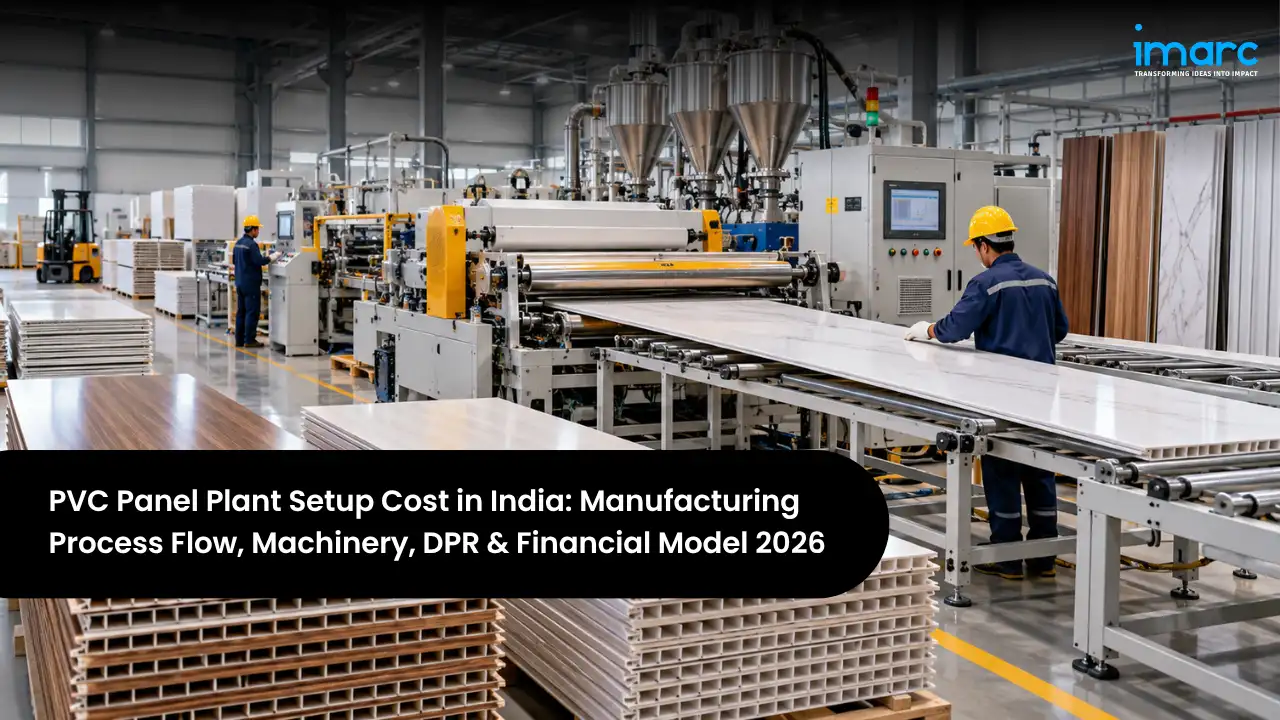
Setting up a PVC Panel Manufacturing Plant in India is a high-demand, construction-driven venture, powered by the country's building boom, fast-growing interior and renovation market, and the shift away from plywood and plaster toward affordable, waterproof panels. PVC panels are extruded wall and ceiling boards used for interior cladding, and demand rises with every home, office, shop, and institution fitted out. With abundant PVC resin and filler supply, simple and proven extrusion technology, and strong replacement demand, a PVC Panel Manufacturing Plant is one of the more accessible and quick-payback opportunities in the building-materials economy.
The PVC Panel Manufacturing Plant Cost depends on capacity, panel types, and level of automation, with total project investment typically ranging from INR 2 crore to INR 20 crore. PVC resin and mineral fillers are the largest operating inputs, so material sourcing and extrusion efficiency are the most important financial decisions in the project, and together they shape the overall PVC Panel Investment Cost. At healthy capacity utilisation, a well-run unit in India delivers a net profit margin of 8 to 15% and an IRR of 20 to 30%, with payback typically achieved within 3 to 4 years.
This guide is written for investors and entrepreneurs asking how to start an PVC Panel manufacturing plant in India. It covers what the business involves, why demand is rising, the process flow, the machinery and raw materials required, location and infrastructure planning, a detailed cost and financial breakdown, the licenses you must secure, and how a project report and DPR turns all of this into a bankable plan.
India Market Snapshot
| Key Facts | Details |
|---|---|
| India Building Materials Market | Large, multi-billion dollar (indicative) |
| Primary Products | PVC wall and ceiling panels |
| Projected Market CAGR (2026–2034) | 10–14% (indicative) |
| Typical Plant Capacity | Few hundred to thousands of panels/day |
| Indicative Total Investment | INR 2–20 Crore |
| Typical Payback Period | 3–4 Years |
The snapshot captures why a PVC Panel Manufacturing Plant in India attracts strong investor interest: an essential, affordable interior product, broad and growing demand across construction and renovation, and a simple, well-established technology. The wide investment range reflects a genuine choice of capacity and product mix, from a compact single-line unit to a larger plant producing decorative, foam, and WPC panels. Because panels are a fast-moving, repeat-purchase building material with strong replacement demand, the market is resilient, which is part of why lenders view the sector favourably. The rest of this guide unpacks that decision in detail.
Investment Highlights
Indicative Project Cost in India (2026)
| Parameter | Value |
|---|---|
| Plant Capacity (Typical) | Few hundred to thousands/day |
| Total Project Investment | INR 2 – 20 Crore |
| Payback Period | 3 – 4 Years |
| Net Profit Margin | 8 – 15% |
| IRR | 20 – 30% |
| Best Locations | Gujarat, Delhi-NCR, Maharashtra, Uttar Pradesh, Rajasthan |
| Mandatory Approvals | Factory License, GST, BIS, Fire NOC, EPF/ESI |
| Primary Revenue | PVC wall and ceiling panels |
These indicative parameters give a realistic frame for early feasibility work. The returns are attractive, but they depend on securing competitively priced resin and fillers, running an efficient extrusion line, and building steady buyers among dealers, interior contractors, and builders. A well-prepared PVC Panel Feasibility Report tightens each of these numbers to your specific location, capacity, and product range.
Table of Contents
- What is PVC Panel Manufacturing?
- Why is PVC Panel Manufacturing Growing in India?
- PVC Panel Manufacturing Process
- Raw Materials and India Sourcing
- Location, Land & Infrastructure
- Machinery and Equipment Required
- PVC Panel Manufacturing Plant Setup Cost in India (CapEx & OpEx)
- Financial Analysis and Profitability
- Licenses and Approvals for PVC Panel Manufacturing Plant in India
- Recent Developments in the India PVC Panel Manufacturing Industry
- How a PVC Panel Manufacturing Project Report and DPR Helps Investors
- Frequently Asked Questions
What is PVC Panel Manufacturing?
PVC panel manufacturing is the production of extruded polyvinyl-chloride boards used for interior wall and ceiling cladding. The process blends PVC resin with fillers, stabilizers, and additives, then extrudes the mix through a die into hollow or solid panels that are cut, finished, and, for decorative grades, laminated or printed. The output is used across homes, offices, shops, and institutions as an affordable, waterproof, and easy-to-install alternative to plywood, plaster, and tiles.
From a business perspective, what makes this sector attractive in India is the combination of low entry cost, simple technology, and strong replacement demand. Every builder, interior contractor, dealer, and renovator is a potential buyer, and abundant resin and filler supply supports production. A manufacturer that runs an efficient line and offers attractive designs is positioned to serve a large, essential, and fast-growing market driven by construction, affordable interiors, and the steady shift to panel-based cladding.
- Plain Wall Panels: Standard hollow PVC wall panels for economical interior cladding, a high-volume category.
- Decorative & Laminated Panels: Printed, marble-finish, or laminated panels that command better prices.
- Ceiling Panels: Lightweight panels for false ceilings and covings.
- Foam Boards & WPC Panels: PVC foam boards and wood-plastic composite panels for premium and structural uses.
The Main Segments in PVC Panel Manufacturing
Understanding which segment your unit will serve is the foundational decision, because it drives formulation, machinery, and value:
| Segment | Typical Product | Key Property | Primary Demand |
|---|---|---|---|
| Plain Panels | Hollow wall panels | Low cost, high volume | Economy interiors |
| Decorative | Printed / laminated | Better margin | Homes and offices |
| Ceiling | Ceiling boards | Lightweight | False ceilings |
| Foam / WPC | Foam and WPC boards | Premium, structural | Furniture and cladding |
This choice shapes the entire unit, because plain panels are a high-volume commodity while decorative, foam, and WPC panels command better margins but need lamination, printing, or specialized formulation. Many Indian entrants begin with plain and laminated wall panels, the largest and most accessible segment, and add foam boards and WPC panels as they build capability and buyers. The segment decision drives everything from machinery to the level of investment required.
Why is PVC Panel Manufacturing Growing in India?
Key Growth Drivers in the Indian Market
India's panel sector is being propelled by several structural factors that combine a construction boom with a shift toward affordable, durable interiors. Few products ride as many favourable trends at once:
- Construction and housing boom: Rapid residential and commercial construction drives constant demand for interior cladding.
- Shift from plywood and plaster: Waterproof, termite-proof, low-cost panels are steadily replacing traditional materials.
- Renovation and interiors market: A large and growing renovation and fit-out market sustains strong replacement demand.
- Affordability and easy installation: Low cost and quick, low-skill installation make panels attractive across price segments.
- Design and premiumization: Growing demand for decorative, marble-finish, and WPC panels adds higher-value opportunity.
India-Specific Market Opportunity
| Segment | India Market Context | Panel Role |
|---|---|---|
| Residential | Booming housing | Walls and ceilings |
| Commercial | Offices and retail | Interior cladding |
| Renovation | Large fit-out market | Replacement demand |
| Institutional | Schools and hospitals | Durable interiors |
| Premium Interiors | Design-led demand | Decorative and WPC |
The strongest opportunity lies in supplying dealers, interior contractors, and builders with consistent, competitively priced, attractive panels, ideally near both resin supply and construction demand. A manufacturer that runs efficiently and offers good designs can lock in steady, repeat orders. Moving into decorative, foam, and WPC panels, where margins are better and competition thinner, further strengthens a unit's position in a large, growing market.
PVC Panel Manufacturing Process
Understanding how a panel is actually made helps you plan equipment, material handling, and the main cost drivers. Production is a continuous extrusion operation that turns a resin-and-filler blend into a formed, cooled, finished, and cut panel, with quality control throughout. The typical flow moves the compound through mixing and extrusion to finishing, cutting, and packing:
The PVC Panel Manufacturing Process
In this flow, PVC resin, fillers, and additives are dry-blended in a high-speed mixer, extruded through a panel die, calibrated and cooled to shape, then laminated or printed for decorative grades, cut to length, and packed. Consistent compounding and stable extrusion are essential to panels that are flat, strong, and dimensionally accurate at a competitive cost.
| Unit Operation | Key Activity |
|---|---|
| Material Intake | Resin, fillers, additives received and checked |
| Mixing | Dry-blended in high-speed mixer |
| Extrusion | Compound extruded through the die |
| Calibration | Panel sized and shaped |
| Cooling | Panel cooled to set shape |
| Lamination / Printing | Decorative finish applied |
| Haul-off | Panel drawn at controlled speed |
| Cutting | Cut to length |
| Inspection | Checked for finish and dimensions |
| Packing & Dispatch | Bundled, packed, and dispatched |
Two points determine profitability across this flow. First, the formulation and compounding, especially the resin-to-filler ratio, drive both quality and material cost, so recipe control directly governs outcomes. Second, stable extrusion with low scrap is a decisive margin lever, because a continuous line must run smoothly to be economical. Consistent inspection, for flatness, thickness, and finish, is what allows a manufacturer to supply reliable panels and win repeat orders. Because dealers and contractors want panels that install cleanly and look good, consistent quality and finish matter as much to them as headline price.
Raw Materials and India Sourcing
The main inputs are PVC resin and mineral fillers, supported by stabilizers, additives, and, for decorative grades, laminating film, and securing them at competitive prices and consistent quality is the single biggest determinant of a unit's viability. Because resin and fillers dominate cost and resin price varies with petrochemical cycles, procurement strategy and a reliable supplier network materially affect margin, alongside the additives and consumables the process needs.
| Raw Material | Role in Process | India Sourcing | % of OpEx |
|---|---|---|---|
| PVC Resin | Primary polymer | Domestic and imports | 40–50% |
| Calcium Carbonate | Mineral filler | Domestic suppliers | 10–15% |
| Stabilizers & Additives | Processing and stability | Domestic suppliers | 8–12% |
| Laminating Film / Inks | Decorative finish | Domestic and imports | 5–10% |
| Utilities & Consumables | Power and packing | Grid and suppliers | 5–10% |
Because resin and fillers are such a large share of cost, sourcing and formulation are the biggest levers on profitability. India has a growing domestic PVC base supplemented by imports, so resin is available, but its price can swing with petrochemical cycles, making reliable supplier relationships and sensible inventory important. Optimising the filler ratio and additive package, within quality limits, is a key way to control cost, since fillers are far cheaper than resin. Additives, film, and consumables are smaller but important to quality and appearance, and a good formulation is what balances cost against a strong, attractive panel.
Location, Land & Infrastructure
Choosing the best location for PVC Panel manufacturing plant setup significantly affects resin access, power reliability, and proximity to construction demand. Being near resin and filler supply, building-materials markets, and reliable power shapes site selection, alongside adequate covered space for extrusion lines, material storage, and finished-panel handling.
Best States for PVC Panel Manufacturing Plant Setup in India
| State | Why It Works | Key Advantage |
|---|---|---|
| Gujarat | Plastics and resin base | Material and logistics |
| Delhi-NCR | Large building market | Dealers and demand |
| Maharashtra | Construction and industry | Demand and access |
| Uttar Pradesh | Big housing market | Demand and labour |
| Rajasthan | Growing construction | Land and demand |
| Tamil Nadu | Industrial and building base | Demand and ecosystem |
The strongest locations combine reliable resin and filler supply and power with proximity to building-materials markets and construction demand. Gujarat offers a strong plastics ecosystem, while Delhi-NCR, Maharashtra, Uttar Pradesh, and Rajasthan add large building markets and distribution reach. Because extrusion depends on continuous power and panels are bulky, power reliability, covered production and storage space, and good road access should weigh heavily in the final choice, alongside room to add lines as demand grows.
Infrastructure Requirements (Mid-Sized Plant)
| Infrastructure Element | Specification | India-Specific Note |
|---|---|---|
| Total Shed Area | 1,000 – 6,000 sq. meters | Covered production space |
| Extrusion Line Area | Line layout with haul-off | Length for the line |
| Mixing Section | High-speed mixer area | For compounding |
| Lamination Area | Finishing zone | For decorative panels |
| Material Storage | Covered storage | For resin and fillers |
| Power & Cooling | Reliable power and water | For extrusion and cooling |
| Finished-Goods Store | Panel storage | For bulky finished panels |
Infrastructure for a panel unit centres on the extrusion line, a mixing section, and, for decorative grades, a lamination area, because output, quality, and finish depend on all of them. Reliable power and cooling water are important given that extrusion runs continuously, and a proper store keeps resin, fillers, and finished panels organized. Planning the shed with room to add extrusion lines later makes future expansion far cheaper than reconfiguring a cramped layout, so scalable design pays off early.
Machinery and Equipment Required
The equipment set centres on the extrusion line, with finishing equipment for decorative grades, and the line-up scales with capacity and product range. Because quality and productivity depend on stable, well-controlled extrusion, machinery must be robust and well matched to the product. The core machinery, from compounding through finished-panel cutting, is summarized below.
| Equipment | Function | Key Specification |
|---|---|---|
| High-Speed Mixer | Blend the compound | Heater-cooler unit |
| Twin-Screw Extruder | Extrude the panel | Sized to output |
| Panel Die / Mould | Shape the panel | Product-specific die |
| Calibration Table | Size and set shape | Vacuum calibration |
| Cooling System | Cool the panel | Water cooling |
| Haul-Off Unit | Draw the panel | Speed control |
| Cutting Machine | Cut to length | Automatic cutter |
| Lamination Machine | Apply decorative film | For decorative grades |
| Printing Unit | Print designs | For printed panels |
| Scrap Grinder | Reprocess scrap | For material recovery |
Equipment selection should follow your product range and capacity rather than the other way around. A plain-panel unit centres on the mixer, extruder, die, and cutting, while decorative and foam grades need lamination, printing, or foaming capability and better process control. Die quality and extruder stability are easy to under-plan yet decisive, because they determine panel quality, output speed, and scrap, and therefore the cost per panel and the ability to meet volumes and finishes.
PVC Panel Manufacturing Plant Setup Cost in India (CapEx & OpEx)
The tables below give you a breakdown of both the upfront capital investment and the ongoing operating costs, based on industry analysis of a mid-sized facility in India. The actual PVC Panel Manufacturing Plant Cost for your specific project will depend on your chosen location, capacity, product range, and level of automation.
Capital Expenditure (CapEx) Cost Structure
| CapEx Component | % of Total CapEx | What It Covers |
|---|---|---|
| Extrusion Line & Dies | 35–45% | Extruder, dies, and calibration |
| Mixing & Finishing | 10–15% | Mixer and lamination |
| Shed & Civil Works | 12–18% | Production shed and interiors |
| Utilities & Power | 6–10% | Power, cooling, and air |
| Pre-operative & Misc. Costs | 4–7% | Engineering fees, DPR, and approvals |
| Contingency Reserve | 5–8% | Standard buffer for cost variability |
| Working Capital | 15–22% | Resin stock, WIP, and receivables |
The CapEx profile is dominated by the extrusion line and dies, with finishing equipment added for decorative grades. Working capital is unusually important because resin and fillers must be bought and stocked ahead of production and sales, and dealer credit ties up cash. Under-provisioning working capital or die quality is a common and costly mistake, so both are modelled carefully in the PVC Panel Business Plan and Financial Model.
Operating Expenditure (OpEx) Cost Structure
| OpEx Component | % of Total OpEx | India-Specific Note |
|---|---|---|
| PVC Resin & Fillers | 55–65% | Largest cost; resin price varies |
| Additives & Film | 8–12% | Stabilizers and laminating film |
| Power & Utilities | 8–12% | Extrusion is energy-using |
| Labour & Manpower | 6–10% | Line operators and helpers |
| Maintenance & Consumables | 3–6% | Machine and die upkeep |
| Logistics & Overheads | 3–6% | Freight and factory costs |
With resin and fillers dominating operating cost, this is fundamentally a materials-and-conversion business, and margin depends on cheap material, an optimised formulation, and efficient, low-scrap extrusion. Resin prices move with petrochemical cycles, so a financial model should track them closely and stress-test margins against resin-cost swings, which are the biggest variable, while accounting for the steady demand that construction and renovation provide. Getting the filler ratio and line efficiency right is what separates a comfortable margin from a thin one on plain panels, with decorative grades lifting the blended margin.
Financial Analysis and Profitability
Based on analysis of a mid-sized panel facility in India, the financial profile is attractive and quick-paying, supported by essential, growing demand and simple technology. Because material and conversion costs drive economics, profitability improves markedly with efficient sourcing, an optimised formulation, high line utilisation, and a move toward decorative and higher-value products.
| Financial Metric | Indicative Value | India Context |
|---|---|---|
| Gross Profit Margin | 18–28% | Driven by material cost and product mix |
| Net Profit Margin | 8–15% | After depreciation and Indian corporate taxes |
| Payback Period | 3–4 Years | Faster with high utilisation |
| IRR (Internal Rate of Return) | 20–30% | Higher for decorative and WPC panels |
| Capacity Utilization (stable ops) | 70–90% | Continuous line favours high run rates |
| Break-even Capacity Utilization | 50–65% | Steady building demand supports throughput |
Material cost, formulation, and line utilisation are the factors that most determine outcomes, because an extrusion line must run at good utilisation to spread its fixed costs given thin margins on plain panels. An operator with reliable resin supply, a well-tuned recipe, and steady dealer demand can run comfortably above break-even, while one exposed to resin-price swings or low utilisation will see margins squeezed. This is why sourcing and formulation are as central to the financial model as the machinery itself.
There are several ways to strengthen returns in the Indian context: securing competitively priced resin and fillers, optimising the formulation to balance cost and quality, moving into decorative, foam, and WPC panels, keeping the line well utilised, and controlling scrap through recycling. Reliable dealer and contractor relationships further stabilize order flow and pricing. Offering attractive designs and consistent quality also helps a unit build a strong dealer network, which smooths out the demand swings that hurt smaller, order-to-order producers and supports steady growth.
Key Risks and Mitigation
The principal risks are resin price volatility, thin margins on plain panels, and competition. Material risk is mitigated by diversified suppliers, formulation optimisation, and inventory planning; margin risk is mitigated by scrap control, efficiency, and a shift to decorative and premium grades; and competition risk is mitigated by design, quality, and a strong dealer network. A manufacturer that treats sourcing, formulation, and branding as core priorities is far better placed to sustain healthy returns.
Licenses and Approvals for PVC Panel Manufacturing Plant in India
The approvals for this business are straightforward but important, because a panel unit is a factory operation using plastics and machinery. Manufacturers planning to establish a PVC Panel Manufacturing Plant generally need to obtain the following before commencing operations, and factory and product-standard compliance are especially central:
- Factory License: Factory establishment and operation approval under the Occupational Safety, Health and Working Conditions Code, 2020.
- Business & Tax Registration: Company or firm incorporation, GST registration, and Udyam (MSME) registration.
- BIS / Product Standards: Compliance with relevant Indian Standards for PVC panels, valued by quality-conscious buyers.
- Pollution Control Consent: Consent from the State Pollution Control Board for the manufacturing process.
- Fire Safety NOC: Fire safety compliance for the factory premises.
- Import-Export Code (IEC): IEC for units importing resin or exporting panels.
- Labour Registrations: EPF, ESI, and other workforce-welfare registrations required for factory employment.
For a panel unit, the factory license, pollution-control consent, and fire compliance are the critical items and should be pursued early, in parallel with shed setup, because a plant with machinery cannot operate without them. Product-standard compliance and IEC for importers or exporters should be arranged early too, since these support market access. Engaging a consultant familiar with factory and product regulations is usually worth the cost, since delays can idle a ready line. Sequencing approvals well, alongside material and dealer development, can shave weeks off the project timeline.
Note: The exact approvals, registrations, licenses, and compliance requirements may vary depending on factors such as plant location, capacity, product type, and applicable regulations. Businesses are advised to undertake a detailed regulatory assessment during the project planning stage to ensure full compliance and timely implementation.
Recent Developments in the India PVC Panel Manufacturing Industry
A few structural trends give useful context for investors considering entry into this industry:
- Construction and interiors growth: Sustained housing, commercial, and renovation activity continues to drive strong panel demand.
- Premiumization and design: Rising demand for decorative, marble-finish, and WPC panels is shifting the mix toward higher value.
- Sustainability and recycling: Use of recycled content and reduced wastage is growing with cost and environmental focus.
The common thread is a market growing with construction and interiors, with design, quality, and premiumization increasingly important. For a new entrant, the implication is clear: the window to establish an efficient line and build a dealer network is open, and those who build sourcing discipline, formulation, and design into their model from the start will be best placed as demand grows through the decade.
How a PVC Panel Manufacturing Project Report and DPR Helps Investors
A comprehensive PVC Panel Project Report, prepared as a Detailed Project Report (DPR), provides a structured roadmap for establishing the facility by evaluating every aspect of the venture, from market demand and product mix to machinery selection, plant layout, and economics. It helps investors determine the optimal capacity and product range, estimate capital expenditure (CapEx) and operating expenditure (OpEx), assess profitability, and identify potential risks before implementation.
The report also brings together a PVC Panel Business Plan with revenue forecasts, production costs, cash flow analysis, break-even assessment, return on investment (ROI), and payback period calculations, supported by a detailed PVC Panel Financial Model. These insights enable investors, lenders, and stakeholders to make informed decisions and evaluate the long-term viability of the project. Many investors engage a PVC Panel Business Plan Consultant in India or a PVC Panel Manufacturing Consultant in India to prepare and validate these documents.
For a panel project specifically, a strong DPR also clarifies the material and formulation strategy, the product and design focus, and the target dealer segments, which are the factors most likely to determine success in this volume-driven business. By modelling utilisation against realistic demand and testing margins against resin-cost swings, the report turns a competitive but essential-product opportunity into an executable plan that lenders and partners can trust. It also maps the phased scale-up, from an initial line to full capacity, so investors can see how the unit grows and when each tranche of funding is needed.
Frequently Asked Questions
How to start an PVC panel manufacturing plant in India?
Begin by choosing your product mix and capacity, then prepare a feasibility report and DPR, secure a shed near resin supply and demand, arrange an extrusion line with mixing and, if needed, lamination, tie up resin and filler suppliers and dealers, and obtain factory, pollution, and fire approvals. A detailed project report maps each step for your target setup.
What is the PVC panel manufacturing plant cost in India?
It typically ranges from INR 2 crore to INR 20 crore depending on capacity, product mix, and automation, and the wider PVC Panel Investment Cost is driven by the extrusion line, dies, and working capital. Machinery and resin stock are the largest components.
What is the PVC panel manufacturing process?
The process runs from material intake and high-speed mixing, through extrusion, calibration, and cooling, to lamination or printing for decorative grades, cutting, inspection, and packing, with quality checks on flatness, thickness, and finish throughout.
What machinery is required for a PVC panel plant?
Key equipment includes a high-speed mixer, a twin-screw extruder with panel die, a calibration table, cooling and haul-off units, a cutting machine, and lamination or printing units for decorative panels, along with a scrap grinder for material recovery.
What is the best location for PVC panel manufacturing plant setup?
The ideal site combines reliable resin and filler supply and power with proximity to building-materials markets and construction demand. Gujarat, Delhi-NCR, Maharashtra, Uttar Pradesh, and Rajasthan are leading choices.
Is PVC panel manufacturing profitable in India?
Yes, it is typically attractive, with an 8 to 15% net profit margin, a 20 to 30% IRR, and a 3 to 4 year payback at healthy utilization. Returns improve with efficient sourcing, an optimised formulation, decorative and WPC panels, and high line utilisation, though margins track resin prices.
How do I get a project report or feasibility report for a PVC panel plant?
A PVC Panel Project Report and PVC Panel Feasibility Report cover the full plant setup and financials. Many investors engage a PVC Panel Plant Project Report Consultant in India or a PVC Panel Manufacturing Feasibility Study Consultant to prepare and validate them.
Our Clients










Contact Us
Have a question or need assistance?
Please complete the form with your inquiry or reach out to us at
Phone Number
+91-120-433-0800+1-201-971-6302
+44-113-547-7077
Previous Post

Setting up an Electric Motor Manufacturing Plant in India is a high-value, engineering-driven venture, powered by the country's industrial expansion, energy-efficiency push, and the rise of electric vehicles and automation.
Setting up an Iron Ore Pellets Manufacturing Plant in India is a capital-intensive, high-demand venture, powered by the country's ambitious steel-capacity expansion, the shift toward value-added iron ore, and rising demand from blast furnaces and sponge iron units.
The Saudi Arabia construction market has emerged as one of the most closely watched construction economies in the world. The market reached USD 101.4 Billion in 2025 and is projected to reach USD 140.4 Billion by 2034, expanding at a compound annual growth rate (CAGR) of 3.6% between 2026 and 2034.
A WPC (Wood Plastic Composite) door is a type of composite door made from a combination of wood fibers or wood flour and thermoplastic resins like PVC, polyethylene, or polypropylene, with additives to improve durability and processability. The resulting composite material is then extruded or molded into door panels and frames, providing the attractive look of wood and the strength and water-resistance of plastic.
UPVC windows refer to window frames and window assemblies manufactured from ‘unplasticized polyvinyl chloride,’ which is a relatively rigid and strong thermoplastic substance. While PVC is a flexible material that requires the addition of a softening substance called a plasticizer to be formed into a durable performance material, PVC window frames and UPVC window assemblies, for instance, do not display such requirements due to the presence of unplasticizers, a component of the material that provides enhanced strength, stability, and resistance to the elements such as UV radiation, moisture, and temperature changes.
The Saudi Arabia factoring market represents a critical component of the Kingdom's evolving financial services landscape, offering businesses an increasingly popular alternative to traditional bank lending. Factoring, which involves the sale of accounts receivable to a third-party financial institution at a discount, has emerged as a vital mechanism for improving liquidity, managing cash flow, and mitigating credit risk across diverse industry sectors.
The GCC bridge construction market represents a vital component of the region's ambitious infrastructure transformation agenda, serving as a cornerstone for enhanced mobility, economic integration, and sustainable urban development across the Gulf states.
The Australia industrial couplings industry stands at a transformative juncture in 2025, propelled by technological advancement and surging demand across critical sectors. As mechanical devices connecting two shafts to transmit power and torque, industrial couplings form the backbone of machinery operations in manufacturing, mining, automotive, and energy sectors.
The Saudi Arabia real estate market stands at a pivotal juncture in its evolution, representing one of the most dynamic and transformative sectors within the Kingdom's economy. With this country having a very ambitious agenda of economic diversification and modernization, the real estate business has come out as one of the pillars of this transformation.
Steel is an alloy that consists of iron and carbon in addition to trace amounts of other elements like manganese, silicon, chromium, and nickel. The amount of carbon in steel is usually less than two percent and is an important factor in determining the strength, hardness, and ductility of steel.
Saudi Arabia’s precast concrete market reached USD 1.2 Billion in 2024 as per the IMARC Group, clear proof that off-site construction is rapidly becoming the Kingdom’s go-to building solution. With residential, commercial, and major infrastructure projects multiplying, developers are increasingly turning to precast building solutions to keep pace.
The GCC cold storage construction market represents critical infrastructure underpinning regional food security, pharmaceutical distribution, and temperature-sensitive logistics across the Arabian Peninsula. As Gulf Cooperation Council nations diversify their economies and reduce hydrocarbon dependence, robust cold chain infrastructure has emerged as a cornerstone of sustainable development planning.
PVC panels are lightweight, durable building materials made from polyvinyl chloride using extrusion or molding processes. They are available as rigid or semi-rigid sheets designed primarily for wall and ceiling cladding, partitions, and decorative finishes. Known for their excellent resistance to moisture, chemicals, termites, and corrosion, PVC panels offer a smooth surface and a clean, polished look that’s easy to maintain. Available in an extensive range of colors, textures, and patterns, these panels serve as a practical alternative to traditional materials like wood, plaster, or tiles.
Ready mix concrete (RMC) is a precisely engineered construction material produced in a controlled environment within a batching plant and delivered to construction sites in a freshly mixed, plastic state. It is formulated by combining cement, aggregates, water, and chemical or mineral admixtures in carefully proportioned quantities to achieve specific performance characteristics. Unlike site-mixed concrete, RMC ensures consistent quality, uniformity, and superior workability through automated production and quality control processes.
The construction industry across the Gulf Cooperation Council (GCC) member states is at the core of a monumental economic transformation. Far exceeding traditional building activities, the sector now serves as the principal vehicle for national economic diversification strategies, moving these nations beyond reliance on oil revenues.
Paver blocks are precast construction material made basically from cement, aggregates, sand, and pigments for constructing surfacing. They are produced in standardized shape and thickness, allowing each unit to interlock to form a strong, load-bearing surface with no need for continuous concrete pouring. Paver blocks possess high compressive strength, abrasion resistance, and are easy to lay and maintain.
The Brazil ceramic tiles market has witnessed stable growth, reflecting broader trends in the construction and building materials industries of the country. The Brazil ceramic tiles market size was valued at USD 1.6 Billion in 2025. The market is expected to reach USD 2.2 Billion by 2034, exhibiting a CAGR of 3.91% during 2026-2034.
MDF is an engineered wood product produced by breaking down hardwood or softwood residuals into wood fibers, which are then combined with resin binders under heat and pressure. MDF exhibits a homogeneous density, a smooth surface, and fine texture, ensuring a much more workable material compared to natural wood.
Float glass is a type of flat glass that is manufactured by floating molten glass on a bed of molten tin. This produces a smooth, uniform surface and consistent thickness. The float process was developed by Pilkington in the 1950s and revolutionized glassmaking because it enabled the production of large, flawless sheets of glass without needing polishing or grinding. The basic raw materials used-silica sand, soda ash, limestone, and dolomite-are heated in the furnace to a very high temperature, then continuously poured onto the tin bath, where the molten glass spreads out into an even layer. It cools and solidifies into a perfectly flat and perfectly transparent sheet. As it provides optical clarity and strength and is easily processed into coated, laminated, or toughened forms, float glass is used as a basic product for various applications, ranging from architectural and automotive to industrial applications.
ERW steel pipes can be identified as one of the most important categories of welded pipes and find wide applications in infrastructure, construction, and other industries because of their precision, cost-effectiveness, and reliability. The raw material to produce these pipes is either hot-rolled or cold-rolled steel coils that are longitudinally formed and welded by the application of high-frequency electric resistance welding.
Drill bits are specifically designed cutting instruments intended to produce cylindrical holes in various materials, ranging from soft woods and plastics to hardened steels, stone, and rock. Although they seem straightforward, drill bits consist of various specialized shapes, coatings, and materials that are designed to suit the cutting characteristics of the intended material and the requirements of the drilling task.
Concrete is among the most widely used construction materials in the world due to its strength, versatility, and durability. It is a composite material largely made of cement, water, aggregates-sand, gravel, or crushed stone-and in some cases, admixtures which give special properties to the concrete.
Clay bricks are one of the oldest and most extensively used construction materials in the globe, appreciated for their strength, durability, insulation against heat, and beauty. They are produced mainly from natural clay and shale, which are fashioned, dried, and subjected to high-temperature firing to produce a hard, dense material that can resist multiple environmental and structural stresses. The mix generally consists of alumina, silica, lime, iron oxide, and magnesia that collectively decide the color, texture, and performance properties of the brick.
Metal beam crash barriers and high mast light poles are essential infrastructural features providing security and visibility on highways, city roads, and industrial sites. Metal beam crash barriers or guardrails are made of galvanized steel beams, typically W-beam or Thrie-beam, that are designed to dissipate the impact energy on impact with a vehicle and minimize death and damage to vehicles.
Laminated plywood is an engineered wood material that is produced by laminating several layers of thin veneers of wood together with powerful adhesives and covering them with a protective or decorative laminate sheet. This amalgamation not only increases the strength of the plywood but also its beauty, which is why it is extremely versatile for use in furniture, cabinetry, floors, paneling, and interior design.
Ductile iron pipes (DIP) are a key part of new water and wastewater infrastructure, providing enhanced performance capabilities over older piping materials. Cast from ductile cast iron, a material that has the strength of steel combined with the resistance to corrosion of cast iron, these pipes are designed to endure high-pressure use while still being flexible enough to absorb stress without cracking.
The real estate sector plays a critical role in driving economic growth and shaping communities. It significantly contributes to national economies by generating jobs, influencing investment flows, and boosting government revenues through taxes. Beyond these economic benefits, real estate development directly affects the quality of life by creating homes, enhancing infrastructure, and revitalizing urban areas.
Gypsum boards, also referred to as drywall or plasterboard, are lightweight, strong and fireproof building materials that are frequently used for partitions, walls and ceilings. Constructed from a gypsum core encased in paper liners, they provide improved acoustics, cost effectiveness, and speedy installation. Gypsum boards are favoured in industrial, commercial, and residential construction because of its environmentally beneficial qualities, ability to withstand moisture, and ability to insulate against heat. They are an essential part of efficient and sustainable construction methods because of their adaptability to contemporary building processes.
A frameless shower door is a modern and aesthetically appealing bathroom fixture that has gained popularity for its sleek and minimalist design. They are constructed without the bulky metal framing that surrounds the glass panels and are typically made from thick, tempered glass that is securely attached to the wall and floor using hinges or brackets.