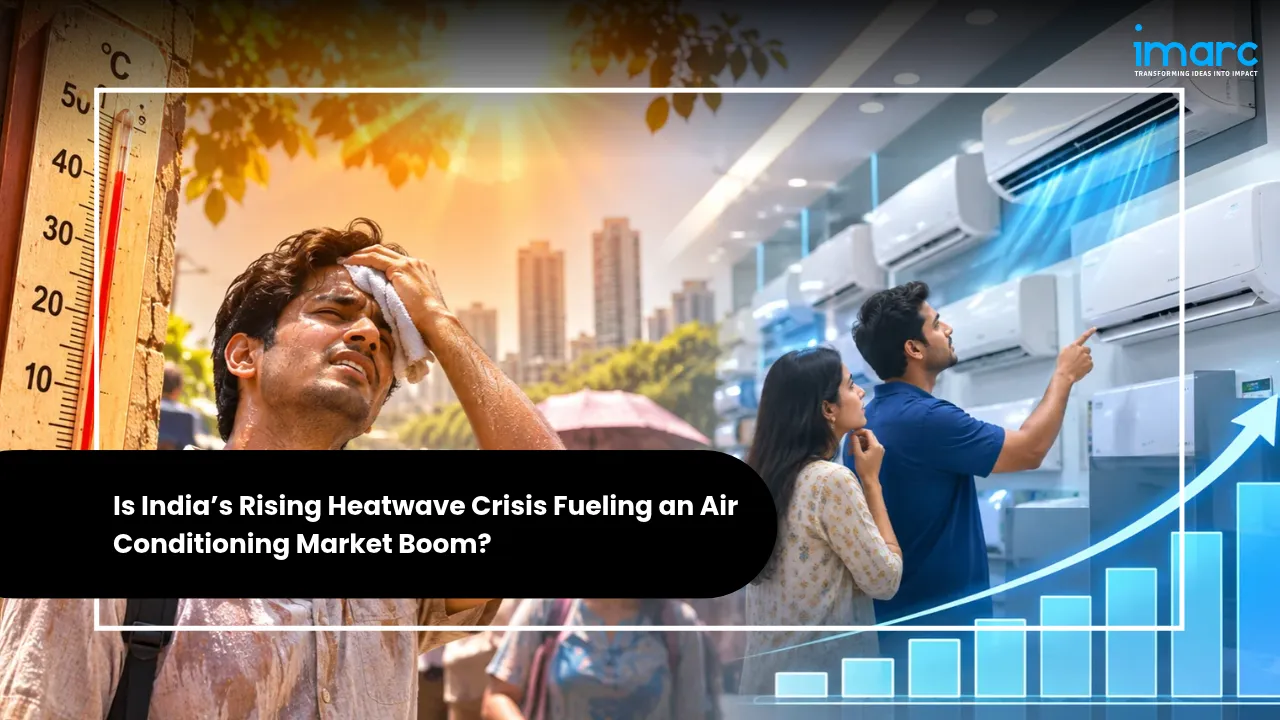
Is India’s Rising Heatwave Crisis Fueling an Air Conditioning Market Boom?
Introduction: India Air Conditioning Market Heats Up
Yes, India's intensifying heat is one of the clearest demand signals behind the India air conditioning market, which IMARC Group values at USD 6.15 Billion in 2025 and USD 7.07 Billion in 2026. The market is projected to reach USD 21.59 Billion by 2034, growing at a CAGR of 14.98% during 2026-2034. That implies more than USD 15 Billion of new value creation in under a decade, which places India among the fastest-growing HVAC markets globally.
Heat is the trigger, but it is not the only driver. Rapid urbanization, rising household incomes, expanding residential and commercial construction, and government support for domestic manufacturing all reinforce the demand curve. Because AC penetration in India remains low compared with developed markets, each additional degree of summer heat converts latent demand into purchases, especially among first-time buyers.
The market is also changing in composition. Inverter models now dominate split AC sales, smart and IoT-enabled units are moving beyond the premium tier, and global players are localizing.
This blog examines the AC market in India across size, segments, recent developments, trends, regional hotspots, competition, policy, risks and the 2026-2034 outlook, so that manufacturers, investors and channel partners can judge where the opportunity is concentrated.
Key Takeaways
- The India air conditioning market grew from USD 6.15 Billion in 2025 to USD 7.07 Billion in 2026 and is forecast to reach USD 21.59 Billion by 2034, at a CAGR of 14.98% during 2026-2034.
- Room Air Conditioners lead the product mix with a 48.05% share in 2025, while Residential applications lead end use with a 44.05% share, which shows that household demand is the core of the market.
- North India is the largest region with a 29% share in 2025, while South India, at 24.8%, is the fastest-growing region on the back of IT corridor and data centre expansion.
- In 2026, Daikin Industries announced a INR 1,000 crore investment in India for its first global R&D centre outside Japan, and Blue Star announced a INR 200 crore capex plan, signalling deeper localization of manufacturing and innovation.
- Inverter, smart and higher star-rated ACs are the defining trend: inverter models account for most sales at leading brands, and updated Bureau of Energy Efficiency norms are pushing consumers toward premium, efficient units.
India Air Conditioning Market Size, Share & Growth Outlook
According to IMARC Group, the India air conditioning market increased from USD 6.15 Billion in 2025 to USD 7.07 Billion in 2026 and is projected to reach USD 21.59 Billion by 2034, expanding at a CAGR of 14.98% during 2026-2034. A 14.98% growth rate means the market is expected to roughly triple from its 2026 level, a pace that is well above what would be expected from replacement demand alone, and points to a large pool of first-time buyers entering the market. The leading segments are:
- Type: Room Air Conditioners account for a 48.05% share in 2025, followed by Ductless ACs at 22.4%, Ducted systems at 17.8% and Centralized AC at 11.75%. The 1.5-ton split category dominates, and replacement of older window units adds to volume.
- Application: Residential leads with a 44.05% share in 2025. Commercial and Retail contribute 24.3%, Hospitality 14.7%, Healthcare 11.6% and Others 5.35%, which shows that demand extends well beyond homes.
- Region: North India commands the largest share at 29% in 2025, followed by West India at 26.4%, South India at 24.8% and East India at 19.8%.
The segment mix shows a market anchored in mass-market room ACs but with meaningful depth in commercial, hospitality and healthcare cooling, which supports higher-value HVAC sales as construction activity grows.
Recent News & Mega Announcements
Recent corporate moves show manufacturers positioning for sustained AC demand in India, with investment concentrated in R&D, capacity and first-time buyer reach:
- Daikin's India R&D Centre (2026): Daikin Industries announced a INR 1,000 crore investment to establish its first global R&D centre outside Japan in India. The centre will focus on advanced HVAC solutions, including chillers and air-conditioning systems for residential, commercial and data centre applications worldwide. Daikin India already operates manufacturing and R&D facilities in Neemrana and Hyderabad.
- Voltas Targets First-Time Buyers (2026): Voltas, with around 18% share of the Indian AC market, is focusing on first-time buyers, who account for nearly 85% of demand, to drive double-digit growth. The figure underlines how much of the market is still being built from zero ownership.
- Voltas Volume Milestone (2024): Voltas sold over 2 million air conditioners in FY2024, becoming the first company in India to reach that level, against revenue of INR 12,400 crore.
- Blue Star Capex and Pricing (2026): Blue Star announced a INR 200 crore capex plan covering manufacturing, R&D and marketing, while signalling price hikes of up to 13-15% linked to rising commodity costs and new energy-efficiency norms.
- Blue Star Demand Outlook (2025): Blue Star projected up to 20% growth in room AC sales, driven by expected GST reductions, with its unitary cooling segment contributing nearly half of revenue and a market share of around 14%.
- Heat as a Demand Catalyst (2024): IMARC notes that 2024 was among the warmest years on record in India, with more frequent and intense heatwaves lifting cooling demand across residential and commercial buildings.
Industry Trends Shaping 2026
Three structural shifts are redefining how the air conditioner market in India competes and where margins are being earned.
1. Inverter Dominance and Efficiency-Led Premiumization
Inverter ACs have become the dominant category, with Daikin, LG Electronics and Voltas reporting that inverter models account for most of their sales. Variable-speed compressors use significantly less energy than fixed-speed units, which is a strong selling point where electricity costs and grid stress are a concern. Updated energy-efficiency norms from the Bureau of Energy Efficiency are pushing consumers toward higher star ratings, which supports premium upgrades but also raises input costs, as Blue Star's indicated 13-15% price increase shows.
2. Smart, IoT-Connected and AI-Enabled Cooling
Smart ACs with Wi-Fi, app control and voice assistant integration (Amazon Alexa and Google Assistant) are growing quickly, particularly in the premium tier. Samsung and Daikin are integrating airflow optimization and adaptive climate control. IMARC expects AI-powered smart features such as auto-learning temperature management and predictive service to move from premium add-ons to mainstream expectations by 2034, supported by rising smartphone penetration and smart home adoption.
3. Commercial Growth in VRF, Data Centre Cooling and Service Ecosystems
Variable Refrigerant Flow and centralized HVAC systems are gaining traction in offices, malls and hotels because of energy efficiency and zone-level control, which explains the 22.4% share of ductless systems. Data centre cooling is an emerging B2B segment, supported by investments from Microsoft, Amazon Web Services and Google in India's data centre infrastructure. In parallel, Blue Star, Daikin and Carrier are strengthening Annual Maintenance Contracts and extended warranties to build recurring revenue and retain customers.

Geographic Hotspots in the AC Market in India
North India is the largest regional market, with a 29% share in 2025. Peak temperatures of 40-48°C across Rajasthan, Uttar Pradesh, Haryana and Delhi-NCR create a long, intense summer, and dense urban populations in Delhi-NCR, Uttar Pradesh and Punjab convert that heat into strong residential and retail demand. The flip side is seasonality: Peak sales are concentrated in the summer months, which puts pressure on inventory and logistics.
West India holds a 26.4% share. Commercial construction in Mumbai and Pune, industrial growth along Gujarat's corridors under the DMIC, high-humidity coastal conditions and robust organized retail sustain both residential and commercial demand. Humid coastal climates also tend to support year-round usage rather than a short seasonal peak.
South India accounts for 24.8% and is the fastest-growing region. IT campuses in Bengaluru, Hyderabad and Chennai drive large commercial HVAC procurement and data centre cooling, while residential adoption is rising in Tamil Nadu and Andhra Pradesh. Daikin's Hyderabad facility and Fujitsu General's strong South India commercial base reflect this concentration.
East India holds 19.8% and is the most underpenetrated region. Emerging demand from Kolkata, Odisha, Jharkhand and Bihar, improving electricity infrastructure and healthcare sector growth point to the highest long-term headroom as electrification and urbanization accelerate through 2034.
Beyond metros, IMARC identifies Tier-2 and Tier-3 cities such as Lucknow, Jaipur, Coimbatore, Surat and Nagpur as key growth markets. AC penetration in India remains in single digits overall and is significantly lower in smaller cities, so each rise in income or housing completion in these locations has a disproportionate effect on unit volumes. The International Energy Agency has also examined India's cooling demand trajectory, reinforcing the long-term scale of this opportunity.
Competitive Landscape & Key Players Strategies
The India air conditioning market is moderately concentrated at the top. The five leading brands (Voltas, Daikin, LG, Blue Star and Samsung) together accounted for approximately 55-60% of unitary AC sales by volume in FY2024, with Daikin and Voltas alone holding a combined 35-40%. Below that tier, the entry-level segment remains fragmented, with domestic, global, emerging and unorganized players competing on price. Rising investment needs in inverter compressors, IoT connectivity and refrigerant transition are raising barriers for sub-scale operators. Key players and their strategies include:
- Daikin Air Conditioning India Pvt. Ltd.: Premium inverter leader with manufacturing and R&D in Neemrana and Hyderabad.
- Voltas Limited: India's leading AC brand by volume, with over 2 million units sold in FY2024 and about 18% share. Strategy centres on deeper distribution, first-time buyer penetration, premium inverter growth and the Tata ecosystem.
- Blue Star Limited: Commercial HVAC leader with FY2024 revenue of INR 11,229 crore and around 14% share. It is expanding in residential cooling and Tier-2/3 cities, backed by a INR 200 crore capex plan.
- Carrier Airconditioning & Refrigeration Ltd.: Strong in commercial cooling, chillers and B2B projects, leveraging global engineering expertise and strengthening service networks.
- LG Electronics India Pvt. Ltd.: Competes with Dual Inverter compressor technology and a broad product range supported by electronics brand synergy.
- Samsung India Electronics Pvt. Ltd.: Differentiates with WindFree technology and smartphone ecosystem integration.
- Bosch Home Comfort India (Hitachi), Panasonic and Godrej & Boyce: Challengers and emerging players using AI-enabled smart ACs, Nanoe-X air purification and value-for-money inverter ranges respectively.
Policy & Regulatory Landscape, Challenges & Risks
Government policy has become a primary force shaping product design, manufacturing location and pricing in the sector. Key frameworks include:
- Production Linked Incentive (PLI) Scheme for White Goods: Administered under the Department for Promotion of Industry and Internal Trade, the scheme supports domestic manufacturing of AC components, including compressors. It is helping domestic manufacturers become cost-competitive challengers to imported brands and encouraging Voltas, Daikin and others to expand local capacity.
- Bureau of Energy Efficiency Star Labelling Norms: The Bureau of Energy Efficiency sets the star-rating framework for room ACs. Updated norms are pushing demand toward higher star-rated, inverter-based models and raising manufacturing costs, which Blue Star cited when signalling price increases in 2026.
- Kigali Amendment and National Cooling Policy: India is phasing down HFC refrigerants under the Kigali Amendment, as coordinated by the Ozone Cell, Ministry of Environment. The shift from R-22 toward lower-GWP refrigerants such as R-32 and R-290 is steering product redesign and R&D investment.
- Housing and Urban Programmes (PMAY and Smart Cities Mission): Under PM Awas Yojana, over 11.8 million homes were built by 2024, each a potential AC installation, while the Smart Cities Mission supports HVAC demand through infrastructure development.
On the constraining side, several structural risks persist:
- High Energy Consumption and Grid Stress: ACs are a major contributor to peak electricity demand in Indian cities. Rising power costs make consumers sensitive to operating expenses and may slow adoption of lower-efficiency units.
- Price Sensitivity in Rural and Tier-3 Markets: Entry-level split ACs cost INR 28,000 to INR 45,000, which is out of reach for many semi-urban and rural households and limits market depth beyond Tier-1 and Tier-2 cities.
- Seasonal Demand Concentration and Workforce Gaps: A large share of sales falls in peak summer months, creating inventory, supply chain and pricing volatility. A shortage of trained HVAC technicians also affects installation quality and after-sales service in smaller cities.
- Import Dependence and Cost Pressure: Reliance on imported components, particularly from China, and the presence of low-cost brands create pricing pressure and margin challenges for domestic manufacturers, compounded by refrigerant transition costs.
Forecast 2026-2034
IMARC projects the India air conditioning market to rise from USD 7.07 Billion in 2026 to USD 21.59 Billion by 2034, a CAGR of 14.98%. Value creation of more than USD 15 Billion over the period is expected to come from urbanization, rising temperatures, higher incomes and commercial real estate expansion. The forecast uses bottom-up brand-level sales aggregation and top-down household penetration and real estate modelling, cross-validated against GDP growth, climate projections and historical CAGR under base, optimistic and conservative scenarios.
IMARC identifies three forces that will reshape competition through 2034. First, AI-powered smart ACs will shift from a premium add-on to a mainstream expectation. Second, a move toward ultra-low-GWP natural refrigerants such as R-290 and CO2 will require fundamental product redesigns that reward early movers. Third, solar-hybrid and energy-storage-integrated AC systems are expected to gain material share as India's distributed renewable energy infrastructure grows.
Room ACs and Ductless ACs are expected to be the fastest-growing product categories, and Residential is expected to sustain the highest application-level growth. By region, South India is expected to keep outpacing the rest of the country, while East India offers the largest untapped headroom. Over the long term, India is expected to become one of the largest AC markets globally, and companies with strong distribution, efficient products and service networks are best placed to benefit.
Opportunities for Stakeholders
- Manufacturers and OEMs: Invest in inverter, smart and low-GWP product lines and in localized component production, including compressors, to benefit from PLI support and to manage commodity and import-cost exposure.
- Retailers and Distributors: Deepen reach in Tier-2 and Tier-3 cities such as Lucknow, Jaipur, Coimbatore, Surat and Nagpur, where first-time buyers drive demand and penetration is still low. Financing and exchange offers can address the INR 28,000 to INR 45,000 entry price barrier.
- Commercial HVAC and Data Centre Suppliers: Target precision cooling for the data centre capacity build-out, as well as VRF and centralized systems for offices, malls, hotels and hospitals in Bengaluru, Hyderabad, Chennai, Mumbai and Pune.
- Service Providers: Build technician training, AMC programmes and extended warranties to fill the installation and service workforce gap and to generate recurring revenue.
- Real Estate Developers: Bundle energy-efficient cooling into residential and commercial projects, aligning with housing and smart city programmes and growing tenant expectations.
- Investors: Focus on companies combining distribution scale with technology depth in inverter compressors, IoT and refrigerant transition, as these barriers are squeezing out sub-scale players.
Rising Heat, Rising Cooling Demand
India's heatwaves are a real and measurable catalyst for the India air conditioning market, but the boom rests on a broader base. Urbanization, higher incomes, housing construction, commercial real estate and supportive policy all work together with climate pressure. IMARC's USD 21.59 Billion forecast for 2034, at a 14.98% CAGR, reflects that combination rather than weather alone.
The winners will be those that pair efficiency with affordability. Inverter and smart ACs, low-GWP refrigerants, localized manufacturing and strong service networks address the main constraints of energy cost, price sensitivity and regulation. With AC penetration in India still in single digits overall, and first-time buyers making up the bulk of demand, the market is early in its growth cycle. Stakeholders who plan for seasonal volatility and invest ahead of regulatory shifts are well positioned to capture the next decade of cooling demand.
Our Clients









Contact Us
Have a question or need assistance?
Please complete the form with your inquiry or reach out to us at
Phone Number
+91-120-433-0800+1-201-971-6302
+44-113-547-7077
Previous Post

An Alkaline Battery Manufacturing Plant Setup in India addresses a product used in almost every home, office, and clinic, yet until recently made almost entirely abroad.
An LED Light Manufacturing Plant Setup in India taps into one of the largest and most mature consumer electrical markets in the country.
An LED Chip Manufacturing Plant Setup in India addresses one of the biggest gaps in the country's lighting and display supply chain. India assembles hundreds of millions of LED bulbs, battens, panels, and displays every year, yet almost all LED chips, the tiny semiconductor dies that actually emit light, are imported, mainly from China, Taiwan, and South Korea.
A Smartphone Manufacturing Plant Setup in India places an investor inside one of the country's biggest industrial success stories of the past decade.
A Smart Watch Manufacturing Plant Setup in India serves one of the world's largest wearables markets. Indian consumers buy tens of millions of smartwatches every year, and domestic brands have shifted much of their production from imports to local contract manufacturers.
The India Semiconductor Market has moved past the stage of ambition documents and into the stage of concrete assets, approved sites and dated delivery milestones. The India Semiconductor Market size reached USD 59.78 Billion in 2025, expanded to USD 73.00 Billion in 2026, and is projected to reach USD 180.20 Billion by 2034, growing at a CAGR of 11.95% over the 2026-2034 forecast period.
A genset combines an engine, usually diesel or gas, with an alternator that converts its motion into electricity, mounted on a steel base frame with a fuel tank, exhaust and emission after-treatment, a control panel, and in most cases a soundproof acoustic enclosure.
Setting up a Power Cable Manufacturing Plant in India puts an investor directly in the path of one of the country's largest infrastructure build-outs.
Servos are precision electric motors fitted with a position sensor, called an encoder, and paired with an electronic drive that controls speed, torque, and position very accurately.
PVC-insulated wires and cables are made by drawing copper or aluminium rod into fine conductors, annealing and stranding them, and covering them with coloured PVC insulation and, for multi-core cables, an outer PVC sheath and sometimes steel armour.
Portable chargers are compact battery packs made from lithium-ion or lithium-polymer cells, a charging and protection circuit board, ports or wireless coils, and a plastic or metal casing.
Small electric cooking and food preparation products, such as mixer grinders, induction cooktops, electric kettles, air fryers, hand blenders, and sandwich makers, are made by moulding plastic bodies, forming steel and aluminium parts, winding motors or fitting heating elements, assembling control boards, and wiring and testing each unit for safety.
Aluminum-air batteries generate electricity by reacting aluminum plates with oxygen from the air in a water-based electrolyte. Aluminum has a very high theoretical energy density, and instead of being recharged from a socket, spent plates are swapped for fresh ones while the aluminum hydroxide produced is recycled into new aluminum.
LED bulbs use light-emitting diodes mounted on a metal-core circuit board, powered by a small electronic driver and housed in a plastic and aluminium body with a diffuser and a standard B22 or E27 cap.
Inverters convert direct current from batteries or solar panels into the alternating current used by homes, shops, and factories.
Electrical control panels are steel enclosures that house circuit breakers, contactors, relays, busbars, meters, drives, and controllers to distribute power and control motors, machines, and processes safely.
Microchips, or integrated circuits and semiconductor devices, are the building blocks of phones, computers, vehicles, appliances, power systems, telecom networks, and defence equipment.
Resistors are the most widely used electronic components, found by the dozens or hundreds in almost every circuit board, from phones, laptops, and televisions to vehicles, appliances, telecom equipment, power electronics, medical devices, and defence systems.
Rare earth magnets, mainly neodymium-iron-boron (NdFeB) and samarium-cobalt, are the strongest permanent magnets made, and they sit at the heart of electric vehicle motors, wind turbine generators, electronics, industrial automation, medical devices, and defence systems. India imported over 53,000 tonnes of rare earth permanent magnets in 2024-25 and has almost no domestic production, while demand is expected to double by 2030.
Wires and cables carry power and signals through every home, office, factory, railway, data centre, and solar park, and India's market has grown to about USD 10 billion as construction, power transmission, renewable energy, and industrial investment have expanded.
Heat exchangers are among the most widely used pieces of engineering equipment in the world. Refineries, petrochemical and fertiliser plants, power stations, pharmaceutical and food factories, HVAC systems, and data centers all depend on them to heat, cool, condense, and recover energy from process streams.
India's trucks and buses rarely rest. They carry freight across highway corridors, move goods from ports and factories, and ferry millions of passengers every day, often under heavy loads and tough road conditions.
Silicon wafers are the thin, precisely sliced discs and squares on which solar cells and computer chips are built. India has rapidly become a major assembler of solar modules and is now building cell capacity, but almost all of the wafers those cells need are still imported.
Every video call, UPI payment, and 5G connection in India ultimately travels over glass. Fiber optic cables carry the country's data between cities, into mobile towers and data centres, and increasingly right into homes through fiber-to-the-home connections.
Setting up an Air Conditioner Manufacturing Plant in India is an assembly-driven, high-volume consumer durable venture, powered by rising household incomes, extreme summers, rapid urbanisation, and one of the lowest room air-conditioning penetration rates among large economies.
Setting up a High Voltage Cable Manufacturing Plant in India is a capital-intensive, high-value venture, powered by the country's massive power-transmission expansion, renewable-energy build-out, and the shift toward underground cabling in cities.
Setting up a Copper Cable Manufacturing Plant in India is a high-demand, infrastructure-driven venture, powered by the country's construction boom, rapid electrification, and steady industrial and appliance demand.
Setting up a Junction Box Manufacturing Plant in India is a high-demand, infrastructure-driven venture, powered by the country's construction boom, rapid electrification, and expanding solar and industrial sectors.
Setting up an Electric Cable Manufacturing Plant in India is a high-demand, infrastructure-linked venture, powered by the country's rapid growth in power, construction, renewable energy, and electrification. Cables and wires are essential to every building, factory, grid, and vehicle, giving an Electric Cable Manufacturing Plant a large and steadily growing market.
Setting up a Semiconductor Fabrication Manufacturing Plant in India is a highly capital-intensive but strategically transformative venture, driven by the country's semiconductor mission, deep policy incentives, and a vast import-substitution opportunity. Semiconductors are the foundation of every modern electronic and digital product, yet India currently imports almost all of its chip requirement.
Setting up a PCB Manufacturing Plant in India is a capital-intensive but strategically timed venture, driven by the country's electronics manufacturing push, strong policy incentives, and a large import-substitution opportunity. Printed circuit boards are the backbone of every electronic product, yet India still imports the overwhelming majority of its PCB requirement.
The Indian PCB (Printed Circuit Board) Market is emerging as the physical backbone of the country's electronics manufacturing ambitions. The market reached USD 7.27 Billion in 2025 and is projected to reach USD 25.48 Billion by 2034, growing at a CAGR of 14.96% (2026–2034), a total addressable market expansion driven by the Production Linked Incentive (PLI) scheme, 5G infrastructure rollout, and rising domestic consumer electronics demand.
Setting up an E-waste Recycling Plant in India is a capital-intensive but high-potential venture, driven by the country's soaring volume of discarded electronics, tightening Extended Producer Responsibility regulations, and the rising value of recovered metals. India is now among the world's largest generators of electronic waste, yet only a small share is processed through formal, compliant channels, leaving a large, policy-backed opportunity for organized recyclers who can capture volumes shifting from the informal sector.
Global semiconductor demand across automotive, data centers, and defense, highlighting market segmentation, key applications, regional dynamics, and industry shifts.
The hearables market represents one of the most dynamic segments within consumer electronics and wearable technology. These intelligent audio devices have evolved beyond simple wireless earbuds into multifunctional platforms combining premium audio with health monitoring, artificial intelligence, and seamless digital connectivity.
A smart washing machine is a sophisticated home appliance that incorporates advanced digital features such as connectivity, sensor technology, and automated controls for improved efficiency, convenience, and user control. In contrast to traditional washing machines, smart washing machines come pre-installed with advanced features such as Wi-Fi connectivity, smart load detection, smart detergent dispensing, and voice-control capability.
A smartphone is a portable electronic device that combines sophisticated capabilities in computer processing, wireless communication, multimedia entertainment, and internet access. Smartphones are distinct from other mobile phones in that their operation involves highly sophisticated platforms of operation that are capable of supporting multiple applications, multitasking, and connectivity with internet platforms.
Semiconductor manufacturing is a highly specialized industrial process that involves the design, fabrication, and assembly of semiconductor devices including integrated circuits (ICs), memory chips, sensors, and discrete components. The process transforms raw semiconductor materials, primarily silicon, into sophisticated electronic components through a combination of physical and chemical processing steps, such as wafer fabrication, photolithography, doping, etching, thin-film deposition, and packaging.
The retail landscape is experiencing a profound transformation as self-checkout systems emerge as critical infrastructure components reshaping consumer experiences and operational efficiency globally. These automated solutions enable customers to independently scan, bag, and pay for purchases without cashier assistance, representing a fundamental shift in modern commerce.
The webcams market is experiencing unprecedented transformation as digital communication becomes the cornerstone of modern business, education, and healthcare. Global webcam industry dynamics are being reshaped by technological innovation and evolving workplace models.
As smartphones become a way of life for most Filipinos, the market has changed dramatically and expectations from consumers are higher than ever before. With the demand for smartphones growing, there is a significant change in consumer shopping habits with more emphasis on using online platforms for shopping. This change is closely interlinked with the fast growth of the Philippines e-commerce market, both bringing opportunities and challenges to the stakeholders of the smartphone industry.
As technology continues to advance, lighting has transformed from a basic necessity into a strategic enabler of innovation, efficiency, and sustainability. The evolution from incandescent bulbs to LEDs, smart systems, and intelligent lighting networks represents not just technological change but a redefinition of how energy, design, and functionality intersect in the built environment.
An LED light is an illuminating device that utilizes Light Emitting Diodes as its source of light, generating light through a semiconductor-based process called electroluminescence. When electrical current flows across the semiconductor material of the diode, electrons emit energy as photons and thus produce highly efficient and concentrated illumination.
An LED bulb is a solid-state lighting device that uses Light Emitting Diodes (LEDs) as its illumination source. Different from incandescent or fluorescent lamps, light in LED bulbs is produced by electroluminescence, a process where the passing of an electric current through a semiconductor material emits photons directly. This process is highly energy-efficient, with a far larger percentage of the electricity being converted to usable light and very little heat generated in the process.
The junction box, generally made from plastic, metal, or composite materials, houses wire connections, terminations, and protective components to allow the safe distribution and routing of electrical circuits. The junction box will provide insulation, mechanical protection, and a secure environment to avoid accidental contact with live electrical parts, moisture intrusion, or dust accumulation.
The Japan power electronics market is poised to grow substantially, driven by rising demand in automotive, energy, industrial automation, and infrastructure sectors. According to IMARC Group, the Japan power electronics market is studied from 2019 to 2024 with projections extending to 2033.
Japan's printed circuit board (PCB) industry is the world leader in technology innovation, enabling consumer electronics, automotive, and next-generation communication system development. As a key enabler of modern electronic products, PCBs provide the essential building blocks for embedding semiconductors, sensors, and microchips into miniaturized, high-performance devices. Japan, through its world-class manufacturing base and engineering expertise, remains the hub of the global PCB supply chain.
Aluminum-Air (Al-Air) battery is a new energy storage technology that has attracted interest as a future alternative to conventional lithium-ion batteries, specifically for electric vehicle (EV) use. As opposed to normal rechargeable batteries, the Al-Air battery is a metal-air electrochemical cell with aluminum as the anode, oxygen from the ambient air as the cathode reactant, and a liquid electrolyte (commonly sodium hydroxide or potassium hydroxide) as the medium through which the reaction occurs.
Aluminium wire is an essential industrial commodity commonly employed in power transmission, electrical distribution, building construction, and manufacturing processes owing to its high conductivity-to-weight ratio, resistance to corrosion, and cost advantage over copper. Produced by methods including continuous casting, rolling, and drawing, aluminum wire is available in various grades and alloys to serve the wide demands, from overhead transmission conductors and building wiring to automotive harnesses and electronic applications.
Air conditioners are electromechanical devices used to control indoor climate by extracting heat and humidity and ensuring optimum air circulation. Generally consisting of a compressor, condenser, evaporator, refrigerant fluid, filters, fans, and electronic controls, air conditioners work based on the principle of heat exchange, moving heat from indoor areas to the external environment. Contemporary units come in diverse configurations, such as split systems, window units, central air systems, and portable models, supporting respective residential, commercial, and industrial applications. Some of the major characteristics are efficiency in cooling, energy use, noise rating, and environmental footprint in relation to refrigerant type.
E-waste, or electronic waste, is electrical and electronic equipment that has been discarded, such as computers, cell phones, television sets, servers, and household appliances. It is among the world's fastest-growing streams of waste, consisting of a heterogeneous combination of metals, plastics, glass, and toxic substances. E-waste contains valuable metals like copper, aluminum, gold, silver, palladium, and rare earth elements, in addition to toxic materials like lead, mercury, cadmium, and brominated flame retardants.
Polished silicon wafers are very pure, ultra-flat semiconductor substrates that are produced from high-quality single-crystal silicon. The wafers act as the material base for making integrated circuits, power devices, and MEMS (Microelectromechanical Systems). The wafers are made of monocrystalline silicon ingots using the Czochralski or Float-Zone process, from which the wafers are cut, lapped, etched, and polished to atomic-scale flatness and defect-free surfaces.
AI is revolutionizing Japan’s semiconductor industry by boosting innovation and efficiency across the entire value chain. Advanced artificial intelligence (AI)-powered Electronic Design Automation (EDA) tools significantly shorten chip design cycles, improving performance and energy efficiency.
Recent projections indicate that Australia semiconductor market, including services, is growing at a steady compound annual growth rate as the nation deepens its tech infrastructure. The importance of semiconductors spans electronics, defense systems, telecommunications, and emerging AI applications, which position the local ecosystem as strategically vital for growth.
Fiber optic cables are high-tech communications cables that carry information like bursts of light along extremely thin glass or plastic strands, providing high-speed, high-bandwidth connectivity with little loss of signal. Fiber optic cables make up the foundation of contemporary telecommunications, carrying internet, cloud computing, 5G networks, and smart infrastructure.
CAT (Category) cables are twisted-pair Ethernet cables utilized for copper-based wired network communications, varying from CAT5e to CAT8 standards. The cables carry data through copper conductors, but with different speeds (up to 40 Gbps for CAT8) and bandwidths, supporting networks such as LANs, data centers, and smart buildings.
India's semiconductor industry is undergoing a revolutionary phase driven by rising demand from industries like consumer electronics, automotive technologies, industrial automation, and telecom infrastructure.
USB data cables are critical elements of contemporary digital connectivity, enabling high-speed and consistent data transfer and power supply for a broad scope of electronic products. They provide the foundation for charging and synchronizing smartphones, tablets, laptops, and other peripherals, with significant applications in consumer electronics, industrial automation, and new technologies. With technologies like USB-C, the cables today carry faster data speeds, more power output, and universal compatibility, making them essential in a world that is connected.
Thin-film-transistor (TFT) liquid-crystal display (LCD) is a type of display technology used in many electronic devices, such as smartphones, tablets, laptops, and televisions (TVs). A backlight, colour filters, a thin-film transistor array, and a liquid crystal layer are among the layers that make up this flat-panel display. TFT LCDs are made to produce sharp images with superb viewing angles, strong contrast, and accurate colour reproduction. They are made up of thousands of tiny transistors that regulate how much light enters each pixel. This makes it possible for the display to generate crisp, detailed images at rapid refresh rates. TFT LCD technology's low power consumption is one of its main benefits, which makes it perfect for battery-operated gadgets.
Polycrystalline solar photovoltaic (PV) modules are a key component of solar energy systems, harnessing sunlight and converting it into electricity through the photovoltaic effect. These modules are composed of multiple interconnected solar cells, each made from polycrystalline silicon. Polycrystalline solar panels are renowned for their efficiency, affordability, and versatility, making them a popular choice for various applications such as solar installations, commercial and industrial projects, off-grid systems and solar farms.
The LED chip is the core component of an LED bulb, comprising semiconductor layers that enable the free flow of protons and electrons. Employed in all LED lighting fixtures—from bulbs to tubes—the LED chip fundamentally determines light quality, with variations in brightness, voltage, and wavelength. These chips are manufactured through a process called MOCVD (metal-organic chemical vapor deposition), which creates the semiconductor layers that facilitate electric flow. Major applications of these chips include backlighting, illumination, automotive lighting, signs, and signals.
Semiconductors are crucial components in the modern electronics industry, used in electronic equipment and devices to manage and control the flow of electricity. They are found in consumer items like smartphones, wearables, smart TVs, and advanced equipment used in industrial applications, defense, and aerospace. Semiconductors are further divided into four broad categories: optoelectronics, discrete components, integrated circuits, and sensors. Memory devices, logic devices, analog ICs, MPUs, discrete power devices, MCUs, and sensors are some of the major components of semiconductors.