How Big Is the India Energy Storage Industry and What Is Driving Its Growth?
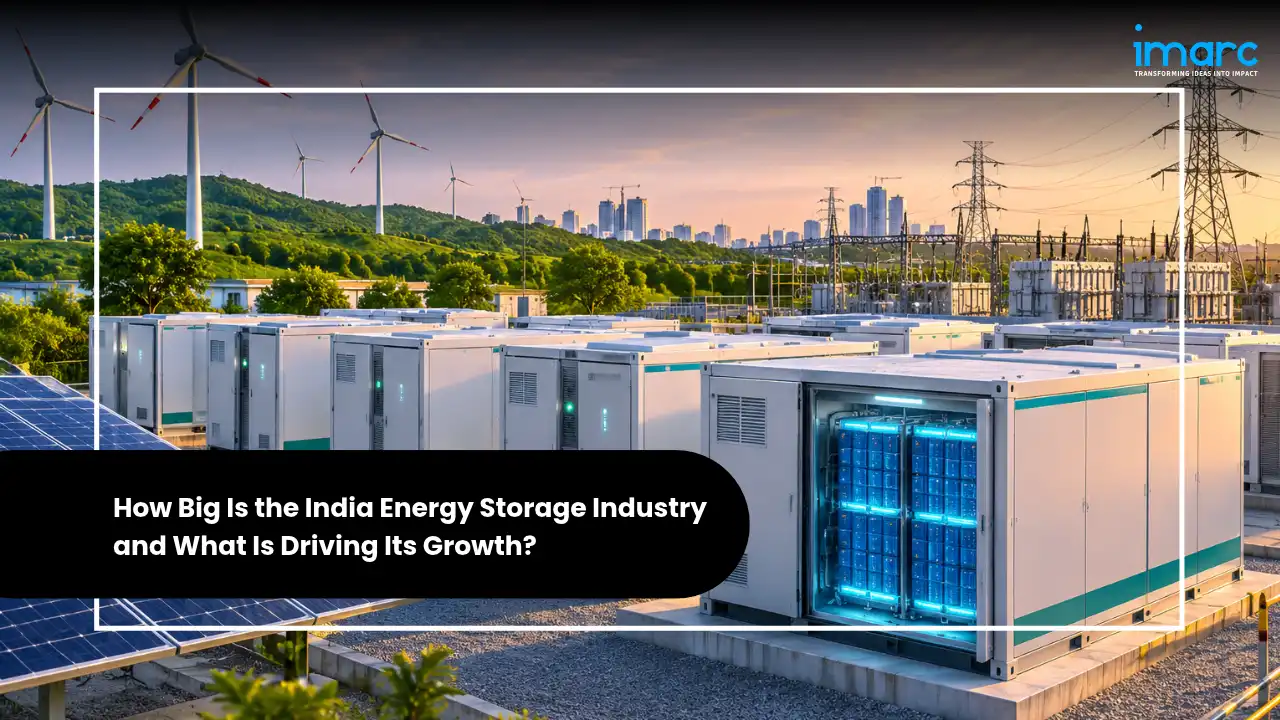
Introduction: A Market Scaling Fast
India's energy storage market has moved from pilot projects to procured infrastructure, and the numbers now reflect that shift. The India energy storage market reached a volume of 331.3 MWh in 2025 and is projected to reach 9,294.4 MWh by 2034, expanding at a CAGR of 40.03% during 2026-2034. That trajectory implies close to a 28-fold increase in nine years, a scale-up that places storage alongside solar and wind as a core asset class in the country's power system rather than an ancillary service for grid operators.
Three key factors are driving this acceleration. India's solar capacity stood at 129 GW as of December 2025, and wind generation remains concentrated in a small number of resource-rich states, so the variability of new renewable capacity has become the binding constraint on grid operations. Falling lithium-ion cell and system prices have lowered the levelized cost of storage, improving project economics without relying solely on subsidy. Rising demand for frequency regulation, peak shaving and voltage support has widened the addressable market beyond renewable co-location, while central and state policy has converted that demand into tenders.
The defining trend is the migration from small demonstration systems to utility-scale, tender-driven capacity. In June 2025 the government approved an expanded Viability Gap Funding scheme covering 30 GWh of battery storage with an outlay of INR 5,400 crore, turning policy intent into a near-term pipeline of bankable projects. Developers such as Greenko Group are bundling solar, wind and pumped storage into single integrated projects, while NHPC Limited is advancing pumped-storage hydroelectricity through joint ventures with state agencies to serve grid-balancing requirements.
This blog examines the size and structure of the India energy storage market, its regional hotspots, recent announcements, the trends shaping 2026, the competitive and policy landscape, the principal risks and the forecast to 2034.
Key Takeaways
- The India energy storage market reached 331.3 MWh in 2025 and is forecast to reach 9,294.4 MWh by 2034, registering a CAGR of 40.03% over 2026-2034.
- Battery energy storage systems (BESS) lead the type segment with a 63.8% share in 2025, well ahead of pumped-storage hydroelectricity at 24.7%.
- South India accounts for a 32.6% share of 2025 market volume, followed by North India at 27.9%, West India at 24.3% and East India at 15.2%.
- The most material recent development was the June 2025 approval of an expanded Viability Gap Funding scheme covering 30 GWh of battery storage, backed by an outlay of INR 5,400 crore.
- The dominant trend is the shift toward utility-scale and integrated renewable-storage projects, with utility scale already holding 54.3% of end-user demand in 2025.
India Energy Storage Market Size, Share & Growth Outlook
According to IMARC Group, the India energy storage market reached a volume of 331.3 MWh in 2025 and is projected to reach 9,294.4 MWh by 2034, exhibiting a CAGR of 40.03% during 2026-2034. The historical series shows the market moving from 61.5 MWh in 2020 to 331.3 MWh in 2025, representing an approximately 5.39-fold expansion over five years and establishing the base for the current forecast.
IMARC's trajectory anchors the market at 1,783.7 MWh in 2030 before the step-up to 9,294.4 MWh in 2034, which indicates that the heaviest volume additions are expected in the 2030-2034 window, once pumped storage projects sanctioned in the late 2020s begin commissioning alongside a maturing battery pipeline. The leading segments are:
- Type: Battery energy storage system (BESS) accounts for a 63.8% share in 2025, supported by modular deployment, short commissioning timelines and central incentives that apply to standalone as well as hybrid configurations. Pumped-storage hydroelectricity follows with 24.7%, a share driven by long-duration capacity built inside large integrated renewable projects.
- End User: Utility-scale applications account for the largest share of market volume at 54.3% in 2025, reflecting the concentration of grid-balancing tenders and renewable co-location mandates awarded to central and state utilities. Commercial and industrial applications account for 28.6% of market volume, driven by peak shaving, tariff arbitrage, and reliability requirements among energy-intensive manufacturers, while residential applications represent the smallest segment. The residential segment's exact share is not specified.
- Region: South India commands a 32.6% share in 2025 on the back of strong solar and wind resources and active state-level tenders, ahead of North India at 27.9%, West India at 24.3% and East India at 15.2%.
Read together, these shares describe a market that is battery-led, utility-driven and geographically concentrated. That concentration matters commercially, because it determines where system integration capacity, engineering procurement and construction crews, and grid interconnection investment will cluster over the forecast period, and because the three leading regions already account for more than four-fifths of installed volume.
Recent News & Mega Announcements
Developments between 2023 and 2025 have converted storage from a policy aspiration into a procurement pipeline with defined volumes and funding. The most consequential announcements are:
- Expanded Viability Gap Funding for battery storage (June 2025): The Union Government approved an expanded VGF scheme covering 30 GWh of battery storage capacity with an outlay of INR 5,400 crore, building on the initial allocation sanctioned in 2023. The volume commitment is significant because it gives developers a visible near-term order book against which cell supply, land and interconnection can be planned.
- Initial VGF approval of INR 3,760 crore (September 2023): The first tranche of viability gap support for battery energy storage established the funding template that the 2025 expansion later scaled, and it signalled that the cost gap between storage and conventional peaking capacity would be bridged with public support rather than left to tariff discovery alone.
- Investment outlook revised upward (April 2025): Industry analysis published in April 2025 projected that India's energy storage sector would expand fivefold between 2026 and 2032, attracting investment of roughly INR 479 thousand crore over that period. The figure reframes storage as a capital formation story rather than a marginal grid expense.
- Renewable base expansion through December 2025: India's solar capacity reached 129 GW by December 2025, and total installed renewable capacity has grown well beyond the 178 GW recorded in 2023. Each incremental megawatt of variable generation strengthens the commercial case for co-located or standalone storage, since curtailment risk rises as renewable penetration increases.
- Developer-level capacity commitments: Adani Group is integrating battery storage with its renewable generation platform, Greenko Group continues to expand pumped storage within integrated renewable projects, Tata Power is commissioning battery capacity across its generation and distribution footprint, and NHPC Limited is progressing a pumped storage pipeline through joint ventures and memoranda of understanding with state agencies. ReNew is pursuing hybrid renewable-storage projects with global technology partners from a challenger position.
Taken together, the announcements point to a market where public funding de-risks early volumes while private balance sheets absorb the larger build-out, a sequencing that has historically shortened the gap between tender award and commercial operation in Indian power infrastructure.
Industry Trends Shaping 2026
Three structural shifts define how capital will be deployed across the India energy storage industry through 2026 and beyond.
1. Utility-Scale Battery Deployment Reaching Commercial Scale
Standalone battery storage is moving from pilot and demonstration scale to gigawatt-hour class procurement. Utility scale already holds 54.3% of end-user volume, and the June 2025 VGF expansion covering 30 GWh gives developers a defined pipeline to build against. The practical consequence is a shift in engineering practice: developers are standardising containerised, modular battery designs that reduce land footprint, compress civil works and shorten commissioning timelines from years to months. Standardisation also improves financeability, because lenders can underwrite performance warranties and degradation curves on proven configurations rather than bespoke designs.
The commercial logic rests on more than renewable co-location. Storage assets are increasingly contracted for frequency regulation, voltage support and peak shaving, which broadens revenue stacks beyond a single tariff stream. That diversification is what allows projects to clear competitive auctions at sustainable tariffs, and it explains why utility-scale battery capacity is expected to grow faster than the overall market CAGR through the forecast period.
2. Integrated Renewable-Storage Project Models
Developers are bundling solar, wind and storage into single projects contracted to deliver round-the-clock or dispatchable power. This model solves two problems at once: it improves the bankability of renewable generation by converting variable output into a firm supply obligation, and it reduces transmission congestion by locating generation and storage behind a shared interconnection point. Greenko Group's integrated renewable and pumped storage platform is the clearest example among Indian developers, pairing long-duration hydro storage with solar and wind to serve firm power contracts.
The model also changes how storage is sized. Instead of optimising a battery for arbitrage within a single day, developers size hybrid assets against contractual availability obligations across a full dispatch curve, which favours a mix of short-duration batteries and long-duration pumped storage. As power demand continues to rise with industrial expansion and electrification, firm and dispatchable renewable capacity becomes the product that utilities and distribution companies are most willing to contract.
3. Domestic Cell Manufacturing and Supply Chain Localisation
Import dependence for lithium-ion cells is the sector's principal structural vulnerability, and central incentives for advanced chemistry cell manufacturing are beginning to change the calculus. Gigafactory-scale announcements aim to localise cell production, which would reduce exposure to landed import costs, currency movements and global shipping disruptions that have repeatedly distorted project economics. Localisation also shortens lead times, a material consideration when storage capacity must be commissioned within the construction schedule of a co-located renewable plant.
The transition will be gradual rather than immediate. Cell chemistry qualification, warranty structures and lender acceptance take time to establish for new domestic supply, and early domestic output is likely to serve the utility-scale segment first because of its volume concentration. Even so, the direction of travel is clear: a domestic cell base would shift value capture within the India energy storage sector from importers toward integrated manufacturers and would make the 40.03% forecast CAGR considerably easier to finance.

Geographic Hotspots in the India Energy Storage Market
South India leads the India energy storage market with a 32.6% share in 2025. The region combines the country's strongest solar and wind resource base with a dense industrial load in Tamil Nadu, Karnataka, Andhra Pradesh and Telangana, which produces both the variable generation that requires balancing and the industrial demand that pays for reliability. State-level tender activity has been more consistent in the south than elsewhere, giving developers a repeatable procurement channel and allowing engineering supply chains to concentrate locally. The share is therefore a reflection of resource endowment and procurement discipline rather than of any single large project.
North India follows with 27.9%, supported by large grid capacity, high peak demand variability and substantial pumped storage potential in Himalayan terrain. The region's advantage is duration rather than chemistry: states with access to elevation differences can develop pumped hydro assets that serve multi-hour and multi-day balancing needs at a lower levelized cost than lithium-ion configurations. The concentration of peak demand variability in the northern grid also strengthens the case for storage as a peak management tool rather than a pure renewable integration measure.
West India holds 24.3% and is the fastest growing region, anchored by extensive renewable energy parks, strong industrial infrastructure and active state-level tenders. The presence of large contiguous renewable parks in Gujarat and Maharashtra creates the co-location economics that make hybrid storage attractive, and industrial demand from petrochemicals, textiles and manufacturing provides a commercial and industrial customer base for behind-the-meter systems. Because the region starts from a smaller base while adding capacity quickly, it represents the most significant incremental opportunity for developers able to deliver large-format grid-connected storage.
East India accounts for 15.2%, the smallest regional share, but the composition of demand is changing. Emerging renewable capacity additions, grid modernisation programmes and rising industrial electricity demand are creating the preconditions for storage deployment, even though tender activity remains thinner than in the other three regions. For equipment suppliers and integrators, the east is a market-building opportunity rather than an immediate volume market, and early positioning in state-level procurement frameworks is likely to matter more than near-term order intake.
Competitive Landscape & Key Players Strategies
The India energy storage market is moderately concentrated. Diversified energy conglomerates and public sector undertakings dominate utility-scale project development, while specialised manufacturers compete separately on cell chemistry, power conversion and system integration. Project execution capability, balance-sheet strength and access to policy and procurement channels form the principal competitive moats, and each of those advantages compounds as tender sizes increase.
- Adani Group (AGEL BESS): Positions storage as an extension of its renewable generation platform, deploying large-scale battery capacity integrated with solar assets. The strategy leverages existing land banks, transmission connectivity and in-house engineering to compress development timelines.
- Greenko Group (Greenko IREP): Focuses on integrated renewable and storage infrastructure, combining solar, wind and pumped storage to deliver dispatchable clean power. It holds the deepest pumped storage pipeline among private developers, which positions it for long-duration and firm power contracts.
- Tata Power (Tata Power Renewable Energy Limited, TPREL): Integrates generation, storage and distribution across multiple states, which allows it to test storage use cases on its own distribution network before scaling them commercially. Its portfolio spans utility-scale solar plus battery projects and distribution-connected systems supporting grid resilience.
- NHPC Limited: Leads public sector pumped storage development and grid balancing, advancing projects through joint ventures and memoranda of understanding with state agencies. Its role is structural, since public sector capacity underpins the long-duration segment where private capital has a longer payback horizon.
- ReNew: Operates from a challenger position with hybrid renewable-storage project development supported by global technology partners, focusing on contracts that require firm supply rather than simple energy delivery.
Barriers to entry reinforce this hierarchy. High capital requirements, multi-state regulatory navigation, scalable execution capability and access to competitive financing all favour well-capitalised incumbents with established renewable portfolios. Consolidation is consequently expected to continue, with smaller developers partnering with larger players for technology access and financing, and with strategic tie-ups between developers, manufacturers and utilities hardening competitive positions.
Policy & Regulatory Landscape, Challenges & Risks
Government policy has become the primary market force in the India energy storage sector, shaping both the volume of capacity procured and the price at which it clears. Key frameworks include:
- Viability Gap Funding for battery energy storage: The Union Government approved INR 3,760 crore of VGF support in September 2023 to bridge the cost gap between storage and conventional capacity, a mechanism later expanded in June 2025 to cover 30 GWh with an outlay of INR 5,400 crore. The scheme directly addresses the financing barrier that has slowed standalone battery deployment by reducing the effective capital cost borne by developers.
- Renewable capacity targets and storage-linked procurement: India's non-fossil capacity target for 2030, set against 178 GW of installed renewable capacity recorded in 2023, requires a grid that can absorb variable generation at scale. Central and state procurement now routinely bundles storage obligations with renewable tenders, which converts a national target into project-level demand.
- Production Linked Incentive for advanced chemistry cells: Central incentives for cell manufacturing encourage gigafactory-scale production within India, with the explicit objective of reducing import dependence and anchoring a domestic supply chain. The effect on the market is medium term: it lowers input costs and lead times once commissioned, but requires sustained policy continuity to justify capital commitment.
- State-level storage and pumped storage frameworks: State electricity regulatory commissions and state utilities have introduced storage-specific tenders and pumped storage policy support, particularly in regions with elevation potential. These frameworks determine land allocation, water usage rights and tariff treatment, which are the practical determinants of project viability for long-duration assets.
On the constraining side, several structural risks persist:
- High upfront capital costs and financing constraints: Storage projects require substantial investment in batteries, power conversion, civil works and grid integration before any revenue accrues. Aggressive tariff bidding in recent auctions has compounded the problem by raising lender concerns about long-term project viability, which can tighten debt availability precisely when volumes need to scale.
- Land and environmental clearance delays: Pumped storage projects require reservoir construction, water allocation and environmental approvals that can extend project timelines by several years. Since pumped hydro contributes 24.7% of current type share, delays in this segment directly affect the pace at which long-duration capacity reaches the grid.
- Import dependence for battery cells: Domestic lithium-ion cell manufacturing remains nascent, leaving developers exposed to import costs, currency fluctuation and global supply chain disruption. This transmission channel can erode project margins even when tariffs are contracted, and it limits how quickly the battery segment can respond to tender timelines.
- Transmission bottlenecks and auction underbidding: Renewable capacity growth continues to outpace transmission infrastructure development, creating curtailment risk and delayed grid connection for storage projects. Combined with underbidding in competitive auctions, this creates a scenario where capacity is awarded faster than it can be profitably built, which would slow actual commissioning relative to tender volumes.
Forecast 2026-2034
The India energy storage market is forecast to expand from 331.3 MWh in 2025 to 9,294.4 MWh by 2034, at a CAGR of 40.03%, with the trajectory anchored at 1,783.7 MWh in 2030. The shape of the curve matters as much as its endpoint: growth through 2030 is driven largely by battery capacity procured through VGF-backed tenders and renewable co-location mandates, while the 2030-2034 period is expected to absorb the first full wave of pumped storage capacity commissioned from projects currently in planning and joint venture development.
Four forces will shape the market through 2034. Continued renewable capacity additions will require grid-balancing storage at a scale that increases with every gigawatt of variable generation. Falling battery costs will improve project economics and reduce reliance on viability gap support over time, shifting the market from subsidy-led to merchant and contract-led deployment. Expanding pumped storage development will add duration to a system currently dominated by short-duration batteries. A maturing regulatory and safety framework, covering battery management systems, thermal monitoring and fire suppression standards, will lower technical risk and improve insurability of assets.
Segment-level dynamics reinforce the aggregate forecast. Battery energy storage systems and utility-scale deployments are both expected to grow faster than the overall market CAGR, supported by falling costs, renewable co-location and large-format grid tenders. West India is projected to be the fastest growing region, anchored by renewable energy parks and active state-level tenders, even though South India should retain the largest absolute share for most of the forecast period. By 2034, the India energy storage sector is expected to be defined by large-format, utility-scale deployment, with battery storage and pumped hydro together supporting a substantially higher share of the country's renewable-integrated grid capacity.
Opportunities for Stakeholders
The forecast creates distinct opportunities for each part of the value chain, and the sequencing of those opportunities differs by segment.
- Cell and component manufacturers: The Production Linked Incentive framework for advanced chemistry cells opens space for domestic gigafactory capacity, with the strongest near-term demand coming from the utility-scale battery segment that already holds 63.8% type share. Localisation reduces landed cost and lead time simultaneously, which is the single largest lever on project economics.
- Project developers and independent power producers: Integrated renewable-storage projects contracted to deliver firm or round-the-clock power offer the most defensible revenue model, because they combine generation margins with availability-based storage payments. The 30 GWh VGF pipeline provides a defined entry point for developers without large existing storage portfolios.
- Utilities and grid operators: Ancillary services, including frequency regulation, voltage support and black-start capability, represent an under-contracted revenue stream. As renewable penetration rises, the value of these services increases, and utilities that define procurement frameworks early capture the benefit of competitive pricing.
- Commercial and industrial consumers: With a 28.6% share of end-user volume, commercial and industrial storage is already commercially viable for peak shaving and demand charge reduction. Energy-intensive manufacturers facing rising tariffs and reliability concerns can underwrite behind-the-meter systems on avoided cost alone, without depending on policy support.
- Long-duration technology providers: Flow batteries, sodium-ion chemistries and compressed-air storage are positioned to complement lithium-ion and pumped hydro for multi-hour and multi-day requirements. Early pilots that establish performance data in Indian conditions will be well placed when long-duration procurement becomes standard.
- Financiers and infrastructure investors: Projected investment of roughly INR 479 thousand crore between 2026 and 2032 makes storage one of the largest capital deployment opportunities in Indian power infrastructure, with VGF support reducing early-stage construction risk.
Conclusion: Storage as Grid Infrastructure
The India energy storage market is no longer an experiment attached to renewable projects. At 331.3 MWh in 2025 and a projected 9,294.4 MWh by 2034, storage is becoming a distinct infrastructure class with its own procurement channels, financing structures and competitive hierarchy. The 40.03% CAGR is notable less for its magnitude than for what it implies about system design: a grid built around variable generation requires reliable dispatchable capacity, with energy storage playing an increasingly important role. The economic viability of storage solutions varies depending on duration requirements, technology selection, and end-use applications.
The risks are real and should not be discounted. Financing costs, land and clearance delays for pumped storage, import dependence for cells and transmission bottlenecks could each slow commissioning relative to tender volumes. But the direction of policy, the trajectory of battery costs and the volume of contracted demand all point the same way. For developers, manufacturers, financiers and industrial consumers, the strategic question has shifted from whether to participate in the India energy storage sector to where along the value chain and in which region to position, because the capacity being procured now will define competitive standing for the following decade.
Our Clients







Contact Us
Have a question or need assistance?
Please complete the form with your inquiry or reach out to us at
Phone Number
+91-120-433-0800+1-201-971-6302
+44-113-547-7077
Previous Post

A Biodiesel Manufacturing Plant Setup in India connects two national priorities: cutting diesel imports and turning waste oils into clean fuel. Biodiesel is a renewable fuel made of fatty acid methyl esters (FAME), produced by reacting oils and fats with methanol.
The India solar energy market is no longer a niche policy play; it sits at the centre of the country's power investment case. According to IMARC Group, the market grew from USD 30.03 Billion in 2025 to USD 41.39 Billion in 2026 and is projected to reach USD 538.91 Billion by 2034, expanding at a CAGR of 37.82% during 2026-2034.
Setting up a Bio-LNG Manufacturing Plant in India is an opportunity to turn agricultural residue, press mud, cattle dung, and municipal organic waste into a premium, low-carbon transport and industrial fuel.
Lithium-ion cells store energy by moving lithium ions between a cathode and an anode through an electrolyte, and can be charged and discharged thousands of times.
LPG is a mixture of propane and butane that is recovered from natural gas streams and produced in crude oil refineries, then stored as a liquid under moderate pressure and supplied in cylinders, bulk tankers, and pipelines.
Graphene-enhanced batteries use graphene, a single-atom-thick sheet of carbon with outstanding electrical and thermal conductivity, to improve conventional battery chemistries.
A utility-scale photovoltaic project turns sunlight into electricity through fields of PV modules, converts it from DC to AC in inverters, steps up the voltage, and feeds it into the grid for sale under long-term power purchase agreements.
Distribution transformers step down medium-voltage power, typically 11, 22, or 33 kV, to the 415 or 230 volts used by homes, shops, farms, and factories. They are the last link in the power supply chain and are installed in very large numbers on poles, plinths, and in substations across every town and village.
Flexible solar panels are lightweight, frameless modules that can bend to fit curved or weak surfaces where standard glass-and-aluminium panels are too heavy or rigid.
The low voltage cable market sits exactly where electrification stops being a policy target and becomes physical infrastructure. Every new solar rooftop, data centre hall, charging depot, factory line and connected building relies on low voltage cable to move power from a transformer to the load, which is why demand keeps compounding even when headline generation projects pause.
Recycled, or secondary, aluminium is made by melting aluminium scrap and refining it into alloy ingots, billets, and liquid metal, using about 95% less energy than making primary aluminium from bauxite.
The Australia Power Industry is the physical foundation of one of the developed world's most coal-reliant electricity systems, which is precisely why its transition now ranks among the largest infrastructure investment programmes in the country's history.
Every solar panel is connected by cables built to survive 25 years or more of sun, heat, rain, and high DC voltage. India added a record 44.6 GW of solar capacity in 2025-26, taking cumulative solar capacity past 150 GW, and rooftop programmes such as PM Surya Ghar are adding millions of smaller systems.
Biomass briquettes, often called white coal, are dense blocks of compressed agricultural and forestry residues that burn cleanly in industrial boilers, furnaces, and power plants.
Lead-acid batteries start every car, truck, and two-wheeler, back up telecom towers, data centres, and homes through inverters and UPS systems, and store energy for solar installations. Almost all of the lead, plastic, and acid in a used battery can be recovered, and India already meets more than 80% of its lead demand from recycling.
Fuel cells turn hydrogen into electricity with water as the only exhaust, which makes them one of the most important technologies in India's clean energy transition. They power hydrogen buses, trucks, and trains, provide backup power for telecom towers and data centres, and supply off-grid and distributed electricity where diesel generators are used today.
India's cities generate well over a lakh tonnes of municipal solid waste every day, and much of it still ends up in overflowing dumpsites that release methane, catch fire, and pollute land and water.
Every solar power system needs an inverter to convert the direct current produced by solar panels into alternating current that homes, businesses, and the grid can use.
Sodium-ion batteries are emerging as a practical complement to lithium-ion technology. They work on the same principle, shuttling ions between a cathode and an anode, but use sodium, which is abundant, inexpensive, and available within India, in place of lithium.
Few industries in India have scaled as quickly as solar manufacturing. Backed by ambitious renewable energy targets, a rooftop programme for households, import duties on foreign modules, and the Approved List of Models and Manufacturers (ALMM), domestic module capacity has multiplied in just a few years.
Setting up an Electrical Panel Manufacturing Plant in India is a fabrication-and-assembly venture powered by heavy grid modernisation, a fast-growing renewable-energy build-out, rising industrial and commercial construction, and the spread of automation across factories and buildings.
Saudi Arabia has turned its power transition into one of the world's largest procurement programmes, and international developers, lenders, and equipment makers are following the tenders.
Setting up a Battery Manufacturing Plant in India is a high-demand, energy-driven venture, powered by the country's booming automotive sector, huge power-backup market, and the fast-growing shift to electric vehicles and renewable storage.
Setting up a Liquefied Natural Gas (LNG) Manufacturing Plant in India is a capital-intensive, strategically important venture, powered by the country's push toward a gas-based economy, the shift to cleaner fuels in transport and industry, and rising demand for LNG as a truck, bus, and industrial fuel.
The India carbon credit market is moving from a voluntary, project-by-project trade into a regulated national system with binding targets, a central registry, and exchange-based price discovery. According to IMARC Group, the market was valued at USD 33.69 Billion in 2025, grew to USD 44.42 Billion in 2026, and is projected to reach USD 405.47 Billion by 2034, expanding at a CAGR of 31.84% (2026–2034).
Setting up a Syngas Production Plant in India is a capital-intensive but strategically valuable venture, driven by the country's push for cleaner industrial fuels, coal and biomass utilization, and chemical self-reliance. Syngas, or synthesis gas, is a mixture of hydrogen and carbon monoxide produced by gasifying carbon-rich feedstocks, and it serves as a versatile building block for power, chemicals, hydrogen, and synthetic fuels. With abundant biomass, coal, and waste feedstock and growing policy support for gasification, India offers a favourable environment for new plants.
Setting up a Battery Energy Storage System Manufacturing Plant in India is a capital-efficient, high-growth venture, driven by the country's renewable energy expansion, grid modernization, and supportive storage policies. As solar and wind capacity scales up and the grid needs to balance variable generation, battery energy storage systems have become essential infrastructure.
Setting up a Lithium-ion Battery Recycling Plant in India is a capital-intensive but high-potential venture. India's rapid rise as a major electric-vehicle market, its large consumer-electronics base, and its fast-growing energy-storage sector are together creating one of the deepest and fastest-expanding pools of end-of-life lithium-ion batteries in the world.
Solar glass is a type of specialty glass that has high transmittance and is designed exclusively for use in solar energy systems. Unlike regular flat glass, solar glass is designed to have maximum light transmission with minimal losses due to reflection and absorption.
A solar inverter is a vital component in solar photovoltaic (PV) systems, responsible for transforming the direct current (DC) electricity produced by solar panels into alternating current (AC) electricity. This AC power is then suitable for use by the electrical grid, various appliances, and industrial equipment.
Australia has firmly established itself as a dominant force in the global liquefied natural gas (LNG) market, maintaining its position as one of the world's leading exporters. The country's strategic geographical location in the Asia-Pacific region, combined with substantial natural gas reserves, has enabled it to become a critical energy supplier to rapidly growing Asian economies, particularly China, Japan, and South Korea.
Japan's lead acid battery market stands as a cornerstone of the nation's energy storage infrastructure, demonstrating remarkable resilience and adaptability in an era dominated by rapid technological evolution. Despite the global shift toward lithium-ion technologies, the Japanese lead acid battery sector continues to thrive, driven by its unmatched cost-effectiveness, proven reliability, and exceptional recyclability.
Green hydrogen is the cleanest form of hydrogen available, as it is produced through water electrolysis using the electricity generated from renewable energy sources such as solar, wind, or hydropower. Carbon dioxide emissions are zero since no fossil fuels are used. Essentially, an electrolyzer is used in the electrolysis process to split water molecules into hydrogen and oxygen. The resulting hydrogen is refined by purification, compression, or liquefaction and then fed into various applications. Green hydrogen is considered a cornerstone of the global energy transition because it can store renewable energy, decarbonize hard-to-abate sectors, and serve as a sustainable alternative to fossil-fuel-based hydrogen.
Japan’s thermal power plant industry remains a crucial pillar of the nation’s energy infrastructure, providing a stable and reliable source of electricity for both industrial and residential consumption. Thermal power generation, which primarily involves the combustion of fossil fuels such as coal, natural gas, and oil, continues to play a key role despite increasing investments in renewable energy.
An electrical panel, also called a distribution board or switchboard, is an important installation in electrical infrastructure that acts as the main center for the distribution, control, and protection of electrical power within residential, commercial, and industrial systems. It acts as the point at which electrical energy is received from the utility or a source of power generation and is distributed to various circuits and equipment in an organized manner.
The global oil and gas EPC market is currently experiencing a remarkable transformation as it positions itself at the intersection of traditional energy demands and technological innovation. As of 2024, the market is demonstrating robust growth, reaching USD 52.9 Billion in 2024, depending on regional scope and market segmentation approaches. This substantial market base is supporting a major number of capital projects worldwide, including offshore platform projects and onshore installations that are collectively shaping the energy landscape.
Bamboo pellets are a biomass fuel type created through the compression of bamboo residues like shavings, sawdust, and chips into thick cylindrical pellets. They are an environmentally friendly substitute for conventional fossil fuels like natural gas and coal. Due to the fast growth rate and high biomass yield of bamboo, it has become one of the most renewable raw materials for the production of bioenergy.
Biomass briquettes are dense, solid fuel blocks made of compressed organic waste materials like sawdust, agricultural wastes, wood shavings, coconut shells, rice husk, or herbaceous biomass. The briquetting process usually involves drying the biomass to lower the moisture content (usually down to 10-15%), grinding or milling for a fine particle size uniformity, and then compressing under high pressure with or without a binding agent.
Biogas is a renewable energy form generated by the anaerobic fermentation of organic matter including agricultural residues, animal waste, municipal solid waste, sewage sludge, and food waste. Microorganisms in the absence of oxygen break down organic substances in the process and produce a gaseous mixture of mainly methane (CH4) and carbon dioxide (CO2), with traces of hydrogen sulfide (H2S) and water vapor.
A battery is an electrochemical energy storage system that transforms chemical energy into electrical energy by way of redox reactions between its electrodes and electrolyte. It consists of a single or multiple electrochemical cells, each having a positive electrode (cathode), a negative electrode (anode), and an electrolyte for ion transfer. Batteries are categorically divided into primary (non-rechargeable) and secondary (rechargeable) types.
The global energy landscape is undergoing a seismic transformation, with green hydrogen emerging as one of the most promising solutions to achieve deep decarbonization across sectors. Far from a niche technology, green hydrogen is emerging as a critical pillar of the future energy system, offering a pathway to a sustainable and resilient economy.
Transmission line towers are essential support components of transmission lines installed on overhead to distribute high-voltage electricity over long distances. Towers are made of galvanized steel, primarily, and are designed to tolerate mechanical stress, environmental loads, and electrical safety. Some of the important characteristics of transmission line towers are high structural strength, corrosion resistance, adaptability for modular design, and high service life. They are normally produced in lattice form (tubular or free-standing towers) or tubular form, with types including suspension towers, tension towers, angle towers, and terminal towers based on use.
The energy storage revolution is here, and it's powered by graphene. While the world struggles with the limitations of conventional lithium-ion batteries, a new technology is emerging that promises to shatter every performance barrier we've accepted as unchangeable.
Australia is undergoing a significant energy transformation, underscoring the growing role of renewable energy sources. These sources are key to combating climate change by reducing greenhouse gas emissions, the primary cause of global warming and air pollution. Beyond environmental benefits, renewable energy strengthens energy security by diversifying power sources and reducing dependence on volatile fossil fuel imports, contributing to greater energy independence.
Learn how to plan capital investment, manage raw material costs, post manufacturing cost and optimize operations for setting up solar panel plant.
Battery Energy Storage System (BESS) represents a power grid technology that stores electricity to enhance electric power grid reliability while increasing operational efficiency. BESS permits battery recharging during periods of low demand or extra grid supply capacity. BESS provides three principal operational functionalities which include power grid stabilization during supply disruptions, control of energy supply variations, and integration of intermittent renewable generation from wind and solar resources.
China's economic presence is expanding globally, and Latin America and the Caribbean (LAC) have become a focal point for its investments, especially within the energy sector. The region, rich in natural resources and experiencing rising energy demands, offers strategic opportunities for Chinese energy giants looking to invest and expand. LAC is currently leading a transformative movement towards sustainable energy. From 2015 to 2022, the region increased its renewable energy capacity by an impressive 51%, now generating 64% of its electricity from renewables such as hydropower, wind, and solar. This shift addresses the global demand for cleaner energy while supporting local economic growth and enhancing energy security.
Hydrogen is a clean, renewable, and widely available energy source that can be produced through various methods. Production techniques such as coal gasification, steam methane reforming, electrolysis, and thermochemical processes highlight its versatility. Hydrogen is essential in several critical sectors, including methanol and ammonia production, petroleum refining, transportation, power generation, as well as in electronics, metal industries, and as a rocket propellant. The increasing concern over carbon emissions and greenhouse gases has led to a shift towards cleaner fuel options. Hydrogen is recognized for its cleanliness and versatility as an energy carrier. Additionally, supportive government initiatives and favorable policies are driving the growth of hydrogen production globally.
Hydrogen is a clean, renewable, and abundant energy source derived from various methods. Its applications span across transportation, heating, and power generation. Diverse production methods, including coal gasification, steam methane reforming, electrolysis, and thermochemical processes, contribute to its versatility. Hydrogen plays a pivotal role in crucial sectors like methanol and ammonia production, petroleum refining, transportation, power generation, as well as in electronics, metal industries, and as a rocket propellant.
A floating solar farm is a renewable energy installation in which solar panels are mounted on floating structures in water bodies such as lakes, reservoirs, ponds, or even the sea. This technology, also known as a floating photovoltaic (PV) system, or “floatovoltaics,” enables solar power generation in areas with limited available land or where land use is restricted for other purposes. Floating solar farms offer various benefits, including improved solar panel efficiency through cooling, land conservation, reduction of evaporation and algae growth, and integration with hydropower facilities to generate both solar and hydroelectric power in the same location.
Nuclear power utilizes nuclear reactions to generate heat, which is then converted into electricity. This energy is released from the nucleus—the core of atoms composed of protons and neutrons. Nuclear power can be derived from nuclear fission, nuclear decay, and nuclear fusion reactions. Across the globe, nuclear power plants predominantly use the fission of uranium and plutonium to produce electricity. The heat generated from fission is used to create steam, which drives turbines connected to generators. Nuclear power offers several advantages over fossil fuels, such as minimal greenhouse gas emissions and a higher energy density, meaning a small amount of nuclear fuel produces a large amount of energy.