Stone Crushing Plant Setup Cost in India: Process Flow, Machinery, DPR & Financial Model 2026
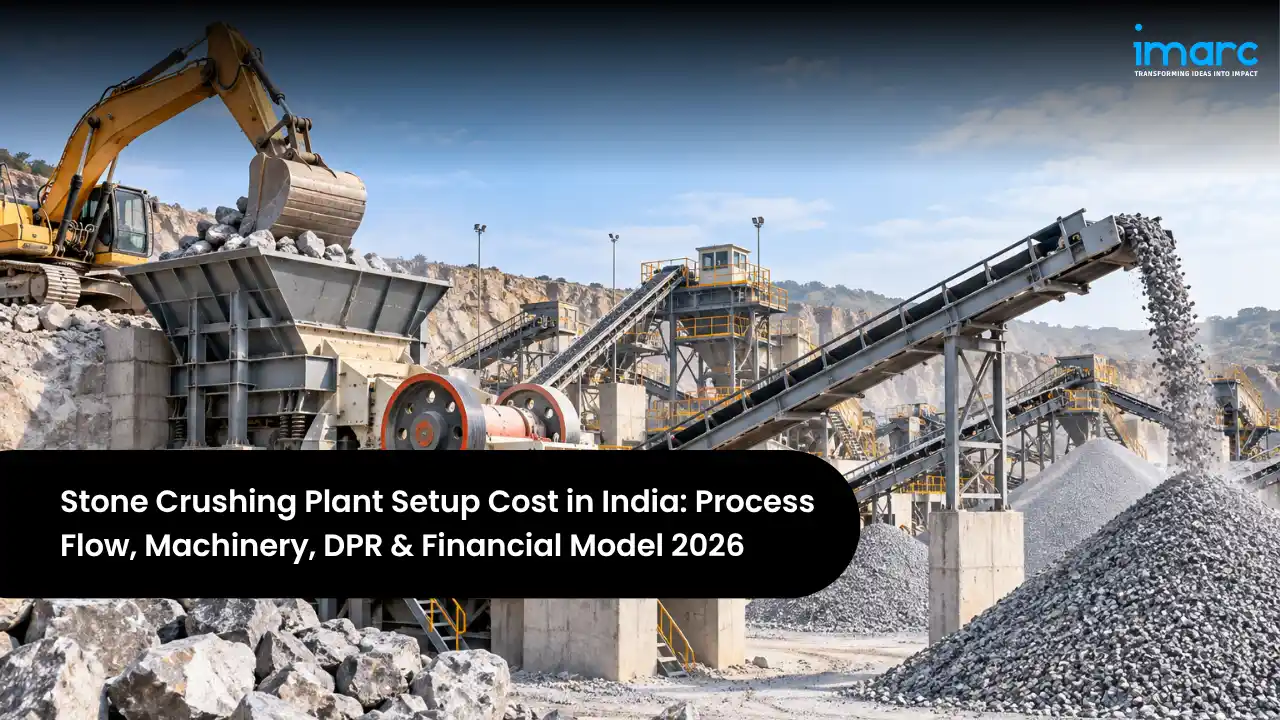
Crushed stone aggregates and manufactured sand are the most widely used construction materials after water. They form the bulk of concrete, the base layers of roads and runways, railway ballast, and the fill under buildings, factories, and ports. India's record investment in highways, expressways, railways, metros, housing, and industrial corridors is driving strong, sustained demand. At the same time, courts and regulators have restricted river sand mining, pushing builders towards manufactured sand from crushers. These trends make Stone Crushing Manufacturing Plant Setup in India a practical and well-established opportunity for investors who can secure good rock reserves, the necessary leases, and compliant operations.
Investment depends on crushing capacity in tonnes per hour, the product range, whether the plant includes a captive quarry with drilling and earthmoving equipment, and whether it adds manufactured sand production with washing. The Stone Crushing Manufacturing Plant Cost ranges from about INR 1.5–4 crore for a small 50 to 100 tonnes per hour crusher, through INR 10–25 crore for a 200 to 300 tonnes per hour plant with vertical shaft impactors and sand washing, to INR 40–80 crore for a large integrated quarry and crushing complex. Power, fuel, wear parts, and quarrying costs make up most of the operating cost, so rock quality, crushing efficiency, and logistics to customers are the decisions that shape profitability. At healthy utilisation, a well-run plant can deliver a gross margin of 50 to 60% and a net profit margin of 25 to 35%, with payback typically within 2 to 4 years.
This guide is written for investors trying to understand how to start a Stone Crushing manufacturing plant in India. It covers the main products and their markets, the demand drivers, the process flow, machinery and raw materials, location and infrastructure, a detailed cost and financial breakdown, the leases and approvals involved, and how a DPR and financial model turn all of this into a bankable plan.
India Market Snapshot
| Key Facts | Details |
|---|---|
| India Sand Demand | Around 900 Million Tonnes a year (industry estimate) |
| Asia-Pacific Share of Crushed Stone Market | More than 38% |
| M-Sand Standard | Manufactured sand recognised in IS 383:2016 |
| Recycled C&D Material Mandate | 5% in 2026-27, rising to 25% by 2030-31 |
| Typical Plant Capacity | 5 Lakh to 20 Lakh Tonnes a year |
| Indicative Total Investment | INR 1.5–80 Crore |
The snapshot shows huge and rising demand for aggregates and sand, with Asia-Pacific the largest regional market and India one of its biggest consumers. Restrictions on river sand mining have made manufactured sand a mainstream product, and Indian Standards now recognise it for concrete. New rules requiring the use of recycled construction and demolition materials add a further dimension, creating opportunities for crushers that can also process demolition waste. The wide investment range reflects a genuine choice between a small crusher supplying local builders and a large, integrated plant serving highway, railway, and ready mix concrete customers. The sections below work through that choice.
Investment Highlights
Indicative Project Cost in India (2026)
| Parameter | Value |
|---|---|
| Product Range | Aggregates, M-sand, plaster sand, GSB, WMM, railway ballast, and crusher dust |
| Total Project Investment | INR 1.5 – 80 Crore (capacity and scope dependent) |
| Payback Period | 2 – 4 Years |
| Net Profit Margin | 25 – 35% |
| IRR | 22 – 32% |
| Preferred States | Rajasthan, Karnataka, Telangana, Tamil Nadu, Maharashtra, Gujarat |
| Key Approvals | Quarry lease, mining plan, environmental clearance, SPCB consents, blasting permissions |
| Key Requirement | Good rock reserves, valid leases, and strong dust control |
These ranges provide a realistic frame for early planning, but actual returns depend on rock quality and reserves, royalty and quarrying costs, power and diesel prices, wear rates, distance to customers, and local competition and pricing. A site-specific Stone Crushing Feasibility Report narrows each of these assumptions to your chosen site, products, capacity, and markets.
Table of Contents
- What is Stone Crushing?
- Why is Stone Crushing Manufacturing Growing in India?
- Stone Crushing Manufacturing Process Flow
- Raw Materials Required for Stone Crushing Manufacturing
- Location, Land & Infrastructure
- Stone Crushing Manufacturing Machinery and Equipment
- Stone Crushing Manufacturing Plant Setup Cost in India (CapEx & OpEx)
- Financial Analysis and Profitability
- Licenses and Approvals for Stone Crushing Manufacturing in India
- Recent Developments in the India Stone Crushing Manufacturing Industry
- How a Stone Crushing Manufacturing Project Report and DPR Helps Investors
- Frequently Asked Questions
What is Stone Crushing?
Stone crushing reduces large rocks into graded aggregates and sand of specified sizes and shapes. Rock such as granite, basalt, limestone, or sandstone is blasted and excavated from a quarry or bought as boulders. It is then fed through a series of crushers: a jaw crusher for primary size reduction, a cone crusher for secondary crushing, and often a vertical shaft impactor that shapes particles into cubical aggregates and produces manufactured sand. Vibrating screens separate the material into sizes, and washing removes excess fines and silt from sand. Rock hardness, crusher selection, and screening efficiency determine product quality, shape, and yield.
Commercially, crushed products serve every type of construction. A Stone Crushing Manufacturing Plant can supply highway and expressway contractors, railway projects needing ballast, ready mix concrete plants and precast factories, real estate developers and building contractors, cement and lime producers in the case of limestone, and local buyers through dealers. Large infrastructure projects often set up dedicated crushers or sign long-term supply contracts.
- Roads & Highways: Granular sub-base, wet mix macadam, and bituminous aggregates.
- Concrete & Construction: Coarse aggregates and manufactured sand for RMC, precast, and site concrete.
- Railways: Track ballast meeting railway specifications.
- Building & Plaster: Plaster sand, masonry sand, and fill materials.
The Main Crushed Stone Products
Choosing the product range is an important commercial decision, because it determines crusher configuration, screening, washing, and customers:
| Product | Typical Size | Key Property | Primary Demand |
|---|---|---|---|
| Coarse Aggregates | 40 mm, 20 mm, 10–12 mm | Strength and good shape | Concrete and road works |
| Manufactured Sand (M-Sand) | Below 4.75 mm | Replaces river sand in concrete | RMC, precast, and builders |
| Plaster Sand (P-Sand) | Finer graded sand | Smooth finish | Plastering and masonry |
| GSB & WMM | Graded mixes | Road base layers | Highway contractors |
| Railway Ballast | Specified sizes | Hard, angular stone | Railway projects |
Product choice shapes the whole plant. A basic crusher with jaw, cone, and screens produces aggregates and road materials, while adding vertical shaft impactors and sand washing allows production of high-quality M-sand and plaster sand that command better prices. Railway ballast requires hard rock and specific sizing and testing. Many new entrants start with aggregates and road materials for nearby projects, then add M-sand and washing as demand from RMC plants and builders grows.
Why is Stone Crushing Manufacturing Growing in India?
Key Growth Drivers in the Indian Market
Demand is supported by infrastructure, construction, and the shift away from river sand:
- Infrastructure investment: Large public spending on highways, expressways, railways, metros, airports, and ports consumes vast quantities of aggregates.
- Housing and urbanisation: Rapid growth in housing and commercial construction drives demand for concrete aggregates and sand.
- River sand restrictions: Court and tribunal orders and state policies limiting river sand mining are accelerating the shift to M-sand.
- Ready mix concrete growth: RMC plants need consistent, graded aggregates and sand in large volumes.
- Quality standards: Indian Standards and government specifications increasingly require well-graded, cubical aggregates.
India-Specific Market Opportunity
| Segment | India Market Context | Manufacturing Role |
|---|---|---|
| Highways & Expressways | Large national and state programmes | GSB, WMM, and bituminous aggregates |
| Railways & Metros | New lines and track renewal | Ballast and concrete aggregates |
| RMC & Precast | Rapid urban growth | Consistent aggregates and M-sand |
| Real Estate & Housing | Housing schemes and urban projects | Aggregates, M-sand, and plaster sand |
| C&D Waste Recycling | New recycled content mandates | Recycled aggregates from demolition waste |
The strongest opportunities lie near growing cities and major infrastructure corridors where demand is high and transport distances are short, since aggregates are heavy and freight quickly erodes margins. Plants that produce high-quality, washed M-sand and well-shaped aggregates can serve premium RMC and infrastructure customers, while those able to process demolition waste can tap a new market created by recycled content rules.
Stone Crushing Manufacturing Process Flow
Understanding the process helps you plan the quarry, plant layout, and where yield and cost are decided. Stone crushing runs from quarrying and feeding through primary, secondary, and tertiary crushing, screening, washing, and stockpiling. Matching crushers to rock type, maintaining wear parts, and controlling dust determine product quality, cost, and compliance.
The Stone Crushing Manufacturing Process Flow
The sequence below reflects a stationary three-stage plant with M-sand production and washing. Smaller plants may use only two stages, while mobile crushers perform similar steps at project sites or quarries.
| Unit Operation | Key Activity |
|---|---|
| Quarry Drilling & Blasting | Rock broken under an approved mining plan |
| Loading & Hauling | Boulders loaded and transported to the crusher |
| Feeding & Scalping | Vibrating grizzly feeder removes fines and soil |
| Primary Crushing | Jaw crusher reduces large boulders |
| Secondary Crushing | Cone crusher reduces material further |
| Tertiary Crushing & Shaping | VSI produces cubical aggregates and M-sand |
| Screening | Vibrating screens separate products by size |
| Sand Washing & Classification | Excess fines and silt removed from sand |
| Water Recycling & Fines Handling | Water recovered; fines dewatered |
| Stockpiling, Weighing & Dispatch | Products stockpiled, weighed, and loaded |
Two factors decide profitability across this flow. The first is product yield and mix selecting the right crushers for the rock and tuning screens to market demand maximise high-value products such as M-sand and shaped aggregates while minimising low-value dust. The second is operating cost per tonne, because power or diesel, wear parts, and maintenance make up much of the cost; well-chosen crushers, choke-fed operation, timely liner replacement, and efficient conveyors keep cost per tonne low and uptime high.
Raw Materials Required for Stone Crushing Manufacturing
The main input is rock, either quarried from a captive lease or bought as boulders from quarry operators. Quarrying requires explosives, drilling consumables, and diesel for earthmoving equipment, and the operator pays royalty and related contributions to the state for every tonne mined. Because rock quality determines product quality and quarrying cost determines margins, secure, good-quality reserves are central to project planning.
| Input | Role in Process | India Sourcing | % of OpEx |
|---|---|---|---|
| Stone Boulders / Quarrying | Main raw material | Captive quarry or purchased boulders | 15–22% |
| Royalty & Statutory Contributions | Payments to the state per tonne | State mining department | 3–5% |
| Explosives & Drilling Consumables | Breaking rock in the quarry | Licensed suppliers | 2–3% |
Hard rocks such as granite and basalt are abundant in peninsular India, Rajasthan, and parts of eastern India, providing good material for aggregates and M-sand. Rock testing for strength, abrasion, and shape properties should be done early, since some rock types produce weak or flaky aggregates. A captive quarry gives better control over cost and supply but requires a lease, mining plan, and environmental clearance, while buying boulders lowers investment but exposes the plant to supply and price risk.
Location, Land & Infrastructure
Site selection for a stone crushing plant is shaped by the availability of good-quality rock under a valid lease, proximity to construction markets and infrastructure projects, road access for heavy trucks, power availability, water for dust suppression and washing, and compliance with siting rules that require distances from habitation, highways, and sensitive areas.
Choosing the Best Location for Stone Crushing Manufacturing Plant Setup
| State / Region | Why It Works | Key Advantage |
|---|---|---|
| Rajasthan | Abundant hard rock and M-sand policy support | Reserves and northern markets |
| Karnataka | Granite reserves and early M-sand adoption | Bengaluru demand and reserves |
| Telangana & Andhra Pradesh | Granite and basalt near growing cities | Hyderabad and infrastructure demand |
| Tamil Nadu | Hard rock and large construction market | Chennai and Coimbatore demand |
| Maharashtra | Basalt reserves and major projects | Mumbai, Pune, and highway demand |
| Gujarat | Rock reserves and industrial corridors | Infrastructure and port projects |
The ideal site combines a good rock deposit under a secure lease with short haul distances to major demand centres such as metropolitan areas, expressway corridors, and railway projects. Southern and western states with hard rock and large construction markets offer strong conditions, while Rajasthan has an established M-sand policy and large reserves. The final choice should weigh rock quality and reserves, distance to customers, siting rules, power, water, and local competition.
Dust Control, Safety and Quality
Stone crushers are closely regulated for dust, noise, and safety, and good environmental performance is essential for consents and community acceptance. A credible plant needs enclosed crushers and conveyors, water sprinklers or fog cannons at transfer points, paved internal roads, green belts, wind barriers, and covered transport, along with safe blasting practices, machine guarding, and trained operators. Product quality should be tested regularly for gradation, shape, and strength to meet Indian Standards and project specifications. An experienced Stone Crushing Manufacturing Consultant in India can help evaluate rock reserves, design the crushing circuit, plan dust control and safety systems, and navigate leasing and approvals so the plant operates efficiently and compliantly.
Infrastructure Requirements (200–300 TPH Plant)
| Infrastructure Element | Specification | India-Specific Note |
|---|---|---|
| Plant & Stockpile Area | 5 – 15 acres | Plus quarry lease area |
| Crusher Foundations & Structures | For crushers, screens, and conveyors | Designed for vibration loads |
| Dust Suppression System | Sprinklers, fog cannons, enclosures | Critical for consent |
| Water Supply & Recycling | For dust control and washing | Recycling ponds or thickeners |
| Power Supply | 0.5 – 2 MW | HT connection or DG sets |
| Internal Roads & Weighbridge | Paved roads and dispatch control | Reduces dust and delays |
| Explosive Magazine (Captive Quarry) | Licensed storage | Safety distances required |
Crusher foundations and structures, conveyors and stockpile areas, dust suppression and water systems, a reliable power supply, internal roads, and a weighbridge are the defining infrastructure needs. For captive quarries, a licensed explosive magazine and proper haul roads are also required. Water recycling is important where sand washing is installed, both to reduce water use and to meet environmental conditions.
Stone Crushing Manufacturing Machinery and Equipment
The equipment set covers quarrying, feeding, crushing, screening, washing, conveying, and dust control. Crushers, screens, and conveyors account for most of the plant budget, while drills, excavators, and dumpers make up the quarry fleet. The main items are summarised below.
| Equipment | Function | Key Specification |
|---|---|---|
| Drills & Excavators | Drill blast holes and load rock | Matched to quarry output |
| Dumpers & Wheel Loaders | Haul and handle material | Fleet sized to plant capacity |
| Vibrating Grizzly Feeder | Feed and scalp material | Removes soil and fines |
| Jaw Crusher | Primary crushing | Large feed opening |
| Cone Crusher | Secondary crushing | Choke-fed for best shape |
| Vertical Shaft Impactor (VSI) | Shape aggregates and make M-sand | Rock-on-rock or rock-on-anvil |
| Vibrating Screens | Separate products by size | Multi-deck screens |
| Sand Washers & Classifiers | Wash and grade sand | Removes silt and excess fines |
| Belt Conveyors & Stackers | Move and stockpile products | Covered for dust control |
| Dust Suppression System | Control dust emissions | Sprinklers, fog cannons, enclosures |
| Weighbridge, Control Panel & DG Set | Dispatch control and power | Automated operation |
Machinery should follow the rock type, product mix, and capacity plan. Hard, abrasive rocks such as granite need robust crushers and frequent wear part changes, while softer rocks such as limestone may suit impact crushers. Adding a VSI and sand washing plant allows production of premium M-sand, and mobile crushers can serve project sites or remote quarries. Automation and good conveyor design improve throughput and reduce downtime.
Stone Crushing Manufacturing Plant Setup Cost in India (CapEx & OpEx)
The tables below break down capital and operating costs for a 200 to 300 tonnes per hour plant with captive quarry, M-sand production, and washing. The final Stone Crushing Investment Cost for your project will depend on capacity, the number of crushing stages, sand washing, quarry equipment, land and lease costs, and location.
Capital Expenditure (CapEx) Cost Structure
| CapEx Component | % of Total CapEx | What It Covers |
|---|---|---|
| Crushing & Screening Plant | 40–50% | Crushers, screens, feeders, and conveyors |
| Quarry & Mobile Equipment | 15–25% | Drills, excavators, dumpers, and loaders |
| Sand Washing & Water Systems | 6–10% | Washers, classifiers, and water recycling |
| Civil Works & Electricals | 8–12% | Foundations, structures, power, and roads |
| Dust Control & Environmental Systems | 3–5% | Sprinklers, enclosures, and green belt |
| Lease, Approvals & Pre-operative | 4–8% | Lease costs, mining plan, EC, DPR |
| Working Capital | 5–8% | Spares, fuel, and receivables |
The crushing plant and quarry equipment dominate the capital budget, while leases and approvals can be a significant upfront cost depending on the state and auction outcomes. Working capital is needed for spares, fuel, and credit to contractors and dealers. A detailed Stone Crushing Business Plan should model reserves and lease tenure, royalty, quarrying and crushing costs, product mix and prices, transport distances, and payment terms together, so that funding matches the real economics of the operation.
Operating Expenditure (OpEx) Cost Structure
| OpEx Component | % of Total OpEx | India-Specific Note |
|---|---|---|
| Raw Material & Quarrying (incl. royalty) | 20–30% | Royalty rates vary by state |
| Utilities (power and diesel) | 25–35% | Crushing and earthmoving are energy-intensive |
| Wear Parts & Maintenance | 10–15% | Higher for abrasive rocks |
| Labour | 8–12% | Operators, mechanics, and quarry staff |
| Loading & Internal Transport | 5–8% | Loaders and haulage |
| Environmental Compliance & Overheads | 3–5% | Dust control and administration |
With quarrying, energy, and wear parts making up most of the cost, margins depend on efficient crushing, good maintenance, and a favourable product mix. A good operating model tracks cost per tonne, power and diesel use per tonne, wear part life, plant availability, and the share of high-value products, and tests how margins respond when diesel or power prices rise, royalty rates change, or local prices fall due to competition.
Financial Analysis and Profitability
Based on analysis of a mid-sized stone crushing plant with a captive quarry, the financial profile is strong, supported by steady construction demand, low raw material cost relative to selling price, and relatively simple technology. The profitability of Stone Crushing manufacturing business in India improves markedly with good rock reserves under a long lease, proximity to major customers, a high share of M-sand and shaped aggregates, efficient operations, and long-term supply contracts.
| Financial Metric | Indicative Value | India Context |
|---|---|---|
| Gross Profit Margin | 50–60% | With captive quarry and good location |
| Net Profit Margin | 25–35% | After depreciation and Indian corporate taxes |
| Payback Period | 2–4 Years | Faster near large projects |
| IRR (Internal Rate of Return) | 22–32% | Higher with M-sand and contracts |
| Capacity Utilization (stable ops) | 60–80% | Seasonal dip in monsoon |
| Break-even Capacity Utilization | 30–40% | Moderate fixed costs |
Location and leases decide where a plant lands within these ranges. A plant with good rock near a large city or a major infrastructure project can sell its full output at good prices, while one far from markets loses much of its margin to freight. Demand typically slows during the monsoon, and local competition can pressure prices, so contracts with infrastructure projects and RMC plants help stabilise volumes.
Returns can be strengthened by securing long lease tenures, investing in VSI and washing for premium M-sand, signing supply contracts with highway, railway, and RMC customers, optimising crushers and wear part management, and adding C&D waste recycling to meet new recycled-content demand. Reliable quality and supply are what earn repeat business from contractors and RMC producers.
Key Risks and Mitigation
The main risks are delays or disputes in obtaining leases and clearances, regulatory action over dust and siting, local price competition, seasonal demand swings, diesel and power cost increases, and safety incidents. Approval risk is reduced through thorough documentation and early applications; regulatory risk by strong dust control and compliance; price risk by product differentiation and contracts; seasonality by planning stock and maintenance around the monsoon; and safety risk by training and safe blasting practices. Promoters often work with a Stone Crushing Business Plan Consultant in India to test these scenarios before committing capital.
Licenses and Approvals for Stone Crushing Manufacturing in India
Approvals for a stone crushing plant combine mining leases for minor minerals with environmental, safety, and pollution control requirements. Promoters setting up a Stone Crushing Manufacturing Plant in India generally need the following:
- Quarry Lease & Mining Plan: A quarry or mining lease for minor minerals under the state concession rules, usually through auction, and an approved mining plan.
- Environmental Clearance: Environmental clearance for the quarry from the appropriate state or district authority.
- Pollution Control Consents: Consent to Establish and Consent to Operate for the crusher from the State Pollution Control Board, meeting siting and dust control conditions.
- Blasting & Explosives Permissions: Explosives storage license and compliance with mine safety requirements for blasting operations.
- Royalty & Transit Permits: Payment of royalty and statutory contributions, and transit passes for dispatch of minerals as required by the state.
- Power, Factory & Labour Registrations: Electricity connection, factory or mine registrations as applicable, and labour welfare registrations.
- Product Standards & Business Registration: Products meeting IS 383:2016 and project specifications, with GST, Udyam, and other business registrations.
The quarry lease, mining plan, and environmental clearance are usually the longest steps and determine whether the project can proceed, while pollution consent depends on meeting siting and dust control requirements. Plants that buy boulders rather than operating a quarry need fewer mining approvals but still require crusher consents. Planning these approvals early and maintaining strong compliance avoids costly stoppages.
Note: The exact approvals, registrations, licenses, and certification requirements may vary depending on factors such as the state, lease type, quarry size, plant capacity, products, siting conditions, and applicable regulations. Businesses are advised to undertake a detailed regulatory assessment during the project planning stage to ensure full compliance and timely implementation.
Recent Developments in the India Stone Crushing Manufacturing Industry
Several recent developments give useful context for investors considering this market:
- Shift to manufactured sand: Restrictions on river sand mining and state M-sand policies continue to push builders and RMC plants towards crushed sand.
- C&D waste rules: Rules notified in April 2025 and effective from April 1, 2026, require rising use of recycled construction and demolition materials, from 5% in 2026-27 to 25% for buildings and 15% for roads by 2030-31.
- Infrastructure momentum: Continued high public capital expenditure on roads, railways, and urban infrastructure sustains strong aggregate demand.
- Stricter dust control: Regulators and courts are paying closer attention to dust from crushers and quarries, raising the bar for compliance.
The common thread is strong construction demand combined with tighter environmental expectations and a shift towards manufactured and recycled materials. New entrants who secure good reserves, invest in modern crushing and dust control, and produce high-quality M-sand and aggregates will be best placed as India's construction boom continues through the decade.
How a Stone Crushing Manufacturing Project Report and DPR Helps Investors
A detailed DPR provides a structured roadmap for the venture, from rock reserves and market demand to plant design, equipment, leases, approvals, and economics. It helps investors decide the right capacity, crushing circuit, and product mix, estimate capital and operating expenditure, assess profitability, and identify risks before committing funds.
At its core is a detailed Stone Crushing Financial Model covering reserves and production schedule, product mix and prices, quarrying, royalty, power, diesel, and wear costs, transport, working capital, cash flows, break-even, return on investment, and payback over the lease period. Banks and investors rely on this model to judge long-term viability, which is why many promoters appoint a Stone Crushing Plant Project Report Consultant in India to prepare the report and validate its assumptions against current market data.
For a stone crushing project, a strong DPR also clarifies the geological and rock quality assessment, the crushing and washing configuration, the approval and lease strategy, and the market and logistics plan, which together are the factors most likely to decide success. By testing margins against price competition, energy costs, and demand seasonality, the report turns a construction materials opportunity into a plan that lenders and partners can trust.
Frequently Asked Questions
What are the first steps to set up a stone crushing manufacturing plant in India?
Start by identifying a site with good rock reserves and nearby demand, and test the rock quality. Then commission a feasibility study and DPR, obtain a quarry lease through the state process if you plan a captive quarry, prepare a mining plan, secure environmental clearance and pollution consents, install crushers, screens, conveyors, sand washing, and dust control systems, and build relationships with contractors, RMC plants, and dealers.
How much does it cost to set up a stone crushing manufacturing plant in India?
Investment ranges from about INR 1.5–4 crore for a small 50 to 100 tonnes per hour crusher, through INR 10–25 crore for a 200 to 300 tonnes per hour plant with M-sand and washing, to INR 40–80 crore for a large integrated quarry and crushing complex.
What are the main steps in stone crushing?
The flow runs from quarry drilling and blasting through loading and hauling, feeding and scalping, primary crushing, secondary crushing, tertiary crushing and shaping, screening, sand washing and classification, water recycling and fines handling, and stockpiling, weighing, and dispatch.
Which machinery does a stone crushing manufacturing plant need?
Key equipment includes drills, excavators, dumpers, and wheel loaders, vibrating grizzly feeders, jaw crushers, cone crushers, vertical shaft impactors, vibrating screens, sand washers and classifiers, belt conveyors and stackers, dust suppression systems, a weighbridge, control panels, and power supply.
What raw materials are used in stone crushing?
The main raw material is rock such as granite, basalt, limestone, or sandstone, quarried under a lease or bought as boulders, together with explosives and drilling consumables for quarrying and diesel and power for operations.
How profitable is a stone crushing manufacturing plant in India?
A well-run plant with good reserves and location typically earns a 50 to 60% gross margin and a 25 to 35% net margin, with payback in 2 to 4 years. Profitability depends on rock quality, royalty and energy costs, distance to customers, product mix, and local competition.
Which approvals does a stone crushing manufacturing plant need in India?
Typical approvals include a quarry lease and approved mining plan for captive quarries, environmental clearance, State Pollution Control Board consents with siting and dust conditions, explosives and blasting permissions, royalty and transit permits, power and labour registrations, and GST and business registrations.
How do I get a feasibility study or DPR for a stone crushing manufacturing project?
A detailed feasibility study and DPR covers rock reserves, market demand, crushing configuration, approvals, and full financials. Investors usually engage a Stone Crushing Manufacturing Feasibility Study Consultant with experience in mining and construction materials projects to prepare the report and validate it for lenders.
Our Clients










Contact Us
Have a question or need assistance?
Please complete the form with your inquiry or reach out to us at
Phone Number
+91-120-433-0800+1-201-971-6302
+44-113-547-7077
Previous Post

Almost every industrial process generates heat that has to be removed. Power plants, steel mills, refineries, chemical and pharmaceutical units, food processors, plastics moulders, and now data centers all rely on cooling towers, chillers, and heat rejection equipment running around the clock.
Steel is the backbone of India's economic growth. Buildings, bridges, railways, highways, ports, power plants, automobiles, machinery, and household appliances all depend on it. India is the world's second-largest steel producer, and crude steel output reached about 170 million tonnes in 2025-26.
Ready mix concrete (RMC) is concrete batched in a central plant to a precise, engineered mix design and delivered to construction sites in transit mixers, ready to pour.
Open a modular kitchen cabinet, a wardrobe shutter, or an office workstation in India today and there is a good chance it is made from medium density fibreboard.
India is the world's second-largest producer of ceramic tiles, and walking through any new apartment, mall, hospital, or metro station shows why. Tiles have replaced mosaic, stone, and plain cement floors in homes across the country, while large-format glazed vitrified slabs are now standard in premium projects.
Setting up a TMT Bar Manufacturing Plant in India is a high-demand, infrastructure-driven venture, powered by the country's massive construction and housing boom, government infrastructure spending, and steady urbanisation.
Setting up a Cement Manufacturing Plant in India is a capital-intensive, high-demand venture, powered by the country's massive infrastructure programme, housing boom, and status as the world's second-largest cement producer.
Setting up a PVC Panel Manufacturing Plant in India is a high-demand, construction-driven venture, powered by the country's building boom, fast-growing interior and renovation market, and the shift away from plywood and plaster toward affordable, waterproof panels.
Setting up an Electric Motor Manufacturing Plant in India is a high-value, engineering-driven venture, powered by the country's industrial expansion, energy-efficiency push, and the rise of electric vehicles and automation.
Setting up an Iron Ore Pellets Manufacturing Plant in India is a capital-intensive, high-demand venture, powered by the country's ambitious steel-capacity expansion, the shift toward value-added iron ore, and rising demand from blast furnaces and sponge iron units.
The Saudi Arabia construction market has emerged as one of the most closely watched construction economies in the world. The market reached USD 101.4 Billion in 2025 and is projected to reach USD 140.4 Billion by 2034, expanding at a compound annual growth rate (CAGR) of 3.6% between 2026 and 2034.
A WPC (Wood Plastic Composite) door is a type of composite door made from a combination of wood fibers or wood flour and thermoplastic resins like PVC, polyethylene, or polypropylene, with additives to improve durability and processability. The resulting composite material is then extruded or molded into door panels and frames, providing the attractive look of wood and the strength and water-resistance of plastic.
UPVC windows refer to window frames and window assemblies manufactured from ‘unplasticized polyvinyl chloride,’ which is a relatively rigid and strong thermoplastic substance. While PVC is a flexible material that requires the addition of a softening substance called a plasticizer to be formed into a durable performance material, PVC window frames and UPVC window assemblies, for instance, do not display such requirements due to the presence of unplasticizers, a component of the material that provides enhanced strength, stability, and resistance to the elements such as UV radiation, moisture, and temperature changes.
The Saudi Arabia factoring market represents a critical component of the Kingdom's evolving financial services landscape, offering businesses an increasingly popular alternative to traditional bank lending. Factoring, which involves the sale of accounts receivable to a third-party financial institution at a discount, has emerged as a vital mechanism for improving liquidity, managing cash flow, and mitigating credit risk across diverse industry sectors.
The GCC bridge construction market represents a vital component of the region's ambitious infrastructure transformation agenda, serving as a cornerstone for enhanced mobility, economic integration, and sustainable urban development across the Gulf states.
The Australia industrial couplings industry stands at a transformative juncture in 2025, propelled by technological advancement and surging demand across critical sectors. As mechanical devices connecting two shafts to transmit power and torque, industrial couplings form the backbone of machinery operations in manufacturing, mining, automotive, and energy sectors.
The Saudi Arabia real estate market stands at a pivotal juncture in its evolution, representing one of the most dynamic and transformative sectors within the Kingdom's economy. With this country having a very ambitious agenda of economic diversification and modernization, the real estate business has come out as one of the pillars of this transformation.
Steel is an alloy that consists of iron and carbon in addition to trace amounts of other elements like manganese, silicon, chromium, and nickel. The amount of carbon in steel is usually less than two percent and is an important factor in determining the strength, hardness, and ductility of steel.
Saudi Arabia’s precast concrete market reached USD 1.2 Billion in 2024 as per the IMARC Group, clear proof that off-site construction is rapidly becoming the Kingdom’s go-to building solution. With residential, commercial, and major infrastructure projects multiplying, developers are increasingly turning to precast building solutions to keep pace.
The GCC cold storage construction market represents critical infrastructure underpinning regional food security, pharmaceutical distribution, and temperature-sensitive logistics across the Arabian Peninsula. As Gulf Cooperation Council nations diversify their economies and reduce hydrocarbon dependence, robust cold chain infrastructure has emerged as a cornerstone of sustainable development planning.
PVC panels are lightweight, durable building materials made from polyvinyl chloride using extrusion or molding processes. They are available as rigid or semi-rigid sheets designed primarily for wall and ceiling cladding, partitions, and decorative finishes. Known for their excellent resistance to moisture, chemicals, termites, and corrosion, PVC panels offer a smooth surface and a clean, polished look that’s easy to maintain. Available in an extensive range of colors, textures, and patterns, these panels serve as a practical alternative to traditional materials like wood, plaster, or tiles.
Ready mix concrete (RMC) is a precisely engineered construction material produced in a controlled environment within a batching plant and delivered to construction sites in a freshly mixed, plastic state. It is formulated by combining cement, aggregates, water, and chemical or mineral admixtures in carefully proportioned quantities to achieve specific performance characteristics. Unlike site-mixed concrete, RMC ensures consistent quality, uniformity, and superior workability through automated production and quality control processes.
The construction industry across the Gulf Cooperation Council (GCC) member states is at the core of a monumental economic transformation. Far exceeding traditional building activities, the sector now serves as the principal vehicle for national economic diversification strategies, moving these nations beyond reliance on oil revenues.
Paver blocks are precast construction material made basically from cement, aggregates, sand, and pigments for constructing surfacing. They are produced in standardized shape and thickness, allowing each unit to interlock to form a strong, load-bearing surface with no need for continuous concrete pouring. Paver blocks possess high compressive strength, abrasion resistance, and are easy to lay and maintain.
The Brazil ceramic tiles market has witnessed stable growth, reflecting broader trends in the construction and building materials industries of the country. The Brazil ceramic tiles market size was valued at USD 1.6 Billion in 2025. The market is expected to reach USD 2.2 Billion by 2034, exhibiting a CAGR of 3.91% during 2026-2034.
MDF is an engineered wood product produced by breaking down hardwood or softwood residuals into wood fibers, which are then combined with resin binders under heat and pressure. MDF exhibits a homogeneous density, a smooth surface, and fine texture, ensuring a much more workable material compared to natural wood.
Float glass is a type of flat glass that is manufactured by floating molten glass on a bed of molten tin. This produces a smooth, uniform surface and consistent thickness. The float process was developed by Pilkington in the 1950s and revolutionized glassmaking because it enabled the production of large, flawless sheets of glass without needing polishing or grinding. The basic raw materials used-silica sand, soda ash, limestone, and dolomite-are heated in the furnace to a very high temperature, then continuously poured onto the tin bath, where the molten glass spreads out into an even layer. It cools and solidifies into a perfectly flat and perfectly transparent sheet. As it provides optical clarity and strength and is easily processed into coated, laminated, or toughened forms, float glass is used as a basic product for various applications, ranging from architectural and automotive to industrial applications.
ERW steel pipes can be identified as one of the most important categories of welded pipes and find wide applications in infrastructure, construction, and other industries because of their precision, cost-effectiveness, and reliability. The raw material to produce these pipes is either hot-rolled or cold-rolled steel coils that are longitudinally formed and welded by the application of high-frequency electric resistance welding.
Drill bits are specifically designed cutting instruments intended to produce cylindrical holes in various materials, ranging from soft woods and plastics to hardened steels, stone, and rock. Although they seem straightforward, drill bits consist of various specialized shapes, coatings, and materials that are designed to suit the cutting characteristics of the intended material and the requirements of the drilling task.
Concrete is among the most widely used construction materials in the world due to its strength, versatility, and durability. It is a composite material largely made of cement, water, aggregates-sand, gravel, or crushed stone-and in some cases, admixtures which give special properties to the concrete.
Clay bricks are one of the oldest and most extensively used construction materials in the globe, appreciated for their strength, durability, insulation against heat, and beauty. They are produced mainly from natural clay and shale, which are fashioned, dried, and subjected to high-temperature firing to produce a hard, dense material that can resist multiple environmental and structural stresses. The mix generally consists of alumina, silica, lime, iron oxide, and magnesia that collectively decide the color, texture, and performance properties of the brick.
Metal beam crash barriers and high mast light poles are essential infrastructural features providing security and visibility on highways, city roads, and industrial sites. Metal beam crash barriers or guardrails are made of galvanized steel beams, typically W-beam or Thrie-beam, that are designed to dissipate the impact energy on impact with a vehicle and minimize death and damage to vehicles.
Laminated plywood is an engineered wood material that is produced by laminating several layers of thin veneers of wood together with powerful adhesives and covering them with a protective or decorative laminate sheet. This amalgamation not only increases the strength of the plywood but also its beauty, which is why it is extremely versatile for use in furniture, cabinetry, floors, paneling, and interior design.
Ductile iron pipes (DIP) are a key part of new water and wastewater infrastructure, providing enhanced performance capabilities over older piping materials. Cast from ductile cast iron, a material that has the strength of steel combined with the resistance to corrosion of cast iron, these pipes are designed to endure high-pressure use while still being flexible enough to absorb stress without cracking.
The real estate sector plays a critical role in driving economic growth and shaping communities. It significantly contributes to national economies by generating jobs, influencing investment flows, and boosting government revenues through taxes. Beyond these economic benefits, real estate development directly affects the quality of life by creating homes, enhancing infrastructure, and revitalizing urban areas.
Gypsum boards, also referred to as drywall or plasterboard, are lightweight, strong and fireproof building materials that are frequently used for partitions, walls and ceilings. Constructed from a gypsum core encased in paper liners, they provide improved acoustics, cost effectiveness, and speedy installation. Gypsum boards are favoured in industrial, commercial, and residential construction because of its environmentally beneficial qualities, ability to withstand moisture, and ability to insulate against heat. They are an essential part of efficient and sustainable construction methods because of their adaptability to contemporary building processes.
A frameless shower door is a modern and aesthetically appealing bathroom fixture that has gained popularity for its sleek and minimalist design. They are constructed without the bulky metal framing that surrounds the glass panels and are typically made from thick, tempered glass that is securely attached to the wall and floor using hinges or brackets.