Cement Electric Poles Plant Setup Cost in India: Manufacturing Process Flow, Machinery, DPR & Financial Model 2026
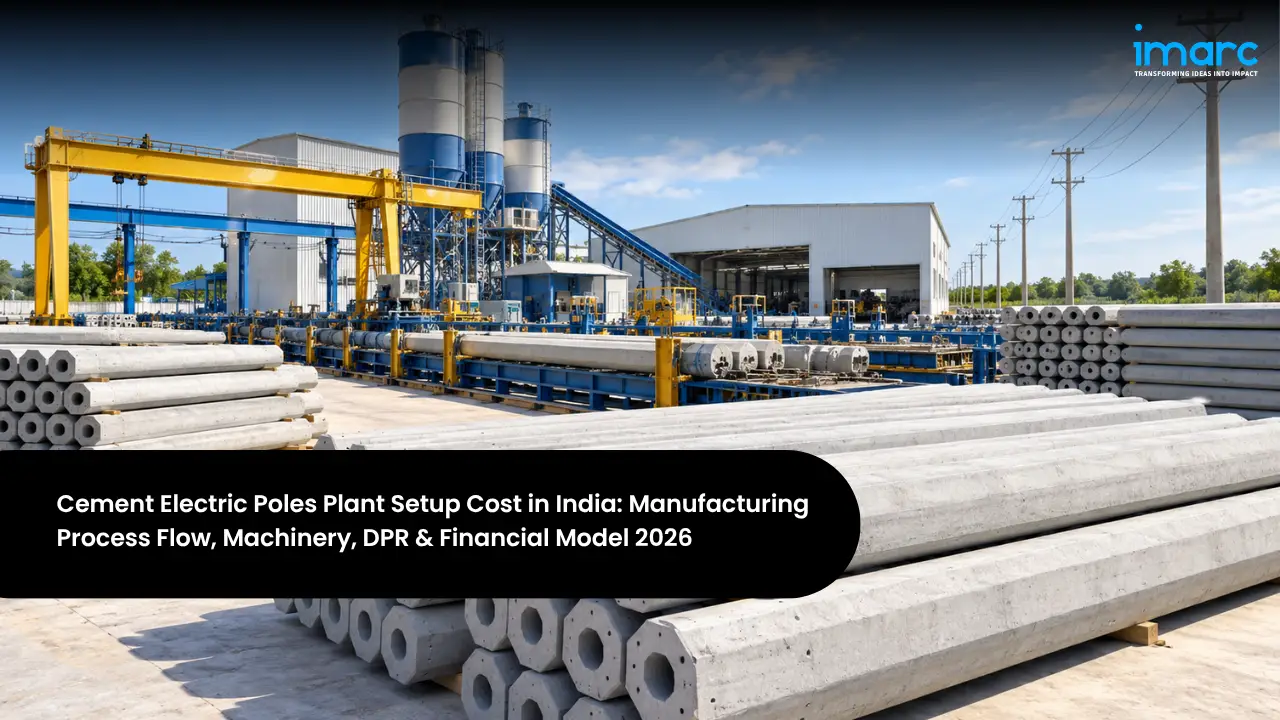
Concrete poles carry most of India's low-tension and 11 kV distribution lines, as well as street lights, rural feeders, and telecom cables. They are strong, durable, resistant to rust, rot, and termites, need almost no maintenance, and cost less than steel poles, which makes them the default choice for state power distribution companies. Large programmes to strengthen distribution networks, reduce losses, segregate agricultural feeders, extend rural supply, and light new roads and smart cities keep demand high, and India's utility poles market is projected to grow at about 7% a year. This steady, tender-driven demand, combined with modest capital requirements, makes Cement Electric Poles Manufacturing Plant Setup in India an attractive opportunity in infrastructure materials.
Investment depends above all on the pole type and the degree of mechanisation. A long-line prestressed concrete (PSC) pole yard with steel moulds, wire tensioning, and natural curing is a modest project, while a mechanised plant with a batching plant, steam curing, and gantry cranes, or a spun pole plant with centrifugal spinning machines, needs more capital. The Cement Electric Poles Manufacturing Plant Cost ranges from about INR 2–6 crore for a small long-line PSC unit of 20,000 to 50,000 poles a year to INR 8–25 crore for a mechanised PSC plant of 50,000 to 1,50,000 poles a year, and INR 25–60 crore for a spun concrete pole plant. Cement and high-tensile steel wire make up most of the 55 to 65% share of raw materials in operating cost, so input prices, freight to project sites, and tender pricing shape profitability. A well-run plant typically earns a gross margin of 30 to 40% and a net margin of 15 to 20%.
This guide is written for investors weighing how to start a Cement Electric Poles manufacturing plant in India. It focuses on a mechanised plant producing PSC poles of 8 to 11 metres for power distribution, and also explains spun concrete poles for street lighting and higher-voltage lines. It covers products and markets, the demand outlook, the production process flow, machinery and raw materials, location and infrastructure, a detailed cost and financial breakdown, approvals, and how a DPR and financial model turn all of this into a bankable plan.
India Market Snapshot
| Key Facts | Details |
|---|---|
| India Utility Poles Market (2023) | USD 3,384.8 Million |
| Projected Market Size (2030) | USD 5,433.4 Million, 7% CAGR |
| Transmission & Distribution Share (2023) | 68.03% of utility pole revenue |
| RDSS Total Outlay | About INR 3.04 Lakh Crore, deadline March 2028 |
| RDSS Loss Reduction Works Sanctioned | About INR 1.48 Lakh Crore |
| Indicative Total Investment | INR 2 Crore to 60 Crore |
The snapshot shows a steadily growing market dominated by transmission and distribution poles, supported by one of the largest distribution investment programmes in India's history. Under the Revamped Distribution Sector Scheme (RDSS), loss reduction works such as new and reconductored lines, feeder segregation, and network strengthening were only about 29% complete by mid-2025, leaving a large volume of pole-intensive work still to be executed before the March 2028 deadline. The wide investment range reflects a real choice between a regional PSC pole yard and a larger spun pole plant. The sections below work through that choice.
Investment Highlights
Indicative Project Cost in India (2026)
| Parameter | Value |
|---|---|
| Product Range | PSC poles (8–11 m), spun concrete poles, and RCC poles |
| Plant Capacity | 50,000 – 1,50,000 poles per year (mechanised plant) |
| Total Project Investment | INR 2 Crore (small PSC unit) to 25–60 Crore (spun pole plant) |
| Payback Period | 3 – 6 Years |
| Net Profit Margin | 15 – 20% |
| IRR | 18 – 25% |
| Preferred States | Uttar Pradesh, Bihar, Rajasthan, Madhya Pradesh, Maharashtra, Odisha |
| Key Requirement | Discom vendor approval, steady orders, and nearby raw materials |
These ranges provide a realistic frame for early planning, but actual returns depend on the order book from power distribution companies and their contractors, tender pricing, cement and steel wire prices, freight distances to project sites, payment cycles, and capacity utilisation through the year. A site-specific Cement Electric Poles Feasibility Report narrows each of these assumptions to your chosen pole types, capacity, location, and customers.
Table of Contents
- What are Cement Electric Poles Manufacturing?
- Why is Cement Electric Poles Manufacturing Growing in India?
- Cement Electric Poles Manufacturing Process Flow
- Raw Materials Required for Cement Electric Poles Manufacturing
- Location, Land & Infrastructure
- Cement Electric Poles Manufacturing Machinery and Equipment
- Cement Electric Poles Manufacturing Plant Setup Cost in India (CapEx & OpEx)
- Financial Analysis and Profitability
- Licenses and Approvals for Cement Electric Poles Manufacturing in India
- Recent Developments in the India Cement Electric Poles Manufacturing Industry
- How a Cement Electric Poles Manufacturing Project Report and DPR Helps Investors
- Frequently Asked Questions
What are Cement Electric Poles Manufacturing?
Cement electric poles are precast concrete poles that support overhead power lines, street lights, and communication cables. Most distribution poles in India are prestressed cement concrete (PSC) poles, in which high-tensile steel wires are stretched before high-strength concrete is cast around them; once the concrete hardens, the wires are released, compressing the concrete and giving a slender, crack-resistant pole that can carry the bending loads of conductors and wind. Spun concrete poles are made by spinning concrete in a rotating mould to form a dense, hollow section, while reinforced cement concrete (RCC) poles use ordinary steel reinforcement without prestressing.
Commercially, pole demand is driven by power and infrastructure projects. A Cement Electric Poles Manufacturing Plant can supply state power distribution companies, turnkey contractors executing distribution and rural electrification works, municipal bodies and smart city projects for street lighting, highway and railway authorities, telecom and cable operators, industrial estates, and export markets in Africa and South Asia. Buyers value compliance with specifications, consistent strength, timely delivery to project sites, and competitive pricing.
- Power Distribution: Poles for LT lines, 11 kV feeders, and 33 kV lines in urban and rural networks.
- Street & Highway Lighting: Spun and decorative poles for roads, highways, and smart cities.
- Rural Electrification & Agriculture: Poles for feeder segregation, agricultural connections, and new villages.
- Telecom & Other Uses: Poles for cables, fencing, railways, and industrial estates.
The Main Pole Types and Applications
Choosing the pole types and sizes is the most important commercial decision, because it determines moulds, process, capital cost, and customers:
| Pole Type | Description | Key Property | Primary Demand |
|---|---|---|---|
| PSC Poles (8 m and 9 m) | Prestressed, cast on long-line beds | Light and crack-resistant | LT and 11 kV distribution lines |
| PSC Poles (11 m and above) | Larger prestressed sections | Higher load capacity | 11 kV and 33 kV lines |
| Spun Concrete Poles | Centrifugally cast hollow poles | High strength, smooth finish | 33–66 kV lines, street lighting |
| RCC Poles | Reinforced without prestressing | Simple to produce | Low-load and rural uses |
| Street Light & Decorative Poles | Finished spun or shaped poles | Appearance and durability | Roads, highways, smart cities |
| Telecom & Fencing Poles | Smaller precast sections | Low cost, long life | Cables, fencing, railways |
These choices shape the whole plant. PSC poles of 8 to 11 metres are the volume product for distribution companies and can be made on long-line beds with relatively simple equipment, while spun poles need spinning machines and heavier handling but command higher prices in lighting, metro, and higher-voltage applications. Most new entrants therefore start with PSC poles to the specifications of their state's distribution companies, secure vendor approval and repeat orders, and add spun or street light poles as their customer base widens.
Why is Cement Electric Poles Manufacturing Growing in India?
Key Growth Drivers in the Indian Market
Demand is supported by distribution network investment, rural and agricultural electrification, urban infrastructure, and the replacement of ageing poles:
- Distribution network strengthening: RDSS loss reduction works include new and reconductored lines, feeder segregation, and network strengthening, all of which use large numbers of poles.
- Rural and agricultural supply: Separate agricultural feeders, solar pumps, and new rural connections extend LT and 11 kV networks.
- Urban growth and street lighting: New roads, highways, housing, and smart city projects need street lighting and distribution poles.
- Replacement demand: Damaged, rusted, or ageing poles and wooden or rail poles in older networks are replaced with concrete poles.
- Cost and durability advantage: Concrete poles cost less than steel poles, do not rust or rot, and need little maintenance, so utilities specify them widely.
India-Specific Market Opportunity
| Segment | India Market Context | Manufacturing Role |
|---|---|---|
| State Discoms | Large RDSS and state-funded works | PSC poles to discom specifications |
| Turnkey Contractors | Execute distribution packages | Bulk supply to project sites |
| Rural & Agricultural Feeders | Feeder segregation and solar pumps | Volume PSC poles |
| Urban & Highway Lighting | Smart cities and road building | Spun and street light poles |
The strongest opportunity for new entrants lies in regional supply to distribution companies and their contractors, where proximity to project sites keeps freight low and vendor approval with one or two discoms can fill a plant.
Cement Electric Poles Manufacturing Process Flow
Understanding the process helps you plan equipment, yard space, and where cost and quality are decided. PSC pole production runs from raw material testing and mould preparation through wire laying and tensioning, concrete batching and casting, curing, de-tensioning, and demoulding to yard curing, testing, and dispatch. Correct prestressing force, concrete strength, and cover to steel determine whether poles pass load tests, while cement use, mould turnaround, and breakage are the largest controllable costs.
The Cement Electric Poles Manufacturing Process Flow
The sequence below reflects a mechanised long-line PSC pole plant. A spun pole plant replaces long-line casting with filling and closing individual moulds, spinning them at high speed to compact the concrete, and then steam curing.
| Unit Operation | Key Activity |
|---|---|
| Raw Material Testing | Cement, aggregates, and HT wire checked |
| Mould Preparation | Steel moulds cleaned, oiled, and aligned |
| Wire Laying & Tensioning | HT wires laid and pretensioned by hydraulic jacks |
| Fixtures & Inserts | Stirrups, earthing, and bolt holes placed |
| Concrete Batching | High-strength concrete mixed to design |
| Casting & Vibration | Concrete poured and compacted |
| Initial Curing | Steam or controlled curing to early strength |
| De-tensioning & Demoulding | Wires released and cut, poles lifted out |
| Yard Curing & Stacking | Water curing and stacking by type |
| Testing, Marking & Dispatch | Load tests, inspection, and loading for sites |
Two factors decide profitability across this flow. The first is mould turnaround steam curing allows moulds to be reused every day rather than every few days, raising output from the same casting beds and reducing the number of costly moulds needed. The second is quality consistency, because poles that fail load tests or crack in handling are scrapped, so accurate tensioning, proper concrete mix design and compaction, and careful lifting and stacking protect both margins and vendor ratings.
Raw Materials Required for Cement Electric Poles Manufacturing
The main inputs are ordinary Portland cement, high-tensile prestressing steel wire, coarse aggregates, sand, and water, together with stirrups and fittings, admixtures, and mould release oil. Because cement and steel wire make up most of the material cost and their prices move with commodity markets, reliable supply contracts and efficient mix design are central to project planning.
| Raw Material | Role in Process | India Sourcing | % of OpEx |
|---|---|---|---|
| Cement (OPC 53 grade) | Binds the concrete | Domestic cement plants | 20–25% |
| High-Tensile Steel Wire | Prestressing reinforcement | Domestic wire makers | 18–22% |
| Coarse Aggregates & Sand | Bulk of the concrete | Local quarries and crushers | 8–10% |
| Stirrups, Fittings & Earthing | Shear steel and pole hardware | Domestic suppliers | 4–6% |
| Admixtures, Mould Oil & Water | Workability and release | Domestic suppliers | 1–2% |
India's large cement and steel wire industries give pole makers dependable domestic supply, and crushed stone and manufactured sand are available in most regions. Because aggregates and sand are bulky and prices vary locally, sourcing from nearby crushers keeps costs down.
Location, Land & Infrastructure
Site selection for a pole plant is shaped by proximity to demand from distribution companies and project sites, availability of cement, aggregates, and steel wire, road access for heavy trailers, availability of large flat land for casting beds and stacking yards, water, power, and the procurement practices of the state discoms. Because poles are heavy and bulky, freight to sites often limits economical supply to a few hundred kilometres, so many producers locate close to their main customers.
Choosing the Best Location for Cement Electric Poles Manufacturing Plant Setup
| State / Region | Why It Works | Key Advantage |
|---|---|---|
| Uttar Pradesh | Very large distribution network | High discom and contractor demand |
| Bihar & Jharkhand | Rural network strengthening | Eastern demand and contractors |
| Rajasthan & Madhya Pradesh | Vast rural and agricultural networks | Demand and nearby cement plants |
| Maharashtra & Gujarat | Urban, industrial, and agricultural load | Demand, cement, and wire supply |
| Odisha & Chhattisgarh | Cement and steel clusters | Raw materials and eastern markets |
| Southern States | Large discom networks, concrete pole push | Regional demand and ports |
Uttar Pradesh, Bihar, Rajasthan, and Madhya Pradesh suit plants targeting large rural and agricultural distribution works, while Maharashtra and Gujarat combine strong demand with cement and wire supply. Odisha and Chhattisgarh offer raw material advantages, and southern states provide sizeable regional markets with port access for exports. The final choice should weigh discom demand and vendor approval prospects, freight distances, raw material supply, land for yards, and water.
Quality, Safety and Environmental Systems
Poles must be made to the relevant Indian Standards, such as IS 1678 for prestressed concrete poles and IS 13158 for spun poles, and to the drawings and specifications of each distribution company, which typically inspect or appoint third-party inspectors before dispatch. A credible plant needs a laboratory for cement, aggregate, wire, and concrete cube testing, a pole load testing rig, records of tensioning force and curing for each batch, and traceable marking on every pole. Wire tensioning stores large amounts of energy and poles are heavy, so tensioning guards, crane safety, and handling procedures are essential, along with dust control at the batching plant and recycling of wash water. An experienced Cement Electric Poles Manufacturing Consultant in India can help plan pole designs, mould sets, curing, quality systems, and discom vendor approval so the plant meets specifications from the start.
Infrastructure Requirements (Mechanised PSC Pole Plant)
| Infrastructure Element | Specification | India-Specific Note |
|---|---|---|
| Total Land Area | 3 – 8 acres | Large yards for casting and stacking |
| Casting Beds | Long-line beds with anchor blocks | Sized for 8–11 m poles |
| Curing System | Steam boiler or curing chambers | Raises mould turnaround |
| Batching Plant | 15 – 30 m3 per hour | Close to casting beds |
| Power Supply | LT or HT connection, 100 – 300 kW | Batching, cranes, and vibrators |
| Water Supply | Mixing and curing water | Recycling of wash water |
| Stacking Yard & Access | Hard-standing yard and gantry | Access for heavy trailers |
Large, level land with well-built casting beds and a hard-standing stacking yard is the most important infrastructure requirement, since output is limited by bed length and curing time. A steam curing system, a reliable batching plant, gantry cranes or hydraulic loaders, water for mixing and curing, and good road access for trailers complete the core needs.
Cement Electric Poles Manufacturing Machinery and Equipment
The equipment set covers raw material handling, concrete batching, mould and wire handling, prestressing, casting, curing, demoulding, handling, and testing. Moulds, the batching plant, tensioning equipment, and cranes account for most of the machinery budget. The main items are summarised below.
| Equipment | Function | Key Specification |
|---|---|---|
| Concrete Batching Plant | Weigh and mix concrete | Accurate dosing of cement and water |
| Steel Pole Moulds | Shape the poles | Sets for each pole length and type |
| Wire Decoiler & Cutting Machine | Prepare HT wires | Straight, accurate cut lengths |
| Hydraulic Prestressing Jacks | Tension wires | Calibrated force measurement |
| Anchor Blocks & Long-Line Beds | Hold tensioned wires | Rigid, load-rated structure |
| Vibrators | Compact concrete | Table or needle vibrators |
| Steam Boiler & Curing System | Accelerate curing | Controlled temperature cycle |
| Spinning Machines (spun poles) | Spin moulds to compact concrete | Variable speed control |
| Gantry Cranes & Loaders | Lift and stack poles | Safe working load for long poles |
| Stirrup Bending Machine | Make shear reinforcement | Repeatable shapes |
| Testing Laboratory & Load Rig | Test materials and poles | Cube testing and transverse load test |
Machinery should follow the pole types and capacity plan. A long-line PSC plant needs moulds, jacks, anchor blocks, vibrators, and handling equipment, while a spun pole plant adds spinning machines, heavier moulds, and stronger cranes. Investing in a batching plant, steam curing, and enough moulds to keep beds working every day raises output and consistency.
Cement Electric Poles Manufacturing Plant Setup Cost in India (CapEx & OpEx)
The tables below break down capital and operating costs for a mid-sized mechanised PSC pole plant in India. The final Cement Electric Poles Investment Cost for your project will depend on capacity, pole types and lengths, the number of moulds and beds, curing method, any spun pole line, the level of mechanisation, and location.
Capital Expenditure (CapEx) Cost Structure
| CapEx Component | % of Total CapEx | What It Covers |
|---|---|---|
| Plant & Machinery | 30–40% | Batching plant, jacks, cranes, curing, lab |
| Moulds & Casting Beds | 10–15% | Mould sets, beds, and anchor blocks |
| Civil Works & Buildings | 12–18% | Sheds, stores, office, foundations |
| Land & Yard Development | 8–12% | Land, hard-standing yards, and roads |
| Utilities & Curing Systems | 4–6% | Power, water, and steam distribution |
| Pre-operative & Contingency | 3–5% | Engineering, DPR, approvals, buffer |
| Working Capital | 12–18% | Materials, pole stock, and receivables |
Machinery, moulds, and yard development make up most of the fixed investment, which is modest compared with many manufacturing projects. Working capital takes a larger share than usual, because pole stocks must be built ahead of project seasons and distribution companies and contractors often pay after inspection and delivery, sometimes with delays. Because orders come through tenders and contractor packages, a detailed Cement Electric Poles Business Plan should model order inflows, tender prices, raw material costs, freight, and payment cycles together, so that funding can carry the plant through uneven demand.
Operating Expenditure (OpEx) Cost Structure
| OpEx Component | % of Total OpEx | India-Specific Note |
|---|---|---|
| Raw Materials (cement, wire, aggregates) | 55–65% | Cement and HT wire dominate |
| Utilities (power, steam fuel, water) | 15–20% | Steam curing and batching |
| Labour | 8–12% | Casting, tensioning, and yard crews |
| Logistics (delivery to sites) | 6–10% | Heavy trailers to project locations |
| Maintenance & Mould Upkeep | 2–4% | Moulds, jacks, and cranes |
| Overheads, Testing & Inspection | 2–3% | Laboratory and third-party inspection |
With raw materials making up most of the cost, margins depend on cement and wire prices, mix efficiency, breakage rates, freight, and tender prices. A good operating model tracks cost per pole by type, cement consumption per cubic metre, mould turnaround, rejection and breakage rates, freight per pole, and receivable days, and tests how margins respond when cement or steel wire prices rise or when tender prices fall.
Financial Analysis and Profitability
Based on analysis of a mid-sized mechanised PSC pole plant, the financial profile is healthy, supported by steady demand from power distribution works and modest capital requirements, but returns depend on order flow and on collecting payments on time. The profitability of Cement Electric Poles manufacturing business in India improves markedly with vendor approvals across several discoms, short freight distances, efficient curing and mould use, good raw material pricing, and disciplined working capital management.
| Financial Metric | Indicative Value | India Context |
|---|---|---|
| Gross Profit Margin | 30–40% | Depends on tender prices and inputs |
| Net Profit Margin | 15–20% | After depreciation and Indian corporate taxes |
| Payback Period | 3–6 Years | Faster with steady discom orders |
| IRR (Internal Rate of Return) | 18–25% | Higher with spun and lighting poles |
| Capacity Utilization (stable ops) | 60–80% | Depends on order book and season |
| Break-even Capacity Utilization | 40–50% | Modest fixed costs |
Order flow and cost position decide where a plant lands within these ranges. Plants with approvals from several distribution companies and relationships with major contractors keep utilisation high, while plants dependent on a single buyer face idle periods between tenders.
Returns can be strengthened by securing vendor approvals in neighbouring states, adding steam curing to raise output per mould, optimising mix design to save cement, adding spun or street light poles, building relationships with turnkey contractors, and locating close to major project clusters.
Key Risks and Mitigation
The main risks are dependence on government-funded programmes and tender cycles, delayed payments, cement and steel wire price increases, intense local competition, freight costs, and quality rejections at inspection. Programme risk is reduced through diversified customers and regions; payment risk by contract terms, channel financing, and careful credit limits; input risk by price variation clauses where available; competition risk by cost efficiency and quality; and rejection risk by strong process control. Promoters often work with a Cement Electric Poles Business Plan Consultant in India to test these scenarios before committing capital.
Licenses and Approvals for Cement Electric Poles Manufacturing in India
Approvals for a pole plant combine industrial and environmental permits with product standards and vendor approval from buyers. Promoters setting up a Cement Electric Poles Manufacturing Plant in India generally need the following:
- Pollution Control Consents: Consent to Establish and Consent to Operate from the State Pollution Control Board, covering dust from batching and aggregate handling.
- Product Standards & Certification: Production to IS 1678, IS 13158, or other applicable standards, with BIS certification where required by buyers.
- Discom Vendor Approval: Vendor registration and type testing with state distribution companies, and registration on GeM and tender portals.
- Factory & Safety Approvals: Factory license under the Occupational Safety, Health and Working Conditions Code, 2020, boiler registration under the Boilers Act for steam curing, and Fire NOC.
- Land & Local Permits: Industrial land use approval, building plan approval, and trade license from the local authority.
- Power & Water Approvals: Electricity connection and groundwater or water supply permissions.
- Business & Trade Registrations: Company incorporation, GST, Udyam where applicable, IEC for exports, and EPF and ESI registrations.
Discom vendor approval and type testing are usually on the critical path, since a plant cannot bid for most distribution works until its poles are approved, while pollution consents and the factory license are needed before production. Planning approvals, sample production, and vendor registration in parallel with construction shortens the time from investment decision to the first orders.
Note: The exact approvals, registrations, licenses, and certification requirements may vary depending on factors such as plant location, capacity, pole types, buyer specifications, export markets, and applicable regulations. Businesses are advised to undertake a detailed regulatory assessment during the project planning stage to ensure full compliance and timely implementation.
Recent Developments in the India Cement Electric Poles Manufacturing Industry
Several recent developments give useful context for investors considering this market:
- RDSS works pipeline: By June 2025, loss reduction works worth about INR 1.48 lakh crore had been sanctioned under RDSS, with physical progress of about 29%, and the scheme deadline now runs to March 2028.
- Network modernisation: By mid-2025, RDSS had modernised more than 2 lakh circuit kilometres of lines and 3 lakh transformers, with much more work still to be executed.
- Concrete pole adoption: In February 2026, Karnataka's electricity regulator planned amendments to supply conditions to implement concrete electricity poles and improve network stability.
- Export demand: Countries in Africa are replacing wooden poles with concrete, such as Cameroon’s plan to install 50,000 concrete poles in 2025 under an African Development Bank-funded project.
The common thread is a large and continuing pipeline of distribution works, growing preference for durable concrete poles, and new export opportunities.
How a Cement Electric Poles Manufacturing Project Report and DPR Helps Investors
A detailed DPR provides a structured roadmap for the venture, from demand from distribution companies and contractors to plant design, machinery, raw material sourcing, approvals, and economics. It helps investors decide the right pole types, capacity, and location, estimate capital and operating expenditure, assess profitability, and identify risks before committing funds.
At its core is a detailed Cement Electric Poles Financial Model covering revenue by pole type and customer, tender prices, cement and wire costs, mould turnaround, labour and freight, working capital and receivable days, debt servicing, cash flows, break-even, return on investment, and payback under different order and price scenarios. Banks and investors rely on this model to judge long-term viability, which is why many promoters appoint a Cement Electric Poles Plant Project Report Consultant in India to prepare the report and validate its assumptions against current market data.
For a pole project, a strong DPR also clarifies the vendor approval plan, the target discoms and contractors, the phasing of spun or lighting pole lines, and the working capital strategy, which together are the factors most likely to decide success. By testing margins against slow orders, payment delays, and input price swings, the report turns a steady infrastructure opportunity into a plan that lenders and partners can trust.
Frequently Asked Questions
What are the first steps to set up a cement electric poles manufacturing plant in India?
Start by studying demand from distribution companies and contractors in your region, and choose pole types, capacity, and location. Then commission a feasibility study and DPR, secure land with space for beds and yards, obtain pollution consents and the factory license, build casting beds, install the batching plant, moulds, and tensioning equipment, produce sample poles for type testing, and register as an approved vendor before bidding for orders.
How much does it cost to set up a cement electric poles manufacturing plant in India?
Investment ranges from about INR 2–6 crore for a small long-line PSC unit of 20,000 to 50,000 poles a year to INR 8–25 crore for a mechanised PSC plant of 50,000 to 1,50,000 poles a year, and INR 25–60 crore for a spun concrete pole plant.
What are the main steps in cement electric poles manufacturing?
The flow runs from raw material testing through mould preparation, wire laying and tensioning, placing fixtures and inserts, concrete batching, casting and vibration, initial curing, de-tensioning and demoulding, yard curing and stacking, and testing, marking, and dispatch.
Which machinery does a cement electric poles manufacturing plant need?
Key equipment includes a concrete batching plant, steel pole moulds, wire decoilers and cutters, hydraulic prestressing jacks, anchor blocks and long-line beds, vibrators, a steam boiler and curing system, spinning machines for spun poles, gantry cranes or loaders, a stirrup bending machine, and a testing laboratory with a load rig.
What raw materials are used to make cement electric poles?
The main inputs are OPC 53 grade cement, high-tensile prestressing steel wire, coarse aggregates, sand, and water, along with stirrups, fittings and earthing hardware, admixtures, and mould release oil.
How profitable is a cement electric poles manufacturing business in India?
A well-run plant typically earns a 30 to 40% gross margin and a 15 to 20% net margin, with payback in about 3 to 6 years. Profitability depends on order flow, tender prices, cement and wire costs, freight, and payment cycles.
Which approvals does a cement electric poles manufacturing plant need in India?
Typical approvals include State Pollution Control Board consents, production to applicable Indian Standards with BIS certification where required, discom vendor approval and type testing, a factory license, boiler registration for steam curing, Fire NOC, power and water approvals, and GST and labour registrations.
How do I get a feasibility study or DPR for a cement electric poles manufacturing project?
A detailed feasibility study and DPR covers demand, pole specifications, raw materials, plant design, approvals, and full financials. Investors usually engage a Cement Electric Poles Manufacturing Feasibility Study Consultant with experience in precast concrete and power infrastructure projects to prepare the report and validate it for lenders.
Our Clients










Contact Us
Have a question or need assistance?
Please complete the form with your inquiry or reach out to us at
Phone Number
+91-120-433-0800+1-201-971-6302
+44-113-547-7077
Previous Post

Crushed stone aggregates and manufactured sand are the most widely used construction materials after water. They form the bulk of concrete, the base layers of roads and runways, railway ballast, and the fill under buildings, factories, and ports.
Almost every industrial process generates heat that has to be removed. Power plants, steel mills, refineries, chemical and pharmaceutical units, food processors, plastics moulders, and now data centers all rely on cooling towers, chillers, and heat rejection equipment running around the clock.
Steel is the backbone of India's economic growth. Buildings, bridges, railways, highways, ports, power plants, automobiles, machinery, and household appliances all depend on it. India is the world's second-largest steel producer, and crude steel output reached about 170 million tonnes in 2025-26.
Ready mix concrete (RMC) is concrete batched in a central plant to a precise, engineered mix design and delivered to construction sites in transit mixers, ready to pour.
Open a modular kitchen cabinet, a wardrobe shutter, or an office workstation in India today and there is a good chance it is made from medium density fibreboard.
India is the world's second-largest producer of ceramic tiles, and walking through any new apartment, mall, hospital, or metro station shows why. Tiles have replaced mosaic, stone, and plain cement floors in homes across the country, while large-format glazed vitrified slabs are now standard in premium projects.
Setting up a TMT Bar Manufacturing Plant in India is a high-demand, infrastructure-driven venture, powered by the country's massive construction and housing boom, government infrastructure spending, and steady urbanisation.
Setting up a Cement Manufacturing Plant in India is a capital-intensive, high-demand venture, powered by the country's massive infrastructure programme, housing boom, and status as the world's second-largest cement producer.
Setting up a PVC Panel Manufacturing Plant in India is a high-demand, construction-driven venture, powered by the country's building boom, fast-growing interior and renovation market, and the shift away from plywood and plaster toward affordable, waterproof panels.
Setting up an Electric Motor Manufacturing Plant in India is a high-value, engineering-driven venture, powered by the country's industrial expansion, energy-efficiency push, and the rise of electric vehicles and automation.
Setting up an Iron Ore Pellets Manufacturing Plant in India is a capital-intensive, high-demand venture, powered by the country's ambitious steel-capacity expansion, the shift toward value-added iron ore, and rising demand from blast furnaces and sponge iron units.
The Saudi Arabia construction market has emerged as one of the most closely watched construction economies in the world. The market reached USD 101.4 Billion in 2025 and is projected to reach USD 140.4 Billion by 2034, expanding at a compound annual growth rate (CAGR) of 3.6% between 2026 and 2034.
A WPC (Wood Plastic Composite) door is a type of composite door made from a combination of wood fibers or wood flour and thermoplastic resins like PVC, polyethylene, or polypropylene, with additives to improve durability and processability. The resulting composite material is then extruded or molded into door panels and frames, providing the attractive look of wood and the strength and water-resistance of plastic.
UPVC windows refer to window frames and window assemblies manufactured from ‘unplasticized polyvinyl chloride,’ which is a relatively rigid and strong thermoplastic substance. While PVC is a flexible material that requires the addition of a softening substance called a plasticizer to be formed into a durable performance material, PVC window frames and UPVC window assemblies, for instance, do not display such requirements due to the presence of unplasticizers, a component of the material that provides enhanced strength, stability, and resistance to the elements such as UV radiation, moisture, and temperature changes.
The Saudi Arabia factoring market represents a critical component of the Kingdom's evolving financial services landscape, offering businesses an increasingly popular alternative to traditional bank lending. Factoring, which involves the sale of accounts receivable to a third-party financial institution at a discount, has emerged as a vital mechanism for improving liquidity, managing cash flow, and mitigating credit risk across diverse industry sectors.
The GCC bridge construction market represents a vital component of the region's ambitious infrastructure transformation agenda, serving as a cornerstone for enhanced mobility, economic integration, and sustainable urban development across the Gulf states.
The Australia industrial couplings industry stands at a transformative juncture in 2025, propelled by technological advancement and surging demand across critical sectors. As mechanical devices connecting two shafts to transmit power and torque, industrial couplings form the backbone of machinery operations in manufacturing, mining, automotive, and energy sectors.
The Saudi Arabia real estate market stands at a pivotal juncture in its evolution, representing one of the most dynamic and transformative sectors within the Kingdom's economy. With this country having a very ambitious agenda of economic diversification and modernization, the real estate business has come out as one of the pillars of this transformation.
Steel is an alloy that consists of iron and carbon in addition to trace amounts of other elements like manganese, silicon, chromium, and nickel. The amount of carbon in steel is usually less than two percent and is an important factor in determining the strength, hardness, and ductility of steel.
Saudi Arabia’s precast concrete market reached USD 1.2 Billion in 2024 as per the IMARC Group, clear proof that off-site construction is rapidly becoming the Kingdom’s go-to building solution. With residential, commercial, and major infrastructure projects multiplying, developers are increasingly turning to precast building solutions to keep pace.
The GCC cold storage construction market represents critical infrastructure underpinning regional food security, pharmaceutical distribution, and temperature-sensitive logistics across the Arabian Peninsula. As Gulf Cooperation Council nations diversify their economies and reduce hydrocarbon dependence, robust cold chain infrastructure has emerged as a cornerstone of sustainable development planning.
PVC panels are lightweight, durable building materials made from polyvinyl chloride using extrusion or molding processes. They are available as rigid or semi-rigid sheets designed primarily for wall and ceiling cladding, partitions, and decorative finishes. Known for their excellent resistance to moisture, chemicals, termites, and corrosion, PVC panels offer a smooth surface and a clean, polished look that’s easy to maintain. Available in an extensive range of colors, textures, and patterns, these panels serve as a practical alternative to traditional materials like wood, plaster, or tiles.
Ready mix concrete (RMC) is a precisely engineered construction material produced in a controlled environment within a batching plant and delivered to construction sites in a freshly mixed, plastic state. It is formulated by combining cement, aggregates, water, and chemical or mineral admixtures in carefully proportioned quantities to achieve specific performance characteristics. Unlike site-mixed concrete, RMC ensures consistent quality, uniformity, and superior workability through automated production and quality control processes.
The construction industry across the Gulf Cooperation Council (GCC) member states is at the core of a monumental economic transformation. Far exceeding traditional building activities, the sector now serves as the principal vehicle for national economic diversification strategies, moving these nations beyond reliance on oil revenues.
Paver blocks are precast construction material made basically from cement, aggregates, sand, and pigments for constructing surfacing. They are produced in standardized shape and thickness, allowing each unit to interlock to form a strong, load-bearing surface with no need for continuous concrete pouring. Paver blocks possess high compressive strength, abrasion resistance, and are easy to lay and maintain.
The Brazil ceramic tiles market has witnessed stable growth, reflecting broader trends in the construction and building materials industries of the country. The Brazil ceramic tiles market size was valued at USD 1.6 Billion in 2025. The market is expected to reach USD 2.2 Billion by 2034, exhibiting a CAGR of 3.91% during 2026-2034.
MDF is an engineered wood product produced by breaking down hardwood or softwood residuals into wood fibers, which are then combined with resin binders under heat and pressure. MDF exhibits a homogeneous density, a smooth surface, and fine texture, ensuring a much more workable material compared to natural wood.
Float glass is a type of flat glass that is manufactured by floating molten glass on a bed of molten tin. This produces a smooth, uniform surface and consistent thickness. The float process was developed by Pilkington in the 1950s and revolutionized glassmaking because it enabled the production of large, flawless sheets of glass without needing polishing or grinding. The basic raw materials used-silica sand, soda ash, limestone, and dolomite-are heated in the furnace to a very high temperature, then continuously poured onto the tin bath, where the molten glass spreads out into an even layer. It cools and solidifies into a perfectly flat and perfectly transparent sheet. As it provides optical clarity and strength and is easily processed into coated, laminated, or toughened forms, float glass is used as a basic product for various applications, ranging from architectural and automotive to industrial applications.
ERW steel pipes can be identified as one of the most important categories of welded pipes and find wide applications in infrastructure, construction, and other industries because of their precision, cost-effectiveness, and reliability. The raw material to produce these pipes is either hot-rolled or cold-rolled steel coils that are longitudinally formed and welded by the application of high-frequency electric resistance welding.
Drill bits are specifically designed cutting instruments intended to produce cylindrical holes in various materials, ranging from soft woods and plastics to hardened steels, stone, and rock. Although they seem straightforward, drill bits consist of various specialized shapes, coatings, and materials that are designed to suit the cutting characteristics of the intended material and the requirements of the drilling task.
Concrete is among the most widely used construction materials in the world due to its strength, versatility, and durability. It is a composite material largely made of cement, water, aggregates-sand, gravel, or crushed stone-and in some cases, admixtures which give special properties to the concrete.
Clay bricks are one of the oldest and most extensively used construction materials in the globe, appreciated for their strength, durability, insulation against heat, and beauty. They are produced mainly from natural clay and shale, which are fashioned, dried, and subjected to high-temperature firing to produce a hard, dense material that can resist multiple environmental and structural stresses. The mix generally consists of alumina, silica, lime, iron oxide, and magnesia that collectively decide the color, texture, and performance properties of the brick.
Metal beam crash barriers and high mast light poles are essential infrastructural features providing security and visibility on highways, city roads, and industrial sites. Metal beam crash barriers or guardrails are made of galvanized steel beams, typically W-beam or Thrie-beam, that are designed to dissipate the impact energy on impact with a vehicle and minimize death and damage to vehicles.
Laminated plywood is an engineered wood material that is produced by laminating several layers of thin veneers of wood together with powerful adhesives and covering them with a protective or decorative laminate sheet. This amalgamation not only increases the strength of the plywood but also its beauty, which is why it is extremely versatile for use in furniture, cabinetry, floors, paneling, and interior design.
Ductile iron pipes (DIP) are a key part of new water and wastewater infrastructure, providing enhanced performance capabilities over older piping materials. Cast from ductile cast iron, a material that has the strength of steel combined with the resistance to corrosion of cast iron, these pipes are designed to endure high-pressure use while still being flexible enough to absorb stress without cracking.
The real estate sector plays a critical role in driving economic growth and shaping communities. It significantly contributes to national economies by generating jobs, influencing investment flows, and boosting government revenues through taxes. Beyond these economic benefits, real estate development directly affects the quality of life by creating homes, enhancing infrastructure, and revitalizing urban areas.
Gypsum boards, also referred to as drywall or plasterboard, are lightweight, strong and fireproof building materials that are frequently used for partitions, walls and ceilings. Constructed from a gypsum core encased in paper liners, they provide improved acoustics, cost effectiveness, and speedy installation. Gypsum boards are favoured in industrial, commercial, and residential construction because of its environmentally beneficial qualities, ability to withstand moisture, and ability to insulate against heat. They are an essential part of efficient and sustainable construction methods because of their adaptability to contemporary building processes.
A frameless shower door is a modern and aesthetically appealing bathroom fixture that has gained popularity for its sleek and minimalist design. They are constructed without the bulky metal framing that surrounds the glass panels and are typically made from thick, tempered glass that is securely attached to the wall and floor using hinges or brackets.