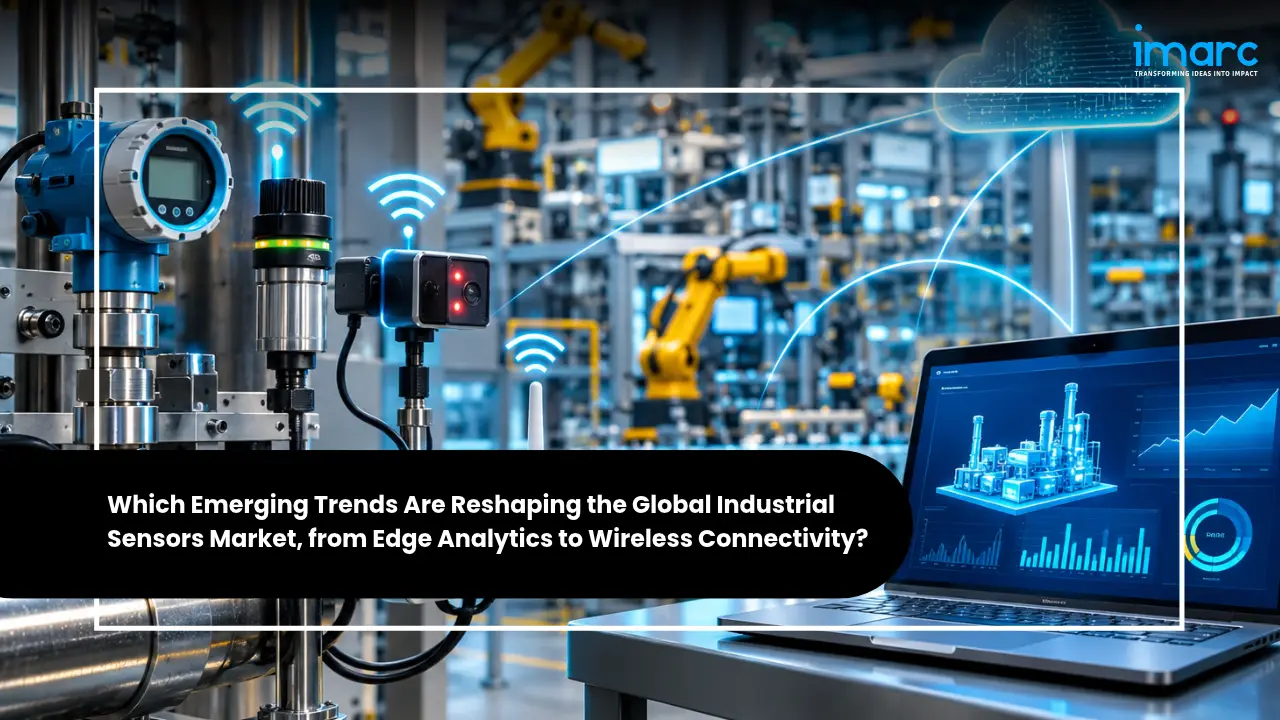
Which Emerging Trends Are Reshaping the Global Industrial Sensors Market, from Edge Analytics to Wireless Connectivity?
Introduction: Smarter Sensing Powers Industry
The industrial sensors market is moving from simple measurement hardware to connected, data-rich intelligence at the heart of modern plants. IMARC Group reports that the global market grew from USD 28.5 Billion in 2025 to USD 31.1 Billion in 2026. It expects the market to reach USD 54.0 Billion by 2034, exhibiting a CAGR of 7.14% during 2026-2034. That trajectory shows sensors becoming a structural layer of industrial operations rather than an optional add-on.
Growth is supported by wider adoption of industrial automation, the rise of the Internet of Things (IoT) and Industry 4.0 programmes, and stricter worker safety and environmental rules. A focus on energy efficiency, advances in sensor technology, rising demand for smart sensors and a shift toward predictive maintenance add further momentum. Manufacturers want to raise productivity, reduce downtime and prove compliance, and all three goals depend on reliable real-time data.
The defining theme is intelligence moving closer to the sensor. Artificial intelligence (AI), machine learning (ML) and real-time analytics are being paired with wireless and IoT-enabled devices. In March 2025, for example, onsemi launched its Hyperlux ID series, an indirect time-of-flight sensor that captures a full scene while running depth processing in real time.
This blog examines the market size and segment leaders, recent deals and launches, the three trends shaping 2026, regional hotspots, competitive strategies, the policy and risk environment, and the outlook to 2034.
Key Takeaways
- The industrial sensors market grew from USD 28.5 Billion in 2025 to USD 31.1 Billion in 2026 and is projected to reach USD 54.0 Billion by 2034, at a CAGR of 7.14% during 2026-2034.
- Level sensors are the leading sensor segment, supported by demand for accurate liquid level measurement in manufacturing, chemical and water and wastewater treatment, while manufacturing is the largest end use industry.
- North America is identified by IMARC Group as the dominant regional market, owing to its strong industrial base and early technology projects, while Asia Pacific is a major demand centre driven by industrialization in China and India.
- In January 2026, Crane Company completed its USD 1.06 billion acquisition of Precision Sensors & Instrumentation (Druck, Panametrics and Reuter-Stokes) from Baker Hughes, a sign of strong consolidation interest in specialist sensing assets.
- AI and ML integration, wireless and IoT-enabled sensors, and predictive maintenance are the key trends, with IMARC projecting the global predictive maintenance market to reach USD 80.6 Billion by 2033.
Industrial Sensors Market Size, Share & Growth Outlook
According to IMARC Group, the global industrial sensors market grew from USD 28.5 Billion in 2025 to USD 31.1 Billion in 2026 and is expected to reach USD 54.0 Billion by 2034, at a CAGR of 7.14% during 2026-2034. The 2025 to 2026 step-up shows that demand is already compounding, and the forecast implies the market will expand by roughly 1.7 times between 2026 and 2034. The leading segments are:
- Sensor: Level sensors lead the market, driven by the need for accurate and consistent liquid level measurement in manufacturing, chemical, and water and wastewater treatment.
- Type: Contact sensors are the leading segment, supported by demand for precise, reliable sensing across industrial applications and by miniaturized, more durable designs.
- End Use Industry: Manufacturing holds the largest share, as robotics and programmable logic controllers (PLCs) raise the number of sensing points per production line.
- Region: North America is identified as the dominant region on the strength of its industrial base and early technology projects, while Asia Pacific is a major demand centre led by China and India.
The leadership of level sensors and manufacturing shows where sensing value is concentrated today: process control, safety and compliance. The growth is increasingly coming from smarter, connected versions of these devices.
Recent News & Mega Announcements
Recent activity shows capital flowing toward high-value sensing assets, regional manufacturing and next-generation technologies. Key developments include:
- Crane Company and PSI (January 2026): Crane completed its acquisition of Precision Sensors & Instrumentation (PSI) from Baker Hughes on January 1, 2026, for USD 1.06 billion after adjusting for expected tax benefits (about USD 1.15 billion in cash). PSI, which serves aerospace, nuclear and process industries, generated USD 382 million in revenue in 2024. Its Druck brand has been integrated into Crane's Aerospace & Advanced Technologies segment, while Panametrics and Reuter-Stokes have joined Process Flow Technologies, where these businesses and the optek-Danulat acquisition together added 23.9% to segment sales in Q3 2026.
- Teledyne Gas & Flame Detection and IDS (June 2025): The two companies opened a 699 square metre factory in Dammam, Saudi Arabia, on June 19, 2025, to produce high-precision sensors for toxic and flammable gas detection. The plant serves oil and gas drilling units, LNG and CNG terminals, refineries and petrochemical complexes, and its locally made DM-Tox toxic gas sensor and FP-LEL and IR-LEL combustible gas sensors have since received Saudi Aramco approval.
- Industrial Scientific (June 2025): The company added H2 and CO High sensors to the Ventis Pro5, and NH3 and HCN sensors to the Tango TX2. The additions widen connected gas detection coverage across oil and gas, chemicals, utilities, mining, and fire and hazmat uses.
- Aeva Eve 1D (April 2025): Aeva launched the Eve 1 series, starting with Eve 1D, described as the first FMCW-based laser displacement sensor optimized for inline factory and process automation. It targets the USD 4 billion global laser displacement sensor market.
- onsemi Hyperlux ID (March 2025): The series is positioned as the first real-time indirect time-of-flight sensor in the industry. It enables depth sensing at distances of up to 30 meters, four times the range of traditional iToF sensors, in a more compact size.
- Aeva and SICK (December 2024): Aeva deepened its strategic alliance with SICK, a global supplier of sensor-driven industrial solutions, to bring Aeva's FMCW technology into industrial applications.
Together these announcements show three priorities: portfolio consolidation, localized production for safety-critical sensing, and a move toward more precise, longer-range and data-rich devices.
Industrial Sensors Market Trends Shaping 2026
Three connected shifts are redefining how industrial sensors are designed, deployed and valued. Each moves intelligence closer to the machine and makes sensor data more actionable.
1. AI, ML and Edge Analytics Turn Sensor Data into Predictions
Plants now generate large volumes of sensor data, and AI and ML algorithms are being used to interpret it in ways manual review cannot match. AI-enabled sensing can process complex real-time data sets, recognize patterns and flag anomalies, such as abnormal vibration and temperature signatures that signal a future mechanical fault. ML models also improve with each additional data set, becoming more accurate at detecting small changes in condition. This directly feeds predictive maintenance, which IMARC identifies as a core use of sensors in automotive, oil and gas, and manufacturing. IMARC projects the global predictive maintenance market to reach USD 80.6 Billion by 2033, which signals how much downstream value depends on sensor data. The onsemi Hyperlux ID series, which runs depth measurement processing in real time alongside image capture, illustrates the push toward on-device analytics.
2. Wireless and IoT-Enabled Sensors Cut Installation Cost and Widen Reach
Wireless sensors transmit data without complex wiring, which gives operators more flexibility in placement, shorter installation times and lower cost. They can also be deployed in unreachable or hazardous locations where wired devices are impractical. IMARC expects the growing role of IoT in industry to drive wider use of connected sensors, since real-time data helps optimize processes and improves operational transparency. Level sensing shows the shift clearly: demand is rising for non-contact and wireless level sensors and for smart versions that support remote monitoring and cloud-based analytics. In 2025, El-Watch launched the Neuron kWh Electric Energy Meter, a wireless sensor device that tracks and records electricity use in real time, helping firms identify ways to reduce consumption and operating costs.
3. Robotics, Advanced Sensing and Sustainability Broaden Demand
Robots and automated systems rely on sensors for feedback, obstacle detection and environmental awareness, and collaborative robots depend on them for safe interaction with human workers. Seiko Epson, which announced development of its first collaborative robot in June 2025, launched the AX6 cobot in the US in September 2026 and opened orders in Japan in October 2026. New sensing technologies, such as FMCW laser displacement and long-range time-of-flight imaging, are also widening what sensors can measure. Sustainability adds a further pull, as manufacturing, oil and gas, and utilities use sensors to track energy consumption and emissions. Stricter environmental standards are encouraging adoption of sensor-based monitoring systems.
Geographic Hotspots
North America is identified by IMARC Group as the dominant region in the industrial sensors market. The leadership rests on a strong industrial base and early technological advancement projects, which have made the region an early adopter of automation, IoT-linked monitoring and predictive maintenance. Established manufacturing, oil and gas, and aerospace and defense clusters give sensor suppliers a deep installed base for upgrades and replacements.
Asia Pacific is a major demand hub, driven by industrialization and urbanization, particularly in China and India, where infrastructure development and economic growth lift demand across manufacturing, construction and transportation. Rising adoption of industrial automation and Industry 4.0 technologies supports sensor deployment for real-time monitoring and control. Government initiatives for smart cities, renewable energy and sustainable development also pull sensors into energy and environmental monitoring. Expansion in healthcare and agriculture opens specialized uses such as medical diagnostics and precision farming. Within the region, the IMARC report covers China, Japan, India, South Korea, Australia and Indonesia.
Europe, covering Germany, France, the United Kingdom, Italy, Spain and Russia, remains an important base for industrial automation. Latin America (Brazil and Mexico) and the Middle East and Africa are earlier-stage but strategically relevant. The Middle East illustrates this: in June 2025, Teledyne Gas & Flame Detection and Industrial Detection Solutions moved to localize production of gas detection sensors in Dammam, Saudi Arabia, to serve regional oil, gas and petrochemical operators.
Competitive Landscape & Key Players Strategies
The global industrial sensors market combines diversified automation groups, semiconductor specialists and focused sensing companies. IMARC Group's competitive analysis covers market structure, player positioning, top winning strategies and company evaluation, and profiles major companies including:
- ABB Ltd: Focuses on industrial measurement technologies, sensor systems, and automation solutions, serving manufacturing, energy, utilities, and process industries. The company emphasizes operational efficiency, precision monitoring, and smart industrial automation.
- Amphenol Corporation: Specializes in advanced sensor technologies, interconnect products, and electronic components, supporting industrial automation, transportation, aerospace, and harsh-environment applications. The company focuses on reliable connectivity and high-performance sensing solutions.
- ams AG: Provides advanced sensor solutions, including optical, environmental, and position sensing technologies, catering to industrial automation, consumer electronics, automotive, and medical applications. The company emphasizes sensor miniaturization, accuracy, and intelligent sensing capabilities.
- Bosch Sensortec GmbH (Robert Bosch GmbH): Focuses on MEMS-based sensor technologies, motion sensors, environmental sensors, and integrated sensing solutions, supporting industrial monitoring, automation, and connected applications.
- Dwyer Instruments, LLC (DwyerOmega): Supplies pressure, temperature, flow, level, humidity and gas detection sensors and instrumentation through brands including Dwyer, Omega, Michell and Rotronic, serving industrial automation, HVAC and building automation, pharmaceutical, semiconductor and process control applications. Owned by Arcline Investment Management, the company has expanded through acquisitions such as Lake Shore Cryotronics in June 2026.
- Honeywell International Inc: Offers a broad portfolio of pressure, temperature, gas, humidity, and other industrial sensing solutions, serving manufacturing, oil and gas, aerospace, and process industries. The company emphasizes connected sensors, workplace safety, and predictive maintenance.
- NXP Semiconductors N.V.: Specializes in semiconductor-based sensing technologies, including pressure sensors, magnetic sensors, and intelligent sensor interfaces, supporting industrial automation, automotive electronics, and connected industrial systems.
- Panasonic Corporation: Competes through industrial sensors, photoelectric sensors, pressure sensors, and measurement technologies, supporting factory automation, quality inspection, and manufacturing applications.
- Renesas Electronics Corporation: Offers sensor interface ICs, power management solutions, and semiconductor technologies that enable intelligent sensing systems across industrial automation, automotive, and infrastructure applications.
- Rockwell Automation: Focuses on industrial automation, smart sensors, control systems, and connected manufacturing technologies, helping businesses improve production efficiency, equipment monitoring, and predictive maintenance.
- Siemens AG: Provides industrial sensing and automation technologies, including process instrumentation, temperature measurement, pressure monitoring, and connected sensor solutions. The company emphasizes digitalization, industrial IoT, and smart manufacturing.
- STMicroelectronics: Specializes in MEMS sensors, environmental sensors, motion sensors, and semiconductor-based sensing technologies, supporting industrial monitoring, robotics, automotive, and smart factory applications.
- TE Connectivity Ltd: Offers pressure, temperature, position, vibration, and other industrial sensor solutions, catering to harsh industrial environments, transportation, energy, and manufacturing applications.
- Texas Instruments Incorporated: Provides analog and embedded semiconductor technologies, including temperature sensors, current sensors, magnetic sensors, and signal-conditioning solutions, supporting industrial automation and precision measurement applications.
IMARC notes that leading players are concentrating on research and development to improve accuracy, sensitivity and reliability, and on broader product portfolios for diverse applications. Strategic partnerships, collaborations and acquisitions are used to enter new markets and access complementary technologies, as seen in Crane's USD 1.06 billion PSI acquisition, completed in January 2026, and the Aeva and SICK alliance. Geographic expansion into high-growth regions such as Asia Pacific, through manufacturing facilities, distribution networks and sales offices, is another priority. Companies are also developing eco-friendly sensor solutions and green manufacturing practices to meet regulatory and customer expectations.
Policy & Regulatory Landscape, Challenges & Risks
Regulation is a steady demand driver, because compliance increasingly depends on continuous measurement. Key policy forces include:
- Worker Safety Regulations: Stringent government rules on worker safety push facilities in oil and gas, chemicals and mining to deploy gas, flame and level detection. Teledyne's Saudi plant and Industrial Scientific's expanded gas sensor lines reflect this need.
- Environmental Protection and Emissions Standards: Governments and regulators are enforcing stricter environmental standards, prompting industries to adopt sensor-based emissions and energy monitoring that supports compliance and a smaller environmental footprint.
- Quality and Process Control Requirements: Tighter quality rules in automotive, food and beverage, and oil and gas compel producers to embed sensors in processes, so contact sensors that give real-time monitoring and detection remain in demand.
- Smart City, Renewable Energy and Sustainability Initiatives: Government programmes in Asia Pacific that promote smart cities and sustainable development increase sensor integration in energy and environmental monitoring.
On the constraining side, several structural risks persist:
- Integration Complexity: Connecting sensors to AI, ML and cloud platforms requires data engineering and system compatibility, which can slow projects at plants with legacy equipment.
- Data Volume and Reliability: Large sensor data sets only create value if analytics models are accurate, so poor data quality or weak models can erode confidence in predictive maintenance.
- Harsh Operating Environments: Sensors must remain accurate in demanding conditions, and failures in safety-critical settings carry high operational and compliance consequences.
- Deployment Cost and Technology Pace: Advanced and wireless sensors add upfront investment, and rapid innovation can shorten the useful life of earlier-generation devices, which pressures buyers' budgets and suppliers' margins.
Forecast 2026-2034
IMARC Group expects the industrial sensors market to rise from USD 31.1 Billion in 2026 to USD 54.0 Billion by 2034, at a CAGR of 7.14%. This is steady, compounding growth rather than a short-lived spike. It reflects the fact that sensors are being specified into new plants and retrofitted into existing ones as automation and digitalization spread.
Developing economies are expected to contribute strongly as their industries automate and modernize, supported by the need for better performance and safety. The growing relevance of IoT will drive broader use of connected sensors, because real-time information lets industries optimize processes and improve operational transparency. Predictive maintenance, wireless deployment and AI-enabled analytics should raise the value of each sensor installed, not only the number of units.
By segment, level sensors, contact sensors and manufacturing applications are likely to remain the anchors of demand, while non-contact, wireless and smart variants take a growing share of new installations. Regionally, North America should retain its industrial and technology-adoption advantage, and Asia Pacific should remain a key volume and growth engine through industrialization in China and India.
Opportunities for Stakeholders
- Sensor Manufacturers: Invest in smart, wireless and miniaturized devices, and in non-contact and long-range sensing, where the launches from onsemi and Aeva show demand for greater precision.
- Automation and Robotics Providers: Embed richer sensing in robots and collaborative systems, as Seiko Epson's planned cobot entry shows, to improve safety and flexibility.
- Industrial End Users: Use sensor-led predictive maintenance and process monitoring to reduce downtime, extend equipment life and improve quality control, particularly in manufacturing, chemicals and water treatment.
- Energy and Utility Operators: Adopt wireless energy monitoring, such as El-Watch's Neuron kWh meter, to find inefficiencies and support sustainability goals.
- Investors and Acquirers: Look to specialist sensing assets in aerospace, nuclear and process industries, as the Crane and PSI transaction demonstrates.
- Regional Entrants: Localize production and distribution in high-growth regions, following Teledyne's Dammam approach, to serve safety-critical customers closer to demand.
Connected Intelligence Defines the Next Phase
The industrial sensors market is expanding at a measured but durable pace, from USD 31.1 Billion in 2026 toward USD 54.0 Billion by 2034, at a 7.14% CAGR. Growth rests on automation, regulatory pressure and the economics of preventing downtime, which together make sensing a core operational input.
The most important change is in what sensors deliver. AI, ML and real-time analytics are turning raw readings into early warnings and optimized decisions, while wireless and IoT-enabled designs lower installation barriers and extend sensing to hard-to-reach locations. Stakeholders that combine precise hardware, connectivity and analytics, and that manage integration and cost risks well, are best placed to capture value as industry moves toward smarter, more connected operations.
Our Clients










Contact Us
Have a question or need assistance?
Please complete the form with your inquiry or reach out to us at
Phone Number
+91-120-433-0800+1-201-971-6302
+44-113-547-7077
Previous Post

A Control Cables Manufacturing Plant Setup in India produces the multicore cables that carry control, signalling, and instrumentation signals between switchgear, motors, sensors, PLCs, and control panels in power plants, substations, factories, refineries, railways, metro systems, buildings, and data centres.
The global power cables market is a capital goods market whose size moves with grid investment, and grid investment is currently being rebuilt around electrification, renewables and data-centre load growth. According to IMARC Group, the power cables market reached USD 195.8 Billion in 2025 and is projected to reach USD 296.7 Billion by 2034, exhibiting a CAGR of 4.73% during 2026-2034.
A Recycled Electric Wire Manufacturing Plant Setup in India turns discarded wires and cables into high-value copper and aluminium granules and reusable plastic, feeding the country's fast-growing demand for copper and aluminium.
A SiC Power Devices Manufacturing Plant Setup in India places investors at the centre of the country's semiconductor and energy transition plans.
A P.C.C. Electric Poles Manufacturing Plant Setup in India supplies the backbone of the country's power distribution network. Prestressed cement concrete (P.C.C.) poles are made by casting high-strength concrete around high-tensile steel wires that are stretched before casting and released once the concrete has hardened, which puts the concrete into compression and gives a slender, strong, and durable pole.
Yes, India's intensifying heat is one of the clearest demand signals behind the India air conditioning market, which IMARC Group values at USD 6.15 Billion in 2025 and USD 7.07 Billion in 2026. The market is projected to reach USD 21.59 Billion by 2034, growing at a CAGR of 14.98% during 2026-2034.
An Alkaline Battery Manufacturing Plant Setup in India addresses a product used in almost every home, office, and clinic, yet until recently made almost entirely abroad.
An LED Light Manufacturing Plant Setup in India taps into one of the largest and most mature consumer electrical markets in the country.
An LED Chip Manufacturing Plant Setup in India addresses one of the biggest gaps in the country's lighting and display supply chain. India assembles hundreds of millions of LED bulbs, battens, panels, and displays every year, yet almost all LED chips, the tiny semiconductor dies that actually emit light, are imported, mainly from China, Taiwan, and South Korea.
A Smartphone Manufacturing Plant Setup in India places an investor inside one of the country's biggest industrial success stories of the past decade.
A Smart Watch Manufacturing Plant Setup in India serves one of the world's largest wearables markets. Indian consumers buy tens of millions of smartwatches every year, and domestic brands have shifted much of their production from imports to local contract manufacturers.
The India Semiconductor Market has moved past the stage of ambition documents and into the stage of concrete assets, approved sites and dated delivery milestones. The India Semiconductor Market size reached USD 59.78 Billion in 2025, expanded to USD 73.00 Billion in 2026, and is projected to reach USD 180.20 Billion by 2034, growing at a CAGR of 11.95% over the 2026-2034 forecast period.
A genset combines an engine, usually diesel or gas, with an alternator that converts its motion into electricity, mounted on a steel base frame with a fuel tank, exhaust and emission after-treatment, a control panel, and in most cases a soundproof acoustic enclosure.
Setting up a Power Cable Manufacturing Plant in India puts an investor directly in the path of one of the country's largest infrastructure build-outs.
Servos are precision electric motors fitted with a position sensor, called an encoder, and paired with an electronic drive that controls speed, torque, and position very accurately.
PVC-insulated wires and cables are made by drawing copper or aluminium rod into fine conductors, annealing and stranding them, and covering them with coloured PVC insulation and, for multi-core cables, an outer PVC sheath and sometimes steel armour.
Portable chargers are compact battery packs made from lithium-ion or lithium-polymer cells, a charging and protection circuit board, ports or wireless coils, and a plastic or metal casing.
Small electric cooking and food preparation products, such as mixer grinders, induction cooktops, electric kettles, air fryers, hand blenders, and sandwich makers, are made by moulding plastic bodies, forming steel and aluminium parts, winding motors or fitting heating elements, assembling control boards, and wiring and testing each unit for safety.
Aluminum-air batteries generate electricity by reacting aluminum plates with oxygen from the air in a water-based electrolyte. Aluminum has a very high theoretical energy density, and instead of being recharged from a socket, spent plates are swapped for fresh ones while the aluminum hydroxide produced is recycled into new aluminum.
LED bulbs use light-emitting diodes mounted on a metal-core circuit board, powered by a small electronic driver and housed in a plastic and aluminium body with a diffuser and a standard B22 or E27 cap.
Inverters convert direct current from batteries or solar panels into the alternating current used by homes, shops, and factories.
Electrical control panels are steel enclosures that house circuit breakers, contactors, relays, busbars, meters, drives, and controllers to distribute power and control motors, machines, and processes safely.
Microchips, or integrated circuits and semiconductor devices, are the building blocks of phones, computers, vehicles, appliances, power systems, telecom networks, and defence equipment.
Resistors are the most widely used electronic components, found by the dozens or hundreds in almost every circuit board, from phones, laptops, and televisions to vehicles, appliances, telecom equipment, power electronics, medical devices, and defence systems.
Rare earth magnets, mainly neodymium-iron-boron (NdFeB) and samarium-cobalt, are the strongest permanent magnets made, and they sit at the heart of electric vehicle motors, wind turbine generators, electronics, industrial automation, medical devices, and defence systems. India imported over 53,000 tonnes of rare earth permanent magnets in 2024-25 and has almost no domestic production, while demand is expected to double by 2030.
Wires and cables carry power and signals through every home, office, factory, railway, data centre, and solar park, and India's market has grown to about USD 10 billion as construction, power transmission, renewable energy, and industrial investment have expanded.
Heat exchangers are among the most widely used pieces of engineering equipment in the world. Refineries, petrochemical and fertiliser plants, power stations, pharmaceutical and food factories, HVAC systems, and data centers all depend on them to heat, cool, condense, and recover energy from process streams.
India's trucks and buses rarely rest. They carry freight across highway corridors, move goods from ports and factories, and ferry millions of passengers every day, often under heavy loads and tough road conditions.
Silicon wafers are the thin, precisely sliced discs and squares on which solar cells and computer chips are built. India has rapidly become a major assembler of solar modules and is now building cell capacity, but almost all of the wafers those cells need are still imported.
Every video call, UPI payment, and 5G connection in India ultimately travels over glass. Fiber optic cables carry the country's data between cities, into mobile towers and data centres, and increasingly right into homes through fiber-to-the-home connections.
Setting up an Air Conditioner Manufacturing Plant in India is an assembly-driven, high-volume consumer durable venture, powered by rising household incomes, extreme summers, rapid urbanisation, and one of the lowest room air-conditioning penetration rates among large economies.
Setting up a High Voltage Cable Manufacturing Plant in India is a capital-intensive, high-value venture, powered by the country's massive power-transmission expansion, renewable-energy build-out, and the shift toward underground cabling in cities.
Setting up a Copper Cable Manufacturing Plant in India is a high-demand, infrastructure-driven venture, powered by the country's construction boom, rapid electrification, and steady industrial and appliance demand.
Setting up a Junction Box Manufacturing Plant in India is a high-demand, infrastructure-driven venture, powered by the country's construction boom, rapid electrification, and expanding solar and industrial sectors.
Setting up an Electric Cable Manufacturing Plant in India is a high-demand, infrastructure-linked venture, powered by the country's rapid growth in power, construction, renewable energy, and electrification. Cables and wires are essential to every building, factory, grid, and vehicle, giving an Electric Cable Manufacturing Plant a large and steadily growing market.
Setting up a Semiconductor Fabrication Manufacturing Plant in India is a highly capital-intensive but strategically transformative venture, driven by the country's semiconductor mission, deep policy incentives, and a vast import-substitution opportunity. Semiconductors are the foundation of every modern electronic and digital product, yet India currently imports almost all of its chip requirement.
Setting up a PCB Manufacturing Plant in India is a capital-intensive but strategically timed venture, driven by the country's electronics manufacturing push, strong policy incentives, and a large import-substitution opportunity. Printed circuit boards are the backbone of every electronic product, yet India still imports the overwhelming majority of its PCB requirement.
The Indian PCB (Printed Circuit Board) Market is emerging as the physical backbone of the country's electronics manufacturing ambitions. The market reached USD 7.27 Billion in 2025 and is projected to reach USD 25.48 Billion by 2034, growing at a CAGR of 14.96% (2026–2034), a total addressable market expansion driven by the Production Linked Incentive (PLI) scheme, 5G infrastructure rollout, and rising domestic consumer electronics demand.
Setting up an E-waste Recycling Plant in India is a capital-intensive but high-potential venture, driven by the country's soaring volume of discarded electronics, tightening Extended Producer Responsibility regulations, and the rising value of recovered metals. India is now among the world's largest generators of electronic waste, yet only a small share is processed through formal, compliant channels, leaving a large, policy-backed opportunity for organized recyclers who can capture volumes shifting from the informal sector.
Global semiconductor demand across automotive, data centers, and defense, highlighting market segmentation, key applications, regional dynamics, and industry shifts.
The hearables market represents one of the most dynamic segments within consumer electronics and wearable technology. These intelligent audio devices have evolved beyond simple wireless earbuds into multifunctional platforms combining premium audio with health monitoring, artificial intelligence, and seamless digital connectivity.
A smart washing machine is a sophisticated home appliance that incorporates advanced digital features such as connectivity, sensor technology, and automated controls for improved efficiency, convenience, and user control. In contrast to traditional washing machines, smart washing machines come pre-installed with advanced features such as Wi-Fi connectivity, smart load detection, smart detergent dispensing, and voice-control capability.
A smartphone is a portable electronic device that combines sophisticated capabilities in computer processing, wireless communication, multimedia entertainment, and internet access. Smartphones are distinct from other mobile phones in that their operation involves highly sophisticated platforms of operation that are capable of supporting multiple applications, multitasking, and connectivity with internet platforms.
Semiconductor manufacturing is a highly specialized industrial process that involves the design, fabrication, and assembly of semiconductor devices including integrated circuits (ICs), memory chips, sensors, and discrete components. The process transforms raw semiconductor materials, primarily silicon, into sophisticated electronic components through a combination of physical and chemical processing steps, such as wafer fabrication, photolithography, doping, etching, thin-film deposition, and packaging.
The retail landscape is experiencing a profound transformation as self-checkout systems emerge as critical infrastructure components reshaping consumer experiences and operational efficiency globally. These automated solutions enable customers to independently scan, bag, and pay for purchases without cashier assistance, representing a fundamental shift in modern commerce.
The webcams market is experiencing unprecedented transformation as digital communication becomes the cornerstone of modern business, education, and healthcare. Global webcam industry dynamics are being reshaped by technological innovation and evolving workplace models.
As smartphones become a way of life for most Filipinos, the market has changed dramatically and expectations from consumers are higher than ever before. With the demand for smartphones growing, there is a significant change in consumer shopping habits with more emphasis on using online platforms for shopping. This change is closely interlinked with the fast growth of the Philippines e-commerce market, both bringing opportunities and challenges to the stakeholders of the smartphone industry.
As technology continues to advance, lighting has transformed from a basic necessity into a strategic enabler of innovation, efficiency, and sustainability. The evolution from incandescent bulbs to LEDs, smart systems, and intelligent lighting networks represents not just technological change but a redefinition of how energy, design, and functionality intersect in the built environment.
An LED light is an illuminating device that utilizes Light Emitting Diodes as its source of light, generating light through a semiconductor-based process called electroluminescence. When electrical current flows across the semiconductor material of the diode, electrons emit energy as photons and thus produce highly efficient and concentrated illumination.
An LED bulb is a solid-state lighting device that uses Light Emitting Diodes (LEDs) as its illumination source. Different from incandescent or fluorescent lamps, light in LED bulbs is produced by electroluminescence, a process where the passing of an electric current through a semiconductor material emits photons directly. This process is highly energy-efficient, with a far larger percentage of the electricity being converted to usable light and very little heat generated in the process.
The junction box, generally made from plastic, metal, or composite materials, houses wire connections, terminations, and protective components to allow the safe distribution and routing of electrical circuits. The junction box will provide insulation, mechanical protection, and a secure environment to avoid accidental contact with live electrical parts, moisture intrusion, or dust accumulation.
The Japan power electronics market is poised to grow substantially, driven by rising demand in automotive, energy, industrial automation, and infrastructure sectors. According to IMARC Group, the Japan power electronics market is studied from 2019 to 2024 with projections extending to 2033.
Japan's printed circuit board (PCB) industry is the world leader in technology innovation, enabling consumer electronics, automotive, and next-generation communication system development. As a key enabler of modern electronic products, PCBs provide the essential building blocks for embedding semiconductors, sensors, and microchips into miniaturized, high-performance devices. Japan, through its world-class manufacturing base and engineering expertise, remains the hub of the global PCB supply chain.
Aluminum-Air (Al-Air) battery is a new energy storage technology that has attracted interest as a future alternative to conventional lithium-ion batteries, specifically for electric vehicle (EV) use. As opposed to normal rechargeable batteries, the Al-Air battery is a metal-air electrochemical cell with aluminum as the anode, oxygen from the ambient air as the cathode reactant, and a liquid electrolyte (commonly sodium hydroxide or potassium hydroxide) as the medium through which the reaction occurs.
Aluminium wire is an essential industrial commodity commonly employed in power transmission, electrical distribution, building construction, and manufacturing processes owing to its high conductivity-to-weight ratio, resistance to corrosion, and cost advantage over copper. Produced by methods including continuous casting, rolling, and drawing, aluminum wire is available in various grades and alloys to serve the wide demands, from overhead transmission conductors and building wiring to automotive harnesses and electronic applications.
Air conditioners are electromechanical devices used to control indoor climate by extracting heat and humidity and ensuring optimum air circulation. Generally consisting of a compressor, condenser, evaporator, refrigerant fluid, filters, fans, and electronic controls, air conditioners work based on the principle of heat exchange, moving heat from indoor areas to the external environment. Contemporary units come in diverse configurations, such as split systems, window units, central air systems, and portable models, supporting respective residential, commercial, and industrial applications. Some of the major characteristics are efficiency in cooling, energy use, noise rating, and environmental footprint in relation to refrigerant type.
E-waste, or electronic waste, is electrical and electronic equipment that has been discarded, such as computers, cell phones, television sets, servers, and household appliances. It is among the world's fastest-growing streams of waste, consisting of a heterogeneous combination of metals, plastics, glass, and toxic substances. E-waste contains valuable metals like copper, aluminum, gold, silver, palladium, and rare earth elements, in addition to toxic materials like lead, mercury, cadmium, and brominated flame retardants.
Polished silicon wafers are very pure, ultra-flat semiconductor substrates that are produced from high-quality single-crystal silicon. The wafers act as the material base for making integrated circuits, power devices, and MEMS (Microelectromechanical Systems). The wafers are made of monocrystalline silicon ingots using the Czochralski or Float-Zone process, from which the wafers are cut, lapped, etched, and polished to atomic-scale flatness and defect-free surfaces.
AI is revolutionizing Japan’s semiconductor industry by boosting innovation and efficiency across the entire value chain. Advanced artificial intelligence (AI)-powered Electronic Design Automation (EDA) tools significantly shorten chip design cycles, improving performance and energy efficiency.
Recent projections indicate that Australia semiconductor market, including services, is growing at a steady compound annual growth rate as the nation deepens its tech infrastructure. The importance of semiconductors spans electronics, defense systems, telecommunications, and emerging AI applications, which position the local ecosystem as strategically vital for growth.
Fiber optic cables are high-tech communications cables that carry information like bursts of light along extremely thin glass or plastic strands, providing high-speed, high-bandwidth connectivity with little loss of signal. Fiber optic cables make up the foundation of contemporary telecommunications, carrying internet, cloud computing, 5G networks, and smart infrastructure.
CAT (Category) cables are twisted-pair Ethernet cables utilized for copper-based wired network communications, varying from CAT5e to CAT8 standards. The cables carry data through copper conductors, but with different speeds (up to 40 Gbps for CAT8) and bandwidths, supporting networks such as LANs, data centers, and smart buildings.
India's semiconductor industry is undergoing a revolutionary phase driven by rising demand from industries like consumer electronics, automotive technologies, industrial automation, and telecom infrastructure.
USB data cables are critical elements of contemporary digital connectivity, enabling high-speed and consistent data transfer and power supply for a broad scope of electronic products. They provide the foundation for charging and synchronizing smartphones, tablets, laptops, and other peripherals, with significant applications in consumer electronics, industrial automation, and new technologies. With technologies like USB-C, the cables today carry faster data speeds, more power output, and universal compatibility, making them essential in a world that is connected.
Thin-film-transistor (TFT) liquid-crystal display (LCD) is a type of display technology used in many electronic devices, such as smartphones, tablets, laptops, and televisions (TVs). A backlight, colour filters, a thin-film transistor array, and a liquid crystal layer are among the layers that make up this flat-panel display. TFT LCDs are made to produce sharp images with superb viewing angles, strong contrast, and accurate colour reproduction. They are made up of thousands of tiny transistors that regulate how much light enters each pixel. This makes it possible for the display to generate crisp, detailed images at rapid refresh rates. TFT LCD technology's low power consumption is one of its main benefits, which makes it perfect for battery-operated gadgets.
Polycrystalline solar photovoltaic (PV) modules are a key component of solar energy systems, harnessing sunlight and converting it into electricity through the photovoltaic effect. These modules are composed of multiple interconnected solar cells, each made from polycrystalline silicon. Polycrystalline solar panels are renowned for their efficiency, affordability, and versatility, making them a popular choice for various applications such as solar installations, commercial and industrial projects, off-grid systems and solar farms.
The LED chip is the core component of an LED bulb, comprising semiconductor layers that enable the free flow of protons and electrons. Employed in all LED lighting fixtures—from bulbs to tubes—the LED chip fundamentally determines light quality, with variations in brightness, voltage, and wavelength. These chips are manufactured through a process called MOCVD (metal-organic chemical vapor deposition), which creates the semiconductor layers that facilitate electric flow. Major applications of these chips include backlighting, illumination, automotive lighting, signs, and signals.
Semiconductors are crucial components in the modern electronics industry, used in electronic equipment and devices to manage and control the flow of electricity. They are found in consumer items like smartphones, wearables, smart TVs, and advanced equipment used in industrial applications, defense, and aerospace. Semiconductors are further divided into four broad categories: optoelectronics, discrete components, integrated circuits, and sensors. Memory devices, logic devices, analog ICs, MPUs, discrete power devices, MCUs, and sensors are some of the major components of semiconductors.