Submersible Pump Plant Setup Cost in India: Manufacturing Process Flow, Machinery, DPR & Financial Model 2026
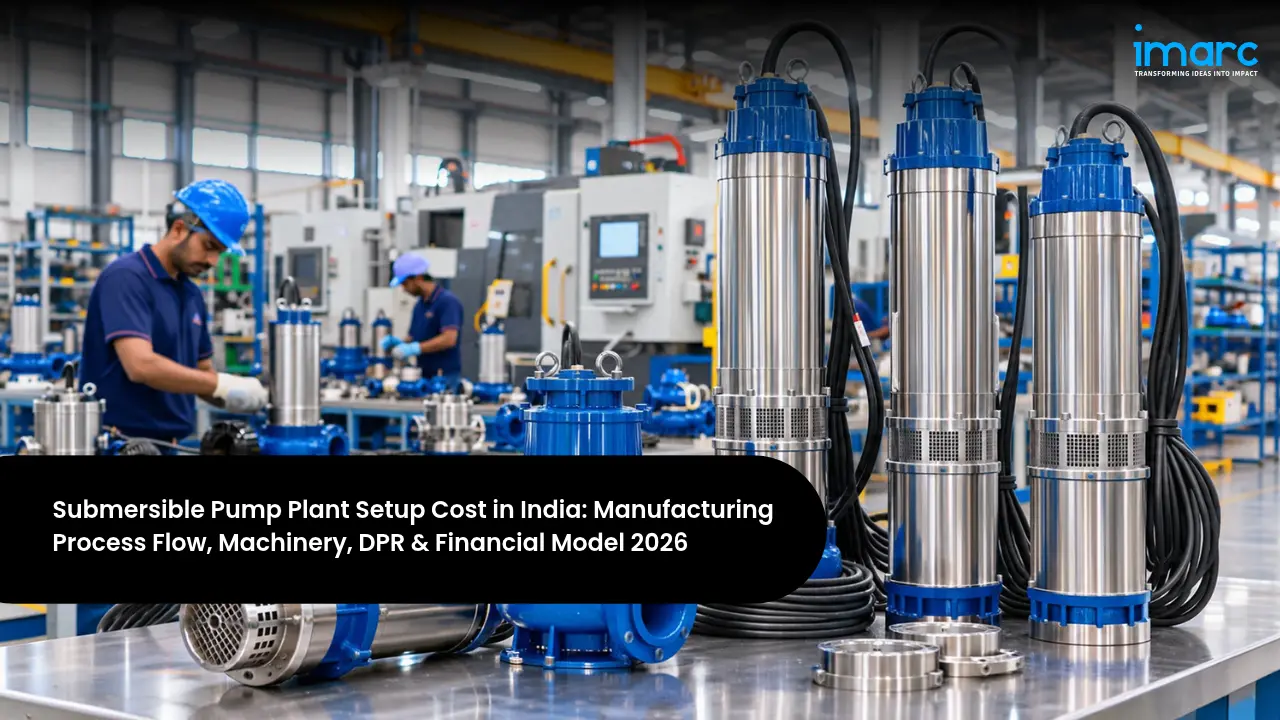
A Submersible Pump Manufacturing Plant Setup in India produces sealed pump and motor units that work underwater to lift water from borewells, open wells, sumps, and tanks, and to move sewage and drainage water. Products include borewell submersible pumpsets in 3, 4, 5, 6, and 8-inch sizes, open well submersibles, sewage and dewatering pumps, and solar submersible pumpsets with high-efficiency motors and controllers, built from stainless steel, cast iron, and engineering plastics with water-filled or oil-filled motors. Demand comes from agriculture, domestic water supply, buildings, municipal water and sewerage, and industry.
The overall Submersible Pump Manufacturing Plant Cost depends mainly on capacity, the depth of in-house manufacturing (motors, stampings, castings, and pump stages), lamination presses, winding and rotor equipment, CNC machining, stage pressing or moulding, welding, assembly lines, test beds, land and buildings, and working capital for copper and steel stocks and dealer credit. A plant producing about 150,000 pumpsets a year typically needs INR 25 crore to INR 40 crore in fixed assets, or about INR 40 crore to INR 60 crore including working capital. A smaller assembly unit of 15,000 to 25,000 pumpsets a year using bought-in components can start at around INR 3 crore to INR 6 crore. IMARC Group puts typical capacities at 100,000 to 300,000 units a year, with gross margins of 30 to 40% and net margins of 12 to 18%.
This guide is written for pump and motor makers, electrical product companies, solar pump integrators, engineering firms, distributors, and investors exploring how to start a Submersible Pump manufacturing plant in India. It explains product types and end uses, demand drivers, the production flow, machinery and raw materials, site selection in pump clusters, a detailed cost and returns breakdown, the BIS, scheme empanelment, and quality approvals involved, and how a DPR pulls these elements into a bankable plan.
India Market Snapshot
| Key Facts | Details |
|---|---|
| India Water Pumps Market (2025) | USD 2.07 Billion |
| Projected India Market (2034) | USD 3.01 Billion (3.74% CAGR) |
| Global Submersible Pump Market (2025) | USD 14.09 Billion |
| PM-KUSUM Pumps Installed or Solarised | About 25 Lakh (Aug 2026) |
| Typical Plant Capacity | 100,000–300,000 Units a Year |
| Indicative Total Investment | INR 40–60 Crore (150,000 Units, incl. working capital) |
IMARC Group values India's water pumps market at USD 2.07 billion in 2025 and the global submersible pump market at USD 14.09 billion. Solar pumping under PM-KUSUM and state schemes, together with groundwater irrigation and urban water supply, keeps submersible pumps among the fastest-moving products in the sector.
Investment Highlights
Indicative Project Cost in India (2026)
| Parameter | Value |
|---|---|
| Product Range | 3 to 8-inch borewell pumpsets, open well submersibles, sewage and dewatering pumps, and solar submersible pumpsets |
| Total Project Investment | INR 40 – 60 Crore incl. working capital (150,000 units); INR 3 – 6 Crore (15,000–25,000 units) |
| Payback Period | 4 – 5 Years |
| Net Profit Margin | 12 – 18% (IMARC benchmark) |
| IRR | 18 – 22% |
| Best Locations | Gujarat, Tamil Nadu, Madhya Pradesh, Maharashtra, Uttar Pradesh, Punjab |
| Mandatory Approvals | BIS Certification, Factory License, SPCB Consents, Fire NOC, Scheme Empanelment, GST, Udyam |
| Key Requirement | Efficient motors, reliable sealing, tested performance, and a strong dealer network |
These figures offer a practical frame for early evaluation. Returns depend on motor efficiency and reliability, precise machining and sealing, consistent test-bed performance, BIS certification and scheme empanelment, efficient assembly, a wide dealer and service network, and control of copper and stainless steel costs. A capacity- and product-specific Submersible Pump Feasibility Report refines these numbers before capital is committed.
Table of Contents
- What is Submersible Pump Manufacturing?
- Why is Submersible Pump Manufacturing Growing in India?
- Submersible Pump Manufacturing Process Flow
- Raw Materials Required for Submersible Pump Manufacturing
- Location, Land & Infrastructure
- Submersible Pump Manufacturing Machinery and Equipment
- Submersible Pump Manufacturing Plant Setup Cost in India (CapEx & OpEx)
- Financial Analysis and Profitability
- Licenses and Approvals for Submersible Pump Manufacturing in India
- Recent Developments in the India Submersible Pump Manufacturing Industry
- How Submersible Pump Manufacturing Project Report and DPR Helps Investors
- Frequently Asked Questions
What is Submersible Pump Manufacturing?
A submersible pumpset combines a multistage pump end with a sealed electric motor designed to run underwater. Electrical steel laminations are stamped and stacked into stator and rotor cores, stators are wound with insulated copper wire for rewindable water-filled motors or enamelled wire for oil-filled motors, and rotors are die cast or fabricated, machined, and dynamically balanced. Shafts and components are machined on CNC lathes and machining centres. Pump stages, made of pressed stainless steel, engineering plastics, or castings, are assembled with diffusers, bearings, and shafts inside stainless steel shells. Motors are filled, sealed with mechanical seals, and coupled to the pump end. Every pumpset is tested on a performance test bed for head, discharge, and efficiency, along with leak and insulation tests. A Submersible Pump Manufacturing Plant therefore combines stamping, winding, rotor making, machining, stage forming, welding, assembly, testing, painting, and packing.
Products are sold to farmers through dealers, solar pump integrators and state scheme suppliers, domestic and building users, municipal water and sewerage bodies, construction and mining contractors, industrial plants, OEMs, and export customers. Buyers expect efficient and reliable performance, BIS certification, energy efficiency, durable seals and bearings, good after-sales service, and competitive pricing.
- Borewell Submersible Pumps: 3 to 8-inch pumpsets for deep borewells.
- Open Well Submersibles: Pumps for wells, sumps, and tanks.
- Sewage and Dewatering Pumps: Drainage, wastewater, and construction use.
- Solar Submersible Pumpsets: High-efficiency motors with solar controllers.
Main Product Types in Submersible Pump Production
The product mix shapes machinery, materials, and margins:
| Product Type | Description | Key Feature | Primary Market |
|---|---|---|---|
| 4-inch Borewell Pumpsets | Most common borewell size | High volume | Agriculture, domestic |
| 6 & 8-inch Borewell Pumpsets | Larger flows and depths | Higher power | Agriculture, water supply |
| Open Well Submersibles | Horizontal or vertical units | Wells and sumps | Domestic, agriculture |
| Sewage & Dewatering Pumps | Solids-handling designs | Rugged construction | Municipal, construction |
| Solar Pumpsets | BLDC or PMSM motors | Off-grid operation | PM-KUSUM, state schemes |
Many new entrants start with 3 and 4-inch borewell pumpsets and open well submersibles assembled around in-house motors, then add 6 and 8-inch pumps, stainless steel pump ends, solar pumpsets, and sewage pumps as volumes, approvals, and dealer reach grow. Solar, stainless steel, and larger pumps usually earn better margins than small standard pumpsets.
Why is Submersible Pump Manufacturing Growing in India?
Key Growth Drivers in the Indian Market
Demand for submersible pumps in India comes from agriculture, water supply, and buildings:
- Groundwater irrigation: Millions of borewells across India rely on submersible pumps for irrigation.
- Solar pumping schemes: PM-KUSUM and state schemes are installing and solarising lakhs of pumps.
- Domestic and urban water: Homes, apartments, and towns use submersibles for water supply.
- Sewerage and drainage: Urban sewerage, flood control, and construction dewatering need submersible pumps.
- Replacement demand: Ageing and inefficient pumps are replaced with more efficient models.
End-Use Market Opportunity
| End Use | Demand Driver | Product Role |
|---|---|---|
| Agriculture | Borewell irrigation | 4 to 8-inch borewell pumps |
| Solar Schemes | PM-KUSUM, state programmes | Solar submersible pumpsets |
| Domestic & Buildings | Water supply | Small borewell and open well pumps |
| Municipal Water & Sewage | Supply and sewerage | Large and sewage pumps |
| Construction & Mining | Dewatering | Dewatering pumps |
The strongest position for a Submersible Pump Manufacturing Plant in India combines efficient motor design, in-house stamping and winding, precise machining, reliable sealing, accredited test beds, BIS certification and scheme empanelment, a wide dealer and service network, and a range spanning domestic, agricultural, solar, and sewage pumps.
Submersible Pump Manufacturing Process Flow
Understanding the Submersible Pump Manufacturing Process helps promoters plan stamping, winding, machining, stage making, assembly, layout, staffing, and quality control. Product quality depends on lamination quality, winding insulation, rotor balance, machining accuracy, seal quality, stage hydraulics, and testing discipline. The flow below reflects a typical pumpset plant.
Step-by-Step Submersible Pump Production Flow
Laminations are stamped and stacked, stators are wound, rotors are made and balanced, and components are machined. Pump stages are formed and assembled, motors are filled and sealed, and complete pumpsets are tested, painted, and packed.
| Unit Operation | Key Activity |
|---|---|
| Incoming Inspection | Copper, steel, castings, seals |
| Lamination Stamping | Stator and rotor cores |
| Stator Winding | Insulated copper windings |
| Rotor Making & Balancing | Die casting, machining, balancing |
| Component Machining | Shafts, housings, brackets |
| Pump Stage Forming | Pressed, moulded, or cast stages |
| Motor Assembly & Sealing | Filling, seals, bearings |
| Pumpset Assembly | Couple pump end and motor |
| Testing | Performance, leak, insulation |
| Painting & Packing | Finish, label, pack |
Two factors decide profitability. The first is motor and hydraulic efficiency: efficient motors and well-designed stages lower power use, help win scheme orders and star-rated listings, and reduce field failures, so design, winding quality, and testing directly protect margins. The second is distribution and service: submersible pumps are sold mainly through dealers and scheme tenders and need prompt service in rural areas, so a strong dealer network, brand trust, and service support decide volumes and pricing.
Raw Materials Required for Submersible Pump Manufacturing
The main inputs are copper winding wire, stainless steel sheet and bar, electrical steel laminations, castings, engineering plastics, bearings, mechanical seals, and cables. IMARC Group estimates raw materials, mainly stainless steel and cast iron for casings, at 65 to 75% of operating cost and utilities at 10 to 15%.
| Raw Material | Role in Process | India Sourcing | % of OpEx |
|---|---|---|---|
| Copper Winding Wire | Motor windings | Domestic producers | 20–25% |
| Stainless Steel Sheet & Bar | Stages, shells, shafts | Domestic steel producers | 18–22% |
| Electrical Steel Laminations | Stator and rotor cores | Domestic and imported | 8–10% |
| Castings & Plastics | Housings, impellers, diffusers | Domestic foundries, moulders | 8–11% |
| Seals, Bearings & Cables | Sealing, rotation, power | Domestic and imported | 6–8% |
Copper, stainless steel, castings, and plastics are widely available in India, while some electrical steel grades, mechanical seals, and solar controller electronics are imported. Copper and stainless steel prices move with global markets, so manufacturers should use price-linked supply arrangements, revise dealer prices regularly, qualify multiple suppliers for seals and laminations, and test incoming materials.
Location, Land & Infrastructure
Location shapes access to components, skilled labour, and customers. The best location for Submersible Pump manufacturing plant setup lies in an established pump and motor cluster with foundries, stamping and machining suppliers, skilled winders and machinists, reliable power, and good road access to major agricultural and urban markets.
Preferred States for Submersible Pump Plants in India
| State | Why It Works | Key Advantage |
|---|---|---|
| Gujarat | Rajkot and Ahmedabad pump clusters | Large supplier base |
| Tamil Nadu | Coimbatore, India's pump city | Skilled workforce, foundries |
| Madhya Pradesh | Pithampur pump and motor units | Central location, land |
| Maharashtra | Pune pump and engineering industry | Established brands |
| Uttar Pradesh | Large agricultural market | Northern demand |
| Punjab | Ludhiana engineering base | Irrigation demand |
Gujarat's Rajkot and Ahmedabad and Tamil Nadu's Coimbatore are India's main submersible pump hubs, with deep supplier networks and skilled labour. Madhya Pradesh and Maharashtra host major pump makers, while Uttar Pradesh and Punjab offer large irrigation markets in the north. Locating in a cluster lowers component costs and speeds up product development.
Product Quality and Compliance Requirements
Borewell submersible pumpsets are made to IS 8034, open well submersibles to IS 14220, and submersible motors to IS 9283, while solar pumps must meet MNRE technical specifications for scheme supply. Buyers check head, discharge, overall efficiency, power consumption, insulation, and leak tightness. Key controls include incoming material testing, winding and insulation checks, rotor balancing, dimensional inspection, routine performance testing of every pumpset, periodic type tests at accredited laboratories, and batch traceability.
Infrastructure Requirements (150,000 Units Plant)
| Infrastructure Element | Specification | India-Specific Note |
|---|---|---|
| Total Land Area | 3 – 5 acres | Production, stores, dispatch |
| Production Building | 6,000 – 10,000 m² | Press shop, machining, assembly |
| Power | 800 – 1,500 kW connected load | Presses, CNC, test beds |
| Water | 30 – 60 KLD | Test sumps, cooling, utilities |
| Test Facilities | Performance test beds, test sumps | Routine and type tests |
| Tool Room | Dies and fixtures | Stamping and pressing |
| Stores | Components and finished pumps | Dealer dispatch |
Infrastructure for a pump plant centres on a press shop for laminations and stages, winding and rotor sections, CNC machining, welding, assembly lines, test beds with deep test sumps, a painting area, a tool room, and component and finished goods stores. Planning space for additional assembly lines, larger pump test beds, and solar pump integration from the outset supports growth.
Submersible Pump Manufacturing Machinery and Equipment
Most pump machinery, including power presses, winding machines, CNC lathes, balancing machines, and test beds, is made in India, while high-speed lamination presses, automatic winding systems, and advanced performance test systems are often imported. The main equipment is summarised below.
| Equipment | Function | Key Specification |
|---|---|---|
| Power Presses & Dies | Lamination stamping | High-speed, progressive dies |
| Stator Winding Machines | Motor windings | Automatic or semi-automatic |
| Rotor Die Casting Machine | Rotor cages | Aluminium or copper |
| CNC Lathes & Machining Centres | Shafts and housings | Precision machining |
| Dynamic Balancing Machines | Rotor balance | Vibration control |
| Stage Presses / Moulding Machines | Pump stages | Stainless steel or plastics |
| TIG / Laser Welding | Stainless steel shells | Leak-tight welds |
| Assembly Lines | Motor and pumpset assembly | Torque-controlled tools |
| Performance Test Beds | Head, discharge, efficiency | Computerised testing |
| Leak, HV & IR Testers, Paint Booth | Quality and finishing | Routine testing |
Presses, winding, and assembly lines largely determine output, while machining, balancing, and test beds determine reliability and efficiency. Many promoters begin by making motors in-house and buying pump stages and castings, then add stage pressing or moulding, stainless steel shell welding, larger pump lines, and solar controllers as volumes grow.
Submersible Pump Manufacturing Plant Setup Cost in India (CapEx & OpEx)
The tables below summarise the capital and operating cost structure of a plant producing about 150,000 pumpsets a year in India. The final Submersible Pump Investment Cost for a specific project depends on capacity, product mix, the depth of in-house manufacturing, press and machining equipment, test facilities, land and building costs, and working capital for materials, finished stock, and dealer and scheme receivables.
Capital Expenditure (CapEx) Cost Structure
| CapEx Component | % of Total CapEx | What It Covers |
|---|---|---|
| Press Shop & Tooling | 12–16% | Presses, dies, stage tooling |
| Motor Manufacturing | 12–16% | Winding, rotor casting, balancing |
| CNC Machining & Welding | 12–16% | Lathes, VMCs, welding |
| Assembly & Testing | 8–12% | Lines, test beds, testers |
| Utilities & Painting | 3–5% | Compressors, paint booth |
| Land & Buildings | 15–18% | Site and production building |
| Working Capital | 22–28% | Copper, steel, stock, receivables |
Press, motor, and machining equipment form the largest share of fixed investment, while working capital is significant because dealers buy on credit, a wide range of models must be stocked, and scheme payments can be slow. A Submersible Pump Business Plan models these components so that capacity, product mix, and financing rest on realistic material prices, conversion costs, utilisation, dealer margins, and payment terms.
Operating Expenditure (OpEx) Cost Structure
| OpEx Component | % of Total OpEx | India-Specific Note |
|---|---|---|
| Raw Materials & Components | 65–72% | Copper, stainless steel, laminations |
| Labour | 8–10% | Winders, machinists, assemblers |
| Utilities | 6–8% | Presses, CNC, testing |
| Selling & Distribution | 6–8% | Dealer schemes, marketing |
| Logistics | 2–3% | Dispatch to dealers and sites |
| Maintenance, Warranty & Overheads | 4–6% | Service, tooling, administration |
With materials forming most of operating cost, profitability depends on design efficiency, material yields, assembly productivity, product mix, and warranty control. A sound financial model should test margins against copper and stainless steel price swings, dealer price competition, warranty claims, slower scheme orders, delayed government payments, and a weak monsoon.
Financial Analysis and Profitability
Submersible pump manufacturing offers solid returns for producers with efficient products and strong distribution. The profitability of Submersible Pump manufacturing business in India improves with in-house motors and stampings, efficient hydraulics, low warranty returns, BIS certification and scheme empanelment, a wide dealer and service network, a growing share of solar and stainless steel pumps, and careful management of receivables.
| Financial Metric | Indicative Value | India Context |
|---|---|---|
| Gross Profit Margin | 30–40% | IMARC benchmark |
| Net Profit Margin | 12–18% | IMARC benchmark |
| Payback Period | 4–5 Years | Moderate capital needs |
| IRR (Internal Rate of Return) | 18–22% | Sensitive to materials and orders |
| Capacity Utilization (stable ops) | 65–80% | Seasonal and scheme-linked |
| Break-even Capacity Utilization | 45–55% | Tooling and overheads |
Product reliability and market reach are the decisive factors. Makers whose pumps perform reliably in the field, who are empanelled for solar schemes, and who build loyal dealer networks earn stable returns, while those competing only on price with basic pumpsets face thin margins and warranty costs.
Returns can be strengthened by making motors and stages in-house, developing high-efficiency and star-rated models, adding solar pumpsets with controllers, entering stainless steel and sewage pump segments, securing state scheme empanelment, building service networks, and exporting to Africa, the Middle East, and Southeast Asia.
Key Risks and Mitigation
The main risks are copper and stainless steel price volatility, intense competition from organised brands and small local assemblers, warranty claims from field failures, dependence on government schemes and their payment cycles, monsoon-linked demand swings, and counterfeit products. Price risk is reduced through regular price revisions; competition through efficiency, quality, and service; warranty risk through robust design and testing; and scheme risk through a balanced mix of dealer, institutional, and export sales.
Licenses and Approvals for Submersible Pump Manufacturing in India
A submersible pump unit requires product certification, scheme, industrial, environmental, quality, and business approvals. Promoters typically need the following before starting commercial production:
- BIS Certification: ISI mark for submersible pumpsets, open well submersibles, and motors under IS 8034, IS 14220, and IS 9283.
- Scheme Empanelment: Testing at MNRE-approved laboratories and empanelment with state nodal agencies for solar pump schemes.
- Energy Efficiency Labelling: BEE star labelling for pumpsets where buyers or schemes require it.
- Factory License and Fire NOC: Factory registration and fire safety approval for the plant.
- Pollution Control Consents: Consent to Establish and Consent to Operate from the State Pollution Control Board for machining, welding, and painting.
- Quality Certifications: ISO 9001, plus CE or other approvals for export markets.
- Business Registrations: Company registration, GST, Udyam, trade license, and an Import Export Code.
BIS certification, type testing, and scheme empanelment often take the longest and are essential for government and dealer sales. Engaging a Submersible Pump Manufacturing Consultant in India can help promoters select machinery, plan product ranges and in-house manufacturing, obtain certifications and empanelment, and build dealer networks.
Note: The exact approvals, registrations, licenses, and certification requirements may vary depending on factors such as plant location, product range, capacity, target customers, and applicable regulations. Businesses are advised to undertake a detailed regulatory assessment during the project planning stage to ensure full compliance and timely implementation.
Recent Developments in the India Submersible Pump Manufacturing Industry
Several recent developments are shaping the submersible pump industry in India:
- Capacity expansion: In February 2026, Kirloskar Brothers expanded capacity with a new factory building at its Kaniyur plant in Tamil Nadu, about 80% powered by renewable energy.
- PM-KUSUM extended: In August 2026, the PM-KUSUM deadline was reported extended to March 2027, with about 25 lakh pumps installed or solarised so far.
- Large solar pump orders: In September 2026, Shakti Pumps received an empanelment order from MSEDCL for 10,000 off-grid solar pumping systems worth about INR 235 crore.
Together these point to strong demand from solar schemes and agriculture, with leading makers adding capacity. For new entrants, success depends on efficient products, certification, scheme access, and distribution.
How Submersible Pump Manufacturing Project Report and DPR Helps Investors
A detailed Submersible Pump Project Report gives investors a structured roadmap covering demand by end use and region, competition, product mix, component strategy, process design, machinery, testing, approvals, distribution, and economics. It helps promoters choose the right capacity, product range, and level of integration, estimate capital expenditure (CapEx) and operating expenditure (OpEx), assess profitability, and identify risks before implementation.
At the core of the DPR is a Submersible Pump Financial Model covering copper, stainless steel, lamination, and casting prices, material yields, labour, utilities, selling prices by model, dealer margins, warranty costs, scheme payment cycles, working capital, cash flow projections, break-even, return on investment (ROI), and payback. Because material prices and receivables drive returns, lenders expect detailed sensitivity analysis, which is why many promoters engage a Submersible Pump Plant Project Report Consultant in India to prepare bank-ready documents.
For a pump project specifically, a strong DPR also answers the questions that matter most: which markets and channels will provide steady sales, which components to make in-house, how long BIS certification and scheme empanelment will take, how much working capital dealer and scheme credit will require, and how returns hold up if material prices or scheme demand change. An experienced Submersible Pump Manufacturing Feasibility Study Consultant tests these scenarios so that the final plan is one lenders and partners can back with confidence.
Frequently Asked Questions
How do I set up a submersible pump manufacturing factory in India?
Start by identifying target products and markets, then commission a feasibility study and DPR. Choose a site in a pump cluster, install stamping, winding, rotor, machining, stage forming, assembly, and testing equipment, obtain BIS certification, factory, pollution, and fire approvals, complete type tests, and pursue scheme empanelment and dealer appointments.
What is the cost of setting up a submersible pump manufacturing plant in India?
A plant producing about 150,000 pumpsets a year typically needs INR 25 crore to INR 40 crore in fixed assets, or about INR 40 crore to INR 60 crore including working capital. A smaller assembly unit of 15,000 to 25,000 pumpsets a year can start at around INR 3 crore to INR 6 crore.
How are submersible pumps made?
Laminations are stamped and stacked, stators are wound, and rotors are cast, machined, and balanced. Pump stages are formed and assembled into stainless steel shells, motors are filled and sealed, and complete pumpsets are tested for performance and leaks before painting and packing.
What machinery is needed for a submersible pump manufacturing plant?
Key equipment includes power presses and dies, stator winding machines, rotor die casting machines, CNC lathes and machining centres, dynamic balancing machines, stage presses or moulding machines, TIG or laser welding, assembly lines, performance test beds, and leak and insulation testers.
What raw materials are used for submersible pumps?
The main inputs are copper winding wire, stainless steel sheet and bar, electrical steel laminations, castings, engineering plastics, bearings, mechanical seals, and cables.
Is submersible pump manufacturing profitable in India?
Benchmark figures point to a 12 to 18% net margin and an IRR of around 18 to 22%, with payback in 4 to 5 years. Profitability depends mainly on product efficiency, material prices, distribution, scheme access, and warranty control.
What licenses are needed for a submersible pump manufacturing unit in India?
A unit typically needs BIS certification, a Factory License, Fire NOC, State Pollution Control Board consents, type tests, scheme empanelment for solar pumps, ISO 9001, GST, Udyam registration, and an Import Export Code.
Which state is best for a submersible pump manufacturing plant?
Gujarat, Tamil Nadu, Madhya Pradesh, Maharashtra, Uttar Pradesh, and Punjab are strong options. The best site combines an established pump supplier ecosystem with access to large agricultural and urban markets.
How do I get a feasibility study or DPR for a submersible pump manufacturing plant?
A professionally prepared DPR covers market and channel assessment, technical design, approvals, costs, and financial projections for bank appraisal. Many promoters work with a Submersible Pump Business Plan Consultant in India to prepare it and align it with lender requirements.
Our Clients









Contact Us
Have a question or need assistance?
Please complete the form with your inquiry or reach out to us at
Phone Number
+91-120-433-0800+1-201-971-6302
+44-113-547-7077
Previous Post

A Solar Pump Manufacturing Plant Setup in India serves one of the country's largest clean energy programmes for farmers.
A Coal Tar Pitch Distillation Manufacturing Plant Setup in India sits between two of the country's largest metals industries.
A Solar Water Heater Manufacturing Plant Setup in India supplies one of the simplest and most cost-effective renewable energy products available to households and businesses.
A Solar Glass Manufacturing Plant Setup in India fills a critical gap in the country's fast-growing solar supply chain. Every crystalline silicon solar module needs a sheet of front glass, and bifacial glass-glass modules need a second sheet at the back.
A Solar Cell Manufacturing Plant Setup in India sits at the centre of the country's push to build a complete domestic solar supply chain. Solar cells are the semiconductor devices that convert sunlight into electricity, and they are the core component of every crystalline silicon solar module.
India's energy storage market has moved from pilot projects to procured infrastructure, and the numbers now reflect that shift. The India energy storage market reached a volume of 331.3 MWh in 2025 and is projected to reach 9,294.4 MWh by 2034, expanding at a CAGR of 40.03% during 2026-2034.
A Biodiesel Manufacturing Plant Setup in India connects two national priorities: cutting diesel imports and turning waste oils into clean fuel. Biodiesel is a renewable fuel made of fatty acid methyl esters (FAME), produced by reacting oils and fats with methanol.
The India solar energy market is no longer a niche policy play; it sits at the centre of the country's power investment case. According to IMARC Group, the market grew from USD 30.03 Billion in 2025 to USD 41.39 Billion in 2026 and is projected to reach USD 538.91 Billion by 2034, expanding at a CAGR of 37.82% during 2026-2034.
Setting up a Bio-LNG Manufacturing Plant in India is an opportunity to turn agricultural residue, press mud, cattle dung, and municipal organic waste into a premium, low-carbon transport and industrial fuel.
Lithium-ion cells store energy by moving lithium ions between a cathode and an anode through an electrolyte, and can be charged and discharged thousands of times.
LPG is a mixture of propane and butane that is recovered from natural gas streams and produced in crude oil refineries, then stored as a liquid under moderate pressure and supplied in cylinders, bulk tankers, and pipelines.
Graphene-enhanced batteries use graphene, a single-atom-thick sheet of carbon with outstanding electrical and thermal conductivity, to improve conventional battery chemistries.
A utility-scale photovoltaic project turns sunlight into electricity through fields of PV modules, converts it from DC to AC in inverters, steps up the voltage, and feeds it into the grid for sale under long-term power purchase agreements.
Distribution transformers step down medium-voltage power, typically 11, 22, or 33 kV, to the 415 or 230 volts used by homes, shops, farms, and factories. They are the last link in the power supply chain and are installed in very large numbers on poles, plinths, and in substations across every town and village.
Flexible solar panels are lightweight, frameless modules that can bend to fit curved or weak surfaces where standard glass-and-aluminium panels are too heavy or rigid.
The low voltage cable market sits exactly where electrification stops being a policy target and becomes physical infrastructure. Every new solar rooftop, data centre hall, charging depot, factory line and connected building relies on low voltage cable to move power from a transformer to the load, which is why demand keeps compounding even when headline generation projects pause.
Recycled, or secondary, aluminium is made by melting aluminium scrap and refining it into alloy ingots, billets, and liquid metal, using about 95% less energy than making primary aluminium from bauxite.
The Australia Power Industry is the physical foundation of one of the developed world's most coal-reliant electricity systems, which is precisely why its transition now ranks among the largest infrastructure investment programmes in the country's history.
Every solar panel is connected by cables built to survive 25 years or more of sun, heat, rain, and high DC voltage. India added a record 44.6 GW of solar capacity in 2025-26, taking cumulative solar capacity past 150 GW, and rooftop programmes such as PM Surya Ghar are adding millions of smaller systems.
Biomass briquettes, often called white coal, are dense blocks of compressed agricultural and forestry residues that burn cleanly in industrial boilers, furnaces, and power plants.
Lead-acid batteries start every car, truck, and two-wheeler, back up telecom towers, data centres, and homes through inverters and UPS systems, and store energy for solar installations. Almost all of the lead, plastic, and acid in a used battery can be recovered, and India already meets more than 80% of its lead demand from recycling.
Fuel cells turn hydrogen into electricity with water as the only exhaust, which makes them one of the most important technologies in India's clean energy transition. They power hydrogen buses, trucks, and trains, provide backup power for telecom towers and data centres, and supply off-grid and distributed electricity where diesel generators are used today.
India's cities generate well over a lakh tonnes of municipal solid waste every day, and much of it still ends up in overflowing dumpsites that release methane, catch fire, and pollute land and water.
Every solar power system needs an inverter to convert the direct current produced by solar panels into alternating current that homes, businesses, and the grid can use.
Sodium-ion batteries are emerging as a practical complement to lithium-ion technology. They work on the same principle, shuttling ions between a cathode and an anode, but use sodium, which is abundant, inexpensive, and available within India, in place of lithium.
Few industries in India have scaled as quickly as solar manufacturing. Backed by ambitious renewable energy targets, a rooftop programme for households, import duties on foreign modules, and the Approved List of Models and Manufacturers (ALMM), domestic module capacity has multiplied in just a few years.
Setting up an Electrical Panel Manufacturing Plant in India is a fabrication-and-assembly venture powered by heavy grid modernisation, a fast-growing renewable-energy build-out, rising industrial and commercial construction, and the spread of automation across factories and buildings.
Saudi Arabia has turned its power transition into one of the world's largest procurement programmes, and international developers, lenders, and equipment makers are following the tenders.
Setting up a Battery Manufacturing Plant in India is a high-demand, energy-driven venture, powered by the country's booming automotive sector, huge power-backup market, and the fast-growing shift to electric vehicles and renewable storage.
Setting up a Liquefied Natural Gas (LNG) Manufacturing Plant in India is a capital-intensive, strategically important venture, powered by the country's push toward a gas-based economy, the shift to cleaner fuels in transport and industry, and rising demand for LNG as a truck, bus, and industrial fuel.
The India carbon credit market is moving from a voluntary, project-by-project trade into a regulated national system with binding targets, a central registry, and exchange-based price discovery. According to IMARC Group, the market was valued at USD 33.69 Billion in 2025, grew to USD 44.42 Billion in 2026, and is projected to reach USD 405.47 Billion by 2034, expanding at a CAGR of 31.84% (2026–2034).
Setting up a Syngas Production Plant in India is a capital-intensive but strategically valuable venture, driven by the country's push for cleaner industrial fuels, coal and biomass utilization, and chemical self-reliance. Syngas, or synthesis gas, is a mixture of hydrogen and carbon monoxide produced by gasifying carbon-rich feedstocks, and it serves as a versatile building block for power, chemicals, hydrogen, and synthetic fuels. With abundant biomass, coal, and waste feedstock and growing policy support for gasification, India offers a favourable environment for new plants.
Setting up a Battery Energy Storage System Manufacturing Plant in India is a capital-efficient, high-growth venture, driven by the country's renewable energy expansion, grid modernization, and supportive storage policies. As solar and wind capacity scales up and the grid needs to balance variable generation, battery energy storage systems have become essential infrastructure.
Setting up a Lithium-ion Battery Recycling Plant in India is a capital-intensive but high-potential venture. India's rapid rise as a major electric-vehicle market, its large consumer-electronics base, and its fast-growing energy-storage sector are together creating one of the deepest and fastest-expanding pools of end-of-life lithium-ion batteries in the world.
Solar glass is a type of specialty glass that has high transmittance and is designed exclusively for use in solar energy systems. Unlike regular flat glass, solar glass is designed to have maximum light transmission with minimal losses due to reflection and absorption.
A solar inverter is a vital component in solar photovoltaic (PV) systems, responsible for transforming the direct current (DC) electricity produced by solar panels into alternating current (AC) electricity. This AC power is then suitable for use by the electrical grid, various appliances, and industrial equipment.
Australia has firmly established itself as a dominant force in the global liquefied natural gas (LNG) market, maintaining its position as one of the world's leading exporters. The country's strategic geographical location in the Asia-Pacific region, combined with substantial natural gas reserves, has enabled it to become a critical energy supplier to rapidly growing Asian economies, particularly China, Japan, and South Korea.
Japan's lead acid battery market stands as a cornerstone of the nation's energy storage infrastructure, demonstrating remarkable resilience and adaptability in an era dominated by rapid technological evolution. Despite the global shift toward lithium-ion technologies, the Japanese lead acid battery sector continues to thrive, driven by its unmatched cost-effectiveness, proven reliability, and exceptional recyclability.
Green hydrogen is the cleanest form of hydrogen available, as it is produced through water electrolysis using the electricity generated from renewable energy sources such as solar, wind, or hydropower. Carbon dioxide emissions are zero since no fossil fuels are used. Essentially, an electrolyzer is used in the electrolysis process to split water molecules into hydrogen and oxygen. The resulting hydrogen is refined by purification, compression, or liquefaction and then fed into various applications. Green hydrogen is considered a cornerstone of the global energy transition because it can store renewable energy, decarbonize hard-to-abate sectors, and serve as a sustainable alternative to fossil-fuel-based hydrogen.
Japan’s thermal power plant industry remains a crucial pillar of the nation’s energy infrastructure, providing a stable and reliable source of electricity for both industrial and residential consumption. Thermal power generation, which primarily involves the combustion of fossil fuels such as coal, natural gas, and oil, continues to play a key role despite increasing investments in renewable energy.
An electrical panel, also called a distribution board or switchboard, is an important installation in electrical infrastructure that acts as the main center for the distribution, control, and protection of electrical power within residential, commercial, and industrial systems. It acts as the point at which electrical energy is received from the utility or a source of power generation and is distributed to various circuits and equipment in an organized manner.
The global oil and gas EPC market is currently experiencing a remarkable transformation as it positions itself at the intersection of traditional energy demands and technological innovation. As of 2024, the market is demonstrating robust growth, reaching USD 52.9 Billion in 2024, depending on regional scope and market segmentation approaches. This substantial market base is supporting a major number of capital projects worldwide, including offshore platform projects and onshore installations that are collectively shaping the energy landscape.
Bamboo pellets are a biomass fuel type created through the compression of bamboo residues like shavings, sawdust, and chips into thick cylindrical pellets. They are an environmentally friendly substitute for conventional fossil fuels like natural gas and coal. Due to the fast growth rate and high biomass yield of bamboo, it has become one of the most renewable raw materials for the production of bioenergy.
Biomass briquettes are dense, solid fuel blocks made of compressed organic waste materials like sawdust, agricultural wastes, wood shavings, coconut shells, rice husk, or herbaceous biomass. The briquetting process usually involves drying the biomass to lower the moisture content (usually down to 10-15%), grinding or milling for a fine particle size uniformity, and then compressing under high pressure with or without a binding agent.
Biogas is a renewable energy form generated by the anaerobic fermentation of organic matter including agricultural residues, animal waste, municipal solid waste, sewage sludge, and food waste. Microorganisms in the absence of oxygen break down organic substances in the process and produce a gaseous mixture of mainly methane (CH4) and carbon dioxide (CO2), with traces of hydrogen sulfide (H2S) and water vapor.
A battery is an electrochemical energy storage system that transforms chemical energy into electrical energy by way of redox reactions between its electrodes and electrolyte. It consists of a single or multiple electrochemical cells, each having a positive electrode (cathode), a negative electrode (anode), and an electrolyte for ion transfer. Batteries are categorically divided into primary (non-rechargeable) and secondary (rechargeable) types.
The global energy landscape is undergoing a seismic transformation, with green hydrogen emerging as one of the most promising solutions to achieve deep decarbonization across sectors. Far from a niche technology, green hydrogen is emerging as a critical pillar of the future energy system, offering a pathway to a sustainable and resilient economy.
Transmission line towers are essential support components of transmission lines installed on overhead to distribute high-voltage electricity over long distances. Towers are made of galvanized steel, primarily, and are designed to tolerate mechanical stress, environmental loads, and electrical safety. Some of the important characteristics of transmission line towers are high structural strength, corrosion resistance, adaptability for modular design, and high service life. They are normally produced in lattice form (tubular or free-standing towers) or tubular form, with types including suspension towers, tension towers, angle towers, and terminal towers based on use.
The energy storage revolution is here, and it's powered by graphene. While the world struggles with the limitations of conventional lithium-ion batteries, a new technology is emerging that promises to shatter every performance barrier we've accepted as unchangeable.
Australia is undergoing a significant energy transformation, underscoring the growing role of renewable energy sources. These sources are key to combating climate change by reducing greenhouse gas emissions, the primary cause of global warming and air pollution. Beyond environmental benefits, renewable energy strengthens energy security by diversifying power sources and reducing dependence on volatile fossil fuel imports, contributing to greater energy independence.
Learn how to plan capital investment, manage raw material costs, post manufacturing cost and optimize operations for setting up solar panel plant.
Battery Energy Storage System (BESS) represents a power grid technology that stores electricity to enhance electric power grid reliability while increasing operational efficiency. BESS permits battery recharging during periods of low demand or extra grid supply capacity. BESS provides three principal operational functionalities which include power grid stabilization during supply disruptions, control of energy supply variations, and integration of intermittent renewable generation from wind and solar resources.
China's economic presence is expanding globally, and Latin America and the Caribbean (LAC) have become a focal point for its investments, especially within the energy sector. The region, rich in natural resources and experiencing rising energy demands, offers strategic opportunities for Chinese energy giants looking to invest and expand. LAC is currently leading a transformative movement towards sustainable energy. From 2015 to 2022, the region increased its renewable energy capacity by an impressive 51%, now generating 64% of its electricity from renewables such as hydropower, wind, and solar. This shift addresses the global demand for cleaner energy while supporting local economic growth and enhancing energy security.
Hydrogen is a clean, renewable, and widely available energy source that can be produced through various methods. Production techniques such as coal gasification, steam methane reforming, electrolysis, and thermochemical processes highlight its versatility. Hydrogen is essential in several critical sectors, including methanol and ammonia production, petroleum refining, transportation, power generation, as well as in electronics, metal industries, and as a rocket propellant. The increasing concern over carbon emissions and greenhouse gases has led to a shift towards cleaner fuel options. Hydrogen is recognized for its cleanliness and versatility as an energy carrier. Additionally, supportive government initiatives and favorable policies are driving the growth of hydrogen production globally.
Hydrogen is a clean, renewable, and abundant energy source derived from various methods. Its applications span across transportation, heating, and power generation. Diverse production methods, including coal gasification, steam methane reforming, electrolysis, and thermochemical processes, contribute to its versatility. Hydrogen plays a pivotal role in crucial sectors like methanol and ammonia production, petroleum refining, transportation, power generation, as well as in electronics, metal industries, and as a rocket propellant.
A floating solar farm is a renewable energy installation in which solar panels are mounted on floating structures in water bodies such as lakes, reservoirs, ponds, or even the sea. This technology, also known as a floating photovoltaic (PV) system, or “floatovoltaics,” enables solar power generation in areas with limited available land or where land use is restricted for other purposes. Floating solar farms offer various benefits, including improved solar panel efficiency through cooling, land conservation, reduction of evaporation and algae growth, and integration with hydropower facilities to generate both solar and hydroelectric power in the same location.
Nuclear power utilizes nuclear reactions to generate heat, which is then converted into electricity. This energy is released from the nucleus—the core of atoms composed of protons and neutrons. Nuclear power can be derived from nuclear fission, nuclear decay, and nuclear fusion reactions. Across the globe, nuclear power plants predominantly use the fission of uranium and plutonium to produce electricity. The heat generated from fission is used to create steam, which drives turbines connected to generators. Nuclear power offers several advantages over fossil fuels, such as minimal greenhouse gas emissions and a higher energy density, meaning a small amount of nuclear fuel produces a large amount of energy.