Battery Plate Plant Setup Cost in India: Manufacturing Process Flow, Machinery, DPR & Financial Model 2026
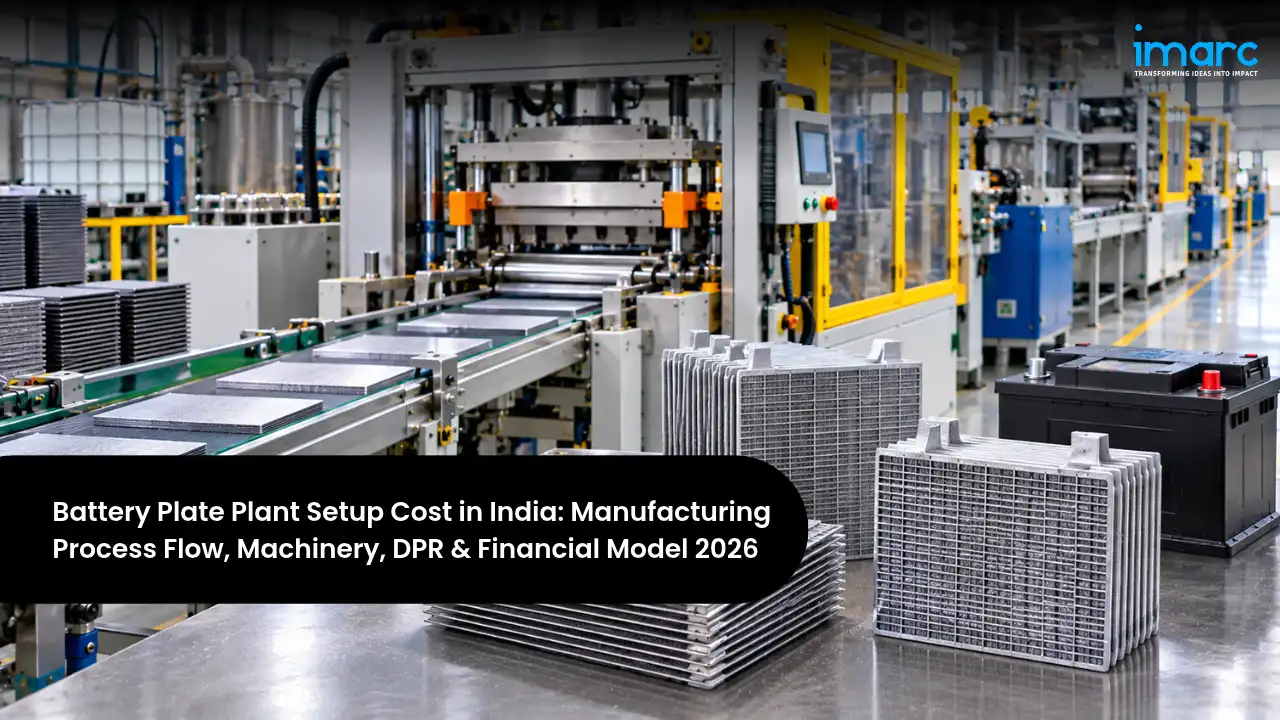
A Battery Plate Manufacturing Plant Setup in India produces the positive and negative electrodes at the heart of every lead-acid battery. Products include flat pasted plates for automotive, two-wheeler, and inverter batteries, tubular positive plates for inverter, solar, e-rickshaw, and industrial batteries, and matching negative plates, supplied formed, dry-charged, or unformed to battery assemblers and brands. Lead-acid batteries remain India's most widely used storage technology for vehicles, home inverters, telecom towers, solar systems, and electric three-wheelers, creating large and steady demand for quality plates.
The overall Battery Plate Manufacturing Plant Cost depends mainly on capacity, the split between flat and tubular plates, grid and spine casting technology, the lead oxide plant, paste mixing and pasting lines, curing chambers, formation facilities, pollution control and effluent treatment, land and buildings, and working capital, which is large because lead is costly. A plant producing about 10 million plates a year typically needs INR 25 crore to INR 40 crore in fixed assets, or about INR 40 crore to INR 60 crore including working capital. A smaller unit of 1 to 2 million plates a year can start at around INR 3 crore to INR 6 crore. IMARC Group puts typical capacities at 5 to 20 million plates a year, with gross margins of 25 to 35% and net margins of 12 to 18%.
This guide is written for battery assemblers, lead recyclers, automotive and inverter battery brands, electrical product companies, and investors exploring how to start a Battery Plate manufacturing plant in India. It explains plate types and end uses, demand drivers, the production flow, machinery and raw materials, site selection, a detailed cost and returns breakdown, the environmental, occupational health, and quality approvals involved, and how a DPR pulls these elements into a bankable plan.
India Market Snapshot
| Key Facts | Details |
|---|---|
| India Lead-Acid Battery Market (2025) | USD 4.59 Billion |
| Projected Market (2034) | USD 6.98 Billion, 4.22% CAGR |
| Used Batteries Recycled in India | About 1.2 Million Tonnes a year |
| Typical Plant Capacity | 5–20 Million plates a year |
| Indicative Total Investment | INR 40–60 Crore (10 Million plates, incl. working capital) |
India's lead-acid battery market was valued at about USD 4.59 Billion in 2025 and is expected to reach about USD 6.98 Billion by 2034. A large recycling base, which supplies most domestic lead, gives plate makers ready access to their main raw material.
Investment Highlights
Indicative Project Cost in India (2026)
| Parameter | Value |
|---|---|
| Product Range | Flat pasted positive and negative plates, tubular positive plates, formed, dry-charged, and unformed plates for automotive, inverter, solar, e-rickshaw, and industrial batteries |
| Total Project Investment | INR 40 – 60 Crore incl. working capital (10 Million plates); INR 3 – 6 Crore (1–2 Million plates) |
| Payback Period | 4 – 5 Years |
| Net Profit Margin | 12 – 18% (IMARC benchmark) |
| IRR | 18 – 22% |
| Best Locations | Gujarat, Maharashtra, Uttarakhand, Haryana, Andhra Pradesh, West Bengal |
| Mandatory Approvals | SPCB Consents, Hazardous Waste Authorisation, Factory License, Fire NOC, GST, Udyam, Customer Approvals |
| Key Requirement | Lead management, consistent plate quality, pollution control, and worker health safeguards |
These figures offer a practical frame for early evaluation. Returns depend on buying lead and alloys well, consistent grid and paste quality, controlled curing and formation, low scrap and rework, strong pollution control and worker health systems, and long-term supply relationships with battery makers. A capacity- and product-specific Battery Plate Feasibility Report refines these numbers before capital is committed.
Table of Contents
- What is Battery Plate Manufacturing?
- Why is Battery Plate Manufacturing Growing in India?
- Battery Plate Manufacturing Process Flow
- Raw Materials Required for Battery Plate Manufacturing
- Location, Land & Infrastructure
- Battery Plate Manufacturing Machinery and Equipment
- Battery Plate Manufacturing Plant Setup Cost in India (CapEx & OpEx)
- Financial Analysis and Profitability
- Licenses and Approvals for Battery Plate Manufacturing in India
- Recent Developments in the India Battery Plate Manufacturing Industry
- How Battery Plate Manufacturing Project Report and DPR Helps Investors
- Frequently Asked Questions
What is Battery Plate Manufacturing?
Battery plates are made in two parts: a lead alloy grid or spine that conducts current, and active material that stores energy. Lead alloys are melted and cast into grids for flat plates, or pressure die cast into spines for tubular plates, while pure lead is converted into lead oxide in a ball mill or Barton pot. The oxide is mixed with sulphuric acid, water, and additives into a paste that is applied to grids on a pasting line, or filled as dry oxide into fabric gauntlets around tubular spines. Plates are flash dried and cured under controlled temperature and humidity, then formed by passing current in dilute acid to convert the material into active lead dioxide on positive plates and sponge lead on negative plates. A Battery Plate Manufacturing Plant therefore combines alloy melting, oxide production, casting, paste mixing, pasting or filling, curing, formation, inspection, and packing.
Plates are sold to battery assemblers and brands, automotive and two-wheeler battery makers, inverter and solar battery companies, e-rickshaw battery makers, industrial and telecom battery producers, and export customers. Buyers expect consistent plate weight and thickness, correct active material composition, good grid corrosion resistance, uniform curing and formation, and reliable supply.
- Flat Pasted Plates: Automotive, two-wheeler, and flat-plate inverter batteries.
- Tubular Positive Plates: Long-life inverter, solar, and e-rickshaw batteries.
- Negative Plates: Matched negative plates with expanders.
- Formed and Dry-Charged Plates: Ready plates for assemblers without formation.
Main Product Types in Battery Plate Production
The product mix shapes machinery, process control, and margins:
| Product Type | Description | Key Feature | Primary Market |
|---|---|---|---|
| Flat Pasted Positive | Pasted cast or expanded grid | High cranking power | Automotive, two-wheeler |
| Flat Pasted Negative | Pasted grid with expander | Charge acceptance | All lead-acid batteries |
| Tubular Positive | Spine in filled gauntlets | Long cycle life | Inverter, solar, e-rickshaw |
| Formed / Dry-Charged | Formed and dried plates | Ready for assembly | Small and mid assemblers |
| Industrial Plates | Heavy-duty plates | Deep discharge | Telecom, UPS, traction |
Many new entrants start with tubular positive plates and flat negative plates for inverter and e-rickshaw batteries, a market served by many small and mid-sized assemblers, then add flat automotive plates and industrial plates as process control and customer approvals grow. Tubular and industrial plates usually earn better margins than standard flat plates.
Why is Battery Plate Manufacturing Growing in India?
Key Growth Drivers in the Indian Market
Demand for battery plates in India comes from vehicles, power backup, and energy storage:
- Vehicle growth: Rising car, two-wheeler, and commercial vehicle sales, plus a large replacement market, drive automotive battery demand.
- Inverters and solar: Home inverters and rooftop and off-grid solar systems use tubular batteries extensively.
- Electric three-wheelers: E-rickshaws in smaller towns rely heavily on affordable lead-acid batteries.
- Telecom and industrial: Telecom towers, UPS systems, and industrial backup need reliable batteries.
- Cost advantage: Lead-acid remains far cheaper per kWh than lithium-ion for many applications.
End-Use Market Opportunity
| End Use | Demand Driver | Plate Type |
|---|---|---|
| Automotive & Two-Wheelers | New vehicles, replacement | Flat pasted plates |
| Home Inverters | Power backup | Tubular and flat plates |
| Solar Storage | Off-grid and rooftop solar | Tubular plates |
| E-Rickshaws | Low-cost electric mobility | Tubular plates |
| Telecom & Industrial | Backup and UPS | Industrial plates |
The strongest position for a Battery Plate Manufacturing Plant in India combines efficient casting and pasting, tight control of curing and formation, consistent quality across batches, strong pollution control and worker health practices, long-term supply relationships with battery brands and assemblers, and a mix of tubular, flat, and industrial plates.
Battery Plate Manufacturing Process Flow
Understanding the Battery Plate Manufacturing Process helps promoters plan oxide production, casting, pasting, curing, formation, layout, staffing, pollution control, and quality control. Plate quality depends on alloy composition, grid integrity, oxide quality, paste density, curing conditions, and formation control. The flow below reflects a typical plate plant.
Step-by-Step Battery Plate Production Flow
Lead alloys are melted and cast into grids or spines while pure lead is converted to oxide. The oxide is mixed into paste and applied to grids, or filled into gauntlets for tubular plates, then dried, cured, formed, inspected, and packed.
| Unit Operation | Key Activity |
|---|---|
| Lead & Alloy Melting | Prepare pure lead and alloys |
| Lead Oxide Production | Ball mill or Barton pot |
| Grid & Spine Casting | Gravity, continuous, or die casting |
| Paste Mixing | Oxide, acid, water, additives |
| Pasting / Oxide Filling | Flat pasting or tubular filling |
| Flash Drying | Surface drying after pasting |
| Curing | Controlled temperature and humidity |
| Formation | Electrochemical charging in acid |
| Washing, Drying & Inspection | Dry-charge and check plates |
| Packing & Dispatch | Pack by type and customer |
Two factors decide profitability. The first is lead cost and yield: lead and alloys make up most of operating cost and prices move with global markets, so smart buying, accurate plate weights, low scrap, and recycling of in-house scrap and dross directly lift margins. The second is process control: curing and formation largely determine battery life and warranty performance, so consistent conditions, testing, and customer approvals decide volumes, pricing, and repeat orders.
Raw Materials Required for Battery Plate Manufacturing
The main inputs are pure lead for oxide, lead-calcium and lead-antimony alloys for grids and spines, sulphuric acid, additives, and gauntlets for tubular plates. IMARC Group estimates raw materials, mainly lead and lead alloys, at 75 to 85% of operating cost and utilities at 10 to 15%.
| Raw Material | Role in Process | India Sourcing | % of OpEx |
|---|---|---|---|
| Pure Lead | Lead oxide for active material | Primary and secondary smelters | 40–45% |
| Lead Alloys | Grids and spines | Domestic alloy makers, recyclers | 26–30% |
| Sulphuric Acid & DM Water | Paste mixing and formation | Domestic suppliers | 2–3% |
| Expanders & Additives | Paste performance | Domestic and imported | 1–2% |
| Gauntlets & Bottom Bars | Tubular plate assembly | Domestic suppliers | 2–4% |
India has a large secondary lead industry that recycles used batteries, alongside primary lead production, so lead is readily available, but prices track global markets and the rupee. Plate makers should buy from authorised, compliant smelters, use price-linked contracts with customers, test incoming lead for purity and alloy composition, and recycle internal scrap and dross through authorised channels.
Location, Land & Infrastructure
Location shapes lead supply, environmental approvals, and access to customers. The best location for Battery Plate manufacturing plant setup lies in an approved industrial area that permits lead processing, close to battery assembly clusters and authorised lead smelters, with reliable power, water for DM plants, effluent treatment options, and good road connectivity.
Preferred States for Battery Plate Plants in India
| State | Why It Works | Key Advantage |
|---|---|---|
| Gujarat | Industrial estates, lead recyclers | Supply chain, approvals |
| Maharashtra | Battery and auto industry | Large customer base |
| Uttarakhand | Haridwar battery cluster | Established battery plants |
| Haryana | NCR auto and inverter market | Northern demand |
| Andhra Pradesh | Major battery manufacturing hub | Southern demand, suppliers |
| West Bengal | Eastern battery industry | Eastern market access |
Gujarat and Maharashtra offer strong industrial ecosystems with lead recyclers and battery makers, while Uttarakhand, Andhra Pradesh, and West Bengal host major battery plants that buy or use plates. Haryana serves the large northern auto and inverter market. Because lead processing falls in the strictest pollution category, sites must be in industrial areas where such units are permitted.
Product Quality and Compliance Requirements
Plates must meet battery makers' specifications for grid alloy, thickness, weight, paste density, free lead and moisture after curing, and formation level, so that finished batteries meet applicable Indian standards and BIS requirements. Lead processing also requires strict pollution control, including fume and dust extraction, stack monitoring, acid effluent treatment, and safe handling of dross and sludge, along with regular blood lead monitoring and protective measures for workers. Key controls include alloy analysis, grid inspection, paste testing, curing checks, formation monitoring, and batch traceability.
Infrastructure Requirements (10 Million Plates Plant)
| Infrastructure Element | Specification | India-Specific Note |
|---|---|---|
| Total Land Area | 3 – 5 acres | Plant, stores, ETP |
| Production Building | 4,000 – 6,000 m² | Ventilated, segregated zones |
| Power | 800 – 1,500 kW connected load | Mills, casting, formation |
| Water | 30 – 60 KLD | DM water, formation, cooling |
| Pollution Control | Bag filters, scrubbers, stacks | SPCB red category |
| Effluent Treatment | Acidic effluent ETP | Lead-bearing sludge handling |
| Worker Facilities | Change rooms, showers, medical | Lead exposure safeguards |
Infrastructure for a plate plant centres on alloy melting, an oxide plant, casting, paste mixing and pasting lines, curing chambers, a formation area with rectifiers and acid handling, pollution control systems, an ETP, a quality laboratory, and worker hygiene facilities. Planning segregated, well-ventilated zones and space for additional casting and curing capacity from the outset supports growth.
Battery Plate Manufacturing Machinery and Equipment
Most plate machinery, including melting pots, oxide mills, casting machines, paste mixers, curing chambers, and formation rectifiers, is made in India, while continuous grid lines, high-speed pasting lines, and automated tubular filling machines are often imported. The main equipment is summarised below.
| Equipment | Function | Key Specification |
|---|---|---|
| Lead Melting Pots & Alloy Furnace | Melt lead and alloys | Temperature control |
| Lead Oxide Plant | Produce oxide | Ball mill or Barton pot |
| Grid Casting Machines | Cast flat plate grids | Gravity or continuous |
| Spine Pressure Die Casting | Tubular spines | Multi-spine moulds |
| Paste Mixer | Mix active material | Controlled density |
| Pasting Machine & Flash Dryer | Paste and dry grids | Uniform thickness |
| Tubular Oxide Filling Machine | Fill gauntlets | Vibratory or wet filling |
| Curing & Drying Chambers | Cure plates | Humidity control |
| Formation Tanks & Rectifiers | Form plates | Acid circulation, cooling |
| Pollution Control & Lab | Fume capture, testing | Bag filters, scrubbers, analysers |
Casting and pasting lines largely determine output, while curing and formation determine plate quality. Many promoters begin with gravity casting, spine die casting, oxide filling, and batch curing for tubular plates, then add continuous grid lines, automated pasting, and larger formation capacity as volumes and customer approvals grow.
Battery Plate Manufacturing Plant Setup Cost in India (CapEx & OpEx)
The tables below summarise the capital and operating cost structure of a plant producing about 10 million plates a year in India. The final Battery Plate Investment Cost for a specific project depends on capacity, plate mix, casting technology, oxide plant, pasting and filling lines, curing and formation capacity, pollution control, land and building costs, and working capital for lead inventory and customer credit.
Capital Expenditure (CapEx) Cost Structure
| CapEx Component | % of Total CapEx | What It Covers |
|---|---|---|
| Oxide Plant & Melting | 10–14% | Mills, pots, furnaces |
| Casting Equipment | 12–16% | Grid and spine casting |
| Pasting, Filling & Curing | 12–16% | Mixers, pasters, chambers |
| Formation & Utilities | 8–12% | Tanks, rectifiers, DM plant |
| Pollution Control & ETP | 6–9% | Bag filters, scrubbers, ETP |
| Land & Buildings | 14–18% | Site, segregated plant |
| Working Capital | 25–30% | Lead stock, WIP, receivables |
Process equipment and pollution control form a large share of fixed investment, while working capital is high because lead is valuable and battery makers typically buy on credit. A Battery Plate Business Plan models these components so that capacity, plate mix, and financing rest on realistic lead prices, plate weights, scrap rates, utilisation, and payment terms.
Operating Expenditure (OpEx) Cost Structure
| OpEx Component | % of Total OpEx | India-Specific Note |
|---|---|---|
| Lead & Lead Alloys | 70–75% | Linked to LME prices |
| Other Materials | 4–6% | Acid, additives, gauntlets |
| Utilities | 8–10% | Power for formation and mills |
| Labour | 5–7% | Operators, QC, maintenance |
| Compliance & Health | 1–2% | Monitoring, medicals, waste |
| Maintenance & Overheads | 2–4% | Moulds, equipment, administration |
With lead forming most of operating cost, profitability depends on conversion margins, yields, scrap recovery, utilisation, and product mix. A sound financial model should test margins against lead price swings, rupee movements, slower battery demand, longer payment cycles, rising compliance costs, and the gradual shift of some applications to lithium-ion.
Financial Analysis and Profitability
Battery plate manufacturing offers solid returns for producers with good process control and steady customers. The profitability of Battery Plate manufacturing business in India improves with smart lead buying and price pass-through, accurate plate weights, low scrap, consistent curing and formation, long-term supply contracts with battery brands and assemblers, a growing share of tubular and industrial plates, and efficient pollution control.
| Financial Metric | Indicative Value | India Context |
|---|---|---|
| Gross Profit Margin | 25–35% | IMARC benchmark |
| Net Profit Margin | 12–18% | IMARC benchmark |
| Payback Period | 4–5 Years | Moderate capital needs |
| IRR (Internal Rate of Return) | 18–22% | Sensitive to lead prices |
| Capacity Utilization (stable ops) | 65–80% | Linked to customer contracts |
| Break-even Capacity Utilization | 45–55% | Working capital intensive |
Customer relationships and lead management are the decisive factors. Plants that supply consistent plates to established battery brands under price-linked contracts earn stable returns, while those selling to small assemblers on spot terms face price competition and credit risk.
Returns can be strengthened by integrating oxide production, recycling scrap through authorised partners, adding tubular, industrial, and dry-charged plates, investing in continuous grid casting and automated pasting, offering technical support to assemblers, securing approvals with leading battery brands, and exporting to neighbouring markets.
Key Risks and Mitigation
The main risks are lead price volatility, environmental non-compliance, worker lead exposure, quality failures leading to battery warranty claims, customer concentration and credit risk, and long-term competition from lithium-ion in some segments. Price risk is reduced through price-linked contracts; compliance and health risks through strong pollution control and medical surveillance; quality risk through process control and testing; and market risk through diversified customers and plate types.
Licenses and Approvals for Battery Plate Manufacturing in India
A plate unit requires environmental, industrial, occupational health, quality, and business approvals. Promoters typically need the following before starting commercial production:
- Pollution Control Consents: Consent to Establish and Consent to Operate from the State Pollution Control Board, as lead processing falls in the red category.
- Hazardous Waste Authorisation: Authorisation under the Hazardous and Other Wastes Rules for lead dross, sludge, and other wastes.
- Factory License and Fire NOC: Factory registration, including requirements for hazardous processes and lead exposure, and fire safety approval.
- Occupational Health Compliance: Medical surveillance, blood lead monitoring, and workplace exposure controls.
- Battery Waste Management Rules: Producer obligations apply where plates are sold as finished batteries; plate makers should align with customers' EPR needs.
- Quality Certifications: ISO 9001, plus IATF 16949, ISO 14001, and ISO 45001 where customers require.
- Business Registrations: Company registration, GST, Udyam, trade license, and an Import Export Code.
Pollution control consents often take the longest because of the red category classification and site restrictions. Engaging a Battery Plate Manufacturing Consultant in India can help promoters select sites and machinery, design pollution control systems, obtain approvals, and build supply relationships with battery makers.
Note: The exact approvals, registrations, licenses, and certification requirements may vary depending on factors such as plant location, product range, capacity, target customers, and applicable regulations. Businesses are advised to undertake a detailed regulatory assessment during the project planning stage to ensure full compliance and timely implementation.
Recent Developments in the India Battery Plate Manufacturing Industry
Several recent developments are shaping the lead-acid battery and plate industry in India:
- New industrial battery capacity: In February 2025, Luminous Power Technologies began production at a new industrial battery plant in Haridwar with 1.5 to 2 GWh of annual capacity and a green positive plate system.
- CPCB recycling guidelines: In July 2026, CPCB released guidelines on collecting, transporting, storing, and recycling waste batteries, including automated battery breaking and worker lead testing for lead recyclers.
- Strong lead-acid demand: In November 2026, Exide Industries reported 20.3% revenue growth for the September quarter, with automotive OEM sales up over 25% and home inverter and solar sales up over 20%.
Together these point to healthy lead-acid demand alongside tighter environmental oversight of the lead value chain. For new entrants, success depends on lead management, process control, compliance, and customer relationships.
How Battery Plate Manufacturing Project Report and DPR Helps Investors
A detailed Battery Plate Project Report gives investors a structured roadmap covering demand by end use and region, competition, plate mix, lead sourcing, process design, machinery, pollution control, approvals, logistics, and economics. It helps promoters choose the right capacity, plate range, and level of integration, estimate capital expenditure (CapEx) and operating expenditure (OpEx), assess profitability, and identify risks before implementation.
At the core of the DPR is a Battery Plate Financial Model covering lead and alloy prices, plate weights, scrap and recovery rates, oxide conversion, labour, utilities, compliance costs, selling prices by plate type, customer payment terms, working capital, cash flow projections, break-even, return on investment (ROI), and payback. Because lead prices and receivables drive returns, lenders expect detailed sensitivity analysis, which is why many promoters engage a Battery Plate Plant Project Report Consultant in India to prepare bank-ready documents.
For a plate project specifically, a strong DPR also answers the questions that matter most: which battery makers will buy the output, which plate types to start with, whether to produce oxide in-house, how long environmental approvals will take, how much working capital lead stocks and credit terms will require, and how returns hold up if lead prices or demand change. An experienced Battery Plate Manufacturing Feasibility Study Consultant tests these scenarios so that the final plan is one lenders and partners can back with confidence.
Frequently Asked Questions
How do I set up a battery plate manufacturing factory in India?
Start by identifying target plate types and customers, then commission a feasibility study and DPR. Choose a site in an industrial area that permits lead processing, install melting, oxide, casting, pasting or filling, curing, and formation equipment with pollution control, obtain pollution, hazardous waste, factory, and fire approvals, and secure supply agreements with battery makers.
What is the cost of setting up a battery plate manufacturing plant in India?
A plant producing about 10 million plates a year typically needs INR 25 crore to INR 40 crore in fixed assets, or about INR 40 crore to INR 60 crore including working capital. A smaller unit of 1 to 2 million plates a year can start at around INR 3 crore to INR 6 crore.
How are battery plates made?
Lead alloys are cast into grids or spines and pure lead is converted to oxide. The oxide is mixed into paste and applied to grids, or filled into gauntlets for tubular plates, then the plates are dried, cured, formed, inspected, and packed.
What machinery is needed for a battery plate manufacturing plant?
Key equipment includes lead melting pots and alloy furnaces, a lead oxide plant, grid casting machines, spine die casting machines, paste mixers, pasting machines and flash dryers, tubular filling machines, curing chambers, formation tanks and rectifiers, and pollution control systems.
What raw materials are used for battery plates?
The main inputs are pure lead for oxide, lead-calcium and lead-antimony alloys for grids and spines, sulphuric acid, DM water, expanders and additives, and gauntlets and bottom bars for tubular plates.
Is battery plate manufacturing profitable in India?
Benchmark figures point to a 12 to 18% net margin and an IRR of around 18 to 22%, with payback in 4 to 5 years. Profitability depends mainly on lead prices, yields, process control, customer contracts, and compliance costs.
What licenses are needed for a battery plate manufacturing unit in India?
A unit typically needs State Pollution Control Board consents, hazardous waste authorisation, a Factory License, Fire NOC, occupational health compliance, ISO certifications as customers require, GST, Udyam registration, and an Import Export Code.
Which state is best for a battery plate manufacturing plant?
Gujarat, Maharashtra, Uttarakhand, Haryana, Andhra Pradesh, and West Bengal are strong options. The best site is in an industrial area that permits lead processing and lies close to battery makers and authorised lead suppliers.
How do I get a feasibility study or DPR for a battery plate manufacturing plant?
A professionally prepared DPR covers market and customer assessment, technical design, pollution control, approvals, costs, and financial projections for bank appraisal. Many promoters work with a Battery Plate Business Plan Consultant in India to prepare it and align it with lender requirements.
Our Clients










Contact Us
Have a question or need assistance?
Please complete the form with your inquiry or reach out to us at
Phone Number
+91-120-433-0800+1-201-971-6302
+44-113-547-7077
Previous Post

The industrial sensors market is moving from simple measurement hardware to connected, data-rich intelligence at the heart of modern plants. IMARC Group reports that the global market grew from USD 28.5 Billion in 2025 to USD 31.1 Billion in 2026. It expects the market to reach USD 54.0 Billion by 2034, exhibiting a CAGR of 7.14% during 2026-2034. That trajectory shows sensors becoming a structural layer of industrial operations rather than an optional add-on.
A Control Cables Manufacturing Plant Setup in India produces the multicore cables that carry control, signalling, and instrumentation signals between switchgear, motors, sensors, PLCs, and control panels in power plants, substations, factories, refineries, railways, metro systems, buildings, and data centres.
The global power cables market is a capital goods market whose size moves with grid investment, and grid investment is currently being rebuilt around electrification, renewables and data-centre load growth. According to IMARC Group, the power cables market reached USD 195.8 Billion in 2025 and is projected to reach USD 296.7 Billion by 2034, exhibiting a CAGR of 4.73% during 2026-2034.
A Recycled Electric Wire Manufacturing Plant Setup in India turns discarded wires and cables into high-value copper and aluminium granules and reusable plastic, feeding the country's fast-growing demand for copper and aluminium.
A SiC Power Devices Manufacturing Plant Setup in India places investors at the centre of the country's semiconductor and energy transition plans.
A P.C.C. Electric Poles Manufacturing Plant Setup in India supplies the backbone of the country's power distribution network. Prestressed cement concrete (P.C.C.) poles are made by casting high-strength concrete around high-tensile steel wires that are stretched before casting and released once the concrete has hardened, which puts the concrete into compression and gives a slender, strong, and durable pole.
Yes, India's intensifying heat is one of the clearest demand signals behind the India air conditioning market, which IMARC Group values at USD 6.15 Billion in 2025 and USD 7.07 Billion in 2026. The market is projected to reach USD 21.59 Billion by 2034, growing at a CAGR of 14.98% during 2026-2034.
An Alkaline Battery Manufacturing Plant Setup in India addresses a product used in almost every home, office, and clinic, yet until recently made almost entirely abroad.
An LED Light Manufacturing Plant Setup in India taps into one of the largest and most mature consumer electrical markets in the country.
An LED Chip Manufacturing Plant Setup in India addresses one of the biggest gaps in the country's lighting and display supply chain. India assembles hundreds of millions of LED bulbs, battens, panels, and displays every year, yet almost all LED chips, the tiny semiconductor dies that actually emit light, are imported, mainly from China, Taiwan, and South Korea.
A Smartphone Manufacturing Plant Setup in India places an investor inside one of the country's biggest industrial success stories of the past decade.
A Smart Watch Manufacturing Plant Setup in India serves one of the world's largest wearables markets. Indian consumers buy tens of millions of smartwatches every year, and domestic brands have shifted much of their production from imports to local contract manufacturers.
The India Semiconductor Market has moved past the stage of ambition documents and into the stage of concrete assets, approved sites and dated delivery milestones. The India Semiconductor Market size reached USD 59.78 Billion in 2025, expanded to USD 73.00 Billion in 2026, and is projected to reach USD 180.20 Billion by 2034, growing at a CAGR of 11.95% over the 2026-2034 forecast period.
A genset combines an engine, usually diesel or gas, with an alternator that converts its motion into electricity, mounted on a steel base frame with a fuel tank, exhaust and emission after-treatment, a control panel, and in most cases a soundproof acoustic enclosure.
Setting up a Power Cable Manufacturing Plant in India puts an investor directly in the path of one of the country's largest infrastructure build-outs.
Servos are precision electric motors fitted with a position sensor, called an encoder, and paired with an electronic drive that controls speed, torque, and position very accurately.
PVC-insulated wires and cables are made by drawing copper or aluminium rod into fine conductors, annealing and stranding them, and covering them with coloured PVC insulation and, for multi-core cables, an outer PVC sheath and sometimes steel armour.
Portable chargers are compact battery packs made from lithium-ion or lithium-polymer cells, a charging and protection circuit board, ports or wireless coils, and a plastic or metal casing.
Small electric cooking and food preparation products, such as mixer grinders, induction cooktops, electric kettles, air fryers, hand blenders, and sandwich makers, are made by moulding plastic bodies, forming steel and aluminium parts, winding motors or fitting heating elements, assembling control boards, and wiring and testing each unit for safety.
Aluminum-air batteries generate electricity by reacting aluminum plates with oxygen from the air in a water-based electrolyte. Aluminum has a very high theoretical energy density, and instead of being recharged from a socket, spent plates are swapped for fresh ones while the aluminum hydroxide produced is recycled into new aluminum.
LED bulbs use light-emitting diodes mounted on a metal-core circuit board, powered by a small electronic driver and housed in a plastic and aluminium body with a diffuser and a standard B22 or E27 cap.
Inverters convert direct current from batteries or solar panels into the alternating current used by homes, shops, and factories.
Electrical control panels are steel enclosures that house circuit breakers, contactors, relays, busbars, meters, drives, and controllers to distribute power and control motors, machines, and processes safely.
Microchips, or integrated circuits and semiconductor devices, are the building blocks of phones, computers, vehicles, appliances, power systems, telecom networks, and defence equipment.
Resistors are the most widely used electronic components, found by the dozens or hundreds in almost every circuit board, from phones, laptops, and televisions to vehicles, appliances, telecom equipment, power electronics, medical devices, and defence systems.
Rare earth magnets, mainly neodymium-iron-boron (NdFeB) and samarium-cobalt, are the strongest permanent magnets made, and they sit at the heart of electric vehicle motors, wind turbine generators, electronics, industrial automation, medical devices, and defence systems. India imported over 53,000 tonnes of rare earth permanent magnets in 2024-25 and has almost no domestic production, while demand is expected to double by 2030.
Wires and cables carry power and signals through every home, office, factory, railway, data centre, and solar park, and India's market has grown to about USD 10 billion as construction, power transmission, renewable energy, and industrial investment have expanded.
Heat exchangers are among the most widely used pieces of engineering equipment in the world. Refineries, petrochemical and fertiliser plants, power stations, pharmaceutical and food factories, HVAC systems, and data centers all depend on them to heat, cool, condense, and recover energy from process streams.
India's trucks and buses rarely rest. They carry freight across highway corridors, move goods from ports and factories, and ferry millions of passengers every day, often under heavy loads and tough road conditions.
Silicon wafers are the thin, precisely sliced discs and squares on which solar cells and computer chips are built. India has rapidly become a major assembler of solar modules and is now building cell capacity, but almost all of the wafers those cells need are still imported.
Every video call, UPI payment, and 5G connection in India ultimately travels over glass. Fiber optic cables carry the country's data between cities, into mobile towers and data centres, and increasingly right into homes through fiber-to-the-home connections.
Setting up an Air Conditioner Manufacturing Plant in India is an assembly-driven, high-volume consumer durable venture, powered by rising household incomes, extreme summers, rapid urbanisation, and one of the lowest room air-conditioning penetration rates among large economies.
Setting up a High Voltage Cable Manufacturing Plant in India is a capital-intensive, high-value venture, powered by the country's massive power-transmission expansion, renewable-energy build-out, and the shift toward underground cabling in cities.
Setting up a Copper Cable Manufacturing Plant in India is a high-demand, infrastructure-driven venture, powered by the country's construction boom, rapid electrification, and steady industrial and appliance demand.
Setting up a Junction Box Manufacturing Plant in India is a high-demand, infrastructure-driven venture, powered by the country's construction boom, rapid electrification, and expanding solar and industrial sectors.
Setting up an Electric Cable Manufacturing Plant in India is a high-demand, infrastructure-linked venture, powered by the country's rapid growth in power, construction, renewable energy, and electrification. Cables and wires are essential to every building, factory, grid, and vehicle, giving an Electric Cable Manufacturing Plant a large and steadily growing market.
Setting up a Semiconductor Fabrication Manufacturing Plant in India is a highly capital-intensive but strategically transformative venture, driven by the country's semiconductor mission, deep policy incentives, and a vast import-substitution opportunity. Semiconductors are the foundation of every modern electronic and digital product, yet India currently imports almost all of its chip requirement.
Setting up a PCB Manufacturing Plant in India is a capital-intensive but strategically timed venture, driven by the country's electronics manufacturing push, strong policy incentives, and a large import-substitution opportunity. Printed circuit boards are the backbone of every electronic product, yet India still imports the overwhelming majority of its PCB requirement.
The Indian PCB (Printed Circuit Board) Market is emerging as the physical backbone of the country's electronics manufacturing ambitions. The market reached USD 7.27 Billion in 2025 and is projected to reach USD 25.48 Billion by 2034, growing at a CAGR of 14.96% (2026–2034), a total addressable market expansion driven by the Production Linked Incentive (PLI) scheme, 5G infrastructure rollout, and rising domestic consumer electronics demand.
Setting up an E-waste Recycling Plant in India is a capital-intensive but high-potential venture, driven by the country's soaring volume of discarded electronics, tightening Extended Producer Responsibility regulations, and the rising value of recovered metals. India is now among the world's largest generators of electronic waste, yet only a small share is processed through formal, compliant channels, leaving a large, policy-backed opportunity for organized recyclers who can capture volumes shifting from the informal sector.
Global semiconductor demand across automotive, data centers, and defense, highlighting market segmentation, key applications, regional dynamics, and industry shifts.
The hearables market represents one of the most dynamic segments within consumer electronics and wearable technology. These intelligent audio devices have evolved beyond simple wireless earbuds into multifunctional platforms combining premium audio with health monitoring, artificial intelligence, and seamless digital connectivity.
A smart washing machine is a sophisticated home appliance that incorporates advanced digital features such as connectivity, sensor technology, and automated controls for improved efficiency, convenience, and user control. In contrast to traditional washing machines, smart washing machines come pre-installed with advanced features such as Wi-Fi connectivity, smart load detection, smart detergent dispensing, and voice-control capability.
A smartphone is a portable electronic device that combines sophisticated capabilities in computer processing, wireless communication, multimedia entertainment, and internet access. Smartphones are distinct from other mobile phones in that their operation involves highly sophisticated platforms of operation that are capable of supporting multiple applications, multitasking, and connectivity with internet platforms.
Semiconductor manufacturing is a highly specialized industrial process that involves the design, fabrication, and assembly of semiconductor devices including integrated circuits (ICs), memory chips, sensors, and discrete components. The process transforms raw semiconductor materials, primarily silicon, into sophisticated electronic components through a combination of physical and chemical processing steps, such as wafer fabrication, photolithography, doping, etching, thin-film deposition, and packaging.
The retail landscape is experiencing a profound transformation as self-checkout systems emerge as critical infrastructure components reshaping consumer experiences and operational efficiency globally. These automated solutions enable customers to independently scan, bag, and pay for purchases without cashier assistance, representing a fundamental shift in modern commerce.
The webcams market is experiencing unprecedented transformation as digital communication becomes the cornerstone of modern business, education, and healthcare. Global webcam industry dynamics are being reshaped by technological innovation and evolving workplace models.
As smartphones become a way of life for most Filipinos, the market has changed dramatically and expectations from consumers are higher than ever before. With the demand for smartphones growing, there is a significant change in consumer shopping habits with more emphasis on using online platforms for shopping. This change is closely interlinked with the fast growth of the Philippines e-commerce market, both bringing opportunities and challenges to the stakeholders of the smartphone industry.
As technology continues to advance, lighting has transformed from a basic necessity into a strategic enabler of innovation, efficiency, and sustainability. The evolution from incandescent bulbs to LEDs, smart systems, and intelligent lighting networks represents not just technological change but a redefinition of how energy, design, and functionality intersect in the built environment.
An LED light is an illuminating device that utilizes Light Emitting Diodes as its source of light, generating light through a semiconductor-based process called electroluminescence. When electrical current flows across the semiconductor material of the diode, electrons emit energy as photons and thus produce highly efficient and concentrated illumination.
An LED bulb is a solid-state lighting device that uses Light Emitting Diodes (LEDs) as its illumination source. Different from incandescent or fluorescent lamps, light in LED bulbs is produced by electroluminescence, a process where the passing of an electric current through a semiconductor material emits photons directly. This process is highly energy-efficient, with a far larger percentage of the electricity being converted to usable light and very little heat generated in the process.
The junction box, generally made from plastic, metal, or composite materials, houses wire connections, terminations, and protective components to allow the safe distribution and routing of electrical circuits. The junction box will provide insulation, mechanical protection, and a secure environment to avoid accidental contact with live electrical parts, moisture intrusion, or dust accumulation.
The Japan power electronics market is poised to grow substantially, driven by rising demand in automotive, energy, industrial automation, and infrastructure sectors. According to IMARC Group, the Japan power electronics market is studied from 2019 to 2024 with projections extending to 2033.
Japan's printed circuit board (PCB) industry is the world leader in technology innovation, enabling consumer electronics, automotive, and next-generation communication system development. As a key enabler of modern electronic products, PCBs provide the essential building blocks for embedding semiconductors, sensors, and microchips into miniaturized, high-performance devices. Japan, through its world-class manufacturing base and engineering expertise, remains the hub of the global PCB supply chain.
Aluminum-Air (Al-Air) battery is a new energy storage technology that has attracted interest as a future alternative to conventional lithium-ion batteries, specifically for electric vehicle (EV) use. As opposed to normal rechargeable batteries, the Al-Air battery is a metal-air electrochemical cell with aluminum as the anode, oxygen from the ambient air as the cathode reactant, and a liquid electrolyte (commonly sodium hydroxide or potassium hydroxide) as the medium through which the reaction occurs.
Aluminium wire is an essential industrial commodity commonly employed in power transmission, electrical distribution, building construction, and manufacturing processes owing to its high conductivity-to-weight ratio, resistance to corrosion, and cost advantage over copper. Produced by methods including continuous casting, rolling, and drawing, aluminum wire is available in various grades and alloys to serve the wide demands, from overhead transmission conductors and building wiring to automotive harnesses and electronic applications.
Air conditioners are electromechanical devices used to control indoor climate by extracting heat and humidity and ensuring optimum air circulation. Generally consisting of a compressor, condenser, evaporator, refrigerant fluid, filters, fans, and electronic controls, air conditioners work based on the principle of heat exchange, moving heat from indoor areas to the external environment. Contemporary units come in diverse configurations, such as split systems, window units, central air systems, and portable models, supporting respective residential, commercial, and industrial applications. Some of the major characteristics are efficiency in cooling, energy use, noise rating, and environmental footprint in relation to refrigerant type.
E-waste, or electronic waste, is electrical and electronic equipment that has been discarded, such as computers, cell phones, television sets, servers, and household appliances. It is among the world's fastest-growing streams of waste, consisting of a heterogeneous combination of metals, plastics, glass, and toxic substances. E-waste contains valuable metals like copper, aluminum, gold, silver, palladium, and rare earth elements, in addition to toxic materials like lead, mercury, cadmium, and brominated flame retardants.
Polished silicon wafers are very pure, ultra-flat semiconductor substrates that are produced from high-quality single-crystal silicon. The wafers act as the material base for making integrated circuits, power devices, and MEMS (Microelectromechanical Systems). The wafers are made of monocrystalline silicon ingots using the Czochralski or Float-Zone process, from which the wafers are cut, lapped, etched, and polished to atomic-scale flatness and defect-free surfaces.
AI is revolutionizing Japan’s semiconductor industry by boosting innovation and efficiency across the entire value chain. Advanced artificial intelligence (AI)-powered Electronic Design Automation (EDA) tools significantly shorten chip design cycles, improving performance and energy efficiency.
Recent projections indicate that Australia semiconductor market, including services, is growing at a steady compound annual growth rate as the nation deepens its tech infrastructure. The importance of semiconductors spans electronics, defense systems, telecommunications, and emerging AI applications, which position the local ecosystem as strategically vital for growth.
Fiber optic cables are high-tech communications cables that carry information like bursts of light along extremely thin glass or plastic strands, providing high-speed, high-bandwidth connectivity with little loss of signal. Fiber optic cables make up the foundation of contemporary telecommunications, carrying internet, cloud computing, 5G networks, and smart infrastructure.
CAT (Category) cables are twisted-pair Ethernet cables utilized for copper-based wired network communications, varying from CAT5e to CAT8 standards. The cables carry data through copper conductors, but with different speeds (up to 40 Gbps for CAT8) and bandwidths, supporting networks such as LANs, data centers, and smart buildings.
India's semiconductor industry is undergoing a revolutionary phase driven by rising demand from industries like consumer electronics, automotive technologies, industrial automation, and telecom infrastructure.
USB data cables are critical elements of contemporary digital connectivity, enabling high-speed and consistent data transfer and power supply for a broad scope of electronic products. They provide the foundation for charging and synchronizing smartphones, tablets, laptops, and other peripherals, with significant applications in consumer electronics, industrial automation, and new technologies. With technologies like USB-C, the cables today carry faster data speeds, more power output, and universal compatibility, making them essential in a world that is connected.
Thin-film-transistor (TFT) liquid-crystal display (LCD) is a type of display technology used in many electronic devices, such as smartphones, tablets, laptops, and televisions (TVs). A backlight, colour filters, a thin-film transistor array, and a liquid crystal layer are among the layers that make up this flat-panel display. TFT LCDs are made to produce sharp images with superb viewing angles, strong contrast, and accurate colour reproduction. They are made up of thousands of tiny transistors that regulate how much light enters each pixel. This makes it possible for the display to generate crisp, detailed images at rapid refresh rates. TFT LCD technology's low power consumption is one of its main benefits, which makes it perfect for battery-operated gadgets.
Polycrystalline solar photovoltaic (PV) modules are a key component of solar energy systems, harnessing sunlight and converting it into electricity through the photovoltaic effect. These modules are composed of multiple interconnected solar cells, each made from polycrystalline silicon. Polycrystalline solar panels are renowned for their efficiency, affordability, and versatility, making them a popular choice for various applications such as solar installations, commercial and industrial projects, off-grid systems and solar farms.
The LED chip is the core component of an LED bulb, comprising semiconductor layers that enable the free flow of protons and electrons. Employed in all LED lighting fixtures—from bulbs to tubes—the LED chip fundamentally determines light quality, with variations in brightness, voltage, and wavelength. These chips are manufactured through a process called MOCVD (metal-organic chemical vapor deposition), which creates the semiconductor layers that facilitate electric flow. Major applications of these chips include backlighting, illumination, automotive lighting, signs, and signals.
Semiconductors are crucial components in the modern electronics industry, used in electronic equipment and devices to manage and control the flow of electricity. They are found in consumer items like smartphones, wearables, smart TVs, and advanced equipment used in industrial applications, defense, and aerospace. Semiconductors are further divided into four broad categories: optoelectronics, discrete components, integrated circuits, and sensors. Memory devices, logic devices, analog ICs, MPUs, discrete power devices, MCUs, and sensors are some of the major components of semiconductors.