EV Wiring Harness Manufacturing Plant Setup Cost in India: Investment, Machinery, Raw Materials & Profitability
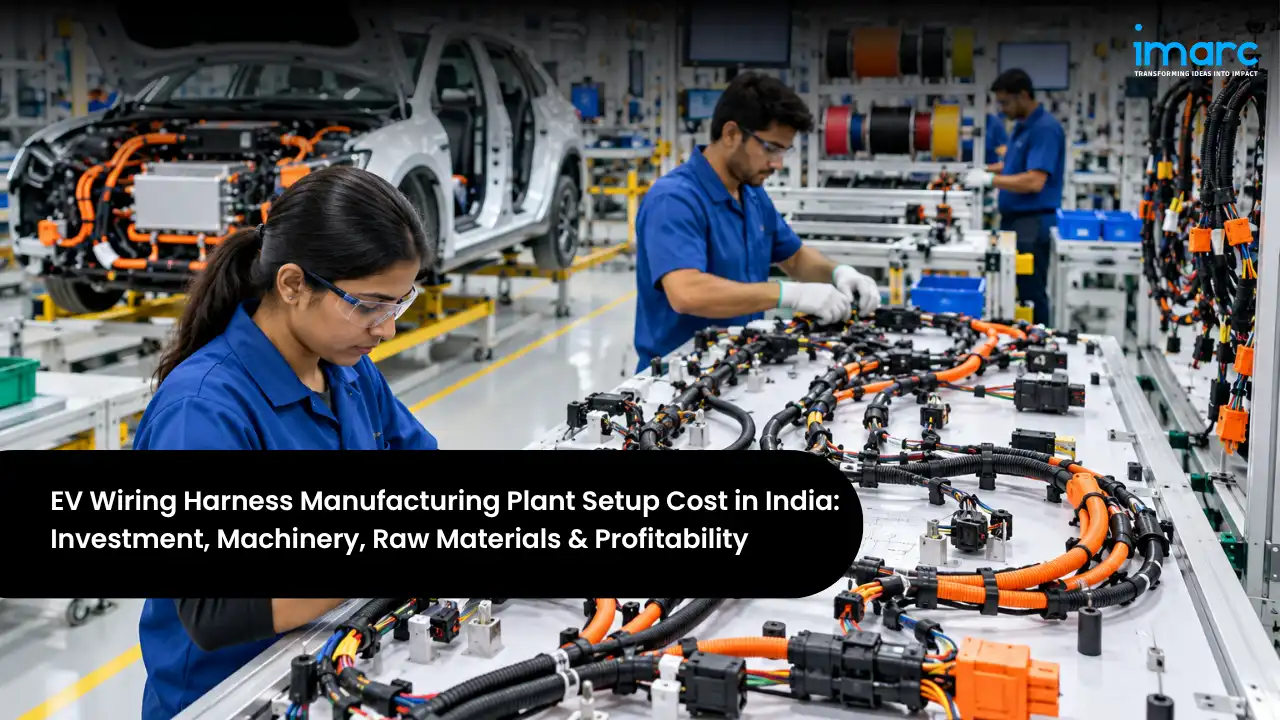
If the battery is the heart of an electric vehicle, the wiring harness is its nervous system. Every EV needs low-voltage harnesses for lights, sensors, and controls, plus high-voltage harnesses that carry hundreds of volts and high currents between the battery, inverter, motor, and charging port, and dedicated harnesses inside the battery pack that monitor every cell. With India selling more than 2.5 million electric vehicles a year and carmakers, two-wheeler brands, and commercial vehicle makers all localising their supply chains, an EV Wiring Harness Manufacturing Plant Setup in India is a timely way to enter the electrification value chain with moderate capital and strong demand visibility.
Investment depends on the harness types produced, the vehicle segments served, the share of high-voltage work, and the level of automation. For a typical plant supplying low- and high-voltage harnesses to two-wheeler, three-wheeler, and four-wheeler makers, the EV Wiring Harness Manufacturing Plant Cost ranges from about INR 15 crore to INR 150 crore. Cables, connectors, and terminals account for most of the operating cost, and harness assembly remains labour-intensive, so sourcing, process automation, and first-pass quality are the decisions that shape profitability. At healthy utilisation, a well-run plant can deliver a net profit margin of 10 to 14% and an IRR of 16 to 24%, with payback typically within 3.5 to 5 years.
This guide is written for investors trying to understand how to start an EV Wiring Harness manufacturing plant in India. It covers the main harness types, the demand outlook, the production flow, machinery and raw materials, location and infrastructure, a detailed cost and financial breakdown, the certifications and customer approvals involved, and how a DPR turns all of this into a plan that lenders and vehicle makers can trust.
India Market Snapshot
| Key Facts | Details |
|---|---|
| EV Sales (FY2025–26) | 2,550,865 units, up 25% year on year |
| EV Share of Vehicle Sales | About 8.6% in FY2025–26 |
| Electric Four-Wheeler Sales | 222,870 units, up about 90% |
| India Automotive Wiring Harness Market (2025) | USD 1.8 Billion, 3.55% CAGR to 2034 |
| Indicative Total Investment | INR 15–150 Crore |
| Typical Payback Period | 3.5–5 Years |
The snapshot shows why EV harnesses stand out within a mature wiring harness industry. The overall harness market grows steadily with vehicle production, but EV sales are growing several times faster, and each EV needs additional high-voltage and battery harnesses that are more complex and more valuable than conventional wiring. The wide investment range reflects a genuine choice between a focused plant making low-voltage and battery harnesses for two- and three-wheelers and a larger facility with full high-voltage capability for electric cars and commercial vehicles. The sections below work through that choice.
Investment Highlights
Indicative Project Cost in India (2026)
| Parameter | Value |
|---|---|
| Product Range | LV, HV, battery pack, motor, and charging harnesses |
| Total Project Investment | INR 15 – 150 Crore |
| Payback Period | 3.5 – 5 Years |
| Net Profit Margin | 10 – 14% |
| IRR | 16 – 24% |
| Preferred States | Tamil Nadu, Maharashtra, Karnataka, Gujarat, Haryana, Telangana |
| Key Approvals | Factory License, IATF 16949, customer PPAP approvals, AIS compliance support, Fire NOC |
| Key Requirement | High-voltage process capability and OEM approvals |
These ranges provide a realistic frame for early planning, but actual returns depend on copper and connector prices, the share of high-voltage work, labour productivity, and how quickly the plant wins nominations from vehicle and battery pack makers. A site-specific EV Wiring Harness Feasibility Report narrows each of these assumptions to your chosen products, customers, location, and capacity.
Table of Contents
- What is EV Wiring Harness Manufacturing?
- Why is EV Wiring Harness Manufacturing Growing in India?
- EV Wiring Harness Manufacturing Process Flow
- Raw Materials Required for EV Wiring Harness Manufacturing
- Location, Land & Infrastructure
- EV Wiring Harness Manufacturing Machinery and Equipment
- EV Wiring Harness Manufacturing Plant Setup Cost in India (CapEx & OpEx)
- Financial Analysis and Profitability
- Licenses and Approvals for EV Wiring Harness Manufacturing in India
- Recent Developments in the India EV Wiring Harness Manufacturing Industry
- How an EV Wiring Harness Manufacturing Project Report and DPR Helps Investors
- Frequently Asked Questions
What is EV Wiring Harness Manufacturing?
A wiring harness is an organised assembly of cables, terminals, connectors, and protective coverings that carries power and signals around a vehicle. In an electric vehicle, harnesses fall into two broad groups. Low-voltage harnesses, similar to those in conventional vehicles, connect lights, controls, sensors, and infotainment. High-voltage harnesses carry traction power between the battery pack, inverter, motor, onboard charger, DC-DC converter, and charging inlet, typically using appropriately rated, often orange-coloured, shielded cables and sealed connectors built to withstand high voltage, heat, vibration, and water.
Commercially, harness makers sit close to vehicle and battery pack manufacturers, often supplying just-in-time to their assembly lines. An EV Wiring Harness Manufacturing Plant can serve electric two-wheeler and three-wheeler makers, passenger and commercial EV manufacturers, battery pack assemblers who need cell monitoring and pack harnesses, and charging equipment makers. Because harnesses are designed around each vehicle model, long-term supply nominations give strong visibility once a plant is approved.
- Low-Voltage Vehicle Harnesses: Body, chassis, dashboard, and lighting harnesses for EVs of every segment.
- High-Voltage Power Harnesses: Shielded cables linking battery, inverter, motor, and onboard charger.
- Battery Pack Harnesses: Cell voltage and temperature sensing harnesses and pack interconnects.
- Charging Harnesses: Charging inlet assemblies and charging cable harnesses.
The Main EV Wiring Harness Product Types
Choosing which harness types to produce is the most important commercial decision, because it determines the machinery, testing, certifications, and customers you can serve:
| Harness Type | Description | Key Property | Primary Demand |
|---|---|---|---|
| Complete 2W/3W Harness | Full vehicle LV harness with power leads | Cost-effective, high volume | Electric scooters, motorcycles, three-wheelers |
| LV Harness for Cars & CVs | Body, chassis, and cockpit wiring | Complex routing, many circuits | Electric cars and commercial vehicles |
| HV Power Harness | Shielded high-voltage cables and connectors | High current, insulation safety | Electric cars, buses, and trucks |
| Battery Pack Harness | Cell sensing and pack interconnects | Precision and reliability | Battery pack assemblers |
| Charging Harness | Inlet and charging cable assemblies | Durability and sealing | Vehicles and charging equipment |
Product choice shapes the whole plant. Two- and three-wheeler harnesses rely on high-speed cutting, crimping, and board assembly, while high-voltage harnesses need shield termination, ultrasonic welding, sealed connector assembly, and high-voltage testing. Many new entrants begin with two-wheeler, three-wheeler, and battery pack harnesses, where volumes are large and approval cycles shorter, then add high-voltage harnesses for four-wheelers and commercial vehicles as capability and customer approvals grow.
Why is EV Wiring Harness Manufacturing Growing in India?
Key Growth Drivers in the Indian Market
Demand is driven by rapid EV adoption and the push to build a domestic EV supply chain:
- Fast-growing EV sales: India sold more than 2.5 million EVs in FY2025–26, and electric car sales nearly doubled.
- Higher harness content per vehicle: EVs need high-voltage, battery, and charging harnesses in addition to conventional wiring.
- Localisation of EV components: Vehicle makers and incentive schemes favour local sourcing to reduce cost and import dependence.
- Electric commercial vehicles: E-buses, e-trucks, and electric goods carriers are growing quickly and need heavy-duty HV harnesses.
- Rising electronics content: Connected features, driver assistance, and battery management add more circuits to every vehicle.
India-Specific Market Opportunity
| Segment | India Market Context | Manufacturing Role |
|---|---|---|
| Electric Two-Wheelers | About 58% of EV sales | High-volume complete harnesses |
| Electric Three-Wheelers | Rapid adoption in passenger and cargo use | Cost-effective harness sets |
| Electric Cars | Fastest-growing EV segment | LV and HV harness programmes |
| Battery Pack Makers | Expanding local cell and pack assembly | Pack and sensing harnesses |
| E-Buses & E-Trucks | Fleet electrification | Heavy-duty HV harnesses |
The strongest opportunity lies in becoming a qualified harness partner to fast-growing EV makers and battery pack assemblers, starting where volumes are highest and building high-voltage capability for the faster-growing car and commercial vehicle segments. Engineering support during vehicle development, quick prototyping, and reliable delivery are what win long-term nominations.
EV Wiring Harness Manufacturing Process Flow
Understanding the process helps you plan machinery, testing, floor layout, and where cost and quality are decided. Harness production combines automated wire processing with skilled manual assembly on layout boards, followed by thorough electrical testing. High-voltage harnesses add extra steps for shielding, sealing, and insulation testing, because safety at high voltage is non-negotiable.
The EV Wiring Harness Manufacturing Process Flow
The sequence below reflects a typical plant producing both low- and high-voltage EV harnesses.
| Unit Operation | Key Activity |
|---|---|
| Design & Engineering | Harness drawings, routing, and bills of materials prepared |
| Wire Cutting & Stripping | Cables cut to length and insulation stripped automatically |
| Crimping & Sealing | Terminals and seals applied with crimp force monitoring |
| Ultrasonic Welding & Splicing | Splices and HV terminals welded |
| HV Shield Termination | Cable shields prepared and terminated |
| Harness Assembly | Wires routed on layout boards, taped, and sleeved |
| Connector Assembly | Connectors fitted, locked, and sealed |
| Electrical Testing | Continuity, hi-pot, and insulation resistance tests |
| Leak & Visual Inspection | Sealing checks and final inspection |
| Labelling, Packing & Dispatch | Traceability labels and just-in-time delivery |
Two factors decide profitability across this flow. The first is first-pass quality: a single bad crimp or misrouted wire can cause a vehicle fault or recall, so crimp force monitoring, cross-section analysis, and 100% electrical testing are standard practice and essential for keeping customers. The second is labour productivity, because harness assembly remains largely manual; well-designed layout boards, ergonomic workstations, and automation in cutting, crimping, and testing lower cost per harness significantly.
Raw Materials Required for EV Wiring Harness Manufacturing
The main inputs are low- and high-voltage cables, terminals, connectors, protective materials such as conduits, tapes, and heat shrink sleeves, and electrical components such as fuses and busbars. Because cables and connectors dominate cost, and high-voltage connectors in particular are largely imported, a strong and qualified supplier base is central to project planning.
| Raw Material | Role in Harness | India Sourcing | % of OpEx |
|---|---|---|---|
| LV Automotive Cables | Signal and low-power circuits | Domestic cable makers | 15–22% |
| HV Shielded Cables | Traction power transmission | Domestic and imported | 12–20% |
| Connectors & Terminals | Electrical connections | Domestic and largely imported for HV | 22–30% |
| Protection Materials | Conduits, tapes, sleeves, grommets | Domestic suppliers | 5–8% |
| Fuses, Busbars & Components | Circuit protection and distribution | Domestic and imported | 3–5% |
| Clips, Seals & Packaging | Fixing, sealing, and protection | Domestic suppliers | 2–4% |
Copper prices affect cable costs directly, so most harness contracts include metal price adjustment clauses, and securing these terms is important for protecting margins. Vehicle makers usually specify approved connector and cable brands, which means the plant must work within customer-approved supplier lists. Localising cables, protective materials, and simpler connectors while building relationships with global high-voltage connector suppliers is the most practical sourcing strategy.
Location, Land & Infrastructure
Site selection for an EV harness plant is driven mainly by proximity to vehicle and battery pack customers, because harnesses are bulky, model-specific, and often supplied just-in-time. Access to a large, trainable workforce, supplier networks, and good logistics also matters.
Choosing the Best Location for EV Wiring Harness Manufacturing Plant Setup
| State / Region | Why It Works | Key Advantage |
|---|---|---|
| Tamil Nadu (Hosur, Krishnagiri & Chennai) | Largest cluster of EV two-wheeler and car makers | Customers, suppliers, and workforce |
| Maharashtra (Pune & Chakan) | Major EV car, two-wheeler, and CV hub | OEM proximity and engineering talent |
| Karnataka (Bengaluru) | EV start-up and design ecosystem | Engineering support and customers |
| Gujarat (Sanand & Hansalpur) | Growing EV car manufacturing base | OEM plants and incentives |
| Haryana & NCR | Large auto and two-wheeler cluster | Northern customers and logistics |
| Telangana (Hyderabad) | Growing EV and battery ecosystem | Incentives and skilled manpower |
Tamil Nadu's Hosur and Chennai belt is a natural first choice, with India's largest concentration of electric two-wheeler makers alongside major car plants. Pune suits plants targeting electric cars, two-wheelers, and commercial vehicles, while Gujarat is attractive for suppliers to its growing EV car manufacturing base. Many harness makers eventually operate satellite plants near each major customer, so the first location should be chosen for its anchor customer and room to grow.
Quality, Safety and High-Voltage Capability
Vehicle makers expect harness suppliers to operate certified quality systems with full traceability, validated processes, and complete testing. For high-voltage work, the plant also needs trained operators, controlled shield termination, sealed connector assembly, hi-pot and insulation resistance testing, leak testing for sealed assemblies, and strict electrical safety procedures. Supporting customers in meeting Indian EV safety standards and their own specifications is part of the job. An experienced EV Wiring Harness Manufacturing Consultant in India can help set up the process validation, testing, and quality systems that vehicle makers look for, so the plant can move from samples to series supply without delay.
Infrastructure Requirements (Mid-Sized Plant)
| Infrastructure Element | Specification | India-Specific Note |
|---|---|---|
| Total Built-Up Area | 5,000 – 25,000 sq. metres | Assembly boards need floor space |
| Wire Processing Area | Automated cutting and crimping zone | Clean, well-lit, organised |
| Assembly Area | Layout boards and conveyor lines | Largest area; labour-intensive |
| HV Assembly & Test Zone | Segregated, safety-controlled area | Trained staff and interlocked test bays |
| Power Requirement | 300 kW – 1.5 MW | Moderate electrical load |
| Quality Laboratory | Crimp analysis and electrical testing | Supports PPAP and audits |
| Warehouse | Component and finished harness storage | Just-in-time dispatch capability |
Floor space for assembly boards, a segregated high-voltage area, and a strong quality laboratory are the defining infrastructure needs. Because each vehicle programme needs its own layout boards and test fixtures, the layout must be flexible enough to add and change lines as new models are nominated. Ready-built industrial sheds near customer plants can shorten the time to production considerably.
EV Wiring Harness Manufacturing Machinery and Equipment
The equipment set covers wire processing, crimping, welding, high-voltage preparation, assembly, and testing. Automation is concentrated in wire processing and testing, while assembly remains largely manual with the support of well-designed boards and tools. The main items are summarised below.
| Equipment | Function | Key Specification |
|---|---|---|
| Automatic Cut-Strip-Crimp Machines | Prepare wire leads | Multi-station with seal application |
| Crimp Force Monitoring & Applicators | Ensure crimp quality | Inline monitoring on every crimp |
| HV Cable Processing Machines | Strip and prepare shielded cables | Precise multi-layer stripping |
| Ultrasonic Welding Machines | Weld splices and HV terminals | Consistent, low-resistance joints |
| Heat Shrink & Twisting Machines | Seal and twist wires | Uniform shrink and twist |
| Layout Boards & Rotary Assembly Lines | Assemble harnesses | Product-specific boards |
| Taping & Sleeving Tools | Bundle and protect wires | Semi-automatic taping |
| Continuity Test Benches | Check every circuit | 100% electrical testing |
| Hi-Pot & Insulation Resistance Testers | Verify HV insulation | Interlocked, safe test bays |
| Leak & Pull Testers | Check sealing and joint strength | For sealed HV assemblies |
| Crimp Cross-Section Lab & Label Printers | Analyse crimps and mark harnesses | Micrograph analysis and traceability labels |
Machinery should follow the harness types and volumes planned. A plant focused on two- and three-wheeler harnesses invests mainly in automatic crimping machines, assembly boards, and continuity testers, while high-voltage work adds shielded cable processing, ultrasonic welding, and hi-pot and leak testing. Test fixtures and layout boards are product-specific, so they should be budgeted with every new nomination rather than treated as a one-time cost.
EV Wiring Harness Manufacturing Plant Setup Cost in India (CapEx & OpEx)
The tables below break down capital and operating costs for a mid-sized EV harness facility in India. The final EV Wiring Harness Investment Cost for your project will depend on product types, the share of high-voltage work, automation, the number of vehicle programmes, and location.
Capital Expenditure (CapEx) Cost Structure
| CapEx Component | % of Total CapEx | What It Covers |
|---|---|---|
| Plant & Machinery | 35–45% | Cutting, crimping, welding, and HV processing |
| Land & Buildings (or Fit-Out) | 15–22% | Assembly halls, HV zone, and warehouse |
| Testing Equipment & Fixtures | 8–12% | Electrical test benches and HV testers |
| Layout Boards & Tooling | 5–8% | Product-specific boards and applicators |
| Utilities & Quality Lab | 3–6% | Power, lighting, and crimp analysis lab |
| Pre-operative & Contingency | 4–6% | Engineering, DPR, certifications, buffer |
| Working Capital | 12–18% | Cables, connectors, and customer receivables |
Machinery and testing equipment take the largest share of capital, while programme-specific boards, fixtures, and applicators recur with every new vehicle model. Working capital also matters, because connectors and cables must be stocked for multiple programmes and customers usually pay on credit terms. A detailed EV Wiring Harness Business Plan should model each vehicle programme separately, including its tooling, volumes, and ramp-up, so that funding matches the real pattern of nominations.
Operating Expenditure (OpEx) Cost Structure
| OpEx Component | % of Total OpEx | India-Specific Note |
|---|---|---|
| Raw Materials (cables, connectors, terminals) | 70–78% | Connectors and cables dominate |
| Labour & Skilled Manpower | 10–15% | Assembly remains labour-intensive |
| Tooling & Maintenance | 2–4% | Applicators, dies, and fixtures |
| Logistics & Packaging | 2–4% | Just-in-time deliveries |
| Power & Utilities | 1–3% | Low energy intensity |
| Quality, Testing & Overheads | 3–5% | Audits, validation, and administration |
With materials making up most of the cost sheet and labour the next largest item, margins depend on buying cables and connectors well, keeping scrap and rework low, and raising assembly productivity. A good operating model tracks material cost per harness, labour minutes per harness, first-pass yield, and copper price exposure, and tests how margins respond when copper prices or labour costs change.
Financial Analysis and Profitability
Based on analysis of a mid-sized harness facility, the financial profile is attractive, supported by rapid EV growth, higher harness content per EV, and long-term supply nominations. The profitability of EV Wiring Harness manufacturing business in India improves markedly with high-voltage capability, a diversified set of vehicle programmes, strong first-pass quality, and metal price adjustment clauses in customer contracts.
| Financial Metric | Indicative Value | India Context |
|---|---|---|
| Gross Profit Margin | 18–25% | Higher for HV and battery harnesses |
| Net Profit Margin | 10–14% | After depreciation and Indian corporate taxes |
| Payback Period | 3.5–5 Years | Faster with anchor OEM nominations |
| IRR (Internal Rate of Return) | 16–24% | Higher with HV product mix |
| Capacity Utilization (stable ops) | 65–85% | Depends on programme volumes |
| Break-even Capacity Utilization | 45–55% | Moderate fixed costs |
Product mix and customer base decide where a plant lands within these ranges. A plant supplying only standard low-voltage harnesses to a single customer will face tighter pricing and volume risk, while one supplying high-voltage, battery, and charging harnesses to several EV makers can earn better margins and more stable volumes. Because each programme runs for several years, winning the right nominations early has a lasting effect on returns.
Returns can be strengthened by building high-voltage capability early, diversifying across two-wheeler, car, commercial vehicle, and battery pack customers, automating wire processing and testing, localising connectors and components where possible, and offering design support during vehicle development. Consistently low defect rates are the most important factor in keeping and expanding customer relationships.
Key Risks and Mitigation
The main risks are copper price volatility, dependence on a few EV makers whose volumes can swing, rapid changes in vehicle designs, and import dependence for high-voltage connectors. Price risk is reduced through metal price adjustment clauses; customer risk by diversifying programmes; design risk by close engineering engagement and flexible lines; and supply risk by qualifying multiple connector sources and localising where possible. Promoters often work with an EV Wiring Harness Business Plan Consultant in India to test these scenarios before committing capital.
Licenses and Approvals for EV Wiring Harness Manufacturing in India
Approvals for a harness plant combine standard industrial registrations with the quality certifications and customer approvals that decide which programmes the plant can supply. Promoters setting up an EV Wiring Harness Manufacturing Plant in India generally need the following:
- Factory License: Registration and plan approval under the Occupational Safety, Health and Working Conditions Code, 2020.
- Pollution Control Consent: Consent from the State Pollution Control Board as applicable to harness assembly, which is typically a low-impact activity.
- Quality Certifications: IATF 16949 and ISO 9001, with ISO 14001 and ISO 45001 often requested by vehicle makers.
- Customer Approvals: Process validation and part approval through PPAP and customer audits for each harness programme.
- Standards Compliance Support: Harnesses built to customer specifications and relevant automotive standards, supporting vehicle makers’ compliance with Indian EV safety requirements such as AIS standards for traction batteries and electric powertrains.
- Business & Tax Registration: Company incorporation, GST, Udyam, and an IEC for importing connectors and components.
- Fire Safety & Labour Registrations: Fire NOC and employee welfare registrations such as EPF and ESI.
Customer approvals and IATF certification are usually on the critical path, because vehicle makers will not place series orders until processes are validated and audited. Engaging target customers early, producing samples, and completing process validation alongside machine installation can shorten the time from commissioning to series supply considerably.
Note: The exact approvals, registrations, licenses, and certification requirements may vary depending on factors such as plant location, harness types, target customers, export markets, and applicable regulations. Businesses are advised to undertake a detailed regulatory assessment during the project planning stage to ensure full compliance and timely implementation.
Recent Developments in the India EV Wiring Harness Manufacturing Industry
Several recent developments give useful context for investors considering this market:
- Record EV sales: India sold 2,550,865 EVs in FY2025–26, up about 25%, with EVs reaching roughly 8.6% of vehicle sales.
- Electric car momentum: Electric four-wheeler sales rose about 90% to around 223,000 units, raising demand for high-voltage harnesses.
- Commercial EV growth: Electric goods carrier sales more than doubled, and fleet electrification is expanding demand for heavy-duty harnesses.
- Localisation push: Vehicle makers and incentive schemes are encouraging domestic sourcing of EV components, including harnesses, cables, and connectors.
The common thread is a fast-growing EV market that is steadily deepening its local supply chain. New entrants who build high-voltage capability, certified quality systems, and close relationships with EV makers and battery pack assemblers will be best placed as electrification accelerates through the decade.
How an EV Wiring Harness Manufacturing Project Report and DPR Helps Investors
A detailed DPR provides a structured roadmap for the venture, from market demand and product selection to machinery, testing, layout, certification, and economics. It helps investors decide the right harness types and capacity, estimate capital and operating expenditure, assess profitability, and identify risks before committing funds.
At its core is a detailed EV Wiring Harness Financial Model covering revenue by programme and customer, material cost per harness, labour productivity, tooling and fixture costs, metal price adjustments, working capital, cash flows, break-even, return on investment, and payback. Banks and investors rely on this model to judge long-term viability, which is why many promoters appoint an EV Wiring Harness Plant Project Report Consultant in India to prepare the report and validate its assumptions against current market data.
For a harness project, a strong DPR also clarifies the customer and programme strategy, the high-voltage capability plan, the component sourcing approach, and the automation roadmap, which together are the factors most likely to decide success. By modelling utilisation against realistic EV volumes and testing margins against copper and labour cost swings, the report turns a fast-moving opportunity into a plan that lenders and partners can trust.
Frequently Asked Questions
What are the first steps to set up an EV wiring harness manufacturing plant in India?
Start by choosing your harness types, target customers, and capacity, then commission a feasibility study and DPR. Next, secure a factory near your anchor customers, install cutting, crimping, welding, and testing equipment, set up a segregated high-voltage area, arrange cable and connector supply, obtain the factory license, pursue IATF certification, and complete customer sampling and PPAP.
How much does it cost to set up an EV wiring harness manufacturing plant in India?
A typical plant needs roughly INR 15 crore to INR 150 crore, depending on harness types, the share of high-voltage work, automation, and the number of vehicle programmes. Machinery, testing equipment, buildings, and working capital are the largest components.
What are the main steps in EV wiring harness manufacturing?
The flow runs from design and engineering through wire cutting and stripping, crimping and sealing, ultrasonic welding, high-voltage shield termination, harness assembly on layout boards, connector assembly, electrical and high-voltage testing, leak and visual inspection, and labelling and dispatch.
Which machinery does an EV wiring harness manufacturing plant need?
Key equipment includes automatic cut-strip-crimp machines, crimp force monitoring systems, HV cable processing machines, ultrasonic welders, heat shrink and twisting machines, layout boards and rotary assembly lines, taping tools, continuity test benches, hi-pot and insulation resistance testers, leak and pull testers, and a crimp analysis laboratory.
What raw materials are used to make EV wiring harnesses?
The main inputs are low-voltage automotive cables, high-voltage shielded cables, connectors and terminals, protective conduits, tapes, sleeves, and grommets, fuses and busbars, and clips, seals, and packaging materials.
How profitable is EV wiring harness manufacturing in India?
A well-run plant typically earns a 10 to 14% net margin and a 16 to 24% IRR, with payback in 3.5 to 5 years at healthy utilisation. Profitability improves with high-voltage and battery harnesses, diversified customers, automation, and metal price pass-through, while margins track copper prices and labour productivity.
Which approvals does an EV wiring harness manufacturing plant need in India?
Typical approvals include a factory license, pollution consent as applicable, IATF 16949 and ISO certifications, customer PPAP approvals, compliance with customer and automotive standards, a Fire NOC, and GST, Udyam, IEC, and labour registrations.
How do I get a feasibility study or DPR for an EV wiring harness manufacturing project?
A detailed feasibility study and DPR covers market demand, customer and programme strategy, plant design, high-voltage capability, certifications, and full financials. Investors usually engage an EV Wiring Harness Manufacturing Feasibility Study Consultant with experience in automotive electrical and EV component projects to prepare the report and validate it for lenders.
Our Clients










Contact Us
Have a question or need assistance?
Please complete the form with your inquiry or reach out to us at
Phone Number
+91-120-433-0800+1-201-971-6302
+44-113-547-7077
Previous Post

Every electric vehicle needs a brain between the battery and the motor. The motor controller, often called the traction inverter in larger vehicles, converts DC power from the battery into precisely controlled AC power for the motor, manages acceleration, regenerative braking, and efficiency, and protects the whole powertrain from faults.
Every vehicle on the road depends on forged parts. Crankshafts, connecting rods, steering knuckles, axle beams, gears, and hubs are forged because the process gives steel a continuous grain flow and the strength to survive millions of load cycles.
Setting up an Automotive Components Manufacturing Plant in India is a high-potential, export-capable venture, powered by the country's large automobile industry, deep supplier base, and growing role as a global sourcing hub for auto parts.
The global automotive lead-acid battery market reached USD 13.89 Billion in 2025 and is projected to reach USD 16.60 Billion by 2034, growing at a CAGR of 1.94% (2026–2034).
Setting up an Electric Scooter Manufacturing Plant in India is a capital-efficient, high-growth venture, driven by the country's rapid shift to electric mobility, supportive EV policies, and surging demand for affordable, clean urban transport. As two-wheelers dominate Indian roads and buyers move from petrol to battery-powered scooter manufacturing, an EV Scooter Manufacturing Plant is one of the most accessible and strategically timed entry points into the electric vehicle economy.
Capital is flowing into the united states used car market because structural affordability pressure, digital retail maturity, and a record-old national vehicle fleet have converged into a genuinely investable thesis.
The Europe Tire Market reached a volume of 458.89 Million Units in 2025 and is projected to reach 565.69 Million Units by 2034, growing at a CAGR of 2.35% (2026–2034).
A strategic analysis of how PLI policies and localization drive global OEM investments. India’s EV battery market hits USD 15,898.31 Million by 2034 (21.7% CAGR).
A tyre is circular in shape and made of a combination of rubber materials that fit perfectly over a circular rim on a wheel, providing traction, load-carrying capabilities, shock absorption, and directional stability. As such, tyres are engineered materials composed of a combination of natural or synthetic materials. They are composed of a combination of materials such as rubber, a combination of materials such as steel or textile, and various chemical materials, among others.
A tractor is a self-propelled, torque-requiring vehicle intended primarily for pulling power at low speeds for agricultural, industrial, and utility purposes. It functions as a mobile power source that can be used for towing, pushing, lifting, or driving a variety of agricultural implements through mechanical, hydraulic, or power take-off systems. Tractors are designed with powerful propulsion systems, sturdy frames, and versatile coupling systems for use on different terrains and under heavy loads.
The electric boat and ship market size is experiencing unparalleled growth as the marine industry embraces electrification on a large scale across different geographies. As sustainability is becoming a strategic priority, with each passing day, more and more marine operators look to electric propulsion technologies as alternatives aimed at cutting down emissions, improving operational efficiencies, and enabling greener ports.
The GCC car rental market has emerged as a critical component of the region's transportation ecosystem, driven by robust tourism activity, expanding business travel, and a substantial expatriate population. Countries across the Gulf Cooperation Council are witnessing unprecedented demand for flexible mobility solutions that cater to diverse customer segments. The GCC car rental market size was valued at USD 1.65 Billion in 2024 as governments prioritize infrastructure development and sustainable tourism initiatives.
The Indian automotive sector has formed a vital part of the country's industrial and economic development for a long period. Over the years, the industry has transformed significantly, influenced by changes in technology, global trends, and consumer preference. Among the various factors shaping its trajectory, government policies have emerged as a decisive force driving growth, innovation, and competitiveness in the India auto parts manufacturing industry.
The India motorcycle tires market continues to evolve in response to changing mobility preferences, rising urbanization, and the growing significance of two-wheelers as essential transportation assets for millions of riders. As per sources, the India motorcycle tires market size reached USD 933.66 Million in 2024. The market is projected to reach USD 2,419.36 Million by 2033, exhibiting a growth rate (CAGR) of 10.3% during 2025-2033.
The Saudi Arabia tire market is undergoing a significant transformation driven by the nation’s economic diversification, rapid urbanization, and growing vehicle ownership. As one of the largest automotive hubs in the Middle East, Saudi Arabia is witnessing increasing demand for both passenger and commercial vehicle tires across urban and industrial regions.
One of the world's most dynamic and quickly changing markets, India's automotive industry is undergoing revolutionary changes in both the new and used car markets. Despite general economic uncertainty, the used car industry has shown remarkable resilience and growth potential, making it a particularly vibrant part of this ecosystem.
One of the world's most vibrant and quickly growing automobile markets is India's passenger car sector. From technological innovation to economic development, a number of interrelated factors have contributed to the sector's remarkable transformation. For stakeholders looking to take advantage of the enormous opportunities in this dynamic market, it is imperative that they comprehend these growth drivers.
India's truck industry is at a turning point in its development, driven by extensive government policies that are changing the commercial vehicle market. The industry, which is the foundation of the country's logistics ecosystem, is gaining previously unheard-of momentum thanks to smart regulatory frameworks and forward-thinking legislative initiatives. A fundamental change in truck operations on Indian highways is being sparked by government initiatives ranging from infrastructure development to emission standards, digitalization, and financial incentives.
The electric rickshaw sector in India has experienced a significant upheaval in recent years and is now a vital part of the country's sustainable transportation network. Strategic government policies aimed at hastening the adoption of clean mobility solutions have played a major role in orchestrating this evolution. India's larger vision of sustainable urbanization is in line with the electric rickshaw industry, which combines social development objectives, economic opportunities, and environmental imperatives.
Transportation in India is undergoing a spectacular change with the advent of electric two-wheelers that are quite an enticing alternative to traditional fuel-powered ones. This change is not merely an act of technological transformation, but an indication of how millions of Indians will think about city mobility, eco-awareness, and economic effectiveness.
As one of the world's leading industrial powerhouses, Japan has long been recognized for its commitment to technological innovation and manufacturing precision. The industry for industrial automation components—encompassing sensors, controllers, actuators, drives, robotics, and human-machine interfaces—represents the backbone of modern manufacturing infrastructure.
The Australian brakes and clutches industry plays a vital role in ensuring vehicle performance, safety, and efficiency across both automotive and industrial segments. As the nation transitions toward electric mobility and smarter manufacturing systems, the demand for advanced braking and clutch mechanisms is rising significantly.
The Philippines automotive wiring harness industry stands at a transformative juncture, driven by technological innovations that are reshaping vehicle electrical architectures worldwide. As vehicles evolve into sophisticated mobile computing platforms, the wiring harness, the circulatory system transmitting electrical power and data throughout modern automobiles, has become increasingly complex and critical to vehicle performance.
Japan's hybrid vehicles market stands as a global benchmark for sustainable mobility innovation, demonstrating remarkable growth and technological leadership. The market achieved a valuation of USD 33.57 Billion in 2024. Japan's hybrid vehicle (HV) market is one of the most established globally, originating with pioneering models like the Toyota Prius. It currently represents a significant portion of the country's automotive sales.
The Japan warehouse robotics market is a highly dynamic and rapidly expanding segment of the global automation industry. The market, valued at USD 414.0 Million in 2024, is on a sharp growth trajectory. Its growth is fueled by critical domestic factors, including a severe labor shortage, the rapid expansion of e-commerce, and Japan's strategic position as a world-leading robotics manufacturer.
The UK is rapidly evolving into a dynamic hub for autonomous vehicle research, testing, and early-stage deployments. A strong ecosystem comprising academic institutions, technology start-ups, automakers, and mobility service providers fosters continuous innovation. Supported by a skilled workforce specializing in software, sensing, robotics, and transportation systems, the nation has become a fertile ground for experimentation.
Japan’s transportation landscape is on the brink of a major shift, with robo taxis, autonomous, driverless vehicles designed for passenger and goods transport, emerging as a practical mobility solution. The Japan robo taxi market reached USD 83.2 Million in 2024 . This remarkable expansion reflects Japan’s broader move toward smart mobility, sustainability, and automation.
The Japan electric truck market is experiencing transformative growth as the nation accelerates toward sustainable transportation and carbon neutrality. As a leading automotive manufacturing hub, Japan is witnessing unprecedented momentum in commercial vehicle electrification, driven by stringent environmental regulations, technological innovation, and strategic government support. The electric truck industry represents a critical component of Japan's commitment to achieving 100% electrified vehicle sales by 2035 and carbon neutrality by 2050.
An EV charging station represents the necessary main infrastructure that allows electrical energy to be transferred from the power grid into electric vehicles to enable their use for transportation. Unlike conventional fueling stations that offer liquid fuels, EV charging stations provide electric power through the use of standardized connectors and smart control systems. The core components include a power conversion unit, which transforms alternating current from the grid into direct current for the vehicle battery; a charging controller controlling communication between the charger and the EV; and a connector or plug matched to the vehicle's charging interface.
An electric scooter is a two-wheeled vehicle powered by an electric motor and rechargeable battery, aimed at offering the means for efficient, eco-friendly, and cost-effective urban mobility. Apart from the traditional scooters that are powered by internal combustion engines, the electric scooters make use of lithium-ion or lead-acid batteries that feed an electric supply to a BLDC motor, which drives the wheels either directly or via a belt or chain mechanism.
Electric bikes, commonly referred to as e-bikes, are one of the most transformational innovations in modern personal mobility, combining conventional bicycle mechanics with advanced electric propulsion technology. At the heart of e-bikes are an electric motor, a rechargeable battery, and a control system that add assistance to the rider while pedaling, making cycling easier, faster, and more accessible across varied terrains. Based on their design, they can be further categorized into pedal-assist, throttle-controlled, or hybrid models, each providing different levels of rider control and engagement of the motor.
The micro-mobility industry has emerged as a transformative force in urban transportation, revolutionizing how people navigate cities worldwide. According to IMARC, the global micro-mobility market size was valued at USD 63.10 Billion in 2024. Looking forward, IMARC Group estimates the market to reach USD 204.83 Billion by 2033, exhibiting a CAGR of 12.86% from 2025-2033.
India's electric vehicle (EV) revolution is accelerating at a breakneck speed, powered by a strategic combination of government incentives, infrastructure investments, and manufacturing policies that are transforming the automotive landscape. The IMARC Group forecasts that the Indian electric car market reached USD 963 Million in 2024.
The diesel engine industry is standing at a transformative crossroads. As global markets are pushing for sustainability, stricter emissions compliance, and cutting-edge innovations, diesel powertrains are facing both immense pressure and promising potential.
The global tire market is a multi-billion-dollar industry, driven by the growing demand for vehicles across emerging economies and the replacement tire segment in developed countries. The global tire market is expected to grow at a compound annual growth rate (CAGR) of 4.70% between 2025 and 2033. The industry is heavily influenced by factors such as technological advancements, raw material prices, environmental regulations, and consumer preferences.
Australia's electric vehicle (EV) sector is experiencing swift expansion, fueled by increasing interest in eco-friendly transportation alternatives. In 2024, sales of battery electric and plug-in hybrid vehicles hit an all-time high, totaling around 114,000 units.
The electric bus industry is the part of the transportation sector that deals with the production and installation of buses that run completely or partially on electricity, employing battery packs or fuel cells in place of conventional diesel or gasoline engines. The buses deliver lower greenhouse gas emissions, lesser noise levels, and enhanced energy efficiency, and thus they are a prime solution for environmentally friendly public transport.
India's electric vehicle market is undergoing a profound transformation, impelled by green priorities, economic imperatives, and changing consumer trends. With rising concerns about air pollution and fossil fuel dependence, electric mobility has become a strategic option for India's transport industry. Policy clarity, technology development, and an emerging ecosystem of makers and suppliers are driving this market shift.
The global electric vehicle market size was valued at USD 755 Billion in 2024. The global EV market is rapidly expanding, driven by technological advancements, government incentives, stricter emission regulations, rising fuel costs, extended battery range, growing environmental consciousness, and significant investments in charging and production infrastructure.
Electric Vehicles, or EVs, are vehicles operated partially or wholly by electrical power, generally with rechargeable battery packs as their fuel. In contrast to conventional internal combustion engine cars, EVs emit no tailpipe emissions, making them a cleaner, environmentally friendly transportation choice. EVs comprise Battery Electric Vehicles (BEVs), Plug-in Hybrid Electric Vehicles (PHEVs), and Hybrid Electric Vehicles (HEVs), and are gaining ground in passenger, commercial, and two-wheeler segments owing to developments in battery technology, charging infrastructure, and policy support.
Aluminum alloy wheels are high-performance, lightweight, and durable components widely used in the automotive industry. Their superior strength-to-weight ratio enhances vehicle efficiency, fuel economy, and handling, making them a preferred choice for both passenger and commercial vehicles. Beyond their functional benefits, aluminum alloy wheels contribute to vehicle aesthetics, offering sleek designs and customization options that appeal to consumers. Their corrosion resistance and thermal conductivity further enhance braking performance and longevity. With increasing demand for fuel-efficient and stylish vehicles, aluminum alloy wheels play a crucial role in the global automotive sector, catering to OEMs, aftermarket suppliers, and performance vehicle manufacturers.
A tyre is a crucial component of a vehicle, serving as the outer covering of a wheel. Its main purposes are to support the vehicle's weight, provide traction for movement, and act as a flexible cushion that absorbs shocks from the road. Usually composed of rubber, tires are strengthened with steel and cloth. Tires for cars, trucks, motorbikes, bicycles, and other vehicles have different designs and compositions depending on the vehicle type and its intended usage. To improve stability and grip, they have a tread pattern on the outside.
Electric kick scooters are small, battery-operated personal transportation vehicles intended for short-distance and urban movement. They offer an economical and environmentally responsible substitute for conventional modes of mobility thanks to their electric engine, rechargeable battery, and lightweight frame. The need for sustainable transportation options, traffic congestion, and growing urbanisation have all contributed to their rise in popularity. Electric kick scooters are now the go-to option for last-mile connectivity and personal commuting because to developments in battery technology, connectivity features, and government programs encouraging micro-mobility.
An automotive wiring harness is an organized assembly of electrical wires, connectors, and terminals that transmit power and signals across a vehicle’s electrical system. It guarantees effective communication between several parts, including the engine control unit, lighting, and sensors. Wiring harnesses are intended to increase vehicle performance and safety by lowering the possibility of short circuits. By maximising electrical connectivity and lowering wire complexity, they are utilised in both conventional and electric automobiles and are essential to contemporary automotive technology.
In an automotive braking system, brake pads are the most important parts since they are engineered to contact the brake rotor to produce friction, thus stopping or slowing down a vehicle in virtually any driving condition safely and efficiently. The key way of classifying these pads is according to their material types: low metallic, ceramic, organic, and semi-metallic.
Tires are essential components of vehicles designed to provide traction, support, and absorb road shocks. Primarily made of rubber, tires consist of treads, belts, and sidewalls that work together to offer grip, stability, and durability. Modern tires come in various types – such as all-season, winter, and performance tires – each engineered for specific driving conditions. The two major tire categories are radial and bias tires, and they are available in different sizes to suit various vehicle types, including passenger cars, light commercial vehicles, medium and heavy commercial vehicles, two-wheelers, and off-road vehicles.
Electric Vehicles (EVs) are powered by electric motors instead of traditional internal combustion engines (ICEs). Electric motors propel EVs by utilizing electricity stored in rechargeable batteries or other energy storage systems. They produce lower or zero tailpipe emissions, reduce air pollution and greenhouse gas (GHG) emissions, and help in mitigating climate change. Electric vehicles consist of various components, such as battery cells and packs, reducers, fuel stacks, power control units, power conditioners, air compressors, humidifiers, motors, on-board chargers, battery management systems, and others. EVs are classified into four types based on propulsion, outlined below.
Saudi Arabia is the second-largest producer and exporter of crude oil and holds the second-largest proven oil reserves in the world, with around 267 billion barrels. The country's oil sector is a significant part of its economy, accounting for 75% of government revenue and approximately 90% of exports. However, due to the volatility of oil prices and the potential for economic instability, Saudi Arabia is increasingly focusing on non-oil activities to reduce its dependency on the oil sector. Non-oil commodities tend to have more stable prices, providing protection against these fluctuations and strengthening the country's social, economic, and financial sectors.