Electric Switches, Plugs and Sockets Plant Setup Cost in India: Manufacturing Process Flow, Machinery, DPR & Financial Model 2026
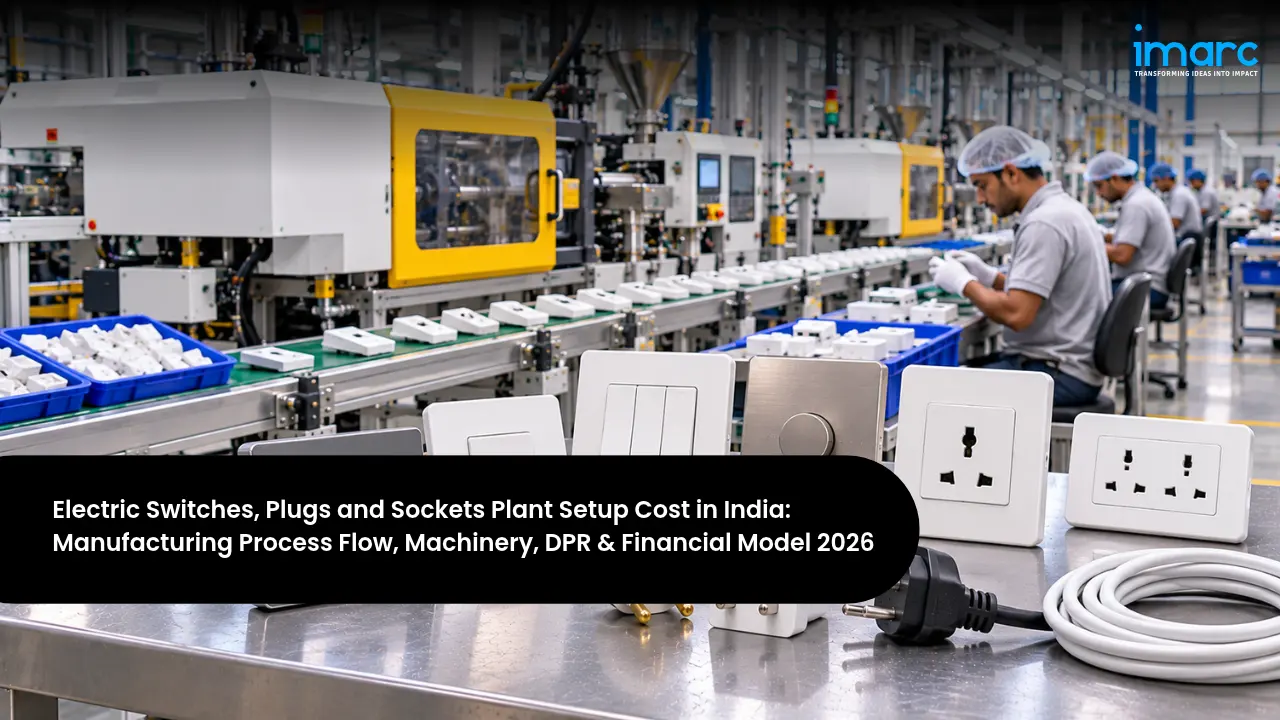
An Electric Switches, Plugs and Sockets Manufacturing Plant Setup in India produces the wiring devices found in every home, office, shop, factory, and public building. Products include modular switches and sockets with cover plates, conventional piano and flush switches, 6A and 16A socket outlets, switch-socket combinations, plug tops, multi-pin adaptors, bell pushes, fan regulators, USB charging sockets, and smart Wi-Fi switches. They are made from flame-retardant engineering plastics, brass and phosphor bronze contacts and terminals, and silver alloy contact points. Demand is driven by housing construction, commercial real estate, renovation, electrification, and the shift to premium modular and smart products.
The overall Electric Switches, Plugs and Sockets Manufacturing Plant Cost depends mainly on capacity, the product range, the number of injection moulding machines and moulds, metal stamping presses and dies, contact riveting equipment, assembly automation, the tool room, testing laboratory, land and buildings, and working capital for metals, plastics, finished stock, and dealer credit. A plant producing about 60 million units a year typically needs INR 25 crore to INR 40 crore in fixed assets, or about INR 35 crore to INR 55 crore including working capital. A smaller unit making 5 to 10 million basic switches and sockets a year can start at around INR 2 crore to INR 5 crore. IMARC Group puts typical capacities at 50 to 200 million units a year, with gross margins of 35 to 45% and net margins of 18 to 25%.
This guide is written for electrical product companies, plastic moulders, brass component makers, distributors building their own brands, and investors exploring how to start an Electric Switches, Plugs and Sockets manufacturing plant in India. It explains product types and end uses, demand drivers, the production flow, machinery and raw materials, site selection, a detailed cost and returns breakdown, the BIS and quality approvals involved, and how a DPR pulls these elements into a bankable plan.
India Market Snapshot
| Key Facts | Details |
|---|---|
| Asia Pacific Share of Global Market | About 40.6% |
| PMAY-Urban 2.0 Target | 1 Crore urban houses |
| Key Indian Standards | IS 3854, IS 1293, IS 15787 |
| QCO for Switch-Socket Outlets | In force from 13 January 2026 |
| Typical Plant Capacity | 50–200 Million Units a Year |
| Indicative Total Investment | INR 35–55 Crore (60 Million Units, incl. working capital) |
Asia Pacific accounts for about 40.6% of the global wiring device market according to IMARC Group, and India's housing programmes, commercial construction, and renovation demand keep volumes growing. Mandatory BIS certification under quality control orders now covers switches, plugs, sockets, and switch-socket outlets, favouring organised, compliant manufacturers.
Investment Highlights
Indicative Project Cost in India (2026)
| Parameter | Value |
|---|---|
| Product Range | Modular and conventional switches, socket outlets, switch-socket combinations, plug tops, adaptors, regulators, USB and smart switches, and cover plates |
| Total Project Investment | INR 35 – 55 Crore incl. working capital (60 Million Units); INR 2 – 5 Crore (5–10 Million Units) |
| Payback Period | 4 – 5 Years |
| Net Profit Margin | 18 – 25% (IMARC benchmark) |
| IRR | 18 – 24% |
| Best Locations | Gujarat, Uttarakhand, Himachal Pradesh, Haryana, Maharashtra, Uttar Pradesh |
| Mandatory Approvals | BIS Certification, Factory License, SPCB Consents, Fire NOC, Legal Metrology, GST, Udyam |
| Key Requirement | Precision moulds, reliable contacts, BIS-certified range, and a strong dealer and electrician network |
These figures offer a practical frame for early evaluation. Returns depend on precise moulds and tooling, reliable brass and silver contacts, consistent quality across a wide range, BIS certification for every product, efficient assembly, attractive designs, and a strong distribution network built on dealers and electricians. A capacity- and range-specific Electric Switches, Plugs and Sockets Feasibility Report refines these numbers before capital is committed.
Table of Contents
- What is Electric Switches, Plugs and Sockets Manufacturing?
- Why is Electric Switches, Plugs and Sockets Manufacturing Growing in India?
- Electric Switches, Plugs and Sockets Manufacturing Process Flow
- Raw Materials Required for Electric Switches, Plugs and Sockets Manufacturing
- Location, Land & Infrastructure
- Electric Switches, Plugs and Sockets Manufacturing Machinery and Equipment
- Electric Switches, Plugs and Sockets Manufacturing Plant Setup Cost in India (CapEx & OpEx)
- Financial Analysis and Profitability
- Licenses and Approvals for Electric Switches, Plugs and Sockets Manufacturing in India
- Recent Developments in the India Electric Switches, Plugs and Sockets Manufacturing Industry
- How Electric Switches, Plugs and Sockets Manufacturing Project Report and DPR Helps Investors
- Frequently Asked Questions
What is Electric Switches, Plugs and Sockets Manufacturing?
Wiring devices combine moulded plastic housings with stamped metal current-carrying parts. Housings, plates, rockers, and bases are injection moulded from polycarbonate, nylon, and other flame-retardant plastics, while traditional products may use compression-moulded urea or melamine formaldehyde. Brass and phosphor bronze strips are stamped into terminals, contact arms, socket contacts, and plug pins, which are plated where needed. Silver alloy contact rivets are fixed to switch contacts for long electrical life, and springs give the switching action. Sub-assemblies such as switch mechanisms and socket shutters are built and combined with housings on assembly lines, then every unit is tested for electrical safety and function, marked, and packed. An Electric Switches, Plugs and Sockets Manufacturing Plant therefore combines moulding, stamping, contact making, sub-assembly, final assembly, testing, marking, and packing.
Products are sold through electrical distributors and retailers, to electricians and contractors, real estate developers, builders and interior designers, institutional buyers, OEMs and panel builders, e-commerce platforms, and export customers. Buyers expect BIS certification, safe and reliable switching, firm socket grip, attractive design and finishes, a complete matching range, and good availability through local dealers.
- Modular Switches and Sockets: Plate-based ranges for homes and offices.
- Conventional Switches and Sockets: Piano and flush-type products for value markets.
- Plugs and Adaptors: Plug tops, multi-pin and travel adaptors.
- USB and Smart Devices: Charging sockets and Wi-Fi switches.
Main Product Types in Wiring Device Production
The product mix shapes moulds, assembly, and margins:
| Product Type | Description | Key Feature | Primary Market |
|---|---|---|---|
| Modular Switches | Switch modules with plates | Design and finish options | Homes, offices |
| Modular Sockets | 6A and 16A socket modules | Shutters, safety | Homes, commercial |
| Conventional Switches | Piano and flush types | Low cost | Value and rural markets |
| Plugs & Adaptors | Plug tops, multi-pin units | Portable use | Retail, appliances |
| USB & Smart Switches | Charging and connected devices | Premium pricing | Premium homes, offices |
Many new entrants start with a conventional or entry-level modular range of switches, sockets, and plugs, then add premium modular plates, USB sockets, dimmers, and smart switches as moulds, brand awareness, and dealer reach grow. Premium modular and smart ranges usually earn better margins than conventional products.
Why is Electric Switches, Plugs and Sockets Manufacturing Growing in India?
Key Growth Drivers in the Indian Market
Demand for switches, plugs, and sockets in India comes from construction, renovation, and premiumisation:
- Housing construction: Government housing programmes and private real estate drive large volumes.
- Commercial real estate: Offices, malls, hotels, hospitals, and data centres need modern wiring devices.
- Renovation and upgrades: Homeowners replace old switches with modular and designer ranges.
- Premiumisation and smart homes: Demand is growing for premium finishes, USB sockets, and smart switches.
- Quality regulation: Mandatory BIS certification shifts demand from unbranded to compliant products.
End-Use Market Opportunity
| End Use | Demand Driver | Product Role |
|---|---|---|
| Residential | New homes and renovation | Modular and conventional ranges |
| Commercial | Offices, retail, hospitality | Premium modular, USB sockets |
| Institutional | Hospitals, schools, government | Durable modular ranges |
| Industrial | Factories and workshops | Industrial sockets, plugs |
| Retail & E-commerce | Replacement and DIY | Plugs, adaptors, switches |
The strongest position for an Electric Switches, Plugs and Sockets Manufacturing Plant in India combines precise in-house tooling, efficient moulding and stamping, reliable contacts, a BIS-certified range from entry to premium, attractive designs, a strong dealer and electrician loyalty programme, and access to project sales through builders and contractors.
Electric Switches, Plugs and Sockets Manufacturing Process Flow
Understanding the Electric Switches, Plugs and Sockets Manufacturing Process helps promoters plan moulding, stamping, contact making, assembly, layout, staffing, and quality control. Product quality depends on plastic grade and flame retardance, mould precision, metal strip quality, contact material, spring force, plating, assembly accuracy, and testing discipline. The flow below reflects a typical wiring device plant.
Step-by-Step Wiring Device Production Flow
Plastic parts are moulded and metal parts are stamped and plated. Contacts are riveted, sub-assemblies are built, and final products are assembled, tested, marked, and packed.
| Unit Operation | Key Activity |
|---|---|
| Raw Material Inspection | Plastics, brass, silver contacts |
| Injection Moulding | Housings, plates, rockers |
| Metal Stamping | Terminals, contacts, pins |
| Plating | Nickel or tin on brass parts |
| Contact Riveting | Silver alloy contacts |
| Sub-Assembly | Switch mechanisms, shutters |
| Final Assembly | Automatic or semi-automatic |
| Electrical Testing | High voltage, function, continuity |
| Marking & Printing | Ratings, logos, ISI mark |
| Packing & Dispatch | Retail and bulk packs |
Two factors decide profitability. The first is tooling and material efficiency: precise moulds and progressive dies cut cycle times, scrap, and rework, while brass and silver make up a large share of material cost, so good design and careful buying directly lift margins. The second is distribution and brand: switches are bought mainly on the recommendation of electricians and dealers, so a wide, attractive, certified range supported by dealer schemes and electrician loyalty programmes decides volumes and pricing.
Raw Materials Required for Electric Switches, Plugs and Sockets Manufacturing
The main inputs are engineering plastics, brass and phosphor bronze strips, silver alloy contact rivets, springs and screws, electronic components for USB and smart products, and packaging. IMARC Group estimates raw materials, mainly plastics, at 65 to 75% of operating cost and utilities at 5 to 10%.
| Raw Material | Role in Process | India Sourcing | % of OpEx |
|---|---|---|---|
| Engineering Plastics (PC, PA, UF) | Housings, plates, rockers | Domestic and imported | 25–30% |
| Brass & Phosphor Bronze Strip | Terminals, contacts, pins | Domestic mills | 20–25% |
| Silver Alloy Contacts | Switching contacts | Domestic and imported | 6–9% |
| Springs, Screws & Fasteners | Mechanisms and terminals | Domestic suppliers | 3–5% |
| Electronics & Packaging | USB, smart devices, boxes | Domestic and imported | 5–8% |
Engineering plastics, brass strips, and silver contacts are available in India, while some flame-retardant polycarbonate grades and electronic components for smart products are imported. Brass, silver, and plastic prices move with global markets, so manufacturers should use price-linked supply arrangements, review dealer prices regularly, recycle brass and plastic scrap, and test incoming materials for grade and flame retardance.
Location, Land & Infrastructure
Location shapes access to moulders, tool makers, and markets. The best location for Electric Switches, Plugs and Sockets manufacturing plant setup lies in an established electrical products cluster with skilled tool makers and moulding operators, reliable power, access to brass and plastics suppliers, and good road connectivity to major distribution hubs.
Preferred States for Wiring Device Plants in India
| State | Why It Works | Key Advantage |
|---|---|---|
| Gujarat | Electrical and plastics cluster | Supplier base, nearby Daman units |
| Uttarakhand | Haridwar electrical industry | Established brands |
| Himachal Pradesh | Baddi electrical units | Industrial estates |
| Haryana | Faridabad and NCR | Northern market access |
| Maharashtra | Nashik, Jalgaon, Pune | Western demand, suppliers |
| Uttar Pradesh | Noida and western UP | Large consumer market |
Gujarat and the nearby Daman area, along with Uttarakhand and Himachal Pradesh, host many leading wiring device plants and suppliers. Haryana and Uttar Pradesh serve the large NCR and northern markets, while Maharashtra offers western demand and established electrical manufacturing. Locating near tool rooms and moulders shortens product development and reduces costs.
Product Quality and Compliance Requirements
Switches are made to IS 3854, plugs and socket outlets to IS 1293, and switch-socket outlets to IS 15787, all covered by mandatory BIS certification under quality control orders. Tests include temperature rise, making and breaking capacity, mechanical and electrical endurance, insulation and high-voltage withstand, resistance to heat and glow wire, and socket withdrawal force. Key controls include incoming material testing, mould and die inspection, dimensional checks, contact quality checks, routine electrical tests on every unit, periodic type tests, and batch traceability.
Infrastructure Requirements (60 Million Units Plant)
| Infrastructure Element | Specification | India-Specific Note |
|---|---|---|
| Total Land Area | 2 – 4 acres | Production, stores, dispatch |
| Production Building | 5,000 – 8,000 m² | Moulding, press, assembly halls |
| Power | 800 – 1,500 kW connected load | Moulding and presses |
| Water | 15 – 30 KLD | Mould cooling, utilities |
| Tool Room | EDM, wire cut, CNC | Mould and die making |
| Testing Laboratory | Routine and type test equipment | BIS compliance |
| Stores | Raw materials and finished goods | Wide SKU range |
Infrastructure for a wiring device plant centres on a moulding hall with material drying and handling, a press shop, contact riveting and sub-assembly areas, assembly lines, a testing laboratory, a well-equipped tool room, printing and packing areas, and organised stores for many products and finishes. Planning space for additional moulding machines and automated assembly lines from the outset supports growth.
Electric Switches, Plugs and Sockets Manufacturing Machinery and Equipment
Injection moulding machines, power presses, assembly machines, and testing equipment are widely made in India, while high-precision moulds, high-speed presses, and fully automatic assembly lines are often imported. The main equipment is summarised below.
| Equipment | Function | Key Specification |
|---|---|---|
| Injection Moulding Machines | Housings, plates, rockers | 80 – 250 tonne, servo drive |
| Moulds & Mould Bases | Product tooling | Multi-cavity, hardened steel |
| Compression Moulding Presses | UF and melamine parts | For conventional ranges |
| Power Presses & Progressive Dies | Brass terminals and contacts | High-speed stamping |
| Contact Riveting Machines | Silver contacts | Automatic feeding |
| CNC & Turning Machines | Plug pins, brass parts | Precision machining |
| Assembly Machines | Switch and socket assembly | Automatic or semi-automatic |
| Tool Room Equipment | Mould and die making | EDM, wire cut, VMC |
| Testing Equipment | Routine and type tests | HV, temperature rise, endurance |
| Marking & Packing Machines | Marking and dispatch | Pad print, laser, packing |
Moulding machines, presses, and assembly lines largely determine output, while mould quality, contacts, and testing determine reliability. Many promoters begin with semi-automatic assembly and outsourced plating, then add automatic assembly machines, in-house tool making, premium plate finishes, and smart product lines as volumes grow.
Electric Switches, Plugs and Sockets Manufacturing Plant Setup Cost in India (CapEx & OpEx)
The tables below summarise the capital and operating cost structure of a plant producing about 60 million units a year in India. The final Electric Switches, Plugs and Sockets Investment Cost for a specific project depends on capacity, product range, number of moulds and dies, level of automation, tool room and testing facilities, land and building costs, and working capital for metals, plastics, finished stock across many SKUs, and dealer receivables.
Capital Expenditure (CapEx) Cost Structure
| CapEx Component | % of Total CapEx | What It Covers |
|---|---|---|
| Injection Moulding Machines | 14–18% | Machines, dryers, robots |
| Moulds & Dies | 14–18% | Product tooling |
| Press Shop & Contact Equipment | 8–10% | Presses, riveting machines |
| Assembly & Testing | 10–14% | Assembly lines, lab equipment |
| Tool Room & Utilities | 6–8% | EDM, CNC, chillers, compressors |
| Land & Buildings | 14–18% | Site and production building |
| Working Capital | 20–26% | Metals, plastics, stock, receivables |
Moulding machines and tooling form the largest share of fixed investment, while working capital is significant because a wide range of products and finishes must be stocked and dealers buy on credit. An Electric Switches, Plugs and Sockets Business Plan models these components so that capacity, product mix, and financing rest on realistic material prices, cycle times, utilisation, dealer margins, and marketing spend.
Operating Expenditure (OpEx) Cost Structure
| OpEx Component | % of Total OpEx | India-Specific Note |
|---|---|---|
| Raw Materials | 62–70% | Plastics, brass, silver |
| Labour | 8–10% | Operators, assemblers, tool makers |
| Utilities | 5–8% | Moulding and presses |
| Selling & Marketing | 8–12% | Dealer schemes, electrician loyalty |
| Logistics | 2–3% | Distribution to dealers |
| Maintenance & Overheads | 3–5% | Moulds, testing, administration |
With materials and marketing forming most of operating cost, profitability depends on design efficiency, cycle times, scrap, product mix, and distribution productivity. A sound financial model should test margins against brass, silver, and plastic price swings, dealer price competition, higher marketing spend, slower construction activity, counterfeit products, and longer credit periods.
Financial Analysis and Profitability
Wiring device manufacturing can offer attractive returns for producers with good tooling and strong market access. The profitability of Electric Switches, Plugs and Sockets manufacturing business in India improves with in-house mould making, efficient moulding and stamping, reliable contacts, a BIS-certified range, premium and smart products, a loyal dealer and electrician network, and careful management of inventory and receivables.
| Financial Metric | Indicative Value | India Context |
|---|---|---|
| Gross Profit Margin | 35–45% | IMARC benchmark |
| Net Profit Margin | 18–25% | IMARC benchmark; new entrants lower |
| Payback Period | 4–5 Years | Moderate capital needs |
| IRR (Internal Rate of Return) | 18–24% | Sensitive to brand and distribution |
| Capacity Utilization (stable ops) | 65–80% | Linked to dealer reach |
| Break-even Capacity Utilization | 40–50% | Tooling and marketing costs |
Brand and distribution are the decisive factors. Established brands with strong dealer and electrician networks earn premium margins, while new entrants usually face lower margins and higher marketing costs until their brand is established, which is why many start with OEM, private label, or regional markets.
Returns can be strengthened by building in-house tooling, offering a complete range from entry to premium, adding USB, smart, and designer modular products, running electrician loyalty programmes, supplying builders and institutional projects, making products for other brands, and exporting to the Middle East, Africa, and South Asia.
Key Risks and Mitigation
The main risks are intense competition from large brands and low-cost local makers, counterfeit products, brass and silver price volatility, high marketing costs, slower construction activity, dealer credit risk, and quality failures that damage reputation. Competition risk is reduced through design, quality, and targeted segments; price risk through regular price revisions; credit risk through dealer limits; and quality risk through in-line testing and certified systems.
Licenses and Approvals for Electric Switches, Plugs and Sockets Manufacturing in India
A wiring device unit requires product certification, industrial, environmental, and business approvals. Promoters typically need the following before starting commercial production:
- BIS Certification: Mandatory ISI mark for switches (IS 3854), plugs and socket outlets (IS 1293), and switch-socket outlets (IS 15787) under quality control orders.
- Factory License and Fire NOC: Factory registration and fire safety approval for the plant.
- Pollution Control Consents: Consent to Establish and Consent to Operate from the State Pollution Control Board, with stricter conditions if plating is done in-house.
- Legal Metrology: Registration for packaged retail products.
- Quality Certifications: ISO 9001, plus CE or other approvals for export markets.
- Trademark Registration: Brand protection, important in a market with counterfeits.
- Business Registrations: Company registration, GST, Udyam, trade license, and an Import Export Code.
BIS licenses for each product family often take the longest and are essential before selling in India. Engaging an Electric Switches, Plugs and Sockets Manufacturing Consultant in India can help promoters plan product ranges and tooling, select machinery, obtain BIS certification, and build dealer and electrician networks.
Note: The exact approvals, registrations, licenses, and certification requirements may vary depending on factors such as plant location, product range, capacity, target customers, and applicable regulations. Businesses are advised to undertake a detailed regulatory assessment during the project planning stage to ensure full compliance and timely implementation.
Recent Developments in the India Electric Switches, Plugs and Sockets Manufacturing Industry
Several recent developments are shaping the switches, plugs, and sockets industry in India:
- Made in India modular range: In February 2025, ABB India launched its Made in India LIORA modular switches at ELECRAMA 2025, with smart features and USB charging.
- Premium modular launches: In March 2025, Havells introduced its premium Apogee modular switches alongside next-generation switchgear.
- New quality control order: In January 2026, BIS certification became mandatory for switch-socket outlets (non-interlock type) under IS 15787.
Together these point to premiumisation, smart features, and tighter quality regulation. For new entrants, success depends on certified products, design, tooling, and distribution.
How Electric Switches, Plugs and Sockets Manufacturing Project Report and DPR Helps Investors
A detailed Electric Switches, Plugs and Sockets Project Report gives investors a structured roadmap covering demand by product and channel, competition, product range, tooling strategy, process design, machinery, testing, approvals, distribution, and economics. It helps promoters choose the right capacity, range, and level of automation, estimate capital expenditure (CapEx) and operating expenditure (OpEx), assess profitability, and identify risks before implementation.
At the core of the DPR is an Electric Switches, Plugs and Sockets Financial Model covering plastic, brass, and silver prices, part weights, cycle times, scrap, labour, utilities, selling prices by product, dealer margins, marketing spend, working capital, cash flow projections, break-even, return on investment (ROI), and payback. Because brand building and distribution drive returns, lenders expect detailed sensitivity analysis, which is why many promoters engage an Electric Switches, Plugs and Sockets Plant Project Report Consultant in India to prepare bank-ready documents.
For a wiring device project specifically, a strong DPR also answers the questions that matter most: which products and price segments to launch with, how many moulds are needed, how long BIS certification will take, how the brand will reach dealers and electricians, how much working capital stock and credit will require, and how returns hold up if metal prices or competition change. An experienced Electric Switches, Plugs and Sockets Manufacturing Feasibility Study Consultant tests these scenarios so that the final plan is one lenders and partners can back with confidence.
Frequently Asked Questions
How do I set up an electric switches, plugs and sockets manufacturing factory in India?
Start by defining your product range and target market, then commission a feasibility study and DPR. Choose a site in an electrical products cluster, install injection moulding, stamping, contact riveting, assembly, and testing equipment with a tool room, obtain BIS certification and factory, pollution, and fire approvals, and build dealer and electrician networks.
What is the cost of setting up an electric switches, plugs and sockets manufacturing plant in India?
A plant producing about 60 million units a year typically needs INR 25 crore to INR 40 crore in fixed assets, or about INR 35 crore to INR 55 crore including working capital. A smaller unit making 5 to 10 million basic switches and sockets a year can start at around INR 2 crore to INR 5 crore.
How are electric switches, plugs and sockets made?
Plastic housings and plates are injection moulded, brass terminals and contacts are stamped and plated, and silver contacts are riveted on. Switch mechanisms and socket shutters are assembled into housings, and every unit is tested, marked, and packed.
What machinery is needed for an electric switches, plugs and sockets manufacturing plant?
Key equipment includes injection moulding machines and moulds, compression moulding presses, power presses and progressive dies, contact riveting machines, CNC turning machines, assembly machines, tool room equipment, testing equipment, and pad printing and laser marking machines.
What raw materials are used for an electric switches, plugs and sockets?
The main inputs are engineering plastics such as polycarbonate and nylon, brass and phosphor bronze strips, silver alloy contact rivets, springs and screws, electronic components for USB and smart products, and packaging.
Is electric switches, plugs and sockets manufacturing profitable in India?
Benchmark figures point to an 18 to 25% net margin for established players, with an IRR of around 18 to 24% and payback in 4 to 5 years, though new brands usually earn less at first. Profitability depends mainly on tooling, material costs, brand, distribution, and product mix.
What licenses are needed for an electric switches, plugs and sockets manufacturing unit in India?
A unit typically needs BIS certification under IS 3854, IS 1293, and IS 15787, a Factory License, Fire NOC, State Pollution Control Board consents, Legal Metrology registration, trademark registration, GST, Udyam registration, and an Import Export Code.
Which state is best for an electric switches, plugs and sockets manufacturing plant?
Gujarat, Uttarakhand, Himachal Pradesh, Haryana, Maharashtra, and Uttar Pradesh are strong options. The best site combines an electrical products ecosystem, skilled tool makers, and good access to major distribution hubs.
How do I get a feasibility study or DPR for an electric switches, plugs and sockets manufacturing plant?
A professionally prepared DPR covers market and channel assessment, technical design, approvals, costs, and financial projections for bank appraisal. Many promoters work with an Electric Switches, Plugs and Sockets Business Plan Consultant in India to prepare it and align it with lender requirements.
Our Clients










Contact Us
Have a question or need assistance?
Please complete the form with your inquiry or reach out to us at
Phone Number
+91-120-433-0800+1-201-971-6302
+44-113-547-7077
Previous Post

An Electric Motor Starter Manufacturing Plant Setup in India produces the devices that start, stop, and protect electric motors in pumps, fans, compressors, conveyors, machine tools, and HVAC systems.
A Computer Accessories Manufacturing Plant Setup in India produces the peripherals and connectivity products used with desktops, laptops, and other devices.
A Battery Plate Manufacturing Plant Setup in India produces the positive and negative electrodes at the heart of every lead-acid battery.
The industrial sensors market is moving from simple measurement hardware to connected, data-rich intelligence at the heart of modern plants. IMARC Group reports that the global market grew from USD 28.5 Billion in 2025 to USD 31.1 Billion in 2026. It expects the market to reach USD 54.0 Billion by 2034, exhibiting a CAGR of 7.14% during 2026-2034. That trajectory shows sensors becoming a structural layer of industrial operations rather than an optional add-on.
A Control Cables Manufacturing Plant Setup in India produces the multicore cables that carry control, signalling, and instrumentation signals between switchgear, motors, sensors, PLCs, and control panels in power plants, substations, factories, refineries, railways, metro systems, buildings, and data centres.
The global power cables market is a capital goods market whose size moves with grid investment, and grid investment is currently being rebuilt around electrification, renewables and data-centre load growth. According to IMARC Group, the power cables market reached USD 195.8 Billion in 2025 and is projected to reach USD 296.7 Billion by 2034, exhibiting a CAGR of 4.73% during 2026-2034.
A Recycled Electric Wire Manufacturing Plant Setup in India turns discarded wires and cables into high-value copper and aluminium granules and reusable plastic, feeding the country's fast-growing demand for copper and aluminium.
A SiC Power Devices Manufacturing Plant Setup in India places investors at the centre of the country's semiconductor and energy transition plans.
A P.C.C. Electric Poles Manufacturing Plant Setup in India supplies the backbone of the country's power distribution network. Prestressed cement concrete (P.C.C.) poles are made by casting high-strength concrete around high-tensile steel wires that are stretched before casting and released once the concrete has hardened, which puts the concrete into compression and gives a slender, strong, and durable pole.
Yes, India's intensifying heat is one of the clearest demand signals behind the India air conditioning market, which IMARC Group values at USD 6.15 Billion in 2025 and USD 7.07 Billion in 2026. The market is projected to reach USD 21.59 Billion by 2034, growing at a CAGR of 14.98% during 2026-2034.
An Alkaline Battery Manufacturing Plant Setup in India addresses a product used in almost every home, office, and clinic, yet until recently made almost entirely abroad.
An LED Light Manufacturing Plant Setup in India taps into one of the largest and most mature consumer electrical markets in the country.
An LED Chip Manufacturing Plant Setup in India addresses one of the biggest gaps in the country's lighting and display supply chain. India assembles hundreds of millions of LED bulbs, battens, panels, and displays every year, yet almost all LED chips, the tiny semiconductor dies that actually emit light, are imported, mainly from China, Taiwan, and South Korea.
A Smartphone Manufacturing Plant Setup in India places an investor inside one of the country's biggest industrial success stories of the past decade.
A Smart Watch Manufacturing Plant Setup in India serves one of the world's largest wearables markets. Indian consumers buy tens of millions of smartwatches every year, and domestic brands have shifted much of their production from imports to local contract manufacturers.
The India Semiconductor Market has moved past the stage of ambition documents and into the stage of concrete assets, approved sites and dated delivery milestones. The India Semiconductor Market size reached USD 59.78 Billion in 2025, expanded to USD 73.00 Billion in 2026, and is projected to reach USD 180.20 Billion by 2034, growing at a CAGR of 11.95% over the 2026-2034 forecast period.
A genset combines an engine, usually diesel or gas, with an alternator that converts its motion into electricity, mounted on a steel base frame with a fuel tank, exhaust and emission after-treatment, a control panel, and in most cases a soundproof acoustic enclosure.
Setting up a Power Cable Manufacturing Plant in India puts an investor directly in the path of one of the country's largest infrastructure build-outs.
Servos are precision electric motors fitted with a position sensor, called an encoder, and paired with an electronic drive that controls speed, torque, and position very accurately.
PVC-insulated wires and cables are made by drawing copper or aluminium rod into fine conductors, annealing and stranding them, and covering them with coloured PVC insulation and, for multi-core cables, an outer PVC sheath and sometimes steel armour.
Portable chargers are compact battery packs made from lithium-ion or lithium-polymer cells, a charging and protection circuit board, ports or wireless coils, and a plastic or metal casing.
Small electric cooking and food preparation products, such as mixer grinders, induction cooktops, electric kettles, air fryers, hand blenders, and sandwich makers, are made by moulding plastic bodies, forming steel and aluminium parts, winding motors or fitting heating elements, assembling control boards, and wiring and testing each unit for safety.
Aluminum-air batteries generate electricity by reacting aluminum plates with oxygen from the air in a water-based electrolyte. Aluminum has a very high theoretical energy density, and instead of being recharged from a socket, spent plates are swapped for fresh ones while the aluminum hydroxide produced is recycled into new aluminum.
LED bulbs use light-emitting diodes mounted on a metal-core circuit board, powered by a small electronic driver and housed in a plastic and aluminium body with a diffuser and a standard B22 or E27 cap.
Inverters convert direct current from batteries or solar panels into the alternating current used by homes, shops, and factories.
Electrical control panels are steel enclosures that house circuit breakers, contactors, relays, busbars, meters, drives, and controllers to distribute power and control motors, machines, and processes safely.
Microchips, or integrated circuits and semiconductor devices, are the building blocks of phones, computers, vehicles, appliances, power systems, telecom networks, and defence equipment.
Resistors are the most widely used electronic components, found by the dozens or hundreds in almost every circuit board, from phones, laptops, and televisions to vehicles, appliances, telecom equipment, power electronics, medical devices, and defence systems.
Rare earth magnets, mainly neodymium-iron-boron (NdFeB) and samarium-cobalt, are the strongest permanent magnets made, and they sit at the heart of electric vehicle motors, wind turbine generators, electronics, industrial automation, medical devices, and defence systems. India imported over 53,000 tonnes of rare earth permanent magnets in 2024-25 and has almost no domestic production, while demand is expected to double by 2030.
Wires and cables carry power and signals through every home, office, factory, railway, data centre, and solar park, and India's market has grown to about USD 10 billion as construction, power transmission, renewable energy, and industrial investment have expanded.
Heat exchangers are among the most widely used pieces of engineering equipment in the world. Refineries, petrochemical and fertiliser plants, power stations, pharmaceutical and food factories, HVAC systems, and data centers all depend on them to heat, cool, condense, and recover energy from process streams.
India's trucks and buses rarely rest. They carry freight across highway corridors, move goods from ports and factories, and ferry millions of passengers every day, often under heavy loads and tough road conditions.
Silicon wafers are the thin, precisely sliced discs and squares on which solar cells and computer chips are built. India has rapidly become a major assembler of solar modules and is now building cell capacity, but almost all of the wafers those cells need are still imported.
Every video call, UPI payment, and 5G connection in India ultimately travels over glass. Fiber optic cables carry the country's data between cities, into mobile towers and data centres, and increasingly right into homes through fiber-to-the-home connections.
Setting up an Air Conditioner Manufacturing Plant in India is an assembly-driven, high-volume consumer durable venture, powered by rising household incomes, extreme summers, rapid urbanisation, and one of the lowest room air-conditioning penetration rates among large economies.
Setting up a High Voltage Cable Manufacturing Plant in India is a capital-intensive, high-value venture, powered by the country's massive power-transmission expansion, renewable-energy build-out, and the shift toward underground cabling in cities.
Setting up a Copper Cable Manufacturing Plant in India is a high-demand, infrastructure-driven venture, powered by the country's construction boom, rapid electrification, and steady industrial and appliance demand.
Setting up a Junction Box Manufacturing Plant in India is a high-demand, infrastructure-driven venture, powered by the country's construction boom, rapid electrification, and expanding solar and industrial sectors.
Setting up an Electric Cable Manufacturing Plant in India is a high-demand, infrastructure-linked venture, powered by the country's rapid growth in power, construction, renewable energy, and electrification. Cables and wires are essential to every building, factory, grid, and vehicle, giving an Electric Cable Manufacturing Plant a large and steadily growing market.
Setting up a Semiconductor Fabrication Manufacturing Plant in India is a highly capital-intensive but strategically transformative venture, driven by the country's semiconductor mission, deep policy incentives, and a vast import-substitution opportunity. Semiconductors are the foundation of every modern electronic and digital product, yet India currently imports almost all of its chip requirement.
Setting up a PCB Manufacturing Plant in India is a capital-intensive but strategically timed venture, driven by the country's electronics manufacturing push, strong policy incentives, and a large import-substitution opportunity. Printed circuit boards are the backbone of every electronic product, yet India still imports the overwhelming majority of its PCB requirement.
The Indian PCB (Printed Circuit Board) Market is emerging as the physical backbone of the country's electronics manufacturing ambitions. The market reached USD 7.27 Billion in 2025 and is projected to reach USD 25.48 Billion by 2034, growing at a CAGR of 14.96% (2026–2034), a total addressable market expansion driven by the Production Linked Incentive (PLI) scheme, 5G infrastructure rollout, and rising domestic consumer electronics demand.
Setting up an E-waste Recycling Plant in India is a capital-intensive but high-potential venture, driven by the country's soaring volume of discarded electronics, tightening Extended Producer Responsibility regulations, and the rising value of recovered metals. India is now among the world's largest generators of electronic waste, yet only a small share is processed through formal, compliant channels, leaving a large, policy-backed opportunity for organized recyclers who can capture volumes shifting from the informal sector.
Global semiconductor demand across automotive, data centers, and defense, highlighting market segmentation, key applications, regional dynamics, and industry shifts.
The hearables market represents one of the most dynamic segments within consumer electronics and wearable technology. These intelligent audio devices have evolved beyond simple wireless earbuds into multifunctional platforms combining premium audio with health monitoring, artificial intelligence, and seamless digital connectivity.
A smart washing machine is a sophisticated home appliance that incorporates advanced digital features such as connectivity, sensor technology, and automated controls for improved efficiency, convenience, and user control. In contrast to traditional washing machines, smart washing machines come pre-installed with advanced features such as Wi-Fi connectivity, smart load detection, smart detergent dispensing, and voice-control capability.
A smartphone is a portable electronic device that combines sophisticated capabilities in computer processing, wireless communication, multimedia entertainment, and internet access. Smartphones are distinct from other mobile phones in that their operation involves highly sophisticated platforms of operation that are capable of supporting multiple applications, multitasking, and connectivity with internet platforms.
Semiconductor manufacturing is a highly specialized industrial process that involves the design, fabrication, and assembly of semiconductor devices including integrated circuits (ICs), memory chips, sensors, and discrete components. The process transforms raw semiconductor materials, primarily silicon, into sophisticated electronic components through a combination of physical and chemical processing steps, such as wafer fabrication, photolithography, doping, etching, thin-film deposition, and packaging.
The retail landscape is experiencing a profound transformation as self-checkout systems emerge as critical infrastructure components reshaping consumer experiences and operational efficiency globally. These automated solutions enable customers to independently scan, bag, and pay for purchases without cashier assistance, representing a fundamental shift in modern commerce.
The webcams market is experiencing unprecedented transformation as digital communication becomes the cornerstone of modern business, education, and healthcare. Global webcam industry dynamics are being reshaped by technological innovation and evolving workplace models.
As smartphones become a way of life for most Filipinos, the market has changed dramatically and expectations from consumers are higher than ever before. With the demand for smartphones growing, there is a significant change in consumer shopping habits with more emphasis on using online platforms for shopping. This change is closely interlinked with the fast growth of the Philippines e-commerce market, both bringing opportunities and challenges to the stakeholders of the smartphone industry.
As technology continues to advance, lighting has transformed from a basic necessity into a strategic enabler of innovation, efficiency, and sustainability. The evolution from incandescent bulbs to LEDs, smart systems, and intelligent lighting networks represents not just technological change but a redefinition of how energy, design, and functionality intersect in the built environment.
An LED light is an illuminating device that utilizes Light Emitting Diodes as its source of light, generating light through a semiconductor-based process called electroluminescence. When electrical current flows across the semiconductor material of the diode, electrons emit energy as photons and thus produce highly efficient and concentrated illumination.
An LED bulb is a solid-state lighting device that uses Light Emitting Diodes (LEDs) as its illumination source. Different from incandescent or fluorescent lamps, light in LED bulbs is produced by electroluminescence, a process where the passing of an electric current through a semiconductor material emits photons directly. This process is highly energy-efficient, with a far larger percentage of the electricity being converted to usable light and very little heat generated in the process.
The junction box, generally made from plastic, metal, or composite materials, houses wire connections, terminations, and protective components to allow the safe distribution and routing of electrical circuits. The junction box will provide insulation, mechanical protection, and a secure environment to avoid accidental contact with live electrical parts, moisture intrusion, or dust accumulation.
The Japan power electronics market is poised to grow substantially, driven by rising demand in automotive, energy, industrial automation, and infrastructure sectors. According to IMARC Group, the Japan power electronics market is studied from 2019 to 2024 with projections extending to 2033.
Japan's printed circuit board (PCB) industry is the world leader in technology innovation, enabling consumer electronics, automotive, and next-generation communication system development. As a key enabler of modern electronic products, PCBs provide the essential building blocks for embedding semiconductors, sensors, and microchips into miniaturized, high-performance devices. Japan, through its world-class manufacturing base and engineering expertise, remains the hub of the global PCB supply chain.
Aluminum-Air (Al-Air) battery is a new energy storage technology that has attracted interest as a future alternative to conventional lithium-ion batteries, specifically for electric vehicle (EV) use. As opposed to normal rechargeable batteries, the Al-Air battery is a metal-air electrochemical cell with aluminum as the anode, oxygen from the ambient air as the cathode reactant, and a liquid electrolyte (commonly sodium hydroxide or potassium hydroxide) as the medium through which the reaction occurs.
Aluminium wire is an essential industrial commodity commonly employed in power transmission, electrical distribution, building construction, and manufacturing processes owing to its high conductivity-to-weight ratio, resistance to corrosion, and cost advantage over copper. Produced by methods including continuous casting, rolling, and drawing, aluminum wire is available in various grades and alloys to serve the wide demands, from overhead transmission conductors and building wiring to automotive harnesses and electronic applications.
Air conditioners are electromechanical devices used to control indoor climate by extracting heat and humidity and ensuring optimum air circulation. Generally consisting of a compressor, condenser, evaporator, refrigerant fluid, filters, fans, and electronic controls, air conditioners work based on the principle of heat exchange, moving heat from indoor areas to the external environment. Contemporary units come in diverse configurations, such as split systems, window units, central air systems, and portable models, supporting respective residential, commercial, and industrial applications. Some of the major characteristics are efficiency in cooling, energy use, noise rating, and environmental footprint in relation to refrigerant type.
E-waste, or electronic waste, is electrical and electronic equipment that has been discarded, such as computers, cell phones, television sets, servers, and household appliances. It is among the world's fastest-growing streams of waste, consisting of a heterogeneous combination of metals, plastics, glass, and toxic substances. E-waste contains valuable metals like copper, aluminum, gold, silver, palladium, and rare earth elements, in addition to toxic materials like lead, mercury, cadmium, and brominated flame retardants.
Polished silicon wafers are very pure, ultra-flat semiconductor substrates that are produced from high-quality single-crystal silicon. The wafers act as the material base for making integrated circuits, power devices, and MEMS (Microelectromechanical Systems). The wafers are made of monocrystalline silicon ingots using the Czochralski or Float-Zone process, from which the wafers are cut, lapped, etched, and polished to atomic-scale flatness and defect-free surfaces.
AI is revolutionizing Japan’s semiconductor industry by boosting innovation and efficiency across the entire value chain. Advanced artificial intelligence (AI)-powered Electronic Design Automation (EDA) tools significantly shorten chip design cycles, improving performance and energy efficiency.
Recent projections indicate that Australia semiconductor market, including services, is growing at a steady compound annual growth rate as the nation deepens its tech infrastructure. The importance of semiconductors spans electronics, defense systems, telecommunications, and emerging AI applications, which position the local ecosystem as strategically vital for growth.
Fiber optic cables are high-tech communications cables that carry information like bursts of light along extremely thin glass or plastic strands, providing high-speed, high-bandwidth connectivity with little loss of signal. Fiber optic cables make up the foundation of contemporary telecommunications, carrying internet, cloud computing, 5G networks, and smart infrastructure.
CAT (Category) cables are twisted-pair Ethernet cables utilized for copper-based wired network communications, varying from CAT5e to CAT8 standards. The cables carry data through copper conductors, but with different speeds (up to 40 Gbps for CAT8) and bandwidths, supporting networks such as LANs, data centers, and smart buildings.
India's semiconductor industry is undergoing a revolutionary phase driven by rising demand from industries like consumer electronics, automotive technologies, industrial automation, and telecom infrastructure.
USB data cables are critical elements of contemporary digital connectivity, enabling high-speed and consistent data transfer and power supply for a broad scope of electronic products. They provide the foundation for charging and synchronizing smartphones, tablets, laptops, and other peripherals, with significant applications in consumer electronics, industrial automation, and new technologies. With technologies like USB-C, the cables today carry faster data speeds, more power output, and universal compatibility, making them essential in a world that is connected.
Thin-film-transistor (TFT) liquid-crystal display (LCD) is a type of display technology used in many electronic devices, such as smartphones, tablets, laptops, and televisions (TVs). A backlight, colour filters, a thin-film transistor array, and a liquid crystal layer are among the layers that make up this flat-panel display. TFT LCDs are made to produce sharp images with superb viewing angles, strong contrast, and accurate colour reproduction. They are made up of thousands of tiny transistors that regulate how much light enters each pixel. This makes it possible for the display to generate crisp, detailed images at rapid refresh rates. TFT LCD technology's low power consumption is one of its main benefits, which makes it perfect for battery-operated gadgets.
Polycrystalline solar photovoltaic (PV) modules are a key component of solar energy systems, harnessing sunlight and converting it into electricity through the photovoltaic effect. These modules are composed of multiple interconnected solar cells, each made from polycrystalline silicon. Polycrystalline solar panels are renowned for their efficiency, affordability, and versatility, making them a popular choice for various applications such as solar installations, commercial and industrial projects, off-grid systems and solar farms.
The LED chip is the core component of an LED bulb, comprising semiconductor layers that enable the free flow of protons and electrons. Employed in all LED lighting fixtures—from bulbs to tubes—the LED chip fundamentally determines light quality, with variations in brightness, voltage, and wavelength. These chips are manufactured through a process called MOCVD (metal-organic chemical vapor deposition), which creates the semiconductor layers that facilitate electric flow. Major applications of these chips include backlighting, illumination, automotive lighting, signs, and signals.
Semiconductors are crucial components in the modern electronics industry, used in electronic equipment and devices to manage and control the flow of electricity. They are found in consumer items like smartphones, wearables, smart TVs, and advanced equipment used in industrial applications, defense, and aerospace. Semiconductors are further divided into four broad categories: optoelectronics, discrete components, integrated circuits, and sensors. Memory devices, logic devices, analog ICs, MPUs, discrete power devices, MCUs, and sensors are some of the major components of semiconductors.