Industrial Automation Equipment Manufacturing Plant Setup Cost in India: Investment, Machinery, Technology & Profitability
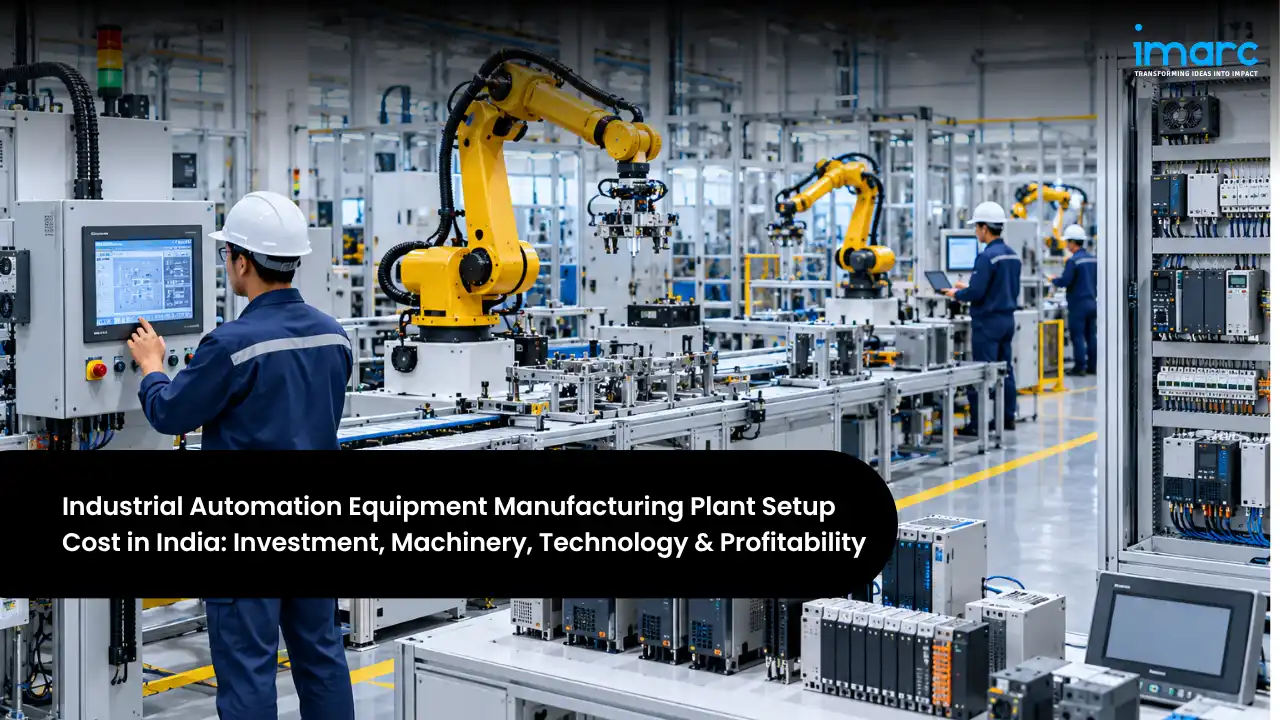
Walk into a modern Indian car parts plant, pharmaceutical packing line, or electronics factory and you will see robots welding and palletising, conveyors moving parts between stations, vision cameras checking quality, and control panels coordinating it all. Rising labour costs, stricter quality demands, and a wave of new factories built under production-linked incentive schemes are pushing manufacturers of every size to automate. Much of the underlying hardware still comes from global brands, but the control panels, special purpose machines, conveyors, and robotic cells that bring them together are increasingly designed and built in India. An Industrial Automation Equipment Manufacturing Plant Setup in India lets engineering entrepreneurs and investors serve this fast-growing demand with moderate capital and high value added through engineering.
Investment depends on the product range, the depth of in-house design and software capability, and the size of fabrication, assembly, and test facilities. For a typical plant producing control panels, special purpose machines, conveyors, and robotic cells, the Industrial Automation Equipment Manufacturing Plant Cost ranges from about INR 15 crore to INR 150 crore. Bought-out automation components and mechanical parts make up most of the material cost, while skilled engineering is the main driver of value, so design capability and project execution are the decisions that shape profitability. At healthy utilisation, a well-run plant can deliver a net profit margin of 10 to 16% and an IRR of 18 to 26%, with payback typically within 3 to 4.5 years.
This guide is written for investors asking how to start an Industrial Automation Equipment manufacturing plant in India. It covers the main product families and their markets, the demand outlook, the production and project flow, machinery and technology, raw materials, location and infrastructure, a detailed cost and financial breakdown, the approvals and certifications involved, and how a DPR turns all of this into a bankable plan.
India Market Snapshot
| Key Facts | Details |
|---|---|
| India Industrial Automation Market (2026) | USD 8.89 Billion, 8.17% CAGR to 2034 |
| Largest Segment | Process automation, about 48.6% share |
| Leading Region | West India, about 38.7% share |
| Industrial Robot Installations (2024) | 9,120 units, sixth-highest in the world |
| Indicative Total Investment | INR 15–150 Crore |
| Typical Payback Period | 3–4.5 Years |
The snapshot shows a large market growing steadily as Indian manufacturers modernise, with robot adoption reaching record levels and automotive, electronics, pharmaceutical, and food industries leading demand. Global brands supply most controllers, drives, and robots, but the engineering that turns those components into working production systems is where Indian manufacturers add value. The wide investment range reflects a genuine choice between a focused control panel and conveyor plant and a larger facility building special purpose machines and robotic cells with full design and testing capability. The sections below work through that choice.
Investment Highlights
Indicative Project Cost in India (2026)
| Parameter | Value |
|---|---|
| Product Range | Control panels, SPMs, conveyors, robotic cells, test and inspection systems |
| Total Project Investment | INR 15 – 150 Crore |
| Payback Period | 3 – 4.5 Years |
| Net Profit Margin | 10 – 16% |
| IRR | 18 – 26% |
| Preferred States | Maharashtra, Tamil Nadu, Karnataka, Gujarat, Haryana, Telangana |
| Key Approvals | Factory License, SPCB consents, ISO 9001, product safety compliance, Fire NOC |
| Key Requirement | Strong mechanical, electrical, and software engineering teams |
These ranges provide a realistic frame for early planning, but actual returns depend on the product mix, engineering productivity, project execution discipline, and relationships with manufacturers and automation technology partners. A site-specific Industrial Automation Equipment Feasibility Report narrows each of these assumptions to your chosen products, target industries, location, and capacity.
Table of Contents
- What is Industrial Automation Equipment Manufacturing?
- Why is Industrial Automation Equipment Manufacturing Growing in India?
- Industrial Automation Equipment Manufacturing Process Flow
- Raw Materials and Components Required for Industrial Automation Equipment Manufacturing
- Location, Land & Infrastructure
- Industrial Automation Equipment Manufacturing Machinery and Equipment
- Industrial Automation Equipment Manufacturing Plant Setup Cost in India (CapEx & OpEx)
- Financial Analysis and Profitability
- Licenses and Approvals for Industrial Automation Equipment Manufacturing in India
- Recent Developments in the India Industrial Automation Equipment Manufacturing Industry
- How Industrial Automation Equipment Manufacturing Project Report and DPR Helps Investors
- Frequently Asked Questions
What is Industrial Automation Equipment Manufacturing?
Industrial automation equipment is the hardware and control systems that let factories run with less manual effort, more consistency, and better data. It includes control panels that house PLCs, drives, and switchgear, special purpose machines built for a specific assembly, machining, or testing task, conveyors and material handling systems, robotic cells for welding, painting, palletising, and machine tending, and vision and end-of-line testing systems. Manufacturing this equipment combines mechanical design, fabrication and machining, electrical panel building, controls software, integration of robots and sensors, and rigorous testing before delivery.
Commercially, most automation equipment is engineered to order, which makes this a knowledge-intensive business where engineering skill creates most of the value. An Industrial Automation Equipment Manufacturing Plant can serve automotive and auto component makers, electronics and appliance manufacturers, pharmaceutical and food and beverage companies, and process industries, as well as machine builders who need panels and controls. Standard products such as conveyors and panels provide base volume, while custom machines and robotic cells earn higher margins.
- Control Panels: PLC, motor control, power control, and drive panels for machines and process plants.
- Special Purpose Machines: Custom assembly, testing, marking, and machining stations for specific products.
- Conveyors & Material Handling: Belt, roller, chain, and overhead conveyors, plus transfer and buffering systems.
- Robotic Cells & Inspection Systems: Welding, palletising, and machine tending cells, and vision and end-of-line test systems.
The Main Industrial Automation Product Families
Choosing which product families to offer is the most important commercial decision, because it determines engineering skills, machinery, testing facilities, and target customers:
| Product Family | Description | Key Property | Primary Demand |
|---|---|---|---|
| Control Panels | PLC, MCC, PCC, and drive panels | Reliable, standards-compliant wiring | Machine builders and process plants |
| Special Purpose Machines | Custom automated workstations | Tailored to each product | Auto parts, electronics, appliances |
| Conveyors & Handling | Material movement systems | Modular and scalable | Warehouses, food, packaging, assembly |
| Robotic Cells | Integrated robot systems | High productivity and consistency | Auto, metal, plastics, packaging |
| Test & Inspection Systems | Vision and end-of-line testers | Quality and traceability | Auto, electronics, pharma |
Product choice shapes the entire plant. Control panels need sheet metal enclosures, busbar and wiring work, and electrical testing, while special purpose machines and robotic cells need mechanical design, precision machining, pneumatics, servo systems, and software development. Many new entrants start with control panels and conveyors, which provide steady business and build relationships with factories, then add special purpose machines, robotic cells, and inspection systems as engineering depth grows.
Why is Industrial Automation Equipment Manufacturing Growing in India?
Key Growth Drivers in the Indian Market
Demand is driven by structural changes in Indian manufacturing:
- New factories and PLI schemes: Production-linked incentives in electronics, automotive, pharmaceuticals, and other sectors are driving large new manufacturing investments that need automation.
- Rising labour costs and skills gaps: Higher wages and shortages of skilled workers make automation more attractive for repetitive tasks.
- Quality and export standards: Global customers expect consistent quality and traceability, which automation delivers.
- Falling technology costs: Lower prices for sensors, robots, and controllers make automation viable for mid-sized factories.
- Industry 4.0 and data: Connected machines, industrial AI, and analytics are pushing factories to upgrade older equipment.
India-Specific Market Opportunity
| Segment | India Market Context | Manufacturing Role |
|---|---|---|
| Automotive & Auto Parts | Largest user of robots in India | Robotic cells, SPMs, and test systems |
| Electronics & Appliances | PLI-driven factory expansion | Assembly automation and inspection |
| Pharma & Food | Hygiene and compliance-driven automation | Conveyors, packing lines, and panels |
| Process Industries | Largest share of automation spending | Control panels and system integration |
| Warehousing & Logistics | E-commerce and distribution growth | Conveyors and material handling |
The strongest opportunity lies in becoming a trusted engineering partner to manufacturers in one or two focus industries, combining standard products such as panels and conveyors with custom machines and robotic cells. Deep application knowledge, fast project delivery, and reliable after-sales service are what differentiate successful Indian automation companies from generic fabricators.
Industrial Automation Equipment Manufacturing Process Flow
Understanding the process helps you plan engineering teams, machinery, and where cost and quality are decided. Most automation equipment is delivered as a project, moving from concept design through fabrication, assembly, software development, and testing, and ending with installation at the customer's site. Engineering accuracy and project management matter as much as shop-floor capability.
The Industrial Automation Equipment Manufacturing Process Flow
The sequence below reflects a plant building control panels, special purpose machines, and robotic cells. Standard products such as conveyors follow a shorter version of the same path.
| Unit Operation | Key Activity |
|---|---|
| Requirement Study & Concept | Customer process studied and solution concept agreed |
| Mechanical, Electrical & Software Design | CAD models, electrical schematics, and control logic prepared |
| Procurement | PLCs, drives, robots, sensors, and mechanical parts ordered |
| Fabrication & Machining | Frames, enclosures, fixtures, and tooling manufactured |
| Panel Building | Components mounted, wired, and labelled |
| Mechanical Assembly | Machines and conveyors assembled with pneumatics and servos |
| Integration & Programming | Robots, vision, and sensors integrated; PLC and HMI programmed |
| Factory Acceptance Testing | Machine run and approved with the customer |
| Dispatch & Installation | Equipment shipped, installed, and commissioned on site |
| Training & Service | Operator training, spares, and maintenance support |
Two factors decide profitability across this flow. The first is engineering productivity: design hours are the biggest controllable cost, so reusable design modules, standard software libraries, and simulation tools that catch problems before fabrication significantly improve margins. The second is project execution, because delays during commissioning at the customer's site are expensive and damage reputation, so thorough factory acceptance testing and disciplined project management are essential.
Raw Materials and Components Required for Industrial Automation Equipment Manufacturing
The main inputs are bought-out automation components such as PLCs, drives, servo motors, HMIs, sensors, and switchgear, robots and vision systems, mechanical components such as linear guides, bearings, gearboxes, and pneumatics, and structural steel, aluminium profiles, and sheet metal. Because many control and robotic components come from global brands, strong distributor and partner relationships are central to project planning.
| Raw Material | Role in Equipment | India Sourcing | % of OpEx |
|---|---|---|---|
| Controls, Drives & Switchgear | PLCs, VFDs, servos, HMIs, breakers | Global brands via Indian distributors | 30–40% |
| Robots & Vision Systems | Robotic arms, cameras, and controllers | Largely imported | 10–18% |
| Mechanical Components | Guides, bearings, gearboxes, pneumatics | Domestic and imported | 8–12% |
| Steel, Aluminium Profiles & Sheet | Frames, enclosures, and guards | Domestic suppliers | 6–10% |
| Cables, Wiring & Accessories | Power and signal connections | Domestic suppliers | 3–5% |
| Consumables & Packaging | Fabrication and dispatch | Domestic suppliers | 2–3% |
Controls, drives, and robots are largely supplied by multinational brands, often specified by the customer, so authorised partnerships with these brands help secure pricing, technical support, and lead times. Mechanical components and structural materials are widely available in India. Keeping designs modular and standardising on a few preferred component families reduces inventory, speeds engineering, and improves purchasing power.
Location, Land & Infrastructure
Site selection for an automation equipment plant is driven mainly by proximity to manufacturing customers and access to engineering talent. Because projects involve frequent customer meetings, factory acceptance tests, and site commissioning, being close to major industrial clusters reduces travel time and improves service.
Choosing the Best Location for Industrial Automation Equipment Manufacturing Plant Setup
| State / Region | Why It Works | Key Advantage |
|---|---|---|
| Maharashtra (Pune & Mumbai) | India’s leading automation and auto hub | Customers, suppliers, and engineering talent |
| Tamil Nadu (Chennai & Coimbatore) | Auto, electronics, and engineering base | Manufacturing customers and skilled workforce |
| Karnataka (Bengaluru) | Design, electronics, and aerospace hub | Software and controls talent |
| Gujarat (Ahmedabad & Vadodara) | Large process and chemical industry | Process automation demand |
| Haryana (Gurugram, Manesar & Faridabad) | Major auto and two-wheeler cluster | Northern customers |
| Telangana (Hyderabad) | Pharma and electronics growth | Customers and incentives |
Pune stands out as a natural first choice, combining a dense base of automotive and engineering customers with a mature ecosystem of automation suppliers and experienced engineers. Chennai and Coimbatore serve strong auto and engineering clusters, Bengaluru offers software and controls talent, Gujarat suits process automation, and Haryana and Hyderabad serve automotive and pharmaceutical customers. Many successful automation companies keep engineering teams in one hub and open service offices near other major customer clusters.
Engineering, Safety and Quality Systems
Automation customers buy on reliability, safety, and support, so a credible plant needs strong multidisciplinary engineering, documented quality systems, and a clear approach to machine safety. That includes design reviews, electrical panel standards, safety guarding and interlocks, risk assessments, software version control, and structured factory acceptance testing with customers. Export customers also expect compliance with international machinery and electrical safety standards. An experienced Industrial Automation Equipment Manufacturing Consultant in India can help define product platforms, engineering processes, and quality and safety systems so the plant can win larger, repeat projects.
Infrastructure Requirements (Mid-Sized Plant)
| Infrastructure Element | Specification | India-Specific Note |
|---|---|---|
| Total Built-Up Area | 3,000 – 15,000 sq. metres | Assembly bays for large machines |
| Design & Engineering Centre | Workstations and software licenses | Core value-creating asset |
| Fabrication & Machining Shop | Sheet metal, welding, and CNC machining | Crane-served area |
| Panel Building Section | Clean, well-lit wiring area | ESD care for electronics |
| Assembly & FAT Bays | Open floor with power and compressed air | Space for customer trials |
| Power Requirement | 300 kW – 1.5 MW | Machining and testing loads |
| Stores & Dispatch | Component storage and packing area | Organised by project |
A strong engineering centre, flexible assembly bays for factory acceptance testing, and a well-equipped fabrication and panel section are the defining infrastructure needs. Because machines vary widely in size, open, crane-served assembly space is more valuable than fixed production lines. Planning room for more engineers and larger projects from the outset makes it easier to grow with customers.
Industrial Automation Equipment Manufacturing Machinery and Equipment
The equipment and technology set covers design software, fabrication and machining, panel building, mechanical assembly, robot integration, and testing. Unlike high-volume manufacturing plants, the most important assets here are engineering tools and skilled people, supported by flexible shop-floor equipment. The main items are summarised below.
| Equipment / Technology | Function | Key Specification |
|---|---|---|
| CAD, Electrical CAD & PLC Software | Design machines, panels, and control logic | Licensed engineering tools |
| Simulation & Virtual Commissioning Tools | Test designs before building | Reduces site commissioning time |
| CNC Laser Cutting & Press Brakes | Fabricate enclosures, guards, and frames | Precise sheet metal work |
| CNC Machining Centres & Lathes | Make fixtures, tooling, and machine parts | Accurate, flexible machining |
| Welding & Powder Coating | Build and finish frames and panels | Durable finishes |
| Wire Processing & Busbar Tools | Prepare wiring and busbars for panels | Cutting, stripping, ferruling, bending |
| Panel Testing Equipment | Verify wiring and electrical safety | Hi-pot, insulation, and functional tests |
| Robot Test & Programming Cell | Integrate and program robots | Safe, fenced test area |
| Vision & Metrology Tools | Calibrate inspection systems and verify accuracy | Cameras, gauges, and CMM access |
| 3D Printers | Produce prototypes and custom grippers | Fast iteration |
| EOT Cranes & Handling Equipment | Move heavy machines and assemblies | Safe lifting |
Technology choices should follow the product plan and focus industries. A control panel and conveyor business invests mainly in fabrication, wiring tools, and panel testing, while special purpose machines and robotic cells add machining, robot programming cells, simulation software, and vision tools. Investment in design software and simulation often pays back faster than any shop-floor machine, because it shortens engineering time and reduces costly rework on site.
Industrial Automation Equipment Manufacturing Plant Setup Cost in India (CapEx & OpEx)
The tables below break down capital and operating costs for a mid-sized automation equipment facility in India. The final Industrial Automation Equipment Investment Cost for your project will depend on product families, engineering team size, fabrication and machining capability, test facilities, and location.
Capital Expenditure (CapEx) Cost Structure
| CapEx Component | % of Total CapEx | What It Covers |
|---|---|---|
| Plant & Machinery | 30–40% | Fabrication, machining, wiring, and test equipment |
| Land & Buildings (or Lease Fit-Out) | 20–28% | Engineering centre, assembly bays, and stores |
| Engineering Software & Design Centre | 6–10% | CAD, electrical CAD, PLC, and simulation tools |
| FAT Bays & Robot Test Cells | 5–8% | Testing and customer trial areas |
| Utilities & Electricals | 3–5% | Power, compressed air, and lighting |
| Pre-operative & Contingency | 4–6% | Engineering, DPR, certifications, buffer |
| Working Capital | 15–20% | Project inventory and milestone receivables |
Machinery and buildings take the largest share of capital, but working capital is unusually important in project-based automation businesses, because components are bought well before customers pay final milestones and retention amounts are common. A detailed Industrial Automation Equipment Business Plan should model the project pipeline, milestone payments, and engineering capacity together, so that funding matches the real cash cycle of the business.
Operating Expenditure (OpEx) Cost Structure
| OpEx Component | % of Total OpEx | India-Specific Note |
|---|---|---|
| Materials & Bought-Out Components | 65–75% | Controls, drives, and robots dominate |
| Engineering & Skilled Manpower | 12–18% | Designers, programmers, and technicians |
| Site Commissioning & Travel | 3–5% | Installation and customer support |
| Software Licenses & R&D | 2–4% | Design tools and product development |
| Power & Utilities | 1–2% | Low energy intensity |
| Maintenance & Overheads | 3–5% | Equipment upkeep and administration |
With bought-out components making up most of the cost and engineering the next largest item, margins depend on accurate project estimation, reusable designs, efficient engineering, and avoiding rework. A good operating model tracks engineering hours per project, component cost variance, commissioning time, and customer payment cycles, and tests how margins respond when projects run late or component prices change.
Financial Analysis and Profitability
Based on analysis of a mid-sized automation equipment facility, the financial profile is attractive, supported by strong manufacturing investment, high engineering value addition, and relatively modest fixed assets. The profitability of Industrial Automation Equipment manufacturing business in India improves markedly with deep industry specialisation, reusable product platforms, repeat customers, and a growing service and retrofit business.
| Financial Metric | Indicative Value | India Context |
|---|---|---|
| Gross Profit Margin | 22–35% | Higher for custom machines and robotic cells |
| Net Profit Margin | 10–16% | After depreciation and Indian corporate taxes |
| Payback Period | 3–4.5 Years | Faster with repeat customers |
| IRR (Internal Rate of Return) | 18–26% | Higher with modest fixed assets |
| Capacity Utilization (stable ops) | 65–85% | Measured by engineering and shop capacity |
| Break-even Capacity Utilization | 40–50% | Moderate fixed costs |
Product mix and specialisation decide where a plant lands within these ranges. A business building standard control panels and conveyors in a competitive market will earn steady but modest margins, while one delivering special purpose machines, robotic cells, and inspection systems to a focused set of industries can earn significantly more per project. Because the business depends on people rather than heavy machinery, returns on capital can be high once the engineering team is productive.
Returns can be strengthened by specialising in a few industries where deep process knowledge commands a premium, building standard machine platforms that can be configured quickly, partnering with leading automation brands, offering retrofit and upgrade services for older machines, and developing annual maintenance and spare parts revenue. On-time delivery and smooth commissioning are what lead to repeat orders and referrals.
Key Risks and Mitigation
The main risks are cost overruns on custom projects, dependence on a few large customers, delays in customer payments, and shortages of experienced engineers. Project risk is reduced by careful estimation, standard designs, and staged payments; customer risk by diversifying across industries; payment risk by clear milestone terms and working capital planning; and talent risk by training programmes and strong engineering culture. Promoters often work with an Industrial Automation Equipment Business Plan Consultant in India to test these scenarios before committing capital.
Licenses and Approvals for Industrial Automation Equipment Manufacturing in India
Approvals for an automation equipment plant are relatively straightforward, but product safety and quality certifications strongly influence which customers and export markets the business can serve. Promoters setting up an Industrial Automation Equipment Manufacturing Plant in India generally need the following:
- Factory License: Registration and plan approval under the Occupational Safety, Health and Working Conditions Code, 2020.
- Pollution Control Consent: Consent from the State Pollution Control Board as applicable, covering fabrication, welding, and powder coating.
- Electrical Component Compliance: Use of BIS-certified components where Indian Quality Control Orders apply, and panel assembly practices aligned with relevant IEC standards.
- Machinery Safety Compliance: Designs aligned with recognised machinery and electrical safety standards, plus CE or UL requirements for export customers.
- Quality Certifications: ISO 9001, with ISO 14001 and ISO 45001 increasingly requested by large manufacturers.
- Business & Tax Registration: Company incorporation, GST, Udyam, trademark registration, and an IEC for importing components and exporting machines.
- Fire Safety & Labour Registrations: Fire NOC and employee welfare registrations such as EPF and ESI.
The factory license and basic consents are usually quick to obtain, while quality certifications and customer approvals take longer and depend on a track record of successful projects. For export customers, meeting international machinery and electrical safety requirements should be built into the design process from the start, since retrofitting compliance later is costly.
Note: The exact approvals, registrations, licenses, and certification requirements may vary depending on factors such as plant location, product families, target industries, export markets, and applicable regulations. Businesses are advised to undertake a detailed regulatory assessment during the project planning stage to ensure full compliance and timely implementation.
Recent Developments in the India Industrial Automation Equipment Manufacturing Industry
Several recent developments give useful context for investors considering this market:
- Record robot installations: India installed 9,120 industrial robots in 2024, up 7%, rising to sixth place worldwide, with an operational stock of about 52,570 units.
- Automotive leadership: The automotive industry accounted for about 45% of robot installations, with installations at parts suppliers rising about 40%.
- Manufacturing incentives: Make in India and production-linked incentive schemes continue to drive new factory investment that requires automation.
- New technologies: Collaborative robots, industrial AI, and software-defined automation are gaining traction, opening new opportunities for system builders.
The common thread is a manufacturing sector steadily moving toward higher automation, with growth spreading from large automotive plants to mid-sized factories across many industries. New entrants who combine strong engineering, industry specialisation, and reliable project delivery will be best placed as Indian manufacturing modernises through the decade.
How Industrial Automation Equipment Manufacturing Project Report and DPR Helps Investors
A detailed DPR provides a structured roadmap for the venture, from market demand and product selection to engineering capability, machinery, testing facilities, certifications, and economics. It helps investors decide the right product mix and capacity, estimate capital and operating expenditure, assess profitability, and identify risks before committing funds.
At its core is a detailed Industrial Automation Equipment Financial Model covering revenue by product family and industry, project margins, engineering capacity and costs, milestone-based working capital, cash flows, break-even, return on investment, and payback. Banks and investors rely on this model to judge long-term viability, which is why many promoters appoint an Industrial Automation Equipment Plant Project Report Consultant in India to prepare the report and validate its assumptions against current market data.
For an automation project, a strong DPR also clarifies the industry focus, the engineering team plan, the technology partnerships, and the service and retrofit strategy, which together are the factors most likely to decide success. By modelling utilisation against realistic project pipelines and testing margins against cost overruns and payment delays, the report turns an engineering-led opportunity into a plan that lenders and partners can trust.
Frequently Asked Questions
What are the first steps to set up an industrial automation equipment manufacturing plant in India?
Start by choosing your product families and focus industries, then commission a feasibility study and DPR. Next, build a core team of mechanical, electrical, and software engineers, secure a facility near your customer base, invest in design software, fabrication, panel building, and test bays, establish partnerships with automation component brands, obtain the factory license, and pursue ISO certification.
How much does it cost to set up an industrial automation equipment manufacturing plant in India?
A plant producing control panels, special purpose machines, conveyors, and robotic cells typically needs about INR 15 crore to INR 150 crore, depending on product families, engineering team size, machining and test facilities, and whether the building is owned or leased. Machinery, buildings, design tools, and working capital are the largest components.
What are the main steps in industrial automation equipment manufacturing?
The flow runs from requirement study and concept design through mechanical, electrical, and software design, procurement, fabrication and machining, panel building, mechanical assembly, robot and sensor integration and programming, factory acceptance testing, installation and commissioning, and training and service.
Which machinery and technology does an industrial automation equipment manufacturing plant need?
Key assets include CAD, electrical CAD, PLC, and simulation software, CNC laser cutting and press brakes, CNC machining centres and lathes, welding and powder coating, wire processing and busbar tools, panel testing equipment, a robot programming cell, vision and metrology tools, 3D printers, and cranes and handling equipment.
What raw materials are used to make industrial automation equipment?
The main inputs are PLCs, drives, servo motors, HMIs, sensors, and switchgear, robots and vision systems, mechanical components such as linear guides, bearings, gearboxes, and pneumatics, steel, aluminium profiles, and sheet metal, and cables, wiring accessories, and consumables.
How profitable is industrial automation equipment manufacturing in India?
A well-run plant typically earns a 10 to 16% net margin and an 18 to 26% IRR, with payback in 3 to 4.5 years at healthy utilisation. Profitability improves with industry specialisation, standard platforms, robotic and inspection systems, and service revenue, while margins depend on project estimation and execution.
Which approvals does an industrial automation equipment manufacturing plant need in India?
Typical approvals include a factory license, pollution consent as applicable, compliance with electrical component and panel standards, machinery safety compliance including CE or UL for exports, ISO certifications, a Fire NOC, and GST, Udyam, trademark, IEC, and labour registrations.
How do I get a feasibility study or DPR for an industrial automation equipment manufacturing project?
A detailed feasibility study and DPR covers market demand, product and industry strategy, engineering capability, plant design, approvals, and full financials. Investors usually engage an Industrial Automation Equipment Manufacturing Feasibility Study Consultant with experience in automation, machinery, and engineering projects to prepare the report and validate it for lenders
Our Clients










Contact Us
Have a question or need assistance?
Please complete the form with your inquiry or reach out to us at
Phone Number
+91-120-433-0800+1-201-971-6302
+44-113-547-7077
Previous Post

Tyres are essential to every vehicle on India's roads, from two-wheelers and three-wheelers to cars, buses, trucks, tractors, and off-highway machines.
If the battery is the heart of an electric vehicle, the wiring harness is its nervous system. Every EV needs low-voltage harnesses for lights, sensors, and controls, plus high-voltage harnesses that carry hundreds of volts and high currents between the battery, inverter, motor, and charging port, and dedicated harnesses inside the battery pack that monitor every cell.
Every electric vehicle needs a brain between the battery and the motor. The motor controller, often called the traction inverter in larger vehicles, converts DC power from the battery into precisely controlled AC power for the motor, manages acceleration, regenerative braking, and efficiency, and protects the whole powertrain from faults.
Every vehicle on the road depends on forged parts. Crankshafts, connecting rods, steering knuckles, axle beams, gears, and hubs are forged because the process gives steel a continuous grain flow and the strength to survive millions of load cycles.
Setting up an Automotive Components Manufacturing Plant in India is a high-potential, export-capable venture, powered by the country's large automobile industry, deep supplier base, and growing role as a global sourcing hub for auto parts.
The global automotive lead-acid battery market reached USD 13.89 Billion in 2025 and is projected to reach USD 16.60 Billion by 2034, growing at a CAGR of 1.94% (2026–2034).
Setting up an Electric Scooter Manufacturing Plant in India is a capital-efficient, high-growth venture, driven by the country's rapid shift to electric mobility, supportive EV policies, and surging demand for affordable, clean urban transport. As two-wheelers dominate Indian roads and buyers move from petrol to battery-powered scooter manufacturing, an EV Scooter Manufacturing Plant is one of the most accessible and strategically timed entry points into the electric vehicle economy.
Capital is flowing into the united states used car market because structural affordability pressure, digital retail maturity, and a record-old national vehicle fleet have converged into a genuinely investable thesis.
The Europe Tire Market reached a volume of 458.89 Million Units in 2025 and is projected to reach 565.69 Million Units by 2034, growing at a CAGR of 2.35% (2026–2034).
A strategic analysis of how PLI policies and localization drive global OEM investments. India’s EV battery market hits USD 15,898.31 Million by 2034 (21.7% CAGR).
A tyre is circular in shape and made of a combination of rubber materials that fit perfectly over a circular rim on a wheel, providing traction, load-carrying capabilities, shock absorption, and directional stability. As such, tyres are engineered materials composed of a combination of natural or synthetic materials. They are composed of a combination of materials such as rubber, a combination of materials such as steel or textile, and various chemical materials, among others.
A tractor is a self-propelled, torque-requiring vehicle intended primarily for pulling power at low speeds for agricultural, industrial, and utility purposes. It functions as a mobile power source that can be used for towing, pushing, lifting, or driving a variety of agricultural implements through mechanical, hydraulic, or power take-off systems. Tractors are designed with powerful propulsion systems, sturdy frames, and versatile coupling systems for use on different terrains and under heavy loads.
The electric boat and ship market size is experiencing unparalleled growth as the marine industry embraces electrification on a large scale across different geographies. As sustainability is becoming a strategic priority, with each passing day, more and more marine operators look to electric propulsion technologies as alternatives aimed at cutting down emissions, improving operational efficiencies, and enabling greener ports.
The GCC car rental market has emerged as a critical component of the region's transportation ecosystem, driven by robust tourism activity, expanding business travel, and a substantial expatriate population. Countries across the Gulf Cooperation Council are witnessing unprecedented demand for flexible mobility solutions that cater to diverse customer segments. The GCC car rental market size was valued at USD 1.65 Billion in 2024 as governments prioritize infrastructure development and sustainable tourism initiatives.
The Indian automotive sector has formed a vital part of the country's industrial and economic development for a long period. Over the years, the industry has transformed significantly, influenced by changes in technology, global trends, and consumer preference. Among the various factors shaping its trajectory, government policies have emerged as a decisive force driving growth, innovation, and competitiveness in the India auto parts manufacturing industry.
The India motorcycle tires market continues to evolve in response to changing mobility preferences, rising urbanization, and the growing significance of two-wheelers as essential transportation assets for millions of riders. As per sources, the India motorcycle tires market size reached USD 933.66 Million in 2024. The market is projected to reach USD 2,419.36 Million by 2033, exhibiting a growth rate (CAGR) of 10.3% during 2025-2033.
The Saudi Arabia tire market is undergoing a significant transformation driven by the nation’s economic diversification, rapid urbanization, and growing vehicle ownership. As one of the largest automotive hubs in the Middle East, Saudi Arabia is witnessing increasing demand for both passenger and commercial vehicle tires across urban and industrial regions.
One of the world's most dynamic and quickly changing markets, India's automotive industry is undergoing revolutionary changes in both the new and used car markets. Despite general economic uncertainty, the used car industry has shown remarkable resilience and growth potential, making it a particularly vibrant part of this ecosystem.
One of the world's most vibrant and quickly growing automobile markets is India's passenger car sector. From technological innovation to economic development, a number of interrelated factors have contributed to the sector's remarkable transformation. For stakeholders looking to take advantage of the enormous opportunities in this dynamic market, it is imperative that they comprehend these growth drivers.
India's truck industry is at a turning point in its development, driven by extensive government policies that are changing the commercial vehicle market. The industry, which is the foundation of the country's logistics ecosystem, is gaining previously unheard-of momentum thanks to smart regulatory frameworks and forward-thinking legislative initiatives. A fundamental change in truck operations on Indian highways is being sparked by government initiatives ranging from infrastructure development to emission standards, digitalization, and financial incentives.
The electric rickshaw sector in India has experienced a significant upheaval in recent years and is now a vital part of the country's sustainable transportation network. Strategic government policies aimed at hastening the adoption of clean mobility solutions have played a major role in orchestrating this evolution. India's larger vision of sustainable urbanization is in line with the electric rickshaw industry, which combines social development objectives, economic opportunities, and environmental imperatives.
Transportation in India is undergoing a spectacular change with the advent of electric two-wheelers that are quite an enticing alternative to traditional fuel-powered ones. This change is not merely an act of technological transformation, but an indication of how millions of Indians will think about city mobility, eco-awareness, and economic effectiveness.
As one of the world's leading industrial powerhouses, Japan has long been recognized for its commitment to technological innovation and manufacturing precision. The industry for industrial automation components—encompassing sensors, controllers, actuators, drives, robotics, and human-machine interfaces—represents the backbone of modern manufacturing infrastructure.
The Australian brakes and clutches industry plays a vital role in ensuring vehicle performance, safety, and efficiency across both automotive and industrial segments. As the nation transitions toward electric mobility and smarter manufacturing systems, the demand for advanced braking and clutch mechanisms is rising significantly.
The Philippines automotive wiring harness industry stands at a transformative juncture, driven by technological innovations that are reshaping vehicle electrical architectures worldwide. As vehicles evolve into sophisticated mobile computing platforms, the wiring harness, the circulatory system transmitting electrical power and data throughout modern automobiles, has become increasingly complex and critical to vehicle performance.
Japan's hybrid vehicles market stands as a global benchmark for sustainable mobility innovation, demonstrating remarkable growth and technological leadership. The market achieved a valuation of USD 33.57 Billion in 2024. Japan's hybrid vehicle (HV) market is one of the most established globally, originating with pioneering models like the Toyota Prius. It currently represents a significant portion of the country's automotive sales.
The Japan warehouse robotics market is a highly dynamic and rapidly expanding segment of the global automation industry. The market, valued at USD 414.0 Million in 2024, is on a sharp growth trajectory. Its growth is fueled by critical domestic factors, including a severe labor shortage, the rapid expansion of e-commerce, and Japan's strategic position as a world-leading robotics manufacturer.
The UK is rapidly evolving into a dynamic hub for autonomous vehicle research, testing, and early-stage deployments. A strong ecosystem comprising academic institutions, technology start-ups, automakers, and mobility service providers fosters continuous innovation. Supported by a skilled workforce specializing in software, sensing, robotics, and transportation systems, the nation has become a fertile ground for experimentation.
Japan’s transportation landscape is on the brink of a major shift, with robo taxis, autonomous, driverless vehicles designed for passenger and goods transport, emerging as a practical mobility solution. The Japan robo taxi market reached USD 83.2 Million in 2024 . This remarkable expansion reflects Japan’s broader move toward smart mobility, sustainability, and automation.
The Japan electric truck market is experiencing transformative growth as the nation accelerates toward sustainable transportation and carbon neutrality. As a leading automotive manufacturing hub, Japan is witnessing unprecedented momentum in commercial vehicle electrification, driven by stringent environmental regulations, technological innovation, and strategic government support. The electric truck industry represents a critical component of Japan's commitment to achieving 100% electrified vehicle sales by 2035 and carbon neutrality by 2050.
An EV charging station represents the necessary main infrastructure that allows electrical energy to be transferred from the power grid into electric vehicles to enable their use for transportation. Unlike conventional fueling stations that offer liquid fuels, EV charging stations provide electric power through the use of standardized connectors and smart control systems. The core components include a power conversion unit, which transforms alternating current from the grid into direct current for the vehicle battery; a charging controller controlling communication between the charger and the EV; and a connector or plug matched to the vehicle's charging interface.
An electric scooter is a two-wheeled vehicle powered by an electric motor and rechargeable battery, aimed at offering the means for efficient, eco-friendly, and cost-effective urban mobility. Apart from the traditional scooters that are powered by internal combustion engines, the electric scooters make use of lithium-ion or lead-acid batteries that feed an electric supply to a BLDC motor, which drives the wheels either directly or via a belt or chain mechanism.
Electric bikes, commonly referred to as e-bikes, are one of the most transformational innovations in modern personal mobility, combining conventional bicycle mechanics with advanced electric propulsion technology. At the heart of e-bikes are an electric motor, a rechargeable battery, and a control system that add assistance to the rider while pedaling, making cycling easier, faster, and more accessible across varied terrains. Based on their design, they can be further categorized into pedal-assist, throttle-controlled, or hybrid models, each providing different levels of rider control and engagement of the motor.
The micro-mobility industry has emerged as a transformative force in urban transportation, revolutionizing how people navigate cities worldwide. According to IMARC, the global micro-mobility market size was valued at USD 63.10 Billion in 2024. Looking forward, IMARC Group estimates the market to reach USD 204.83 Billion by 2033, exhibiting a CAGR of 12.86% from 2025-2033.
India's electric vehicle (EV) revolution is accelerating at a breakneck speed, powered by a strategic combination of government incentives, infrastructure investments, and manufacturing policies that are transforming the automotive landscape. The IMARC Group forecasts that the Indian electric car market reached USD 963 Million in 2024.
The diesel engine industry is standing at a transformative crossroads. As global markets are pushing for sustainability, stricter emissions compliance, and cutting-edge innovations, diesel powertrains are facing both immense pressure and promising potential.
The global tire market is a multi-billion-dollar industry, driven by the growing demand for vehicles across emerging economies and the replacement tire segment in developed countries. The global tire market is expected to grow at a compound annual growth rate (CAGR) of 4.70% between 2025 and 2033. The industry is heavily influenced by factors such as technological advancements, raw material prices, environmental regulations, and consumer preferences.
Australia's electric vehicle (EV) sector is experiencing swift expansion, fueled by increasing interest in eco-friendly transportation alternatives. In 2024, sales of battery electric and plug-in hybrid vehicles hit an all-time high, totaling around 114,000 units.
The electric bus industry is the part of the transportation sector that deals with the production and installation of buses that run completely or partially on electricity, employing battery packs or fuel cells in place of conventional diesel or gasoline engines. The buses deliver lower greenhouse gas emissions, lesser noise levels, and enhanced energy efficiency, and thus they are a prime solution for environmentally friendly public transport.
India's electric vehicle market is undergoing a profound transformation, impelled by green priorities, economic imperatives, and changing consumer trends. With rising concerns about air pollution and fossil fuel dependence, electric mobility has become a strategic option for India's transport industry. Policy clarity, technology development, and an emerging ecosystem of makers and suppliers are driving this market shift.
The global electric vehicle market size was valued at USD 755 Billion in 2024. The global EV market is rapidly expanding, driven by technological advancements, government incentives, stricter emission regulations, rising fuel costs, extended battery range, growing environmental consciousness, and significant investments in charging and production infrastructure.
Electric Vehicles, or EVs, are vehicles operated partially or wholly by electrical power, generally with rechargeable battery packs as their fuel. In contrast to conventional internal combustion engine cars, EVs emit no tailpipe emissions, making them a cleaner, environmentally friendly transportation choice. EVs comprise Battery Electric Vehicles (BEVs), Plug-in Hybrid Electric Vehicles (PHEVs), and Hybrid Electric Vehicles (HEVs), and are gaining ground in passenger, commercial, and two-wheeler segments owing to developments in battery technology, charging infrastructure, and policy support.
Aluminum alloy wheels are high-performance, lightweight, and durable components widely used in the automotive industry. Their superior strength-to-weight ratio enhances vehicle efficiency, fuel economy, and handling, making them a preferred choice for both passenger and commercial vehicles. Beyond their functional benefits, aluminum alloy wheels contribute to vehicle aesthetics, offering sleek designs and customization options that appeal to consumers. Their corrosion resistance and thermal conductivity further enhance braking performance and longevity. With increasing demand for fuel-efficient and stylish vehicles, aluminum alloy wheels play a crucial role in the global automotive sector, catering to OEMs, aftermarket suppliers, and performance vehicle manufacturers.
A tyre is a crucial component of a vehicle, serving as the outer covering of a wheel. Its main purposes are to support the vehicle's weight, provide traction for movement, and act as a flexible cushion that absorbs shocks from the road. Usually composed of rubber, tires are strengthened with steel and cloth. Tires for cars, trucks, motorbikes, bicycles, and other vehicles have different designs and compositions depending on the vehicle type and its intended usage. To improve stability and grip, they have a tread pattern on the outside.
Electric kick scooters are small, battery-operated personal transportation vehicles intended for short-distance and urban movement. They offer an economical and environmentally responsible substitute for conventional modes of mobility thanks to their electric engine, rechargeable battery, and lightweight frame. The need for sustainable transportation options, traffic congestion, and growing urbanisation have all contributed to their rise in popularity. Electric kick scooters are now the go-to option for last-mile connectivity and personal commuting because to developments in battery technology, connectivity features, and government programs encouraging micro-mobility.
An automotive wiring harness is an organized assembly of electrical wires, connectors, and terminals that transmit power and signals across a vehicle’s electrical system. It guarantees effective communication between several parts, including the engine control unit, lighting, and sensors. Wiring harnesses are intended to increase vehicle performance and safety by lowering the possibility of short circuits. By maximising electrical connectivity and lowering wire complexity, they are utilised in both conventional and electric automobiles and are essential to contemporary automotive technology.
In an automotive braking system, brake pads are the most important parts since they are engineered to contact the brake rotor to produce friction, thus stopping or slowing down a vehicle in virtually any driving condition safely and efficiently. The key way of classifying these pads is according to their material types: low metallic, ceramic, organic, and semi-metallic.
Tires are essential components of vehicles designed to provide traction, support, and absorb road shocks. Primarily made of rubber, tires consist of treads, belts, and sidewalls that work together to offer grip, stability, and durability. Modern tires come in various types – such as all-season, winter, and performance tires – each engineered for specific driving conditions. The two major tire categories are radial and bias tires, and they are available in different sizes to suit various vehicle types, including passenger cars, light commercial vehicles, medium and heavy commercial vehicles, two-wheelers, and off-road vehicles.
Electric Vehicles (EVs) are powered by electric motors instead of traditional internal combustion engines (ICEs). Electric motors propel EVs by utilizing electricity stored in rechargeable batteries or other energy storage systems. They produce lower or zero tailpipe emissions, reduce air pollution and greenhouse gas (GHG) emissions, and help in mitigating climate change. Electric vehicles consist of various components, such as battery cells and packs, reducers, fuel stacks, power control units, power conditioners, air compressors, humidifiers, motors, on-board chargers, battery management systems, and others. EVs are classified into four types based on propulsion, outlined below.
Saudi Arabia is the second-largest producer and exporter of crude oil and holds the second-largest proven oil reserves in the world, with around 267 billion barrels. The country's oil sector is a significant part of its economy, accounting for 75% of government revenue and approximately 90% of exports. However, due to the volatility of oil prices and the potential for economic instability, Saudi Arabia is increasingly focusing on non-oil activities to reduce its dependency on the oil sector. Non-oil commodities tend to have more stable prices, providing protection against these fluctuations and strengthening the country's social, economic, and financial sectors.