Concrete Pavers Plant Setup Cost in India: Manufacturing Process Flow, Machinery, DPR & Financial Model 2026
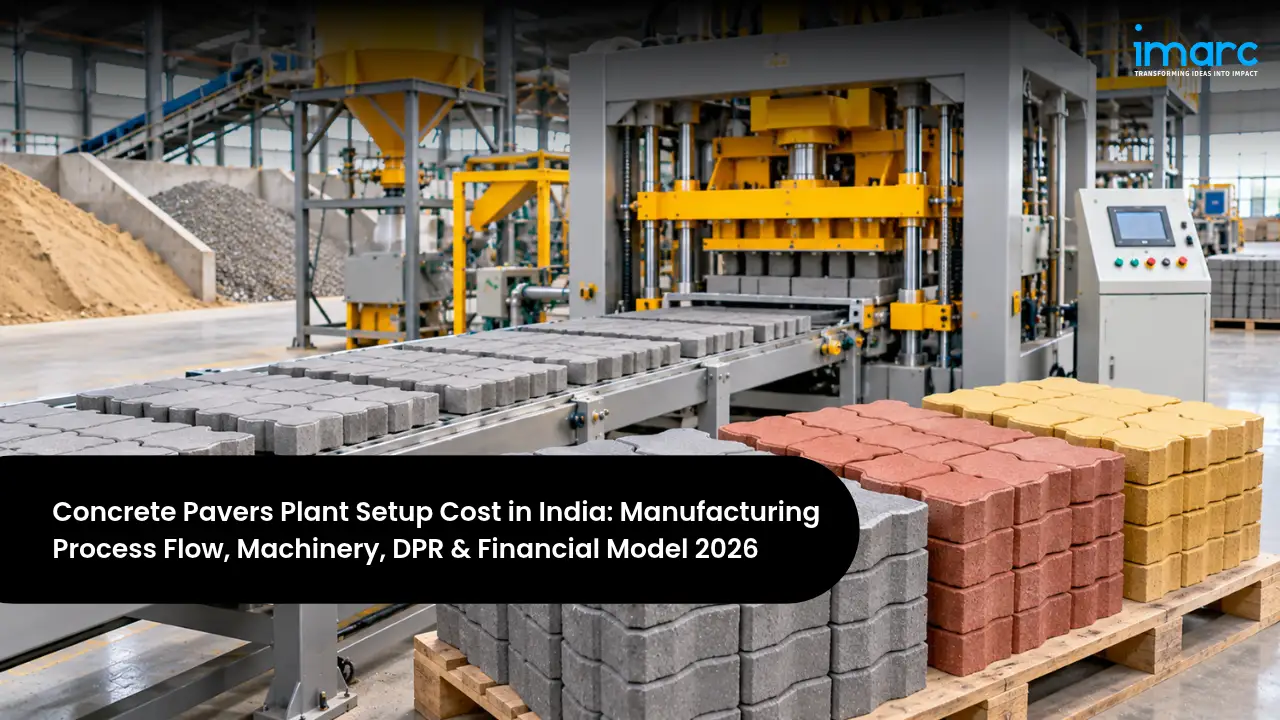
A Concrete Pavers Manufacturing Plant Setup in India produces precast concrete paving blocks used for footpaths, driveways, parking areas, industrial yards, ports, fuel stations, campuses, plazas, and rural roads. Products include interlocking pavers in zigzag, I-shape, and other profiles, rectangular and designer pavers in many colours and textures, heavy-duty pavers for industrial and port use, grass and permeable pavers, and related kerb stones. Concrete pavers are durable, easy to lay and repair, allow water to drain, and need little maintenance, making them a preferred choice for urban infrastructure, smart city projects, and private developments.
The overall Concrete Pavers Manufacturing Plant Cost depends mainly on capacity, the level of automation, aggregate storage and batching, base and face mix mixers, the hydraulic vibro-press block machine and moulds, production pallets, stacking and curing systems, cubing and handling equipment, testing laboratory, land and buildings, and working capital for cement, aggregates, and receivables. A fully automatic plant producing about 1.5 million square metres of pavers a year typically needs INR 8 crore to INR 14 crore in fixed assets, or about INR 11 crore to INR 18 crore including working capital. A smaller semi-automatic unit of 200,000 to 400,000 square metres a year can start at around INR 1 crore to INR 2.5 crore. IMARC Group puts typical capacities at 1 to 5 million square metres a year, with gross margins of 30 to 40% and net margins of 12 to 20%.
This guide is written for building material makers, construction and infrastructure contractors, ready-mix and precast companies, aggregate and cement dealers, and investors exploring how to start a Concrete Pavers manufacturing plant in India. It explains product types and buyers, demand drivers, the production flow, machinery and raw materials, site selection, a detailed cost and returns breakdown, the BIS and other approvals involved, and how a DPR pulls these elements into a bankable plan.
India Market Snapshot
| Key Facts | Details |
|---|---|
| Global Concrete Pavers Market (2025) | USD 17.93 Billion |
| Projected Global Market (2034) | USD 27.81 Billion (5.0% CAGR) |
| India Cement Capacity | About 700 Million Tonnes a Year |
| GST on Cement | 18%, cut from 28% (September 2025) |
| Typical Plant Capacity | 1–5 Million Sq M a Year |
| Indicative Total Investment | INR 11–18 Crore (1.5 Million Sq M, incl. working capital) |
IMARC Group values the global concrete pavers market at USD 17.93 billion in 2025. In India, the cut in GST on cement from 28% to 18% has lowered the cost of the main raw material, while cement demand is expected to keep growing 6 to 7% a year on the back of housing and infrastructure.
Investment Highlights
Indicative Project Cost in India (2026)
| Parameter | Value |
|---|---|
| Product Range | Interlocking, rectangular, designer, heavy-duty, grass, and permeable pavers, plus kerb stones |
| Total Project Investment | INR 11 – 18 Crore incl. working capital (1.5 Million Sq M); INR 1 – 2.5 Crore (200,000–400,000 Sq M) |
| Payback Period | 3 – 5 Years |
| Net Profit Margin | 12 – 20% (IMARC benchmark) |
| IRR | 18 – 24% |
| Best Locations | Maharashtra, Gujarat, Uttar Pradesh, Karnataka, Tamil Nadu, Telangana |
| Mandatory Approvals | BIS License (IS 15658, for tenders), Factory License, SPCB Consents, Groundwater NOC, GST, Udyam, Vendor Registrations |
| Key Requirement | Consistent strength and finish, low-cost aggregates, efficient curing, and steady project and dealer orders |
These figures offer a practical frame for early evaluation. Returns depend on sourcing cement and aggregates at good prices, consistent mix design and compaction for strength and durability, efficient curing and handling, attractive colours and designs, BIS certification for government work, short delivery distances, and steady orders from contractors, developers, municipal bodies, and dealers. A capacity- and site-specific Concrete Pavers Feasibility Report refines these numbers before capital is committed.
Table of Contents
- What is Concrete Pavers Manufacturing?
- Why is Concrete Pavers Manufacturing Growing in India?
- Concrete Pavers Manufacturing Process Flow
- Raw Materials Required for Concrete Pavers Manufacturing
- Location, Land & Infrastructure
- Concrete Pavers Manufacturing Machinery and Equipment
- Concrete Pavers Manufacturing Plant Setup Cost in India (CapEx & OpEx)
- Financial Analysis and Profitability
- Licenses and Approvals for Concrete Pavers Manufacturing in India
- Recent Developments in the India Concrete Pavers Manufacturing Industry
- How Concrete Pavers Manufacturing Project Report and DPR Helps Investors
- Frequently Asked Questions
What is Concrete Pavers Manufacturing?
Concrete pavers are made from a semi-dry, low-water concrete mix of cement, aggregates, sand or stone dust, and sometimes fly ash, pigments, and admixtures, compacted under high vibration and pressure in steel moulds. Raw materials are weighed in a batching system and mixed, often in two mixers to produce a coarse base layer and a fine, coloured face layer. The mix is fed into the mould of a hydraulic vibro-press block machine, compacted, and demoulded immediately onto production pallets, because the stiff mix holds its shape. Green pavers are moved to curing racks or chambers, where they gain strength under controlled moisture over several days, then cubed, strapped, and stored until they reach the required strength. Pavers are tested for compressive strength, water absorption, and abrasion before dispatch. A Concrete Pavers Manufacturing Plant therefore combines aggregate handling, batching, mixing, vibro-compaction, curing, cubing, testing, and logistics.
Products are sold to municipal corporations and smart city agencies, public works and highway departments, railway, port, and airport authorities, real estate developers and builders, industrial and logistics parks, fuel retailers, institutions and campuses, landscaping contractors, building material dealers, and homeowners. Buyers expect pavers that meet strength and durability specifications, have consistent dimensions and colours, interlock properly, carry BIS certification for government work, and arrive on time at competitive prices.
- Interlocking Pavers: Zigzag, I-shape, and other profiles.
- Designer and Coloured Pavers: Rectangular, textured, and multi-colour blocks.
- Heavy-Duty Pavers: 80 to 100 mm blocks for industrial and port yards.
- Grass and Permeable Pavers: Eco-friendly drainage solutions.
Main Product Types in Concrete Paver Production
The product mix shapes moulds, mix design, and margins:
| Product Type | Description | Key Feature | Primary Market |
|---|---|---|---|
| Interlocking (60 mm) | Standard profiles | Pedestrian and light traffic | Footpaths, driveways |
| Interlocking (80 mm) | Thicker blocks | Vehicle traffic | Parking, roads |
| Heavy-Duty (100 mm) | High-strength blocks | Heavy loads | Ports, industrial yards |
| Designer & Coloured | Textured, multi-colour | Premium appearance | Plazas, homes, malls |
| Grass & Permeable | Open or porous blocks | Drainage, greenery | Parks, parking, campuses |
Many new entrants start with standard 60 mm and 80 mm grey and red interlocking pavers for contractors and municipal work, then add designer, coloured, heavy-duty, permeable, and kerb products as moulds, finishing capability, and customer base grow. Designer and permeable pavers usually earn better margins than standard grey blocks.
Why is Concrete Pavers Manufacturing Growing in India?
Key Growth Drivers in the Indian Market
Demand for concrete pavers in India comes from urbanisation, infrastructure, and real estate:
- Urban infrastructure: Footpaths, plazas, and streetscapes in cities and smart city projects use large volumes of pavers.
- Real estate and townships: Housing societies, commercial complexes, and townships use pavers for driveways and open areas.
- Industrial and logistics parks: Warehouses, factories, ports, and container yards need heavy-duty paving.
- Rural roads and village infrastructure: Pavers are used for village lanes and drainage-friendly surfaces.
- Lower cement costs: The GST cut on cement has reduced raw material costs for paver makers.
End-Use Market Opportunity
| End Use | Demand Driver | Product Role |
|---|---|---|
| Municipal & Smart Cities | Footpaths and public spaces | Interlocking and designer pavers |
| Real Estate | Housing and commercial projects | Driveway and landscape pavers |
| Industrial & Logistics | Yards and parking | Heavy-duty pavers |
| Ports, Rail & Airports | High-load areas | 100 mm heavy-duty pavers |
| Homes & Retail | Driveways, patios | Coloured and designer pavers |
The strongest position for a Concrete Pavers Manufacturing Plant in India combines a location close to urban and industrial demand centres and aggregate quarries, an automatic vibro-press line with a range of moulds, consistent quality and BIS certification, efficient curing and handling, competitive pricing, and strong relationships with contractors, developers, government departments, and dealers.
Concrete Pavers Manufacturing Process Flow
Understanding the Concrete Pavers Manufacturing Process helps promoters plan aggregate handling, batching, mixing, compaction, curing, layout, staffing, and quality control. Product quality depends on aggregate grading, cement content, water control, mix uniformity, compaction energy, curing conditions, and pigment quality. The flow below reflects a typical automatic paver plant.
Step-by-Step Concrete Paver Production Flow
Aggregates, sand, cement, and additives are weighed and mixed into base and face mixes, then compacted into pavers on a vibro-press. Green pavers are cured, cubed, tested, and dispatched.
| Unit Operation | Key Activity |
|---|---|
| Raw Material Receipt & Storage | Aggregates, sand, cement, pigments |
| Batching | Weigh to mix design |
| Base Mix Preparation | Coarse layer mixing |
| Face Mix Preparation | Fine, coloured top layer |
| Vibro-Compaction | Hydraulic press with vibration |
| Demoulding | Green pavers onto pallets |
| Curing | Moist or chamber curing |
| Cubing & Strapping | Stack and bundle pavers |
| Quality Testing | Strength, absorption, abrasion |
| Storage & Dispatch | Yard storage, delivery |
Two factors decide profitability. The first is mix design and material cost: cement and aggregates make up most of operating cost, so optimised mix designs, partial replacement of cement with fly ash where permitted, low wastage, and nearby aggregate sources directly lift margins while maintaining strength. The second is sales and logistics: pavers are heavy and low in value per tonne, so serving customers within a short radius, winning repeat orders from contractors and government departments, and managing receivables decide volumes and cash flow.
Raw Materials Required for Concrete Pavers Manufacturing
The main inputs are cement, coarse aggregates, sand or stone dust, fly ash or other supplementary materials, pigments, and admixtures. IMARC Group estimates raw materials, with cement as the main driver, at 60 to 70% of operating cost and utilities at 10 to 15%.
| Raw Material | Role in Process | India Sourcing | % of OpEx |
|---|---|---|---|
| Cement | Binder | Cement plants and dealers | 25–30% |
| Coarse Aggregates (6–10 mm) | Base layer strength | Local stone crushers | 14–18% |
| Sand / Stone Dust | Fine aggregate, face mix | Crushers, M-sand plants | 8–12% |
| Fly Ash / GGBS | Partial cement replacement | Thermal plants, steel plants | 2–4% |
| Pigments & Admixtures | Colour, workability | Domestic suppliers | 3–5% |
Cement and aggregates are widely available across India, and the GST cut has lowered cement costs, but aggregate supply and prices vary with local mining rules. Manufacturers should secure supply from nearby crushers and M-sand plants, test aggregate grading and cleanliness, use quality iron oxide pigments for lasting colour, and use fly ash or GGBS where standards and customers permit.
Location, Land & Infrastructure
Location shapes freight costs and access to customers. The best location for Concrete Pavers manufacturing plant setup lies on the edge of a growing city or industrial region, close to stone crushers and cement supply, with good road access for heavy trucks, reliable power and water, and enough open land for curing and storage yards.
Preferred States for Paver Plants in India
| State | Why It Works | Key Advantage |
|---|---|---|
| Maharashtra | Mumbai, Pune, Nagpur growth | Large urban and industrial demand |
| Gujarat | Industrial corridors, ports | Industrial yards and logistics |
| Uttar Pradesh | NCR, expressways, smart cities | Large infrastructure pipeline |
| Karnataka | Bengaluru expansion | Real estate and campuses |
| Tamil Nadu | Chennai and industrial belts | Industrial and urban demand |
| Telangana | Hyderabad growth | Real estate and infrastructure |
Maharashtra, Gujarat, and Uttar Pradesh offer large and growing urban, industrial, and infrastructure markets, while Karnataka, Tamil Nadu, and Telangana have strong real estate and industrial demand around major cities. Because pavers are heavy, most plants serve customers within about 100 to 150 kilometres, so multiple regional plants are common for larger players.
Product Quality and Compliance Requirements
Concrete paving blocks in India are made to IS 15658, which specifies dimensions, compressive strength grades by traffic category, water absorption, abrasion resistance, and tolerances, and which was amended in December 2025. Government and municipal tenders usually require BIS-certified blocks. Key controls include aggregate grading and moisture checks, batching accuracy, mix consistency, compaction monitoring, curing control, and regular testing of compressive strength, water absorption, and abrasion with batch records.
Infrastructure Requirements (1.5 Million Sq M Plant)
| Infrastructure Element | Specification | India-Specific Note |
|---|---|---|
| Total Land Area | 3 – 5 acres | Production, curing, stock yard |
| Production Shed | 1,500 – 2,500 m² | Batching, press, curing |
| Curing Area | Chambers or covered racks | Controlled moisture |
| Power | 200 – 400 kW connected load | Press, mixers, conveyors |
| Water | 20 – 40 KLD | Mixing and curing |
| Aggregate Storage | Bays and bins | Covered where possible |
| Stock Yard & Laboratory | Open yard, testing room | Storage and QC |
The layout centres on aggregate bays, a cement silo, batching and mixing, the block machine, curing, cubing, a laboratory, and a large stock yard. Leaving space for a second press line supports growth.
Concrete Pavers Manufacturing Machinery and Equipment
Paver machines, mixers, batching plants, and moulds are widely made in India, while high-output automatic plants are often imported from Europe or China. The main equipment is summarised below.
| Equipment | Function | Key Specification |
|---|---|---|
| Aggregate Bins & Conveyors | Store and feed materials | Weighing hoppers |
| Cement Silo & Screw Conveyor | Cement storage | Dust control |
| Weigh Batching System | Accurate proportioning | PLC-controlled |
| Base & Face Mix Mixers | Mix concrete | Planetary or pan mixers |
| Hydraulic Vibro-Press Machine | Form pavers | High vibration and pressure |
| Moulds | Paver shapes and sizes | Hardened steel |
| Production Pallets & Stacker | Handle green pavers | Steel, wood, or plastic |
| Curing Chambers / Racks | Strength gain | Moisture control |
| Cuber & Strapping Machine | Bundle pavers | Automatic stacking |
| Forklifts, Loader & Lab | Handling and testing | Compression testing machine |
The block machine and mixers largely determine output, while moulds, compaction, and curing determine quality. Many promoters begin with a semi-automatic or single automatic line with a few popular moulds, then add face-mix capability, more moulds, automatic stacking and curing systems, and finishing equipment as volumes grow.
Concrete Pavers Manufacturing Plant Setup Cost in India (CapEx & OpEx)
The tables below summarise the capital and operating cost structure of an automatic plant producing about 1.5 million square metres of concrete pavers a year in India. The final Concrete Pavers Investment Cost for a specific project depends on capacity, level of automation, number of moulds, curing and handling systems, testing facilities, land and building costs, and working capital for raw materials and receivables.
Capital Expenditure (CapEx) Cost Structure
| CapEx Component | % of Total CapEx | What It Covers |
|---|---|---|
| Block Machine & Moulds | 22–28% | Vibro-press, moulds |
| Batching & Mixing | 10–14% | Bins, silo, batcher, mixers |
| Pallets, Curing & Cubing | 10–14% | Pallets, racks, cuber |
| Handling Equipment | 6–8% | Forklifts, loader |
| Laboratory & Utilities | 3–5% | Testing, power, water |
| Land & Buildings | 18–22% | Site, shed, yard |
| Working Capital | 15–20% | Materials, stock, receivables |
The block machine and moulds form the largest share of fixed investment, while working capital covers raw materials, finished stock curing in the yard, and receivables from contractors and government buyers. A Concrete Pavers Business Plan models these components so that capacity, product mix, and financing rest on realistic cement and aggregate prices, mix designs, utilisation, selling prices, freight, and payment terms.
Operating Expenditure (OpEx) Cost Structure
| OpEx Component | % of Total OpEx | India-Specific Note |
|---|---|---|
| Cement & Aggregates | 52–60% | Cement after GST cut |
| Pigments & Admixtures | 4–6% | Colour and performance |
| Utilities | 10–12% | Power and water |
| Labour | 8–10% | Operators, handling |
| Logistics | 8–10% | Heavy product delivery |
| Maintenance & Overheads | 4–6% | Moulds, pallets, administration |
With cement, aggregates, and freight forming most of operating cost, profitability depends on mix design, material sourcing, utilisation, mould life, and delivery efficiency. A sound financial model should test margins against cement and aggregate price increases, mining restrictions, slower construction activity, monsoon disruptions, competition from small local units, and delayed payments.
Financial Analysis and Profitability
Concrete paver manufacturing offers attractive returns for well-run plants with steady demand. The profitability of Concrete Pavers manufacturing business in India improves with optimised mix designs, nearby raw materials, high machine utilisation, long mould life, low breakage, a growing share of designer, heavy-duty, and permeable products, BIS certification for tender supply, and strong contractor and dealer relationships.
| Financial Metric | Indicative Value | India Context |
|---|---|---|
| Gross Profit Margin | 30–40% | IMARC benchmark |
| Net Profit Margin | 12–20% | IMARC benchmark |
| Payback Period | 3–5 Years | Moderate capital needs |
| IRR (Internal Rate of Return) | 18–24% | Sensitive to cement prices and orders |
| Capacity Utilization (stable ops) | 60–80% | Seasonal construction activity |
| Break-even Capacity Utilization | 40–50% | Machine and yard fixed costs |
Demand and logistics are the decisive factors. Plants that serve growing urban and industrial areas within a short delivery radius, win repeat contracts, and offer a range of designs earn steady returns, while plants in saturated markets competing only on price with small local units face thin margins.
Returns can be strengthened by adding designer, permeable, and heavy-duty pavers, kerb stones, and other precast products on the same line, offering laying services, securing vendor registration with government departments, using fly ash or GGBS to cut cement costs, and building dealer networks for retail customers.
Key Risks and Mitigation
The main risks are cement and aggregate price volatility, local mining restrictions, seasonal and monsoon-linked demand, competition from many small units, quality failures such as low strength or colour fading, and delayed government payments. Cost risk is reduced through supplier contracts and mix optimisation; demand risk through diversified customers; competition through quality, design, and service; and quality risk through process control and testing.
Licenses and Approvals for Concrete Pavers Manufacturing in India
A paver block unit requires product, industrial, environmental, and business approvals. Promoters typically need the following before starting commercial production:
- BIS License: License to use the ISI mark under IS 15658, commonly required for government and municipal tenders.
- Factory License and Fire NOC: Factory registration and fire safety approval for the plant.
- Pollution Control Consents: Consent to Establish and Consent to Operate from the State Pollution Control Board, covering dust control.
- Groundwater NOC: Permission for groundwater use where applicable.
- Vendor Registrations: Registration with public works departments, municipal bodies, and infrastructure agencies.
- Quality Certification: ISO 9001 where buyers require.
- Business Registrations: Company registration, GST, Udyam, and trade license.
BIS certification and vendor registrations often take the longest and are important for government business. Engaging a Concrete Pavers Manufacturing Consultant in India can help promoters choose machinery and moulds, develop mix designs, plan curing and yard layouts, obtain approvals and BIS certification, and build relationships with contractors and government buyers.
Note: The exact approvals, registrations, licenses, and certification requirements may vary depending on factors such as plant location, product range, capacity, target customers, and applicable regulations. Businesses are advised to undertake a detailed regulatory assessment during the project planning stage to ensure full compliance and timely implementation.
Recent Developments in the India Concrete Pavers Manufacturing Industry
Several recent developments are shaping the concrete paver industry in India:
- GST cut on cement: In September 2025, GST on cement was reduced from 28% to 18%, lowering the cost of the main raw material for paver makers.
- Steady cement demand: In December 2025, ICRA projected cement demand growth of 6 to 7% in FY27, supported by housing and infrastructure spending.
- Paving block standard amended: In January 2026, BIS notified Amendment No. 2 to IS 15658:2021 for concrete paving blocks, with the earlier version valid until June 2026.
Together these point to lower input costs, steady construction demand, and updated quality requirements. For new entrants, success depends on quality, cost control, logistics, and customer relationships.
How Concrete Pavers Manufacturing Project Report and DPR Helps Investors
A detailed Concrete Pavers Project Report gives investors a structured roadmap covering demand by end use and region, competition, product mix, raw material sourcing, process design, machinery and moulds, curing, quality control, approvals, logistics, and economics. It helps promoters choose the right capacity, automation level, and location, estimate capital expenditure (CapEx) and operating expenditure (OpEx), assess profitability, and identify risks before implementation.
At the core of the DPR is a Concrete Pavers Financial Model covering cement, aggregate, and pigment prices, mix designs per square metre, production rates, curing cycles, labour, utilities, freight, selling prices by product, government and private sales mix, working capital, cash flow projections, break-even, return on investment (ROI), and payback. Because material costs, freight, and orders drive returns, lenders expect detailed sensitivity analysis, which is why many promoters engage a Concrete Pavers Plant Project Report Consultant in India to prepare bank-ready documents.
For a paver project specifically, a strong DPR also answers the questions that matter most: which customers and projects within the delivery radius will provide steady orders, whether to start semi-automatic or fully automatic, which products and moulds to begin with, how BIS certification and vendor registrations will be secured, and how returns hold up if cement prices rise or construction slows. An experienced Concrete Pavers Manufacturing Feasibility Study Consultant tests these scenarios so that the final plan is one lenders and partners can back with confidence.
Frequently Asked Questions
How do I set up a concrete pavers manufacturing factory in India?
Start by identifying target customers and products, then commission a feasibility study and DPR. Choose a site near urban demand and aggregate supply, install batching, mixing, vibro-press, pallet, curing, and cubing equipment with a testing lab, obtain factory, pollution, and BIS approvals, and register with contractors, developers, and government departments.
What is the cost of setting up a concrete pavers manufacturing plant in India?
A fully automatic plant producing about 1.5 million square metres a year typically needs INR 8 crore to INR 14 crore in fixed assets, or about INR 11 crore to INR 18 crore including working capital. A smaller semi-automatic unit of 200,000 to 400,000 square metres a year can start at around INR 1 crore to INR 2.5 crore.
How are concrete pavers made?
Cement, aggregates, sand, and pigments are batched and mixed into a semi-dry concrete, compacted under vibration and pressure in steel moulds, and demoulded onto pallets. The green pavers are cured, cubed, tested, and dispatched.
What machinery is needed for a concrete pavers manufacturing plant?
Key equipment includes aggregate bins and conveyors, a cement silo, a weigh batching system, base and face mix mixers, a hydraulic vibro-press block machine with moulds, production pallets and stackers, curing chambers or racks, a cuber and strapping machine, forklifts, and a compression testing machine.
What raw materials are used for concrete pavers?
The main inputs are cement, coarse aggregates of about 6 to 10 mm, sand or stone dust, fly ash or GGBS, iron oxide pigments, and admixtures.
Is concrete pavers manufacturing profitable in India?
Benchmark figures point to a 12 to 20% net margin and an IRR of around 18 to 24%, with payback in 3 to 5 years. Profitability depends mainly on cement and aggregate costs, utilisation, delivery distance, product mix, and customer relationships.
What licenses are needed for a concrete pavers manufacturing unit in India?
A unit typically needs a BIS license under IS 15658 for tender supply, a Factory License, Fire NOC, State Pollution Control Board consents, groundwater permission where applicable, vendor registrations, GST, and Udyam registration.
Which state is best for a concrete pavers manufacturing plant?
Maharashtra, Gujarat, Uttar Pradesh, Karnataka, Tamil Nadu, and Telangana are strong options. The best site sits close to growing cities or industrial regions and to aggregate and cement supply.
How do I get a feasibility study or DPR for a concrete pavers manufacturing plant?
A professionally prepared DPR covers market and customer assessment, technical design, approvals, costs, and financial projections for bank appraisal. Many promoters work with a Concrete Pavers Business Plan Consultant in India to prepare it and align it with lender requirements.
Our Clients










Contact Us
Have a question or need assistance?
Please complete the form with your inquiry or reach out to us at
Phone Number
+91-120-433-0800+1-201-971-6302
+44-113-547-7077
Previous Post

A Metal Cable Tray Manufacturing Plant Setup in India produces the structural systems that support, route, and protect power, control, and data cables in buildings, factories, plants, and infrastructure.
A Copper Strips Manufacturing Plant Setup in India supplies a core material for the country's power, electrical, automotive, and clean energy build-out. Copper strips are flat-rolled copper products, supplied in coils or cut lengths across a range of thicknesses, widths, and tempers.
The Japan real estate market is no longer a purely physical business. Valued at USD 448.31 Billion in 2025, the market is projected to reach USD 576.21 Billion by 2034, expanding at a CAGR of 2.74% during 2026-2034 according to IMARC Group.
A Paver Block Manufacturing Plant Setup in India supplies one of the most widely used building materials in the country's urban and infrastructure boom. Paver blocks are precast concrete units made from cement, stone aggregates, sand, and pigments, pressed and vibrated into interlocking shapes and cured to high strength.
A Copper Pipe Manufacturing Plant Setup in India supplies a material valued for its corrosion resistance, high thermal conductivity, durability, antimicrobial properties, and full recyclability.
A Railway Wagon Manufacturing Plant Setup in India serves one of the country's most important infrastructure priorities: moving more freight by rail. Indian Railways is the world's second-largest freight carrier by volume, and the National Rail Plan aims to raise rail's share of freight from about 27% to 45% by 2030 and double the wagon fleet from around 3 lakh to 6 lakh.
A Medium-Density Fiberboard (MDF) Manufacturing Plant Setup in India gives investors a stake in one of the fastest-changing corners of the wood panel industry. MDF is an engineered board made by breaking plantation wood down into fine fibres, mixing them with resin and wax, and pressing the mat under heat into smooth, uniform panels
A PUF Panel Manufacturing Plant Setup in India serves some of the fastest-moving parts of the construction economy: cold storage, warehousing, pre-engineered buildings, food and pharma processing, clean rooms, and modular structures.
An Engineered Quartz Stone Manufacturing Plant Setup in India places an investor in a sector where the country has become one of the world's major producers. Engineered quartz, often called quartz surfaces or quartz slabs, is made by binding roughly 90% or more crushed natural quartz with polymer resin, pigments, and additives, then compacting the mix under vacuum and vibration into dense, non-porous slabs.
An ERW Steel Pipes Manufacturing Plant Setup in India serves one of the broadest demand bases in the steel value chain. Electric resistance welded (ERW) pipes are made by cold-forming hot-rolled steel strip into a tube and welding the seam with high-frequency current, without any filler metal.
The India Construction Equipment Market stands at a defining crossroads where accelerating infrastructure investment collides with some of the most consequential regulatory changes the sector has ever faced. According to IMARC Group, the market was valued at USD 15.37 Billion in 2025 and is projected to reach USD 29.50 Billion by 2034, growing at a CAGR of 7.52% (2026–2034).
Setting up a WPC Door Manufacturing Plant in India taps into a fast-moving shift in the building materials market. Wood plastic composite (WPC) doors combine wood flour or fibre with PVC or other polymers to create doors and frames that look and work like wood but resist water, termites, rot, and warping.
Setting up a Technical Textiles Manufacturing Plant in India gives investors access to one of the fastest-evolving parts of the textile value chain.
Angle sections are L-shaped profiles made mainly by extruding aluminium alloy billets through a shaped die, then straightening, cutting, and heat treating them.
Japan's construction industry is at an inflection point, and the Japan modular construction market sits at the centre of the response. According to IMARC Group, the Japan modular construction market size increased from USD 18.11 Billion in 2025 to USD 18.85 Billion in 2026 and is projected to reach USD 29.27 Billion by 2034, growing at a compound annual growth rate of 5.65% from 2026 to 2034.
DI pipes are made by treating molten iron with magnesium so that its graphite forms tiny spheres instead of flakes, casting it in spinning water-cooled moulds, and then annealing, zinc coating, cement lining, and testing each pipe.
Gypsum plasterboard is a flat building panel with a core of set gypsum bonded between a face paper and a back paper. Fixed to light steel frames, it creates ceilings, partitions, and wall linings that go up far faster than brick and wet plaster, weigh much less, and resist fire because gypsum holds chemically bound water.
MIG welding wire is a continuous solid wire, usually 0.8 to 1.6 mm in diameter, that is fed through a welding gun and melted by an electric arc under a shielding gas to join metals.
Gypsum board, also called plasterboard or drywall, is a panel made of a set gypsum core sandwiched between two sheets of heavy paper.
Steel forgings are strong, reliable metal parts made by shaping heated steel under the force of presses and hammers, which refines the grain structure and gives far better strength and fatigue resistance than casting or machining from bar.
PVC boards, mainly PVC foam boards and WPC boards, are lightweight, waterproof, termite-proof sheets used as an alternative to plywood and MDF in kitchens, bathrooms, wardrobes, furniture, partitions, signage, and interiors.
Laminated veneer lumber, or LVL, is an engineered wood product made by bonding thin wood veneers with their grain running in the same direction, producing straight, strong, and dimensionally stable members from fast-growing plantation timber.
Fly ash bricks turn a waste product from coal-fired power plants into strong, uniform building blocks that need no firing in a kiln. India's thermal power plants generated about 340 million tonnes of fly ash in 2024-25, and government rules require building projects within 300 km of these plants to use ash-based bricks and blocks where they are priced competitively.
Nuts and bolts hold together almost everything that is built or manufactured, from cars, tractors, and two-wheelers to bridges, towers, railways, machinery, and household appliances.
Precast elements are cast in a factory under controlled conditions and then transported to site, where they are lifted into place like the parts of a kit. India's construction sector is turning to this method to build faster, with better quality and less dependence on site labour.
Rice husk ash (RHA) is the residue left when rice husk is burned, and when the burning is properly controlled it is one of the richest natural sources of amorphous silica, typically 85 to 95% silica by weight.
Concrete poles carry most of India's low-tension and 11 kV distribution lines, as well as street lights, rural feeders, and telecom cables. They are strong, durable, resistant to rust, rot, and termites, need almost no maintenance, and cost less than steel poles, which makes them the default choice for state power distribution companies.
Crushed stone aggregates and manufactured sand are the most widely used construction materials after water. They form the bulk of concrete, the base layers of roads and runways, railway ballast, and the fill under buildings, factories, and ports.
Almost every industrial process generates heat that has to be removed. Power plants, steel mills, refineries, chemical and pharmaceutical units, food processors, plastics moulders, and now data centers all rely on cooling towers, chillers, and heat rejection equipment running around the clock.
Steel is the backbone of India's economic growth. Buildings, bridges, railways, highways, ports, power plants, automobiles, machinery, and household appliances all depend on it. India is the world's second-largest steel producer, and crude steel output reached about 170 million tonnes in 2025-26.
Ready mix concrete (RMC) is concrete batched in a central plant to a precise, engineered mix design and delivered to construction sites in transit mixers, ready to pour.
Open a modular kitchen cabinet, a wardrobe shutter, or an office workstation in India today and there is a good chance it is made from medium density fibreboard.
India is the world's second-largest producer of ceramic tiles, and walking through any new apartment, mall, hospital, or metro station shows why. Tiles have replaced mosaic, stone, and plain cement floors in homes across the country, while large-format glazed vitrified slabs are now standard in premium projects.
Setting up a TMT Bar Manufacturing Plant in India is a high-demand, infrastructure-driven venture, powered by the country's massive construction and housing boom, government infrastructure spending, and steady urbanisation.
Setting up a Cement Manufacturing Plant in India is a capital-intensive, high-demand venture, powered by the country's massive infrastructure programme, housing boom, and status as the world's second-largest cement producer.
Setting up a PVC Panel Manufacturing Plant in India is a high-demand, construction-driven venture, powered by the country's building boom, fast-growing interior and renovation market, and the shift away from plywood and plaster toward affordable, waterproof panels.
Setting up an Electric Motor Manufacturing Plant in India is a high-value, engineering-driven venture, powered by the country's industrial expansion, energy-efficiency push, and the rise of electric vehicles and automation.
Setting up an Iron Ore Pellets Manufacturing Plant in India is a capital-intensive, high-demand venture, powered by the country's ambitious steel-capacity expansion, the shift toward value-added iron ore, and rising demand from blast furnaces and sponge iron units.
The Saudi Arabia construction market has emerged as one of the most closely watched construction economies in the world. The market reached USD 101.4 Billion in 2025 and is projected to reach USD 140.4 Billion by 2034, expanding at a compound annual growth rate (CAGR) of 3.6% between 2026 and 2034.
A WPC (Wood Plastic Composite) door is a type of composite door made from a combination of wood fibers or wood flour and thermoplastic resins like PVC, polyethylene, or polypropylene, with additives to improve durability and processability. The resulting composite material is then extruded or molded into door panels and frames, providing the attractive look of wood and the strength and water-resistance of plastic.
UPVC windows refer to window frames and window assemblies manufactured from ‘unplasticized polyvinyl chloride,’ which is a relatively rigid and strong thermoplastic substance. While PVC is a flexible material that requires the addition of a softening substance called a plasticizer to be formed into a durable performance material, PVC window frames and UPVC window assemblies, for instance, do not display such requirements due to the presence of unplasticizers, a component of the material that provides enhanced strength, stability, and resistance to the elements such as UV radiation, moisture, and temperature changes.
The Saudi Arabia factoring market represents a critical component of the Kingdom's evolving financial services landscape, offering businesses an increasingly popular alternative to traditional bank lending. Factoring, which involves the sale of accounts receivable to a third-party financial institution at a discount, has emerged as a vital mechanism for improving liquidity, managing cash flow, and mitigating credit risk across diverse industry sectors.
The GCC bridge construction market represents a vital component of the region's ambitious infrastructure transformation agenda, serving as a cornerstone for enhanced mobility, economic integration, and sustainable urban development across the Gulf states.
The Australia industrial couplings industry stands at a transformative juncture in 2025, propelled by technological advancement and surging demand across critical sectors. As mechanical devices connecting two shafts to transmit power and torque, industrial couplings form the backbone of machinery operations in manufacturing, mining, automotive, and energy sectors.
The Saudi Arabia real estate market stands at a pivotal juncture in its evolution, representing one of the most dynamic and transformative sectors within the Kingdom's economy. With this country having a very ambitious agenda of economic diversification and modernization, the real estate business has come out as one of the pillars of this transformation.
Steel is an alloy that consists of iron and carbon in addition to trace amounts of other elements like manganese, silicon, chromium, and nickel. The amount of carbon in steel is usually less than two percent and is an important factor in determining the strength, hardness, and ductility of steel.
Saudi Arabia’s precast concrete market reached USD 1.2 Billion in 2024 as per the IMARC Group, clear proof that off-site construction is rapidly becoming the Kingdom’s go-to building solution. With residential, commercial, and major infrastructure projects multiplying, developers are increasingly turning to precast building solutions to keep pace.
The GCC cold storage construction market represents critical infrastructure underpinning regional food security, pharmaceutical distribution, and temperature-sensitive logistics across the Arabian Peninsula. As Gulf Cooperation Council nations diversify their economies and reduce hydrocarbon dependence, robust cold chain infrastructure has emerged as a cornerstone of sustainable development planning.
PVC panels are lightweight, durable building materials made from polyvinyl chloride using extrusion or molding processes. They are available as rigid or semi-rigid sheets designed primarily for wall and ceiling cladding, partitions, and decorative finishes. Known for their excellent resistance to moisture, chemicals, termites, and corrosion, PVC panels offer a smooth surface and a clean, polished look that’s easy to maintain. Available in an extensive range of colors, textures, and patterns, these panels serve as a practical alternative to traditional materials like wood, plaster, or tiles.
Ready mix concrete (RMC) is a precisely engineered construction material produced in a controlled environment within a batching plant and delivered to construction sites in a freshly mixed, plastic state. It is formulated by combining cement, aggregates, water, and chemical or mineral admixtures in carefully proportioned quantities to achieve specific performance characteristics. Unlike site-mixed concrete, RMC ensures consistent quality, uniformity, and superior workability through automated production and quality control processes.
The construction industry across the Gulf Cooperation Council (GCC) member states is at the core of a monumental economic transformation. Far exceeding traditional building activities, the sector now serves as the principal vehicle for national economic diversification strategies, moving these nations beyond reliance on oil revenues.
Paver blocks are precast construction material made basically from cement, aggregates, sand, and pigments for constructing surfacing. They are produced in standardized shape and thickness, allowing each unit to interlock to form a strong, load-bearing surface with no need for continuous concrete pouring. Paver blocks possess high compressive strength, abrasion resistance, and are easy to lay and maintain.
The Brazil ceramic tiles market has witnessed stable growth, reflecting broader trends in the construction and building materials industries of the country. The Brazil ceramic tiles market size was valued at USD 1.6 Billion in 2025. The market is expected to reach USD 2.2 Billion by 2034, exhibiting a CAGR of 3.91% during 2026-2034.
MDF is an engineered wood product produced by breaking down hardwood or softwood residuals into wood fibers, which are then combined with resin binders under heat and pressure. MDF exhibits a homogeneous density, a smooth surface, and fine texture, ensuring a much more workable material compared to natural wood.
Float glass is a type of flat glass that is manufactured by floating molten glass on a bed of molten tin. This produces a smooth, uniform surface and consistent thickness. The float process was developed by Pilkington in the 1950s and revolutionized glassmaking because it enabled the production of large, flawless sheets of glass without needing polishing or grinding. The basic raw materials used-silica sand, soda ash, limestone, and dolomite-are heated in the furnace to a very high temperature, then continuously poured onto the tin bath, where the molten glass spreads out into an even layer. It cools and solidifies into a perfectly flat and perfectly transparent sheet. As it provides optical clarity and strength and is easily processed into coated, laminated, or toughened forms, float glass is used as a basic product for various applications, ranging from architectural and automotive to industrial applications.
ERW steel pipes can be identified as one of the most important categories of welded pipes and find wide applications in infrastructure, construction, and other industries because of their precision, cost-effectiveness, and reliability. The raw material to produce these pipes is either hot-rolled or cold-rolled steel coils that are longitudinally formed and welded by the application of high-frequency electric resistance welding.
Drill bits are specifically designed cutting instruments intended to produce cylindrical holes in various materials, ranging from soft woods and plastics to hardened steels, stone, and rock. Although they seem straightforward, drill bits consist of various specialized shapes, coatings, and materials that are designed to suit the cutting characteristics of the intended material and the requirements of the drilling task.
Concrete is among the most widely used construction materials in the world due to its strength, versatility, and durability. It is a composite material largely made of cement, water, aggregates-sand, gravel, or crushed stone-and in some cases, admixtures which give special properties to the concrete.
Clay bricks are one of the oldest and most extensively used construction materials in the globe, appreciated for their strength, durability, insulation against heat, and beauty. They are produced mainly from natural clay and shale, which are fashioned, dried, and subjected to high-temperature firing to produce a hard, dense material that can resist multiple environmental and structural stresses. The mix generally consists of alumina, silica, lime, iron oxide, and magnesia that collectively decide the color, texture, and performance properties of the brick.
Metal beam crash barriers and high mast light poles are essential infrastructural features providing security and visibility on highways, city roads, and industrial sites. Metal beam crash barriers or guardrails are made of galvanized steel beams, typically W-beam or Thrie-beam, that are designed to dissipate the impact energy on impact with a vehicle and minimize death and damage to vehicles.
Laminated plywood is an engineered wood material that is produced by laminating several layers of thin veneers of wood together with powerful adhesives and covering them with a protective or decorative laminate sheet. This amalgamation not only increases the strength of the plywood but also its beauty, which is why it is extremely versatile for use in furniture, cabinetry, floors, paneling, and interior design.
Ductile iron pipes (DIP) are a key part of new water and wastewater infrastructure, providing enhanced performance capabilities over older piping materials. Cast from ductile cast iron, a material that has the strength of steel combined with the resistance to corrosion of cast iron, these pipes are designed to endure high-pressure use while still being flexible enough to absorb stress without cracking.
The real estate sector plays a critical role in driving economic growth and shaping communities. It significantly contributes to national economies by generating jobs, influencing investment flows, and boosting government revenues through taxes. Beyond these economic benefits, real estate development directly affects the quality of life by creating homes, enhancing infrastructure, and revitalizing urban areas.
Gypsum boards, also referred to as drywall or plasterboard, are lightweight, strong and fireproof building materials that are frequently used for partitions, walls and ceilings. Constructed from a gypsum core encased in paper liners, they provide improved acoustics, cost effectiveness, and speedy installation. Gypsum boards are favoured in industrial, commercial, and residential construction because of its environmentally beneficial qualities, ability to withstand moisture, and ability to insulate against heat. They are an essential part of efficient and sustainable construction methods because of their adaptability to contemporary building processes.
A frameless shower door is a modern and aesthetically appealing bathroom fixture that has gained popularity for its sleek and minimalist design. They are constructed without the bulky metal framing that surrounds the glass panels and are typically made from thick, tempered glass that is securely attached to the wall and floor using hinges or brackets.