Tubeless Tyre Plant Setup Cost in India: Manufacturing Process Flow, Machinery, DPR & Financial Model 2026
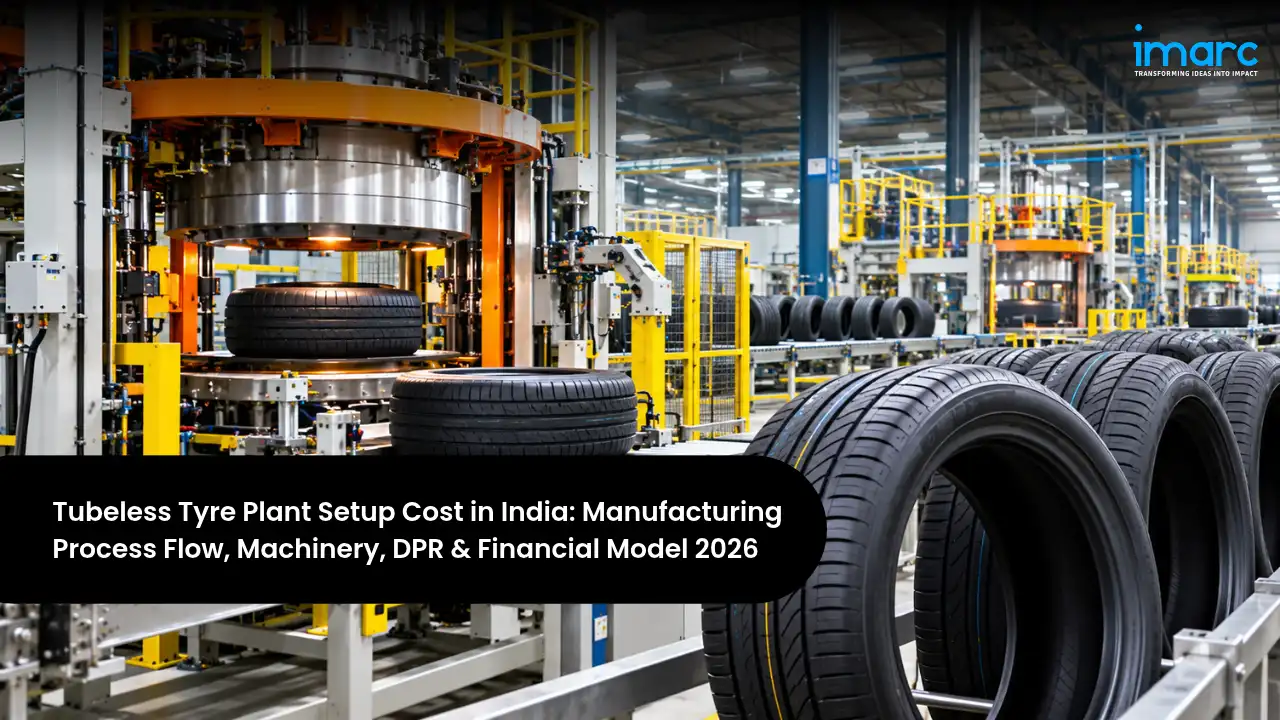
A Tubeless Tyre Manufacturing Plant Setup in India produces tyres that hold air without an inner tube, relying on an airtight halobutyl inner liner and a tight bead seal against the rim. Products include tubeless tyres for scooters and motorcycles, radial passenger car and SUV tyres, light commercial vehicle tyres, and truck and bus radial tyres. Tubeless tyres lose air slowly when punctured, run cooler, and save weight, so they have become standard on new cars and are fast replacing tube-type tyres in two-wheelers and trucks. India's large vehicle production, growing replacement market, and strong tyre exports support steady demand.
The overall Tubeless Tyre Manufacturing Plant Cost depends mainly on capacity, the product segment (two-wheeler, passenger radial, or truck and bus radial), mixing, extrusion, and calendering lines, inner liner and steel cord processing, bead making, tyre building machines, curing presses and moulds, testing and uniformity equipment, utilities, land and buildings, and working capital for rubber and finished stock. Tyre manufacturing is highly capital-intensive. A radial passenger and two-wheeler plant of about 50,000 tonnes a year typically needs INR 2,500 crore to INR 3,500 crore in fixed assets, or about INR 2,800 crore to INR 4,000 crore including working capital. A smaller two-wheeler tubeless tyre plant of 10,000 to 15,000 tonnes a year can start at around INR 250 crore to INR 400 crore. IMARC Group puts typical capacities at 50,000 to 200,000 tonnes a year, with gross margins of 16 to 24% and net margins of 5 to 10%.
This guide is written for tyre and rubber product companies, auto component groups, rubber processors, exporters, and investors exploring how to start a Tubeless Tyre manufacturing plant in India. It explains product types and end uses, demand drivers, the production flow, machinery and raw materials, site selection, a detailed cost and returns breakdown, the BIS, safety, environmental, and OEM approvals involved, and how a DPR pulls these elements into a bankable plan.
India Market Snapshot
| Key Facts | Details |
|---|---|
| India Tyre Industry Turnover | About INR 1 Lakh Crore a year |
| Tyre Exports (FY26) | INR 27,312 Crore, up 9% |
| Domestic Natural Rubber Price (mid-2026) | About INR 280 per kg |
| US Tariff on Indian Tyres | Cut to 18% (Feb 2026) |
| Typical Plant Capacity | 50,000–200,000 Tonnes a year |
| Indicative Total Investment | INR 2,800–4,000 Crore (50,000 TPA radial, incl. working capital) |
India's tyre industry has an annual turnover of about INR 1 lakh crore, with exports reaching a record INR 27,312 crore in FY26 and more than a quarter of output sold abroad. Rising natural rubber and crude-linked input costs in 2026, however, make raw material management central to tyre economics.
Investment Highlights
Indicative Project Cost in India (2026)
| Parameter | Value |
|---|---|
| Product Range | Two-wheeler tubeless tyres, passenger car and SUV radials, LCV tyres, and truck and bus radial tyres |
| Total Project Investment | INR 2,800 – 4,000 Crore incl. working capital (50,000 TPA radial); INR 250 – 400 Crore (10,000–15,000 TPA two-wheeler) |
| Payback Period | 6 – 8 Years |
| Net Profit Margin | 5 – 10% (IMARC benchmark) |
| IRR | 13 – 17% |
| Best Locations | Tamil Nadu, Gujarat, Maharashtra, Andhra Pradesh, Kerala, Madhya Pradesh |
| Mandatory Approvals | BIS Certification, Factory License, SPCB Consents, Fire NOC, Boiler Registration, EPR for Waste Tyres, GST, Udyam |
| Key Requirement | Compound technology, precise building and curing, BIS approvals, and strong OEM and dealer access |
These figures offer a practical frame for early evaluation. Returns depend on compound and design technology, raw material buying, efficient mixing, building, and curing, low scrap, BIS and OEM approvals, a strong replacement dealer network, export certifications, and high utilisation of an expensive asset base. A capacity- and segment-specific Tubeless Tyre Feasibility Report refines these numbers before capital is committed.
Table of Contents
- What is Tubeless Tyre Manufacturing?
- Why is Tubeless Tyre Manufacturing Growing in India?
- Tubeless Tyre Manufacturing Process Flow
- Raw Materials Required for Tubeless Tyre Manufacturing
- Location, Land & Infrastructure
- Tubeless Tyre Manufacturing Machinery and Equipment
- Tubeless Tyre Manufacturing Plant Setup Cost in India (CapEx & OpEx)
- Financial Analysis and Profitability
- Licenses and Approvals for Tubeless Tyre Manufacturing in India
- Recent Developments in the India Tubeless Tyre Manufacturing Industry
- How Tubeless Tyre Manufacturing Project Report and DPR Helps Investors
- Frequently Asked Questions
What is Tubeless Tyre Manufacturing?
A tubeless tyre is built from several rubber components and reinforcing materials, then vulcanised in a mould. Natural and synthetic rubbers are mixed with carbon black, silica, oils, and chemicals in internal mixers to make compounds for the tread, sidewall, inner liner, and other parts. Treads and sidewalls are extruded, fabric and steel cords are coated with rubber on calenders, and an airtight halobutyl inner liner is calendered into a thin sheet. Bead wires are wound and covered with an apex filler. On tyre building machines, these components are assembled into a green tyre, with radial tyres built in two stages to add steel belts and the tread. The green tyre is cured in a heated press, which shapes the tread pattern and sidewall markings, then trimmed and inspected for appearance, uniformity, and balance. A Tubeless Tyre Manufacturing Plant therefore combines compounding, extrusion, calendering, bead making, cutting, building, curing, finishing, testing, and warehousing.
Tyres are sold to two-wheeler, car, commercial vehicle, and tractor makers as original equipment, to the replacement market through dealers and retail chains, to fleet operators, and to export customers in more than 170 countries. OEM buyers expect validated performance, BIS compliance, consistent quality, and delivery to schedule, while replacement buyers look for durability, mileage, grip, price, and brand trust.
- Two-Wheeler Tubeless Tyres: Scooter and motorcycle tyres.
- Passenger Car Radials: Car and SUV tubeless radial tyres.
- LCV Tyres: Light commercial vehicle tyres.
- Truck and Bus Radials: Heavy-duty tubeless radial tyres.
Main Product Types in Tubeless Tyre Production
The product segment shapes machinery, technology, and investment:
| Product Type | Description | Key Feature | Primary Market |
|---|---|---|---|
| Two-Wheeler Tubeless | Bias or radial construction | Very high volume | Scooters, motorcycles |
| Passenger Car Radial | Steel-belted radial | Comfort, fuel efficiency | Cars, SUVs |
| LCV Radial | Reinforced radial | Load capacity | Pickups, vans |
| Truck & Bus Radial | Steel carcass radial | Mileage, retreadability | Trucks, buses |
| Specialty Tubeless | Off-road, performance | Niche designs | Premium, export |
Many new entrants focus on one segment, often two-wheeler tubeless tyres, which need less capital and benefit from the shift away from tube-type tyres, and then move into passenger radials or truck and bus radials as technology, approvals, and dealer networks mature. Radial and premium segments usually earn better margins but require far greater investment and technical capability.
Why is Tubeless Tyre Manufacturing Growing in India?
Key Growth Drivers in the Indian Market
Demand for tubeless tyres in India comes from vehicles, replacement, and exports:
- Vehicle production: Record vehicle sales drive original equipment demand across segments.
- Shift to tubeless: Two-wheelers and trucks are moving steadily from tube-type to tubeless tyres.
- Replacement market: A large and growing vehicle parc creates steady replacement demand.
- Radialisation: Trucks and buses continue to shift to radial tubeless tyres for mileage and fuel savings.
- Exports: Indian tyres reach more than 170 markets, with exports at record levels.
End-Use Market Opportunity
| End Use | Demand Driver | Product Role |
|---|---|---|
| Two-Wheeler OEM & Replacement | Largest vehicle segment | Two-wheeler tubeless tyres |
| Passenger Vehicles | Cars and SUVs | Passenger radials |
| Commercial Vehicles | Freight and buses | Truck and bus radials |
| Fleet Operators | Cost per km | Radial tubeless tyres |
| Exports | Global demand | All segments |
The strongest position for a Tubeless Tyre Manufacturing Plant in India combines strong compound and design technology, efficient automated building and curing, BIS and OEM approvals, a wide replacement dealer network, export certifications, and a clear focus on the segments where the company can compete on quality and cost.
Tubeless Tyre Manufacturing Process Flow
Understanding the Tubeless Tyre Manufacturing Process helps promoters plan compounding, component preparation, building, curing, finishing, layout, staffing, and quality control. Product quality depends on compound formulation and mixing, inner liner integrity, cord adhesion, component accuracy, building precision, curing time and temperature, and testing discipline. The flow below reflects a typical radial tubeless tyre plant.
Step-by-Step Tubeless Tyre Production Flow
Rubbers and fillers are mixed into compounds, which are extruded and calendered into components. Beads are made, components are cut, and green tyres are built, cured, trimmed, inspected, and warehoused.
| Unit Operation | Key Activity |
|---|---|
| Raw Material Testing | Rubber, carbon black, cords |
| Compound Mixing | Master and final batches |
| Extrusion | Tread and sidewall profiles |
| Calendering | Fabric, steel cord, inner liner |
| Bead Making | Bead wire winding and apex |
| Component Cutting | Ply and belt cutting |
| Tyre Building | Assemble green tyre |
| Curing | Vulcanise in moulds |
| Finishing & Inspection | Trim, visual, uniformity, X-ray |
| Warehousing & Dispatch | Store and ship |
Two factors decide profitability. The first is raw material cost: natural rubber, synthetic rubber, carbon black, and cords make up most of operating cost and track rubber and crude oil prices, so smart buying, compound optimisation, low scrap, and timely price increases protect margins. The second is utilisation and technology: tyre plants carry very high fixed costs, so running mixers, building machines, and presses at high utilisation, and winning OEM and export volumes through approved, competitive products, decide returns.
Raw Materials Required for Tubeless Tyre Manufacturing
The main inputs are natural rubber, synthetic rubbers including halobutyl for the inner liner, carbon black and silica, steel cord and bead wire, nylon and polyester fabrics, and process oils and chemicals. IMARC Group estimates raw materials at 65 to 72% of operating cost and utilities at 10 to 14%.
| Raw Material | Role in Process | India Sourcing | % of OpEx |
|---|---|---|---|
| Natural Rubber | Main elastomer | Kerala, northeast, imports | 22–26% |
| Synthetic Rubber (SBR, BR, Halobutyl) | Tread, sidewall, inner liner | Domestic and imported | 14–17% |
| Carbon Black & Silica | Reinforcing fillers | Domestic producers | 10–12% |
| Steel Cord & Bead Wire | Belts, carcass, beads | Domestic and imported | 8–10% |
| Fabrics, Oils & Chemicals | Plies, processing, curing | Domestic and imported | 9–13% |
India produces natural rubber, mainly in Kerala, along with carbon black, nylon fabric, and some synthetic rubbers, but imports part of its natural rubber, halobutyl, steel cord, and specialty chemicals. Prices move with rubber markets, crude oil, and the rupee, so tyre makers should diversify suppliers, maintain strategic stocks, use compound flexibility, and pass cost increases through pricing.
Location, Land & Infrastructure
Location shapes logistics, labour, and market access. The best location for Tubeless Tyre manufacturing plant setup lies in an industrial region with large land parcels, reliable power and water, a skilled workforce, good road and port connectivity for imported materials and exports, and access to automotive clusters and replacement markets.
Preferred States for Tubeless Tyre Plants in India
| State | Why It Works | Key Advantage |
|---|---|---|
| Tamil Nadu | Chennai tyre and auto cluster | Ports, OEMs, skilled labour |
| Gujarat | Industrial corridors, ports | Exports, raw material imports |
| Maharashtra | Pune, Chakan, and Nagpur | Auto OEMs, two-wheeler demand |
| Andhra Pradesh | New tyre plants, ports | Land, incentives, exports |
| Kerala | Natural rubber belt | Rubber supply |
| Madhya Pradesh | Central location | Land, domestic distribution |
Tamil Nadu hosts India's largest concentration of tyre plants around Chennai, with ports and vehicle makers nearby, while Gujarat and Andhra Pradesh offer ports, land, and incentives for large export-oriented plants. Maharashtra serves major auto clusters, Kerala provides natural rubber, and Madhya Pradesh offers a central base for domestic distribution.
Product Quality and Compliance Requirements
Automotive tyres sold in India require BIS certification under IS 15627 for two and three-wheelers, IS 15633 for passenger cars, and IS 15636 for trucks and buses, along with automotive requirements for rolling resistance, wet grip, and noise. Exports need DOT, ECE, or other market approvals. Key controls include raw material testing, compound rheometer checks, component dimension checks, building accuracy, curing monitoring, visual inspection, uniformity and balance testing, X-ray inspection for radials, and periodic endurance and high-speed tests.
Infrastructure Requirements (50,000 TPA Plant)
| Infrastructure Element | Specification | India-Specific Note |
|---|---|---|
| Total Land Area | 80 – 150 acres | Plant, warehouses, expansion |
| Production Buildings | 100,000 – 150,000 m² | Mixing, building, curing halls |
| Power | 25 – 40 MW connected load | Mixers, presses, utilities |
| Steam & Nitrogen | Boilers and nitrogen plant | Curing presses |
| Water | 1,000 – 2,000 KLD | Cooling, steam, utilities |
| Testing Laboratory | Compound, tyre, endurance tests | BIS and OEM compliance |
| Warehousing | Raw material and finished tyres | Large inventory |
Infrastructure for a tyre plant centres on raw material stores, a mixing hall with carbon black handling, extrusion and calendering lines, bead and cutting areas, tyre building and curing halls, finishing and inspection, testing laboratories, boilers, nitrogen and compressed air plants, cooling towers, effluent treatment, and large warehouses. Planning space for additional mixing, building, and curing capacity from the outset supports phased growth.
Tubeless Tyre Manufacturing Machinery and Equipment
Several Indian suppliers make mixers, extruders, curing presses, and bead machines, while radial tyre building machines, steel cord calenders, uniformity machines, and X-ray inspection systems are mostly imported from Europe, Japan, and China. The main equipment is summarised below.
| Equipment | Function | Key Specification |
|---|---|---|
| Internal Mixers with Batch-Off | Compound mixing | Master and final batches |
| Duplex / Triplex Extruders | Tread and sidewall | Multi-compound profiles |
| Fabric & Steel Cord Calenders | Coat reinforcing cords | Precision gauge control |
| Inner Liner Calender | Airtight liner sheets | Halobutyl processing |
| Bead Winding & Apex Machines | Bead assemblies | Consistent bead geometry |
| Bias & Steel Cord Cutters | Ply and belt cutting | Accurate angles and widths |
| Tyre Building Machines | Green tyre assembly | Two-stage radial |
| Curing Presses & Moulds | Vulcanisation | Hydraulic or mechanical |
| Uniformity, Balance & X-ray | Final inspection | Automated testing |
| Boilers, Nitrogen Plant & Utilities | Steam, gas, cooling | Curing support |
Mixing capacity, building machines, and curing presses largely determine output, while calendering, building precision, and curing control determine tyre quality. Many promoters build capacity in phases, starting with one segment and a balanced set of mixers, building machines, and presses, then adding lines as OEM approvals, dealer reach, and exports grow.
Tubeless Tyre Manufacturing Plant Setup Cost in India (CapEx & OpEx)
The tables below summarise the capital and operating cost structure of a radial tubeless tyre plant of about 50,000 tonnes a year in India. The final Tubeless Tyre Investment Cost for a specific project depends on capacity, product segment, technology and machinery sources, level of automation, utilities, testing facilities, land and building costs, state incentives, and working capital for rubber, finished stock, and dealer and OEM receivables.
Capital Expenditure (CapEx) Cost Structure
| CapEx Component | % of Total CapEx | What It Covers |
|---|---|---|
| Mixing & Material Handling | 10–12% | Mixers, carbon black systems |
| Extrusion & Calendering | 12–15% | Extruders, calenders, cutters |
| Tyre Building | 14–18% | Building machines, bead lines |
| Curing Presses & Moulds | 16–20% | Presses, moulds, bladders |
| Testing & Utilities | 10–12% | Labs, boilers, nitrogen, power |
| Land & Buildings | 14–18% | Site, halls, warehouses |
| Working Capital | 10–14% | Rubber, stock, receivables |
Curing presses, moulds, and building machines form the largest share of fixed investment, while working capital covers costly raw materials and finished stock across many sizes. A Tubeless Tyre Business Plan models these components so that capacity, segment mix, and phasing rest on realistic raw material prices, conversion costs, utilisation, selling prices, OEM and replacement mix, and payment terms.
Operating Expenditure (OpEx) Cost Structure
| OpEx Component | % of Total OpEx | India-Specific Note |
|---|---|---|
| Raw Materials | 65–72% | Rubber and crude-linked inputs |
| Utilities | 10–14% | Power, steam, nitrogen |
| Labour | 5–7% | Skilled operators, engineers |
| Selling & Distribution | 5–7% | Dealer network, marketing |
| Logistics | 3–4% | Domestic and export freight |
| Maintenance, Warranty & Overheads | 3–5% | Moulds, claims, administration |
With raw materials forming most of operating cost, profitability depends on rubber and crude-linked prices, compound efficiency, scrap, utilisation, and pricing power. A sound financial model should test margins against natural rubber and crude oil price spikes, rupee depreciation, slower vehicle sales, OEM price pressure, competition from imports, export tariffs, and higher interest costs during ramp-up.
Financial Analysis and Profitability
Tubeless tyre manufacturing offers long-term returns for well-capitalised producers with strong technology and markets. The profitability of Tubeless Tyre manufacturing business in India improves with high utilisation, compound and design efficiency, low scrap and warranty claims, a balanced mix of OEM, replacement, and export sales, premium and radial products, efficient phased investment, and state incentives.
| Financial Metric | Indicative Value | India Context |
|---|---|---|
| Gross Profit Margin | 16–24% | IMARC benchmark |
| Net Profit Margin | 5–10% | IMARC benchmark |
| Payback Period | 6–8 Years | Highly capital-intensive |
| IRR (Internal Rate of Return) | 13–17% | Sensitive to rubber prices and utilisation |
| Capacity Utilization (stable ops) | 70–85% | After ramp-up |
| Break-even Capacity Utilization | 50–60% | High fixed costs |
Scale, technology, and market access are the decisive factors. Large players with established brands, OEM relationships, dealer networks, and export approvals earn steady returns, while new entrants face long ramp-up periods, heavy capital needs, and intense competition, which is why focused segment strategies and technology partnerships matter.
Returns can be strengthened by focusing on a segment with clear demand such as two-wheeler tubeless or truck radials, partnering for compound and design technology, building export certifications early, developing replacement distribution, adding premium and EV-specific tyres, using state investment incentives, and phasing capacity to match demand.
Key Risks and Mitigation
The main risks are natural rubber and crude oil price volatility, rupee depreciation, intense competition from established brands and imports, long ramp-up periods, export tariff changes, product liability and warranty claims, and environmental obligations for waste tyres. Price risk is reduced through pricing discipline and supplier diversification; competition through focused segments and technology; ramp-up risk through phased investment; and market risk through a balanced OEM, replacement, and export mix.
Licenses and Approvals for Tubeless Tyre Manufacturing in India
A tubeless tyre unit requires product certification, industrial, environmental, safety, and business approvals. Promoters typically need the following before starting commercial production:
- BIS Certification: Mandatory certification for automotive tyres under IS 15627, IS 15633, and IS 15636, including applicable rolling resistance, wet grip, and noise requirements.
- Factory License and Fire NOC: Factory registration and fire safety approval for the plant and warehouses.
- Pollution Control Consents: Consent to Establish and Consent to Operate from the State Pollution Control Board, covering mixing emissions and effluents.
- Boiler Registration: Registration and inspection of boilers and pressure vessels.
- EPR for Waste Tyres: Extended Producer Responsibility registration and obligations for waste tyres under the Hazardous and Other Wastes Rules.
- Quality and Export Approvals: IATF 16949 for OEM supply, plus DOT, ECE, or other approvals for export markets.
- Business Registrations: Company registration, GST, Udyam, trade license, trademark, and an Import Export Code.
BIS certification, OEM validation, and export approvals often take the longest and are essential for market access. Engaging a Tubeless Tyre Manufacturing Consultant in India can help promoters choose segments and technology partners, plan phased capacity and machinery, obtain approvals and incentives, and build OEM, replacement, and export channels.
Note: The exact approvals, registrations, licenses, and certification requirements may vary depending on factors such as plant location, product range, capacity, target customers, and applicable regulations. Businesses are advised to undertake a detailed regulatory assessment during the project planning stage to ensure full compliance and timely implementation.
Recent Developments in the India Tubeless Tyre Manufacturing Industry
Several recent developments are shaping the tyre industry in India:
- US tariff relief: In February 2026, the US reduced its tariff on Indian tyres to 18% from 50%, easing pressure on India's largest export market.
- Rolling resistance standard revised: In March 2026, BIS notified the revised IS/ISO 28580:2018 method for measuring rolling resistance of passenger car, truck, and bus tyres.
- Rising input costs and expansion: In July 2026, an industry analysis flagged FY27 margin pressure as domestic natural rubber rose to about INR 280 per kg and crude crossed USD 100 per barrel, while CEAT continued expanding passenger tyre capacity at Chennai.
Together these point to strong export and domestic demand alongside rising input costs and tighter performance standards. For new entrants, success depends on technology, raw material management, approvals, and market access.
How Tubeless Tyre Manufacturing Project Report and DPR Helps Investors
A detailed Tubeless Tyre Project Report gives investors a structured roadmap covering demand by segment and channel, competition, product mix, technology options, raw material sourcing, process design, machinery, utilities, approvals, logistics, and economics. It helps promoters choose the right segment, capacity, and phasing, estimate capital expenditure (CapEx) and operating expenditure (OpEx), assess profitability, and identify risks before implementation.
At the core of the DPR is a Tubeless Tyre Financial Model covering raw material prices and compound costs, tyre weights, scrap, utilities, labour, selling prices by size and channel, OEM and replacement mix, export realisations, ramp-up, working capital, cash flow projections, break-even, return on investment (ROI), and payback. Because rubber prices, utilisation, and ramp-up drive returns, lenders expect detailed sensitivity analysis, which is why many promoters engage a Tubeless Tyre Plant Project Report Consultant in India to prepare bank-ready documents.
For a tyre project specifically, a strong DPR also answers the questions that matter most: which segment and technology route to choose, how quickly capacity can be filled through OEM, replacement, and export sales, how long BIS and OEM approvals will take, how to phase investment, and how returns hold up if rubber prices rise or ramp-up is slower than planned. An experienced Tubeless Tyre Manufacturing Feasibility Study Consultant tests these scenarios so that the final plan is one lenders and partners can back with confidence.
Frequently Asked Questions
How do I set up a tyre factory for tubeless tyres in India?
Start by choosing a target segment and technology partner, then commission a feasibility study and DPR. Secure a large industrial site, install mixing, extrusion, calendering, bead, building, curing, and testing equipment, obtain BIS certification and factory, pollution, fire, and boiler approvals, register for waste tyre EPR, and build OEM, dealer, and export channels.
What is the cost of setting up a tubeless tyre manufacturing plant in India?
A radial passenger and two-wheeler plant of about 50,000 tonnes a year typically needs INR 2,500 crore to INR 3,500 crore in fixed assets, or about INR 2,800 crore to INR 4,000 crore including working capital. A smaller two-wheeler plant of 10,000 to 15,000 tonnes a year can start at around INR 250 crore to INR 400 crore.
How are tubeless tyres made?
Rubber compounds are mixed and formed into treads, sidewalls, an airtight inner liner, and rubber-coated cords. Beads are made, components are assembled into a green tyre on a building machine, and the tyre is cured in a heated mould, then trimmed and inspected.
What machinery is needed for a tubeless tyre manufacturing plant?
Key equipment includes internal mixers, extruders, fabric and steel cord calenders, inner liner calenders, bead winding machines, cutters, tyre building machines, curing presses and moulds, uniformity, balance, and X-ray machines, boilers, and a nitrogen plant.
What raw materials are used for tubeless tyres?
The main inputs are natural rubber, synthetic rubbers including halobutyl for the inner liner, carbon black and silica, steel cord and bead wire, nylon and polyester fabrics, process oils, and curing chemicals.
Is tubeless tyre manufacturing profitable in India?
Benchmark figures point to a 5 to 10% net margin and an IRR of around 13 to 17%, with payback in 6 to 8 years. Profitability depends mainly on raw material prices, utilisation, technology, segment mix, and market access.
What licenses are needed for a tubeless tyre manufacturing unit in India?
A unit typically needs BIS certification, a Factory License, Fire NOC, State Pollution Control Board consents, boiler registration, EPR registration for waste tyres, IATF 16949 for OEM supply, export approvals where relevant, GST, Udyam registration, and an Import Export Code.
Which state is best for a tubeless tyre manufacturing plant?
Tamil Nadu, Gujarat, Maharashtra, Andhra Pradesh, Kerala, and Madhya Pradesh are strong options. The best site combines large land availability, port access, skilled labour, and proximity to automotive and replacement markets.
How do I get a feasibility study or DPR for a tubeless tyre manufacturing plant?
A professionally prepared DPR covers market and segment assessment, technology, technical design, approvals, costs, and financial projections for bank appraisal. Many promoters work with a Tubeless Tyre Business Plan Consultant in India to prepare it and align it with lender requirements.
Our Clients










Contact Us
Have a question or need assistance?
Please complete the form with your inquiry or reach out to us at
Phone Number
+91-120-433-0800+1-201-971-6302
+44-113-547-7077
Previous Post

An Automotive Air Filters Manufacturing Plant Setup in India produces the filter elements that clean air entering vehicle engines and cabins. Products include panel air filters for cars and SUVs, two-wheeler air filter elements, cylindrical primary and safety elements for trucks, buses, tractors, and construction equipment, cabin air filters with particle and activated carbon media, and complete air cleaner assemblies.
International travel has slowed, but luxury at sea has not. According to IMARC Group, the global yacht charter market was valued at USD 9.72 Billion in 2025, is estimated at USD 10.34 Billion in 2026 and is projected to reach USD 16.94 Billion by 2034, growing at a CAGR of 6.36% during 2026-2034.
The increasing adoption of digital platforms is transforming vehicle purchasing behaviour, with consumers increasingly relying on online channels to explore models, compare prices, and evaluate buying options. According to IMARC Group, the global market grew from USD 390.4 Billion in 2025 to USD 424.9 Billion in 2026, and it is projected to reach USD 836.4 Billion by 2034, registering a CAGR of 8.80% during 2026-2034.
An Automotive Filter Manufacturing Plant Setup in India serves one of the most dependable segments of the auto component industry. Every vehicle uses several filters, including engine air filters, oil filters, fuel and diesel filters, and cabin air filters, and most must be replaced at regular service intervals, so demand comes both from new vehicle production and from a very large replacement market.
In a radial, the cords of the body ply run straight across the tyre from bead to bead, at right angles to the direction of travel, and a strong belt of steel cords sits under the tread. This design keeps the tread flat on the road, so the tyre runs cooler, grips better, lasts longer, and saves fuel compared with older bias designs.
Tyre pyrolysis oil, or TPO, is a dark fuel oil made by heating shredded end-of-life tyres to about 400 to 500°C without oxygen, so that the rubber breaks down into oil vapours, gas, carbon char, and steel wire.
A farm tractor is built around a frameless chassis in which the engine, clutch housing, gearbox, and rear axle are bolted together to carry the load, with a hydraulic lift and three-point linkage at the back, a power take-off shaft to drive implements, and large rear tyres for traction.
A traction battery is built from lithium-ion cells, each made by coating metal foils with cathode and anode materials, assembling them with a separator and electrolyte inside a sealed case, and charging them for the first time in a controlled formation process.
A goods carrier is built on a ladder-frame chassis of heavy steel side members, onto which the engine, gearbox, axles, suspension, brakes, fuel or battery system, and a pressed and welded cab are fitted, before the vehicle is painted, tested, and sent to body builders or customers.
E-buses run on large lithium-ion battery packs that drive electric traction motors, producing no tailpipe emissions, little noise, and far lower energy and maintenance costs per kilometre than diesel buses.
The Germany Battery Recycling Industry sits where Europe's largest automotive manufacturing base meets its most demanding battery regulation. According to IMARC Group, the market reached USD 814.3 Million in 2025 and is projected to reach USD 1,617.0 Million by 2034, expanding at a CAGR of 7.68% during 2026–2034.
Electric cars are the fastest-growing part of India's passenger vehicle market. Sales roughly doubled in 2025-26, about 6% of new cars sold in the first seven months of 2026 were electric, and more than a dozen models from Indian and global brands now compete across hatchbacks, sedans, and SUVs.
Every electric vehicle needs a charger, and as India's EV fleet grows, so does demand for the equipment that powers it. India registered more than 2.3 million EVs in 2025, public charging stations grew from about 5,000 in 2022 to more than 27,000 by March 2026, and the PM E-DRIVE scheme is funding 72,300 more public chargers by 2028.
Electric vehicles are moving from early adoption to the mainstream in India. Nearly 19 lakh EVs were registered in the first seven months of 2026, and in some segments the shift is already well advanced: more than four in ten new passenger three-wheelers sold in 2026 were electric, while electric two-wheelers, cars, buses, and light commercial vehicles are all gaining share.
Every function in a modern vehicle that moves, from a brake caliper to an air-conditioning flap, depends on an actuator that turns an electronic command into physical motion. The global automotive actuators market size was valued at USD 31.1 Billion in 2025 and is forecast to reach USD 47.3 Billion by 2034, expanding at a compound annual growth rate (CAGR) of 4.62% during 2026–2034, according to IMARC Group.
India is the world's largest two-wheeler market, and it is steadily going electric. Electric scooters, motorcycles, and mopeds offer running costs far below petrol models, suit short urban commutes and delivery work, and are central to the country's clean mobility goals.
Electric bicycles, or e-bikes, combine a conventional bicycle with a small electric motor, a lithium-ion battery, and a controller that assists the rider's pedalling. In India, models limited to 250 watts and 25 km/h do not need registration or a driving license, cost a few paise per kilometre to run, and suit short commutes, fitness riding, students, and last-mile delivery.
Walk into a modern Indian car parts plant, pharmaceutical packing line, or electronics factory and you will see robots welding and palletising, conveyors moving parts between stations, vision cameras checking quality, and control panels coordinating it all.
Tyres are essential to every vehicle on India's roads, from two-wheelers and three-wheelers to cars, buses, trucks, tractors, and off-highway machines.
If the battery is the heart of an electric vehicle, the wiring harness is its nervous system. Every EV needs low-voltage harnesses for lights, sensors, and controls, plus high-voltage harnesses that carry hundreds of volts and high currents between the battery, inverter, motor, and charging port, and dedicated harnesses inside the battery pack that monitor every cell.
Every electric vehicle needs a brain between the battery and the motor. The motor controller, often called the traction inverter in larger vehicles, converts DC power from the battery into precisely controlled AC power for the motor, manages acceleration, regenerative braking, and efficiency, and protects the whole powertrain from faults.
Every vehicle on the road depends on forged parts. Crankshafts, connecting rods, steering knuckles, axle beams, gears, and hubs are forged because the process gives steel a continuous grain flow and the strength to survive millions of load cycles.
Setting up an Automotive Components Manufacturing Plant in India is a high-potential, export-capable venture, powered by the country's large automobile industry, deep supplier base, and growing role as a global sourcing hub for auto parts.
The global automotive lead-acid battery market reached USD 13.89 Billion in 2025 and is projected to reach USD 16.60 Billion by 2034, growing at a CAGR of 1.94% (2026–2034).
Setting up an Electric Scooter Manufacturing Plant in India is a capital-efficient, high-growth venture, driven by the country's rapid shift to electric mobility, supportive EV policies, and surging demand for affordable, clean urban transport. As two-wheelers dominate Indian roads and buyers move from petrol to battery-powered scooter manufacturing, an EV Scooter Manufacturing Plant is one of the most accessible and strategically timed entry points into the electric vehicle economy.
Capital is flowing into the united states used car market because structural affordability pressure, digital retail maturity, and a record-old national vehicle fleet have converged into a genuinely investable thesis.
The Europe Tire Market reached a volume of 458.89 Million Units in 2025 and is projected to reach 565.69 Million Units by 2034, growing at a CAGR of 2.35% (2026–2034).
A strategic analysis of how PLI policies and localization drive global OEM investments. India’s EV battery market hits USD 15,898.31 Million by 2034 (21.7% CAGR).
A tyre is circular in shape and made of a combination of rubber materials that fit perfectly over a circular rim on a wheel, providing traction, load-carrying capabilities, shock absorption, and directional stability. As such, tyres are engineered materials composed of a combination of natural or synthetic materials. They are composed of a combination of materials such as rubber, a combination of materials such as steel or textile, and various chemical materials, among others.
A tractor is a self-propelled, torque-requiring vehicle intended primarily for pulling power at low speeds for agricultural, industrial, and utility purposes. It functions as a mobile power source that can be used for towing, pushing, lifting, or driving a variety of agricultural implements through mechanical, hydraulic, or power take-off systems. Tractors are designed with powerful propulsion systems, sturdy frames, and versatile coupling systems for use on different terrains and under heavy loads.
The electric boat and ship market size is experiencing unparalleled growth as the marine industry embraces electrification on a large scale across different geographies. As sustainability is becoming a strategic priority, with each passing day, more and more marine operators look to electric propulsion technologies as alternatives aimed at cutting down emissions, improving operational efficiencies, and enabling greener ports.
The GCC car rental market has emerged as a critical component of the region's transportation ecosystem, driven by robust tourism activity, expanding business travel, and a substantial expatriate population. Countries across the Gulf Cooperation Council are witnessing unprecedented demand for flexible mobility solutions that cater to diverse customer segments. The GCC car rental market size was valued at USD 1.65 Billion in 2024 as governments prioritize infrastructure development and sustainable tourism initiatives.
The Indian automotive sector has formed a vital part of the country's industrial and economic development for a long period. Over the years, the industry has transformed significantly, influenced by changes in technology, global trends, and consumer preference. Among the various factors shaping its trajectory, government policies have emerged as a decisive force driving growth, innovation, and competitiveness in the India auto parts manufacturing industry.
The India motorcycle tires market continues to evolve in response to changing mobility preferences, rising urbanization, and the growing significance of two-wheelers as essential transportation assets for millions of riders. As per sources, the India motorcycle tires market size reached USD 933.66 Million in 2024. The market is projected to reach USD 2,419.36 Million by 2033, exhibiting a growth rate (CAGR) of 10.3% during 2025-2033.
The Saudi Arabia tire market is undergoing a significant transformation driven by the nation’s economic diversification, rapid urbanization, and growing vehicle ownership. As one of the largest automotive hubs in the Middle East, Saudi Arabia is witnessing increasing demand for both passenger and commercial vehicle tires across urban and industrial regions.
One of the world's most dynamic and quickly changing markets, India's automotive industry is undergoing revolutionary changes in both the new and used car markets. Despite general economic uncertainty, the used car industry has shown remarkable resilience and growth potential, making it a particularly vibrant part of this ecosystem.
One of the world's most vibrant and quickly growing automobile markets is India's passenger car sector. From technological innovation to economic development, a number of interrelated factors have contributed to the sector's remarkable transformation. For stakeholders looking to take advantage of the enormous opportunities in this dynamic market, it is imperative that they comprehend these growth drivers.
India's truck industry is at a turning point in its development, driven by extensive government policies that are changing the commercial vehicle market. The industry, which is the foundation of the country's logistics ecosystem, is gaining previously unheard-of momentum thanks to smart regulatory frameworks and forward-thinking legislative initiatives. A fundamental change in truck operations on Indian highways is being sparked by government initiatives ranging from infrastructure development to emission standards, digitalization, and financial incentives.
The electric rickshaw sector in India has experienced a significant upheaval in recent years and is now a vital part of the country's sustainable transportation network. Strategic government policies aimed at hastening the adoption of clean mobility solutions have played a major role in orchestrating this evolution. India's larger vision of sustainable urbanization is in line with the electric rickshaw industry, which combines social development objectives, economic opportunities, and environmental imperatives.
Transportation in India is undergoing a spectacular change with the advent of electric two-wheelers that are quite an enticing alternative to traditional fuel-powered ones. This change is not merely an act of technological transformation, but an indication of how millions of Indians will think about city mobility, eco-awareness, and economic effectiveness.
As one of the world's leading industrial powerhouses, Japan has long been recognized for its commitment to technological innovation and manufacturing precision. The industry for industrial automation components—encompassing sensors, controllers, actuators, drives, robotics, and human-machine interfaces—represents the backbone of modern manufacturing infrastructure.
The Australian brakes and clutches industry plays a vital role in ensuring vehicle performance, safety, and efficiency across both automotive and industrial segments. As the nation transitions toward electric mobility and smarter manufacturing systems, the demand for advanced braking and clutch mechanisms is rising significantly.
The Philippines automotive wiring harness industry stands at a transformative juncture, driven by technological innovations that are reshaping vehicle electrical architectures worldwide. As vehicles evolve into sophisticated mobile computing platforms, the wiring harness, the circulatory system transmitting electrical power and data throughout modern automobiles, has become increasingly complex and critical to vehicle performance.
Japan's hybrid vehicles market stands as a global benchmark for sustainable mobility innovation, demonstrating remarkable growth and technological leadership. The market achieved a valuation of USD 33.57 Billion in 2024. Japan's hybrid vehicle (HV) market is one of the most established globally, originating with pioneering models like the Toyota Prius. It currently represents a significant portion of the country's automotive sales.
The Japan warehouse robotics market is a highly dynamic and rapidly expanding segment of the global automation industry. The market, valued at USD 414.0 Million in 2024, is on a sharp growth trajectory. Its growth is fueled by critical domestic factors, including a severe labor shortage, the rapid expansion of e-commerce, and Japan's strategic position as a world-leading robotics manufacturer.
The UK is rapidly evolving into a dynamic hub for autonomous vehicle research, testing, and early-stage deployments. A strong ecosystem comprising academic institutions, technology start-ups, automakers, and mobility service providers fosters continuous innovation. Supported by a skilled workforce specializing in software, sensing, robotics, and transportation systems, the nation has become a fertile ground for experimentation.
Japan’s transportation landscape is on the brink of a major shift, with robo taxis, autonomous, driverless vehicles designed for passenger and goods transport, emerging as a practical mobility solution. The Japan robo taxi market reached USD 83.2 Million in 2024 . This remarkable expansion reflects Japan’s broader move toward smart mobility, sustainability, and automation.
The Japan electric truck market is experiencing transformative growth as the nation accelerates toward sustainable transportation and carbon neutrality. As a leading automotive manufacturing hub, Japan is witnessing unprecedented momentum in commercial vehicle electrification, driven by stringent environmental regulations, technological innovation, and strategic government support. The electric truck industry represents a critical component of Japan's commitment to achieving 100% electrified vehicle sales by 2035 and carbon neutrality by 2050.
An EV charging station represents the necessary main infrastructure that allows electrical energy to be transferred from the power grid into electric vehicles to enable their use for transportation. Unlike conventional fueling stations that offer liquid fuels, EV charging stations provide electric power through the use of standardized connectors and smart control systems. The core components include a power conversion unit, which transforms alternating current from the grid into direct current for the vehicle battery; a charging controller controlling communication between the charger and the EV; and a connector or plug matched to the vehicle's charging interface.
An electric scooter is a two-wheeled vehicle powered by an electric motor and rechargeable battery, aimed at offering the means for efficient, eco-friendly, and cost-effective urban mobility. Apart from the traditional scooters that are powered by internal combustion engines, the electric scooters make use of lithium-ion or lead-acid batteries that feed an electric supply to a BLDC motor, which drives the wheels either directly or via a belt or chain mechanism.
Electric bikes, commonly referred to as e-bikes, are one of the most transformational innovations in modern personal mobility, combining conventional bicycle mechanics with advanced electric propulsion technology. At the heart of e-bikes are an electric motor, a rechargeable battery, and a control system that add assistance to the rider while pedaling, making cycling easier, faster, and more accessible across varied terrains. Based on their design, they can be further categorized into pedal-assist, throttle-controlled, or hybrid models, each providing different levels of rider control and engagement of the motor.
The micro-mobility industry has emerged as a transformative force in urban transportation, revolutionizing how people navigate cities worldwide. According to IMARC, the global micro-mobility market size was valued at USD 63.10 Billion in 2024. Looking forward, IMARC Group estimates the market to reach USD 204.83 Billion by 2033, exhibiting a CAGR of 12.86% from 2025-2033.
India's electric vehicle (EV) revolution is accelerating at a breakneck speed, powered by a strategic combination of government incentives, infrastructure investments, and manufacturing policies that are transforming the automotive landscape. The IMARC Group forecasts that the Indian electric car market reached USD 963 Million in 2024.
The diesel engine industry is standing at a transformative crossroads. As global markets are pushing for sustainability, stricter emissions compliance, and cutting-edge innovations, diesel powertrains are facing both immense pressure and promising potential.
The global tire market is a multi-billion-dollar industry, driven by the growing demand for vehicles across emerging economies and the replacement tire segment in developed countries. The global tire market is expected to grow at a compound annual growth rate (CAGR) of 4.70% between 2025 and 2033. The industry is heavily influenced by factors such as technological advancements, raw material prices, environmental regulations, and consumer preferences.
Australia's electric vehicle (EV) sector is experiencing swift expansion, fueled by increasing interest in eco-friendly transportation alternatives. In 2024, sales of battery electric and plug-in hybrid vehicles hit an all-time high, totaling around 114,000 units.
The electric bus industry is the part of the transportation sector that deals with the production and installation of buses that run completely or partially on electricity, employing battery packs or fuel cells in place of conventional diesel or gasoline engines. The buses deliver lower greenhouse gas emissions, lesser noise levels, and enhanced energy efficiency, and thus they are a prime solution for environmentally friendly public transport.
India's electric vehicle market is undergoing a profound transformation, impelled by green priorities, economic imperatives, and changing consumer trends. With rising concerns about air pollution and fossil fuel dependence, electric mobility has become a strategic option for India's transport industry. Policy clarity, technology development, and an emerging ecosystem of makers and suppliers are driving this market shift.
The global electric vehicle market size was valued at USD 755 Billion in 2024. The global EV market is rapidly expanding, driven by technological advancements, government incentives, stricter emission regulations, rising fuel costs, extended battery range, growing environmental consciousness, and significant investments in charging and production infrastructure.
Electric Vehicles, or EVs, are vehicles operated partially or wholly by electrical power, generally with rechargeable battery packs as their fuel. In contrast to conventional internal combustion engine cars, EVs emit no tailpipe emissions, making them a cleaner, environmentally friendly transportation choice. EVs comprise Battery Electric Vehicles (BEVs), Plug-in Hybrid Electric Vehicles (PHEVs), and Hybrid Electric Vehicles (HEVs), and are gaining ground in passenger, commercial, and two-wheeler segments owing to developments in battery technology, charging infrastructure, and policy support.
Aluminum alloy wheels are high-performance, lightweight, and durable components widely used in the automotive industry. Their superior strength-to-weight ratio enhances vehicle efficiency, fuel economy, and handling, making them a preferred choice for both passenger and commercial vehicles. Beyond their functional benefits, aluminum alloy wheels contribute to vehicle aesthetics, offering sleek designs and customization options that appeal to consumers. Their corrosion resistance and thermal conductivity further enhance braking performance and longevity. With increasing demand for fuel-efficient and stylish vehicles, aluminum alloy wheels play a crucial role in the global automotive sector, catering to OEMs, aftermarket suppliers, and performance vehicle manufacturers.
A tyre is a crucial component of a vehicle, serving as the outer covering of a wheel. Its main purposes are to support the vehicle's weight, provide traction for movement, and act as a flexible cushion that absorbs shocks from the road. Usually composed of rubber, tires are strengthened with steel and cloth. Tires for cars, trucks, motorbikes, bicycles, and other vehicles have different designs and compositions depending on the vehicle type and its intended usage. To improve stability and grip, they have a tread pattern on the outside.
Electric kick scooters are small, battery-operated personal transportation vehicles intended for short-distance and urban movement. They offer an economical and environmentally responsible substitute for conventional modes of mobility thanks to their electric engine, rechargeable battery, and lightweight frame. The need for sustainable transportation options, traffic congestion, and growing urbanisation have all contributed to their rise in popularity. Electric kick scooters are now the go-to option for last-mile connectivity and personal commuting because to developments in battery technology, connectivity features, and government programs encouraging micro-mobility.
An automotive wiring harness is an organized assembly of electrical wires, connectors, and terminals that transmit power and signals across a vehicle’s electrical system. It guarantees effective communication between several parts, including the engine control unit, lighting, and sensors. Wiring harnesses are intended to increase vehicle performance and safety by lowering the possibility of short circuits. By maximising electrical connectivity and lowering wire complexity, they are utilised in both conventional and electric automobiles and are essential to contemporary automotive technology.
In an automotive braking system, brake pads are the most important parts since they are engineered to contact the brake rotor to produce friction, thus stopping or slowing down a vehicle in virtually any driving condition safely and efficiently. The key way of classifying these pads is according to their material types: low metallic, ceramic, organic, and semi-metallic.
Tires are essential components of vehicles designed to provide traction, support, and absorb road shocks. Primarily made of rubber, tires consist of treads, belts, and sidewalls that work together to offer grip, stability, and durability. Modern tires come in various types – such as all-season, winter, and performance tires – each engineered for specific driving conditions. The two major tire categories are radial and bias tires, and they are available in different sizes to suit various vehicle types, including passenger cars, light commercial vehicles, medium and heavy commercial vehicles, two-wheelers, and off-road vehicles.
Electric Vehicles (EVs) are powered by electric motors instead of traditional internal combustion engines (ICEs). Electric motors propel EVs by utilizing electricity stored in rechargeable batteries or other energy storage systems. They produce lower or zero tailpipe emissions, reduce air pollution and greenhouse gas (GHG) emissions, and help in mitigating climate change. Electric vehicles consist of various components, such as battery cells and packs, reducers, fuel stacks, power control units, power conditioners, air compressors, humidifiers, motors, on-board chargers, battery management systems, and others. EVs are classified into four types based on propulsion, outlined below.
Saudi Arabia is the second-largest producer and exporter of crude oil and holds the second-largest proven oil reserves in the world, with around 267 billion barrels. The country's oil sector is a significant part of its economy, accounting for 75% of government revenue and approximately 90% of exports. However, due to the volatility of oil prices and the potential for economic instability, Saudi Arabia is increasingly focusing on non-oil activities to reduce its dependency on the oil sector. Non-oil commodities tend to have more stable prices, providing protection against these fluctuations and strengthening the country's social, economic, and financial sectors.