Why Are Motor Yachts and Superyachts Pulling Ahead in the Yacht Charter Market?
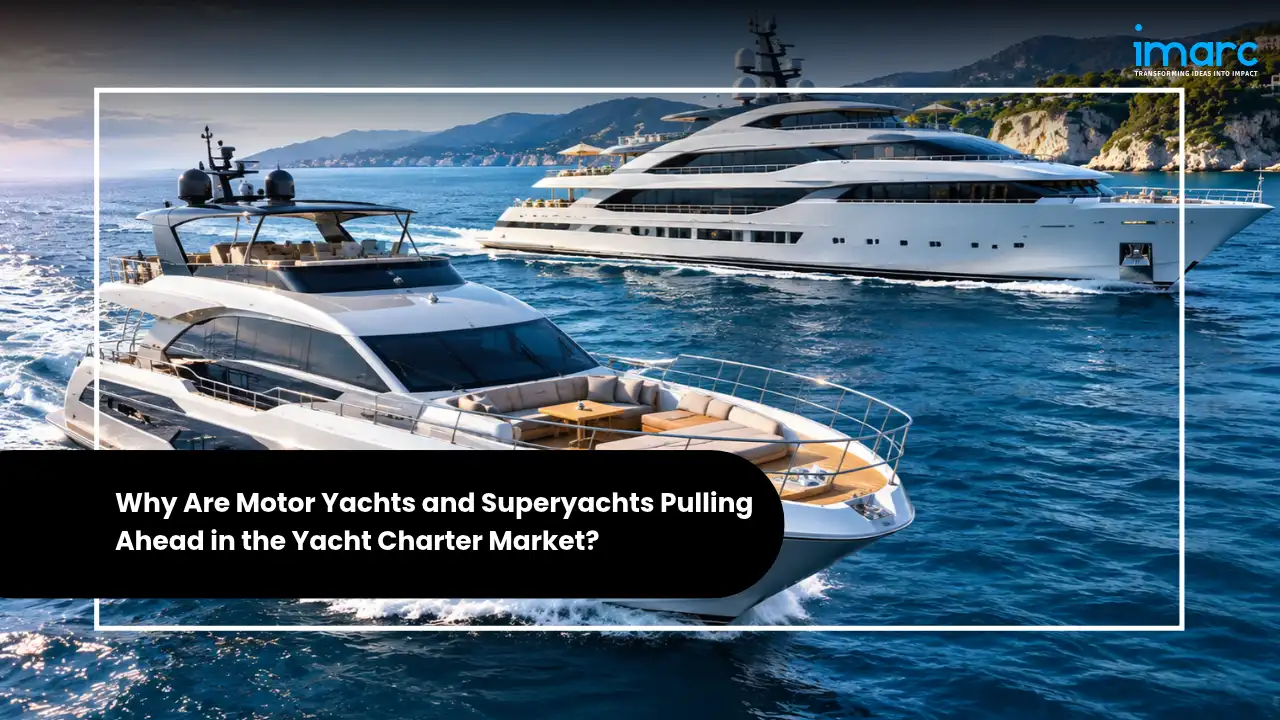
International travel has slowed, but luxury at sea has not. According to IMARC Group, the global yacht charter market was valued at USD 9.72 Billion in 2025, is estimated at USD 10.34 Billion in 2026 and is projected to reach USD 16.94 Billion by 2034, growing at a CAGR of 6.36% during 2026-2034. That is about USD 7.2 Billion of additional annual market value in under a decade. Meanwhile, about 690 million people travelled internationally in the first half of 2026, only 0.4% more than a year earlier.
The real question for an operator, marina developer or investor is not whether the market will grow. It is where that growth will land: which guests, on which boats, in which waters and under which rules. Get it wrong and you are left with idle hulls, empty berths and an unplanned tax bill.
This guide breaks the opportunity down so you can decide where to sail, what to build and what to buy.
How Big Is the Yacht Charter Market and How Fast Is It Growing?
The global yacht charter market grew from USD 9.72 Billion in 2025 to USD 10.34 Billion in 2026, according to IMARC Group's market report, and is projected to reach USD 16.94 Billion by 2034, at a CAGR of 6.36% during 2026-2034, driven by rising HNWI wealth, experiential travel and digital booking platforms.
That growth rate is well ahead of the wider luxury travel market, which IMARC Group values at USD 2,314.6 Billion in 2025 and expects to grow at a CAGR of 3.66% during 2026-2034.
The headline hides big differences: a Croatian bareboat base and a Red Sea marina face very different demand, costs and regulators. That is why fleet, base and acquisition decisions need region, length and contract-type data rather than the global CAGR alone.
Why Is Demand for Yacht Charter Still Rising?
Yacht charter demand keeps rising because four forces are working together, according to IMARC Group: growing HNWI and UHNWI wealth, demand for private and personalised travel, corporate and event use of yachts, and online platforms that bring first-time and younger charterers into the market.
Wealth is creating new charterers. IMARC Group links demand to the rising number of high-net-worth and ultra-high-net-worth individuals, many of whom prefer to charter rather than own. Chartering avoids the purchase price, payroll and berthing costs of ownership.
Experiences are beating objects. A yacht offers privacy and a moving itinerary no hotel can match. IMARC Group highlights AI-driven personalisation as a trend, which in practice means menus, routes and water-sports kits tailored before guests board.
Corporate and event clients fill the shoulder season. IMARC Group notes that motor yachts lead partly because they work across leisure, corporate and event charters. Launches and incentive trips fill weeks leisure guests leave empty.
Tourism volumes provide the base. UN Tourism counted an estimated 1.52 billion international tourist arrivals in 2025, up 4% and almost 60 million more than in 2024. The more wealthy travellers reach coastal destinations, the larger the pool from which charter guests are drawn.
Key Yacht Charter Industry Trends to Watch
Online Booking Is Widening the Funnel
IMARC Group lists the expansion of digital charter platforms as a growth driver and expects AI-powered platforms to widen market access. SamBoat, one of the platforms in the PPF Group charter sale, lists more than 36,400 boats across 75 countries. Live availability and dynamic pricing fill gaps between bookings, but platforms keep more of the customer relationship.
Hybrid and Electric Yachts Enter Charter Fleets
IMARC Group expects hybrid and electric charter vessels to support premium pricing through 2034. The supply side is growing too: IMARC Group's electric boat and ship market report shows growth from USD 7.6 Billion in 2025 to USD 8.3 Billion in 2026, heading to USD 15.7 Billion by 2034 at a CAGR of 8.36%, with Europe holding 36.7%. Silent cruising should sell well in marine parks and sensitive bays, but battery range and marina charging still limit fully electric yachts to shorter itineraries.
Superyachts Pull Value Upmarket
IMARC Group reports that yachts above 50 ft held 22.8% of the yacht charter market in 2025 and are the fastest-growing length band, at an expected CAGR of about 7.1%. On the ownership side, IMARC Group's luxury yacht market analysis values the global luxury yacht market at USD 9.3 Billion in 2025, reaching USD 18.2 Billion by 2034 at a CAGR of 7.57%, with commercial use, including charter, as the largest application. New superyachts need managers, crews and berths, where service businesses capture value.
Bareboat, Crewed or Cabin: How Charter Models Make Money
Yacht charter is really three businesses with three cost structures, and IMARC Group segments the market by contract type into bareboat and crewed charter. Knowing which one you run decides your margins.
Bareboat charter: volume and turnaround. The guest skippers the boat, usually with a recognised licence. Operators save on crew but carry more wear, damage and insurance exposure, so they rely on standard production boats, fast turnarounds and high summer utilisation.
Crewed charter: service and price. A captain and, on larger yachts, a chef and stewards come aboard. Weekly rates are far higher and guests expect hotel-level service. Crew recruitment and retention is a real constraint; IMARC Group lists it among the market's key challenges.
Cabin charter: filling the boat. Guests book one cabin on a skippered yacht or gulet sailing a set route, an entry ticket for couples and solo travellers.
The yacht type then shapes the guest. IMARC Group reports that motor yachts held 86.6% of the yacht charter market in 2025, against 13.4% for sailing yachts, with motor yachts expected to grow at a CAGR of about 6.8%, helped by speed, comfort, range and newer diesel-electric hybrid models. Catamarans, sailing and power, dominate many bareboat and skippered fleets because two hulls give stable decks and separate cabins for each couple or family; IMARC Group's boat rental market report tracks them as their own boat type in a market that grew from USD 21.2 Billion in 2025 to USD 22.3 Billion in 2026. Superyachts sit at the top, sold through brokers and run by management companies.
Traveller profiles map neatly onto these models. IMARC Group reports that vessels of 20 to 50 ft held 64.5% of the market in 2025, favoured by families, small groups and first-time charterers on Mediterranean and Caribbean routes. Younger wealthy guests lean to crewed motor yachts, corporate clients book event charters, and first-timers arrive through platforms.
What it means for you: operators that design for each guest type, and move first-timers into larger crewed boats over time, build more lifetime value than those selling one generic luxury week.
Which Regions Offer the Biggest Yacht Charter Opportunity?
Europe is the largest yacht charter region, with a 44.3% share in 2025 according to IMARC Group, followed by North America at 26.7%, Asia-Pacific at 18.5%, Latin America at 6.1% and the Middle East and Africa at 4.4%. The fastest shifts are in the Red Sea and Southeast Asia.
Europe: The Mediterranean Charter Capital
IMARC Group credits Europe's lead to long coastlines, well-developed marinas and iconic sailing routes. UN Tourism reports that Europe received 793 million international tourists in 2025, 4% more than in 2024 and 6% above 2019, and almost 350 million in the first half of 2026.
In Croatia, the Croatian Bureau of Statistics reports that the country's 216 nautical ports offered 18,850 moorings in 2025, with total income of EUR 195 million excluding VAT, up 7.9% on 2024, of which renting moorings generated 72.1%. Sea moorings ran at 78.0% average occupancy. Italy and France anchor the superyacht end, and IMARC Group's Europe luxury yacht market report gives Italy a 22.8% share of Europe's luxury yacht market in 2025, reflecting its shipbuilding cluster around Viareggio and La Spezia.
What it means for you: Europe is mature but growing; gains go to well-located berths, superyacht services and under-served Eastern Mediterranean bases.
North America and the Caribbean: The Winter Half
IMARC Group links North America's 26.7% share to Caribbean and US coastal charter demand, a strong brokerage network and a growing corporate events market. Weather risk is real: UN Tourism notes that Caribbean arrivals were flat in 2025 after Hurricane Melissa hit some destinations in the last quarter.
What it means for you: Brokerage and corporate charter are the strongest plays, backed by hurricane cover and storm-cancellation terms.
Middle East: Saudi Red Sea and the Gulf
The Middle East is the smallest region today at 4.4% of the market, but IMARC Group expects luxury tourism investment, marina megaprojects and superyacht demand to shift volume toward the region over the forecast period. Yet UN Tourism recorded a 22% fall in Middle East arrivals in the first half of 2026, showing how quickly geopolitical risk can close a season.
What it means for you: The Gulf and Red Sea are forming one winter circuit where early marina and crewed-charter movers can secure licences and partners.
Asia Pacific: Thailand, India and Beyond
Asia-Pacific holds 18.5% of the market, driven by rapid HNWI growth, marina development and government tourism promotion, according to IMARC Group. Under Thailand's Ministry of Transport announcement on Superyacht Commercial Operation in Thai Waters (B.E. 2568/2025), yachts of 24 metres and above carrying no more than 12 passengers can now apply for the Thai Charter License, down from the earlier 30-metre threshold. IMARC Group values the India yacht market at USD 129.0 Million in 2025, reaching USD 213.4 Million by 2034 at a CAGR of 5.58%, with Goa, Kerala, Maharashtra and the Andaman and Nicobar Islands emerging as charter hubs.
What it means for you: In Asia Pacific, one licensing change can open a new superyacht cruising ground, so track rules closely.

Which Yacht Charter Segments Are Growing Fastest?
By length, yachts above 50 ft are the fastest-growing segment at an expected CAGR of about 7.1%, ahead of the overall market's 6.36%, while motor yachts, at 86.6% of the market, are expected to grow at about 6.8%, according to IMARC Group.
Above 50 ft: value over volume. This band held 22.8% of the market in 2025. High weekly rates plus provisioning and fuel make each booking valuable for brokers and managers.
20 to 50 ft: the core of the fleet. At 64.5% of the market in 2025, this band is where families, small groups and first-time charterers book. It is the most competitive band, so utilisation and base efficiency decide winners.
Up to 20 ft: day trips and entry products. Small boats held 12.7% of the market in 2025, serving day charters and resort guests. Segment growth rates diverge enough that a fleet plan built on the market average can misjudge returns by length band.
Rules on the Water: Licensing, VAT and Environmental Regulation
Charter is regulated by the country where guests board, the flag the yacht flies and international maritime law, and each layer changes the economics of a week.
Greece: digital charter permits. Charter activity in Greece is governed by Law 4926/2022, and foreign-flagged professional yachts apply for charter permission and pay the professional pleasure-boat fee through the government's e-CharterPermission service, run by the Ministry of Maritime Affairs and Insular Policy.
Croatia: an ordinance for every charter. Croatia regulates charter through its Ordinance on chartering vessels with or without crew (Official Gazette No. 42/17), published by the Ministry of the Sea, Transport and Infrastructure.
Saudi Arabia: a rulebook built from scratch. The Saudi Red Sea Authority licenses yacht chartering companies for one calendar year at a service fee of SAR 7,500, requires a commercial register for the activity and at least two years of experience, and charges SAR 4,000 for a six-month tourism charter licence per yacht. SRSA's open data library shows 6 yacht chartering service licences processed in 2025 and 5 so far in 2026.
EU VAT: the embarkation port is a tax decision. Under Article 56 of the EU VAT Directive, short-term hire of a vessel, meaning no more than 90 days, is taxed where the boat is put at the customer's disposal, according to the European Commission. Italy allows documented use outside EU waters to be excluded from local VAT, with proof such as satellite or AIS tracking, position photos or non-EU port invoices (Revenue Agency Measure no. 341339 of 29 October 2020). In France, commercial yachts of at least 15 metres that meet crew, registration and 70% high-seas navigation tests can buy, repair and fuel free of VAT, while the pleasure charter itself remains taxable. Thailand's new licence lets foreign-flagged superyachts operate without paying 7% VAT on the yacht's value, with 7% VAT and 5% corporate income tax applied to the charter fee instead.
Cleaner fuel and protected waters. The Mediterranean became an Emission Control Area for sulphur oxides under MARPOL Annex VI on 1 May 2025, capping fuel sulphur content at 0.10% against 0.50% outside such zones, according to the International Maritime Organization. France's Mediterranean maritime prefecture has, since 2020, restricted anchoring for vessels of 24 metres and above over seagrass meadows along much of its coast, including in Calanques National Park.
What it means for you: licensing speed, VAT and anchoring limits now shape itineraries, base location and buoy-field investment, and their timing varies sharply by country.
What Are the Biggest Risks in the Yacht Charter Business?
The main risks in yacht charter are crew shortages, weather and geopolitical shocks that close a season, shifting VAT and licensing rules, and tightening environmental limits, according to IMARC Group's challenge analysis and official tourism data.
Crew is the binding constraint. Every new crewed yacht needs a captain, engineer and hospitality team, and wage inflation lands straight on the operating budget.
Seasons can close fast. A hurricane left Caribbean arrivals flat in 2025 and conflict cut Middle East arrivals by 22% in the first half of 2026. Fleets that can reposition between regions carry less risk than single-base operators.
Ownership is changing hands. New private equity owners often push faster expansion and tighter pricing, which raises competitive pressure on independents.
Who Is Winning in the Yacht Charter Market?
IMARC Group's report profiles key players including Camper & Nicholsons, The Moorings, IYC, Argo Nautical Limited and West Coast Marine Yacht Services Pvt. Ltd.
Our reading: superyacht brokers win on relationships, bareboat fleet operators on base networks and platforms on reach, with the clearest gaps in regional crewed fleets and new-destination marina services.
Recent News and Mega Announcements in the Yacht Charter Market
The main yacht charter developments of 2025-2026 point to consolidation and private equity interest, new destinations opening through regulation, and cleaner fleets. Here is the timeline, latest first.
- October 2026: The Saudi Red Sea Authority granted Red Sea Global operating licences for AMAALA Marina and Shura Marina, as Red Sea Global launched a network to run its marinas and yacht clubs.
- September 2026: PPF Group reached an agreement in principle to sell Dream Yacht Charter, Navigare Yachting and the SamBoat platform to a consortium led by Romain Motteau, former deputy CEO of Fountaine Pajot, with completion possible before the end of 2026.
- September 2026: Peninsula Yachting, a new vehicle of private equity firm Peninsula Capital, acquired a majority stake in IYC, a brokerage and management group with over 200 professionals in 15 offices, to fund geographic and fleet expansion.
- September 2026: FITZROVIA, the first hybrid-powered yacht in YYachts' Y8 series, joined the Western Mediterranean charter fleet.
- May 2026: Lai Sun Development agreed to sell an initial 80% stake in Camper & Nicholsons to Wave Expandary Limited, backed by a vehicle founded by JD.com founder Richard Liu, in a deal valuing the business at EUR 50 million.
- March 2026: Mysea added the fully electric Silent Yachts 62 "Silent Grace" to its Mediterranean charter fleet for summer 2026.
- February 2026: Thailand's Ministry of Transport cut the Thai Charter License threshold for foreign-flagged superyachts from 30 to 24 metres.
- January 2026: The Moorings announced its first Turkish base in Fethiye, opening for summer 2026.
What These Moves Mean for Your Business
Capital is buying service, not just hulls. Camper & Nicholsons and IYC changed control within four months, and a large bareboat group is changing hands. Well-run regional fleets and charter managers are likely to attract more buyers through 2027.
Regulation is opening new waters. Saudi marina licences and Thailand's lower threshold let first movers lock in berths, partners and licences before rivals arrive.
Cleaner boats are becoming a sales tool. Electric and hybrid yachts now sit in real charter fleets. Budget for low-emission options in fleet renewal.
Planning an acquisition or benchmarking a target? IMARC Group's report profiles the key players and their strategies. Speak to an analyst about the competitors and deals in your market.
Practical Recommendations by Business Type
- For charter operators: Build a mixed fleet: 20 to 50 ft catamarans and motor yachts serve the 64.5% core of the market, while yachts above 50 ft grow fastest at about 7.1%.
- For marina developers: Croatia's mooring income grew 7.9% in 2025, and Saudi Arabia and Thailand are actively licensing new capacity, so berths for 24-metre-plus yachts, shore power and provisioning are the scarce assets.
- For tourism boards: Fast digital permits and predictable VAT matter as much as coastline, as Thailand's licence change shows.
- For investors and private equity: The market's 6.36% CAGR outpaces the 3.66% CAGR IMARC Group expects for the overall luxury travel market, and brokerages, platforms and management companies offer asset-light exposure.
- For new entrants: Start with verified cost and return assumptions. IMARC Group's yacht charter services business plan covers fleet acquisition, crew, booking platforms and operating costs.
These are strategic starting points, not guaranteed outcomes. Your final decision should rest on country-level and segment-level data for your specific market.
Conclusion
The yacht charter market is growing from USD 10.34 Billion in 2026 toward USD 16.94 Billion by 2034, according to IMARC Group, with Europe still leading at 44.3% of demand. Saudi Arabia and Thailand are widening the map, while hybrid boats, online booking and private equity are changing how the business runs.
The winners will match the right boats to the right guests in the right waters, and treat licensing, VAT and environmental rules as part of product design. If you are planning a fleet, marina or destination strategy, start with a sample of IMARC Group's Yacht Charter Market report and test the numbers against your plan.
Our Clients







Contact Us
Have a question or need assistance?
Please complete the form with your inquiry or reach out to us at
Phone Number
+91-120-433-0800+1-201-971-6302
+44-113-547-7077
Previous Post

The increasing adoption of digital platforms is transforming vehicle purchasing behaviour, with consumers increasingly relying on online channels to explore models, compare prices, and evaluate buying options. According to IMARC Group, the global market grew from USD 390.4 Billion in 2025 to USD 424.9 Billion in 2026, and it is projected to reach USD 836.4 Billion by 2034, registering a CAGR of 8.80% during 2026-2034.
An Automotive Filter Manufacturing Plant Setup in India serves one of the most dependable segments of the auto component industry. Every vehicle uses several filters, including engine air filters, oil filters, fuel and diesel filters, and cabin air filters, and most must be replaced at regular service intervals, so demand comes both from new vehicle production and from a very large replacement market.
In a radial, the cords of the body ply run straight across the tyre from bead to bead, at right angles to the direction of travel, and a strong belt of steel cords sits under the tread. This design keeps the tread flat on the road, so the tyre runs cooler, grips better, lasts longer, and saves fuel compared with older bias designs.
Tyre pyrolysis oil, or TPO, is a dark fuel oil made by heating shredded end-of-life tyres to about 400 to 500°C without oxygen, so that the rubber breaks down into oil vapours, gas, carbon char, and steel wire.
A farm tractor is built around a frameless chassis in which the engine, clutch housing, gearbox, and rear axle are bolted together to carry the load, with a hydraulic lift and three-point linkage at the back, a power take-off shaft to drive implements, and large rear tyres for traction.
A traction battery is built from lithium-ion cells, each made by coating metal foils with cathode and anode materials, assembling them with a separator and electrolyte inside a sealed case, and charging them for the first time in a controlled formation process.
A goods carrier is built on a ladder-frame chassis of heavy steel side members, onto which the engine, gearbox, axles, suspension, brakes, fuel or battery system, and a pressed and welded cab are fitted, before the vehicle is painted, tested, and sent to body builders or customers.
E-buses run on large lithium-ion battery packs that drive electric traction motors, producing no tailpipe emissions, little noise, and far lower energy and maintenance costs per kilometre than diesel buses.
The Germany Battery Recycling Industry sits where Europe's largest automotive manufacturing base meets its most demanding battery regulation. According to IMARC Group, the market reached USD 814.3 Million in 2025 and is projected to reach USD 1,617.0 Million by 2034, expanding at a CAGR of 7.68% during 2026–2034.
Electric cars are the fastest-growing part of India's passenger vehicle market. Sales roughly doubled in 2025-26, about 6% of new cars sold in the first seven months of 2026 were electric, and more than a dozen models from Indian and global brands now compete across hatchbacks, sedans, and SUVs.
Every electric vehicle needs a charger, and as India's EV fleet grows, so does demand for the equipment that powers it. India registered more than 2.3 million EVs in 2025, public charging stations grew from about 5,000 in 2022 to more than 27,000 by March 2026, and the PM E-DRIVE scheme is funding 72,300 more public chargers by 2028.
Electric vehicles are moving from early adoption to the mainstream in India. Nearly 19 lakh EVs were registered in the first seven months of 2026, and in some segments the shift is already well advanced: more than four in ten new passenger three-wheelers sold in 2026 were electric, while electric two-wheelers, cars, buses, and light commercial vehicles are all gaining share.
Every function in a modern vehicle that moves, from a brake caliper to an air-conditioning flap, depends on an actuator that turns an electronic command into physical motion. The global automotive actuators market size was valued at USD 31.1 Billion in 2025 and is forecast to reach USD 47.3 Billion by 2034, expanding at a compound annual growth rate (CAGR) of 4.62% during 2026–2034, according to IMARC Group.
India is the world's largest two-wheeler market, and it is steadily going electric. Electric scooters, motorcycles, and mopeds offer running costs far below petrol models, suit short urban commutes and delivery work, and are central to the country's clean mobility goals.
Electric bicycles, or e-bikes, combine a conventional bicycle with a small electric motor, a lithium-ion battery, and a controller that assists the rider's pedalling. In India, models limited to 250 watts and 25 km/h do not need registration or a driving license, cost a few paise per kilometre to run, and suit short commutes, fitness riding, students, and last-mile delivery.
Walk into a modern Indian car parts plant, pharmaceutical packing line, or electronics factory and you will see robots welding and palletising, conveyors moving parts between stations, vision cameras checking quality, and control panels coordinating it all.
Tyres are essential to every vehicle on India's roads, from two-wheelers and three-wheelers to cars, buses, trucks, tractors, and off-highway machines.
If the battery is the heart of an electric vehicle, the wiring harness is its nervous system. Every EV needs low-voltage harnesses for lights, sensors, and controls, plus high-voltage harnesses that carry hundreds of volts and high currents between the battery, inverter, motor, and charging port, and dedicated harnesses inside the battery pack that monitor every cell.
Every electric vehicle needs a brain between the battery and the motor. The motor controller, often called the traction inverter in larger vehicles, converts DC power from the battery into precisely controlled AC power for the motor, manages acceleration, regenerative braking, and efficiency, and protects the whole powertrain from faults.
Every vehicle on the road depends on forged parts. Crankshafts, connecting rods, steering knuckles, axle beams, gears, and hubs are forged because the process gives steel a continuous grain flow and the strength to survive millions of load cycles.
Setting up an Automotive Components Manufacturing Plant in India is a high-potential, export-capable venture, powered by the country's large automobile industry, deep supplier base, and growing role as a global sourcing hub for auto parts.
The global automotive lead-acid battery market reached USD 13.89 Billion in 2025 and is projected to reach USD 16.60 Billion by 2034, growing at a CAGR of 1.94% (2026–2034).
Setting up an Electric Scooter Manufacturing Plant in India is a capital-efficient, high-growth venture, driven by the country's rapid shift to electric mobility, supportive EV policies, and surging demand for affordable, clean urban transport. As two-wheelers dominate Indian roads and buyers move from petrol to battery-powered scooter manufacturing, an EV Scooter Manufacturing Plant is one of the most accessible and strategically timed entry points into the electric vehicle economy.
Capital is flowing into the united states used car market because structural affordability pressure, digital retail maturity, and a record-old national vehicle fleet have converged into a genuinely investable thesis.
The Europe Tire Market reached a volume of 458.89 Million Units in 2025 and is projected to reach 565.69 Million Units by 2034, growing at a CAGR of 2.35% (2026–2034).
A strategic analysis of how PLI policies and localization drive global OEM investments. India’s EV battery market hits USD 15,898.31 Million by 2034 (21.7% CAGR).
A tyre is circular in shape and made of a combination of rubber materials that fit perfectly over a circular rim on a wheel, providing traction, load-carrying capabilities, shock absorption, and directional stability. As such, tyres are engineered materials composed of a combination of natural or synthetic materials. They are composed of a combination of materials such as rubber, a combination of materials such as steel or textile, and various chemical materials, among others.
A tractor is a self-propelled, torque-requiring vehicle intended primarily for pulling power at low speeds for agricultural, industrial, and utility purposes. It functions as a mobile power source that can be used for towing, pushing, lifting, or driving a variety of agricultural implements through mechanical, hydraulic, or power take-off systems. Tractors are designed with powerful propulsion systems, sturdy frames, and versatile coupling systems for use on different terrains and under heavy loads.
The electric boat and ship market size is experiencing unparalleled growth as the marine industry embraces electrification on a large scale across different geographies. As sustainability is becoming a strategic priority, with each passing day, more and more marine operators look to electric propulsion technologies as alternatives aimed at cutting down emissions, improving operational efficiencies, and enabling greener ports.
The GCC car rental market has emerged as a critical component of the region's transportation ecosystem, driven by robust tourism activity, expanding business travel, and a substantial expatriate population. Countries across the Gulf Cooperation Council are witnessing unprecedented demand for flexible mobility solutions that cater to diverse customer segments. The GCC car rental market size was valued at USD 1.65 Billion in 2024 as governments prioritize infrastructure development and sustainable tourism initiatives.
The Indian automotive sector has formed a vital part of the country's industrial and economic development for a long period. Over the years, the industry has transformed significantly, influenced by changes in technology, global trends, and consumer preference. Among the various factors shaping its trajectory, government policies have emerged as a decisive force driving growth, innovation, and competitiveness in the India auto parts manufacturing industry.
The India motorcycle tires market continues to evolve in response to changing mobility preferences, rising urbanization, and the growing significance of two-wheelers as essential transportation assets for millions of riders. As per sources, the India motorcycle tires market size reached USD 933.66 Million in 2024. The market is projected to reach USD 2,419.36 Million by 2033, exhibiting a growth rate (CAGR) of 10.3% during 2025-2033.
The Saudi Arabia tire market is undergoing a significant transformation driven by the nation’s economic diversification, rapid urbanization, and growing vehicle ownership. As one of the largest automotive hubs in the Middle East, Saudi Arabia is witnessing increasing demand for both passenger and commercial vehicle tires across urban and industrial regions.
One of the world's most dynamic and quickly changing markets, India's automotive industry is undergoing revolutionary changes in both the new and used car markets. Despite general economic uncertainty, the used car industry has shown remarkable resilience and growth potential, making it a particularly vibrant part of this ecosystem.
One of the world's most vibrant and quickly growing automobile markets is India's passenger car sector. From technological innovation to economic development, a number of interrelated factors have contributed to the sector's remarkable transformation. For stakeholders looking to take advantage of the enormous opportunities in this dynamic market, it is imperative that they comprehend these growth drivers.
India's truck industry is at a turning point in its development, driven by extensive government policies that are changing the commercial vehicle market. The industry, which is the foundation of the country's logistics ecosystem, is gaining previously unheard-of momentum thanks to smart regulatory frameworks and forward-thinking legislative initiatives. A fundamental change in truck operations on Indian highways is being sparked by government initiatives ranging from infrastructure development to emission standards, digitalization, and financial incentives.
The electric rickshaw sector in India has experienced a significant upheaval in recent years and is now a vital part of the country's sustainable transportation network. Strategic government policies aimed at hastening the adoption of clean mobility solutions have played a major role in orchestrating this evolution. India's larger vision of sustainable urbanization is in line with the electric rickshaw industry, which combines social development objectives, economic opportunities, and environmental imperatives.
Transportation in India is undergoing a spectacular change with the advent of electric two-wheelers that are quite an enticing alternative to traditional fuel-powered ones. This change is not merely an act of technological transformation, but an indication of how millions of Indians will think about city mobility, eco-awareness, and economic effectiveness.
As one of the world's leading industrial powerhouses, Japan has long been recognized for its commitment to technological innovation and manufacturing precision. The industry for industrial automation components—encompassing sensors, controllers, actuators, drives, robotics, and human-machine interfaces—represents the backbone of modern manufacturing infrastructure.
The Australian brakes and clutches industry plays a vital role in ensuring vehicle performance, safety, and efficiency across both automotive and industrial segments. As the nation transitions toward electric mobility and smarter manufacturing systems, the demand for advanced braking and clutch mechanisms is rising significantly.
The Philippines automotive wiring harness industry stands at a transformative juncture, driven by technological innovations that are reshaping vehicle electrical architectures worldwide. As vehicles evolve into sophisticated mobile computing platforms, the wiring harness, the circulatory system transmitting electrical power and data throughout modern automobiles, has become increasingly complex and critical to vehicle performance.
Japan's hybrid vehicles market stands as a global benchmark for sustainable mobility innovation, demonstrating remarkable growth and technological leadership. The market achieved a valuation of USD 33.57 Billion in 2024. Japan's hybrid vehicle (HV) market is one of the most established globally, originating with pioneering models like the Toyota Prius. It currently represents a significant portion of the country's automotive sales.
The Japan warehouse robotics market is a highly dynamic and rapidly expanding segment of the global automation industry. The market, valued at USD 414.0 Million in 2024, is on a sharp growth trajectory. Its growth is fueled by critical domestic factors, including a severe labor shortage, the rapid expansion of e-commerce, and Japan's strategic position as a world-leading robotics manufacturer.
The UK is rapidly evolving into a dynamic hub for autonomous vehicle research, testing, and early-stage deployments. A strong ecosystem comprising academic institutions, technology start-ups, automakers, and mobility service providers fosters continuous innovation. Supported by a skilled workforce specializing in software, sensing, robotics, and transportation systems, the nation has become a fertile ground for experimentation.
Japan’s transportation landscape is on the brink of a major shift, with robo taxis, autonomous, driverless vehicles designed for passenger and goods transport, emerging as a practical mobility solution. The Japan robo taxi market reached USD 83.2 Million in 2024 . This remarkable expansion reflects Japan’s broader move toward smart mobility, sustainability, and automation.
The Japan electric truck market is experiencing transformative growth as the nation accelerates toward sustainable transportation and carbon neutrality. As a leading automotive manufacturing hub, Japan is witnessing unprecedented momentum in commercial vehicle electrification, driven by stringent environmental regulations, technological innovation, and strategic government support. The electric truck industry represents a critical component of Japan's commitment to achieving 100% electrified vehicle sales by 2035 and carbon neutrality by 2050.
An EV charging station represents the necessary main infrastructure that allows electrical energy to be transferred from the power grid into electric vehicles to enable their use for transportation. Unlike conventional fueling stations that offer liquid fuels, EV charging stations provide electric power through the use of standardized connectors and smart control systems. The core components include a power conversion unit, which transforms alternating current from the grid into direct current for the vehicle battery; a charging controller controlling communication between the charger and the EV; and a connector or plug matched to the vehicle's charging interface.
An electric scooter is a two-wheeled vehicle powered by an electric motor and rechargeable battery, aimed at offering the means for efficient, eco-friendly, and cost-effective urban mobility. Apart from the traditional scooters that are powered by internal combustion engines, the electric scooters make use of lithium-ion or lead-acid batteries that feed an electric supply to a BLDC motor, which drives the wheels either directly or via a belt or chain mechanism.
Electric bikes, commonly referred to as e-bikes, are one of the most transformational innovations in modern personal mobility, combining conventional bicycle mechanics with advanced electric propulsion technology. At the heart of e-bikes are an electric motor, a rechargeable battery, and a control system that add assistance to the rider while pedaling, making cycling easier, faster, and more accessible across varied terrains. Based on their design, they can be further categorized into pedal-assist, throttle-controlled, or hybrid models, each providing different levels of rider control and engagement of the motor.
The micro-mobility industry has emerged as a transformative force in urban transportation, revolutionizing how people navigate cities worldwide. According to IMARC, the global micro-mobility market size was valued at USD 63.10 Billion in 2024. Looking forward, IMARC Group estimates the market to reach USD 204.83 Billion by 2033, exhibiting a CAGR of 12.86% from 2025-2033.
India's electric vehicle (EV) revolution is accelerating at a breakneck speed, powered by a strategic combination of government incentives, infrastructure investments, and manufacturing policies that are transforming the automotive landscape. The IMARC Group forecasts that the Indian electric car market reached USD 963 Million in 2024.
The diesel engine industry is standing at a transformative crossroads. As global markets are pushing for sustainability, stricter emissions compliance, and cutting-edge innovations, diesel powertrains are facing both immense pressure and promising potential.
The global tire market is a multi-billion-dollar industry, driven by the growing demand for vehicles across emerging economies and the replacement tire segment in developed countries. The global tire market is expected to grow at a compound annual growth rate (CAGR) of 4.70% between 2025 and 2033. The industry is heavily influenced by factors such as technological advancements, raw material prices, environmental regulations, and consumer preferences.
Australia's electric vehicle (EV) sector is experiencing swift expansion, fueled by increasing interest in eco-friendly transportation alternatives. In 2024, sales of battery electric and plug-in hybrid vehicles hit an all-time high, totaling around 114,000 units.
The electric bus industry is the part of the transportation sector that deals with the production and installation of buses that run completely or partially on electricity, employing battery packs or fuel cells in place of conventional diesel or gasoline engines. The buses deliver lower greenhouse gas emissions, lesser noise levels, and enhanced energy efficiency, and thus they are a prime solution for environmentally friendly public transport.
India's electric vehicle market is undergoing a profound transformation, impelled by green priorities, economic imperatives, and changing consumer trends. With rising concerns about air pollution and fossil fuel dependence, electric mobility has become a strategic option for India's transport industry. Policy clarity, technology development, and an emerging ecosystem of makers and suppliers are driving this market shift.
The global electric vehicle market size was valued at USD 755 Billion in 2024. The global EV market is rapidly expanding, driven by technological advancements, government incentives, stricter emission regulations, rising fuel costs, extended battery range, growing environmental consciousness, and significant investments in charging and production infrastructure.
Electric Vehicles, or EVs, are vehicles operated partially or wholly by electrical power, generally with rechargeable battery packs as their fuel. In contrast to conventional internal combustion engine cars, EVs emit no tailpipe emissions, making them a cleaner, environmentally friendly transportation choice. EVs comprise Battery Electric Vehicles (BEVs), Plug-in Hybrid Electric Vehicles (PHEVs), and Hybrid Electric Vehicles (HEVs), and are gaining ground in passenger, commercial, and two-wheeler segments owing to developments in battery technology, charging infrastructure, and policy support.
Aluminum alloy wheels are high-performance, lightweight, and durable components widely used in the automotive industry. Their superior strength-to-weight ratio enhances vehicle efficiency, fuel economy, and handling, making them a preferred choice for both passenger and commercial vehicles. Beyond their functional benefits, aluminum alloy wheels contribute to vehicle aesthetics, offering sleek designs and customization options that appeal to consumers. Their corrosion resistance and thermal conductivity further enhance braking performance and longevity. With increasing demand for fuel-efficient and stylish vehicles, aluminum alloy wheels play a crucial role in the global automotive sector, catering to OEMs, aftermarket suppliers, and performance vehicle manufacturers.
A tyre is a crucial component of a vehicle, serving as the outer covering of a wheel. Its main purposes are to support the vehicle's weight, provide traction for movement, and act as a flexible cushion that absorbs shocks from the road. Usually composed of rubber, tires are strengthened with steel and cloth. Tires for cars, trucks, motorbikes, bicycles, and other vehicles have different designs and compositions depending on the vehicle type and its intended usage. To improve stability and grip, they have a tread pattern on the outside.
Electric kick scooters are small, battery-operated personal transportation vehicles intended for short-distance and urban movement. They offer an economical and environmentally responsible substitute for conventional modes of mobility thanks to their electric engine, rechargeable battery, and lightweight frame. The need for sustainable transportation options, traffic congestion, and growing urbanisation have all contributed to their rise in popularity. Electric kick scooters are now the go-to option for last-mile connectivity and personal commuting because to developments in battery technology, connectivity features, and government programs encouraging micro-mobility.
An automotive wiring harness is an organized assembly of electrical wires, connectors, and terminals that transmit power and signals across a vehicle’s electrical system. It guarantees effective communication between several parts, including the engine control unit, lighting, and sensors. Wiring harnesses are intended to increase vehicle performance and safety by lowering the possibility of short circuits. By maximising electrical connectivity and lowering wire complexity, they are utilised in both conventional and electric automobiles and are essential to contemporary automotive technology.
In an automotive braking system, brake pads are the most important parts since they are engineered to contact the brake rotor to produce friction, thus stopping or slowing down a vehicle in virtually any driving condition safely and efficiently. The key way of classifying these pads is according to their material types: low metallic, ceramic, organic, and semi-metallic.
Tires are essential components of vehicles designed to provide traction, support, and absorb road shocks. Primarily made of rubber, tires consist of treads, belts, and sidewalls that work together to offer grip, stability, and durability. Modern tires come in various types – such as all-season, winter, and performance tires – each engineered for specific driving conditions. The two major tire categories are radial and bias tires, and they are available in different sizes to suit various vehicle types, including passenger cars, light commercial vehicles, medium and heavy commercial vehicles, two-wheelers, and off-road vehicles.
Electric Vehicles (EVs) are powered by electric motors instead of traditional internal combustion engines (ICEs). Electric motors propel EVs by utilizing electricity stored in rechargeable batteries or other energy storage systems. They produce lower or zero tailpipe emissions, reduce air pollution and greenhouse gas (GHG) emissions, and help in mitigating climate change. Electric vehicles consist of various components, such as battery cells and packs, reducers, fuel stacks, power control units, power conditioners, air compressors, humidifiers, motors, on-board chargers, battery management systems, and others. EVs are classified into four types based on propulsion, outlined below.
Saudi Arabia is the second-largest producer and exporter of crude oil and holds the second-largest proven oil reserves in the world, with around 267 billion barrels. The country's oil sector is a significant part of its economy, accounting for 75% of government revenue and approximately 90% of exports. However, due to the volatility of oil prices and the potential for economic instability, Saudi Arabia is increasingly focusing on non-oil activities to reduce its dependency on the oil sector. Non-oil commodities tend to have more stable prices, providing protection against these fluctuations and strengthening the country's social, economic, and financial sectors.